
Budgeting · Updated 2026-10-22
No buy year 2027: rules, examples and a free tracker

A no buy year is a 12-month promise to stop buying things you don't need, while still paying for the things you do. You write your rules once, before January, and then you keep a simple record of how it's going. A low buy year is the gentler version: instead of banning a category, you give it a limit.
The idea grew out of short challenges like No Buy January. In a NerdWallet survey run by The Harris Poll, more than one in 10 Americans joined No Buy January in 2026, and about a third of them had already given up by the time they were asked (Yahoo Finance). Retail press now reports the trend stretching into full no buy years (InternetRetailing). That drop-off is the useful lesson: most people don't fail because the goal is wrong, they fail because the rules were vague.
This guide shows you how to write rules you can keep for a whole year, with example rule sets, what to do when you slip, and a free one-page tracker to start with.
This is general budgeting information, not financial advice. Amounts are examples in euros, but it all works the same in any currency. If you can't cover essentials or you're behind on bills, a free debt advice service in your country is a better first step than any challenge.
No buy year vs low buy year vs no spend challenge
| What it means | Best for | |
|---|---|---|
| No buy year | Chosen categories are off limits for 12 months. Essentials and agreed exceptions continue. | People with one or two clear problem areas, such as clothes or beauty. |
| Low buy year | Categories get a monthly or yearly allowance, for example €40 a month on eating out. | Most people, especially households and anyone who has quit a strict challenge before. |
| No spend challenge | A short burst, often a weekend, a week or a month, with no non-essential spending at all. | A first try, or a reset in the middle of a no buy year. See our no-spend challenge guide. |
You can combine them. A common pattern is a strict No Buy January, then a low buy year from February.
Step 1: write down your why
Before any rules, write one or two sentences about why you're doing this and what the money is for. "Save €3,000 for an emergency fund" or "clear my credit card by December" will carry you through a bad week far better than "spend less". Put a number and a date on it if you can.
Step 2: list what you are not buying
Look at the last three months of bank statements and circle the categories that keep coming back without much thought. Typical ones:
- Clothes, shoes and accessories
- Makeup, skincare and hair products (beyond replacing what runs out)
- Home decor, candles and storage boxes
- Books, stationery and hobby supplies you already have plenty of
- Takeaway and food delivery
- Gadgets, games and in-app purchases
Pick the two to five that matter most. A short list you keep beats a long list you abandon in March.
Step 3: list what you can still buy
This list matters as much as the first one, because it stops every purchase turning into a debate. It usually covers rent, bills, groceries, transport to work, medicine, and gifts for birthdays you already know about. Write it down so "Is this allowed?" has a quick answer.
Step 4: add the three rules that make it last
- Replace only when used up. Shampoo, mascara or running shoes can be replaced when the old one is finished or worn out, not before. Write down which items this applies to.
- Planned purchases. List the big things you already know you'll need in 2027, like a winter coat or a new phone, with a budget. Buying them is part of the plan, not a slip.
- The 30-day wishlist. When you want something that isn't allowed, write it down with the date and price instead of buying it. After 30 days, decide again. Most wants fade, and the ones that don't become planned purchases.
Example rule sets
Example 1: strict no buy year (single person)
- Not buying: clothes, shoes, makeup, home decor, books (use the library).
- Can still buy: rent, bills, groceries, transport, medicine, gifts for family birthdays (€25 each).
- Replace only when used up: skincare basics, toiletries, work shoes.
- Planned purchases: winter boots in October (up to €120).
Example 2: low buy year (couple or family)
- Eating out and takeaway: up to €60 a month together.
- Clothes: €300 a year per adult, children's clothes as they outgrow them.
- Kids' toys: birthdays and holidays only.
- Subscriptions: keep two streaming services, cancel the rest after a subscription audit.
Example 3: one category only
- No new clothes or shoes for 12 months. Everything else stays as normal.
- Exceptions: one replacement pair of work shoes, underwear and socks as needed.
The NerdWallet findings point the same way: picking one category to rein in, and setting limits rather than total bans, is often easier to stick with (source).
How to track it month by month
Tracking is what turns good intentions into a habit you can see. Keep it light:
- Colour a day on a calendar each time you keep your rules. A visible streak is motivating.
- Write down urges: what you wanted, when, and how you felt. After a few weeks you'll see patterns, like late-night scrolling or shopping after a hard day.
- Count the money kept. Each time you skip something you would have bought, add its price to a "money kept" total, then move that money to savings or a debt payment so it doesn't just disappear into the current account.
- Check in monthly. Ten minutes at the end of each month: days kept, money kept, one thing to change. Our monthly budget review guide walks through it.
Free printable: No Buy Month Tracker
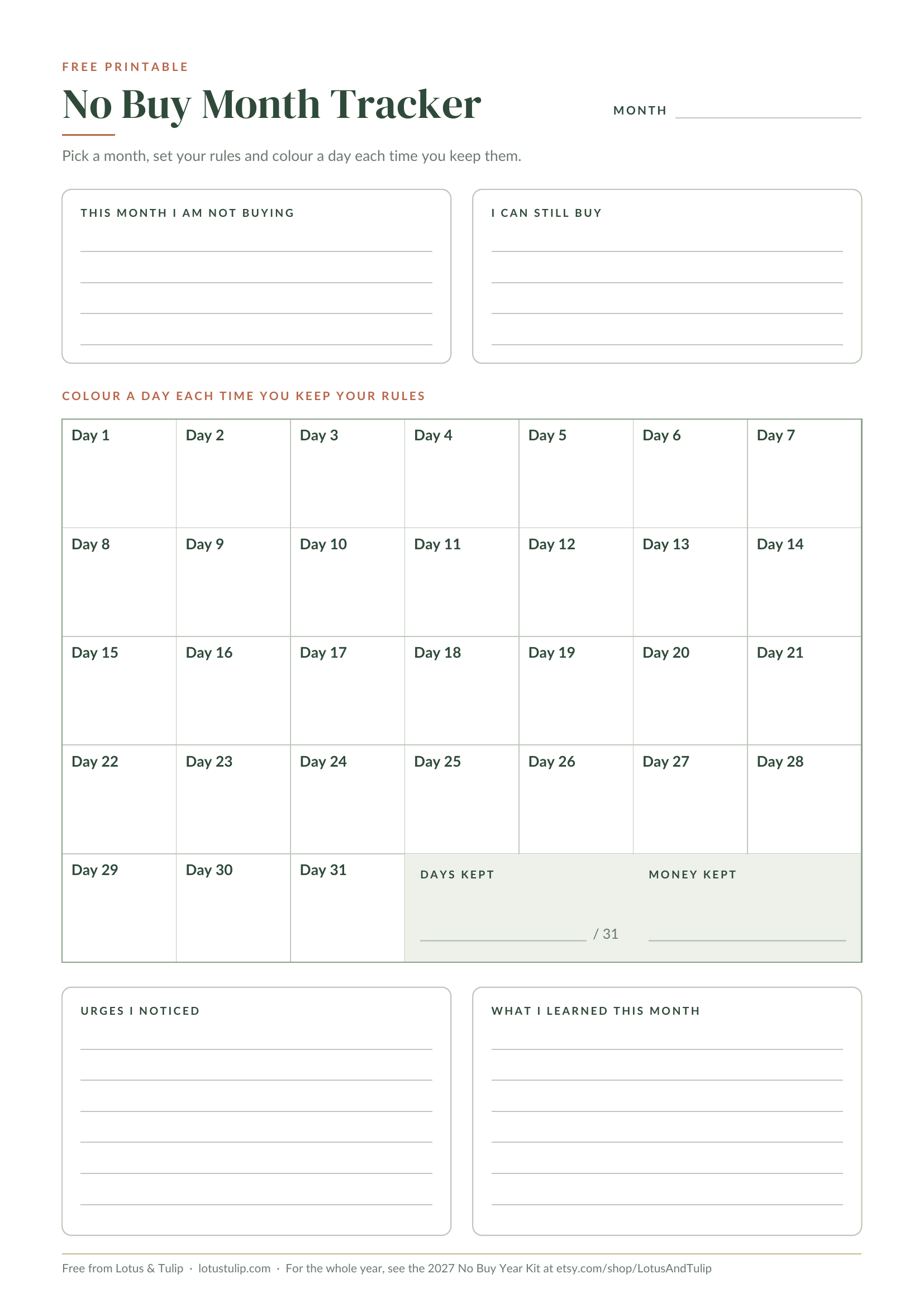
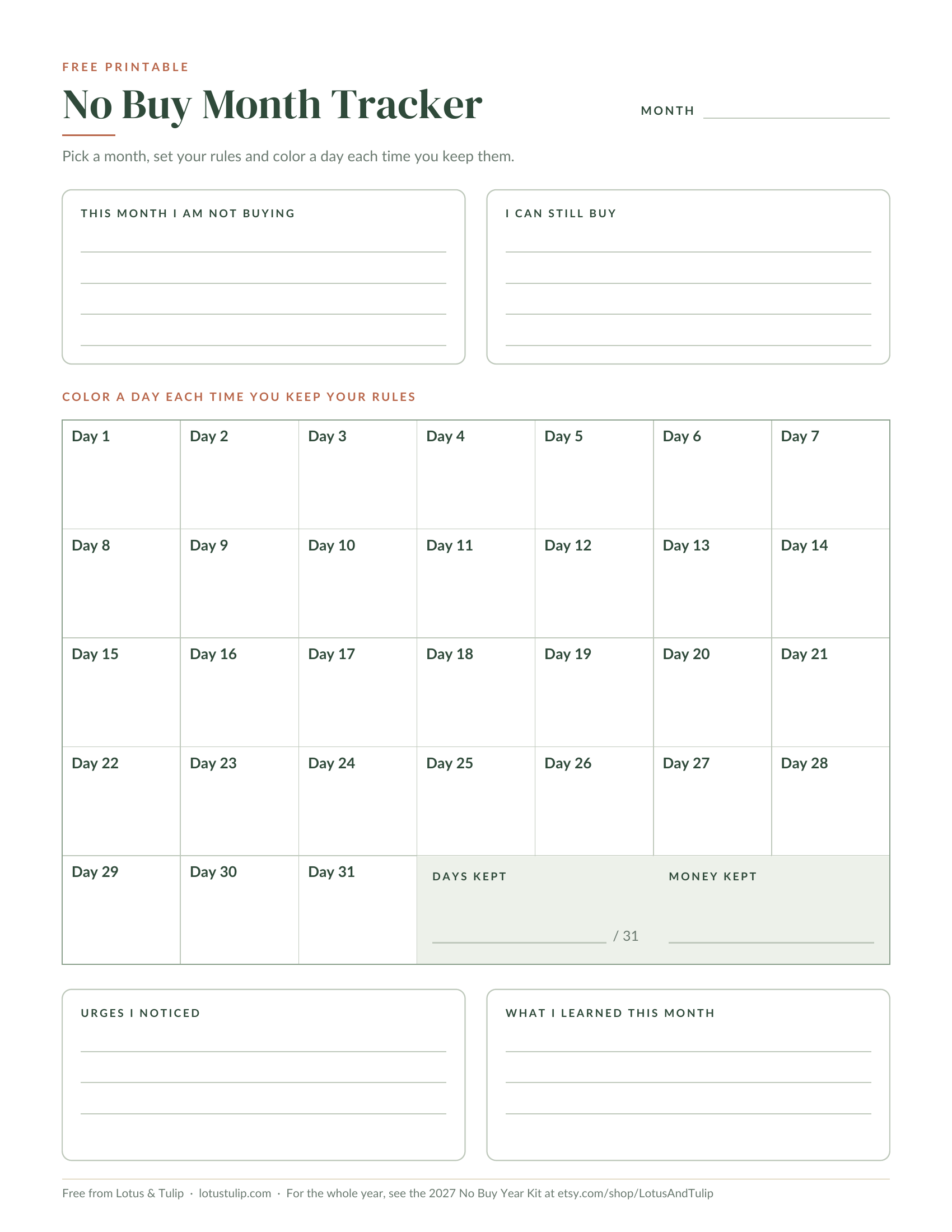
Start with one month. This free one-page tracker has space for what you're not buying, what you can still buy, 31 days to colour in, days kept, money kept, urges you noticed and what you learned. No email needed, just download and print.

What to do when you slip
You will probably buy something you didn't plan to at some point. That's normal, and it isn't the end of the year. What helps:
- Write it down honestly: what, how much, and what was going on.
- Ask whether it can be returned. If yes, return it.
- Decide if a rule needs changing. If you keep breaking the same rule, it may be too strict; turn it into an allowance.
- Start again the next day. One slip doesn't cancel the days you kept.
Make shopping harder
- Unsubscribe from shop newsletters and turn off app notifications.
- Delete saved cards from shopping sites and log out of your accounts.
- Delete shopping apps from your phone for the year.
- Unfollow accounts that mostly make you want things.
- Before buying, "shop your home": check what you already own first.
Common mistakes
- No exceptions list. Without one, every birthday becomes a crisis.
- Too many categories at once. Start with the ones that cost you most.
- Not moving the money. Money you didn't spend but left in your current account tends to get spent on something else.
- Stockpiling in December. Buying a year's worth of everything before 1 January defeats the point.
- Going it alone in a shared household. Agree the rules together, or at least agree which ones are yours only.
FAQ
When should I start a no buy year?
1 January is the classic start, but any month works. Writing your rules in December gives you time to plan exceptions like birthdays and known replacements.
Can I buy gifts during a no buy year?
Yes, if you put them on your "can still buy" list with a budget. Many people also choose experiences, homemade gifts or a set amount per person.
What is the difference between a no buy year and a low buy year?
A no buy year bans chosen categories for 12 months. A low buy year allows them up to a set limit, such as €40 a month on eating out. A low buy year is usually easier to keep.
How much can a no buy year save?
It depends entirely on what you were spending before. Add up the last three months in your chosen categories and multiply by four for a rough yearly figure, then track your real "money kept" as you go.
Is the free tracker really free?
Yes. It's a one-page printable image (200 dpi) in A4 and US Letter. No email or sign-up needed.
Sources: NerdWallet survey by The Harris Poll, reported by Yahoo Finance (Moneywise), 11 February 2026; InternetRetailing, 2026. Checked on 22 October 2026. Related reading: no-spend challenge · sinking funds list · monthly budget review · pay yourself first.