
Therapist worksheets · Updated 2026-11-02
Window of tolerance worksheet: how to explain it to clients (free printable)
Ready-made printable: Trauma Worksheets for Therapists Fillable PDF: type into the window of tolerance, plus trigger map, grounding toolkit, coping plan and 0 to 10 distress scales (20 pages)
Holiday 20% off: about $9.20, was $12 (EUR 10) · instant digital download
Try it free first: download a fillable sample (window of tolerance and grounding toolkit, PDF, 189 KB). Type into it on screen, then get the full pack. No email needed.

The window of tolerance is the zone of arousal in which a person can feel, think and respond without being overwhelmed or shutting down. Above the window is hyperarousal, below it is hypoarousal. It is one of the most useful pictures you can give a client, because it turns "I just lose it" or "I go blank" into something they can notice, name and work with. This guide explains the model in plain words, shows how to walk a client through a worksheet, and includes a free one-page window of tolerance printable you can use in session.
This is educational information for therapists, counselors and other qualified professionals, not a substitute for clinical training or supervision. If a client is in crisis in the US, they can call or text 988, the Suicide and Crisis Lifeline, or call 911 in an emergency.
Jump to the free window of tolerance worksheet
Where the term comes from
Psychiatrist Daniel J. Siegel introduced the term "window of tolerance" in his 1999 book The Developing Mind. It was later developed in trauma treatment, especially by Pat Ogden and colleagues in sensorimotor psychotherapy, who describe the zones above and below the window. Today it is used across trauma informed care, DBT informed skills work, anxiety treatment and school counseling, usually as a simple psychoeducation tool rather than a formal assessment.
The three zones in plain words
- Inside the window (optimal arousal): the person can feel emotions and still think clearly. They can listen, problem solve, stay connected to others and make choices. Feelings may be strong but they feel manageable.
- Above the window (hyperarousal): too much activation. Common signs are racing heart, fast breathing, muscle tension, anxiety or panic, anger, feeling flooded, racing thoughts, wanting to run or fight, being jumpy or hypervigilant.
- Below the window (hypoarousal): too little activation. Common signs are feeling numb, flat or far away, heavy limbs, tiredness that comes on suddenly, blanking out, difficulty speaking or moving, feeling disconnected from the body or the room, collapse or shutdown.
The key message for clients: these states are the nervous system trying to protect them, not a character flaw. Stress, poor sleep, illness, past trauma and current danger can all make the window narrower. Practice, safety and support can help widen it over time.
How to walk a client through the worksheet
- Draw or show the three zones. Keep the language simple: "In the middle zone you can feel things and still think. Above it your body revs up. Below it your body shuts down."
- Fill in the client's own signs. Ask what they notice in their body, thoughts and behavior in each zone. Personal words ("my jaw locks", "I stare at my phone") beat textbook lists.
- Map the triggers. What tends to push them up out of the window, and what tends to drop them below it? Include everyday stressors, not only big events.
- Find what brings them back. Hyperarousal usually calls for down regulating skills, hypoarousal for gently up regulating ones (see the lists below). Pick two or three of each that the client is willing to practice.
- Note early warning signs. The edge of the window is where skills work best. Ask: "What is the first small sign that you are starting to leave the window?"
- Review over time. Bring the sheet back after a hard week: where did they go, what helped, what would they try next time?
Skills for coming down from hyperarousal
- Slow breathing with a longer exhale than inhale.
- Grounding through the senses, for example naming 5 things you see, 4 you can touch, 3 you hear.
- Cold water on the face or holding something cold.
- Pushing against a wall, then letting the muscles release.
- Taking a short walk or stepping out of the room.
- Feet flat on the floor, noticing the chair and the ground holding the body.
Skills for coming up from hypoarousal
- Orienting: slowly look around the room and name what you see.
- Standing up, stretching or gentle movement such as marching on the spot.
- Strong sensory input: a sour candy, a strong smell, textured objects.
- Sitting upright and taking a few energizing breaths.
- Saying the date, the place and one fact about today out loud.
- Connecting with a safe person by voice or eye contact.
Not every skill suits every client, and some, like focusing on the breath, can feel activating for certain trauma survivors. Offer choices and check how each one actually lands.
Free window of tolerance worksheet
The printable below has the three zones, space for the client's own signs in each zone, triggers, early warning signs and two "what helps me" boxes. It is US Letter at print quality.
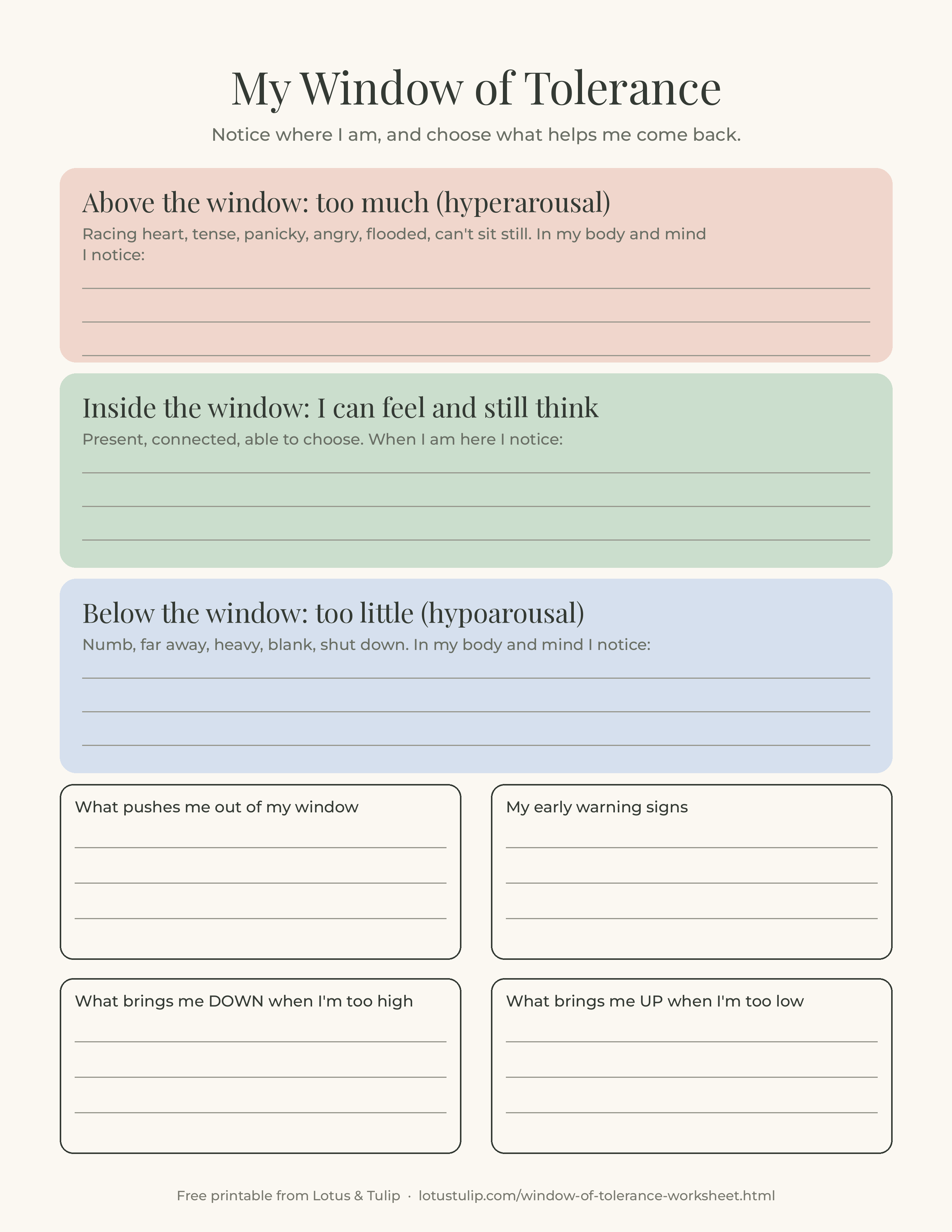
Download the free worksheet (PNG, US Letter)
Free trauma starter pack: Want a fuller version? The free trauma worksheets for therapists starter pack includes the window of tolerance page from our paid trauma informed set, with body and thought signs for each zone, plus a trigger map, 5 senses grounding, a grounding toolkit, a coping plan for hard moments and a support and contacts page (8 pages, client use license, no email).
Using it with kids and teens
With younger clients, many counselors use simpler names such as "too fast, just right, too slow", or colors and an engine image. The idea is the same: notice which zone you are in and pick a tool that helps you get back to "just right". Our coping skills list for kids has 60 ideas sorted by what they help with, and a free coping menu.
Related resources
- Trauma worksheets for therapists: stabilization, grounding and safety pages
- DBT worksheets for therapists
- Anxiety worksheets for therapists
- All therapist worksheets
FAQ
What is the window of tolerance?
It is the range of arousal in which a person can feel emotions and still think, connect and respond. The term was introduced by Daniel J. Siegel in 1999. Above the window is hyperarousal (fight or flight), below it is hypoarousal (shutdown or numbness).
What are signs of hyperarousal and hypoarousal?
Hyperarousal often shows up as racing heart, tension, panic, anger and racing thoughts. Hypoarousal often shows up as numbness, feeling far away, heavy limbs, blanking out and shutting down.
Can you widen your window of tolerance?
Many clinicians describe the window as something that can widen over time with safety, regulation skills practiced when calm, supportive relationships and treatment. It also narrows temporarily with stress, poor sleep or illness.
Is this window of tolerance worksheet free?
Yes. The worksheet on this page is free to print for use with your own clients, students or yourself. Please link to this page rather than re-uploading the file.