
Kids and teens · Updated 2026-11-02
Coping skills list for kids: 60 ideas by category (free printable)
Ready-made printable: Coping Skills Cards for Kids and Teens Holiday 20% off: about $5.52, was $7 (EUR 6) · instant digital download
Buy on Etsy
A coping skill is anything a child can do, on purpose, to get through a big feeling without making things worse. The best list is not the longest one. It is a short, personal menu of five or six skills the child has actually practiced, sorted by what they help with. Below are 60 ideas grouped by category, tips for teaching them, and a free one-page coping menu you can print for a calm corner, a counseling office or the fridge door.
This is general information for parents, teachers and school counselors, not medical or mental health advice. If a child talks about wanting to die or hurting themselves, stay with them and get help. In the US you can call or text 988, the Suicide and Crisis Lifeline, or call 911 in an emergency.
How to use this list
- Pick together, not for them. Read a category aloud and let the child choose two or three that sound doable. Ownership matters more than the perfect skill.
- Practice when calm. A skill learned in the middle of a meltdown rarely sticks. Rehearse breathing or grounding at bedtime, in the car or as a quick class warm up, so it is familiar when it is needed.
- Match the skill to the moment. A very upset body needs a body skill first (breathing, movement, cold water). Thinking skills work better once the child is a little calmer.
- Keep it visible. A printed menu or a ring of cards in a calm corner means the child does not have to remember anything while upset.
- Review and swap. After a hard moment, ask "what helped, even a little?" and update the menu.
1. Calm the body (breathing and relaxation)
- Smell the flower, blow out the candle: a slow breath in through the nose, a long breath out through the mouth.
- Box breathing: in for 4, hold for 4, out for 4, hold for 4, tracing a square with a finger.
- Bubble breaths: blow real or pretend bubbles as slowly as possible.
- Belly breathing with a stuffed animal riding up and down on the tummy.
- Five finger breathing: trace up each finger breathing in, down each finger breathing out.
- Squeeze and release: tighten fists, shoulders or toes for five seconds, then let go.
- Spaghetti test: go from stiff uncooked noodle to floppy cooked noodle.
- Hug yourself tight for ten seconds.
2. Use the senses (grounding)
- 5, 4, 3, 2, 1: name 5 things you see, 4 you can touch, 3 you hear, 2 you smell, 1 you taste.
- Squeeze a stress ball or a piece of putty.
- Splash cool water on your face or hold something cold.
- Wrap up in a weighted or heavy blanket.
- Smell something calming, like a favorite lotion or a cut orange.
- Listen to one calm song with headphones.
- Rub a smooth worry stone or soft fabric.
- Sip water slowly through a straw.
3. Move it out
- Wall push ups: push against the wall as hard as you can ten times.
- Jumping jacks or jumping on the spot for one minute.
- Take a walk, even just to the end of the hallway and back.
- Animal moves: bear crawl, frog jumps, crab walk.
- Shake it out: shake hands, arms, then the whole body.
- Stretch tall like a tree, then fold like a rag doll.
- Dance to one song.
- Carry something heavy, like a stack of books, for a teacher or parent.
4. Take a break and refocus
- Ask for a short break using a break card or a signal.
- Count backward from 20, or by 2s, 5s or 10s.
- Color, doodle or trace a mandala.
- Build with blocks or LEGO for five minutes.
- Do a word search, maze or simple puzzle.
- Read a favorite book or look at pictures.
- Name every animal you can think of from A to Z.
- Play with a fidget toy.
5. Express the feeling
- Name it to tame it: "I feel ___ because ___."
- Point to the feeling on a feelings chart or rate it from 1 to 5.
- Draw the feeling: what color, shape and size is it?
- Write it down, then rip up or crumple the paper.
- Talk to a trusted grown up.
- Tell it to a pet or a stuffed animal.
- Scream into a pillow or squeeze it hard.
- Cry. Crying is allowed and often helps the body reset.
6. Helpful thoughts
- Use a calm phrase: "This feeling will pass" or "I can do hard things."
- Ask "how big is this problem?" Is it a small, medium or big problem?
- Think of a time you got through something like this before.
- Imagine a safe, calm place in as much detail as you can.
- What would you tell a friend who felt this way?
- Find one thing that is going okay right now.
- Remember: mistakes help your brain grow.
- Picture the worry as a cloud floating away.
7. Connect with others
- Ask for a hug or a high five.
- Sit near someone you feel safe with.
- Play a game with a friend or sibling.
- Help someone else with a small job.
- Make a card or drawing for someone.
- Call or video chat with a grandparent or relative.
8. Solve the problem
- Stop, think and pick a plan: what are three things I could do?
- Use an I statement: "I feel ___ when ___. I need ___."
- Break a big task into the very next small step.
- Make a plan with a grown up for next time.
- Ask "is this mine to fix?" Some problems belong to grown ups.
- Try again after a break, using a different way.
Free printable: coping skills menu
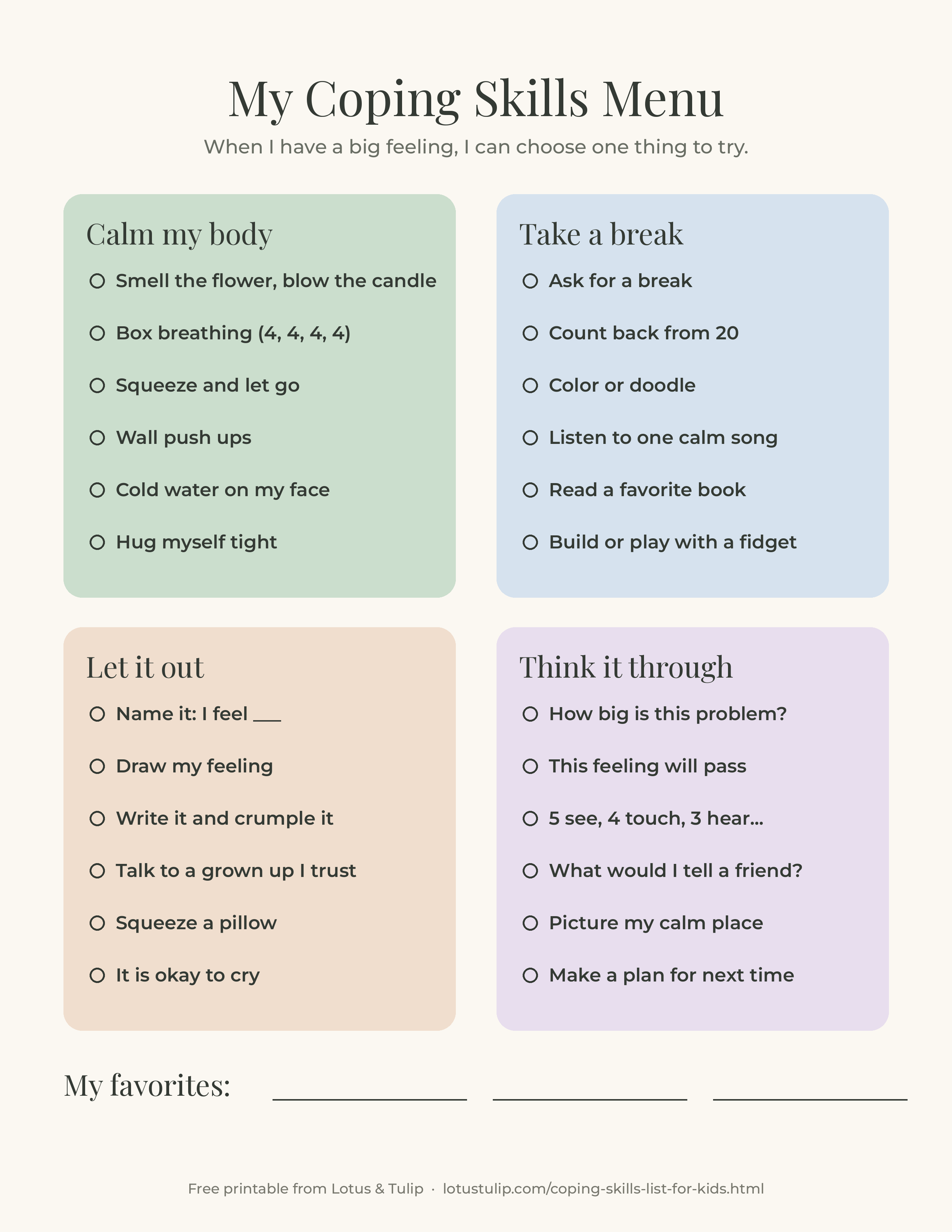
This one-page menu groups 24 of the skills above into the four moments kids most often need them: when their body is upset, when they need a break, when they need to let a feeling out, and when they are ready to think it through. There is a blank row at the bottom for the child's own favorites. US Letter, free to print for home, classroom or office use, no email needed.
Coping skills by age
- Ages 4 to 7: keep it physical and playful. Bubble breaths, animal moves, squeezing putty and naming a feeling with a picture chart work better than talking it through.
- Ages 8 to 11: add simple thinking skills like "how big is this problem?" and counting backward, and let them help design their own menu.
- Ages 12 and up: teens often prefer private, low key skills: music with headphones, a walk, journaling, texting a trusted person, grounding they can do without anyone noticing.
Setting up a calm corner
A calm corner is a small, comfortable space a child chooses to use to reset, not a punishment spot. Keep it simple: a cushion or beanbag, the coping menu at eye level, two or three sensory tools, a feelings chart and a timer so the break has a clear end. Teach how to use it before it is needed, and keep the tone matter of fact: "Your body looks upset. Do you want the calm corner or a drink of water?"
Related resources
- Chronic illness worksheets for kids: coping ideas for children living with diabetes, asthma or epilepsy, with a free health coping plan
- Sibling support worksheets for kids: coping ideas for brothers and sisters of a child with health needs, with a free sibling support plan
- Hospital stay worksheets for kids: calm skills to practice before surgery or a hospital stay, with a free coping plan
- Sensory processing activities for kids: too much, too little and seeking, with a free sensory map and day plan
- Resilience activities for kids: a bounce back plan and resilience builder
- Mindful Moments mindfulness activities for kids and teens
- Kids feelings and social skills worksheets
- Talk and Play therapy games for kids and teens
- Visual schedule and behavior supports kit
- All kids and teens counseling resources
FAQ
What are coping skills for kids?
Coping skills are strategies a child can use on purpose to handle big feelings like anger, worry or sadness, such as slow breathing, moving their body, taking a break, talking to someone or using a calming thought.
How many coping skills should a child have?
Start with five or six the child has practiced and actually likes, ideally at least one from each category: a body skill, a break skill, a way to express the feeling and a thinking skill. Add more over time.
What is the best coping skill for an angry child?
When a child is very angry, body skills usually come first: wall push ups, squeezing a pillow, slow breaths or cold water. Talking and problem solving work better once they have calmed down a little.
Is this coping skills printable free?
Yes. The coping skills menu on this page is free to print for personal, classroom or office use. Please link to this page rather than re-uploading the file.