
Therapist worksheets · Burnout, work stress and recovery · Updated 2026-11-13
Burnout worksheet: the three signs, the six workplace mismatches behind them, and how to plan recovery step by step (free printable)
When the problem is always saying yes: Boundaries Worksheets for Therapists, for limits, wording for saying no and the guilt that follows Holiday 20% off: about $9.20, was $12 (EUR 10) · instant digital download
Buy on EtsyWhen work no longer fits your values: ACT Worksheets for Therapists, incl. values, defusion and committed action pages Holiday 20% off: about $9.20, was $12 (EUR 10) · fillable PDF, instant digital download
Buy on EtsyTry it free first: download a fillable sample (values compass and unhooking from thoughts, PDF, 259 KB). Type into it on screen, then get the full pack. No email needed.
A full caseload: Therapist Worksheets Mega Bundle (8 packs incl. CBT, anxiety, DBT, ACT, grief and ADHD) Holiday 20% off: about $35.88, was $45 (EUR 39) · fillable PDFs for all 8 packs plus 160 printable pages, instant digital download
Buy on EtsyIt starts as tiredness that a weekend no longer fixes. Then the Sunday evening dread arrives earlier each week, emails that used to be routine feel unbearable, and a job you once cared about starts to feel pointless. Many people respond by pushing harder, cutting sleep and hobbies to keep up, which makes it worse. Others decide they are simply not cut out for the work.
This guide is for adults who feel worn down by work and for the therapists, counselors and coaches who support them. It explains what burnout is and is not, the six areas of work life where it usually starts, what research says helps, nine practical steps, common mistakes and examples. It ends with a free 2 page printable: My Burnout Map, which helps you notice the signs and find the mismatch, and My Burnout Recovery Plan, which turns that into one change, one request and protected recovery time.
Download the free burnout worksheet (PDF, 2 pages, US Letter)
Direct download, no email or sign up. See the pages first.
What burnout is, and what it is not
It is a work related syndrome with three parts. The World Health Organization's ICD-11 describes burn-out as "a syndrome conceptualized as resulting from chronic workplace stress that has not been successfully managed." It has three dimensions: feelings of energy depletion or exhaustion; increased mental distance from one's job, or feelings of negativism or cynicism related to it; and reduced professional efficacy. These match the three dimensions Christina Maslach and Susan Jackson measured in their 1981 work on the Maslach Burnout Inventory: emotional exhaustion, depersonalization and reduced personal accomplishment. The term itself was popularized by the psychologist Herbert Freudenberger in a 1974 paper on staff burn-out in helping professions.
It is not a medical diagnosis. WHO lists burn-out as an occupational phenomenon, not a medical condition, in the chapter on factors that influence health or contact with health services. It also says the term refers specifically to the work context and should not be used for other areas of life. Exhaustion from caregiving, for example, is real and serious, but it is described differently.
It can look a lot like depression. A review by Bianchi, Schonfeld and Laurent (2015) of 92 studies concluded that the line between burnout and depression is conceptually fragile and that evidence for burnout as a separate condition has been inconsistent. In practice: if low mood, loss of interest, hopelessness, sleep or appetite changes last most days, or show up outside work too, talk to a doctor or therapist. Exhaustion can also come from physical causes such as thyroid problems, anemia or sleep apnea, so a medical check is sensible.
It is not a personal weakness. Burnout research has consistently pointed at the job as much as the person. That is why this worksheet looks at work conditions, not just coping.
Where burnout starts: six areas of work life
Maslach and Leiter's Areas of Worklife model describes burnout as a mismatch between a person and their job in six areas. The bigger the mismatch, the higher the risk of burnout; the better the fit, the more likely engagement is (Maslach and Leiter, 2016).
- Workload: chronic overload leaves little chance to rest and recover.
- Control: little say in decisions, little autonomy or missing resources to do the job well.
- Reward: not enough recognition, financial, institutional or social.
- Community: relationships at work marked by low support, low trust and unresolved conflict.
- Fairness: decisions that feel unfair or disrespectful, which feeds cynicism and anger.
- Values: a gap between what you care about and what the job asks of you, so you keep trading the work you want to do for the work you have to do.
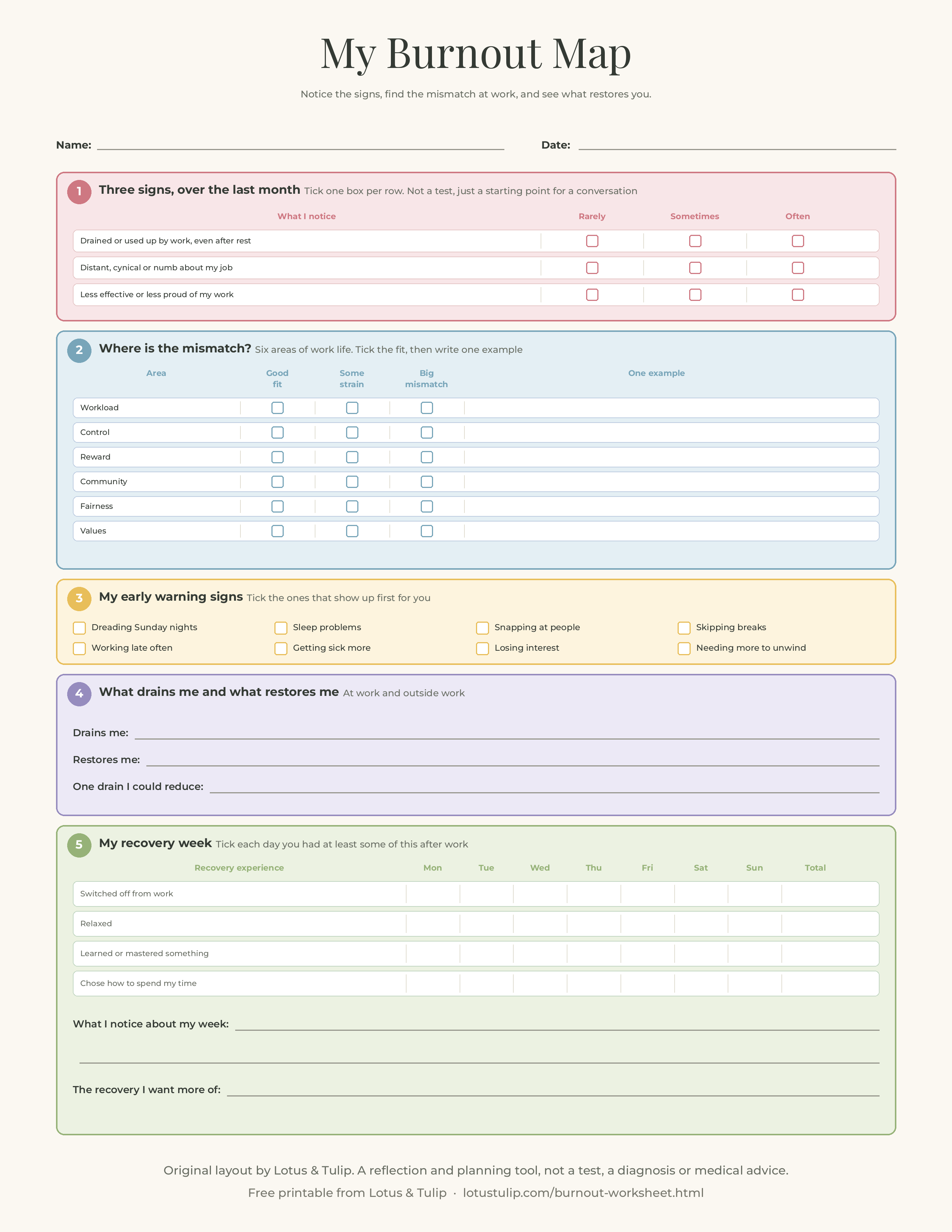
Page 1 of the free worksheet asks you to rate the fit in each area and write one example. Most people find one or two areas carry most of the strain, and that is where a plan should start.
What the research says helps
- Changing the work tends to help more than coping alone. A meta-analysis by Panagioti and colleagues (2017) pooled 20 controlled comparisons from 19 studies with 1,550 physicians. Interventions overall were linked with small reductions in burnout (standardized mean difference about -0.29). Organization directed interventions, such as workload and schedule changes or teamwork and structural changes, had larger effects (about -0.45) than interventions aimed only at the individual physician (about -0.18). The authors concluded burnout is a problem of the whole organization, not just individuals. The study is about physicians, but the lesson travels: look at the job, not only the person.
- Individual strategies still help a little. The same meta-analysis found that physician directed programs, such as mindfulness or communication training, had small but real effects. Personal recovery and boundaries are worth doing, as long as they are not the whole plan.
- Recovery is more than time off. Sonnentag and Fritz (2007) identified four recovery experiences after work: psychological detachment (mentally switching off), relaxation, mastery (learning something or a challenging hobby) and control (deciding for yourself how to spend your time). Their validation studies included 930 workers, and in a subsample of 271, time pressure and overtime hours were linked with less detachment and relaxation. Page 1 tracks these four experiences across a week and page 2 builds a menu for each.
Put together: notice the signs early, find the mismatch, change one thing you control, ask for one thing you do not control, and protect real recovery time. If symptoms are severe or do not improve, get professional help.
How to use a burnout worksheet, step by step
- Check the three signs. On page 1, tick how often over the last month you have felt drained by work even after rest, distant or cynical about your job, and less effective or proud of your work. This is not a score and not a diagnosis; it is a way to name what is happening.
- Rate the six areas of work life. For workload, control, reward, community, fairness and values, tick good fit, some strain or big mismatch, and write one concrete example ("three people's work since the reorganization", "schedule changed without asking me").
- Circle the biggest mismatch. Pick the one or two areas that drive most of the strain. Trying to fix all six at once usually means fixing none.
- Know your early warning signs. Tick the signs that tend to show up first for you, such as Sunday dread, poor sleep, snapping at people, skipping breaks or working late. These are your signal to act before it gets worse.
- List what drains you and what restores you. Include work and life outside work. Write one drain you could realistically reduce this month.
- Track a recovery week. Each day, tick whether you got at least some time switching off from work, relaxing, learning or mastering something, and choosing how to spend your time. Gaps show you where recovery is missing.
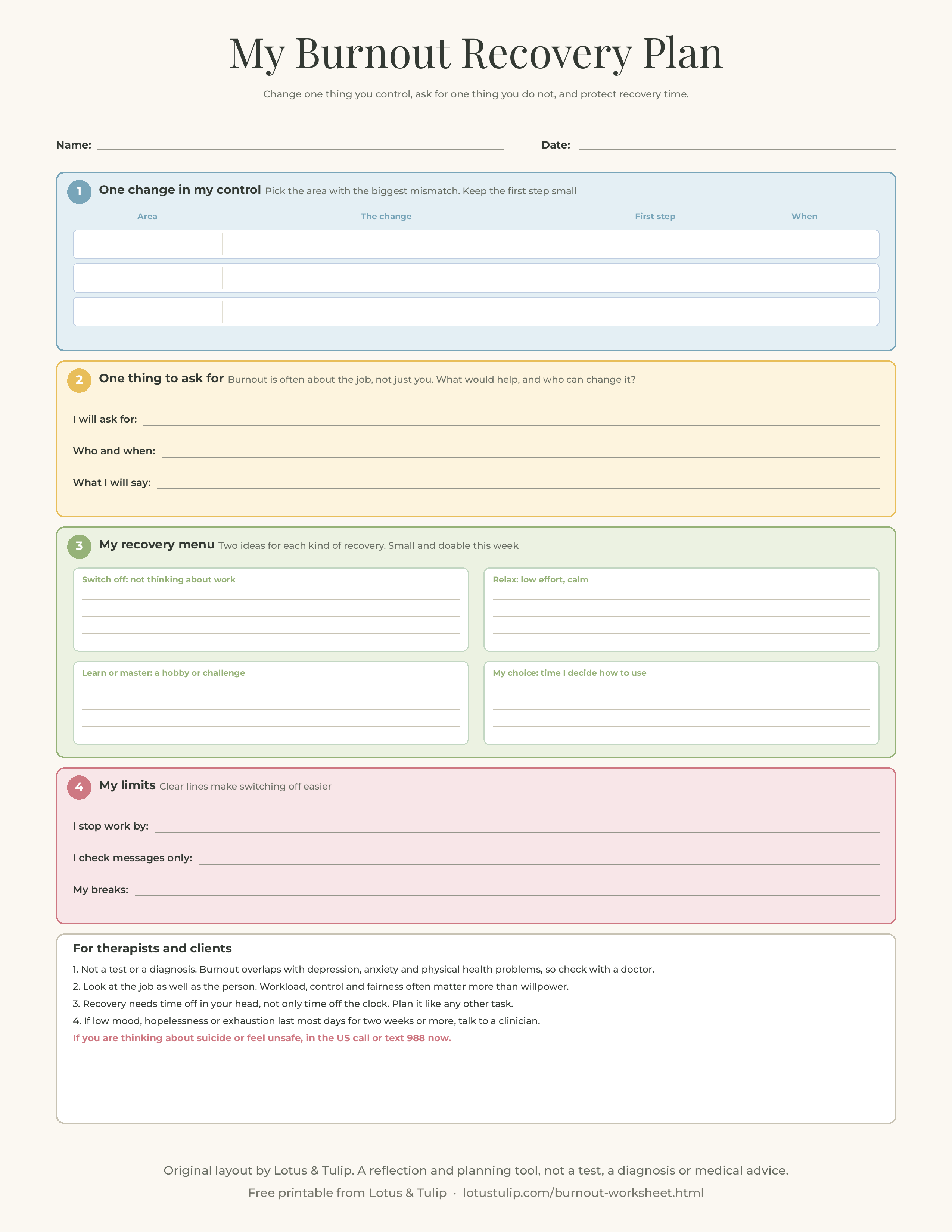
- Plan one change in your control. On page 2, choose the area with the biggest mismatch and write one change, a first step small enough to do this week, and when. Examples: block one meeting free morning, stop checking email after 7 pm, delegate one recurring task.
- Plan one thing to ask for. Many causes of burnout sit with the job, not with you. Write what would help (a clearer priority list, fewer cases, a different schedule), who can change it, and the words you will use. The assertiveness worksheet helps with the wording.
- Build a recovery menu and set limits. Write two ideas for each kind of recovery and set clear lines: when you stop work, when you check messages and when you take breaks. Review the plan in two weeks and adjust.
When the hard part is saying no to extra work, the healthy boundaries worksheet has scripts. When exhaustion has turned into low mood and pulling away from everything, the behavioral activation worksheet is a better starting point.
Common mistakes
- Treating it only as a self care problem. Bubble baths do not fix chronic overload or an unfair system. Use personal recovery and also look at the job.
- Waiting for a vacation to fix it. Time away helps, but if nothing changes at work, the benefit often fades soon after you return. Build recovery into ordinary weeks.
- Cutting the things that restore you. When busy, people drop exercise, hobbies and friends first. Those are often exactly what keeps burnout from deepening.
- Never switching off. Leaving the office but checking messages all evening is not recovery. Set message limits and an end of work routine.
- Ignoring signs of depression or illness. If symptoms are severe, last most days or spread beyond work, see a doctor or therapist rather than just pushing through.
Examples
- The nurse: Felt drained most days and had started to feel numb with patients. Her map showed big mismatches in workload and control after staffing cuts. Her one change was taking her full break away from the unit. Her one request, to her manager, was a predictable schedule for the next month. She tracked her recovery week and noticed she had almost no time switching off, so she added a short walk with no phone after each shift.
- The teacher: Loved teaching but felt cynical about new paperwork demands. His biggest mismatch was values: time spent on forms instead of students. With his therapist he used ACT values work to name what mattered, kept one hour a week for planning lessons he cared about, and raised the paperwork load with his department head with two other colleagues.
- The therapist: Noticed early warning signs in herself: dreading Mondays and needing more and more to unwind. Her map showed workload and reward mismatches in private practice. She capped her weekly caseload, added a monthly peer consultation group for community, and booked one evening a week for a choir she had dropped years ago.
Free burnout worksheet
This free printable is an original Lotus & Tulip layout on US Letter, in our own wording. It is not the Maslach Burnout Inventory or any other published questionnaire, and it does not give a score. Page 1, My Burnout Map, has a three signs check (rarely, sometimes, often), a six areas of work life table with good fit, some strain or big mismatch and an example column, an early warning signs checklist, lines for what drains and restores you, and a recovery week tracker for switching off, relaxing, learning or mastering, and choosing your own time. Page 2, My Burnout Recovery Plan, has one change in your control with a first step and when, one thing to ask for with who and what you will say, a recovery menu with four boxes, your limits and short notes for therapists and clients.
Download the free burnout worksheet (PDF, 2 pages, US Letter)
Prefer single images? Page 1: my burnout map (PNG) · Page 2: my burnout recovery plan (PNG)
Free to print for use with your own clients or for yourself. Please link to this page rather than re-uploading the file. A reflection and planning tool, not a test, a diagnosis or a substitute for therapy or medical care. In the US, call or text 988 in a mental health crisis.
Related resources
- Stress management worksheet for adults: sort what you can change, ease what you can't, free stress map and plan
- Compassion fatigue worksheet: for therapists and helpers carrying clients' trauma, with a free care for the carer plan
- Healthy boundaries worksheet: scripts for saying no without over explaining
- People pleasing worksheet: noticing the automatic yes
- Self care plan template: make room for rest in the week
- Time management worksheet for adults: plan a realistic week with focus blocks and buffers
- ACT values worksheet: name what matters when work no longer fits
- All therapist worksheets: CBT, DBT, ACT and more
FAQ
What is a burnout worksheet?
A burnout worksheet is a structured page that helps you notice the signs of burnout, see which parts of your job are driving it, and plan changes and recovery. This one covers the three signs WHO describes, the six areas of work life from Maslach and Leiter's model, early warning signs, recovery after work, and a plan with one change and one request.
What are the three signs of burnout?
The World Health Organization describes three dimensions: feelings of energy depletion or exhaustion; increased mental distance from your job, or feelings of negativism or cynicism about it; and reduced professional efficacy. WHO calls burn-out an occupational phenomenon tied to chronic workplace stress, not a medical condition.
Is burnout the same as depression?
Not exactly, but they overlap a lot. A 2015 review of 92 studies found the distinction between burnout and depression is conceptually fragile and the evidence for burnout as a separate condition is inconsistent. If low mood, loss of interest or hopelessness last most days or affect life outside work, talk to a doctor or therapist.
What actually helps with burnout?
In a meta-analysis of interventions for physicians, programs that changed the work itself, such as workload and schedule changes, reduced burnout more than programs aimed only at the individual, although both helped. Recovery research also points to four experiences after work: mentally switching off, relaxing, mastering something new and having control over your free time.
Is this burnout worksheet free?
Yes. It is free to print for use with your own clients or for yourself. Please link to this page rather than re-uploading the file.
Sources
- Bianchi, R., Schonfeld, I. S., and Laurent, E. (2015). Burnout-depression overlap: A review. Clinical Psychology Review, 36, 28 to 41.
- Freudenberger, H. J. (1974). Staff burn-out. Journal of Social Issues, 30(1), 159 to 165.
- Maslach, C., and Jackson, S. E. (1981). The measurement of experienced burnout. Journal of Occupational Behaviour, 2(2), 99 to 113.
- Maslach, C., and Leiter, M. P. (2016). Understanding the burnout experience: Recent research and its implications for psychiatry. World Psychiatry, 15(2), 103 to 111.
- Panagioti, M., Panagopoulou, E., Bower, P., and colleagues. (2017). Controlled interventions to reduce burnout in physicians: A systematic review and meta-analysis. JAMA Internal Medicine, 177(2), 195 to 205.
- Sonnentag, S., and Fritz, C. (2007). The Recovery Experience Questionnaire: Development and validation of a measure for assessing recuperation and unwinding from work. Journal of Occupational Health Psychology, 12(3), 204 to 221.
- World Health Organization. (2019). Burn-out an "occupational phenomenon": International Classification of Diseases.