
Therapist worksheets · Stress management, coping and daily resets for adults · Updated 2026-11-13
Stress management worksheet for adults: how stress works, what research shows helps, and how to sort, change and ease it step by step (free printable)
The thoughts that keep stress going: CBT Worksheets for Therapists, 20 pages including thought records and behavioral experiments Holiday 20% off: about $11.04, was $14 (EUR 12) · fillable PDF, instant digital download
Buy on EtsyTry it free first: download a fillable stress sample (problem solving steps and coping cards, PDF, 197 KB). Type into it on screen, then get the full pack. No email needed.
When stress turns into worry: Anxiety Worksheets for Therapists, 20 pages incl. a worry log, grounding and the anxiety cycle Holiday 20% off: about $11.04, was $14 (EUR 12) · fillable PDF, instant digital download
Buy on EtsyTry it free first: download a fillable sample (worry log and fear ladder, PDF, 258 KB). Type into it on screen, then get the full pack. No email needed.
A full caseload: Therapist Worksheets Mega Bundle (8 packs incl. CBT, anxiety, DBT, ACT, grief and ADHD) Holiday 20% off: about $35.88, was $45 (EUR 39) · fillable PDFs for all 8 packs plus 160 printable pages, instant digital download
Buy on EtsyWork is piling up, a family member is unwell, money is tight and your sleep has gone. Everyone says "manage your stress", but nobody says how. Most advice jumps straight to bubble baths or breathing apps, without asking the first useful question: which parts of this can you actually change?
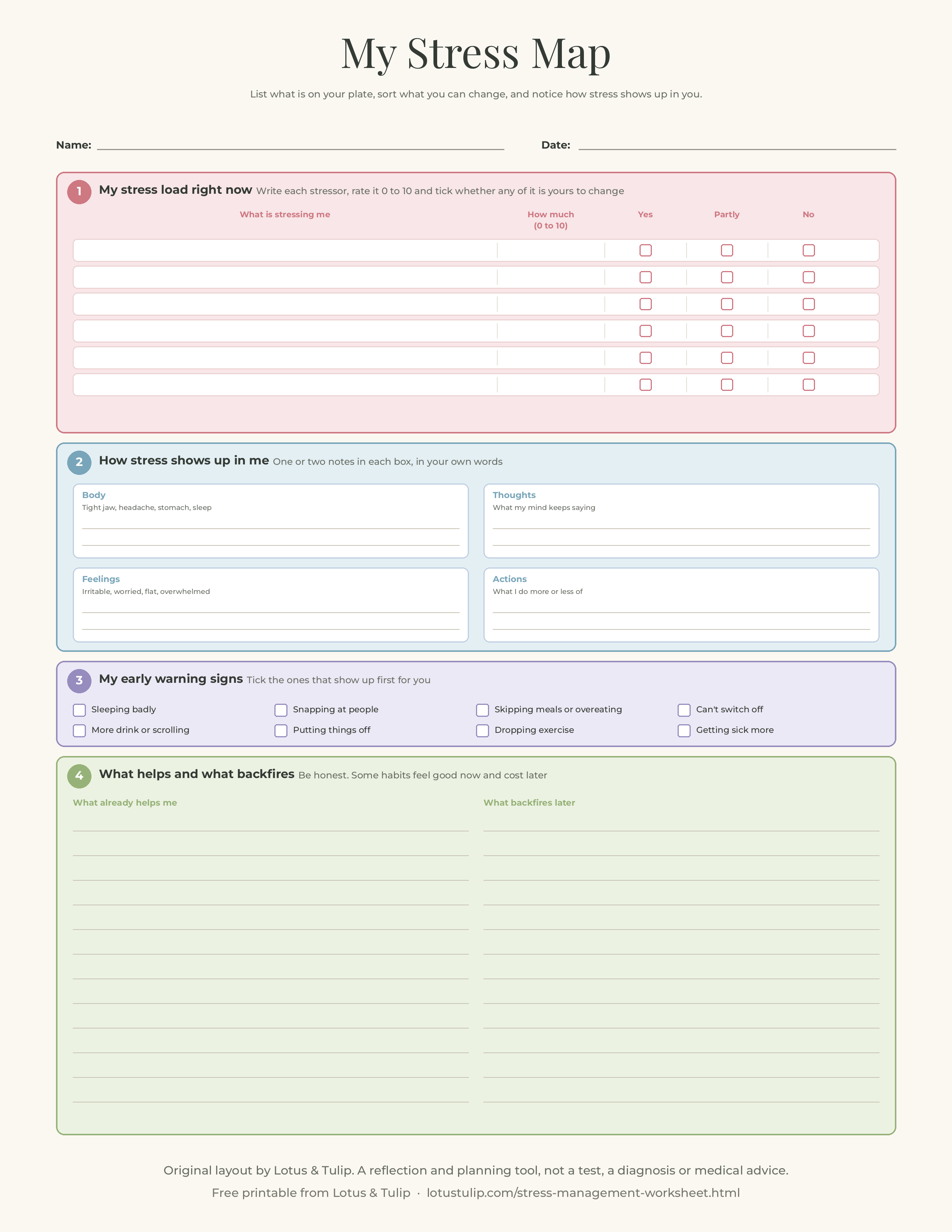
This guide is for adults and for the therapists, counselors and coaches who work with them. It explains how psychologists think about stress, the two kinds of coping almost everyone needs, what research says about stress management programs, nine practical steps, common mistakes and examples. It ends with a free 2 page printable: My Stress Map, which helps you list and sort what is stressing you and notice how stress shows up in you, and My Stress Plan, which turns that into small steps, coping ideas and daily resets.
Download the free stress management worksheet (PDF, 2 pages, US Letter)
Direct download, no email or sign up. See the pages first.
What stress is
Stress is a judgment, not just an event. The most influential model of stress comes from the psychologists Richard Lazarus and Susan Folkman. In their 1984 book Stress, Appraisal, and Coping they described stress as a relationship between a person and their situation: we feel stressed when we judge that the demands on us are important and that they exceed, or nearly exceed, the resources we have to meet them. That is why the same deadline can feel exciting to one person and crushing to another.
Two quick judgments shape it. In Lazarus and Folkman's terms, primary appraisal asks "what is at stake for me here?", for example a threat, a loss or a challenge. Secondary appraisal asks "what can I do about it?" Stress management works on both: seeing the situation more accurately and widening what you can do.
Some stress is normal and useful. Short bursts of stress help you focus for an exam or a hard conversation. The trouble starts when stress is heavy, constant and has no recovery time, so it starts to affect sleep, mood, health and relationships.
The two kinds of coping
Lazarus and Folkman separated coping into two broad functions:
- Problem focused coping changes the situation itself: making a plan, asking for help, setting a limit, getting information or tackling the task in smaller steps.
- Emotion focused coping changes how you feel about and respond to the situation: calming your body, looking at it from another angle, accepting what cannot be changed or seeking comfort from others.
Neither one is better. In a classic study, Folkman and Lazarus (1980) followed 100 men and women aged 45 to 64 for a year with monthly interviews and questionnaires about their stressful encounters. Across 1,332 episodes, people used both problem focused and emotion focused coping in 98 percent of them. The context mattered most: situations where people thought something constructive could be done favored problem focused coping, while situations that had to be accepted favored emotion focused coping. Work situations leaned toward problem focused coping and health situations toward emotion focused coping. They found no gender differences in emotion focused coping.
That finding is the backbone of this worksheet. First sort your stressors by how much of each you can change, then match the kind of coping to the situation instead of using one approach for everything.
What the research says helps
- Structured stress management programs work, and CBT programs most of all. Richardson and Rothstein (2008) pooled 36 experimental studies of workplace stress management programs, covering 55 interventions and 2,847 participants. The overall effect was a medium to large improvement (Cohen's d = 0.526). Cognitive behavioral programs consistently produced larger effects than relaxation, organizational, multimodal or alternative approaches, although adding extra components to a cognitive behavioral program reduced its effect. Most outcomes were psychological, such as perceived stress and mood, rather than physical or workplace measures.
- Mindfulness based stress reduction helps healthy adults. A meta-analysis by Khoury and colleagues (2015) of 29 studies with 2,668 healthy adults found that MBSR was moderately effective overall (Hedges' g = 0.53 compared with control groups), with large effects on stress, moderate effects on anxiety, depression, distress and quality of life, and small effects on burnout. Results held at an average follow up of 19 weeks, though the studies varied a lot.
- Stress can be measured, roughly. The most widely used questionnaire is the Perceived Stress Scale by Sheldon Cohen, Tom Kamarck and Robin Mermelstein (1983), which asks how unpredictable, uncontrollable and overloaded life has felt over the last month. Our worksheet is not the Perceived Stress Scale and gives no score. If you or your clinician want a validated measure, use the original.
Put together: name your stressors, sort what you can and cannot change, take small concrete steps on the first group, use calming, rethinking, acceptance and connection for the second, and build short recovery moments into every day. If stress has turned into constant worry, low mood or poor health, get professional help rather than pushing through.
How to use a stress management worksheet, step by step
- List what is stressing you. On page 1, write up to six current stressors in plain words, such as "quarterly report due Friday", "my dad's hospital appointments" or "credit card bill". Be specific. "Work" is too big to act on; "the 4 pm meeting that always runs late" is not.
- Rate each one from 0 to 10. Rate how much each stressor weighs on you right now. The ratings are for you, not a score. They show where most of the weight sits.
- Sort what you can change. For each stressor tick yes, partly or no: is any of it yours to change? Most stressors are partly. You may not control a layoff rumor, but you can control updating your resume and saving a small buffer.
- Notice how stress shows up in you. Write a note in each of the four boxes: body (tight jaw, headaches, stomach, sleep), thoughts (what your mind keeps saying), feelings (irritable, worried, flat) and actions (what you do more or less of). This helps you catch stress earlier next time.
- Tick your early warning signs. Mark the signs that show up first for you, such as sleeping badly, snapping at people, putting things off or dropping exercise. These are your signal to use the plan.
- Be honest about what helps and what backfires. List what already helps you and what feels good now but costs you later, such as an extra drink, scrolling until 1 am or skipping lunch to catch up.
- Change what you can. On page 2, take the yes and partly stressors and write one small, concrete step for each, with a time. "Email my manager on Monday morning to ask which project comes first" beats "be more organized". The time management worksheet helps when a stressor is really a too full week, and the procrastination worksheet helps when it feels too big to start.
- Ease what you can't change. For the no stressors, pick at least one idea from each box: calm the body (slow breathing, a walk, a stretch), shift the thought (what would you tell a friend?), make room for it (name it, allow it and carry on with what matters) and connect (who can you talk to or simply be with?).
- Build daily resets and check in for a week. Plan one reset of two to five minutes for the morning, midday and evening. Each evening, rate your stress from 0 to 10 and tick whether you did a reset. After a week, look for patterns, adjust the plan and write down when you will review it again.
When one worry thought keeps looping, the CBT thought record and the worry time worksheet are good companions. If stress is mostly about work and has lasted for months, the burnout worksheet may fit better.
Common mistakes
- Treating every stressor the same way. Relaxation alone will not fix a deadline you can renegotiate, and a to do list will not fix a diagnosis you have to live with. Sort first, then choose the kind of coping.
- Waiting for a big block of free time. A vacation helps, but the effect fades. Small daily resets are easier to keep up and fit into a real week.
- Relying on habits that backfire. Alcohol, endless scrolling, skipping meals and cutting sleep can numb stress for an evening and make the next day harder. Name them on the map so you can swap one for something that actually restores you.
- Cutting the things that protect you first. When life gets busy, people often drop exercise, friends and sleep. Those are usually what keeps stress manageable.
- Ignoring signs that it is more than stress. If worry, low mood, panic or physical symptoms get in the way of daily life most days for two weeks or more, talk to a doctor or therapist. A worksheet is a tool, not a treatment.
Examples
- The working parent: Listed work deadlines, the morning school run, a sick parent and money. She ticked partly for the deadlines and the school run and no for her parent's illness. Her change step was asking a neighbor to swap school runs twice a week. For her parent, she chose a 10 minute walk after hospital visits and a weekly call with her sister. Her evening ratings dropped from mostly 8s to mostly 6s over two weeks.
- The new manager: Noticed a tight jaw, Sunday night dread and checking email at midnight. His map showed most stress came from two stressors he could partly change: unclear priorities and back to back meetings. He booked a priorities talk with his director, blocked a 30 minute gap after lunch and set a reset of closing the laptop and stepping outside at 6 pm.
- The graduate student: Felt flat and kept putting off her thesis. Her what backfires list showed late night scrolling and skipped meals. She used the thought box to catch "if this chapter is not perfect I will fail", worked on it with her counselor, and added a morning reset of writing for 20 minutes before opening her phone.
Free stress management worksheet
This free printable is an original Lotus & Tulip layout on US Letter, in our own wording. It is not the Perceived Stress Scale or any other published questionnaire, and it does not give a score. Page 1, My Stress Map, has a stress load table with a 0 to 10 rating and a yes, partly or no column for what you can change, four boxes for how stress shows up in your body, thoughts, feelings and actions, an early warning signs checklist and two columns for what helps and what backfires. Page 2, My Stress Plan, has a change what I can table with a small step and a time, an ease what I can't change menu with four boxes, morning, midday and evening resets, a 7 day stress check and lines for when you will review the plan.
Rather type than handwrite? The free PDF above is for printing. CBT Worksheets for Therapists comes as a fillable PDF you type straight into (642 fields in Adobe Acrobat Reader), plus the printable version: problem solving steps, coping cards, thought record, worry time log and grounding, 20 pages. Try the fillable problem solving and coping cards pages free first (PDF). Holiday 20% off: about $11.04, was $14 (EUR 12) · instant digital download
Buy on Etsy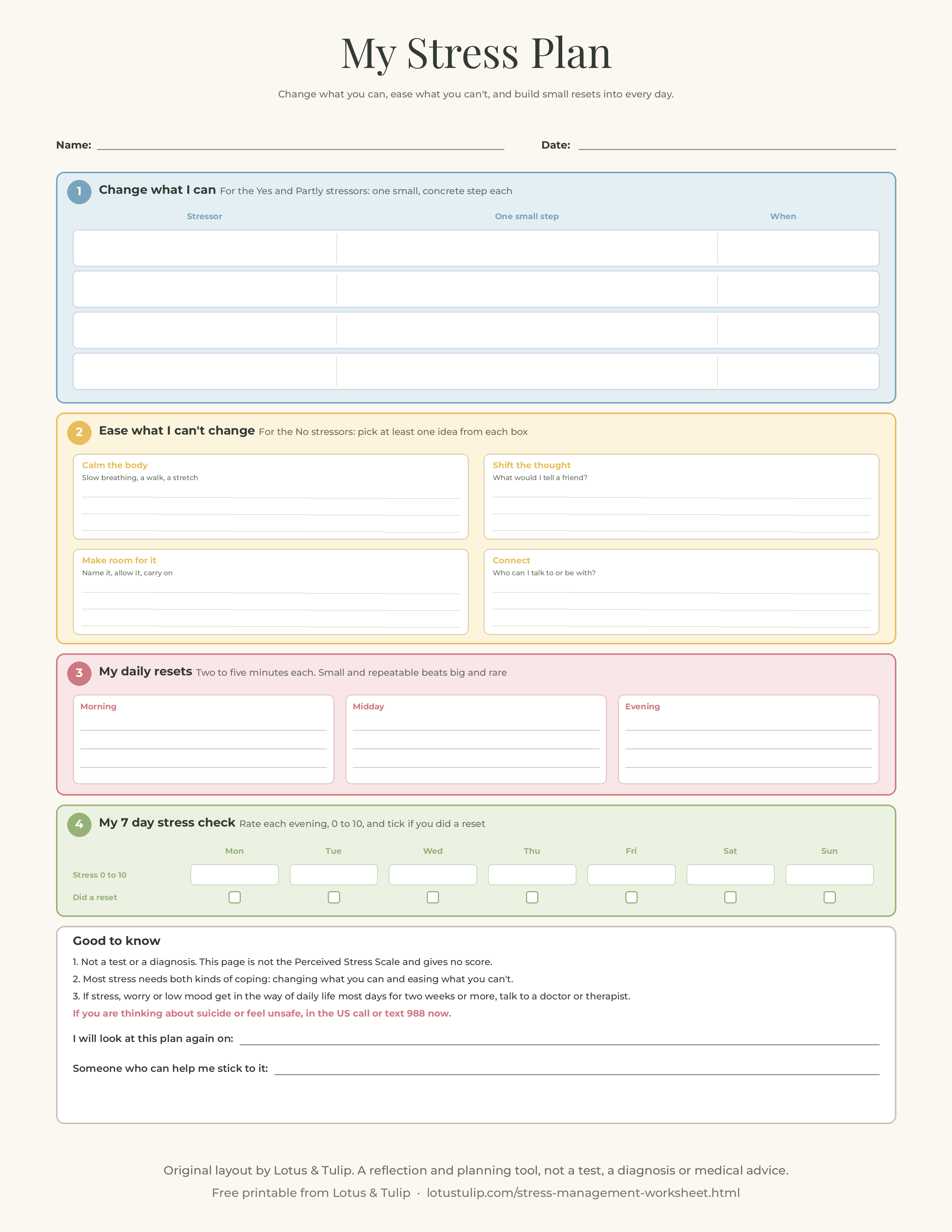
Download the free stress management worksheet (PDF, 2 pages, US Letter)
Prefer single images? Page 1: my stress map (PNG) · Page 2: my stress plan (PNG)
Free to print for yourself or for use with your own clients, groups or team. Please link to this page rather than re-uploading the file. A reflection and planning tool, not a test, a diagnosis or a substitute for therapy or medical care. In the US, call or text 988 in a mental health crisis.
Related resources
- Coping skills worksheets for adults: once your stressors are sorted, build a coping menu for each kind, with a free map and plan
- Emotion regulation worksheets for adults: an emotion log, five points to step in and a free 2 page PDF
- Stress management worksheets for teens: the teen version, with coping activities
- Burnout worksheet: when work stress has lasted for months
- Worry time worksheet: contain worry to one short slot a day
- Self care plan template: make room for rest in the week
- Sleep hygiene worksheet: when stress is costing you sleep
- Body scan meditation script: a mindfulness practice to calm the body
- All therapist worksheets: CBT, DBT, ACT and more
- Problem solving worksheet for adults: work through a stressor you can change, step by step
FAQ
What is a stress management worksheet?
A stress management worksheet is a structured page that helps you list what is stressing you, sort what you can and cannot change, notice how stress shows up in your body, thoughts, feelings and actions, and plan small steps, coping ideas and daily resets. This one has two pages: a stress map and a stress plan.
What is the difference between problem focused and emotion focused coping?
Problem focused coping changes the situation, for example making a plan, asking for help or setting a limit. Emotion focused coping changes how you feel about and respond to it, for example calming your body, rethinking it, accepting it or seeking support. Folkman and Lazarus (1980) found that people used both in 98 percent of stressful episodes, leaning on problem focused coping when something could be done and emotion focused coping when a situation had to be accepted.
What stress management techniques have the best evidence?
In a meta-analysis of 36 workplace studies, Richardson and Rothstein (2008) found that cognitive behavioral programs produced larger effects than relaxation and other approaches. A meta-analysis of 29 studies by Khoury and colleagues (2015) found that mindfulness based stress reduction had large effects on stress in healthy adults. Simple, repeatable habits like movement, sleep and support from other people are also part of most programs.
Can I use this worksheet with clients?
Yes. Therapists, counselors and coaches can print it for use with their own clients, groups or teams. It works well as a first session map and as homework between sessions. Please link to this page rather than re-uploading the file.
Is there a test for stress?
The most widely used questionnaire is the Perceived Stress Scale (Cohen, Kamarck and Mermelstein, 1983), which asks how unpredictable, uncontrollable and overloaded life has felt over the last month. It is not a diagnosis. This worksheet is a reflection and planning tool and gives no score.
When is stress a reason to see a professional?
If stress, worry, low mood, panic or physical symptoms get in the way of work, relationships or daily life most days for two weeks or more, or if you are using alcohol or other substances to cope, talk to a doctor or therapist. If you are thinking about suicide, in the US call or text 988.
Sources
- Cohen, S., Kamarck, T., and Mermelstein, R. (1983). A global measure of perceived stress. Journal of Health and Social Behavior, 24(4), 385 to 396.
- Folkman, S., and Lazarus, R. S. (1980). An analysis of coping in a middle-aged community sample. Journal of Health and Social Behavior, 21(3), 219 to 239.
- Khoury, B., Sharma, M., Rush, S. E., and Fournier, C. (2015). Mindfulness-based stress reduction for healthy individuals: A meta-analysis. Journal of Psychosomatic Research, 78(6), 519 to 528.
- Lazarus, R. S., and Folkman, S. (1984). Stress, appraisal, and coping. New York: Springer.
- Richardson, K. M., and Rothstein, H. R. (2008). Effects of occupational stress management intervention programs: A meta-analysis. Journal of Occupational Health Psychology, 13(1), 69 to 93.