
Therapist worksheets · Updated 2026-11-02
CBT thought record worksheet: how to use it with clients (free printable)
Ready-made printable: CBT Worksheets for Therapists Fillable PDF: type into the thought record, plus exposure ladder, activity logs, coping cards and 0 to 10 scales (20 pages)
Holiday 20% off: about $11.04, was $14 (EUR 12) · instant digital download
Try it free first: download a fillable sample (thought record and evidence for and against, PDF, 105 KB). Type into it on screen, then get the full pack. No email needed.

A thought record is the workhorse of cognitive behavioral therapy. It helps a client slow down a moment that went badly, catch the automatic thought behind the feeling, weigh it against the facts and arrive at a more balanced view. This guide explains the classic 7 column thought record, gives a worked example, covers the mistakes that make clients give up on it, and includes a free one page CBT thought record you can print for session or homework.
This is educational information for therapists, counselors and other qualified professionals, not a substitute for clinical training or supervision. If a client is in crisis in the US, they can call or text 988, the Suicide and Crisis Lifeline, or call 911 in an emergency.
Jump to the free thought record worksheet
Where the thought record comes from
The thought record grew out of Aaron T. Beck's cognitive therapy. An early version, the Daily Record of Dysfunctional Thoughts, appears in Cognitive Therapy of Depression by Beck, Rush, Shaw and Emery (1979). The 7 column format many therapists use today was popularized by Dennis Greenberger and Christine Padesky in the client workbook Mind Over Mood. The core idea has stayed the same: feelings follow from how we interpret a situation, and interpretations can be examined.
The 7 columns, explained
- Situation. Who, what, when, where. Keep it factual and short, like a camera would record it: "Tuesday, 3 pm, boss walked past my desk without saying hello."
- Moods. Name each feeling in one word (anxious, sad, ashamed, angry) and rate its intensity from 0 to 100%.
- Automatic thoughts. What went through the client's mind? Circle the "hot thought", the one most connected to the strongest feeling.
- Evidence that supports the hot thought. Facts only, not interpretations.
- Evidence that does not support it. What would a friend point out? Has this happened before and turned out differently? What is being overlooked?
- Alternative or balanced thought. A statement that takes all the evidence into account. It should be believable, not just positive. Rate how much the client believes it, 0 to 100%.
- Re-rate moods. Rate the original feelings again. A drop from 80% to 50% is a real win; the goal is relief, not zero.
A worked example
- Situation: Texted a friend about weekend plans. No reply after 6 hours.
- Moods: Hurt 70%, anxious 60%.
- Hot thought: "She's annoyed with me and doesn't want to see me."
- Evidence for: She usually replies within an hour. Last time we met she seemed quiet.
- Evidence against: She told me this week is a big deadline at work. She invited me to her birthday last month. She has gone quiet before when busy and then replied warmly.
- Balanced thought: "She's probably busy with her deadline. If something were wrong, I can ask her directly later this week." Believe it 65%.
- Re-rated moods: Hurt 35%, anxious 30%.
Tips that make thought records work
- Start with the 3 column version. Situation, feeling, thought is enough for the first week or two. Add the evidence columns once the client can reliably catch thoughts.
- Do the first one together in session. Pick a recent, moderately upsetting moment, not the worst one.
- Separate thoughts from feelings. "I feel like a failure" is a thought. The feeling might be shame or sadness.
- Look for the hot thought behind the first thought. Questions like "And if that were true, what would it mean about you?" often lead to it.
- Name the thinking trap if it helps. Common ones are all or nothing thinking, mind reading, fortune telling, catastrophizing and "should" statements.
- Review the homework every time. A thought record that is never looked at again teaches the client that it does not matter.
Common mistakes
- Writing a balanced thought that is just the opposite of the hot thought ("Everyone loves me"). If the client does not believe it, it will not shift the feeling.
- Treating the record as a way to prove the client wrong. Sometimes the evidence supports the thought; then the work moves to problem solving or acceptance.
- Using it in the middle of a crisis. When a client is flooded, regulation skills come first. Our window of tolerance guide covers skills for coming back into the window.
Free CBT thought record worksheet
The printable below follows the 7 column structure on one page, with mood ratings before and after and a short list of common thinking traps as prompts. It is US Letter at print quality.
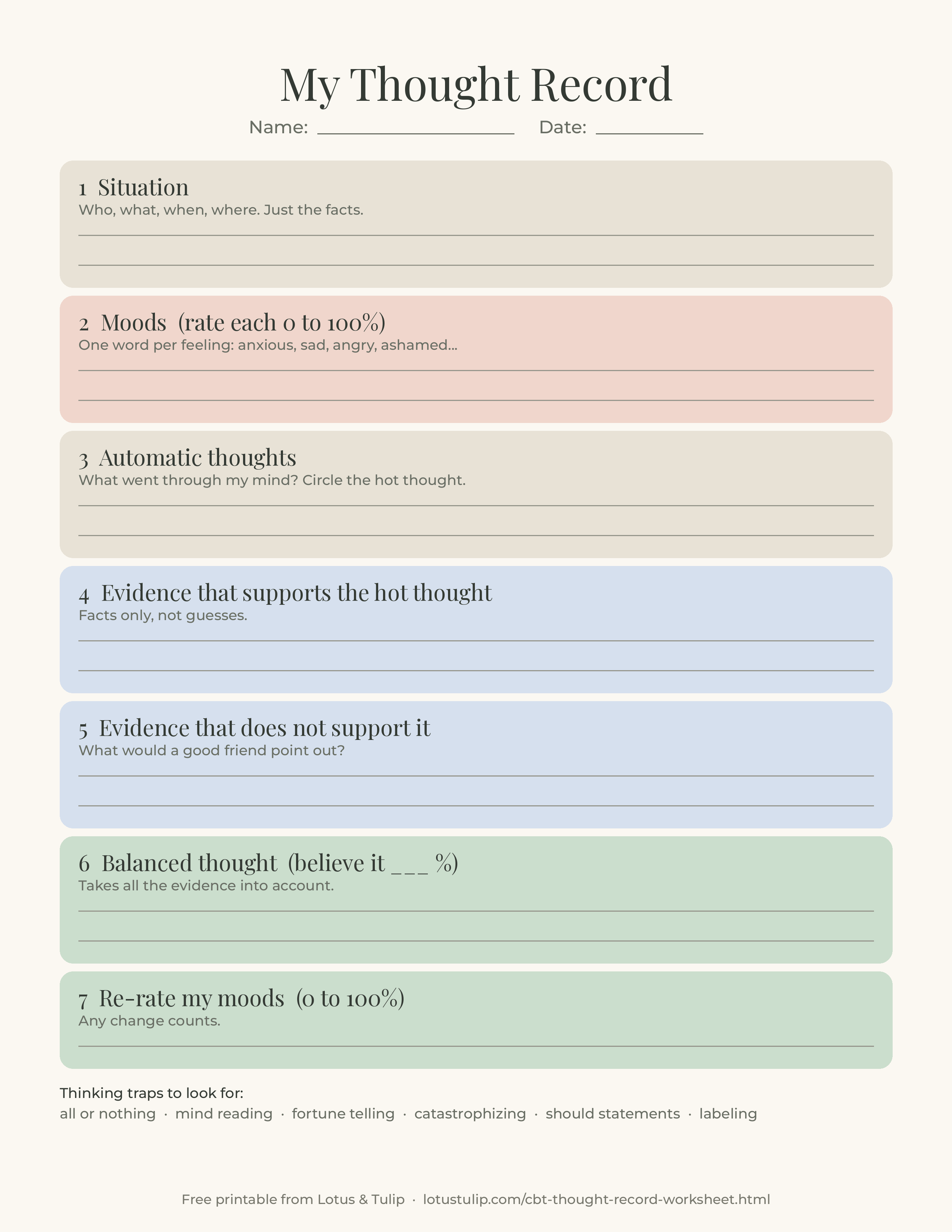
Download the free thought record (PNG, US Letter)
Free CBT starter pack: Want more pages for the same session? The free CBT worksheets starter pack adds the 7 column thought record from our paid set, plus five more real worksheets from our CBT set (8 pages, client use license, no email).
Related resources
- CBT worksheets for therapists
- CBT worksheets for teens
- Anxiety worksheets for therapists
- All therapist worksheets
- Catastrophizing worksheet: when the hot thought is a worst case story, decatastrophize it step by step
FAQ
What is a CBT thought record?
A structured worksheet used in cognitive behavioral therapy to record a situation, the feelings and automatic thoughts it triggered, the evidence for and against the main thought, and a more balanced alternative, followed by re-rating the feelings.
What are the 7 columns of a thought record?
Situation, moods with intensity ratings, automatic thoughts (with the hot thought marked), evidence that supports the hot thought, evidence that does not support it, an alternative or balanced thought, and re-rated moods.
How often should a client complete a thought record?
Many therapists start with one or two a week, ideally soon after an upsetting moment while it is fresh, and review each one in the next session. Frequency depends on the client and the treatment plan.
Is this thought record worksheet free?
Yes. The worksheet on this page is free to print for use with your own clients or yourself. Please link to this page rather than re-uploading the file.