
Therapist worksheets · CBT · Updated 2026-11-14
Catastrophizing worksheet for adults: what catastrophizing is, what research shows, and how to decatastrophize step by step (free printable)
Thought records and the thinking traps behind worst case stories: CBT Worksheets for Therapists, 20 pages including thought records and core beliefs Holiday 20% off: about $11.04, was $14 (EUR 12) · fillable PDF, instant digital download
Buy on EtsyTry it free first: download a fillable sample (thought record and evidence for and against, PDF, 105 KB). Type into it on screen, then get the full pack. No email needed.
Worry logs and probability pages for the what if chain: Anxiety Worksheets for Therapists, 20 pages incl. a worry log, probability and catastrophe and a fear ladder Holiday 20% off: about $11.04, was $14 (EUR 12) · fillable PDF, instant digital download
Buy on EtsyTry it free first: download a fillable sample (worry log and fear ladder, PDF, 258 KB). Type into it on screen, then get the full pack. No email needed.
A full caseload: Therapist Worksheets Mega Bundle (8 packs incl. DBT, CBT, ACT, anxiety, grief and ADHD) Holiday 20% off: about $35.88, was $45 (EUR 39) · fillable PDFs for all 8 packs plus 160 printable pages, instant digital download
Buy on EtsyYour partner is an hour late and not answering. Within ten minutes you have pictured the crash, the phone call from the hospital and the funeral. Then the door opens and they say their phone died. That jump, from an ordinary unknown to the worst possible ending, is catastrophizing.
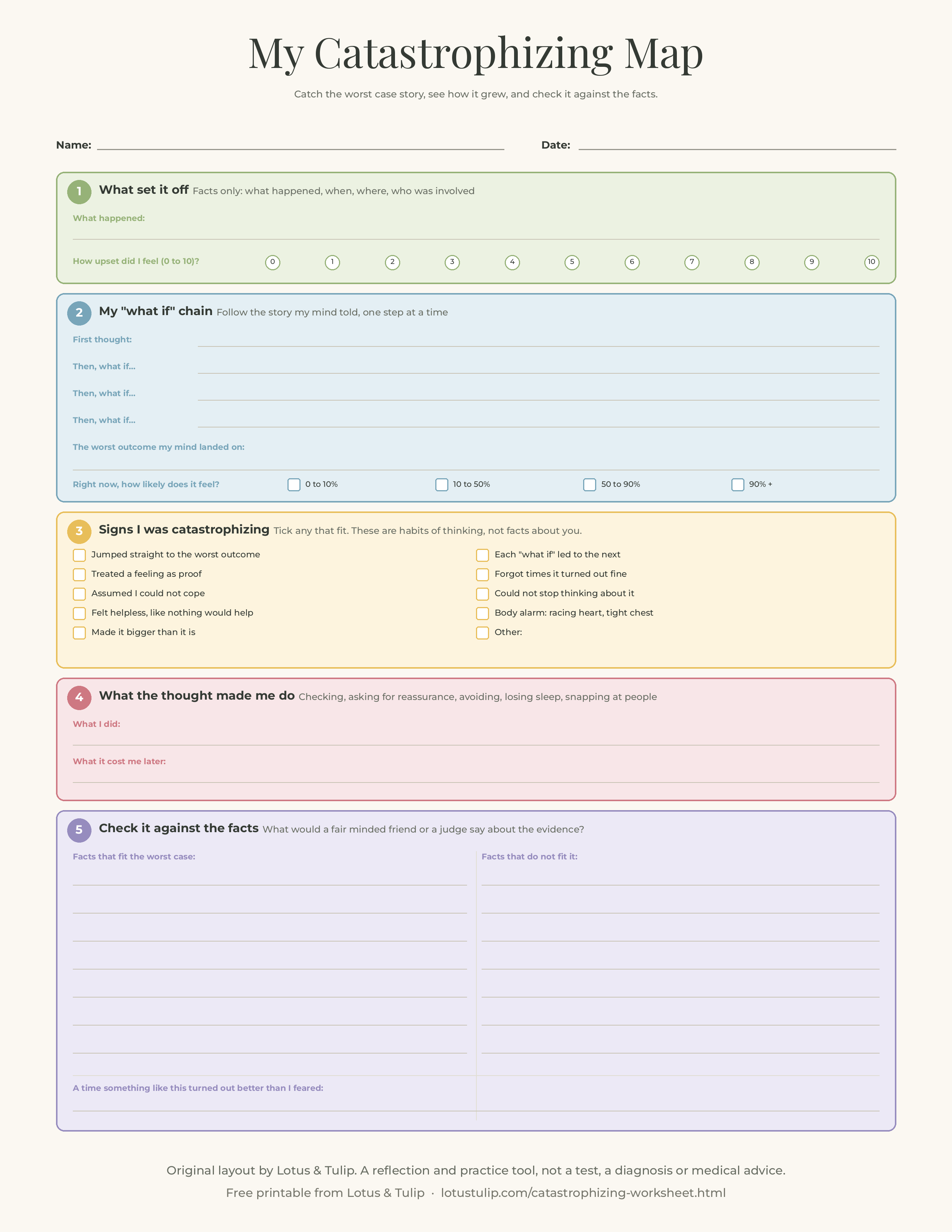
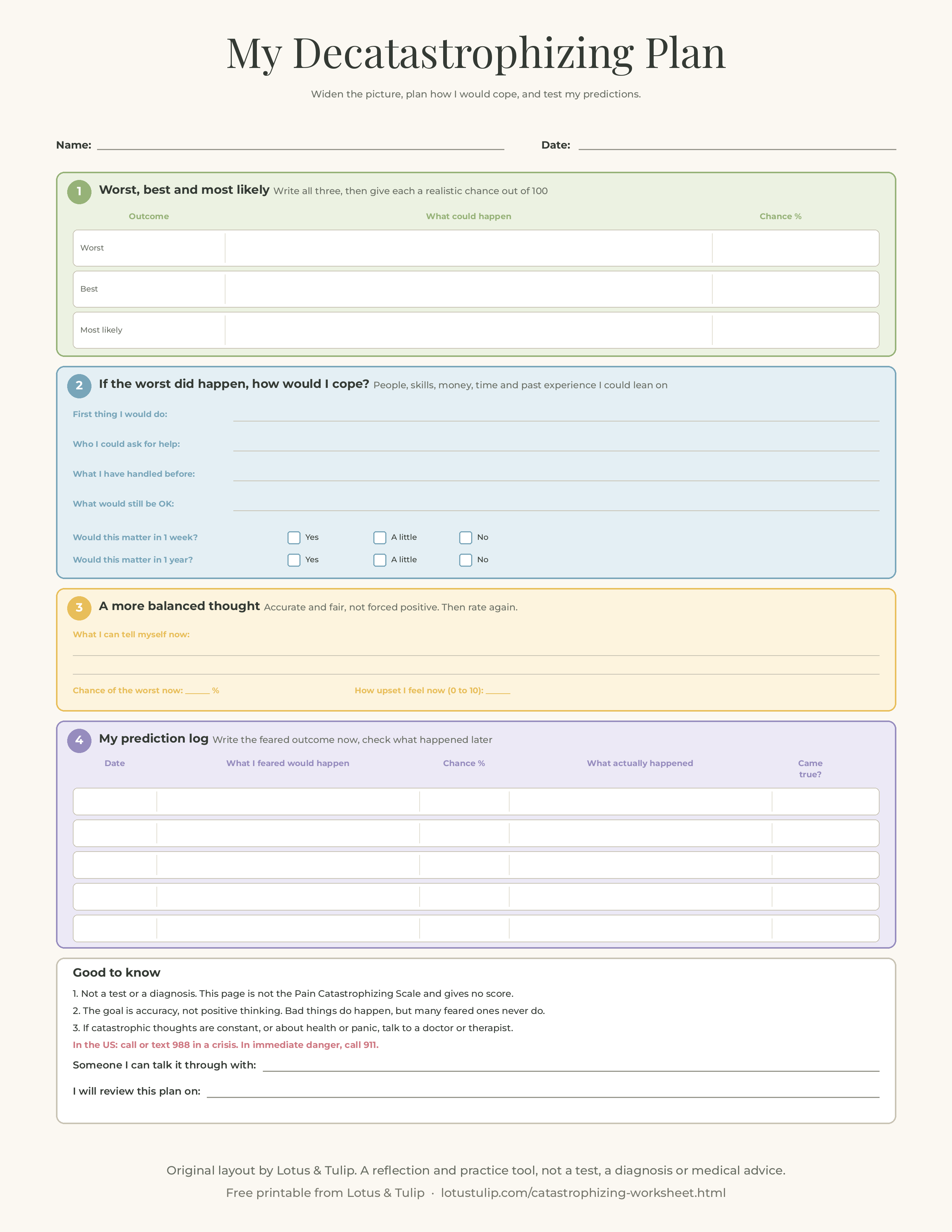
This guide is for adults who catch themselves doing it, and for the therapists, counselors and coaches who help them. It covers what catastrophizing is and where the idea comes from, what the research honestly shows, nine practical steps for decatastrophizing, common mistakes and three short examples. It ends with a free 2 page printable: My Catastrophizing Map, for slowing down one worst case story, and My Decatastrophizing Plan, for weighing the worst, best and most likely outcomes, planning how you would cope and testing your predictions over time.
Download the free catastrophizing worksheet (PDF, 2 pages, US Letter)
Direct download, no email or sign up. See the pages first.
What catastrophizing is
Catastrophizing is a thinking habit where the mind jumps to the worst possible outcome, treats it as likely, and underestimates your ability to cope with it. It is one of the classic cognitive distortions in CBT, alongside all or nothing thinking, mind reading and the others on our cognitive distortions worksheet.
The term goes back to the psychologist Albert Ellis, who described catastrophizing in Reason and Emotion in Psychotherapy (1962). Aaron Beck and colleagues later adapted it in cognitive therapy to describe a pattern seen in people with anxiety and depression. A 2009 review by Quartana, Campbell and Edwards sums up what sat at the core of both men's definitions: an irrationally negative forecast of future events.
Catastrophizing usually has three ingredients, and the worksheet targets each one:
- Overestimating the odds. The worst outcome feels likely, sometimes almost certain, even when it rarely happens.
- Blowing up the cost. The outcome, if it did happen, feels unbearable and permanent rather than painful and survivable.
- Underestimating coping. You picture the disaster but not what you, and the people around you, would actually do next.
It often runs as a chain of "what if" questions. What if I made a mistake in that report? What if my manager notices? What if I get fired? What if I cannot pay rent? Each step feels reasonable on its own. Put together, they turn a typo into homelessness in under a minute.
What the research says
- It shows up across many problems. In a 2016 review in Cognitive Therapy and Research, Resham Gellatly and Aaron Beck looked at catastrophic thinking as a predictor and correlate of panic, phobias, health anxiety, OCD, PTSD, pain and traumatic brain injury. They concluded that the process of catastrophic thinking cuts across disorders while the content differs for each one, and that it has been a focus of both prevention and therapy.
- Panic runs on catastrophic misreadings. David Clark's 1986 cognitive model of panic, published in Behaviour Research and Therapy, proposed that panic attacks come from catastrophically misinterpreting body sensations, for example reading a racing heart as a heart attack. Our panic attack worksheet maps that cycle.
- Worriers build longer catastrophe chains and believe them more. Vasey and Borkovec (1992) asked chronic worriers and nonworriers to follow a worry through a series of "what if" steps, using a method modeled on the cognitive therapy technique of decatastrophizing. Worriers produced significantly more catastrophic steps, felt more uncomfortable as the chain went on, and rated the events as more likely to happen, even though the content of their chains was mostly similar to nonworriers'. Across six studies, Davey and Levy (1998) found worriers would even catastrophize a positive part of their life, and tended to frame their catastrophe steps in terms of personal inadequacy.
- Most feared outcomes do not happen. LaFreniere and Newman (2020) had 29 adults with generalized anxiety disorder record their worries when prompted for 10 days and track the outcomes over 30 days. 91.4% of worry predictions did not come true, and the most common result per person was 100% untrue. People whose records showed more untrue worries improved more over treatment. This was a small sample of people already in treatment for GAD, so the exact figure will not hold for everyone, but it is the idea behind the prediction log on page 2.
- Pain catastrophizing is its own large research area. Sullivan, Bishop and Pivik (1995) developed the Pain Catastrophizing Scale (PCS), a 13 item questionnaire, in four studies starting with 425 undergraduates. Sullivan and colleagues later (2001) described pain catastrophizing as an exaggerated negative mental set brought to bear during actual or anticipated pain. The PCS measures three parts of it: rumination (not being able to stop thinking about it), magnification (expecting something serious) and helplessness (feeling nothing can be done). In their studies, people who catastrophized more reported more pain and more distress. A 2018 meta-analysis by Schütze and colleagues (79 randomized trials, 9,914 adults with chronic noncancer pain) found the best evidence for reducing pain catastrophizing with CBT, multimodal treatment and acceptance and commitment therapy. Effects were generally medium and of questionable clinical size overall, but larger and more consistent in the 8 trials that targeted people with high catastrophizing. The PCS is a clinical measure. We describe it here but do not reproduce or score it, and our worksheet is not the PCS.
Decatastrophizing: the core idea
Decatastrophizing is a standard cognitive therapy technique. It does not ask you to think positively or to pretend the bad thing cannot happen. It asks three honest questions:
- How likely is it, really? Write the worst, best and most likely outcomes side by side and give each a realistic chance out of 100. Seeing the most likely outcome written down is often the turning point.
- If it did happen, how bad would it be, and for how long? Would it still matter in a week? In a year? What would still be OK?
- How would I cope? Name the first thing you would do, who you would call, and what you have already survived. Catastrophizing pictures the disaster and stops. Coping planning carries on to the next scene.
Then, over the following weeks, you check what actually happened. Each prediction that does not come true is evidence your mind can learn from. This is the same logic as a behavioral experiment.
How to use a catastrophizing worksheet, step by step
- Write what set it off, facts only. On page 1, write what actually happened, when and who was involved, in a way a camera could record. "Text from my boss at 9 pm: can we talk tomorrow?" not "my boss is about to fire me." Rate how upset you felt from 0 to 10.
- Follow the "what if" chain. Write the first thought, then each "what if" it led to, until you reach the worst outcome your mind landed on. Seeing the whole chain on paper shows how many steps it took to get from the facts to the disaster.
- Rate how likely the worst feels right now. Tick the range that matches your gut feeling, not what you think the right answer is. You will compare it later.
- Tick the signs of catastrophizing. Jumping to the worst, treating a feeling as proof, forgetting times it turned out fine, assuming you could not cope, feeling helpless, body alarm. Naming the pattern creates a little distance from it.
- Notice what the thought made you do. Checking your phone 40 times, asking for reassurance, avoiding the meeting, lying awake. Write what it cost you later. Most of these actions bring quick relief and keep the fear going.
- Check the facts on both sides. List facts that fit the worst case and facts that do not, as a fair minded judge would. Add one time something like this turned out better than you feared. If you would like a deeper version of this step, use a CBT thought record.
- Write the worst, best and most likely outcomes. On page 2, fill in all three and give each a realistic chance out of 100. The best case matters too: it stretches your view in the other direction, so the most likely outcome sits in the middle where it belongs.
- Plan how you would cope with the worst. Write the first thing you would do, who you could ask for help, what you have handled before and what would still be OK. Then tick whether it would matter in a week and in a year. Write a balanced thought, accurate and fair rather than forced positive, and rate the chance of the worst and how upset you feel again.
- Log your predictions and review them. Each time you catch a catastrophe, add it to the prediction log with your chance estimate. Come back after the date has passed and write what actually happened. After four weeks, look at how many came true. If catastrophic thoughts are constant, revolve around health or panic, or stop you from working or sleeping, talk to a doctor or therapist. In the US, call or text 988 in a mental health crisis.
Common mistakes
- Arguing that nothing bad will ever happen. Bad things do happen, and your mind knows it. "It will definitely be fine" is no more believable than the catastrophe. Aim for accurate, not positive.
- Skipping the coping plan. Lowering the odds helps, but if the worst still feels unbearable, the fear comes back. The coping box is often the part that brings the most relief.
- Using the worksheet as reassurance. If you fill out the same page again and again about the same fear to feel certain, it has become a checking ritual. For repeated, sticky fears, see our intrusive thoughts worksheet and talk to a therapist about exposure based approaches.
- Doing it only at a 9 out of 10. At peak distress it is hard to think clearly. Practice on smaller worries first, and use a calming skill before the worksheet when you are flooded.
- Never checking the outcomes. The prediction log only works if you go back and fill in what actually happened. That evidence is what slowly changes the gut feeling.
- Treating a pain catastrophizing score as a verdict. Tools like the PCS describe how someone tends to think about pain. They do not mean the pain is imagined or exaggerated on purpose.
Examples
- The late night email: At 9 pm her manager wrote, "Can we talk first thing tomorrow?" Her chain ran: I messed up the client report, they are letting me go, I will not find another job, I will lose the apartment. She rated the worst as 50 to 90% likely. On page 2 she wrote the best case (a new project), the most likely (a question about the report or the schedule) and a coping plan (update her resume, call her sister, she has savings for three months). The next morning it was a change to the meeting schedule. She logged it as "did not come true."
- The headache: After three days of headaches he was sure it was a brain tumor and had spent hours reading symptom lists. The map showed his chain and how much checking it had triggered. His facts column included poor sleep, more screen time and no other symptoms. His plan: book one appointment with his doctor instead of searching, and log the prediction. The doctor found tension headaches. If health worries keep coming back, our health anxiety worksheet goes further.
- The therapist and chronic pain: A client with long term back pain said, "This is never going to get better and I will end up in a wheelchair." Her therapist used the worst, best and most likely table without arguing about the pain itself, and the coping box to list what had helped on bad days before: pacing, a heat pack, a call with a friend, a physical therapy exercise. Over several weeks they used the prediction log to track flare ups and how long each one actually lasted.
Free printable: catastrophizing worksheet
This free printable is an original Lotus & Tulip layout on US Letter, in our own wording. It is not the Pain Catastrophizing Scale, and it does not give a score. Page 1, My Catastrophizing Map, covers what set it off and how upset you felt, your "what if" chain and how likely the worst feels, signs of catastrophizing, what the thought made you do, and the facts on both sides. Page 2, My Decatastrophizing Plan, covers the worst, best and most likely outcomes with their chances, how you would cope if the worst happened, a balanced thought with a re-rating, a prediction log, someone to talk it through with and a review date.
Download the free catastrophizing worksheet (PDF, 2 pages, US Letter)
Prefer single images? Page 1: my catastrophizing map (PNG) · Page 2: my decatastrophizing plan (PNG)
Free to print for yourself or for use with your own clients or groups. Please link to this page rather than re-uploading the file. A reflection and practice tool, not a test, a diagnosis or a substitute for therapy. In the US, call or text 988 in a mental health crisis. In immediate danger, call 911.
Related resources
- Overthinking worksheet for adults: when the worry is one part of a wider thinking loop
- Cognitive distortions worksheet: catastrophizing and the other common thinking traps
- CBT thought record worksheet: test one hot thought against the evidence
- Worry tree worksheet: sort a worry into act now or let go
- Worry time worksheet: postpone worries to one daily window
- Journaling prompts for anxiety: 39 prompts and a free worry journal page with worst, best and most likely outcome
- Rumination worksheet: when the same thought keeps looping
- Health anxiety worksheet: when the catastrophe is about your body
- Panic attack worksheet: map the panic cycle when sensations surge
- Coping skills worksheets for adults: build a coping menu for when the worst does happen
- All therapist worksheets: CBT, DBT, ACT and more
FAQ
What is a catastrophizing worksheet?
A catastrophizing worksheet is a structured page that helps you slow down a worst case thought, see the chain of "what ifs" behind it, check it against the facts, and weigh the worst, best and most likely outcomes. The free 2 page printable on this page adds a coping plan and a prediction log. It is an original reflection tool, not a test or a published questionnaire.
What are examples of catastrophizing?
Common examples: a delayed reply means someone is angry with you; a small mistake at work means you will be fired; a headache means a brain tumor; a partner running late means they have been in an accident; one bad grade means you will fail the whole course. Each one jumps from an uncertain fact to the worst possible ending.
What is decatastrophizing?
Decatastrophizing is a cognitive therapy technique for worst case thinking. You estimate how likely the feared outcome really is, compare it with the best and most likely outcomes, ask how bad it would be and for how long, and plan how you would cope if it happened. Over time you check your predictions against what actually happened.
Is catastrophizing a sign of anxiety?
It is common in anxiety, and research links catastrophic thinking with panic, health anxiety, OCD, PTSD, depression and chronic pain. But everyone catastrophizes sometimes, and catastrophizing on its own is not a diagnosis. If it is frequent, intense or getting in the way of work, sleep or relationships, it is worth talking to a doctor or therapist.
How do I stop catastrophizing?
You usually cannot stop the first thought, but you can stop following it. Name it ("that is catastrophizing"), write the facts, list the worst, best and most likely outcomes with realistic chances, plan how you would cope, and log what actually happens. CBT is the approach with the strongest research behind it for this kind of thinking.
What is pain catastrophizing?
Pain catastrophizing is a negative, exaggerated way of thinking and feeling about actual or expected pain. Researchers usually describe three parts: rumination (cannot stop thinking about the pain), magnification (expecting something serious) and helplessness (feeling nothing will help). It is often measured with the Pain Catastrophizing Scale. It does not mean the pain is not real.
Can therapists use this worksheet with clients?
Yes. It is free to print for use with your own clients or groups. Please link to this page rather than re-uploading the file. It works well alongside a thought record, and the prediction log makes a natural between session task. It is not a validated measure, so use a clinical tool such as the PCS if you need a score.
Sources
- Beck, A. T., Rush, A. J., Shaw, B. F., and Emery, G. (1979). Cognitive Therapy of Depression. New York: Guilford Press.
- Clark, D. M. (1986). A cognitive approach to panic. Behaviour Research and Therapy, 24(4), 461 to 470.
- Davey, G. C. L., and Levy, S. (1998). Catastrophic worrying: Personal inadequacy and a perseverative iterative style as features of the catastrophizing process. Journal of Abnormal Psychology, 107(4), 576 to 586.
- Ellis, A. (1962). Reason and Emotion in Psychotherapy. New York: Lyle Stuart.
- Gellatly, R., and Beck, A. T. (2016). Catastrophic thinking: A transdiagnostic process across psychiatric disorders. Cognitive Therapy and Research, 40(4), 441 to 452.
- LaFreniere, L. S., and Newman, M. G. (2020). Exposing worry's deceit: Percentage of untrue worries in generalized anxiety disorder treatment. Behavior Therapy, 51(3), 413 to 423.
- Quartana, P. J., Campbell, C. M., and Edwards, R. R. (2009). Pain catastrophizing: A critical review. Expert Review of Neurotherapeutics, 9(5), 745 to 758.
- Schütze, R., Rees, C., Smith, A., Slater, H., Campbell, J. M., and O'Sullivan, P. (2018). How can we best reduce pain catastrophizing in adults with chronic noncancer pain? A systematic review and meta-analysis. The Journal of Pain, 19(3), 233 to 256.
- Sullivan, M. J. L., Bishop, S. R., and Pivik, J. (1995). The Pain Catastrophizing Scale: Development and validation. Psychological Assessment, 7(4), 524 to 532.
- Sullivan, M. J. L., Thorn, B., Haythornthwaite, J. A., Keefe, F., Martin, M., Bradley, L. A., and Lefebvre, J. C. (2001). Theoretical perspectives on the relation between catastrophizing and pain. The Clinical Journal of Pain, 17(1), 52 to 64.
- Vasey, M. W., and Borkovec, T. D. (1992). A catastrophizing assessment of worrisome thoughts. Cognitive Therapy and Research, 16(5), 505 to 520.