
Therapist worksheets · Updated 2026-11-02
5 4 3 2 1 grounding technique worksheet: how to teach it (free printable)
Ready-made printable: Anxiety Worksheets for Therapists Fillable PDF, 20 pages: worry log, fear ladder, exposure practice log, grounding and 0 to 10 anxiety scales
Holiday 20% off: about $11.04, was $14 (EUR 12) · instant digital download
Try it free first: download a fillable sample (worry log and fear ladder, PDF, 258 KB). Type into it on screen, then get the full pack. No email needed.

The 5 4 3 2 1 grounding technique is one of the simplest coping skills to teach and one of the easiest for clients to remember under stress. It walks attention through the five senses, one step at a time, and pulls focus away from racing thoughts and back to the room. This guide explains how it works, gives a script you can read aloud, shows how to adapt it for kids, teens and clients with trauma, and includes a free one page 5 4 3 2 1 grounding worksheet you can print for session or homework.
This is educational information for therapists, counselors and other qualified professionals, not a substitute for clinical training or supervision. If a client is in crisis in the US, they can call or text 988, the Suicide and Crisis Lifeline, or call 911 in an emergency.
Jump to the free 5 4 3 2 1 grounding worksheet
What the 5 4 3 2 1 technique is
The client names, out loud or silently:
- 5 things they can see. The color of the wall, a crack in the ceiling, a plant, a pen, their own shoes.
- 4 things they can feel. Feet on the floor, the chair against their back, the texture of a sleeve, air on their skin.
- 3 things they can hear. A fan, traffic outside, their own breathing.
- 2 things they can smell. Coffee, soap, fresh air. If nothing is obvious, they can name two smells they like.
- 1 thing they can taste. Toothpaste, a sip of water, or one thing they are grateful for in some kid versions.
It is a sensory grounding exercise. There is no single agreed origin; it is widely used in counseling, school settings and anxiety self help material, and it sits alongside other grounding skills used in trauma informed and DBT informed work.
Why it helps
When someone is anxious or overwhelmed, attention narrows onto threat: worries about the future, replaying the past, or alarming body sensations. Naming concrete things in the present gives the mind a specific, slightly demanding task. Counting down also gives a clear end point, which matters when a person feels like the feeling will never stop. It does not remove the cause of the distress; it helps a person get steady enough to use their next skill, finish a conversation or simply ride out the peak.
A script you can read aloud
Speak slowly and leave real pauses. Invite, do not command.
"Let's slow things down together. Feel your feet on the floor. When you're ready, look around and find five things you can see. Just name them, nothing else... Good. Now notice four things you can feel, like the chair under you or your hands in your lap... Now listen for three sounds, near or far... See if you can find two things you can smell. If nothing comes, think of two smells you like... And one thing you can taste right now. Take one slow breath. What do you notice is different, even a little?"
Afterwards, ask the client to rate their distress again (for example 0 to 10) and compare it with the rating before. That small before and after number is often what convinces a skeptical client to keep using the skill.
Adapting it for different clients
- Young children. Turn it into a game: "I spy five blue things." Use a printed hand where each finger is one sense. Shorter is fine; 3 2 1 works for very young kids.
- Teens. Frame it as a tool they can use anywhere without anyone noticing: in class, before a test, on the bus. Let them practice in session when calm first.
- Clients with trauma histories. Some sensory focus, especially on the body or on smell, can be activating. Offer choices ("you can look around or keep your eyes on one spot"), keep eyes open, and let them skip any sense. Ground in the room, not inward.
- Panic. In a strong panic attack, a client may need to start with feet on the floor and one slow exhale before they can count anything. Then begin with sight, which tends to be the easiest.
- Groups and classrooms. Do it together at the start of a session as a regular warm up, so it is already familiar when someone needs it.
Tips that make it stick
- Practice when calm. A skill rehearsed at a 3 out of 10 is much easier to reach for at an 8.
- Be specific. "A red mug with a chip on the handle" grounds better than "a mug".
- Pair it with a cue. A note on the phone lock screen or a small card in a wallet reminds the client the skill exists.
- Track it. Ask the client to log when they used it and their distress before and after, then review the log in the next session.
Free 5 4 3 2 1 grounding worksheet
One US Letter page with space to write five things seen, four felt, three heard, two smelled and one tasted, plus a before and after distress rating. Print it for session, send it as homework or keep a copy in your calm down corner.
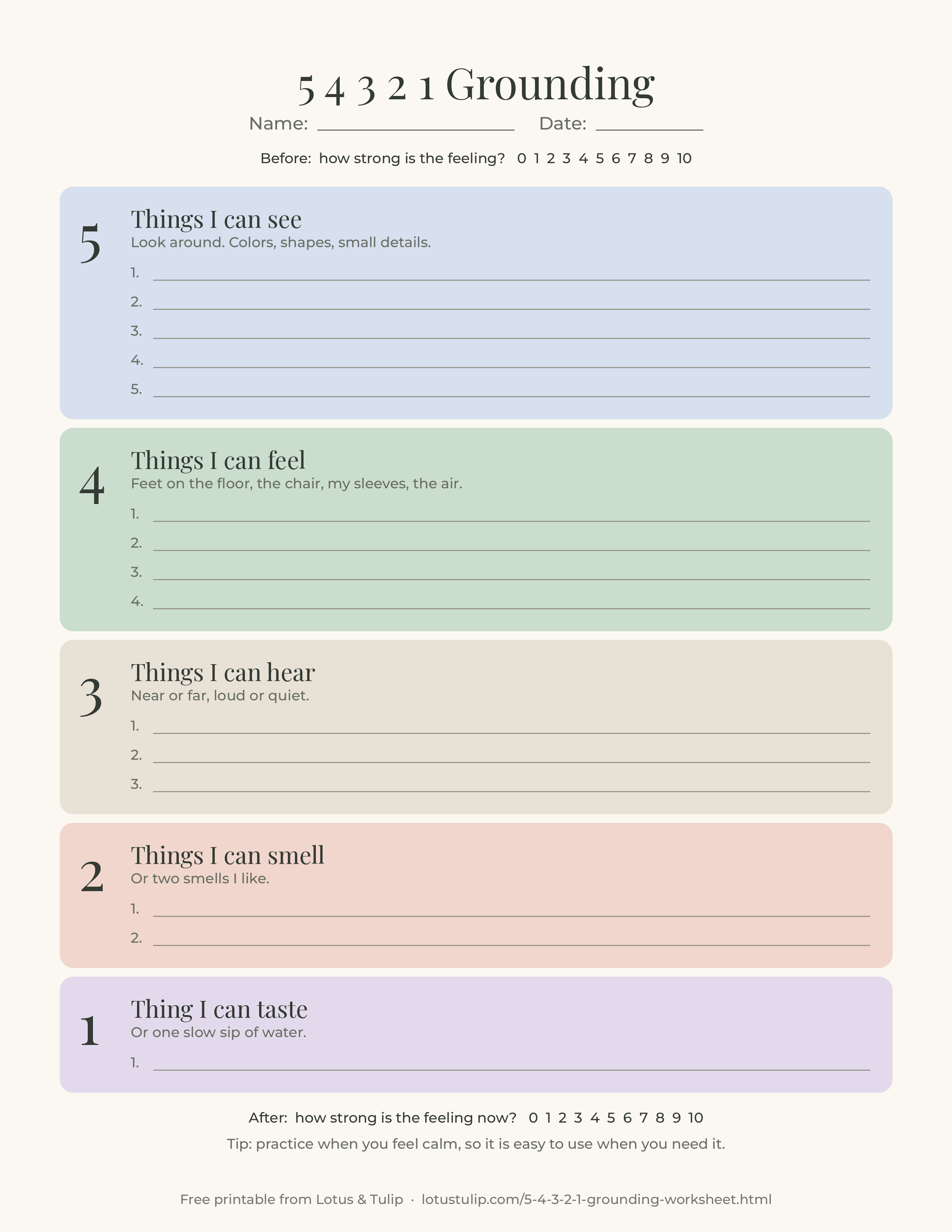
Download the free grounding worksheet (PNG, US Letter)
Free anxiety starter pack: The free anxiety worksheets starter pack includes a 5, 4, 3, 2, 1 grounding page with before and after ratings, plus the anxiety cycle, a worry log, probability and catastrophe, a fear ladder and a support and safety page from our paid anxiety set.
Free trauma starter pack: Working with trauma? The free trauma worksheets for therapists starter pack includes a 5 senses grounding page with before and after ratings and an orienting line, plus a grounding toolkit, a window of tolerance page, a trigger map and a coping plan for hard moments (8 pages, client use license, no email).
Related resources
- Panic attack worksheet: the panic cycle (free printable)
- Window of tolerance worksheet (free printable)
- Coping skills list for kids (free printable menu)
- CBT thought record worksheet (free printable)
- All therapist worksheets
FAQ
What is the 5 4 3 2 1 grounding technique?
A coping skill where you name 5 things you can see, 4 you can feel, 3 you can hear, 2 you can smell and 1 you can taste, to bring attention back to the present moment during anxiety or overwhelm.
Does 5 4 3 2 1 grounding work for panic attacks?
Many people find it helps them ride out the peak of a panic attack, especially when they have practiced it while calm. In strong panic, starting with feet on the floor and one slow exhale before counting can make it easier.
Can kids use the 5 4 3 2 1 technique?
Yes. Children often enjoy it as an "I spy" style game. For younger kids, a shorter 3 2 1 version or a printed hand with one sense per finger works well.
Is this grounding worksheet free?
Yes. The worksheet on this page is free to print for use with your own clients, students or yourself. Please link to this page rather than re-uploading the file.