
Therapist worksheets · Anxiety and panic · Updated 2026-11-12
Panic attack worksheet: map the panic cycle and log episodes (free printable)
Full set: Anxiety Worksheets for Therapists, 20 pages incl. the anxiety cycle, fear ladder, safety behaviors audit and box breathing Holiday 20% off: about $11.04, was $14 (EUR 12) · fillable PDF, instant digital download
Buy on EtsyTry it free first: download a fillable sample (worry log and fear ladder, PDF, 258 KB). Type into it on screen, then get the full pack. No email needed.
CBT set: CBT Worksheets for Therapists, 20 pages incl. a 7 column thought record, evidence for and against and an exposure ladder Holiday 20% off: about $11.04, was $14 (EUR 12) · fillable PDF, instant digital download
Buy on EtsyTry it free first: download a fillable sample (thought record and evidence for and against, PDF, 105 KB). Type into it on screen, then get the full pack. No email needed.
Mega bundle: Therapist Worksheets Mega Bundle (8 packs incl. anxiety, CBT, DBT, ACT, grief and ADHD) Holiday 20% off: about $35.88, was $45 (EUR 39) · fillable PDFs for all 8 packs plus 160 printable pages, instant digital download
Buy on EtsyA panic attack can feel like a medical emergency that came from nowhere. A good panic attack worksheet slows the episode down so the client can see what actually happened: what set it off, what the body did, what the person thought those sensations meant, and what they did to stay safe. This guide is for therapists, counselors and school mental health staff, and it is written so adults and older teens can follow it too. It covers the panic cycle from the cognitive model of panic, the DSM-5-TR difference between a panic attack and panic disorder, safety behaviors, interoceptive exposure, where breathing practice fits, and when symptoms need a medical check first. It ends with a free 2 page printable: a My Panic Cycle map and a Panic Episode Log.
Download the free panic attack worksheet (PDF, 2 pages, US Letter)
Direct download, no email or sign up. See the pages first.
Panic attack or panic disorder?
DSM-5-TR defines a panic attack as an abrupt surge of intense fear or intense discomfort that reaches a peak within minutes, during which four or more of 13 symptoms occur. The surge can start from a calm state or an already anxious one. The 13 symptoms are:
- Palpitations, pounding heart or a racing heart
- Sweating
- Trembling or shaking
- Sensations of shortness of breath or smothering
- Feelings of choking
- Chest pain or discomfort
- Nausea or abdominal distress
- Feeling dizzy, unsteady, light headed or faint
- Chills or heat sensations
- Numbness or tingling (paresthesias)
- Feelings of unreality or of being detached from oneself (derealization or depersonalization)
- Fear of losing control or "going crazy"
- Fear of dying
A panic attack is not a diagnosis on its own. Panic attacks can happen in many conditions, including social anxiety, specific phobia, PTSD and depression, and DSM-5-TR lets clinicians note them with a "with panic attacks" specifier. Panic disorder requires recurrent unexpected panic attacks, and at least one attack followed by a month or more of persistent worry about more attacks or their consequences (a heart attack, losing control), a significant change in behavior to avoid attacks (skipping exercise, avoiding unfamiliar places), or both. The attacks must not be caused by a substance or another medical condition, and must not be better explained by another mental disorder.
Panic is common. Based on National Comorbidity Survey Replication data, NIMH estimates that 2.7% of US adults had panic disorder in the past year (3.8% of women and 1.6% of men) and 4.7% at some point in their lives. Among US adolescents aged 13 to 18, the lifetime estimate is 2.3%.
The panic cycle: the cognitive model in plain words
In 1986 David M. Clark published "A cognitive approach to panic" in Behaviour Research and Therapy. His proposal: panic attacks result from the catastrophic misinterpretation of certain bodily sensations, mostly the normal sensations of anxiety, read as far more dangerous than they really are. His own example is perceiving palpitations as evidence of an impending heart attack. The model works as a loop:
- Trigger. Something inside or outside the person: a crowded store, a thought, a skipped heartbeat, a strong coffee.
- Perceived threat. If the trigger is seen as a threat, a state of mild apprehension follows.
- Apprehension. Anxiety rises, and with it attention to the body.
- Body sensations. Anxiety produces real sensations: a faster heart, tight chest, light headedness, tingling.
- Catastrophic misinterpretation. The sensations are read as proof of danger ("I'm having a heart attack", "I'm going to faint", "I'm losing my mind"). That raises the sense of threat, which produces more sensations, and the loop spins faster.
The model also explains attacks that seem to come out of the blue. Clark suggested that in these cases the trigger is often a body sensation caused by something else, such as caffeine or a different emotion, which the person notices and misreads without connecting it to its everyday cause. Clients often find this the most useful idea of all, because it turns "it just happens to me" into a sequence they can learn to see.
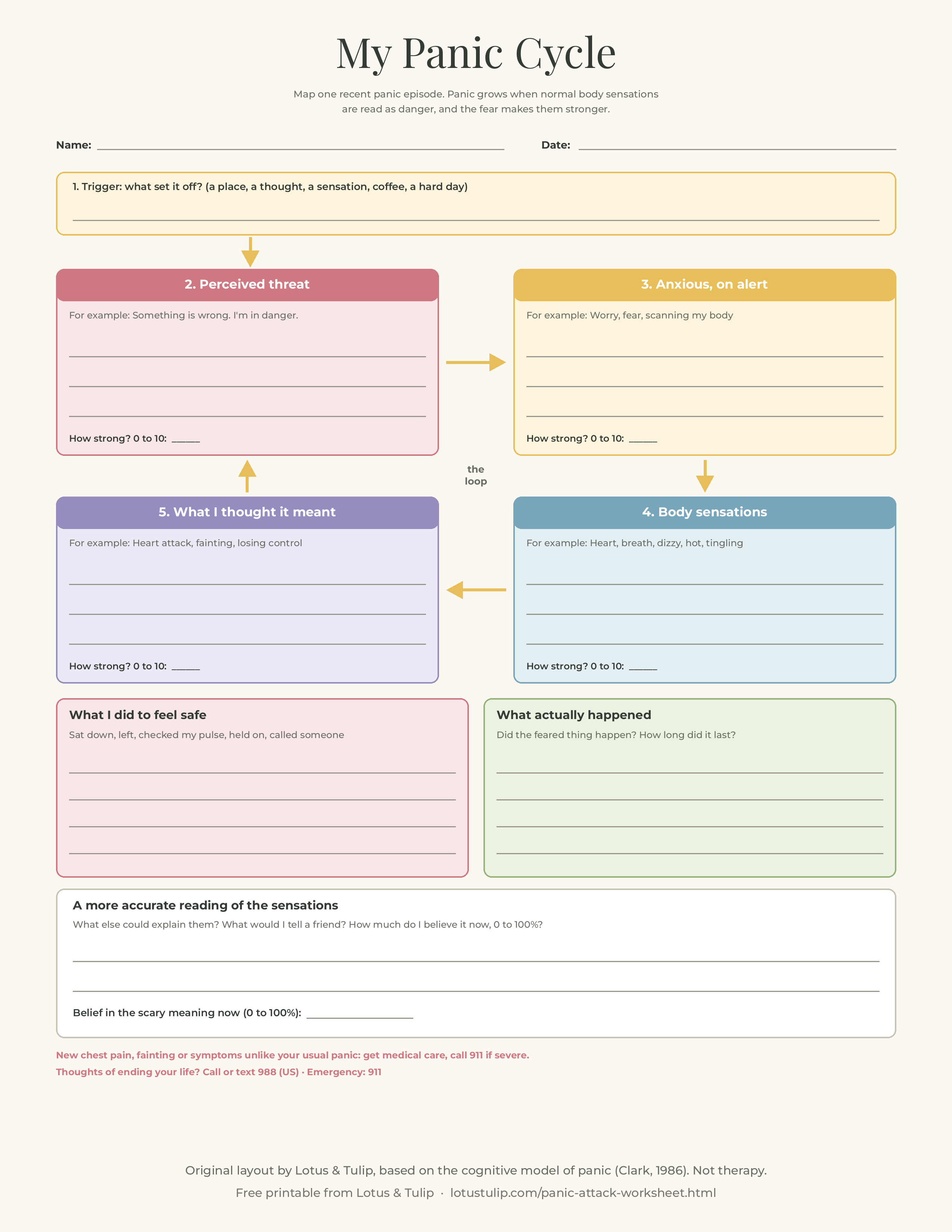
Page 1 of the free printable, My Panic Cycle, lays the loop out as five boxes with arrows, so the client can fill it in from one recent episode.
Safety behaviors: why relief keeps panic going
During and after attacks, most people develop ways to stay safe: sitting down, holding onto something, checking their pulse, leaving, breathing into a bag, carrying water or medication "just in case", or never going out alone. Cognitive theory predicts that these behaviors keep the fear alive, because the person concludes that the catastrophe did not happen because of the safety behavior, not because it was never going to happen.
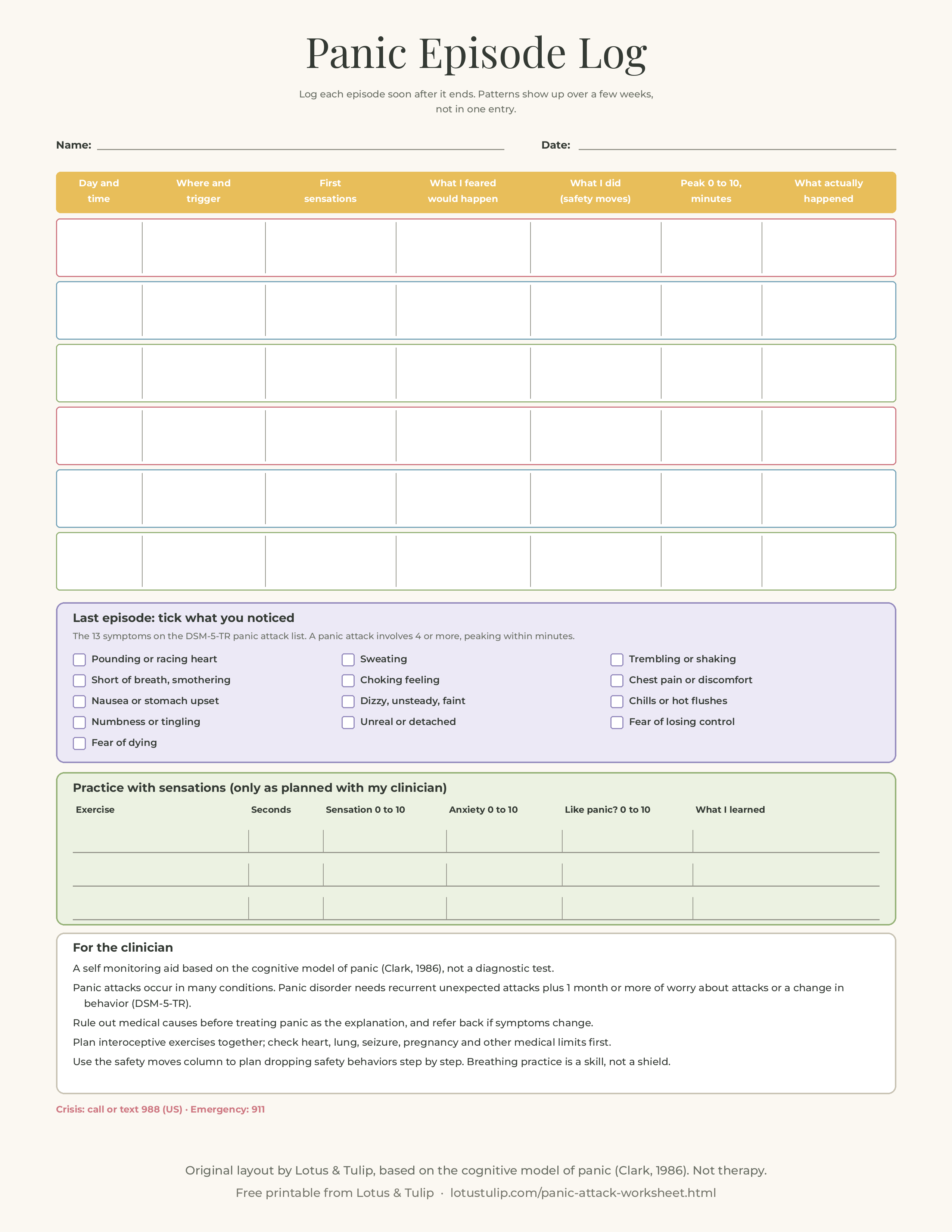
Salkovskis, Clark, Hackmann, Wells and Gelder tested this in 1999 with patients who had panic disorder with agoraphobia. After a short (15 minute) exposure to a feared situation, patients who had been encouraged to drop their safety behaviors showed a significantly greater decrease in catastrophic beliefs and anxiety on a repeat behavior test within two days than patients who kept them. The "What I did to feel safe" box on page 1 and the "What I did (safety moves)" column on page 2 are there to make these behaviors visible, so they can be dropped gradually and on purpose.
Interoceptive exposure basics
If the core fear is of body sensations, exposure needs to include the sensations themselves. Interoceptive exposure uses brief, deliberate exercises to bring on panic like sensations in a safe setting, so the client can learn that they are uncomfortable but not dangerous. It was part of early behavioral treatment for panic (Barlow, Craske, Cerny and Klosko, 1989), which used over breathing and spinning among other methods.
Common exercises include voluntary over breathing, breathing through a narrow straw, breath holding, spinning in a chair, shaking the head, and running in place. In a descriptive study of patients completing CBT for panic disorder, Schmidt and Trakowski (2004) found that four exercises (hyperventilation, breathing through a narrow straw, breath holding and spinning) accounted for most interoceptive exposure sessions, patients completed about 25 such sessions on average, and most sessions led to anxiety going down within the session. In standard protocols, the client rates the intensity of the sensations, their anxiety and how similar the sensations feel to panic, and the exercises that feel most like panic are practiced first in session, then at home.
Two practical points matter. First, the aim is to learn something new, not just to sit until anxiety fades. Craske and colleagues (2014) describe exposure in terms of inhibitory learning: designing practice so the feared outcome is clearly tested and does not happen. So it helps to write down the prediction before an exercise ("I will faint if I spin for 30 seconds") and check it afterward. Second, screen first. Exercises such as over breathing or running are not right for everyone; check with the client's medical provider about heart, lung, seizure, pregnancy and other conditions before planning them. The sensation practice table on page 2 is only for exercises planned with a clinician.
Interoceptive exposure usually sits inside a full CBT package with psychoeducation, cognitive work and exposure to avoided situations. In the UK, NICE guideline CG113 recommends CBT for panic disorder in the optimal range of 7 to 14 hours in total, usually as weekly sessions completed within 4 months.
Paced breathing: a skill, not a shield
Breathing exercises are the most familiar panic tool, and they can help a person ride out a wave of sensations. The evidence calls for some care, though. In a controlled study, Schmidt and colleagues (2000) randomly assigned 77 patients with panic disorder to CBT with or without breathing retraining, or to a delayed treatment group. Outcomes for the two active treatments were generally equivalent, and some data suggested a poorer outcome when breathing retraining was added. The authors questioned whether it adds any benefit on top of the other CBT components.
A sensible way to present it: slow, paced breathing is a skill for staying in a situation and noticing that the wave passes. It becomes a problem when it turns into a safety behavior, used rigidly with the belief "if I don't breathe right, I will pass out". A useful question for clients is: "Am I breathing slowly to stay with this, or to stop something terrible from happening?" If it is the second, it belongs on the list of safety behaviors to drop.
When to get a medical evaluation first
Panic sensations overlap with real medical problems, so panic should not be assumed just because someone is anxious. A 2022 American Family Physician review lists conditions that panic symptoms can suggest, including hyperthyroidism, arrhythmias, asthma and COPD, as well as some medications and substance use or withdrawal (for example caffeine, alcohol, cocaine and amphetamines). Practical guidance for clients and clinicians:
- A first episode, or symptoms that are new or different from usual, should be checked by a medical provider.
- Call 911 for chest discomfort (pressure, squeezing, fullness or pain) that lasts more than a few minutes or goes away and comes back, especially with shortness of breath, a cold sweat, nausea or light headedness. These are American Heart Association heart attack warning signs. Do not drive yourself.
- Fainting, chest pain during exercise, attacks that happen only at night or attacks without any fear deserve a medical review, not only a worksheet. The AAFP review notes that nocturnal attacks and attacks without fear call for a more extensive workup, although both also occur in panic disorder.
- Once a medical cause has been ruled out, the worksheet is about learning that sensations are not dangerous. Repeated checking at the ER or with a heart rate app can itself become a safety behavior; discuss this openly with the client and their doctor.
Anyone having thoughts of ending their life can call or text 988 (the Suicide and Crisis Lifeline) in the US. In an emergency, call 911. Both numbers are printed on the worksheet.
How to use the panic attack worksheet, step by step
- Check medical and safety basics. Confirm that a medical cause has been considered, ask about substances and caffeine, and screen for suicidal thoughts before starting formulation work.
- Pick one recent episode. Choose an attack from the last week or two that the client remembers well. A specific episode works much better than "my panic in general".
- Fill in the trigger. On page 1, write what came just before: a place, a thought, a sensation, a cup of coffee, a stressful call. "I don't know" is fine; it often becomes clear later.
- Work around the loop. Complete perceived threat, anxious and on alert, body sensations and what I thought it meant, with a 0 to 10 strength rating for each. Point out how each box feeds the next.
- Name the safety moves. List everything the client did to feel safe or stop the attack, then ask: "What do you think would have happened if you had not done that?"
- Compare prediction and outcome. In "What actually happened", note whether the feared catastrophe occurred and how long the peak lasted. Many clients notice the same fear has failed to come true many times.
- Build a more accurate reading. Write an alternative explanation for the sensations and rate belief in the scary meaning again, 0 to 100%. Do not argue the client out of it; let the evidence and later experiments do the work.
- Send the log home. Page 2 asks for a short entry after each episode, plus a tick list of the 13 DSM-5-TR symptoms for the latest one. Blank weeks are useful data too.
- Plan experiments. Use the log to plan dropping one safety behavior at a time and, where suitable, interoceptive exercises in session, recorded in the sensation practice table.
Using it with teens
Panic is not only an adult problem: NIMH's lifetime estimate for panic disorder rises from 1.8% at ages 13 to 14 to 3.3% at ages 17 to 18. Teens tend to describe attacks in terms of school, sports, social situations and their phones. The same loop works with simpler words: "body alarm", "what my brain said it meant", "what I did". Practical points: involve a parent or caregiver in safety planning and medical checks; agree on what the teen can do at school (for example a pass to the counselor's office) without that becoming a permanent escape route; and watch for avoidance that spreads to classes, gym or rides. For younger children, use a simpler body clues and brave steps approach, such as the pages in our anxiety worksheets for kids.
Three short examples
| Client (illustrative) | What the cycle showed | Next experiment |
|---|---|---|
| Office manager, 34, attacks in grocery stores | Warm store, light headed, "I'm going to faint", grips the cart and leaves | Stay in the store 10 more minutes without holding the cart; rate belief in fainting before and after |
| Graduate student, 26, after an ER visit with a normal workup | Skipped beat after coffee, "my heart is failing", checks pulse every few minutes | Agreed with her doctor: running in place in session, then a week with no pulse checks, logged on page 2 |
| High school junior, 16, attacks before swim meets | Fast heart and tight chest at the pool, "I can't breathe, I'll drown", asks to sit out | Straw breathing in session with a parent present, then staying at warm up for one meet |
Common mistakes
- Skipping the medical question. Formulation is not a substitute for ruling out a physical cause, especially for a first or changed episode.
- Treating every attack as panic disorder. Ask whether attacks are unexpected or tied to a specific fear such as social evaluation, a phobia or trauma reminders, which points to a different focus.
- Teaching breathing as the main fix. It can quietly become the safety behavior that keeps the fear going.
- Arguing with the catastrophic thought. Verbal reassurance rarely sticks. Experiments that test the prediction carry more weight.
- Doing interoceptive exposure without a plan. Screen medically, start in session, agree on stop rules, and write the prediction first.
- Logging without reviewing. Go through the log every session; the patterns are where the treatment ideas come from.
Free panic attack worksheet
This free printable is an original Lotus & Tulip layout on US Letter. Page 1, My Panic Cycle, maps one episode through trigger, perceived threat, anxious and on alert, body sensations and what I thought it meant, with arrows showing the loop and a 0 to 10 strength rating in each box, then "What I did to feel safe", "What actually happened" and a more accurate reading with a 0 to 100% belief rating. Page 2, Panic Episode Log, has six rows for day and time, trigger, first sensations, feared outcome, safety moves, peak and minutes, and what happened, a tick list of the 13 DSM-5-TR symptoms, a sensation practice table for planned interoceptive exercises, and short clinician notes. Both pages show 988 and 911, and page 1 includes a reminder to get medical care for new chest pain or fainting.
Download the free panic attack worksheet (PDF, 2 pages, US Letter)
Prefer single images? Page 1: my panic cycle (PNG) · Page 2: panic episode log (PNG)
Free to print for use with your own clients or for personal use. Please link to this page rather than re-uploading the file. An original layout based on published research (Clark 1986; Salkovskis et al. 1999). Not affiliated with or endorsed by the authors or any organization named here. A self monitoring aid, not a diagnostic tool or a substitute for medical or clinical care.
Related resources
- Free anxiety worksheets for therapists: 8 page starter pack
- Anxiety worksheets for adults (free printable)
- Worry time worksheet (scheduled worry time, free printable)
- Health anxiety worksheet: when body sensations turn into fear of illness, checking and reassurance, free printable
- Exposure hierarchy worksheet (fear ladder)
- Behavioral experiment worksheet
- CBT thought record worksheet
- 5 4 3 2 1 grounding worksheet
- Anxiety activities for teens
- Safety plan worksheet
FAQ
What is a panic attack worksheet?
It is a structured page for breaking a panic attack into parts: the trigger, the sense of threat, body sensations, what the person thought the sensations meant and what they did to feel safe. Mapping and logging episodes is a standard first step in cognitive behavioral therapy for panic.
What is the panic cycle?
It is the loop described in David Clark's 1986 cognitive model of panic. A trigger is seen as a threat, which causes anxiety and body sensations. The sensations are misread as signs of a catastrophe such as a heart attack, which increases the threat and the sensations, so the attack builds.
How long does a panic attack last?
DSM-5-TR describes a panic attack as an abrupt surge of intense fear or discomfort that reaches a peak within minutes. The log on page 2 asks for peak intensity and minutes so clients can see their own pattern, which is often shorter than it feels.
What is the difference between a panic attack and panic disorder?
A panic attack is a sudden surge of fear with at least four of 13 listed symptoms. It can occur in many conditions. Panic disorder means recurrent unexpected attacks, with at least one followed by a month or more of persistent worry about more attacks or a significant change in behavior to avoid them, not explained by a substance, medical condition or another disorder.
What is interoceptive exposure?
It is a CBT technique that uses brief exercises such as over breathing, straw breathing or spinning to bring on panic like sensations in a planned way, so the person learns the sensations are not dangerous. It should be planned with a clinician after a medical check.
Is this panic attack worksheet free?
Yes. It is free to print for use with your own clients or for personal use. Please link to this page rather than re-uploading the file.
Sources
- Clark, D. M. (1986). A cognitive approach to panic. Behaviour Research and Therapy, 24(4), 461 to 470.
- Salkovskis, P. M., Clark, D. M., Hackmann, A., Wells, A., and Gelder, M. G. (1999). An experimental investigation of the role of safety-seeking behaviours in the maintenance of panic disorder with agoraphobia. Behaviour Research and Therapy, 37(6), 559 to 574.
- American Psychiatric Association (2022). Diagnostic and Statistical Manual of Mental Disorders, 5th edition, text revision (DSM-5-TR): panic attack specifier and panic disorder.
- National Institute of Mental Health. Panic disorder statistics (National Comorbidity Survey Replication and Adolescent Supplement data).
- Barlow, D. H., Craske, M. G., Cerny, J. A., and Klosko, J. S. (1989). Behavioral treatment of panic disorder. Behavior Therapy, 20(2), 261 to 282.
- Schmidt, N. B., and Trakowski, J. (2004). Interoceptive assessment and exposure in panic disorder: A descriptive study. Cognitive and Behavioral Practice, 11(1), 81 to 92.
- Craske, M. G., Treanor, M., Conway, C. C., Zbozinek, T., and Vervliet, B. (2014). Maximizing exposure therapy: An inhibitory learning approach. Behaviour Research and Therapy, 58, 10 to 23.
- Schmidt, N. B., Woolaway-Bickel, K., Trakowski, J., Santiago, H., Storey, J., Koselka, M., and Cook, J. (2000). Dismantling cognitive-behavioral treatment for panic disorder: Questioning the utility of breathing retraining. Journal of Consulting and Clinical Psychology, 68(3), 417 to 424.
- DeGeorge, K. C., Grover, M., and Streeter, G. S. (2022). Generalized anxiety disorder and panic disorder in adults. American Family Physician, 106(2), 157 to 164.
- American Heart Association. Warning signs of a heart attack.
- National Institute for Health and Care Excellence (2011, updated 2020). Generalised anxiety disorder and panic disorder in adults: management (CG113).