
Kids and teens · Updated 2026-11-02
Anger iceberg worksheet: how to use it with kids, teens and adults (free printable)
Ready-made printable: Anger Management Worksheets for Kids and Teens Holiday 20% off: about $9.20, was $12 (EUR 10) · instant digital download
Buy on Etsy
The anger iceberg is a simple picture that changes how people talk about anger. Above the water is the part everyone can see: the yelling, the slammed door, the shutdown, the "I don't care". Under the water, much bigger, are the feelings that anger often sits on top of: hurt, embarrassment, worry, exhaustion, feeling left out. When a child, teen or adult learns to look under the water, the conversation shifts from "stop being angry" to "what is going on underneath?" This guide explains where the anger iceberg comes from, how to introduce it, scripts you can borrow, adaptations for different ages and for groups, and the mistakes that make it backfire. It ends with a free anger iceberg worksheet you can print on US Letter paper.
This is educational information for therapists, school counselors, teachers and parents, not a substitute for clinical training, supervision or care. If anger involves violence, threats or self harm, get professional help. In the US, anyone in crisis can call or text 988, the Suicide and Crisis Lifeline, or call 911 in an emergency.
Jump to the free anger iceberg worksheet
What the anger iceberg is
The anger iceberg compares anger to an iceberg floating in the ocean. Most of an iceberg is hidden below the surface. In the same way, the anger we can see is often only the visible tip, and other feelings sit below it, harder to see and harder to say out loud.
The version most counselors know was popularized by The Gottman Institute, the relationship research and training organization founded by John and Julie Gottman. In the article "The Anger Iceberg" on the Gottman Relationship Blog, author Kyle Benson describes anger as a valid emotion in its own right that can also act as a protector of rawer feelings underneath, such as embarrassment, loneliness, exhaustion or fear. The Gottman Institute also shares its own illustrated iceberg. The idea is used widely now in couples work, family therapy, school counseling and anger management groups, and many different versions circulate, including the free kid friendly one on this page.
A useful framing for clients: anger is not a "bad" feeling and the goal is not to get rid of it. Anger often carries important information, such as "something feels unfair" or "I need a boundary". The iceberg simply adds a second question: is there anything else here too?
Why it helps
- It lowers shame. Kids who are always "the angry one" often hear only that they are a problem. The iceberg says: your anger makes sense, and there is more to you than the tip.
- It points to the real need. "Mad" calls for space. "Embarrassed" calls for privacy and repair. "Left out" calls for connection. "Tired" or "hungry" calls for rest and a snack. Naming the feeling underneath helps choose the right next step.
- It changes how adults respond. Parents, teachers and partners who think "what is under this?" tend to get curious instead of escalating.
- It builds feeling vocabulary. Many kids have only a few words for big feelings. The words under the water give them more to choose from, much like a feelings wheel.
How to introduce it
- Teach it when everyone is calm. The middle of a meltdown is the worst time to learn a new tool. Introduce the iceberg in a quiet session, using a past situation or a story character.
- Start with a real iceberg. Ask: "How much of an iceberg do you think is under the water?" Most of it. Then: "Sometimes anger works like that."
- Use a low stakes example first. A character in a book or show, or a made up kid: "Sam threw his pencil when he got a math problem wrong. What might Sam have been feeling under the anger?"
- Then try a recent moment of their own. Write what people saw at the top, then circle the feelings underneath that fit.
- Finish with the need and a next step. "What did you need right then? What could you try next time?"
Scripts you can borrow
With a young child: "Your body got really mad when your tower fell. I wonder if there was a sad or frustrated feeling under the mad, too. Let's look at our iceberg and see."
With a teen: "Anger is the part everyone saw in class. I'm curious about the part under the water. Was there anything like embarrassed, stressed or not listened to in there? You don't have to share it with me, but it's worth noticing."
With an adult or couple: "When you raised your voice, what was the feeling just before it? If we look under the water, what would we find?"
For parents: "Next time your child explodes, try saying to yourself, 'this is the tip.' Get everyone safe first, then later, when things are calm, get curious about what's underneath."
Adaptations by age and setting
- Preschool and early elementary: Use fewer words (hurt, scared, sad, tired, left out) and let the child point or color instead of writing. Act out the iceberg with a blue blanket as water and a paper iceberg.
- Upper elementary: The full worksheet works well. Add "where did I feel it in my body?" to connect feelings to body signals.
- Teens: Teens often respond better to examples from shows, sports or social media than to their own moments at first. Words like overwhelmed, disrespected, pressured and ignored often land better than "kid" words.
- Adults and couples: Use it to slow down conflict: each person names one feeling under their anger before discussing the issue.
- Neurodivergent kids and kids with limited language: Pair each word with a face or picture, offer two choices at a time ("tired or worried?"), and keep the page short.
Group activities
- Iceberg sort: Write feelings on slips of paper. Group members sort them into "above the water" (what people see, like yelling, eye rolling, going quiet) and "under the water" (what might be underneath).
- Character icebergs: Read a short story or watch a clip, then fill in an iceberg for the character together.
- Same tip, different iceberg: Show one behavior, like slamming a locker, and have each member suggest a different feeling that could be underneath. It teaches that we can't know what is under someone else's anger without asking.
- Need match: For each feeling under the water, brainstorm what would actually help (rest, a hug, space, an apology, a snack, a plan).
Common mistakes
- Using it to dismiss anger. "You're not really angry, you're just sad" can feel invalidating. The point is "and", not "instead": anger is real, and there may be more.
- Teaching it mid explosion. During a big moment, focus on safety and calming down. Do the iceberg later.
- Guessing for the child. Offer options, but let them choose. Their answer may surprise you.
- Stopping at the feeling. The most useful part is often the last step: what was needed, and what to try next time.
- Using it to excuse harm. Understanding why someone was angry does not make hurting people or property okay. Both can be true.
Free anger iceberg worksheet (US Letter)
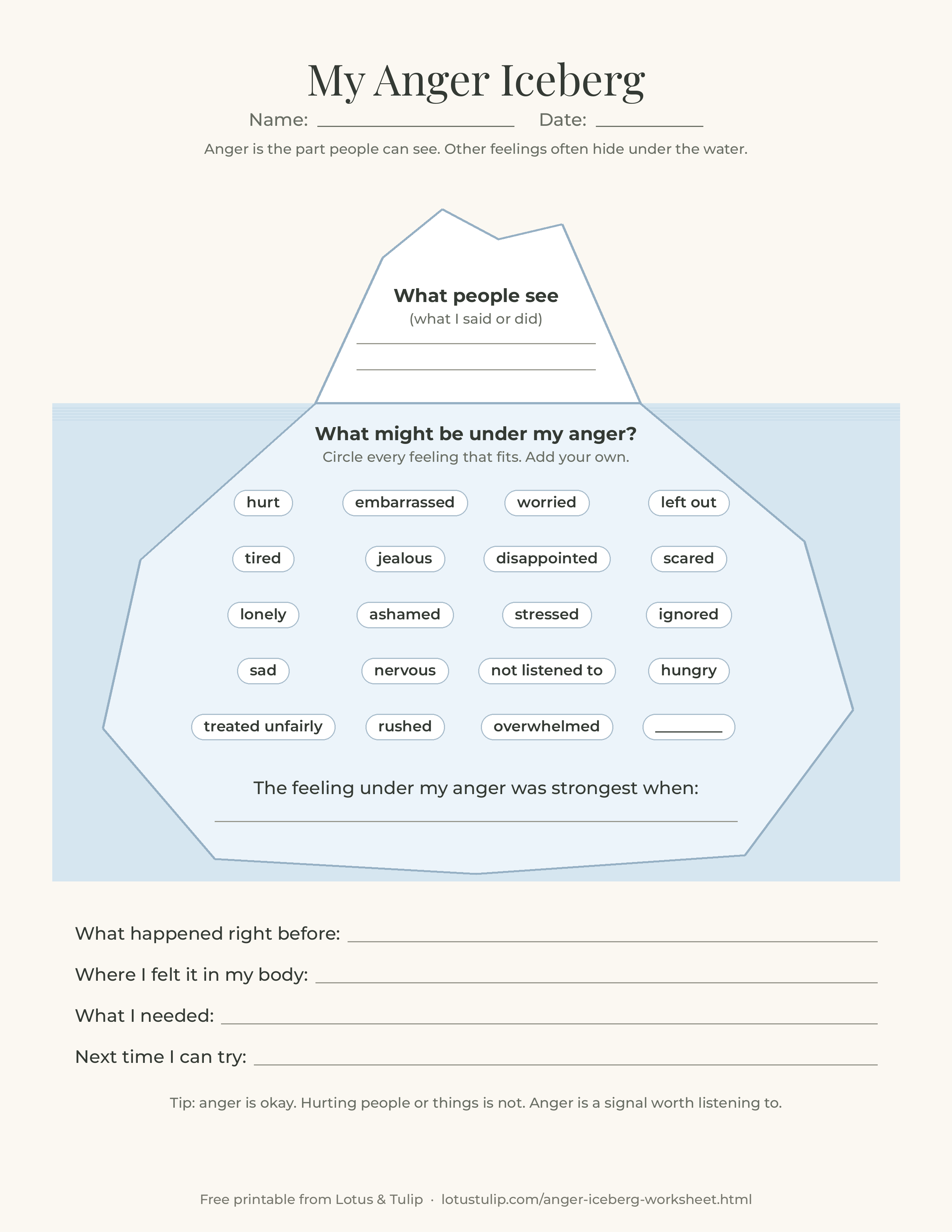
This free worksheet has an iceberg with space at the top for "what people see", 19 feeling words under the water to circle plus a blank for their own, and short prompts: what happened right before, where I felt it in my body, what I needed, and what I can try next time. It is designed for kids and young teens and works for individual sessions, small groups, classrooms and home.
Download the free anger iceberg worksheet (PNG, US Letter, 300 dpi)
Free anger management starter pack: The free anger management worksheets starter pack includes the anger iceberg page from our paid anger set for kids and teens, plus an anger thermometer, stop, think, choose, a cool-off menu, a cool-down plan and a support and safety page.
Related resources
- Anger management worksheets for adults: a free anger log and anger plan for adults
- Feelings wheel printable for kids (free)
- Coping skills list for kids (free printable menu)
- 5 4 3 2 1 grounding worksheet (free printable)
- Coping skills cards for kids and teens
- All kids and teens counseling resources
FAQ
What is the anger iceberg?
The anger iceberg is a visual that compares anger to an iceberg: the anger people can see is the tip above the water, and other feelings such as hurt, embarrassment, fear, loneliness or exhaustion can be hidden underneath.
Who created the anger iceberg?
The best known version was popularized by The Gottman Institute, in the article "The Anger Iceberg" by Kyle Benson on the Gottman Relationship Blog, along with the institute's own illustrated iceberg. Many counselors now use their own versions.
Is anger a secondary emotion?
Anger is often described as a secondary emotion because it can protect or cover other feelings. It is also a valid emotion on its own. The iceberg works best when it adds curiosity about other feelings without dismissing the anger.
What age is the anger iceberg worksheet for?
This free worksheet is designed for kids from about age 7 and young teens. Younger children can point to or color a few simple words with an adult. Teens and adults can use the same idea with more detailed words.
Is this anger iceberg worksheet free?
Yes. It is free to print for use with your own clients, students, children or yourself. Please link to this page rather than re-uploading the file.