
Therapist worksheets · Anger management for adults · Updated 2026-11-13
Anger management worksheets for adults: what anger is, what research shows works, and how to notice it early, cool down and say what you need (free printable)
Emotion regulation and distress tolerance skills: DBT Worksheets for Therapists, skills handouts for adult clients across all four DBT skill areas Holiday 20% off: about $11.04, was $14 (EUR 12) · fillable PDF, instant digital download
Buy on EtsyTry it free first: download a fillable sample (weekly diary card and checking the facts, PDF, 234 KB). Type into it on screen, then get the full pack. No email needed.
The thoughts that fuel anger: CBT Worksheets for Therapists, 20 pages including thought records and behavioral experiments Holiday 20% off: about $11.04, was $14 (EUR 12) · fillable PDF, instant digital download
Buy on EtsyTry it free first: download a fillable sample (thought record and evidence for and against, PDF, 105 KB). Type into it on screen, then get the full pack. No email needed.
A full caseload: Therapist Worksheets Mega Bundle (8 packs incl. CBT, anxiety, DBT, ACT, grief and ADHD) Holiday 20% off: about $35.88, was $45 (EUR 39) · fillable PDFs for all 8 packs plus 160 printable pages, instant digital download
Buy on EtsyYou snapped at your partner over the dishes, sent an email you regret, or sat in traffic gripping the wheel with your heart pounding. Afterwards the anger fades and the cost stays: a hurt look, a tense office, a promise to yourself that next time will be different. Telling yourself to "just calm down" rarely works in the moment. A plan made in advance does.
This guide is for adults who want to handle anger better and for the therapists, counselors and coaches who work with them. It explains what anger is, what research shows actually helps (and the popular idea that does not), nine practical steps, common mistakes and examples. It ends with a free 2 page printable: My Anger Map, an anger log for spotting your triggers, hot thoughts and early warning signs, and My Anger Plan, which covers a time out plan, a cool down menu, cooler thoughts and how to say what you need.
Download the free anger management worksheets (PDF, 2 pages, US Letter)
Direct download, no email or sign up. See the pages first.
What anger is
Anger is a normal emotion, not a disorder. It shows up when we feel wronged, blocked, threatened or treated unfairly, and it can be useful: it tells us something matters and gives us energy to act. The problem is not feeling angry. It is anger that comes too often, too strongly, lasts too long or turns into shouting, threats, aggression or long silences that damage relationships, work and health.
Anger has parts you can work with. The psychologist Raymond Novaco built one of the first cognitive behavioral anger programs in the 1970s (Anger Control, 1975), adapting stress inoculation training. Most modern anger management still works on the same parts: the trigger (what happened), the thoughts about it ("he did that on purpose", "she doesn't respect me"), the body arousal (heart rate, heat, muscle tension) and the behavior that follows. Change any one of them and the whole chain gets weaker.
Anger often sits on top of other feelings. Under a lot of anger is hurt, embarrassment, fear, feeling ignored or simply being exhausted or hungry. Naming that feeling gives you more options than anger alone. The anger iceberg worksheet explores this idea in more depth.
What the research says helps
- Cognitive behavioral anger management works. Beck and Fernandez (1998) pooled 50 studies with 1,640 participants and found a weighted mean effect size of 0.70: the average person who received cognitive behavioral therapy for anger did better than 76 percent of people who did not. Many of those studies involved groups such as abusive parents and spouses, inmates, juvenile offenders and aggressive school children rather than everyday adults, so the result is broad rather than specific.
- It also works for ordinary adults with anger problems. DiGiuseppe and Tafrate (2003) reviewed 57 studies of adult anger treatment covering 92 interventions and 1,841 adults. People who received treatment improved moderately compared with untreated people, with less angry feeling, less aggressive behavior and more positive behavior, and the gains held at follow up. Del Vecchio and O'Leary (2004) included only adults living in the community whose anger was high on standardized measures. Across 23 controlled studies they found medium to large effects. Cognitive approaches did especially well for driving anger, held in anger and a general tendency to get angry, while relaxation did best for anger in the moment.
- Venting makes it worse. The old idea that you should "let it out" by hitting a pillow or a punching bag does not hold up. In a well known experiment, Bushman (2002) angered participants and then had some hit a punching bag while thinking about the person who angered them. That group felt angrier and acted more aggressively afterwards than people who hit the bag while thinking about fitness, or who did nothing at all. Doing nothing worked better than venting.
- Chronic anger is linked with heart health. In a meta-analysis of prospective studies, Chida and Steptoe (2009) found that anger and hostility were associated with a 19 percent higher risk of coronary heart disease in initially healthy people and a 24 percent higher risk of a poorer outcome in people who already had heart disease. These studies show an association, not proof that anger causes heart disease, but they are one more reason to take long running anger seriously.
Put together: track what sets your anger off and what you tell yourself, catch the body's early warning signs, step away before you act, calm your body instead of venting, check the hot thought for a fairer one, and come back to say what you need clearly. That is what the two pages below walk through.
How to use anger management worksheets, step by step
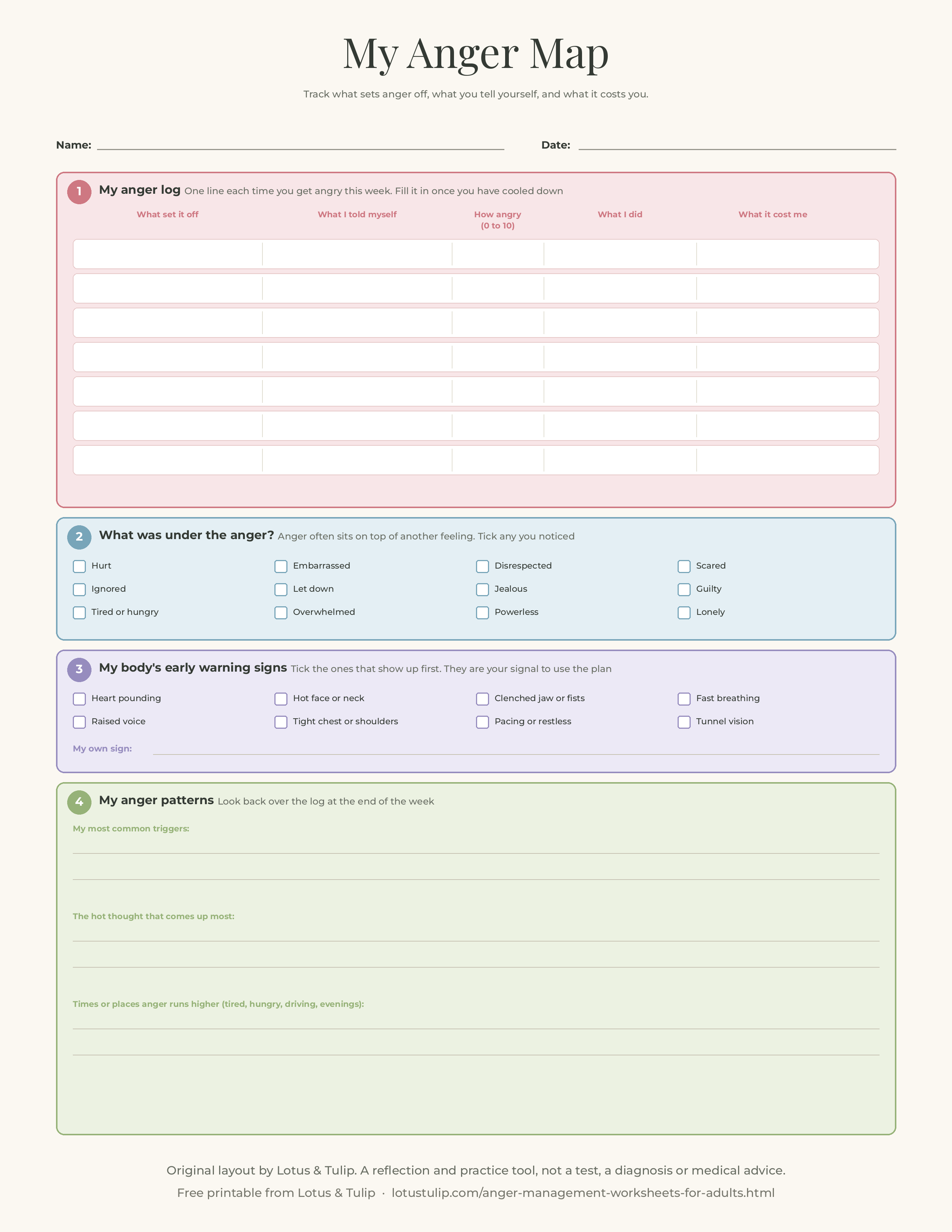
- Log every anger episode for a week. On page 1, write one line each time you get angry, once you have cooled down: what set it off, what you told yourself, how angry you were from 0 to 10, what you did and what it cost you. Small episodes count too. Patterns hide in the everyday ones.
- Write the hot thought word for word. "He's doing this to annoy me" or "I always have to do everything" is more useful than "I was annoyed". Thoughts like these, with words such as always, never and should, are where cognitive work has the most to offer. The cognitive distortions worksheet lists the common thinking traps.
- Look under the anger. For each episode, tick the feelings that were also there: hurt, embarrassed, disrespected, scared, ignored, let down, tired or hungry, overwhelmed. Many people find that a large share of their anger arrives when they are exhausted, stressed or feel unheard.
- Learn your early warning signs. Tick the body signs that show up first, such as a hot face, clenched jaw, fast breathing or a raised voice. These come before you lose control, so they are your signal to use the plan. Pick a number too: "at a 6 out of 10 I step away".
- Find your patterns. At the end of the week, look back over the log. Write your most common triggers, the hot thought that comes up most and the times or places anger runs higher, such as evenings, driving or after work.
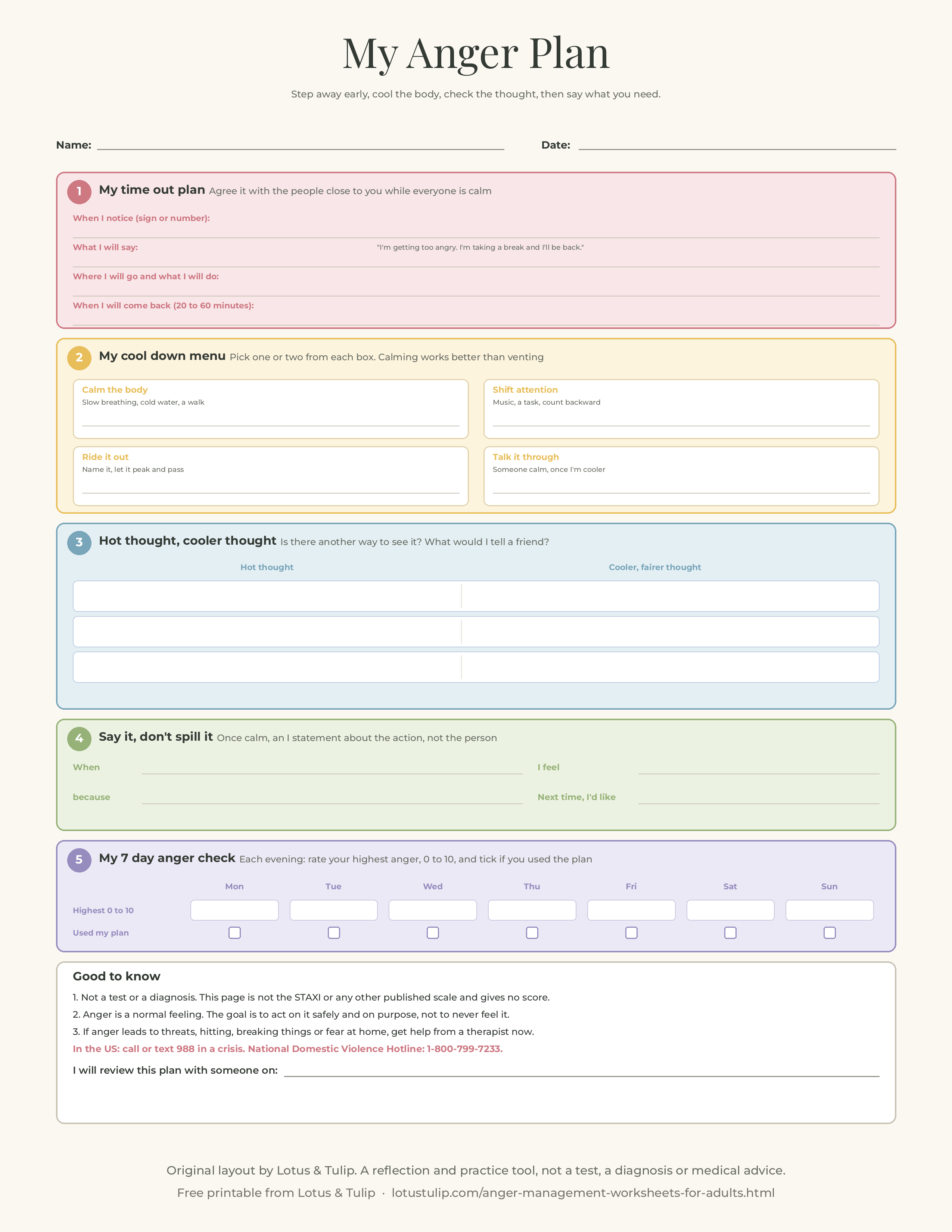
- Make a time out plan in advance. On page 2, decide what sign means "time out", the exact words you will say ("I'm getting too angry. I'm taking a break and I'll be back."), where you will go, what you will do and when you will come back, usually within 20 to 60 minutes. Agree it with the people close to you while everyone is calm, so a time out reads as care, not as storming off.
- Choose your cool down menu. Pick one or two ideas from each box: calm the body (slow breathing, cold water on your face, a brisk walk), shift attention (music, a practical task), ride it out (name the feeling and let it peak and pass) and talk it through with someone calm once you are cooler. Avoid hitting things or replaying the argument in your head, which keeps anger going. For very intense moments, the DBT TIPP skills worksheet and the DBT STOP skill worksheet give fast, body based options.
- Swap the hot thought for a cooler, fairer one. Write two or three hot thoughts from your log and, next to each, a thought that is more accurate and less inflaming. "He's doing this to annoy me" might become "He's distracted and forgot. It's annoying, and I can ask him to set a reminder." The goal is not to pretend you are fine. It is to see the situation fairly. The CBT thought record takes this further.
- Say what you need, then check in for a week. When you are calm, use the I statement lines: "When [the action], I feel [feeling] because [reason]. Next time, I'd like [request]." Talk about the action, not the person's character. Each evening, rate your highest anger from 0 to 10 and tick whether you used the plan. After a week, compare with your first log.
The I statements worksheet and assertiveness worksheet help with step 9, and the stress management worksheet helps when anger is mostly the overflow of a too full life.
Common mistakes
- Trying to never feel angry. Anger is a normal emotion and pushing it down usually means it comes out later, often at the wrong person. The aim is to notice it early and choose what you do with it.
- Venting to "get it out". Punching pillows, slamming doors or ranting about the person keeps your mind on the provocation and, as Bushman's experiment showed, tends to leave you angrier.
- Taking a time out without coming back. Walking away mid argument and then never returning to the topic feels like stonewalling to the other person. Say when you will be back, and come back.
- Talking it through while still hot. Hard conversations go better once your body has settled. If you are still at a 7 or above, you are not ready.
- Ignoring the basics. Poor sleep, hunger, alcohol and constant stress all lower your fuse. If your log shows anger clusters at certain times, fix the conditions as well as the reactions.
- Using a worksheet when the situation needs more. If anger leads to threats, hitting, breaking things or anyone at home feeling afraid, get professional help now. A worksheet is a tool, not a treatment.
Examples
- The commuter: His log showed five of seven episodes happened while driving, with the hot thought "these idiots do it on purpose". His early sign was gripping the wheel. He set a plan: at the first grip, slow breaths and a podcast, and a cooler thought, "most drivers are rushed or distracted, not out to get me". His evening ratings dropped from mostly 7s to mostly 4s over two weeks.
- The parent at bedtime: Her anger peaked between 7 and 8 pm. Under it she ticked tired, overwhelmed and ignored. She agreed a time out phrase with her partner, swapped who handled bedtime twice a week and started eating a proper snack at 5 pm. Shouting episodes went from almost nightly to once a week.
- The team lead: His log showed anger after meetings where he felt his ideas were dismissed, followed by sharp late night emails. He made a rule: no email above a 5, drafts wait until morning. With his therapist he practiced an I statement for his manager: "When my proposals are cut off in meetings, I feel sidelined because I've done the groundwork. I'd like two minutes to finish before we move on."
Free anger management worksheets for adults
This free printable is an original Lotus & Tulip layout on US Letter, in our own wording. It is not the State Trait Anger Expression Inventory (STAXI) or any other published questionnaire, and it does not give a score. Page 1, My Anger Map, has a 7 line anger log (what set it off, what I told myself, how angry from 0 to 10, what I did, what it cost me), a checklist of feelings under the anger, a checklist of body warning signs and space for your anger patterns. Page 2, My Anger Plan, has a time out plan, a cool down menu with four boxes, a hot thought to cooler thought table, I statement lines, a 7 day anger check and a review date.
Download the free anger management worksheets (PDF, 2 pages, US Letter)
Prefer single images? Page 1: my anger map (PNG) · Page 2: my anger plan (PNG)
Free to print for yourself or for use with your own clients or groups. Please link to this page rather than re-uploading the file. A reflection and practice tool, not a test, a diagnosis or a substitute for therapy. In the US, call or text 988 in a mental health crisis. If you are afraid of someone at home, or afraid you might hurt someone, the National Domestic Violence Hotline is 1-800-799-7233.
Related resources
- Forgiveness worksheet for adults: when the anger is about an old hurt that keeps replaying
- Emotion regulation worksheets for adults: an emotion log, five points to step in and a free 2 page PDF
- Anger iceberg worksheet: the feelings under the anger
- Anger management activities for teens: the teen version, with group activities
- DBT TIPP skills worksheet: fast ways to cool the body when anger spikes
- Opposite action worksheet: act against the urge when it does not fit the facts
- Rumination worksheet: when you keep replaying what happened
- Conflict resolution worksheet: working through a disagreement once everyone is calm
- All therapist worksheets: CBT, DBT, ACT and more
FAQ
What are anger management worksheets?
Anger management worksheets are structured pages that help you track what sets your anger off, the thoughts and body signs that come with it, and what it costs you, then plan a time out, calming strategies, fairer thoughts and a clear way to say what you need. This set has two pages: an anger map and an anger plan.
Does anger management actually work?
Yes, for most people. Beck and Fernandez (1998) found in 50 studies that the average person who received cognitive behavioral anger treatment did better than 76 percent of people who did not. Reviews of adult studies by DiGiuseppe and Tafrate (2003) and Del Vecchio and O'Leary (2004) found medium to large effects as well.
Is it good to let your anger out?
Not by venting. In Bushman's (2002) experiment, people who hit a punching bag while thinking about the person who angered them ended up angrier and more aggressive than people who did nothing. Calming the body first and then saying what you need clearly works better than letting it explode.
How long should an anger time out last?
Long enough for your body to settle, often 20 to 60 minutes. Agree the plan in advance, say when you will be back, use the time to calm down rather than replay the argument, and then return to the conversation.
Can I use these worksheets with clients?
Yes. Therapists, counselors and coaches can print them for their own clients or anger management groups. The anger log works well as homework between sessions. Please link to this page rather than re-uploading the file.
When is anger a reason to see a professional?
If anger leads to threats, hitting, breaking things or anyone feeling afraid, if it is damaging your relationships or work, or if you use alcohol or drugs to cope with it, talk to a doctor or therapist. If you are thinking about suicide, in the US call or text 988. If you are afraid of someone at home, call the National Domestic Violence Hotline at 1-800-799-7233.
Sources
- Beck, R., and Fernandez, E. (1998). Cognitive-behavioral therapy in the treatment of anger: A meta-analysis. Cognitive Therapy and Research, 22(1), 63 to 74.
- Bushman, B. J. (2002). Does venting anger feed or extinguish the flame? Catharsis, rumination, distraction, anger, and aggressive responding. Personality and Social Psychology Bulletin, 28(6), 724 to 731.
- Chida, Y., and Steptoe, A. (2009). The association of anger and hostility with future coronary heart disease: A meta-analytic review of prospective evidence. Journal of the American College of Cardiology, 53(11), 936 to 946.
- Del Vecchio, T., and O'Leary, K. D. (2004). Effectiveness of anger treatments for specific anger problems: A meta-analytic review. Clinical Psychology Review, 24(1), 15 to 34.
- DiGiuseppe, R., and Tafrate, R. C. (2003). Anger treatment for adults: A meta-analytic review. Clinical Psychology: Science and Practice, 10(1), 70 to 84.
- Novaco, R. W. (1975). Anger control: The development and evaluation of an experimental treatment. Lexington, MA: Lexington Books.