
Kids and teens · Updated 2026-11-02
Feelings wheel printable for kids: how to use it in sessions (free worksheet)
Ready-made printable: Kids Feelings and Social Skills Worksheets for Counselors and Therapists Fillable PDF, 20 pages: feelings thermometer, calm down plan, friendship skills check, kind words cards and more
Holiday 20% off: about $11.04, was $14 (EUR 12) · instant digital download
Try it free first: download a fillable sample (feelings thermometer and calm-down plan, PDF, 240 KB). Type into it on screen, then get the full pack. No email needed.

A feelings wheel is one of the most useful tools you can keep on the table in a counseling room. Many kids, and plenty of adults, arrive with only a handful of feeling words: good, bad, fine, mad. A wheel gives them more words to choose from, organized so the search is easy: start with the big feeling in the middle, then move outward to a more exact word. This guide explains where the feelings wheel comes from, how to use it with kids, teens and adults, simple scripts you can borrow, adaptations for young children and groups, and the mistakes that make it fall flat. It ends with a free, kid friendly feelings wheel worksheet you can print on US Letter paper.
This is educational information for therapists, school counselors, teachers and parents, not a substitute for clinical training, supervision or care. If a child, teen or adult is in crisis in the US, they can call or text 988, the Suicide and Crisis Lifeline, or call 911 in an emergency.
Jump to the free feelings wheel printable
What a feelings wheel is
A feelings wheel is a circle divided into a few core feelings at the center, with related, more specific feeling words in rings around them. The inner words are broad and easy to reach ("sad"); the outer words are more precise ("lonely", "left out", "disappointed"). The layout turns a hard question, "what exactly am I feeling?", into two easier ones: "which big feeling is closest?" and "which of these words fits best?"
The best known version is The Feeling Wheel by Gloria Willcox, published in 1982 in the Transactional Analysis Journal (Vol. 12, No. 4) as "The Feeling Wheel: A Tool for Expanding Awareness of Emotions and Increasing Spontaneity and Intimacy". Her wheel places six primary feelings in the center (mad, sad, scared, joyful, powerful and peaceful) with two outer rings of secondary feelings related to each one. In the article she describes using it to help clients learn to identify, express, generate and change feelings.
It is often confused with Plutchik's wheel of emotions, a different model. Psychologist Robert Plutchik proposed his wheel in 1980 as part of his psychoevolutionary theory of emotion. It is built around eight primary emotions arranged as opposite pairs (joy and sadness, trust and disgust, fear and anger, surprise and anticipation), with intensity and blends of emotions shown by color and position. Willcox cited Plutchik's work, but the two wheels are organized differently and serve different purposes: Plutchik's is a theory of how emotions relate, Willcox's is a practical vocabulary tool for therapy. Many other versions, with different words and colors, now circulate online, including simplified ones for children like the free printable on this page.
Why naming feelings helps
Putting a precise word to a feeling does several useful things in a session. It slows the moment down. It turns a vague, overwhelming state into something specific that can be talked about. It helps the client and the counselor choose the right next step, because "frustrated" calls for a different response than "embarrassed" or "left out". And for kids, it builds a vocabulary they can use outside the room: telling a teacher "I'm nervous about the test" instead of putting their head on the desk. A wheel will not fix a problem on its own, but it makes almost every other conversation easier.
How to use a feelings wheel in sessions
With kids (about ages 5 to 11)
- Start with a check in, not a crisis. Introduce the wheel at the start of a session when things are calm, so it is familiar before a child needs it.
- Center first, then outward. Ask the child to point to the big feeling in the middle, then look at the words around it. Pointing is enough; they do not have to say anything.
- Connect it to the body. "Where do you notice worried in your body? Tummy, chest, hands?" Body clues help kids recognize a feeling earlier next time.
- Ask about size. Small, medium or big is easier for young children than a 0 to 10 scale.
- Finish with one helpful thing. A drink of water, a stretch, telling a grown up, a coping card. The wheel opens the conversation; a small action closes it.
With teens
- Offer it, do not push it. Leave a copy on the table and say "some people find this useful". Teens are more likely to use a tool they chose.
- Look for mixed feelings. Ask them to pick two or three words. "Excited and nervous" or "relieved and guilty" are common, and naming both is often the real insight.
- Use it for review. "Looking back at that argument, which words fit what you felt before, during and after?"
- Keep a copy on their phone. A photo of the wheel makes it easy to use before a test, a game or a hard conversation.
With adults
- Find the feeling under the feeling. Anger often sits on top of hurt, shame or fear. Moving inward and outward on the wheel can make that visible without forcing an interpretation.
- Use it alongside other tools. In CBT style work, the wheel helps clients fill in the emotion column of a thought record with something more exact than "upset".
- Couples and family work. Each person picks words for the same event, then compares. It often lowers defensiveness, because it is a conversation about feelings, not about who was right.
Simple scripts you can borrow
Keep your tone curious and light. You are inviting, not testing.
Quick check in (kids): "Here's our feelings wheel. Can you point to the big feeling in the middle that is closest to how you feel right now? ... Okay, mad. Let's look at the words around mad. Is it more like annoyed, frustrated or jealous? ... Frustrated. Thanks for telling me. Where do you notice frustrated in your body?"
After a hard moment (kids and teens): "That looked really hard. You don't have to explain yet. Can you just point to one word that fits? ... Left out. That makes sense. Is it a small, medium or big left out? ... Big. Let's figure out one thing that could help a little."
Going deeper (teens and adults): "You said you were angry. Let's look at the wheel together. Is there another word underneath angry that fits too, maybe in a different section? ... Hurt. What would it be like to say that one out loud to them?"
Adaptations
- Younger kids (about 4 to 6) and early readers. Use fewer words and add faces. Four to six core feelings with simple drawn faces is plenty. Read the words aloud and let the child point. The free printable below uses six core feelings with faces and only three words each.
- Children who do not want to talk. Let them color the section that fits, put a counter or sticker on it, or draw on the back. Drawing counts as an answer.
- Neurodivergent kids. Some children find faces hard to read. Pair each face with a short body description ("tight fists", "heavy feeling") and keep the layout the same every time so it is predictable.
- Older kids and teens. Move to a wheel with more outer words, or let them add their own words to blank spaces. Their words are often more accurate than ours.
- English language learners. Faces and colors carry meaning across languages. Invite the child to tell you the word in their home language too.
Group and classroom activities
- Feelings check in circle. Each student places a token on the wheel or names one word as the group opens. Model it yourself first, and allow "pass".
- Feelings charades. Students pull a word from the outer ring and act it out with face and body only; the group guesses which core feeling it belongs to.
- Story detectives. Read a picture book and pause to ask which words on the wheel fit a character. It is easier to talk about a character's feelings than your own.
- Same event, different feelings. Describe a simple situation (a surprise test, a new seat in class) and let each student pick a word. Seeing classmates choose different words teaches that feelings are personal and all of them are okay.
- Build a class wheel. Older students brainstorm words for each core feeling and decide where they go. Arguing about whether "jealous" belongs under mad or sad is a great conversation in itself.
Tips that make it work
- Keep it visible. A wheel on the wall or the table gets used. One in a drawer does not.
- Model it. Name your own feelings with the wheel now and then: "I'm a little frustrated the printer is jammed." Kids learn from watching.
- Validate before you solve. "That makes sense" first, coping ideas second.
- Repeat it. The vocabulary grows with practice over weeks, not in one session.
- Pair it with coping skills. Once a child can name a feeling, link it to two or three things that help. A coping skills menu or a set of coping cards works well right next to the wheel.
Common mistakes
- Too many words too soon. A full adult wheel can overwhelm a young child. Start small and add words over time.
- Treating it like a test. There is no wrong answer. If a child picks "happy" when they look upset, get curious rather than correcting them.
- Labeling feelings as good or bad. Call them comfortable and uncomfortable instead. Mad and sad are not bad feelings; they are information.
- Only using it in a meltdown. At peak distress, many kids cannot read or choose. Calm down first, name the feeling after.
- Stopping at the word. Naming the feeling is the start. Follow up with the body clue, the size and one helpful next step.
Free feelings wheel printable for kids
One US Letter page with an original, simplified kids feelings wheel: six core feelings (happy, calm, surprised, worried, sad and mad), each with a simple face and three more exact words, plus prompts for "I feel... because...", where they notice it in the body, how big it is and something that could help. It is our own simplified design for children, not a copy of the Willcox wheel. Print it for check ins, laminate it for your table or send it home for families.
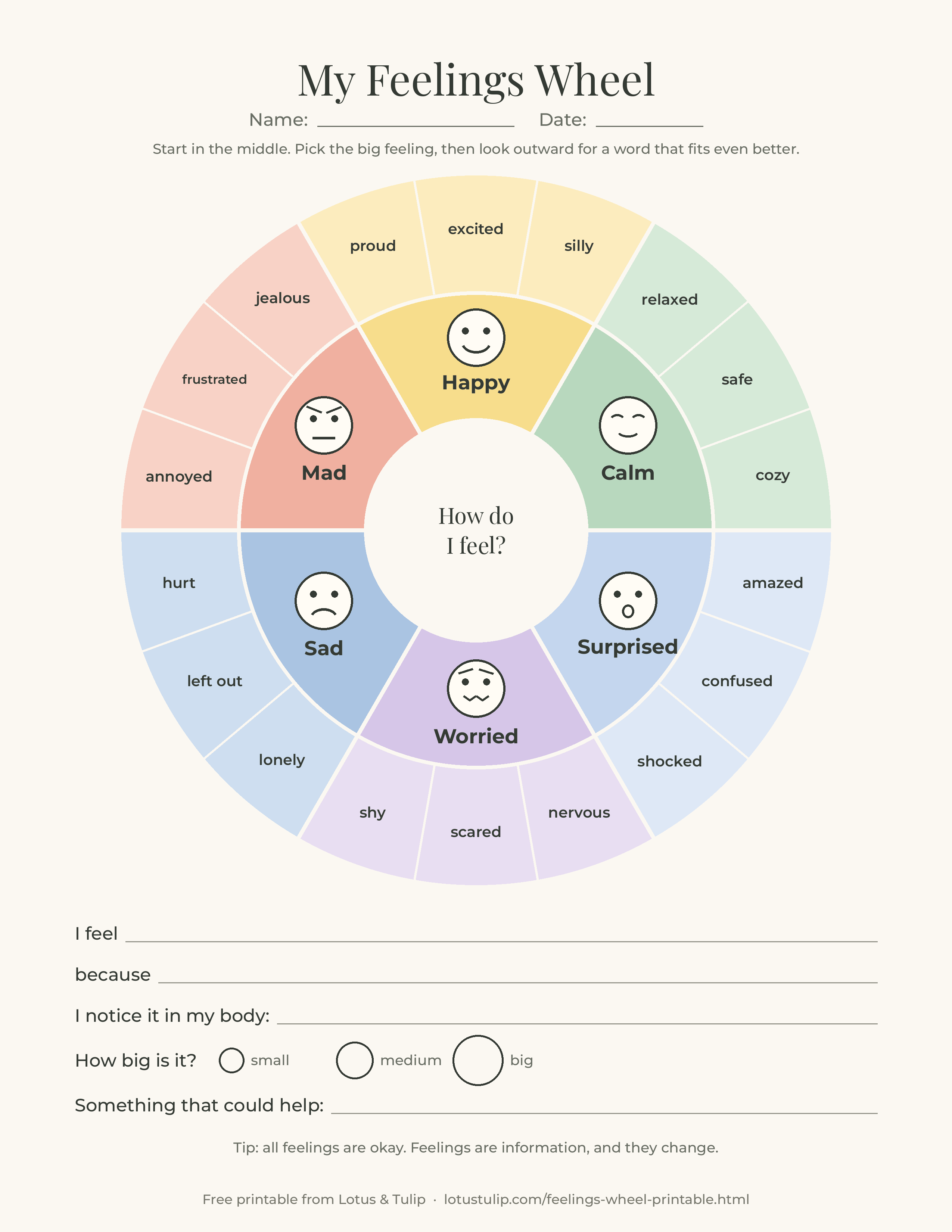
Download the free feelings wheel (PNG, US Letter)
Related resources
- New baby and big sibling worksheets for kids: naming jealous, proud and left out feelings when a new baby arrives, free big sibling map
- Coping skills list for kids (free printable menu)
- 5 4 3 2 1 grounding worksheet (free printable)
- Window of tolerance worksheet (free printable)
- Anger management worksheets for kids and teens
- All kids and teens counseling resources
FAQ
What is a feelings wheel?
A feelings wheel is a circle with a few broad core feelings in the center and more specific feeling words in rings around them. It helps people move from a general feeling like "sad" to a more exact word like "lonely" or "disappointed".
Who created the feelings wheel?
The best known version, The Feeling Wheel, was created by Gloria Willcox and published in 1982 in the Transactional Analysis Journal. Its center has six primary feelings: mad, sad, scared, joyful, powerful and peaceful. Plutchik's wheel of emotions, from 1980, is a different model built on eight primary emotions in opposite pairs.
How do you use a feelings wheel with kids?
Introduce it when the child is calm. Ask them to point to the big feeling in the middle that fits, then choose a more exact word around it. Follow up with where they feel it in their body, how big it is, and one thing that could help.
What age is a feelings wheel for?
Simplified wheels with faces and a few words work from about preschool and kindergarten age. Older kids, teens and adults can use wheels with more words. Match the number of words to the child's reading level and attention.
Is this feelings wheel printable free?
Yes. The feelings wheel on this page is free to print for use with your own clients, students, children or yourself. Please link to this page rather than re-uploading the file.