
Therapist worksheets · Updated 2026-11-03
DEAR MAN worksheet: how to teach the DBT skill for asking and saying no, with script examples (free printable)
Ready-made printable: DBT Worksheets for Therapists Fillable PDF, 20 pages: weekly diary card, chain analysis, pros and cons, crisis survival plan and 0 to 10 suffering scales
Holiday 20% off: about $11.04, was $14 (EUR 12) · instant digital download
Try it free first: download a fillable sample (weekly diary card and checking the facts, PDF, 234 KB). Type into it on screen, then get the full pack. No email needed.

DEAR MAN is the DBT skill clients use when they need something from another person, or need to say no, and the conversation feels too loaded to improvise. It turns a vague "I should speak up" into a short, planned script. This guide explains where DEAR MAN comes from, what each letter means in plain words, how it fits with the GIVE and FAST skills, how to teach it step by step, full example scripts for adults and teens, adaptations, group activities and the mistakes that make it backfire. It ends with a free one page DEAR MAN script planner on US Letter paper.
This is educational information for therapists, school counselors and other helpers, not a substitute for DBT training or supervision. If a client is in danger, follow your crisis protocol. In the US, anyone in crisis can call or text 988, the Suicide and Crisis Lifeline, or call 911 in an emergency.
Jump to the free DEAR MAN worksheet
What DEAR MAN is and where it comes from
DEAR MAN belongs to the interpersonal effectiveness module of dialectical behavior therapy (DBT), the treatment developed by Marsha Linehan. In the second edition of her skills materials, DBT Skills Training Handouts and Worksheets (Guilford Press, 2015), it is presented as the set of guidelines for objectives effectiveness: getting what you want from an interaction, whether that means making a request, saying no to one, or having your opinion taken seriously.
Linehan describes three kinds of effectiveness in any interpersonal situation, each with its own skill:
- Objectives effectiveness (DEAR MAN): did I get what I asked for, or did my no hold?
- Relationship effectiveness (GIVE): is the relationship in the same or better shape afterward?
- Self-respect effectiveness (FAST): do I still respect myself when it is over?
Clients often assume they must choose between being liked and being heard. Teaching the three together shows them they can plan for all three, and decide in advance which one matters most this time.
What DEAR MAN stands for
The first four letters are what the client says. The last three are how they say it.
D: Describe
Start with the facts of the situation, briefly, without judgments or guesses about the other person's motives. A useful test: could a video camera have recorded it? "You've picked me up late three times this month" passes. "You never think about my time" does not.
E: Express
Say how you feel or what you think about the situation, using "I" statements. Do not assume the other person already knows. "I feel anxious when I'm waiting and don't know if you're coming."
A: Assert
Ask for what you want, or say no, clearly and in one or two sentences. Many clients hint, apologize, or bury the request in explanation. Hinting is not asking. "I'd like you to text me if you're going to be more than ten minutes late."
R: Reinforce
Help the other person see what is in it for them: the positive effects of saying yes, or of accepting your no. Then reward them after they respond well, with thanks or appreciation. If needed, the consequences of not getting what you need can be stated honestly, without threats. "That way I won't be upset when you arrive, and we'll start the evening on a better note."
M: (stay) Mindful
Keep the focus on the goal. Two techniques from the skills handouts help. The broken record: calmly repeat the request or the no, in the same words, as many times as needed. Ignoring attacks: if the other person criticizes, threatens or changes the subject, do not take the bait. Return to the point.
A: Appear confident
Use a steady voice, an upright posture and reasonable eye contact. Avoid mumbling, trailing off, looking at the floor or adding "but it's fine if not." Clients do not need to feel confident to look confident, and looking confident often helps the feeling follow.
N: Negotiate
Be willing to give to get. Offer alternatives, reduce the request, or say no to one thing while offering another. When stuck, turn the tables: hand the problem to the other person and ask, "What do you think we could do?"
GIVE and FAST: the companion skills
DEAR MAN on its own can come across as cold or pushy. GIVE and FAST shape the tone.
- GIVE (relationship): be Gentle (no attacks, threats or judging), act Interested (listen and do not interrupt), Validate (acknowledge the other person's feelings and situation out loud), and use an Easy manner (a light, warm tone, a little humor where it fits).
- FAST (self-respect): be Fair to yourself and the other person, no unnecessary Apologies (do not apologize for having a request or an opinion), Stick to your values, and be Truthful (no excuses, exaggeration or acting helpless).
A helpful framing for clients: DEAR MAN is the script, GIVE is the warmth, FAST is the backbone. Before the conversation they pick the priority. With a boss over a schedule change, the objective may come first. With a grieving friend, the relationship may matter more than the request. With a pushy relative, self-respect may be the point.
How strongly to ask: the Dime Game
Linehan's handouts include a way to decide how intensely to ask or say no, often called the Dime Game. The client answers ten questions about the situation, such as whether the other person is able to give what they want, whether the request fits the relationship, whether it is a good time to ask, and whether they have done their homework on what they want. Each answer that favors asking (or saying no) adds a dime. More dimes, firmer ask. No dimes, do not ask at all. It is a guide, checked against wise mind, not a formula. It is especially useful for people pleasers who never ask and for clients who ask everything at full strength.
How to teach DEAR MAN in session
- Pick a real, low stakes situation first. Returning an item, asking a roommate to do the dishes, saying no to an extra shift. Save the conversation with the abusive ex or the critical parent for later practice, when the skill is familiar.
- Clarify the goal and the priority. "What exactly do you want to walk away with? And this time, what matters most: the result, the relationship or how you feel about yourself?"
- Write the D, E, A and R lines. Keep each to one or two sentences. Edit out blame words (always, never, obviously), mind reading and apologies.
- Prepare a broken record line. One short sentence the client can repeat calmly, for example "I'd still like a text if you're running late."
- Decide in advance what to offer. What could they give or accept as a compromise? What is not negotiable?
- Role play it, then switch roles. First, you play a cooperative version of the other person. Then a difficult one who interrupts, guilt trips and changes the subject, so the client practices staying mindful. Then let the client play the other person; this often builds empathy for the GIVE part.
- Plan the when and where. Not in front of others, not when either person is exhausted, hungry or already upset.
- Debrief next session. Did they get what they wanted? How is the relationship? How do they feel about themselves? A partial result is still data, not failure.
DEAR MAN script examples
Adult: saying no to extra work
D: "You've asked me to cover the Saturday shift again. I've worked the last three weekends."
E: "I'm worn out, and I'm worried it's starting to affect my work during the week."
A: "I'm not able to take this Saturday."
R: "Having the weekend off means I'll be fresh on Monday for the inventory count."
M: If pushed: "I understand it's hard to find cover. I'm not able to take this Saturday."
A: Steady voice, no "sorry, sorry."
N: "I could take a weekday evening next week, or help you write the shift request to the team."
Adult: asking a partner for help at home
D: "This week I've cooked every night and done the dishes after."
E: "I'm feeling tired and a bit resentful, and I don't want that to build up."
A: "Would you take over the dishes on the nights I cook?"
R: "I'd have more energy in the evenings, and I think we'd both enjoy the time together more."
N: "If dishes don't work for you, what part of dinner would you rather take on?"
Teen: asking a parent for a later curfew
D: "My curfew is 10 on weekends. The concert on Saturday ends at 10:30."
E: "I really want to go, and I get that you worry when I'm out late."
A: "Can my curfew be 11 that night?"
R: "I'll text you when it ends and when we leave, so you'll know where I am."
M: If the conversation drifts to last month's grades: "I hear you about grades, and we can talk about that too. Right now I'm asking about Saturday."
N: "What if Jordan's mom drives us home and I'm in by 11?"
For more scripts on limits with family, work and friends, see the healthy boundaries worksheet, which uses DEAR MAN as a boundary planner.
Adaptations
- Teens: Frame it as a way to get more yeses from adults. Teens respond well when the role play uses their actual situation (phone rules, curfew, a teacher, a friend who keeps borrowing money) and when they write the script in their own words.
- People pleasers and clients with a trauma history: Start with the Dime Game and FAST before practicing an ask. Many need permission to have a want at all. Watch for freezing during role plays and slow down; a client who leaves their window of tolerance cannot learn the skill in that moment.
- Clients who come across as aggressive: Spend more time on GIVE. Practice the Describe line until it is free of judgment, and rehearse validating the other person before the ask.
- Couples: Each partner writes a DEAR MAN for one specific request, then delivers it while the other practices GIVE in response.
- Text and email: DEAR MAN works in writing too. Mindful becomes not replying to side issues, and Appear confident becomes no excessive softeners or apologies.
When DEAR MAN is not the right tool
- When there is a safety risk. Asserting a request with a partner who is violent or controlling can increase danger. Safety planning comes first. In the US, the National Domestic Violence Hotline is 1-800-799-7233.
- When the client is at the top of the distress scale. Use distress tolerance skills such as TIPP first and plan the conversation for later.
- When the goal is to win. DEAR MAN increases the chance of a good outcome. It does not guarantee one, and it is not a tool for controlling other people.
Group activities for DBT skills groups
- Script relay: Give the group one scenario. Members write one letter each (D, E, A, R) on a card, then read the full script aloud and edit it together.
- Judgment hunt: Read Describe lines full of blame ("You obviously don't care") and have the group rewrite each as something a camera would record.
- Broken record practice: In pairs, one person asks while the other uses every distraction they can think of for 60 seconds. Then switch.
- Three effectiveness vote: For each scenario, the group votes on which matters most: objective, relationship or self-respect. Different answers lead to useful discussion.
- Homework report: Each week, members share one real DEAR MAN they tried and what they would change.
Common mistakes
- Long Describe sections. Two sentences is enough. A long history sounds like an accusation.
- Burying the Assert. If the other person could miss the request, it was a hint.
- Using Reinforce as a threat. Consequences are fine when stated honestly. Threats break GIVE and FAST.
- Arguing back instead of repeating. Responding to every side point is how clients lose the thread. That is what the broken record is for.
- Only practicing with a cooperative partner. Real conversations push back. Role play the hard version too.
- Measuring success only by the yes. A respectful no from the other person, with the relationship and self-respect intact, is still a skillful outcome.
Free DEAR MAN worksheet
This one page DEAR MAN script planner is an original Lotus & Tulip design. It has space for who the conversation is with, what the client wants, and which priority matters most this time, then a row for each letter with a short reminder and lines to write the actual words: the Describe, Express, Assert and Reinforce lines, a broken record line for Mindful, how they will show confidence, and what they could offer to Negotiate. GIVE and FAST reminders sit at the bottom, along with a quick after-conversation check. It prints on US Letter.
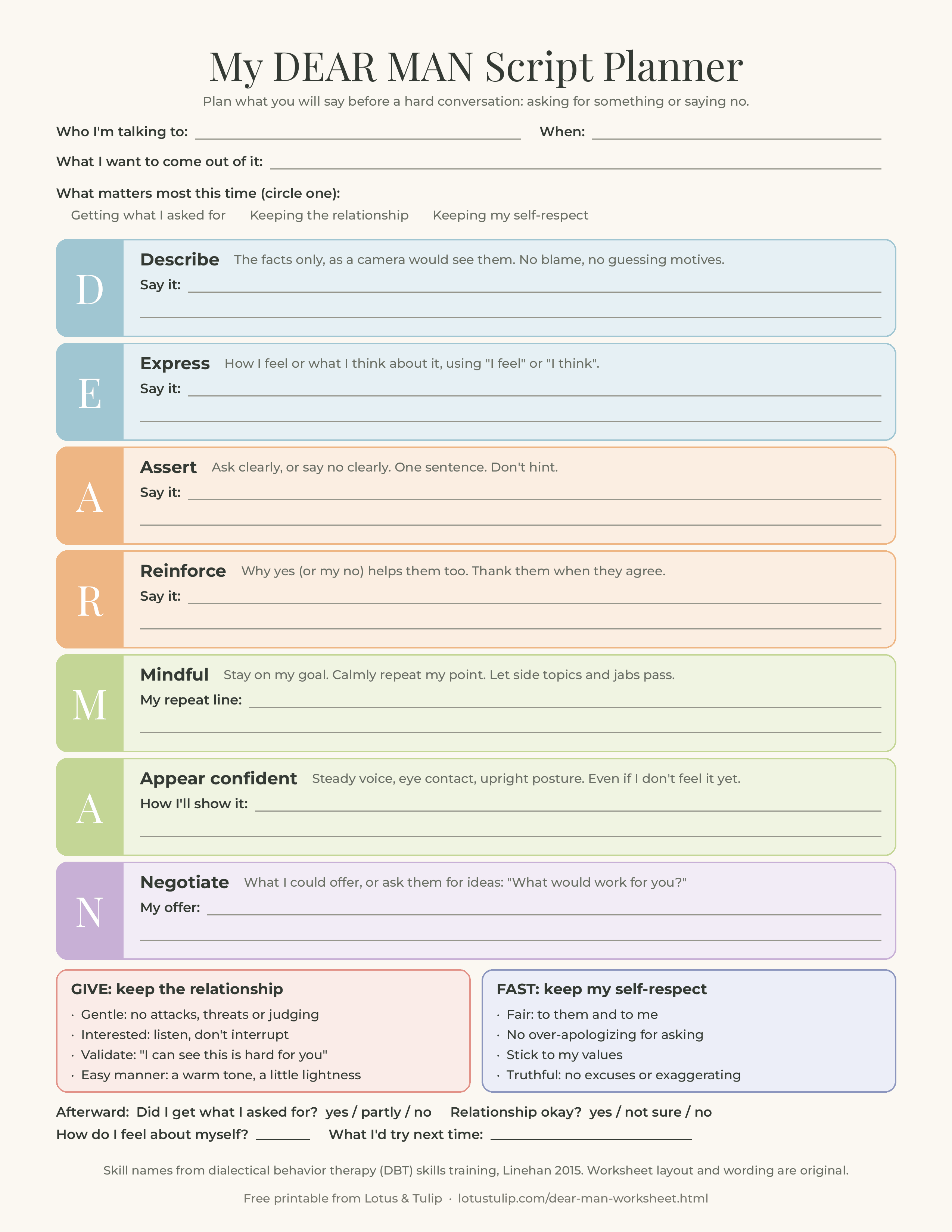
Download the free DEAR MAN worksheet (PNG, US Letter)
Free to print for use with your own clients, students or yourself. Please link to this page rather than re-uploading the file. Not affiliated with or endorsed by Marsha Linehan, Behavioral Tech or Guilford Press.
Related resources
- DBT validation worksheet: six levels and self-validation (free printable)
- Healthy boundaries worksheet with boundary scripts (free printable)
- DBT TIPP skills worksheet (free printable)
- Window of tolerance worksheet (free printable)
- Couples therapy worksheets
- All therapist worksheets: CBT, DBT and ACT
FAQ
What does DEAR MAN stand for in DBT?
DEAR MAN stands for Describe, Express, Assert, Reinforce, (stay) Mindful, Appear confident and Negotiate. It is the interpersonal effectiveness skill from Marsha Linehan's dialectical behavior therapy for asking for what you want, saying no, or getting your point of view taken seriously.
What is the difference between DEAR MAN, GIVE and FAST?
They target three kinds of effectiveness. DEAR MAN is about the objective, getting what you asked for. GIVE (Gentle, Interested, Validate, Easy manner) is about keeping the relationship. FAST (Fair, no unnecessary Apologies, Stick to values, Truthful) is about keeping self-respect. Most conversations use all three, with one as the priority.
What is the broken record technique in DEAR MAN?
It is part of staying Mindful. The person calmly repeats the same request or the same no, in the same words, instead of arguing each new point the other person raises. It is paired with ignoring attacks, which means not responding to criticism, threats or changes of subject and returning to the main point.
Can DEAR MAN be used with teens and kids?
Yes. Teens often take to it when it is framed as a way to get more yeses from adults and practiced with their real situations, such as curfew, phone rules or a friend issue. With younger children, simplify it to say what happened, say how you feel, ask for what you want and say thank you.
Does DEAR MAN always work?
No. It improves the odds of a good outcome but cannot control the other person's answer. A respectful no, with the relationship and self-respect intact, still counts as using the skill well. It should not be used in place of safety planning when a relationship is abusive or unsafe.
Is this DEAR MAN worksheet free?
Yes. It is free to print for use with your own clients, students or yourself. Please link to this page rather than re-uploading the file.