
Therapist worksheets · DBT interpersonal effectiveness · Updated 2026-11-12
DBT validation worksheet: the six levels of validation and self-validation (free printable)
Full DBT set: DBT Worksheets for Therapists, 20 pages incl. a validation practice page, asking for what I need, a diary card and chain analysis Holiday 20% off: about $11.04, was $14 (EUR 12) · fillable PDF, instant digital download
Buy on EtsyTry it free first: download a fillable sample (weekly diary card and checking the facts, PDF, 234 KB). Type into it on screen, then get the full pack. No email needed.
For teens: DBT Worksheets for Teens, 20 pages incl. validation practice, making an ask, friendships and self respect, and school and social media triggers Holiday 20% off: about $11.04, was $14 (EUR 12) · instant digital download
Buy on EtsyMega bundle: Therapist Worksheets Mega Bundle (8 packs incl. DBT, CBT, ACT, anxiety, grief and ADHD) Holiday 20% off: about $35.88, was $45 (EUR 39) · fillable PDFs for all 8 packs plus 160 printable pages, instant digital download
Buy on Etsy"Calm down, it's not a big deal." "You shouldn't feel that way." "I'm so stupid for getting upset." Most people say or hear lines like these every week, usually with good intentions, and they rarely help. Validation is the DBT skill for doing the opposite: letting a person (including yourself) know that a feeling, thought or reaction makes sense, without having to agree with it or approve of what they did next. This guide is for therapists, counselors, DBT skills group leaders, school mental health staff and parents working with a clinician. It covers what validation means in DBT, Linehan's six levels, self-validation, recovering from invalidation, what the research does and does not show, how to teach it, teens and parents, examples and common mistakes. It ends with a free 2 page printable: Validating Someone Else (six levels) and Self-Validation Practice.
Download the free DBT validation worksheet (PDF, 2 pages, US Letter)
Direct download, no email or sign up. See the pages first.
What validation means in DBT
In dialectical behavior therapy, validation means communicating that a person's emotions, thoughts or actions are understandable in their situation. Marsha Linehan, who developed DBT, describes it as one of the three core strategy groups of the treatment, together with dialectical and problem solving strategies, and as something that requires empathy but goes further: it communicates that the response is valid, that it makes sense (Linehan, 1997).
In the second edition of the adult skills materials (Linehan, 2015), validation is taught to clients in the interpersonal effectiveness module, in the "walking the middle path" skills: Interpersonal Effectiveness Handout 17 (Validation), Handout 18 (a how to guide to validation) and Handout 19 (Recovering from Invalidation), with Worksheet 12 (Validating Others) and Worksheet 13 (Self-Validation and Self-Respect). In the adolescent manual by Rathus and Miller (2015), the same material sits in the Walking the Middle Path module, Handouts 8 to 11, with a full handout on self-validation.
The handouts make four points that are worth teaching first, in our own words:
- Validation is not agreement. You can understand why someone is furious and still disagree with their conclusion, or still say no.
- Validate the valid, and only the valid. A feeling can make sense while the action that followed it does not. A teen can be validated for feeling upset about a low grade without the lack of studying being validated.
- Every reaction has causes. Even a response that does not fit the facts makes sense once you know the history, the body state or the beliefs behind it.
- Validation lowers the heat. It reduces the pressure to prove who is right, which makes problem solving, closeness and support easier.
Validation is also built into other DBT skills. The V in GIVE stands for validate, and a good DEAR MAN request often opens with a validating line. This page goes deeper into the skill itself.
The six levels of validation
Linehan (1997) describes six levels of validation, each one communicating a bit more understanding than the one before. Clients do not need to climb all six in every conversation; often one well placed level is enough. The client handout (Interpersonal Effectiveness Handout 18) teaches a closely matching six step how to guide. The table puts the two side by side; the "what it looks like" and example columns are our own wording.
| Level | Linehan (1997), in brief | Client handout step | What it looks like | Example |
|---|---|---|---|---|
| 1 | Listening and observing | Pay attention | Phone down, eyes up, no multitasking; let the person finish | "Go on, I'm listening." |
| 2 | Accurate reflection | Reflect back | Say back what you heard without judgment, in a tone that invites correction | "So the deadline moved again and you feel stuck. Did I get that right?" |
| 3 | Articulating the unverbalized | "Read minds" | Gently name a feeling or need the person has not said, and be open to being wrong | "I wonder if you're also worried about your job?" |
| 4 | Validating in terms of past learning or biology | Understand | Show the reaction makes sense given the person's history or body state, even if it does not fit the present facts | "After how your last partner treated you, it makes sense that a late reply scares you." |
| 5 | Validating in terms of present context | Acknowledge the valid | Show the reaction fits the current situation, the way most people would react, and act on it when that helps | "Anyone would be nervous the night before surgery." |
| 6 | Radical genuineness | Show equality | Treat the person as a capable equal, not as fragile; be yourself, admit mistakes, avoid one up or one down | "That sounds awful. I'd be angry too. What do you want to do?" |
Two details are easy to miss. Level 5 can be shown in action, not only words: if someone is hungry, give them food; if they point out a real mistake, fix it. And level 6 cuts both ways: treating a person as too fragile to hear disagreement is itself a quiet form of invalidation.
Self-validation
Many clients are kinder to friends than to themselves. Self-invalidation sounds like "I shouldn't feel this sad," "It's stupid that I got that upset," or "This shouldn't be so hard." Rathus and Miller (2015) note that self-invalidation is common in emotionally dysregulated teens, sometimes learned from an invalidating environment and sometimes coming from the lens of depression, and they expanded the adolescent validation skill to formally include self-validation (Walking the Middle Path Handout 10). Their manual describes self-validation as noticing and describing one's own emotions nonjudgmentally and acknowledging that they make sense in the situation, and suggests asking what your best friend in wise mind would say to you. The adult materials pair self-validation with self respect on Interpersonal Effectiveness Worksheet 13.
Self-validation uses the same levels turned inward: notice the feeling, name it without "should," find how it makes sense given your past or your body, find how it makes sense given what is happening now, and then take yourself seriously enough to decide what you need. It is not the same as believing every thought. If a reaction does not fit the facts, the next step is check the facts, not more criticism.
Recovering from invalidation
Interpersonal Effectiveness Handout 19 adds a balanced point: invalidation can hurt and still be useful, for example when it corrects facts that were actually wrong. In short, the handout asks the person to be nondefensive and check the facts, if needed with someone they trust; to acknowledge any part of their own reaction that is not valid and work on changing it, without harsh self judgment; to be compassionate and self-soothe, since invalidation hurts even when the other person is right; to validate their own valid reactions; and to practice radical acceptance of the situation and the person. Page 2 of the free printable has a short box for this.
What the research says
- Validation is central to DBT's theory. Linehan's biosocial theory proposes that emotion dysregulation develops through transactions between a person's emotional vulnerability and an invalidating environment. Crowell, Beauchaine and Linehan (2009, Psychological Bulletin) reviewed the developmental evidence and extended the model, describing a likely pathway in which early impulsivity and emotional sensitivity are potentiated by environmental risk factors.
- Validating responses calm stress reactions in the lab. In an experiment by Shenk and Fruzzetti (2011, Journal of Social and Clinical Psychology), participants who received invalidating responses during a stressful task had significantly higher negative affect, heart rate and skin conductance over time than participants who received validating responses, even after accounting for their own emotion regulation skill.
- What is not known. We know of no trial that tests teaching the validation skill on its own against a control condition. Validation is part of a well supported treatment and rests on a sensible theory and experimental work, but its separate effect as a client skill has not been isolated. Use client data, such as the practice log on page 2, to judge whether it is helping a given person.
How to use the DBT validation worksheet, step by step
- Teach the core idea first. Before any practice, make sure the client can say in their own words that validation is not agreement and that only the valid gets validated.
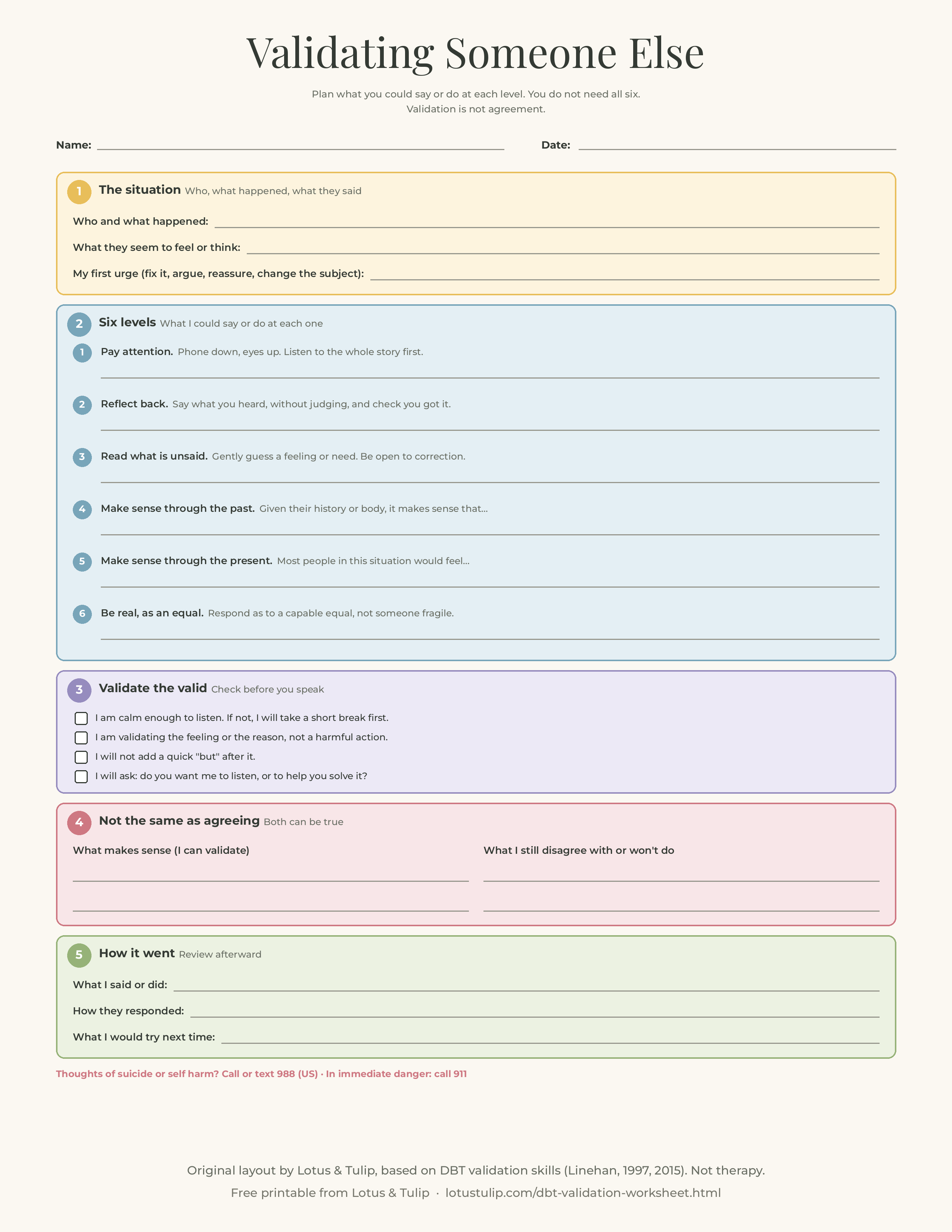
- Pick one real conversation. On page 1, box 1, write a specific situation with a specific person: a partner, a parent, a teen, a coworker. Note the first urge, such as fixing, arguing or reassuring.
- Draft a line for each level. In box 2, write what the client could say or do at each of the six levels. Some will be easy and some will feel unnatural; that is useful information.
- Run the check. Box 3 asks whether the client is calm enough to listen, is validating a feeling rather than a harmful action, will avoid a quick "but," and will ask whether the other person wants listening or help.
- Separate understanding from agreement. In box 4, list what makes sense on one side and what the client still disagrees with or will not do on the other.
- Role play in session. Practice with the clinician playing the other person, then swap roles so the client hears validation from the receiving end.
- Use it, then review. After the real conversation, box 5 records what was said, how the person responded and what to try next time.
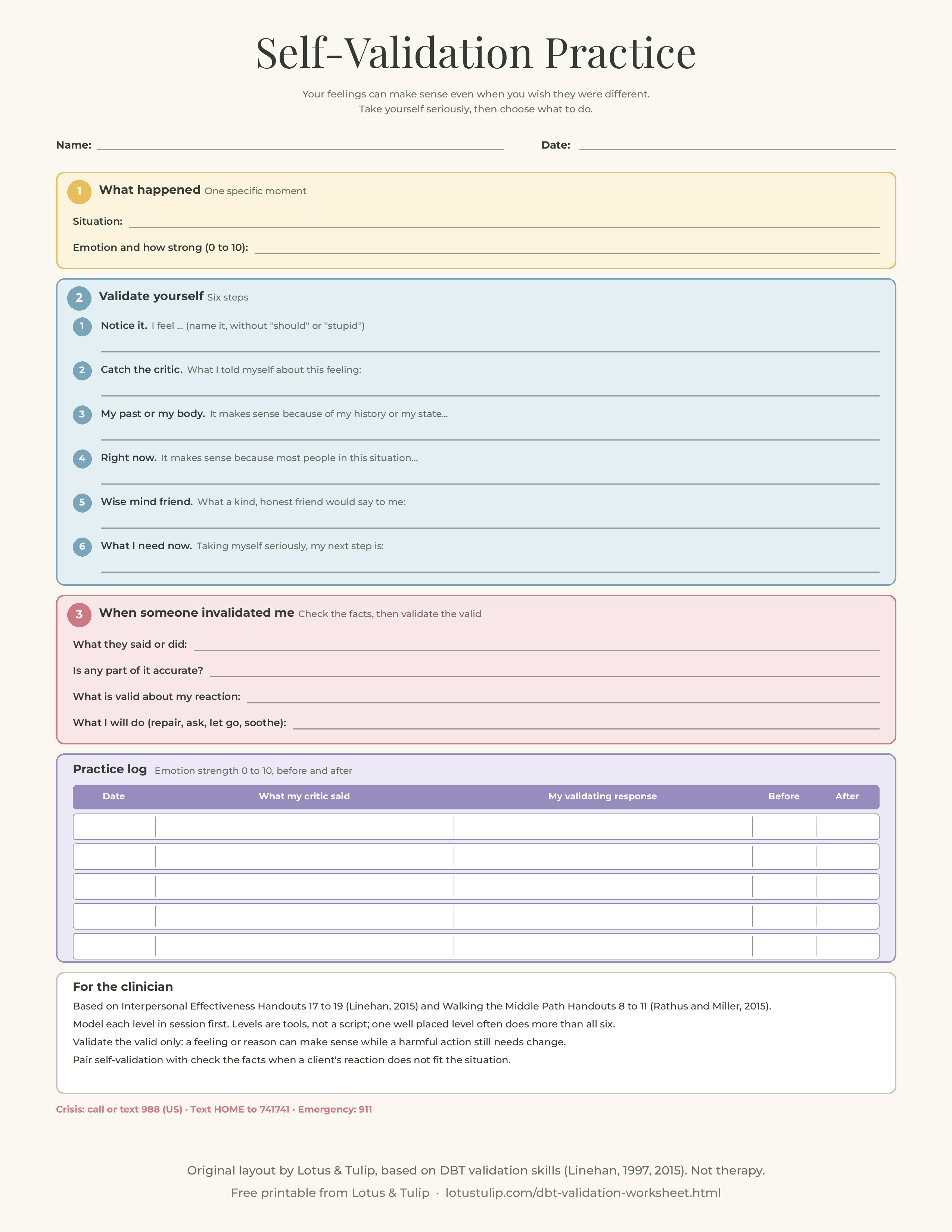
- Turn it inward. On page 2, walk through one moment of self-invalidation with the six self-validation steps, and use the invalidation box when someone else's words stung.
- Log the week. The practice log records the critic's words, the validating response and emotion strength before and after, 0 to 10, to bring to the next session.
Teaching validation to teens and parents
In adolescent DBT, validation is taught in the Walking the Middle Path module, which is designed for teens and caregivers to learn together. That makes it a natural fit for family sessions, and it often helps to have parents and teens fill in page 1 about each other.
- Start with what invalidation looks like without words: eye rolls, heavy sighs, walking away, making light of something serious. Teens spot these fast.
- Give parents one or two levels to practice at first, usually reflecting back and the present context level ("Anyone would be upset about that"), rather than all six.
- Coach parents to validate the feeling and still hold the limit: "It makes sense you're angry that your phone is off tonight, and it is still off."
- For teens who ask for constant reassurance, teach self-validation alongside so the reassurance loop can shrink over time.
Our DBT Worksheets for Teens include a validation practice page, making an ask, and friendships and self respect, which work well next to this printable.
Three short examples
These are illustrative composites written for this guide, not real clients.
- A parent and a 14 year old. The teen slams the door after being left out of a group chat. The parent's first urge is "It's just a chat, don't be dramatic." The planned response instead: reflect back ("You found out they made a chat without you"), present context ("That would hurt anyone"), then ask whether the teen wants to talk or wants space.
- A couple. One partner is anxious when the other comes home late without texting. The partner who was late practices level 4 ("Given what happened in your last relationship, I get why silence feels scary") and level 5 action (agreeing to send a short text), while still disagreeing that being late means they do not care.
- Self-validation. An adult client cries after a work meeting and immediately thinks "I'm pathetic." On page 2 she writes: I feel embarrassed and hurt; it makes sense because I was criticized in front of the whole team; most people would feel stung by that; a kind friend would say it was a rough meeting, not a verdict on me; what I need now is a walk and to plan one question for my manager tomorrow.
Common mistakes
- "I hear you, but..." A validating line followed straight away by a rebuttal usually lands as invalidation. Pause, or join the two with "and."
- Validating the invalid. Agreeing that a harmful action was fine is not validation. Validate the feeling or the reason, not the behavior that needs to change.
- Parroting. Repeating words back mechanically sounds like a technique. Reflect the meaning, and check you got it.
- Guessing as a verdict. Level 3 is a gentle guess, not a diagnosis. Say it in a way the person can correct.
- Treating the person as fragile. Endless soothing without honesty misses level 6. Equals can disagree.
- Using validation to win. If the goal is to get the other person to back down, it is usually felt. Validate because the reaction makes sense, then make your request separately.
- Skipping self-validation. Clients who are harsh with themselves often struggle to validate others when they are flooded. Practice both.
Free DBT validation worksheet
This free printable is an original Lotus & Tulip layout on US Letter. Page 1, Validating Someone Else, has five boxes: the situation (who and what happened, what they seem to feel or think, my first urge), the six levels with a line for what I could say or do at each, a validate the valid checklist, a two column "not the same as agreeing" box, and a how it went review. Page 2, Self-Validation Practice, has what happened with an emotion rating, six self-validation steps (notice it, catch the critic, my past or my body, right now, wise mind friend, what I need now), a when someone invalidated me box, a 5 row practice log with before and after ratings, notes for the clinician and US crisis lines.
Download the free DBT validation worksheet (PDF, 2 pages, US Letter)
Prefer single images? Page 1: validating someone else (PNG) · Page 2: self-validation practice (PNG)
Free to print for use with your own clients or for personal use. Please link to this page rather than re-uploading the file. An original layout based on validation as described in published DBT materials (Linehan, 1997, 2015; Rathus and Miller, 2015); it does not reproduce the handouts. A practice tool, not a substitute for therapy. If you are in crisis in the US, call or text 988, or call 911 in an emergency.
Related resources
- Shame vs guilt worksheet: a thought sort, check the facts and a repair and self-compassion plan
- DBT GIVE FAST worksheet: the V in GIVE, inside a full conversation
- DEAR MAN worksheet: open a request with a validating line
- Check the facts worksheet: when a reaction does not fit the situation
- Wise mind worksheet: the friend in wise mind for self-validation
- DBT what and how skills worksheet: observe, describe and nonjudgmental stance
- Radical acceptance worksheet: acceptance skills for what cannot change
- Communication exercises for couples: validation between partners
- Self-compassion worksheet: a kind inner voice to pair with self-validation
FAQ
What is validation in DBT?
Validation means communicating that a person's emotions, thoughts or actions make sense in their situation. In DBT it is a core therapist strategy (Linehan, 1997) and a client skill taught in the interpersonal effectiveness and walking the middle path materials. It does not mean agreeing or approving.
What are the six levels of validation?
In Linehan's model (1997), in brief: 1) listening and observing, 2) accurate reflection, 3) articulating what has not been said, 4) validating in terms of past learning or biology, 5) validating in terms of the present context, and 6) radical genuineness, treating the person as a capable equal. The client handout calls the steps pay attention, reflect back, read minds, understand, acknowledge the valid and show equality.
Which DBT handouts cover validation?
In Linehan's second edition skills materials (2015): Interpersonal Effectiveness Handouts 17, 18 and 19 with Worksheets 12 and 13. In Rathus and Miller's adolescent manual (2015): Walking the Middle Path Handouts 8 to 11, including Handout 10 on self-validation.
What is self-validation?
Self-validation is applying validation to your own experience: noticing and describing your emotions without judgment and acknowledging that they make sense in the situation. It is not the same as believing every thought; if a reaction does not fit the facts, the next step is to check the facts.
Does validation mean agreeing with someone?
No. You can understand why a person feels the way they do and still disagree, or still keep a limit. The DBT handouts stress validating only what is valid, such as the feeling or the reason, not a harmful action.
Is this DBT validation worksheet free?
Yes. It is free to print for use with your own clients or for personal use. Please link to this page rather than re-uploading the file.
Sources
- Linehan, M. M. (1997). Validation and psychotherapy. In A. C. Bohart and L. S. Greenberg (Eds.), Empathy Reconsidered: New Directions in Psychotherapy (pp. 353 to 392). American Psychological Association.
- Linehan, M. M. (2015). DBT Skills Training Handouts and Worksheets, second edition. Guilford Press. Interpersonal Effectiveness Handouts 17 to 19 and Worksheets 12 and 13.
- Linehan, M. M. (1993). Cognitive-Behavioral Treatment of Borderline Personality Disorder. Guilford Press.
- Rathus, J. H., and Miller, A. L. (2015). DBT Skills Manual for Adolescents. Guilford Press. Walking the Middle Path Handouts 8 to 11.
- Crowell, S. E., Beauchaine, T. P., and Linehan, M. M. (2009). A biosocial developmental model of borderline personality: elaborating and extending Linehan's theory. Psychological Bulletin, 135(3), 495 to 510.
- Shenk, C. E., and Fruzzetti, A. E. (2011). The impact of validating and invalidating responses on emotional reactivity. Journal of Social and Clinical Psychology, 30(2), 163 to 183.