
Therapist worksheets · Updated 2026-11-02
DBT TIPP skills worksheet: how to teach TIPP to clients and teens (free printable)
Ready-made printable: DBT Worksheets for Therapists Fillable PDF, 20 pages: weekly diary card, chain analysis, pros and cons, crisis survival plan and 0 to 10 suffering scales
Holiday 20% off: about $11.04, was $14 (EUR 12) · instant digital download
Try it free first: download a fillable sample (weekly diary card and checking the facts, PDF, 234 KB). Type into it on screen, then get the full pack. No email needed.

TIPP is the DBT skill clients reach for when an emotion is so intense that thinking skills stop working. It does not ask anyone to reframe a thought or solve a problem. It changes the body first, quickly, so the mind can catch up. This guide explains where TIPP comes from, what each letter means, when to use it and when not to, how to teach it in session, scripts for adults and teens, adaptations, group activities and common mistakes. It ends with a free TIPP skills plan worksheet on US Letter paper that clients fill in and test for themselves.
This is educational information for therapists, school counselors and other helpers, not a substitute for DBT training, supervision or medical advice. If a client is in danger, follow your crisis protocol. In the US, anyone in crisis can call or text 988, the Suicide and Crisis Lifeline, or call 911 in an emergency.
Jump to the free TIPP skills worksheet
What TIPP is and where it comes from
TIPP is a set of crisis survival skills from dialectical behavior therapy (DBT), the treatment developed by Marsha Linehan. In the second edition of her skills materials, DBT Skills Training Handouts and Worksheets (Guilford Press, 2015), the skill appears in the distress tolerance module as "TIP skills: changing your body chemistry." The handout lists four techniques and folds the last two under one P, which is why you will see both spellings. Many clinicians write it as TIPP so each technique gets its own letter. Both refer to the same skill.
The purpose is narrow and practical: to bring down extreme emotional arousal fast. When distress is very high, clients often describe it as being unable to think. TIPP works on the body's arousal directly, and once arousal drops, the client can use the rest of their skills.
The four TIPP skills
T: Temperature
The client holds their breath and puts their face in a bowl of cold water, or holds a cold pack or a zip lock bag of cold water over the eyes and cheeks, for about 30 seconds. Linehan's handout says to keep the water above 50°F; cool is enough, and colder is not better. Cold water on the face while holding the breath triggers what is often called the dive response, which slows the heart rate. Clients who cannot use a bowl of water can splash cool water on their face or keep a cold pack in the freezer at home, school or work.
I: Intense exercise
A short burst of hard physical effort, even briefly: running, fast walking, stairs, jumping jacks, lifting weights. Strong emotions prepare the body for action, and intense exercise uses up that stored energy. Afterward, many clients notice they feel tired but calmer.
P: Paced breathing
The client breathes deeply into the belly and slows the breath way down, to about five or six breaths a minute, with the out breath longer than the in breath. The handout's example is about 5 seconds in and 7 seconds out. Clients who find that too long can start at 4 in and 6 out and work toward a slower pace with practice.
P: Paired muscle relaxation
While breathing in, the client tenses the body's muscles (firmly, but not enough to cramp) and notices the tension. While breathing out, they think the word "relax" and let the tension go, then notice the difference. Practiced regularly, pairing the out breath and the word with letting go makes it easier to relax quickly when it matters.
When to use TIPP, and when not to
- Use it at the top of the scale. TIPP is for crisis level arousal, roughly 7 or higher on a 0 to 10 distress scale, when the client cannot think straight. A feelings thermometer or 0 to 10 rating makes this easy to spot.
- It is short term relief, not a solution. TIPP buys time. Once arousal drops, the client still needs to address the situation with problem solving, emotion regulation or interpersonal skills.
- It works best when practiced calm. A skill first tried in the middle of a crisis rarely works. Practice each part in session and between sessions.
- Screen for medical cautions before Temperature and Intense exercise. Linehan's handout notes that very cold water lowers heart rate quickly and intense exercise raises it. Clients with a heart or other medical condition, a lowered resting heart rate from medication, those taking a beta blocker, anyone allergic to cold, and clients with an eating disorder should check with their health care provider first. For clients with an eating disorder, intense exercise in particular may be unsafe or feed the disorder, so choose paced breathing and paired muscle relaxation instead.
- It is not a replacement for safety planning. If a client is at risk of self harm, TIPP sits inside a safety plan, not instead of one.
How to teach TIPP in session
- Start with the why. "When a feeling gets huge, your body is in alarm mode, and the thinking part of your brain goes quiet. TIPP talks to your body directly so the alarm turns down."
- Get a baseline. Ask the client to rate their distress 0 to 10 before each practice, then again after. Seeing the number move is what makes the skill believable.
- Demonstrate paced breathing first. It needs no equipment and is the easiest to practice in the room. Count out loud or use a timer, and find a pace the client can keep.
- Try Temperature with a cold pack. If you keep cold packs in your office, let the client feel the effect for 30 seconds. Many are surprised at how quickly it works.
- Walk through paired muscle relaxation. Start with one muscle group, such as fists, then build to the whole body.
- Plan intense exercise realistically. Where could they do 60 seconds of hard effort at home, school or work? Stairs, a fast walk around the block, wall push ups.
- Fill in the TIPP plan together. The free worksheet below has space for how they will do each skill, what they need nearby, and a before and after rating, so the plan becomes theirs.
- Review it next session. Ask which parts they tried, what the numbers did, and what got in the way. Adjust the plan rather than giving up on the skill.
Scripts you can borrow
With an adult client: "On a scale of 0 to 10, where are you right now? If you're above a 7, let's not try to solve anything yet. Let's bring your body down first. I'm going to count, and we'll breathe in for 5 and out for 7, about six times."
With a teen: "Okay, real talk. When you're at a 9, nobody can think, adults included. That's not you being dramatic, that's your body. This is a reset button. You pick: cold water on your face, a minute of stairs, or slow breathing with me. Which one sounds least annoying?" Teens tend to engage more when TIPP is framed as hacking their own body and when they get to choose.
For parents or school staff supporting a teen: "When they're at the top of the scale, skip the lecture. Offer one TIPP option in a calm voice, like a cold drink or a cold pack, or a walk with you, and save the talk for later when they're back below a 5."
Adaptations
- Teens at school: Agree in advance on a discreet version: cold water from the drinking fountain splashed on the face, a quick walk to the counselor's office, or slow breathing at the desk. Share the plan with the school counselor if the teen agrees.
- Younger children: Use playful versions with adult supervision: an ice pack wrapped in a cloth, "frog jumps" for exercise, "smell the flower, blow out the candle" breathing with a longer out breath, and "spaghetti arms" after squeezing fists tight.
- Clients with medical cautions: Skip Temperature and Intense exercise and build a plan around paced breathing and paired muscle relaxation, which carry fewer physical risks.
- Clients with trauma: Breath holding or face in water can feel unsafe for some survivors. Offer the cold pack version, keep eyes open, let the client control every step, and tie TIPP to the window of tolerance so they understand it as a way back into their window.
- Telehealth: Ask clients to have a cold drink or a bag of frozen vegetables nearby before session so you can practice Temperature together on screen.
Group activities for DBT skills groups
- Before and after experiment: Everyone rates their current tension 0 to 10, does two minutes of paced breathing together, then rates again. Discuss the change without pressure to report a big drop.
- Cold pack trial: With consent and medical screening done, pass out cold packs and try 30 seconds together. Ask what they noticed in their heart rate and thoughts.
- Exercise menu: The group brainstorms intense exercise options that work in real places: a bedroom, a bathroom at work, a school hallway, a car (parked). Everyone picks two for their plan.
- TIPP plan share: Members fill in the worksheet, then pair up to explain their plan in one minute. Hearing other people's ideas often fills gaps.
- Weekly tracking: Each week, members report one time they used TIPP, their before and after numbers, and what they would change.
Common mistakes
- Waiting until the crisis to teach it. Practice when calm, so the skill is automatic when it is needed.
- Treating TIPP as the whole answer. It lowers arousal. It does not fix the problem. Follow it with other skills.
- Skipping the medical screen. Always ask about heart conditions, heart rate medications, cold allergy and eating disorders before Temperature and Intense exercise.
- Using ice cold water. The handout says above 50°F. Cool water works, and colder adds risk without adding benefit.
- Breathing too fast or holding too long. The goal is a slow, comfortable pace with a longer out breath, not gasping or straining.
Free TIPP skills worksheet
This one page TIPP skills plan is an original Lotus & Tulip design. It has a row for each skill (Temperature, Intense exercise, Paced breathing, Paired muscle relaxation) with a short reminder of how it works, lines for "how I will do it" and "what I need nearby", and a before and after 0 to 10 rating so clients can test which parts actually help them. A safety box lists the medical cautions, and the footer includes the 988 line. It prints on US Letter.
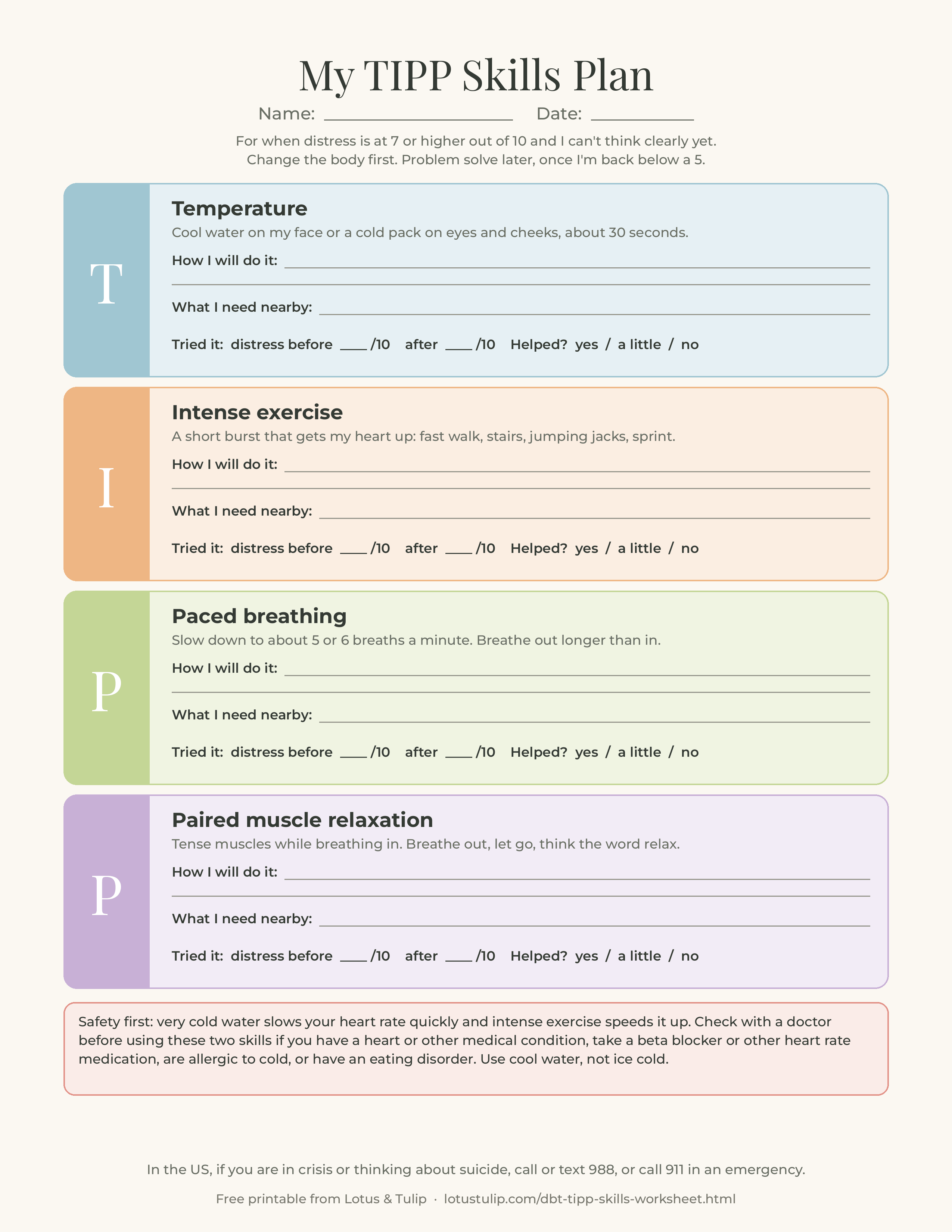
Download the free TIPP skills worksheet (PNG, US Letter)
Free to print for use with your own clients, students or yourself. Please link to this page rather than re-uploading the file. Not affiliated with or endorsed by Marsha Linehan, Behavioral Tech or Guilford Press.
Related resources
- DBT STOP skill worksheet (free printable)
- DBT pros and cons worksheet (free printable)
- Window of tolerance worksheet (free printable)
- 5 4 3 2 1 grounding worksheet (free printable)
- Feelings thermometer printable (free)
- CBT thought record worksheet (free printable)
- All therapist worksheets: CBT, DBT and ACT
FAQ
What does TIPP stand for in DBT?
TIPP stands for Temperature, Intense exercise, Paced breathing and Paired muscle relaxation. In Marsha Linehan's DBT skills handouts it is written as TIP, with both P skills under one letter. It is a distress tolerance skill for bringing down extreme emotion quickly by changing the body's arousal.
Is it TIP or TIPP?
Both. Linehan's handout calls it TIP skills and lists paced breathing and paired muscle relaxation together under P. Many clinicians and worksheets write TIPP so each of the four techniques has its own letter.
How cold should the water be for the TIPP temperature skill?
Linehan's handout says to keep the water above 50°F and hold it on the face, around the eyes and cheeks, for about 30 seconds while holding the breath. Cool water is enough. People with heart conditions, low heart rate from medication, a beta blocker prescription, cold allergy or an eating disorder should check with a health care provider first.
When should someone use TIPP skills?
TIPP is meant for very high distress, roughly 7 or more out of 10, when emotions are so intense that thinking skills are hard to use. It gives short term relief so the person can then use problem solving or other DBT skills. It works best when practiced ahead of time while calm.
Can teens and kids use TIPP?
Yes, with adaptations. Teens often like TIPP because it is quick and physical, and they respond well to choosing their own version. Younger children can use playful, adult supervised versions such as a wrapped ice pack, jumping, slow breathing games and squeeze and release muscle play.
Is this TIPP worksheet free?
Yes. It is free to print for use with your own clients, students or yourself. Please link to this page rather than re-uploading the file.