
Therapist worksheets · Updated 2026-11-03
Healthy boundaries worksheet: how to teach clients to set boundaries, with scripts (free printable)
Ready-made printable: Boundaries Worksheets for Therapists Holiday 20% off: about $9.20, was $12 (EUR 10) · instant digital download
Buy on Etsy
Boundaries come up in almost every caseload: the client who cannot say no at work, the young adult whose parent reads their messages, the partner who keeps giving up weekends to avoid a fight. This guide gives therapists, counselors and other helpers a practical way to teach boundary setting: what a boundary is (and is not), the six types many clinicians use, the difference between porous, rigid and healthy boundaries, a step by step way to plan a boundary conversation using the DBT skill DEAR MAN, scripts for common situations, adaptations for teens, couples and groups, common mistakes and an FAQ. It ends with a free one page healthy boundaries worksheet on US Letter paper.
This is educational information for therapists, school counselors and other helpers, not a substitute for clinical training, supervision or a treatment plan. In the US, anyone in crisis can call or text 988, the Suicide and Crisis Lifeline, or call 911 in an emergency. If a client is in an abusive relationship, safety planning comes before boundary scripts; the National Domestic Violence Hotline is 1-800-799-7233.
Jump to the free healthy boundaries worksheet
What a boundary is, and what it is not
A boundary is a clear statement of what you will and will not do, and what you need, in a relationship. The key idea for clients is that a boundary is about their own actions. "Please don't call me after 9pm" is a request. "I don't answer calls after 9pm, I'll call you back in the morning" is a boundary, because it still holds if the other person keeps calling. A boundary is not a punishment, an ultimatum or a way to control someone else's behavior. Clients who confuse the two often feel guilty setting boundaries, or set them as threats they cannot follow through on.
Six types of boundaries
Therapist and author Nedra Glover Tawwab, LCSW, describes six types of boundaries in Set Boundaries, Find Peace (TarcherPerigee, 2021). Naming the type helps clients notice where their own struggles cluster.
- Physical: personal space, touch, privacy and the body. "I'm not a hugger, a handshake is great."
- Sexual: consent and how sexual topics, jokes, images and touch are handled.
- Intellectual: how thoughts, opinions and beliefs are discussed. "I'm happy to talk politics, but not if it turns into insults."
- Emotional: what, how much and with whom feelings are shared, and how others' emotional needs are handled. "I can listen for a few minutes, but I can't be your only support right now."
- Material: money and possessions, lending and borrowing. "I don't lend my car."
- Time: how time and energy are spent. "I can help on Saturday morning, but I keep Sundays for my family."
Porous, rigid and healthy boundaries
The same book describes three levels. Porous boundaries are weak or poorly expressed: people pleasing, oversharing, saying yes to things you do not want to do. Rigid boundaries are walls: no exceptions, no closeness, often built after being hurt or taken advantage of. Healthy boundaries are clear, communicated and flexible enough to bend when it makes sense. Most clients are not one type everywhere. Someone can be porous with a parent and rigid with a partner. A quick way to explore this is to ask the client to rate each of the six types from porous to rigid, which is the first part of the free worksheet below.
How to plan a boundary conversation with DEAR MAN
Clients often know what boundary they want and freeze on how to say it. DEAR MAN is the interpersonal effectiveness skill from dialectical behavior therapy (DBT), developed by Marsha Linehan, for asking for what you want or saying no clearly. It gives clients a script to plan in advance.
- Describe the situation in plain facts, without judgment. "You've stopped by without texting three times this month."
- Express your feelings or opinion with "I" statements. "I feel on edge when I'm not ready for visitors."
- Assert the request or the no, clearly and in one sentence. "Please text before you come over."
- Reinforce by naming what the other person gains. "Then I can actually relax and enjoy the visit."
- (Stay) Mindful of the goal. If the conversation drifts or turns into an argument, calmly repeat the point (the "broken record").
- Appear confident: steady voice, eye contact, no over apologizing, even if you do not feel confident.
- Negotiate where you can: offer an alternative without giving up the core of the boundary. "If it's last minute, a quick call works too."
The free worksheet includes a DEAR MAN planner with a line for each step, so clients can write the script before the conversation and bring it back to session.
Teaching boundaries step by step
1. Find one real situation
Ask where the client felt resentful, drained or taken for granted in the last week. Resentment is often a sign a boundary is missing. Start with one situation, not a whole life review.
2. Name the type and the level
Is it about time, money, emotions, space? Is the client's current pattern porous or rigid? This keeps the work concrete.
3. Write the boundary as an action the client controls
Turn "I need my sister to stop criticizing me" into "If the criticism starts, I'll say I'm not discussing it and change the subject, and if it continues I'll end the call."
4. Plan the words with DEAR MAN
Keep it short. Most boundary statements work best in two to four sentences. Role play it in session, with the therapist playing the other person, including likely pushback.
5. Plan the follow through
Ask "What will you do if they ignore it?" A boundary without a planned response tends to collapse the first time it is tested. The answer should be something the client is willing and safe to do.
6. Expect guilt, and review afterward
Many clients feel guilty or anxious after setting a boundary, especially if they grew up as the family peacemaker. Normalize that feeling as a sign of change, not proof they did something wrong. Review what happened next session.
Boundary scripts for common situations
Work: "I can't take that on this week without dropping something else. I can start it Monday, or we can look at what to move."
Family: "I'm not going to talk about my weight. If it comes up, I'll step out for a bit."
Friends: "I care about you and I want to help, but I can't talk every night. Can we check in on Sundays?"
Money: "I'm not able to lend money, but I'm happy to help you look at other options."
Phones and texting: "I don't reply to messages after 9pm. I'll answer in the morning."
Partner: "When we disagree, I need a 20 minute break before we keep talking. I'll come back, I just need to calm down first."
Adaptations
- Teens: use examples from friendships, group chats, sharing passwords and social media. Practice saying no to small requests first. Be clear about what is negotiable with parents and what is not.
- Couples: have each partner write their own boundary for the same situation and compare. Focus on requests both can live with, and keep the "I" statement form so it does not become a list of complaints.
- Groups: read short scenarios aloud, decide as a group which type of boundary is involved, then pairs role play a DEAR MAN script and swap roles.
- Clients with trauma histories: boundaries may feel dangerous because saying no once led to harm. Go slowly, start with low stakes situations, and pair the work with grounding skills.
- Telehealth: share the worksheet on screen and fill it in together, then send it for homework. Role plays work well over video.
Common mistakes
- Boundaries as ultimatums. "If you do that again, we're done" is only a boundary if the client means it and can follow through.
- Too many words. Long explanations invite debate. Clear and kind beats detailed and defensive.
- Starting with the hardest relationship. Build confidence with a coworker or friend before a parent or partner.
- No plan for pushback. Most people test a new boundary. Plan the response in advance.
- Ignoring safety. In abusive or controlling relationships, a direct boundary can increase risk. Safety planning comes first.
Free healthy boundaries worksheet
This one page "My Boundary Plan" worksheet is an original Lotus & Tulip design. The top section asks the client to rate each of the six boundary types on a scale from porous to rigid. The middle section names one situation, the type of boundary, the boundary written as the client's own action and the planned follow through if it is not respected. The bottom section is a DEAR MAN script planner with a line for each step, plus a before and after rating of how confident the client feels. The footer includes the 988 line. It prints on US Letter.
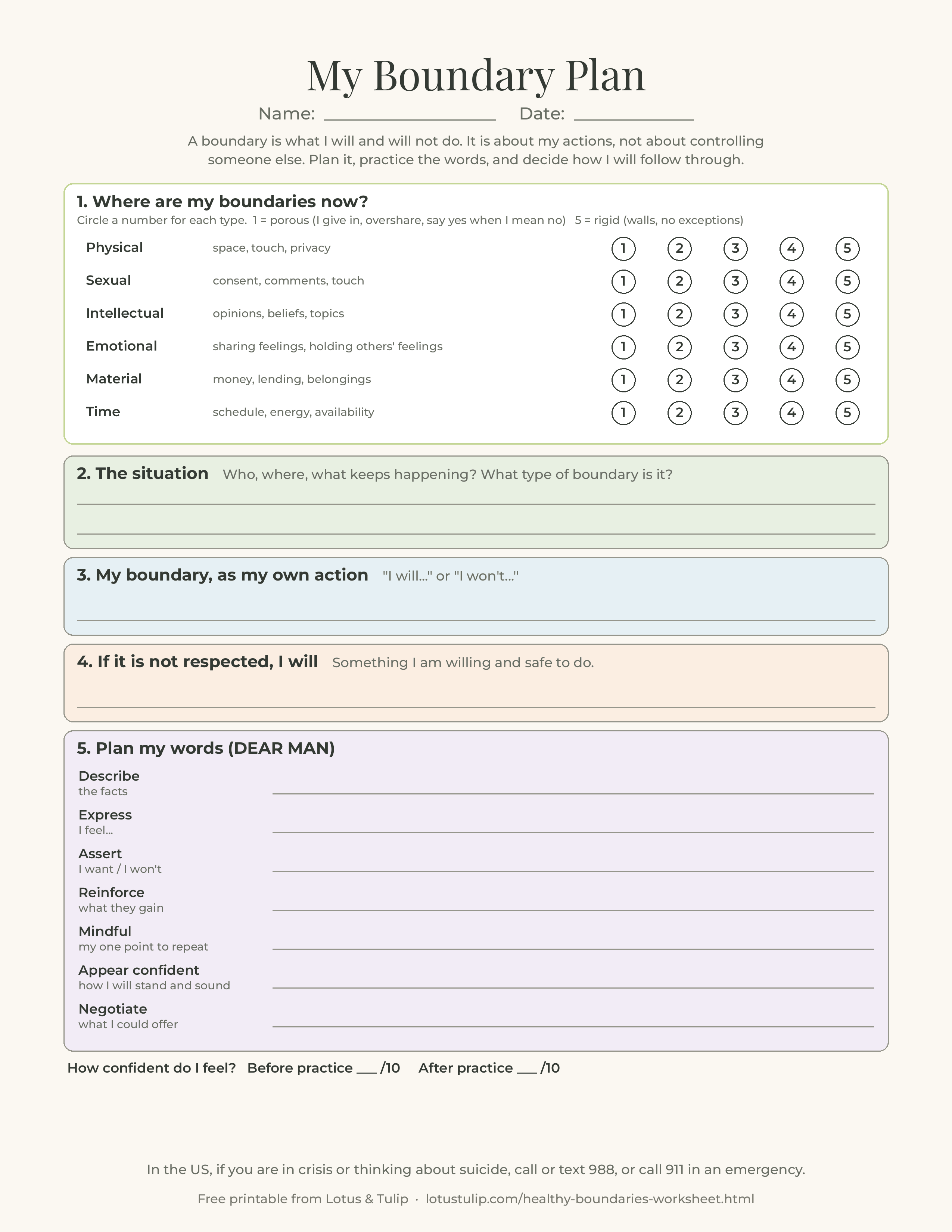
Download the free healthy boundaries worksheet (PNG, US Letter)
Free to print for use with your own clients, students or yourself. Please link to this page rather than re-uploading the file. DEAR MAN is a skill from Marsha Linehan's DBT; this worksheet is an independent planner and is not affiliated with or endorsed by its authors or publishers.
Related resources
- Burnout worksheet: when overwork and saying yes have worn you down, with a free burnout map and recovery plan
- Codependency worksheet: caring for someone without losing yourself, with a free plan
- People pleasing worksheet: noticing the automatic yes, with a free kind no practice plan
- Attachment styles worksheet: a pattern map of worry and distance and a secure moves plan
- DBT TIPP skills worksheet (free printable)
- Cognitive distortions worksheet (free printable)
- Window of tolerance worksheet (free printable)
- Anger iceberg worksheet (free printable)
- All therapist worksheets: CBT, DBT and ACT
FAQ
What are the six types of boundaries?
A widely used list from therapist Nedra Glover Tawwab's book Set Boundaries, Find Peace (2021) names six: physical, sexual, intellectual, emotional, material and time boundaries.
What is the difference between porous, rigid and healthy boundaries?
Porous boundaries are weak or unclear, such as people pleasing or saying yes when you mean no. Rigid boundaries are walls with no exceptions. Healthy boundaries are clear, communicated and flexible enough to adjust when it makes sense.
What does DEAR MAN stand for?
Describe, Express, Assert, Reinforce, (stay) Mindful, Appear confident and Negotiate. It is the DBT interpersonal effectiveness skill, developed by Marsha Linehan, for asking for what you want or saying no.
How do you set a boundary without feeling guilty?
Guilt is common, especially for people who learned early to keep others happy. It usually fades with practice. Keeping the boundary short, framing it as your own action rather than a demand, and reviewing how it went with a therapist all help.
What if someone keeps ignoring my boundary?
Follow through with the action you planned, such as ending the call or leaving. If the person reacts with threats or you feel unsafe, prioritize safety and get support; in the US the National Domestic Violence Hotline is 1-800-799-7233.
Is this healthy boundaries worksheet free?
Yes. It is free to print for use with your own clients, students or yourself. Please link to this page rather than re-uploading the file.