
Therapist worksheets · Grief and loss · Updated 2026-11-12
Dual process model of grief worksheet: how to use it with clients (free printable)
Full set: Grief and Loss Worksheets for Therapists, 20 pages including a two sides of coping page Holiday 20% off: about $11.04, was $14 (EUR 12) · fillable PDF, instant digital download
Buy on EtsyTry it free first: download a fillable sample (grief waves and a plan for hard days, PDF, 182 KB). Type into it on screen, then get the full pack. No email needed.
Mega bundle: Therapist Worksheets Mega Bundle (8 packs incl. grief, anxiety, ADHD, CBT, DBT and ACT) Holiday 20% off: about $35.88, was $45 (EUR 39) · fillable PDFs for all 8 packs plus 160 printable pages, instant digital download
Buy on EtsyThe dual process model of coping with bereavement gives grieving clients a picture that most of them recognize at once: some days are about the loss, some days are about keeping life going, and the healthy pattern is moving between the two rather than finishing one "stage" before the next. This guide is for therapists, grief counselors, hospice and social work teams who want to use the model in session. It covers what Margaret Stroebe and Henk Schut actually proposed, what the research does and does not show, how to introduce it to a client, how to read one sided patterns, and how to use it with couples and families. It ends with a free 2 page printable: a two sides of grief map with a weekly check in, and a 7 day back and forth log.
Download the free dual process model worksheet (PDF, 2 pages, US Letter)
Direct download, no email or sign up. See the pages first.
What the dual process model of grief is
Stroebe and Schut described the model in 1999 in Death Studies ("The dual process model of coping with bereavement: Rationale and description"). They argued that the older "grief work" idea, that a bereaved person must confront and work through the loss to recover, was too narrow. It left out the practical and identity changes that follow a death, and it treated time away from grief as avoidance to be fixed.
The model names two kinds of stressors that a bereaved person has to cope with:
- Loss oriented stressors: the loss itself. Yearning and missing the person, crying, going over the death and life together, looking at photos, imagining how they would react, and working out the ongoing bond with them.
- Restoration oriented stressors: the secondary changes. Taking on tasks the person used to handle (money, cooking, the car), reorganizing life, maybe moving house, and building a new identity, for example from spouse to widow or widower. In the authors' words, restoration refers to "secondary sources of, and coping with, stress", not to an outcome.
The center of the model is oscillation: moving back and forth between the two, confronting at some moments and setting aside at others. Stroebe and Schut also built in time off. Coping, they wrote, is embedded in everyday life, which includes taking time off from grieving, such as watching an engrossing TV program, reading, talking with friends about something else, or sleeping. Their conclusion was that confronting the loss is essential, but it needs "dosage": not relentlessly, and not at the expense of the other tasks that come with a death.
The two sides at a glance
The figure in the 1999 paper lists the processes on each side. Here they are with plain language examples you can use with clients.
| Loss oriented | Restoration oriented |
|---|---|
| Grief work: remembering, telling the story, looking at photos | Attending to life changes: bills, paperwork, meals, the house |
| Intrusion of grief: waves that arrive unasked, a song in a shop | Doing new things: a class, a trip, a new skill they used to handle |
| Letting go, continuing or relocating bonds: finding a place for the relationship | Distraction from grief: work, a series, a walk with a friend |
| Denial or avoidance of restoration changes: leaving the new tasks undone | Denial or avoidance of grief: staying busy so the loss stays out of view |
| New roles, identities and relationships: who am I now, who is in my life |
Two details are easy to miss. Each side includes a form of avoidance of the other side, so avoidance is part of the pattern, not a separate failure. And the model is explicitly not a stage model. The authors describe "a waxing and waning, an ongoing flexibility, over time". Early on the loss side tends to dominate, and later attention turns more and more to the other changes.
Why clients find it useful
Many clients arrive with the five stages in mind and a worry that they are doing grief wrong. The stages come from Elisabeth Kübler-Ross's 1969 book On Death and Dying, which described the reactions of terminally ill patients facing their own death, not people grieving someone else. The dual process model offers a different message that tends to land well:
- A good day is not a betrayal. Laughing at dinner or forgetting the loss for an hour is part of coping.
- Paperwork, cooking and learning to do the taxes are grief related work too, not a distraction from "real" grieving.
- Feeling pulled in two directions is expected. The goal is flexibility, not a fixed balance.
- People close to each other may lean toward different sides, which is different, not less.
What the research says (and what it does not)
The 1999 paper was a theoretical proposal. Stroebe and Schut themselves wrote that caution was needed before deriving practical implications, and that oscillation in particular needed empirical testing. Their 2010 update in Omega ("The dual process model of coping with bereavement: A decade on") summarized the developments since, and repeated the call for stringent tests of the model.
Jennifer Fiore's systematic review in Omega (2021) screened 474 articles published from 1999 to mid 2016 and included 22 quantitative or mixed methods studies. She concluded that the model accurately represents the bereavement experience and that interventions based on it may be more effective than traditional grief therapy, while noting that more research is needed, especially on oscillation, with consistent measures across studies. One example of an intervention built on the model is the program for bereaved spouses and partners described by Lund, Caserta, Utz and de Vries (2010).
The authors have also extended the model. In 2015 they proposed a family level version that looks at how relatives' grief interacts (Perspectives on Psychological Science). In 2016 they added overload, defined as the bereaved person's perception of having more than they feel able to deal with (Omega). It can come from the loss side (for example several deaths close together), the restoration side, both, or from everyday demands unrelated to the death, such as a demanding job or caring for an ill relative. For overload, they argue, oscillation alone is not enough: the stressors themselves need to be reduced, and they point to openness, being direct about one's needs and able to say no. The free printable includes a simple overload rating for that reason.
A fair summary for clients and supervisors: this is a well regarded, widely used framework with growing but still limited direct evidence, not a manualized treatment. Many of the original examples come from the loss of a spouse, so adapt the wording for other losses.
How to use the dual process model worksheet, step by step
- Check safety and timing first. Ask about suicidal thoughts, sleep, substance use and daily functioning before reflective work. In the first days after a death, practical support often matters more than a worksheet.
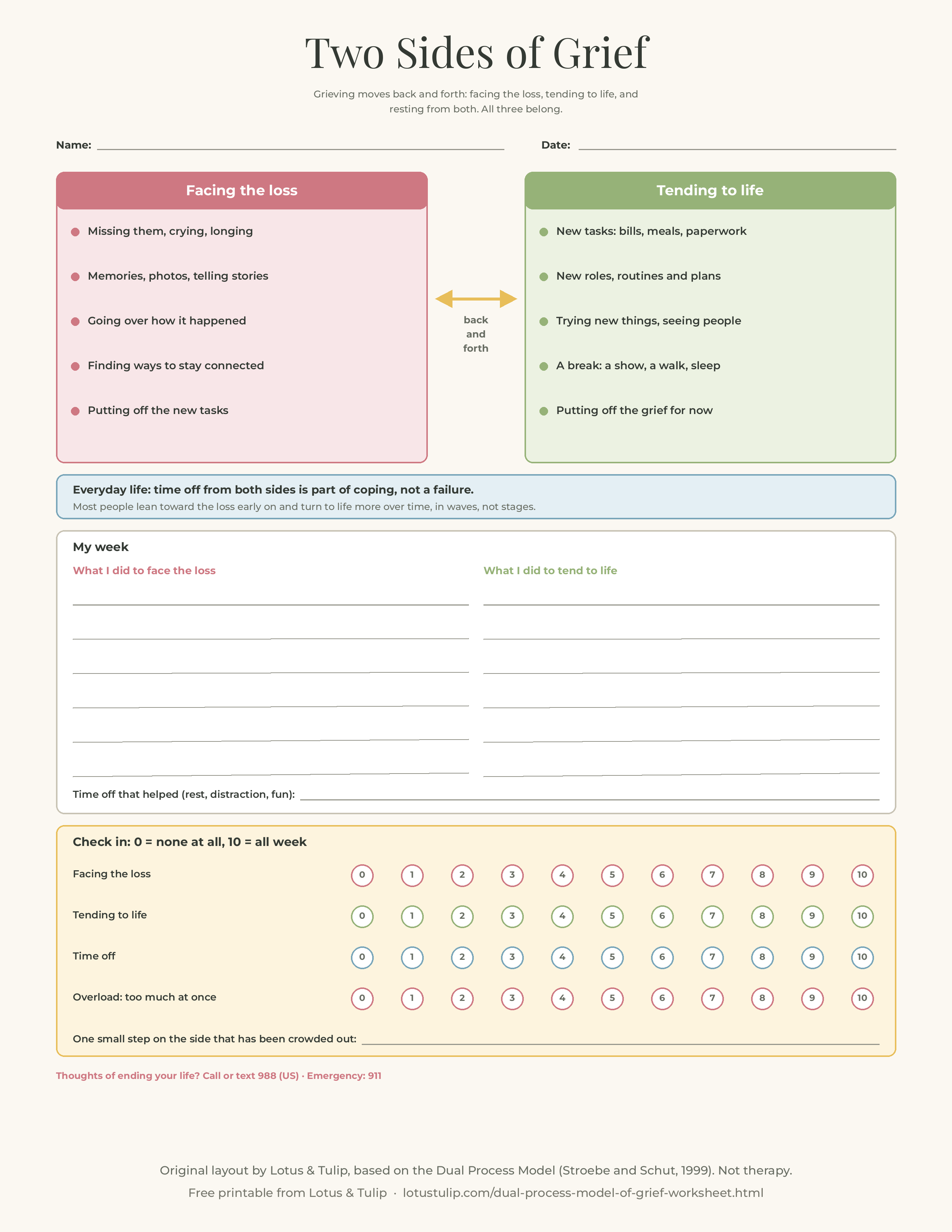
- Introduce the two sides in the client's words. Use the map on page 1 and ask which examples sound familiar. Many clients relax when they see that paperwork and new routines count as grief related work.
- Normalize the back and forth. Explain that moving between the sides, and taking time off from both, is the healthy pattern. Name that the model is not a set of stages with a finish line.
- Fill in "My week" together. List what the client did on each side over the past week. Keep it concrete: "sorted his tools", "cried in the car", "went to book club".
- Rate the check in. Ask for 0 to 10 ratings for facing the loss, tending to life, time off and overload. The numbers are conversation starters, not scores.
- Look for the crowded out side. Ask which side has had little room lately and what makes it hard to go there. Respect the reasons; avoidance often protects something.
- Plan one small step. Choose one manageable action on the crowded out side, for example ten minutes with a photo album, or one phone call about the pension. Smaller is better.
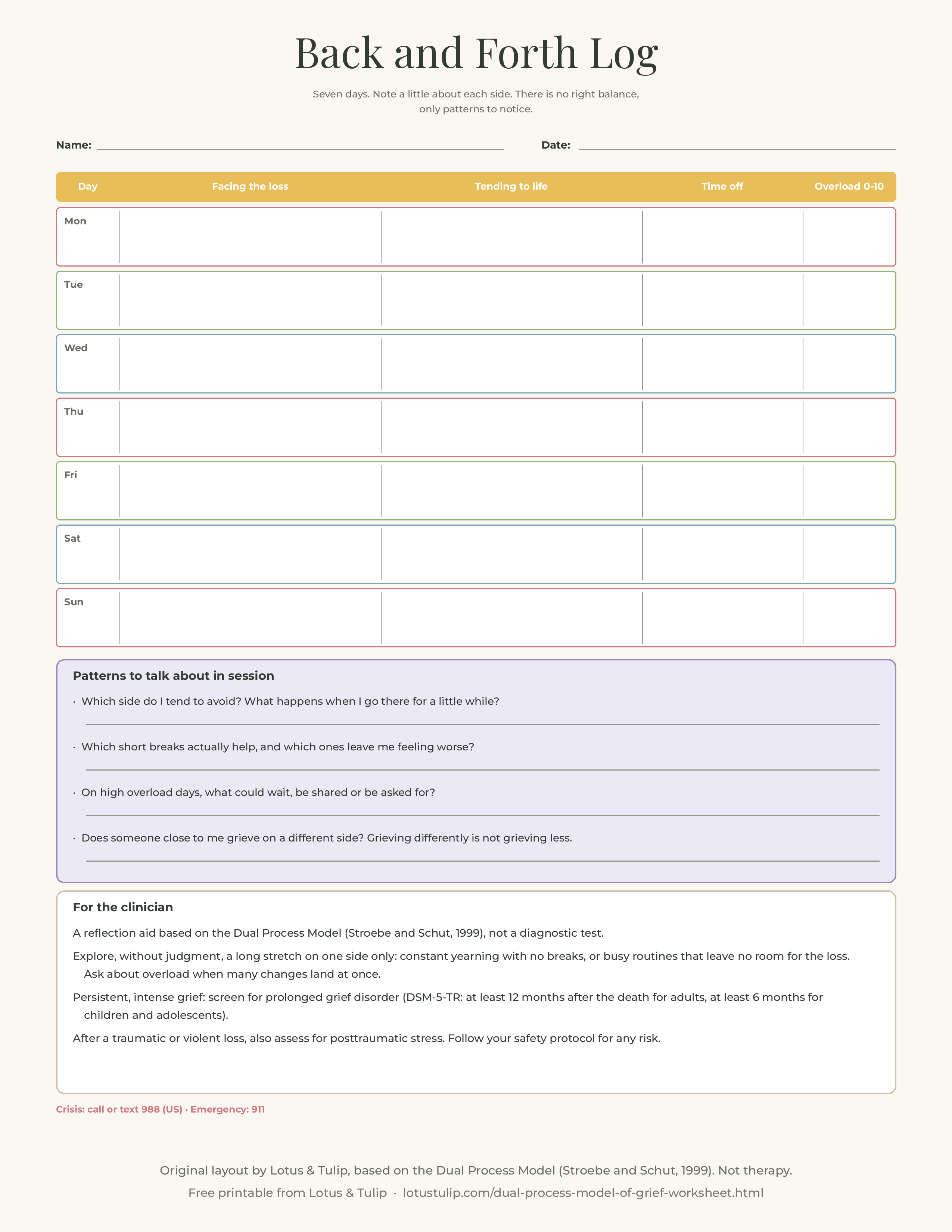
- Send the back and forth log home. Page 2 asks for a few words per day on each side, time off and overload. Agree that blank boxes are fine.
- Review patterns next session. Use the session prompts on page 2. Look at what helped, what made things worse, and whether overload calls for practical help, delegation or postponing decisions.
Reading one sided patterns
A week that leans one way is normal. A pattern that stays one sided for a long time is worth exploring, gently and without labeling the client.
Mostly loss oriented. Constant yearning and rumination with few breaks and little engagement with daily life. Stroebe and Schut linked chronic forms of grief to the loss side and described complicated grief as a disturbance of oscillation. If intense yearning or preoccupation persists, screen for prolonged grief disorder. In DSM-5-TR the death must have occurred at least 12 months earlier for adults, and at least 6 months for children and adolescents, with symptoms nearly every day for at least the last month and clinically significant distress or impairment.
Mostly restoration oriented. Very busy, carrying on "as if nothing happened", with the loss kept out of view. Some time away is healthy; persistent, rigid avoidance can be a sign of inhibited grief. Small, planned contact with the loss side, such as one memory or one visit, is usually more workable than a big confrontation.
Overload. High ratings on both sides at once: grief, a house sale, caregiving, work and legal tasks in the same month. Here the work is practical as much as emotional: what can wait, be shared or be asked for, and how the client can tell people plainly what they need.
Traumatic or violent loss. The 1999 paper described intrusions that are less under voluntary control after a traumatic death, alternating with extreme avoidance. Assess for posttraumatic stress and pace grief work accordingly.
Couples and families: grieving on different sides
One of the most useful applications is relational. The 1999 paper cited evidence that bereaved mothers were more loss oriented than fathers after the death of a child, and noted how easy it is to conclude "he is grieving less than I am" when the more accurate reading is "he is grieving differently". The authors described this research as a starting point that needs replication, so present it as a common pattern, not a rule about gender.
In couples or family sessions, have each person fill in page 1 separately, then compare. Often each partner sees, for the first time, that the other is grieving through a different door. The fourth prompt on page 2 is written for this conversation.
Three short examples
| Client (illustrative) | What the week showed | One small step |
|---|---|---|
| Widow, 68, eight months after her husband's death | Daily visits to the grave, mail unopened, overload 8 | Open the mail with her daughter on Saturday, 30 minutes, then lunch out |
| Man, 45, after his brother's sudden death | Back at work in a week, 60 hour weeks, "fine", no time off | Ten minutes on Sunday with a photo of the two of them, then a walk |
| Parents after a stillbirth | Mother mostly loss side, father mostly restoration side, both hurt by the difference | Each completes page 1, then a joint session using the different sides prompt |
Common mistakes
- Treating it as a target ratio. There is no correct 50/50 split. Flexibility over time matters more than any single week.
- Calling every break avoidance. The model includes time off as part of coping. Ask whether the break restores the client or keeps something away for good.
- Forgetting the restoration side is work. Learning the finances or becoming a single parent is effortful and can be grieved too.
- Overselling the evidence. Describe it as a well supported framework, not a proven treatment.
- Skipping safety. Reflective worksheets are not a substitute for risk assessment.
Free dual process model of grief worksheet
This free printable is an original Lotus & Tulip layout on US Letter. Page 1, Two Sides of Grief, maps facing the loss and tending to life in plain words, with back and forth arrows and a reminder that time off is part of coping, then a "My week" section for each side and a 0 to 10 check in for facing the loss, tending to life, time off and overload, plus one small step on the crowded out side. Page 2, Back and Forth Log, is a 7 day log with columns for each side, time off and overload, four prompts to talk about in session and short notes for the clinician, including prolonged grief disorder screening. Both pages show 988 and 911.
Download the free dual process model worksheet (PDF, 2 pages, US Letter)
Prefer single images? Page 1: two sides of grief (PNG) · Page 2: back and forth log (PNG)
Free to print for use with your own clients. Please link to this page rather than re-uploading the file. An original layout based on published research (Stroebe and Schut 1999, 2010, 2016). Not affiliated with or endorsed by the authors or any organization named here. A reflection aid, not a diagnostic tool or a substitute for clinical care.
Related resources
- Grief worksheets for adults: 12 gentle exercises (free printable)
- Free grief worksheets for therapists: 8 page starter pack
- Grief activities for teens (free printable)
- Grief activities for kids (free memory worksheet)
- Behavioral activation worksheet (free printable)
FAQ
What is the dual process model of grief?
It is a model of coping with bereavement proposed by Margaret Stroebe and Henk Schut in 1999. It describes two kinds of stressors, loss oriented (the loss itself) and restoration oriented (the life changes that follow), and says that healthy coping involves moving back and forth between them, including taking time off from grief.
How is it different from the five stages of grief?
The five stages came from Elisabeth Kübler-Ross's work with dying patients. The dual process model is not a stage model. It describes an ongoing back and forth between facing the loss and tending to life, which changes over time without a fixed order or end point.
What does oscillation mean in the dual process model?
Oscillation is the movement between confronting and setting aside the loss and the restoration tasks. At some moments a person faces the loss, at others they focus on daily life or take a break. The model proposes that this alternation is needed for adjustment over time.
Is the dual process model evidence based?
It is a theoretical model with growing empirical support. A 2021 systematic review by Jennifer Fiore included 22 studies and concluded that it accurately represents the bereavement experience and that interventions based on it may outperform traditional grief therapy, while calling for more research, especially on oscillation.
Can I use this worksheet with teens or children?
The printable is written for adults and older teens. With younger children, keep the two sides idea but use simpler words and drawing, such as "missing them" and "doing my day", and involve a caregiver.
Is this dual process model worksheet free?
Yes. It is free to print for use with your own clients. Please link to this page rather than re-uploading the file.
Sources
- Stroebe, M., and Schut, H. (1999). The dual process model of coping with bereavement: Rationale and description. Death Studies, 23(3), 197 to 224.
- Stroebe, M., and Schut, H. (2010). The dual process model of coping with bereavement: A decade on. Omega: Journal of Death and Dying, 61(4), 273 to 289.
- Stroebe, M., and Schut, H. (2015). Family matters in bereavement: Toward an integrative intra-interpersonal coping model. Perspectives on Psychological Science, 10(6), 873 to 879.
- Stroebe, M., and Schut, H. (2016). Overload: A missing link in the dual process model? Omega: Journal of Death and Dying, 74(1), 96 to 109.
- Fiore, J. (2021). A systematic review of the dual process model of coping with bereavement (1999 to 2016). Omega: Journal of Death and Dying, 84(2), 414 to 458.
- Lund, D., Caserta, M., Utz, R., and de Vries, B. (2010). Experiences and early coping of bereaved spouses/partners in an intervention based on the Dual Process Model (DPM). Omega: Journal of Death and Dying, 61(4), 291 to 313.
- American Psychiatric Association (2022). Diagnostic and Statistical Manual of Mental Disorders, 5th edition, text revision (DSM-5-TR): prolonged grief disorder.
- Kübler-Ross, E. (1969). On Death and Dying. Macmillan.