
Therapists and counselors · Updated 2026-11-07
Grief Worksheets for Adults: 12 Gentle Exercises for Bereavement Work (with Free Printable)
Ready-made printable: Grief and Loss Worksheets for Therapists Fillable PDF, 20 pages: unsent letter, grief waves, hard days plan, weekly grief tracker and 0 to 10 scales
Holiday 20% off: about $11.04, was $14 (EUR 12) · instant digital download
Try it free first: download a fillable sample (grief waves and a plan for hard days, PDF, 182 KB). Type into it on screen, then get the full pack. No email needed.

Grief worksheets for adults give a grieving person somewhere to put what is hard to say out loud: the story of the loss, the waves of feeling that come and go, the dates that hurt, the guilt and the "if only" thoughts, the bond that continues, and the practical tasks of a changed life. This guide is written for US therapists, counselors, social workers, hospice and bereavement staff, and pastoral or peer support leaders who work with bereaved adults. Adults who are grieving can use the free printable too, ideally with someone they trust beside them.
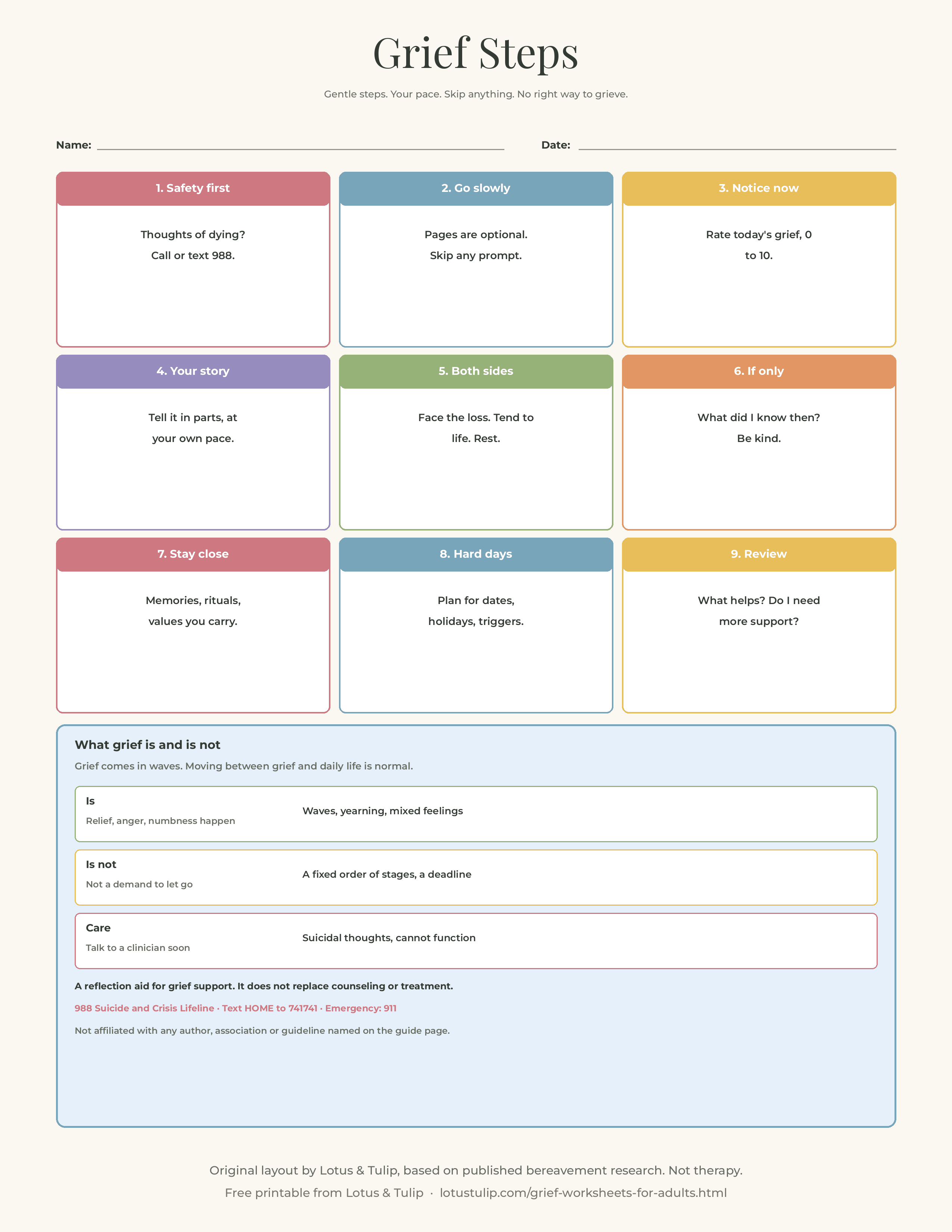
You will get twelve worksheet backed exercises with timing and debrief questions, a six session starter plan, adaptations for different kinds of loss, honest notes on what the research does and does not show, three fictional examples, seven FAQs, a nine step HowTo and a free three page US Letter printable: Grief Steps, My Plan for Hard Days, and a Grief Waves Log with nine pocket cards.
This page is distinct from our grief activities for kids, grief activities for teens and the grief group curriculum for students. Those pages are built around children, teens and school counseling. This one is for adults: partners, adult children, parents who have lost a child, friends, coworkers, and people grieving losses that others may not recognize.
We draw on published bereavement research and diagnostic guidance, without claiming any affiliation or endorsement: the Dual Process Model of coping with bereavement (Stroebe and Schut, 1999); continuing bonds (Klass, Silverman and Nickman, 1996); the tasks of mourning described by J. William Worden; the Yale Bereavement Study (Maciejewski and colleagues, 2007); resilience trajectories after loss (Bonanno and colleagues, 2002); the Currier, Neimeyer and Berman (2008) review of bereavement interventions; and the prolonged grief disorder criteria in DSM-5-TR and ICD-11. The printable is an original Lotus and Tulip layout.
This guide is educational. Grief is not a disorder, and worksheets do not treat prolonged grief disorder, depression or trauma. If you or someone you support is thinking about suicide or about joining the person who died, call or text 988 (Suicide and Crisis Lifeline) or text HOME to 741741 (Crisis Text Line). For immediate danger, call 911. For a written plan for a crisis moment, see our safety plan worksheet.
What grief worksheets for adults are (and are not)
A grief worksheet is a structured page with prompts that help an adult name, sort and carry what the loss has brought. Good grief worksheets are gentle, optional and open ended. They leave room to skip a prompt, to write very little, or to come back later. They do not grade the griever and do not hold a timeline over anyone's head.
What they are not.
- Not a checklist of stages. Many adults have heard that grief moves through denial, anger, bargaining, depression and acceptance in order. Real grief rarely follows a script. Worksheets that ask "which stage are you in?" can leave people feeling they are grieving wrong.
- Not a deadline. There is no correct date by which someone should feel better. Anniversaries, holidays and life events can bring grief back years later, and that is common.
- Not a demand to let go. Many grieving adults keep a bond with the person who died through memories, rituals, values and conversations. Worksheets can support that connection instead of trying to cut it.
- Not a replacement for care. When grief is tangled with suicidal thoughts, severe depression, trauma from how the person died, or substance use, a page is a support, not the treatment.
- Not forced disclosure. Writing can stir up strong feelings. The person decides how much to write and whether to share it.
How grief tends to work: four ideas that shape good worksheets
1. Grief comes in waves, and moving between grief and life is normal. The Dual Process Model (Stroebe and Schut, 1999) describes two kinds of stressors after a death. Loss oriented stressors involve the loss itself: missing the person, looking at photos, crying, thinking about the death. Restoration oriented stressors involve the life that has changed: new tasks, new roles, money, paperwork, a different identity, and taking a break from grief. The model proposes that people cope by oscillating between the two, sometimes facing the loss and sometimes setting it aside, and that taking respite from grief is part of healthy coping, not a failure. Worksheets built on this idea ask about both sides.
2. Yearning is often the loudest feeling, and acceptance can sit alongside it. In the Yale Bereavement Study, Maciejewski, Zhang, Block and Prigerson (2007, JAMA) followed 233 bereaved adults after deaths from natural causes, from 1 to 24 months after the loss. Acceptance of the death was the most frequently endorsed item, even early on, and yearning was the dominant negative feeling throughout. Disbelief, yearning, anger and depression each tended to peak within roughly the first six months. The study looked at natural deaths, not sudden or violent deaths, so it does not describe every loss. It is still a useful corrective to the idea that grief is mostly sadness or that people must be in denial first.
3. Many bonds continue. The book Continuing Bonds: New Understandings of Grief (Klass, Silverman and Nickman, 1996) challenged the older view that healthy grief means detaching from the person who died. Many adults keep an inner relationship with that person: talking to them, keeping a ritual, living a value they cared about. Worksheets can ask "how do you stay connected?" without pathologizing the answer.
4. Most people are resilient, and some are not, and both need respect. Bonanno and colleagues (2002) followed 205 older adults from before the death of a spouse to 18 months after and described several distinct patterns. The most common was resilience (relatively low distress throughout); a smaller group showed chronic grief. Resilience does not mean someone did not love the person. A persistent, impairing pattern is worth a closer clinical look. Good worksheets do not assume everyone is falling apart, and do not assume everyone is fine.
Worden's tasks of mourning, from his clinician text Grief Counseling and Grief Therapy, are another common frame: accepting the reality of the loss, processing the pain of grief, adjusting to a world without the person, and finding an enduring connection with the person while embarking on a new life. Worden describes these as tasks, not fixed stages, and people may revisit them in any order.
When grief may need more than worksheets
Most grief, even very painful grief, is not a mental disorder. A small share of bereaved adults develop prolonged grief disorder, which is now a formal diagnosis. In DSM-5-TR, the death must have happened at least 12 months ago for adults (at least 6 months for children and adolescents), with intense yearning or preoccupation with the person nearly every day for at least the last month, at least three of eight further symptoms (such as identity disruption, marked disbelief, avoidance of reminders, intense emotional pain, difficulty reengaging with life, numbness, feeling life is meaningless, intense loneliness), clear distress or impairment, and a reaction that clearly exceeds cultural and religious norms. ICD-11 uses a minimum of six months after the loss, again with attention to cultural norms. A 2017 meta analysis by Lundorff and colleagues estimated prolonged grief disorder in about 9.8 percent of bereaved adults (14 studies), with wide variation across studies.
Only a qualified clinician can assess this. Practical signs that someone should be seen by a clinician, whatever the time since the loss:
- Thoughts of suicide, of wanting to die, or of wanting to be with the person who died. Use 988, HOME to 741741 or 911 right away when there is risk.
- Grief that keeps the person from basic functioning for a long time: not eating, not sleeping, not working or caring for dependents.
- Intrusive images, nightmares or flashbacks about how the person died, which may point to trauma alongside grief.
- Heavy or increasing use of alcohol, drugs or sleeping pills to cope.
- Depression that looks like more than grief: pervasive worthlessness, inability to feel any pleasure at all, or symptoms that do not ease at all with time.
Worksheets can still be part of care in these situations, but they sit inside a clinical plan, not in place of one.
12 grief worksheet exercises for adults
Each exercise can be a session segment, a take home page or a quiet half hour with a cup of tea. Offer, never force. Let the person skip anything. The free printable covers the core of exercises 1, 2, 6, 9 and 11; the full grief and loss worksheet set covers all twelve themes and more.
1. My loss story
Time: 20 to 40 minutes, often split across sessions. When: early, once there is enough trust.
Prompts walk through who the person was, what happened, how the person learned of the death, the days after, and what life looks like now. Some adults write pages; some write five lines. A clinician can read it with the client or simply ask what it was like to write. Telling the story in one's own words is often the first time the whole arc has been held in one place.
Debrief: "Which part of the story was hardest to write? Which part have you never told anyone?"
2. Grief waves chart
Time: 2 minutes a day for one to two weeks. When: any time; helpful when someone feels "worse again" and fears they are going backward.
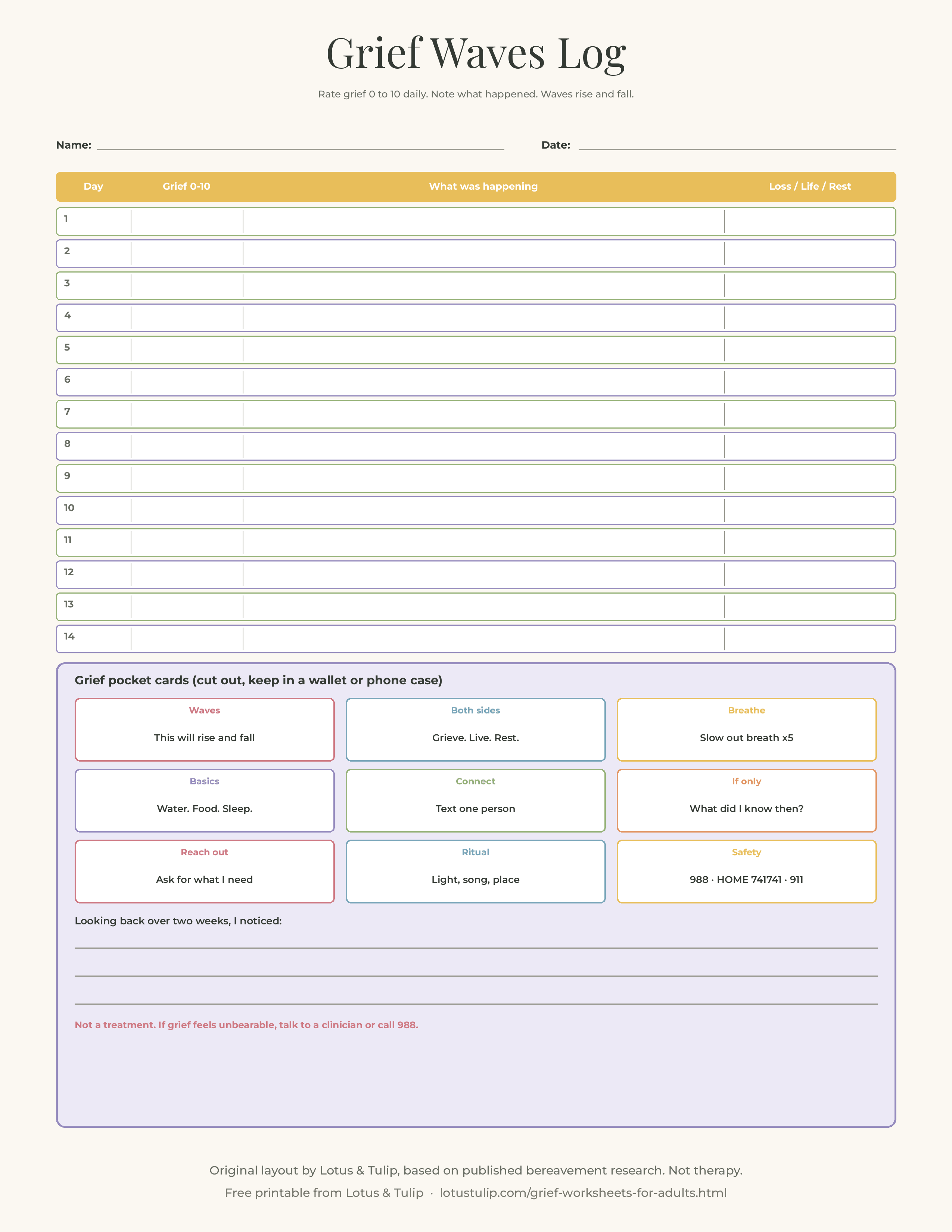
Each day, rate grief intensity from 0 to 10 and note what was happening: a song, a date, a smell, a quiet evening, a busy workday. Over a couple of weeks the chart usually shows rises and falls rather than a straight line. That pattern helps people see that a bad day is a wave, not a collapse, and it helps clinicians spot triggers.
Debrief: "What tends to come before the high points? What was going on during the lower ones?"
3. The many feelings of grief
Time: 15 minutes. When: when someone is surprised by a feeling (relief, anger, numbness, guilt) and judges themselves for it.
A page lists common feelings: sadness, yearning, anger, guilt, relief, numbness, fear, loneliness, gratitude, even moments of joy. The person circles what they have felt and writes where in life it shows up. Naming mixed feelings, especially relief after a long illness or anger at the person who died, often reduces shame.
Debrief: "Which feeling surprised you? Which one do you think you are not allowed to have?"
4. Grief in the body, mind and behavior
Time: 10 to 15 minutes. When: when someone says "I feel like I am going crazy."
Many grieving adults notice fatigue, poor sleep, appetite changes, aches, foggy thinking, forgetfulness, restlessness, or searching for the person in crowds. A body, mind and behavior map normalizes these experiences and separates what may need a medical check (for example, chest pain or major weight loss) from what is common in early grief.
Debrief: "Which of these has worried you most? Is there anything here you would like to check with a doctor?"
5. Myths and truths about grief
Time: 10 minutes. When: when someone is measuring their grief against outside rules.
Pair common myths ("grief ends after a year," "if I stop crying I didn't love them," "I should be over this by now," "talking about them keeps me stuck") with gentler, more accurate statements. Invite the person to add the "rules" they have heard from family, faith communities, work or social media, and to decide which rules they want to keep.
Debrief: "Whose voice is behind the rule that hurts most?"
6. Triggers and hard dates calendar
Time: 15 minutes. When: before birthdays, anniversaries, holidays and first events (the first Thanksgiving, the first wedding without them).
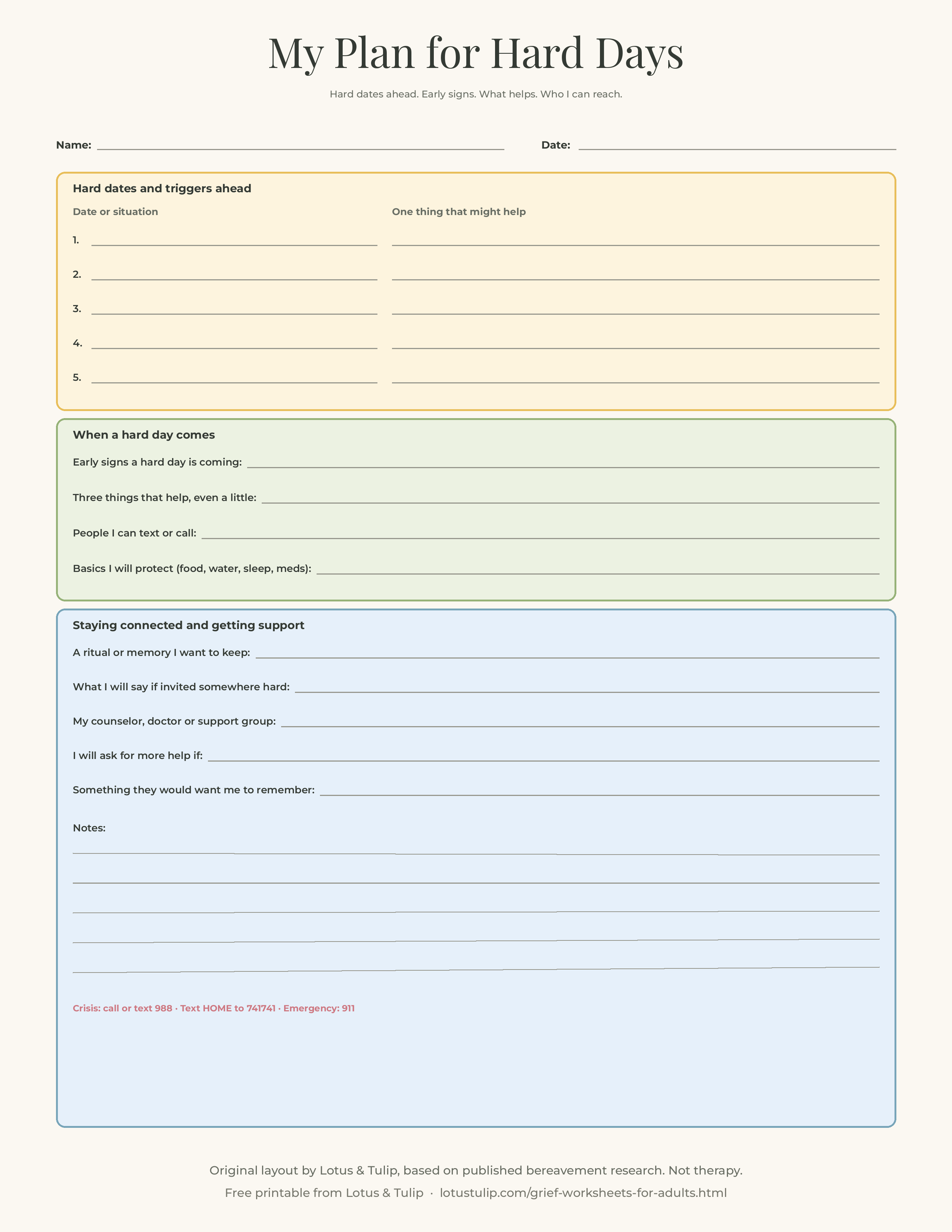
List the dates and situations likely to be hard over the coming months: the anniversary of the death, the person's birthday, holidays, family gatherings, the season of the diagnosis, places you used to go together. For each, note one thing that might help. Anticipating a hard date often makes it less ambushing, even when it still hurts. This is the heart of page two of the free printable.
Debrief: "Which date are you dreading most? Who knows that this day is hard for you?"
7. Two sides of coping (facing the loss and tending to life)
Time: 15 to 20 minutes. When: when someone seems stuck on one side: unable to stop thinking about the loss, or rushing to stay busy and never stopping.
Based on the Dual Process Model, draw two columns. Left: ways I face the loss (looking at photos, visiting the grave, crying, telling stories). Right: ways I tend to life (work, cooking, paperwork, new routines, rest, a show that makes me laugh). Then ask which side has been crowded out this week and plan one small step on that side. Many people feel guilty about breaks from grief; the model treats breaks as part of coping.
Debrief: "Which side has been getting most of your time? What would one small step on the other side look like?"
8. An unsent letter
Time: 20 to 30 minutes. When: when there are things left unsaid: thanks, apology, anger, news the person missed.
The person writes directly to the one who died. Prompts can include "What I want you to know," "What I wish I had said," "What I am angry about," "What I am carrying forward." The letter is not sent; some people keep it, read it aloud in session, place it at a grave or burn it in a small ritual. Go slowly when the relationship was painful, abusive or complicated. The letter can say hard things as well as loving ones.
Debrief: "What was it like to speak to them directly? Is there anything you want to do with the letter now?"
9. If only thoughts and guilt
Time: 15 to 25 minutes. When: when someone keeps replaying the death and what they should have done.
Write the if only thought ("If only I had called the ambulance sooner"). Then gently ask: What did I know at the time? What did I not know then that I know now? What was in my control and what was not? What would I say to a friend who wrote this? Hindsight makes outcomes look obvious that were not obvious then. This is not about arguing someone out of guilt but about giving the thought a fuller context. For a deeper self kindness exercise, pair it with our self compassion worksheet.
Debrief: "Did anything shift, even a little, when you wrote what you actually knew at the time?"
10. Staying connected (rituals and remembrance)
Time: 15 minutes. When: once the acute shock has eased; also helpful before anniversaries.
List ways the bond continues: a recipe made every year, a playlist, a scholarship, a garden, wearing a watch, carrying on a value the person lived by, a story told at each holiday. Then choose one ritual to keep or create. Respect cultural and religious practices; some traditions have defined mourning periods and rituals, and the worksheet should fit those rather than replace them.
Debrief: "What is one way they are still part of your life? Is there a ritual you would like to start?"
11. A plan for hard days
Time: 15 to 20 minutes. When: any time, and especially before the first holiday season after a loss.
A short written plan: early signs a hard day is coming, three things that help even a little, people I can text, what I will say if someone asks me to a gathering, how I will take care of the basics (food, water, sleep, medication), and when to call for more help. Include crisis numbers at the bottom. Page two of the free printable is built for this.
Debrief: "If tomorrow is a hard day, what is the first thing on your plan?"
12. Finding my footing again
Time: 20 minutes. When: later in grief work, when the person is ready to look ahead without leaving the person behind.
Prompts explore roles that have changed (no longer a spouse, a caregiver, a daily phone call), skills learned, small things that bring meaning, people who have shown up, and one or two steps toward a life that holds both the loss and the future. Some people find this exercise premature for a long time. That is fine.
Debrief: "What is one small thing you would like to try in the next month? What would they say about it?"
A six session starter plan for grief work with adults
Every person grieves differently, and many people need more or fewer sessions. This sequence is a starting structure for individual counseling, not a protocol. Let the client lead the pace.
| Session | Focus | Optional take home page |
|---|---|---|
| 1 | Getting to know the person and the loss, safety check, what grief has been like so far, what support exists | Grief waves chart (exercise 2) |
| 2 | Loss story, at the client's pace; many feelings of grief | Feelings page or a short loss story (exercises 1 and 3) |
| 3 | Body, mind and behavior; myths and truths; basic care (sleep, food, movement) | Body and mind map (exercise 4) |
| 4 | Two sides of coping; if only thoughts and guilt if present | Two sides of coping or if only page (exercises 7 and 9) |
| 5 | Continuing bonds, rituals, unsent letter if wanted | Staying connected or unsent letter (exercises 8 and 10) |
| 6 | Hard dates ahead, plan for hard days, next steps and whether further support is needed | Hard dates calendar and plan for hard days (exercises 6 and 11) |
At each session, rate grief intensity and check sleep, appetite, substance use and safety in a sentence or two. If you see signs of prolonged grief disorder, major depression or trauma symptoms, consider formal assessment and evidence based treatments for those conditions, or refer to a clinician who specializes in them.
In a grief support group, the same pages work well as weekly anchors: one shared theme (for example, hard dates), a few minutes of quiet writing, and voluntary sharing in pairs or the full group. Never require people to read their writing aloud.
How to use grief worksheets for adults, step by step
- Check safety first. Ask about thoughts of suicide or of wanting to be with the person who died, substance use, and basic functioning. If there is risk, pause worksheets and use a safety plan, 988, HOME to 741741 or 911.
- Explain the purpose. Say that the pages are optional, that there is no right way to grieve, and that any prompt can be skipped.
- Start with what is alive now. Use a grief waves chart or a simple feelings check before asking for the full loss story.
- Invite the story at their pace. Offer the loss story prompts in parts across sessions if needed.
- Name both sides of coping. Look at time spent facing the loss and time spent tending to life, and plan one small step on whichever side is crowded out.
- Work gently with guilt and if only thoughts. Separate what was known then from what is known now, and what was in the person's control.
- Honor the bond. Explore rituals, memories and values that keep the connection alive in a way that fits the person's culture and faith.
- Plan for hard days and dates. Map upcoming anniversaries and holidays and write a short plan with people to contact and crisis numbers.
- Review and decide next steps. Look back over the pages together and decide whether to continue, taper, or refer for assessment of prolonged grief, depression or trauma.
Adaptations for different kinds of loss
- Loss of a spouse or partner. Expect big restoration side changes: finances, household tasks, social life organized around couples, sleeping alone. The two sides of coping page is often the most useful. Watch for isolation in older adults.
- Loss of a child. Parents may grieve very differently from each other, which can strain the relationship. Avoid comparing grief between partners. Anniversaries and milestones the child would have reached (graduations, birthdays) often need their own plan.
- Loss of a parent. Adult children may grieve both the parent and a role (caregiver, the person who called every Sunday). Sibling conflict over estates or care decisions is common and worth naming.
- Sudden, violent or traumatic death. Suicide, overdose, accidents, homicide and disasters can bring trauma symptoms alongside grief: intrusive images, nightmares, hypervigilance. Go slowly with loss story work and consider trauma informed assessment. Our window of tolerance worksheet can help pace sessions. Survivors of suicide loss face particular stigma and guilt, and the 988 Lifeline is open to them as well.
- Anticipatory grief and long illness. Caregivers may grieve before the death and feel relief after it, then guilt about the relief. The many feelings page helps here.
- Pregnancy loss and infant loss. Others may minimize these losses. Offer the staying connected page carefully, since there may be few shared memories, and validate the loss of a future that was imagined.
- Disenfranchised grief. Grief that others do not recognize, such as the death of an ex partner, a friend from an online community, a coworker, a pet, or a person whose relationship was hidden, can be especially lonely. Name it as real grief.
- Non death losses. Divorce, estrangement, a diagnosis, the loss of a home or a job can bring grief too. Many prompts adapt well; adjust the wording so it does not assume a death.
- Culture and faith. Mourning practices, beliefs about the afterlife, expectations about crying or not crying, and family roles vary widely. Ask what the person's tradition says and what the person believes, and fit the worksheets to that.
- Telehealth. Share pages on screen or by secure portal. Agree on what the person will do after a heavy session at home, since they may be alone when the call ends.
Tips for clinicians and support leaders
- Follow, do not push. Offer a page; let the person choose. Pressure to "process" too fast can feel like another loss of control.
- Use the person's words. If they say "my husband," "Mom" or the person's name, use that rather than "the deceased."
- Normalize waves. A bad week after a few good ones is common, especially near dates. The grief waves chart shows this visually.
- Keep pages short. Fatigue and poor concentration are common in grief. One page and one question is often enough.
- Ask about the basics. Sleep, food, water, movement and medication often slip. Our sleep hygiene worksheet can help when sleep has fallen apart.
- Screen without pathologizing. Most grief is not a disorder, but a quiet check for suicidal thoughts, substance use, trauma symptoms and prolonged grief signs is part of good care.
- Care for yourself. Grief work is heavy. Use consultation and your own support, especially when a client's loss resembles your own.
Common mistakes to avoid
- Teaching the five stages as a required sequence.
- Setting a deadline for feeling better, or praising "moving on" as if it means forgetting.
- Asking for the full story of a traumatic death in the first session.
- Treating relief, anger or numbness as signs of a problem rather than common parts of grief.
- Ignoring the restoration side: paperwork, money, roles and loneliness can be as heavy as the sadness.
- Assuming everyone grieving needs therapy. Many adults cope well with support from family, friends and community, and research suggests that offering treatment to all bereaved people is less helpful than targeting those who are struggling.
- Missing risk. A grieving person who says they want to be with the person who died should be asked directly about suicide.
Worked fictional examples
Denise, 67, eight months after her husband's death. Denise said she was "doing fine" but had stopped seeing friends because they all came as couples. Her grief waves chart showed high points every Sunday evening, when they used to plan the week together. The two sides of coping page showed lots of time on the loss side at home and almost nothing on the restoration side. She chose one step: joining a Sunday afternoon walking group. Her Sunday ratings eased over the following month, though the first holiday season still brought a spike that her plan for hard days helped her get through.
Marcus, 41, after his brother's overdose. Marcus came in with intense guilt: "If only I had answered his call." The if only page helped him write what he knew at the time (he was at work and had answered many such calls before) and what he did not know (that this night was different). He also described nightmares and intrusive images of finding his brother. His counselor added trauma informed assessment and paced the loss story slowly. The unsent letter came months later.
A case where worksheets were not the right first step. A woman in her fifties, a year after the death of her adult son, told her counselor she saw no reason to keep living and had stopped eating regular meals. The counselor set worksheets aside, completed a safety plan, connected her with 988 and arranged a psychiatric evaluation. Grief pages came back into the work weeks later, once she was safer and had more support.
These examples are fictional composites for teaching purposes, not real clients.
Grief worksheets for adults vs related guides
| Guide | Best when the main need is | Overlap |
|---|---|---|
| Grief worksheets for adults (this page) | Adult bereavement: story, waves, guilt, bonds, hard dates | All twelve exercises |
| Grief activities for teens | Grieving teens in school or counseling | Feelings, memories, hard days |
| Grief activities for kids | Young children after a death | Memory and feelings work, simpler language |
| Self compassion worksheet | Harsh self talk and guilt | Exercise 9 |
| Behavioral activation worksheet | Low mood and withdrawal from activities | Restoration side of coping |
| Radical acceptance worksheet | Fighting a reality that cannot be changed | Accepting the reality of the loss |
| Safety plan worksheet | Suicidal thoughts or crisis | Use first when there is risk |
When not to use these worksheets
- Acute crisis. When there are suicidal thoughts with intent or a plan, or the person cannot stay safe, use a safety plan, 988, HOME to 741741 or 911 before any grief page.
- In the first raw days, if the person does not want them. Practical help, presence and rest often matter more than writing in the first days after a death.
- As a substitute for treatment. Prolonged grief disorder, major depression and PTSD have specific, evidence based treatments. Worksheets support that care; they do not replace it.
- When writing makes things worse. If writing about the death reliably leaves someone flooded and unable to settle, slow down, switch to grounding and present focused pages, and consider trauma assessment.
What the research says (honestly)
The Dual Process Model. Stroebe and Schut (1999), in Death Studies, proposed that adaptive coping with bereavement involves oscillating between loss oriented and restoration oriented stressors, including taking time off from grief. It was developed with partner loss in mind and is a theoretical model, widely used in bereavement care, not a treatment trial.
Stage theory under the microscope. Maciejewski and colleagues (2007, JAMA) found in 233 adults bereaved by natural causes that acceptance was the most frequently endorsed grief indicator and yearning was the dominant negative one from 1 to 24 months. The five indicators reached their peaks in the order stage theory predicts, but disbelief was not the dominant early response. The authors suggested that people still scoring high on negative grief indicators beyond about six months may benefit from further evaluation. The sample did not include traumatic deaths.
Different trajectories. Bonanno and colleagues (2002, Journal of Personality and Social Psychology) followed 205 older adults from before to 18 months after the death of a spouse and identified several patterns, with resilience the most common and chronic grief in a smaller group. This supports not assuming that every bereaved adult needs intervention.
Do grief interventions help? Currier, Neimeyer and Berman (2008, Psychological Bulletin) reviewed 61 controlled studies. Overall, interventions had a small effect right after treatment and no statistically significant benefit at follow up. Interventions that targeted grievers showing marked difficulties adapting to the loss did better, with outcomes comparable to psychotherapy for other problems. The authors noted that untreated controls often improved naturally over time. For clinicians, the takeaway is to match intensity to need.
Treatment for complicated or prolonged grief. In a randomized trial of 95 adults with complicated grief, Shear, Frank, Houck and Reynolds (2005, JAMA) found that complicated grief treatment produced a higher response rate than interpersonal psychotherapy (51 percent vs 28 percent), with faster time to response, over 16 sessions. That is a specialized therapy delivered by trained clinicians, not a worksheet program; we mention it so clinicians know specialized options exist.
Prolonged grief disorder. DSM-5-TR and ICD-11 both now include prolonged grief disorder, with time criteria of at least 12 months (DSM-5-TR, adults) and at least 6 months (ICD-11) after the death. Lundorff and colleagues (2017, Journal of Affective Disorders) estimated a pooled prevalence of about 9.8 percent in bereaved adults across 14 studies.
Bottom line. The research supports a gentle, flexible approach for most grieving adults, careful screening, and more intensive, specialized care for those who are struggling most. The free printable on this page has not been tested in a trial. It is a structured aid for reflection and conversation, built on these ideas.
Free grief worksheets for adults printable (PDF)
The free printable has three pages in US Letter size:
- Page 1: Grief Steps. Nine gentle steps that match the HowTo above, what grief is and is not, and crisis resources.
- Page 2: My Plan for Hard Days. Hard dates ahead, early signs, what helps, people to contact, basics, staying connected and when to get more help.
- Page 3: Grief Waves Log + pocket cards. A two week chart for daily grief ratings and notes, plus nine cut out cards (Waves, Both sides, Breathe, Basics, Connect, If only, Reach out, Ritual, Safety).
Download the free grief worksheets for adults printable (PDF, 3 pages, US Letter)
Prefer single images? Page 1: Grief Steps (PNG) · Page 2: My Plan for Hard Days (PNG) · Page 3: Grief Waves Log (PNG)
Free to print for your own use and for use with your own clients. This is an original layout by Lotus & Tulip, drawing on published bereavement research and diagnostic guidance (Stroebe and Schut 1999; Klass, Silverman and Nickman 1996; Worden; Maciejewski et al. 2007; Bonanno et al. 2002; Currier, Neimeyer and Berman 2008; DSM-5-TR; ICD-11). It is not affiliated with or endorsed by any author, organization or guideline body named on this page, does not diagnose or treat any condition, and is not a substitute for therapy. Please link to this page rather than re-uploading the file.
Free grief starter pack: Want more real pages? The free grief worksheets for therapists starter pack adds grief waves, the many feelings of grief, two sides of coping, memories and what I carry, a plan for hard days and a support and safety page from our paid grief and loss set (8 pages, client use license, no email).
Related resources
- Loneliness worksheet for adults: the loneliness that often follows a loss, with a free reconnection plan
- Dual process model of grief worksheet: two sides of grief and a back and forth log, free printable.
- Therapist worksheets: CBT, DBT, ACT and more: all worksheet sets in one place.
- Grief activities for teens: for grieving teenagers.
- Grief activities for kids: for younger children.
- Self compassion worksheet: for guilt and harsh self talk.
- Behavioral activation worksheet: small steps back into life.
- Sleep hygiene worksheet: when grief disrupts sleep.
- Safety plan worksheet: when the moment is about staying safe.
Sources
- American Psychiatric Association. Prolonged grief disorder (patient and family information; DSM-5-TR criteria). psychiatry.org.
- Bonanno, G. A., Wortman, C. B., Lehman, D. R., Tweed, R. G., Haring, M., Sonnega, J., Carr, D., and Nesse, R. M. (2002). Resilience to loss and chronic grief: A prospective study from preloss to 18 months postloss. Journal of Personality and Social Psychology, 83(5), 1150 to 1164.
- Currier, J. M., Neimeyer, R. A., and Berman, J. S. (2008). The effectiveness of psychotherapeutic interventions for bereaved persons: A comprehensive quantitative review. Psychological Bulletin, 134(5), 648 to 661.
- Klass, D., Silverman, P. R., and Nickman, S. L. (Eds.). (1996). Continuing Bonds: New Understandings of Grief. Taylor and Francis.
- Lundorff, M., Holmgren, H., Zachariae, R., Farver-Vestergaard, I., and O'Connor, M. (2017). Prevalence of prolonged grief disorder in adult bereavement: A systematic review and meta analysis. Journal of Affective Disorders, 212, 138 to 149.
- Maciejewski, P. K., Zhang, B., Block, S. D., and Prigerson, H. G. (2007). An empirical examination of the stage theory of grief. JAMA, 297(7), 716 to 723.
- Shear, K., Frank, E., Houck, P. R., and Reynolds, C. F. (2005). Treatment of complicated grief: A randomized controlled trial. JAMA, 293(21), 2601 to 2608.
- Stroebe, M., and Schut, H. (1999). The dual process model of coping with bereavement: Rationale and description. Death Studies, 23(3), 197 to 224.
- Worden, J. W. (2018). Grief Counseling and Grief Therapy: A Handbook for the Mental Health Practitioner (5th ed.). Springer Publishing.
- World Health Organization. ICD-11, 6B42 Prolonged grief disorder. icd.who.int.
Grief worksheets for adults: FAQ
What are grief worksheets for adults?
They are gentle, structured pages that help bereaved adults tell the story of their loss, track grief as it comes and goes, name mixed feelings, work with guilt, stay connected to the person who died and plan for hard days and dates. Therapists use them in session and as optional take home pages.
Do grief worksheets help?
They can give structure and words to an experience that often feels chaotic, but they have not been tested as a standalone treatment. Research suggests that grief support works best when matched to need, with more intensive, specialized treatment for adults who are struggling most.
Are the five stages of grief real?
Many people recognize some of those feelings, but grief rarely follows a fixed order. In the Yale Bereavement Study, acceptance was common even early on and yearning was the strongest negative feeling. Worksheets on this page avoid asking which stage someone is in.
How long does grief last?
There is no set timeline. Many people find the most intense grief eases over the first months, while waves return around anniversaries and holidays for years. Prolonged grief disorder is diagnosed only when intense, impairing grief continues for at least 12 months after a death in adults under DSM-5-TR (6 months under ICD-11), beyond cultural norms.
Can I use these worksheets on my own without a therapist?
Yes, many adults use reflection pages on their own, and the free printable is written to be safe for that. Go at your own pace and skip anything that feels like too much. If grief is making it hard to function, or you have thoughts of suicide, please reach out to a clinician, 988, or text HOME to 741741.
What is the difference between grief and depression?
Grief usually centers on missing the person and comes in waves, often mixed with good memories and moments of comfort. Depression tends to be more pervasive, with low mood and loss of interest across most of life, and often harsh feelings of worthlessness. They can overlap, and a clinician can help sort them out.
When should a grieving adult see a professional?
When there are thoughts of suicide or of wanting to join the person who died, when grief keeps someone from basic functioning for a long time, when there are nightmares or intrusive images about the death, when alcohol or drugs are being used to cope, or when the person simply wants more support. In an emergency, call 911.