
Kids and teens · Updated 2026-11-06
Grief Activities for Teens (with Free Printable)
Ready-made printable: Grief Group Curriculum for Students Holiday 20% off: about $11.04, was $14 (EUR 12) · instant digital download
Buy on EtsyTry it free first: download session 1 free (group at a glance, lesson plan and student page, PDF, 72 KB). Run it with your group, then get all 8 sessions. No email needed.

Grief activities for teens are practice tools that help middle and high school students name a loss, sort grief from depression in plain educational language, map support people, keep a continuing bond with what was lost when that feels right, oscillate between facing the loss and taking restoration breaks (Stroebe and Schut dual process model, credited with clear non-affiliation), try Worden-style mourning tasks without treating stages as a checklist, handle school and social media memorial pressure, log what helps, and know when to pause for safety. Teen grief is not a longer kids grief worksheet. Identity, peers, dating, sports and arts scenes, college talk, delayed grief that hits months later, anger that looks like "attitude," and public memorial posts raise the stakes. Belonging still matters. So does honesty that grief is not one neat curve.
This Lotus and Tulip page is a teen-focused grief activities guide with an original free three page US Letter printable. It targets searches families and helpers actually use: grief activities for teens, grief worksheets for teenagers, bereavement activities for high school, grief group activities for teens, and teen grief counseling worksheets. It is distinct from our grief activities for kids (younger memory pages, Speece and Brent style death concepts, adult-coached language), from grief and loss worksheets for therapists (clinician pack for broader caseloads), from emotional regulation activities for teens, from self esteem activities for teens, from coping skills worksheets for teens, from divorce worksheets for kids (secondary loss of family form, not a primary death grief page), and from safety plan worksheet. Those neighbors help. This page centers adolescent bereavement and non-death losses teens actually face: death of a person, pet loss, friendship endings, and parental divorce as a secondary loss with a cross-link, not as the main topic.
We credit Worden's tasks of mourning, the Stroebe and Schut dual process model of coping with bereavement, and continuing bonds ideas associated with Klass, Silverman, and Nickman with clear non-affiliation. We also cite educational reviews of adolescent grief and school-based bereavement support as research context, not as proof that this free printable remits grief, depression, PTSD, or any diagnosis. We are not affiliated with those authors, any scale publisher, or any branded grief curriculum. This printable is an original educational layout, not a copy of any copyrighted worksheet and not a diagnosis or treatment.
This guide is educational. It is not therapy, not medical advice, and not a diagnosis. If thoughts of ending your life, plans to harm yourself or someone else, or a medical emergency show up, stop the worksheet and get help now: in the US, call or text 988, text HOME to 741741, or call 911. Our safety plan worksheet is a better first tool in that moment. Nearby tools: grief for kids, emotion regulation for teens, self esteem for teens, coping skills for teens, anger management for teens, friendship for teens, and divorce for kids.
Jump to the free grief activities printable (PDF) · How to use grief activities for teens, step by step · Worked examples · Comparisons
What teen grief is (and how it differs from kids grief pages)
Kids grief pages often teach concrete death concepts, simple memory pages, and adult-coached language about what happens to a body and who will care for the child. Teen grief activities keep those bones and add autonomy, identity, peer status, school performance pressure, social media memorials, delayed waves of grief, and anger that adults sometimes misread as defiance.
Teen grief response skills include:
- Safety sort first when crisis risk, self-harm talk, or acute danger is present.
- Naming the loss without forcing a performance of "closure."
- Sorting grief vs depression in educational language (not a diagnosis): grief often stays connected to the loss; clinical depression can bring persistent hopelessness, anhedonia, and self-worth collapse that need professional assessment.
- Mapping support people, places, and school adults who can help.
- Continuing bonds that keep a respectful connection (letters, rituals, shared values) without pretending the person or pet is still alive in a confusing way.
- Dual process oscillation: time facing the loss (loss-oriented) and time doing life tasks and breaks (restoration-oriented), credited to Stroebe and Schut with non-affiliation.
- School and digital scenes: presentations, sports, memorial posts, anniversary triggers in group chats.
- Knowing when not to force talk: optional practice, never forced public disclosure.
Teens also weigh identity groups, dating, college talk, sports and arts scenes, and online audiences. A skill that worked with a younger child (draw a memory and share with the class) may feel babyish or unsafe when the teen needs private memorial options, peer support, and adult backup without becoming the hallway story.
Grief vs depression (educational, not diagnostic)
Helpers and teens often ask: is this grief or depression? Educational sorting helps choose tools. It does not diagnose. Only a qualified clinician can assess for a depressive disorder, PTSD, prolonged grief disorder, or other conditions.
Grief (bereavement response) often includes waves of sadness, yearning, anger, guilt, relief, numbness, or mixed feelings tied to reminders of the loss. Function can dip and then return in uneven bursts. Teens may still laugh with friends and then crash when a song plays. That oscillation is common and does not prove they "do not care."
Depression (as a clinical concern to screen for, not label from a worksheet) more often includes persistent low mood or irritability most of the day, loss of interest in most activities, major sleep or appetite change, harsh self-worth beliefs, and hopelessness that is not only about the person or pet who died. Suicidal thinking can appear in either context. Treat safety first. Prefer a safety plan and crisis pathways when risk is high.
Teach teens a fair line: grief can hurt a lot and still be a human response to loss. Persistent hopelessness, self-hatred, or plans to die need adult help the same day. Do not use this printable to diagnose. Use it to name, map, cope, and log while adults stay in the loop.
Types of teen loss: death, pet, friendship, divorce as secondary loss
Death of a person. Parent, sibling, grandparent, friend, teammate, teacher. Skills: name the loss, map support, continuing bond options, school plan for hard days, adult check-ins.
Pet loss. Often minimized by peers. For many teens the pet was a daily attachment figure. Skills: validate the bond, memorial ritual, talk script for friends who shrug, continuing bond without shame.
Friendship endings. Ghosting, betrayal, moving away, group exclusion after a fight. Not the same as death, and still a real attachment loss. Skills: name what ended, sort healthy vs unhealthy patterns with friendship activities for teens, grief plan for the empty slot in the day.
Parental divorce or separation as secondary loss. Loss of family form, routines, and sometimes a home or pet access. Cross-link to divorce worksheets for kids for two-home planning. This page does not treat divorce as primary death grief. Use divorce tools for logistics and loyalty binds; use this page when the emotional load is bereavement-like yearning, anger, and identity shake.
How to use grief activities for teens, step by step
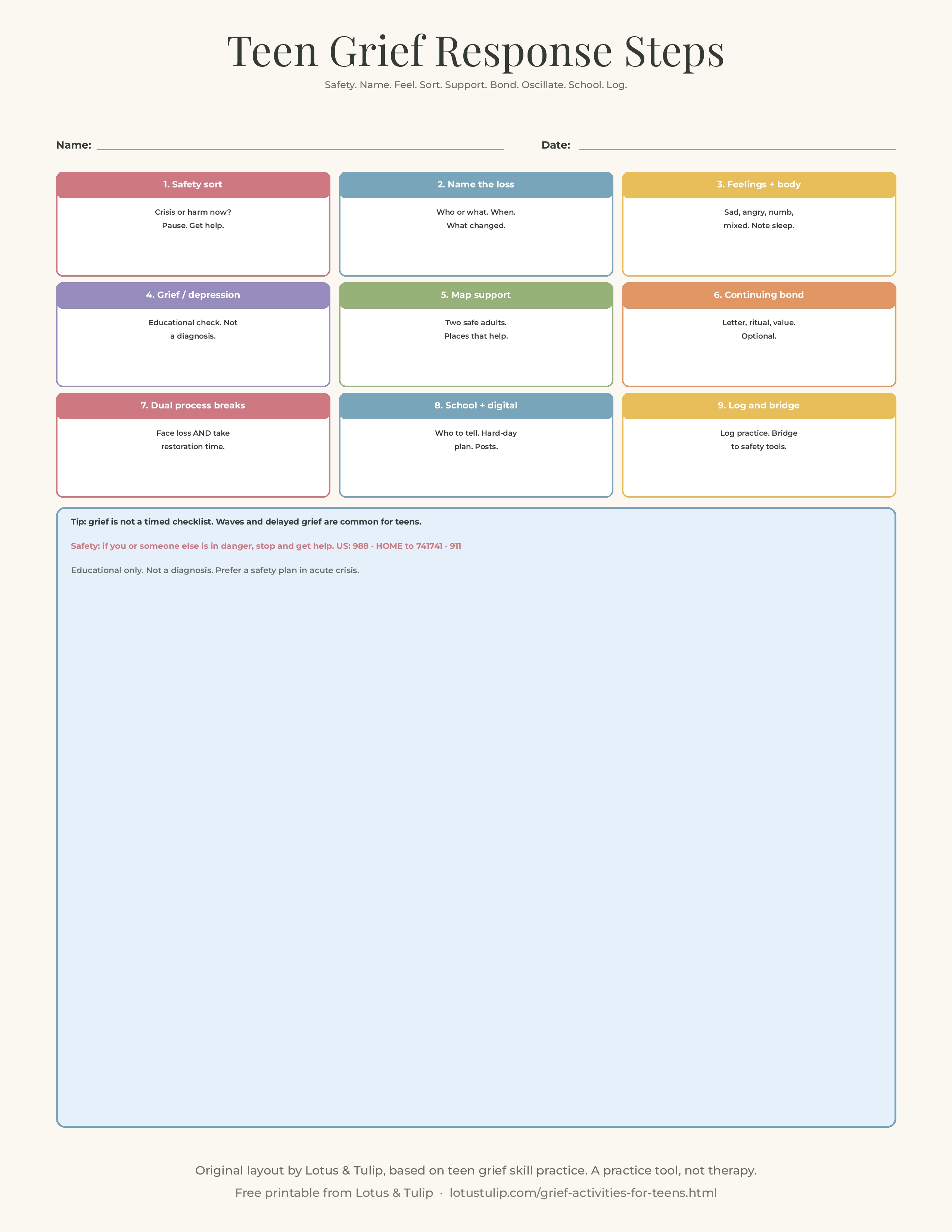
- Safety sort. If acute crisis, self-harm plans, or imminent harm, pause. Use crisis pathways first: 988, HOME to 741741, or 911 when needed. Prefer a safety plan in that moment. Do not force public grief talk.
- Name the loss. Write who or what was lost, when, and what changed in one or two fair sentences on the free plan page. Keep it specific. Avoid forcing "closure" language.
- Sort feelings and body cues. Sad, angry, numb, guilty, relieved, mixed. Note sleep, appetite, energy. Pair with emotion regulation for teens when flooded.
- Grief vs depression check (educational). Is the pain mostly tied to reminders of the loss, or is hopelessness and self-worth collapse covering most of life? If unsure and function is crashing, tell a trusted adult and seek clinical assessment. This step is not a diagnosis.
- Map support. People, school adults, places, and digital spaces that help versus drain. Circle at least two safe adults.
- Choose a continuing bond or memorial move. Letter, playlist, photo ritual, value kept alive, private journal. Optional. Never forced for the class feed.
- Plan dual process breaks. Schedule loss-facing time and restoration time (homework, sport, rest, friends) so grief does not become the only identity. Credit Stroebe and Schut dual process ideas with non-affiliation.
- School and digital plan. Who to tell at school, what to skip or modify on hard days, how to handle memorial posts and anniversary chats. Save evidence of harmful pile-ons if peers turn cruel.
- Log and bridge. Record practice on the log page. Bridge to safety plan, coping skills for teens, self esteem for teens, anger for teens, friendship for teens, or divorce for kids when those are the real neighboring loads.
Practice naming and support mapping on lower-stakes memories first when possible, then rely on the full sequence when waves are high. Skill grows with reps and with adults who take grief seriously without rushing "get over it."
Models helpers credit: Worden tasks, dual process, continuing bonds
Worden's tasks of mourning (credited with clear non-affiliation) often appear in counselor training as accept the reality of the loss, process the pain, adjust to a world without the person or pet, and find an enduring connection while moving forward. Tasks are not a timed checklist. Teens may revisit tasks for years. This page uses task language as a map, not as proof of "stages completed."
Dual process model (Stroebe and Schut, credited with non-affiliation) describes oscillation between loss-oriented coping and restoration-oriented coping. Teens who only "stay in grief mode" can burn out. Teens who only "stay busy" can stall naming. Teach intentional switches, not avoidance lectures.
Continuing bonds ideas associated with Klass, Silverman, and Nickman (credited with non-affiliation) challenge the old demand to "let go completely." Many teens keep a healthy bond through rituals, values, and private talk. Continuing bonds are not the same as denial that the death happened.
We are not affiliated with Worden, Stroebe, Schut, Klass, Silverman, Nickman, or any curriculum that packages these models. Educational credit only.
What helps vs common myths
What often helps: honest naming, predictable adults, optional memorial choices, sleep and food basics, peer support that does not force performance, school flexibility on hard days, dual process breaks, and skill printables used as practice aids.
Myths to drop:
- "Teens bounce back fast." Delayed grief is common. Anniversary and milestone waves are normal.
- "Anger means they are fine or they are bad." Anger can be grief. Pair with anger management for teens when expression harms self or others.
- "If they laugh, they do not care." Oscillation is part of dual process coping.
- "Closure is required." Many people live with an open door of memory. Pushing fake closure can shame teens.
- "Social media memorials always heal." Public posts can help or retraumatize. Let teens choose private options.
- "Pet grief is not real grief." Attachment is attachment. Validate it.
Worked fictional examples
Teen example, grandparent death (fictional): Alex, age 15, lost a grandparent two months ago. Cue: blank stare in algebra, then tears in the bathroom. Safety sort: no crisis plan, but sleep is short. Name: "Grandma died and weekends feel empty." Support map: counselor, uncle, one friend who also lost a grandparent. Continuing bond: keep Grandma's cookie recipe once a month. Dual process: Friday memorial journal for ten minutes, then soccer. School plan: tell the counselor before a presentation week. Plan written on the free grief plan page.
Teen example, pet loss (fictional): Jordan, age 14, lost a dog after ten years. Cue: anger when peers say "just a dog." Safety sort: no self-harm. Name the bond without apology. Memorial: photo page and a letter. Script for peers: "Please do not minimize this." Bridge to self esteem for teens when worth dipped after being mocked.
Teen example, friendship ending (fictional): Sam, age 16, was iced out of a friend group after a fight. Cue: stomach drop at lunch. Safety sort: no crisis. Name: friendship ended, not a death, still a loss. Skills: grief plan for the empty lunch slot plus friendship for teens for healthier next bonds. Avoid forcing a reunion that recreates harm.
School counselor note (fictional): In a twelve minute meeting, a counselor helps a student fill loss name, feeling and body cues, support map, one continuing bond option, dual process break plan, and school next step. Optional practice, never forced public sharing. Follow district crisis protocols if risk appears. For multi-session groups, pair with a grief group curriculum rather than stacking every worksheet in one period.
Teen grief vs kids grief, therapist grief pack, emotion regulation, self esteem, coping skills, and safety plan
| Teen grief (this page) | Kids grief | Therapist grief pack | Emotion regulation teens | Self esteem teens | Coping skills teens | Safety plan | |
|---|---|---|---|---|---|---|---|
| Main job | Name loss, sort grief vs depression educationally, support map, continuing bonds, dual process, school and digital plan | Younger memory pages and death concepts | Clinician worksheets for broader grief caseloads | Cool body then choose a skill | Worth, strengths, kind self talk | Menu of coping moves | Stay safe and alive in crisis |
| Best early use | When teens face bereavement or meaningful non-death loss with adult support | Younger kids with adult coaching | When a therapist needs a full clinical grief set | When flooding blocks any grief talk | When worth collapsed after loss or mockery | When the teen needs a broad coping shelf | When acute risk is present |
| Output | Loss name, feelings, support map, memorial or bond, dual process plan, school next step, practice log | Memory page for kids | Therapist session pages | Notice, name, cool, choose | Strengths and values map | Coping menu and log | Warning signs, contacts, steps to stay safe |
| Cross link | This page | Kids grief | Therapist grief | ER teens | Self esteem teens | Coping teens | Safety plan |
These tools cooperate. Teen grief builds the name-map-bond-oscillate loop. Kids grief keeps younger language. Therapist packs serve clinicians. Emotion regulation cools the body. Self esteem supports worth. Coping skills widen the menu. Safety plans cover acute risk. Teach one tool clearly before stacking four on day one.
School counselor, therapist, and parent tips
Teens. Prefer concrete scenes over lectures about "grief as a construct." Let them reject babyish cartoons. "Name it, map support, keep a bond, take restoration breaks" often lands better than a long theory talk. Keep experiments within their real control. Pair with emotion regulation for teens when flooded, and with self esteem for teens when worth collapsed after loss or mockery.
School counselors. Short meetings favor a compressed sequence: safety sort, loss name, feelings and body cues, support map, one continuing bond option, dual process break, school next step. Groups can practice optional memorial ideas with low-stakes prompts. Never force public disclosure. Follow district crisis protocols if risk appears. Avoid shaming "attention seeking"; target the skill gap and the load (sleep, ADHD supports, trauma, identity-based harm, secondary losses), not the teen's worth. Whole-school bereavement policies and adult follow-through matter more than any single worksheet.
Therapist tips:
- Stay in the client's language. Reflect their scenes and values. Do not overwrite with your favorite grief model label on day one.
- Separate grief, depression risk, and trauma load out loud, repeatedly, without diagnosing from a printable.
- Protect before perform. Do not require public memorials as proof of healing.
- Treat digital memorials as real scenes. Anniversary posts and group chat triggers belong in the plan.
- Bridge to neighbors. Safety plan for acute risk, emotion regulation for flooding, coping skills for the menu, self esteem for worth, anger tools when expression harms, divorce pages when family form is the core loss.
- Measure function. Ask what changed: earlier naming, adults told sooner, sleep slightly better, fewer forced smiles, clearer school asks, less self-blame.
Parents. Take grief seriously the first time, including pet grief. Model naming and calm support out loud. Do not force teens to attend every memorial event to look polite. After a loss, prioritize safety and adult presence, then skill practice when everyone is regulated. Do not turn the grief plan into a new weapon ("fill this out or else") that makes the worksheet feel like punishment. Ask the school what flexibility exists on hard days, and follow up.
Common mistakes
- Rushing closure so real waves never get named or supported.
- Calling pet or friendship loss "not real grief."
- Forcing public sharing in class or on social media.
- Treating dual process breaks as avoidance when restoration time is healthy.
- Ignoring sleep, ADHD supports, trauma load, or identity-based harm while blaming "attitude" alone.
- Using conflict or bullying tools as the first response when the load is bereavement.
- Using it in acute crisis instead of safety first.
- Treating the worksheet as therapy. Paper supports practice. It does not replace a clinician, school policy, or crisis care when problems are severe or lasting.
When not to use this worksheet
Good early uses: a teen who can name a loss, mild to moderate grief with adult support available, homework between counseling sessions, school counseling check-ins, and building a name-map-bond-oscillate sequence.
Prefer another tool first when:
- Acute safety risk or medical emergency: stabilize and get help (988, HOME to 741741, 911). Prefer a safety plan.
- Active plans to die or join the person who died: prioritize safety, supervision, and emergency protocols over worksheets.
- When younger language fits better: use grief activities for kids.
- When the teen is too flooded to engage: co-regulate first, then return to plan work. See emotion regulation for teens.
- When family form change is the primary load: use divorce worksheets for kids alongside, not instead of, clinical care when needed.
What the research says (honestly)
Grief activities and worksheets are a skill practice aid, not a standalone RCT treatment. Do not claim this free printable remits grief intensity, depression, PTSD, prolonged grief disorder, or any diagnosis.
Worden tasks and dual process / continuing bonds. Counselor education often credits Worden's tasks of mourning, Stroebe and Schut dual process oscillation, and continuing bonds work associated with Klass, Silverman, and Nickman. Credit those lineages with clear non-affiliation. They are conceptual maps for helpers, not proof that this three page sheet remits grief.
Adolescent grief and school support. Educational reviews of adolescent bereavement commonly note identity, peer, and school factors; delayed and oscillating grief; and the value of predictable adults and flexible school responses. Treat those as context with caveats: reviews are not technique-only RCTs of this printable.
Honest caveat. Adult support, school policy, sleep, and clinical care when indicated matter. A skill printable is not a standalone RCT treatment and is not a substitute for crisis care. For severe depression, trauma, psychosis, or acute risk, use disorder-appropriate care and crisis pathways. No study tests this three page Lotus and Tulip printable alone.
Free grief activities printable for teens (PDF)
The free grief activities printable has three pages in US Letter size:
- Page 1: Teen Grief Response Steps card. Sequence matching the HowTo: safety sort, name the loss, sort feelings and body cues, grief vs depression educational check, map support, continuing bond or memorial, dual process breaks, school and digital plan, log and bridge, plus safety reminders.
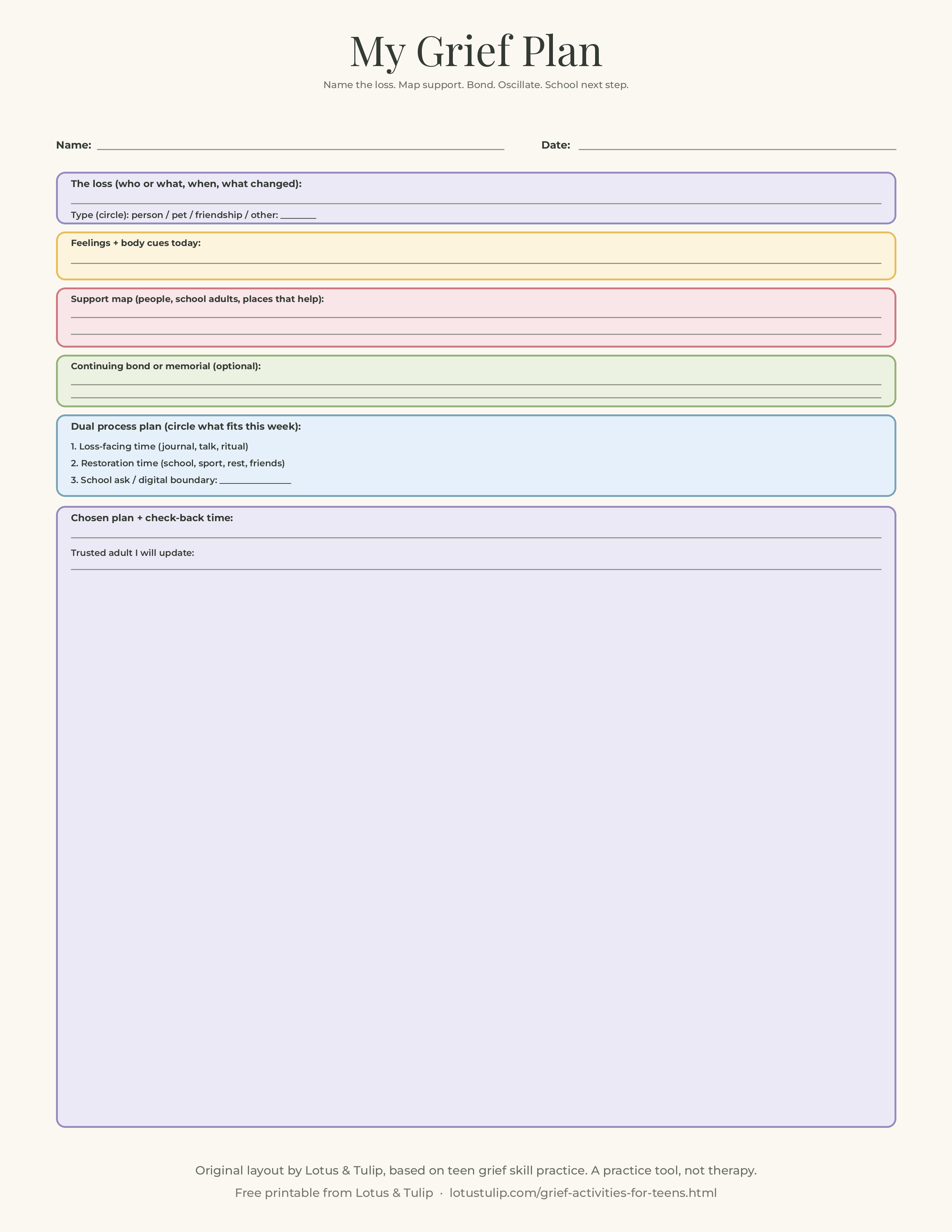
- Page 2: My Grief Plan / memory + support map. Fill in the loss, feelings, support people, continuing bond, dual process plan, and school next step.
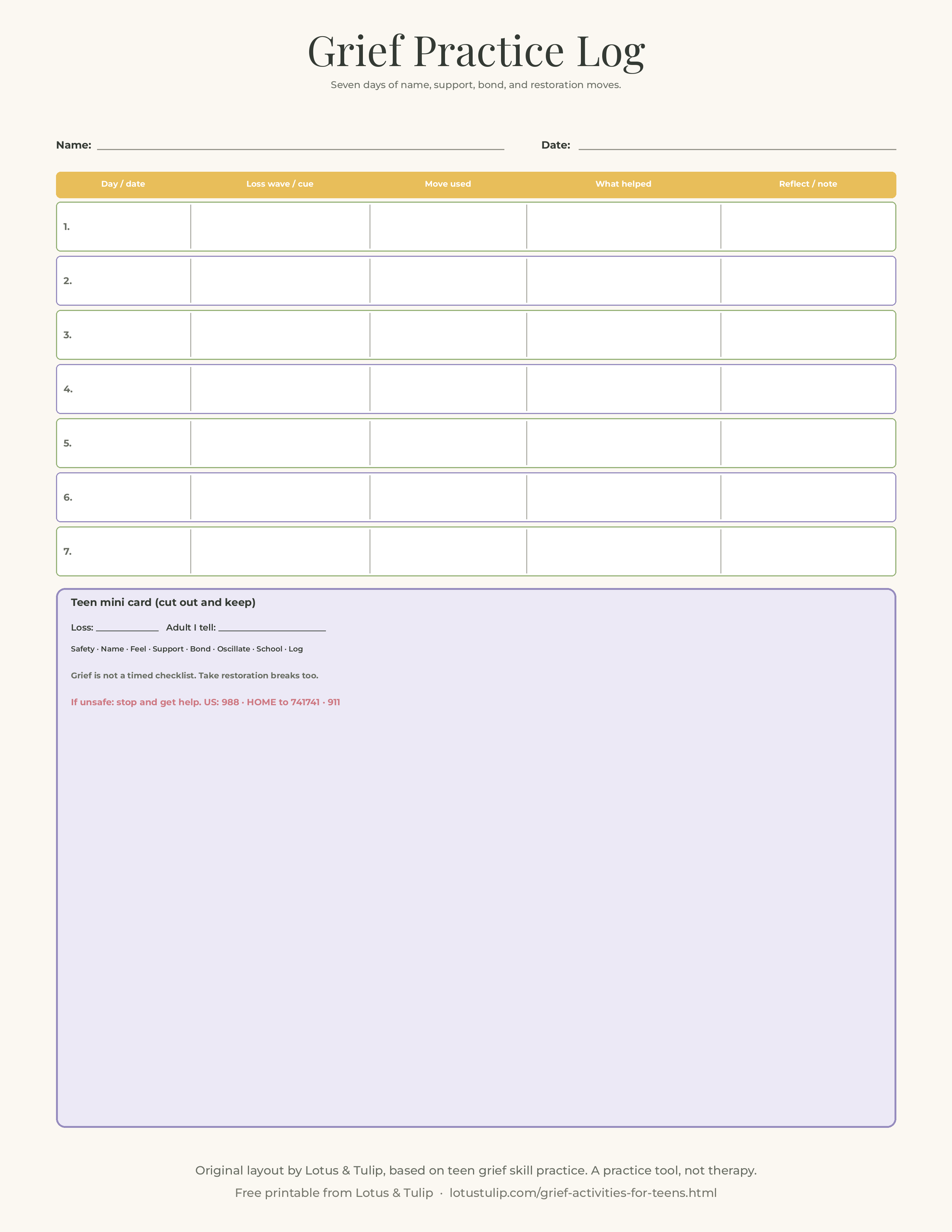
- Page 3: Practice Log + teen mini card. Seven day rows plus a cut out reminder for safety, name, support, bond, oscillate, school, log.
Download the free grief activities printable for teens (PDF, 3 pages, US Letter)
Prefer single images? Page 1: Teen Grief Response Steps (PNG) · Page 2: My Grief Plan (PNG) · Page 3: Practice Log (PNG)
Free to print for your own use and for use with your own clients, students, or groups. This is an original layout by Lotus & Tulip, based on teen grief skill practice associated with Worden tasks, Stroebe and Schut dual process ideas, and continuing bonds neighbors, with clear non-affiliation. It is not affiliated with those authors, any scale publisher, or any specific treatment or curriculum package, and is not a substitute for therapy. Please link to this page rather than re-uploading the file.
Free grief starter pack: Want more real pages? The free grief worksheets for therapists starter pack adds grief waves, the many feelings of grief, two sides of coping, memories and what I carry, a plan for hard days and a support and safety page from our paid grief and loss set (8 pages, client use license, no email).
Related resources
- Death of a grandparent worksheets for kids: helping younger siblings when a grandparent dies, with a free remembering plan.
- Pet loss worksheets for kids: helping younger siblings when a pet dies, with a free remembering plan.
- Dual process model of grief worksheet: two sides of grief and a back and forth log, free printable.
- Grief activities for kids: younger memory pages and death concepts.
- Grief and loss worksheets for therapists: clinician grief pack.
- Emotional regulation activities for teens: cool body then choose.
- Self esteem activities for teens: worth after loss or mockery.
- Coping skills worksheets for teens: broad coping menu.
- Anger management activities for teens: when grief shows up as anger.
- Friendship activities for teens: when friendship ending is the loss.
- Divorce worksheets for kids: secondary loss of family form.
- Safety plan worksheet: when the moment is about staying safe and alive.
- Icebreaker activities for counseling groups: group openers.
Sources
- Worden, J. W. Tasks of mourning tradition in counselor education (accept reality, process pain, adjust, enduring connection). Task map credit with clear non-affiliation. Not a claim that this printable completes mourning or diagnoses grief.
- Stroebe, M., and Schut, H. Dual process model of coping with bereavement (loss-oriented and restoration-oriented oscillation). Educational credit with clear non-affiliation.
- Klass, D., Silverman, P. R., and Nickman, S. L. Continuing bonds tradition. Educational credit with clear non-affiliation. Not a demand for any specific ritual.
- Educational reviews of adolescent bereavement and school-based support noting identity, peer, school, delayed and oscillating grief. Context only; not technique-only RCTs of this sheet.
- Honest caveat: teen grief drills are a skill practice aid. Conceptual models and reviews are not the same as RCTs of this Lotus and Tulip printable. Adult support and clinical care when indicated matter.
Grief activities for teens: FAQ
What are grief activities for teens?
They are practice tools for naming a loss, sorting feelings, mapping support, choosing optional continuing bonds, planning dual process breaks, handling school and digital scenes, and logging what helps. They are educational skill aids, not therapy.
Is this the same as the kids grief page?
No. The kids page uses younger language and memory pages. This teens page centers adolescent grief with identity, peers, school, social media memorials, delayed grief, and educational grief versus depression sorting.
How is grief different from depression?
Grief often stays connected to the loss and comes in waves. Clinical depression concerns include persistent hopelessness, anhedonia, and self-worth collapse that need professional assessment. This page does not diagnose. Use safety pathways when risk is high.
Can school counselors use it with teens?
Yes, often in short meetings with safety sort, loss name, support map, optional memorial, dual process break, and school next steps. Keep practice optional and school safe. Follow crisis protocols when risk appears. Do not use the page as a diagnosis.
What about pet loss or friendship endings?
Both can be real attachment losses. Validate them. Use this plan for naming and support. Pair friendship endings with the friendship teens page when the next bond skills matter.
When should I not use this worksheet?
Do not use it as the first move in acute safety risk, medical emergency, or when the teen is too flooded to engage. Stabilize and get help when needed: 988, HOME to 741741, or 911. Prefer a safety plan in crisis.
Is this affiliated with Worden, Stroebe and Schut, or continuing bonds authors?
No. This is an original Lotus and Tulip educational layout. We credit research lineages with clear non-affiliation and do not reproduce copyrighted manual worksheets.