
Therapist worksheets · Updated 2026-11-03
Behavioral activation worksheet: how to use activity scheduling for depression (free printable)
Ready-made printable: Depression and Behavioral Activation Worksheets for Therapists Holiday 20% off: about $9.20, was $12 (EUR 10) · instant digital download
Buy on Etsy
Behavioral activation is one of the simplest and best supported ways to help a depressed client start moving again. Instead of waiting to feel better before doing things, the client schedules small, meaningful actions and watches what happens to their mood. This guide explains where behavioral activation comes from, what the research says, how to run it step by step, scripts for adults and teens, adaptations, common mistakes and an FAQ. It ends with a free one page behavioral activation plan on US Letter paper that clients can use for a week at a time.
This is educational information for therapists, school counselors and other helpers, not a substitute for clinical training, supervision or a treatment plan. Screen for suicide risk as you normally would. In the US, anyone in crisis can call or text 988, the Suicide and Crisis Lifeline, or call 911 in an emergency.
Jump to the free behavioral activation worksheet
What behavioral activation is
Behavioral activation (BA) is a structured, behavioral approach to depression. Its core idea is that depression and withdrawal feed each other. When life gets harder, people tend to pull back from friends, routines and things they used to enjoy. Pulling back brings short term relief but cuts off the experiences that give a sense of pleasure, connection and accomplishment, so mood drops further and pulling back gets easier still. BA interrupts that loop by helping the client re-engage with specific activities on a plan, regardless of how motivated they feel in the moment.
The short version many clinicians give clients is "outside in, not inside out." Rather than waiting for motivation to arrive, the client acts according to a plan and lets motivation and mood catch up.
Where it comes from and what the research says
BA grew out of the behavioral model of depression developed by Peter Lewinsohn and colleagues at the University of Oregon in the 1970s, which linked low mood to a loss of positive reinforcement and produced tools such as the Pleasant Events Schedule. Activity scheduling was also a component of Aaron Beck's cognitive therapy for depression.
Modern BA took off after a component analysis by Neil Jacobson and colleagues (Journal of Consulting and Clinical Psychology, 1996). They randomly assigned 150 outpatients with major depression to the behavioral activation component of cognitive therapy alone, to BA plus work on automatic thoughts, or to full cognitive therapy, and found no evidence that the full treatment produced better outcomes than BA alone. Christopher Martell, Michael Addis and Jacobson then described the expanded approach in Depression in Context: Strategies for Guided Action (W. W. Norton, 2001). Around the same time, Carl Lejuez, Derek Hopko and Sandra Hopko published a brief, manualized version, the Brief Behavioral Activation Treatment for Depression (Behavior Modification, 2001).
In a larger trial, Sona Dimidjian and colleagues (Journal of Consulting and Clinical Psychology, 2006) compared BA, cognitive therapy, antidepressant medication and placebo in 241 adults with major depression. Among more severely depressed patients, BA was comparable to medication and both outperformed cognitive therapy. A later reanalysis of the 1996 trial did not find that severity advantage for BA over cognitive therapy, so the fair summary is that BA performs about as well as other established treatments, and is simpler to deliver. It is now commonly listed among evidence based psychological treatments for depression.
How to run behavioral activation, step by step
1. Explain the model
Draw the loop with the client: something hard happens, mood drops, they withdraw or avoid, they lose contact with good experiences, and mood drops further. Ask where they see that loop in their own week. Clients often feel relief when they hear that low energy and inactivity are part of depression, not a personal failing.
2. Monitor activity and mood
For a few days, the client writes down what they did each hour or block of the day and rates their mood from 0 to 10. Many therapists also ask for two quick ratings: how much they enjoyed it (pleasure) and how much it felt like an achievement (mastery). The aim is not perfect records. It is to spot patterns: which activities lift mood a little, which flatten it, and where the empty or avoidant stretches are.
3. Identify values and possible actions
Ask what matters to the client in areas such as relationships, work or school, health, home and fun. Then brainstorm concrete actions in each area. Useful categories are routine and self care (meals, sleep, showering, laundry), connection (a text, a call, a visit), accomplishment (one task they have been avoiding) and enjoyment (something they used to like).
4. Grade and schedule
Break each action into a step small enough that the client is very likely to complete it, then put it on a specific day and time. "Exercise more" becomes "walk to the end of the street and back after lunch on Tuesday." Schedule a few actions per week at first, not a full program.
5. Review and problem solve
At the next session, look at what happened. Compare mood before and after. If an action was skipped, get curious rather than critical: was it too big, scheduled at a bad time, or blocked by avoidance or a practical problem? Adjust and try again. Over time, gradually add actions and include harder ones linked to avoided situations.
Scripts you can use
Adults: "Depression tells you to wait until you feel like it. The trouble is that the feeling usually comes after the action, not before. So this week we'll plan a few small things on purpose and you'll be the scientist: rate your mood before and after and we'll look at what the data says."
Teens: "When you feel flat, your brain says skip it, stay in your room, scroll. That makes sense, but it keeps you stuck. Pick two small things this week that you can actually do, like shooting hoops for ten minutes or texting one friend. Rate how you feel before and after. No grades, just experiments."
When a client says it will not help: "You might be right. We don't have to believe it works. We just have to test it. If your mood doesn't change at all after a week, that's useful information too."
Adaptations
- Severe low energy: start with routine and self care only, and make steps tiny, such as getting dressed or opening the curtains.
- Teens: let them choose the actions, keep the worksheet short and consider involving a parent only with the teen's agreement on what is shared.
- Older adults or chronic pain: choose actions that fit physical limits, such as seated activities, phone calls or short outdoor time.
- Group settings: each member picks one action for the week and reports back, which adds gentle accountability.
- Telehealth: share the worksheet on screen, fill in the plan together and ask the client to send a photo of the week's ratings before the next session.
Common mistakes
- Steps that are too big. A missed big goal confirms the depressed belief that nothing works. Shrink the step until success is likely.
- Only pleasant activities. Enjoyment matters, but so do routine tasks and actions linked to values and avoided problems.
- No specific time. "Sometime this week" rarely happens. A day, time and place make follow through more likely.
- Skipping the review. The learning comes from comparing mood before and after and adjusting the plan.
- Treating a skipped action as failure. Use it as information about what got in the way.
Free behavioral activation worksheet
This one page behavioral activation plan is an original Lotus & Tulip design. The top half has four boxes for brainstorming small actions (routine and self care, connection, accomplishment, enjoyment and values). The bottom half is a seven day plan with space for the planned action and time, a done or not done check, mood before and after, and 0 to 10 ratings for enjoyment and achievement, followed by a short end of week review. The footer includes the 988 line. It prints on US Letter.
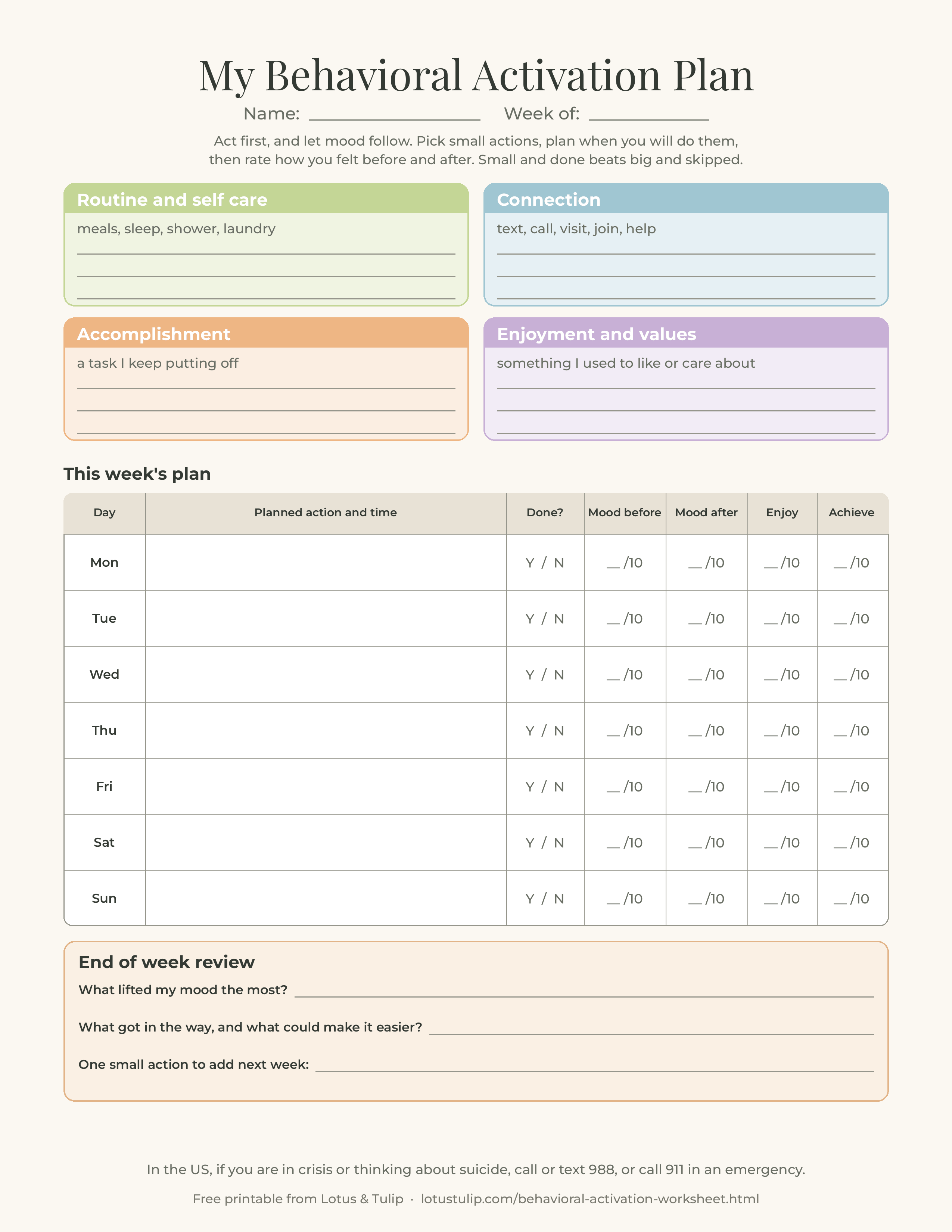
Download the free behavioral activation worksheet (PNG, US Letter)
Free to print for use with your own clients, students or yourself. Please link to this page rather than re-uploading the file.
Related resources
- Habit tracker worksheet for adults (free printable): keep one helpful activity going as a daily habit
- Procrastination worksheet for adults: the avoid and relief loop, tiny first steps and a free get started plan
- Loneliness worksheet for adults: small connection steps and a free reconnection practice plan
- Rumination worksheet: stop overthinking loops by switching from why to how (free printable)
- CBT thought record worksheet (free printable)
- Window of tolerance worksheet (free printable)
- DBT TIPP skills worksheet (free printable)
- Feelings thermometer printable (free)
- All therapist worksheets: CBT, DBT and ACT
Free depression starter pack: Want more real pages? The free depression worksheets for therapists starter pack adds the low mood cycle, a daily activity and mood log, an activity menu, break it into small steps, a weekly activity plan and a support and safety page from our paid depression and behavioral activation set (8 pages, client use license, no email).
FAQ
What is a behavioral activation worksheet?
It is a form clients use to track and plan activities as part of behavioral activation for depression. It usually includes space to list possible actions, schedule them on specific days and times, and rate mood before and after, so the client can see which activities help.
Is behavioral activation evidence based?
Yes. In a 1996 component analysis by Jacobson and colleagues, behavioral activation alone did as well as full cognitive therapy for major depression, and a 2006 trial by Dimidjian and colleagues found it comparable to antidepressant medication for more severely depressed adults. It is widely regarded as an evidence based treatment for depression.
What is the difference between behavioral activation and CBT?
Behavioral activation began as one part of cognitive behavioral therapy for depression. As a standalone treatment it focuses on changing what the person does, through activity monitoring, scheduling and reducing avoidance, without directly challenging thoughts. Many therapists use it alongside cognitive work.
What are pleasure and mastery ratings?
They are two quick 0 to 10 ratings after an activity: how much the client enjoyed it (pleasure) and how much it gave a sense of accomplishment (mastery). This worksheet calls them enjoy and achieve. They help clients notice that even unexciting tasks can lift mood through a sense of getting something done.
Can behavioral activation be used with teens?
Yes. Behavioral activation has been adapted for adolescents. Keep the steps small, let the teen pick the actions and use examples from their own life, such as sports, friends, music or school tasks.
Is this behavioral activation worksheet free?
Yes. It is free to print for use with your own clients, students or yourself. Please link to this page rather than re-uploading the file.