
Kids and teens · Updated 2026-11-02
Feelings thermometer printable: how to use it with kids and teens (free worksheet)
Ready-made printable: Anger Management Worksheets for Kids and Teens Holiday 20% off: about $9.20, was $12 (EUR 10) · instant digital download
Buy on Etsy
A feelings thermometer is one of the simplest tools in counseling, and one of the most useful. Instead of asking a child "how do you feel?" and getting "fine" or a shrug, you ask "how big is the feeling?" and point to a number. That small shift gives kids, teens and the adults around them a shared language for intensity, and it opens the door to the most practical question of all: what helps at this level? This guide covers what a feelings thermometer is, why rating intensity helps, how to introduce it, scripts for kids, teens and parents, adaptations, group activities, coping ideas matched to each level, and common mistakes. It ends with a free feelings thermometer printable on US Letter paper that also works as an anger thermometer for kids.
This is educational information for therapists, school counselors, teachers and parents, not a substitute for clinical training, supervision or care. If a child or teen talks about wanting to hurt themselves or someone else, get help right away. In the US, anyone in crisis can call or text 988, the Suicide and Crisis Lifeline, or call 911 in an emergency.
Jump to the free feelings thermometer printable
What a feelings thermometer is
A feelings thermometer is a picture of a thermometer split into levels, usually 1 to 5 or 0 to 10, from calm at the bottom to very intense at the top. Each level has a color, a short label and, in the better versions, the body clues that tend to show up at that level. The person points to or names the level that matches how big their feeling is right now.
The idea of rating how strong a feeling is has a long history in therapy. Behavior therapists Joseph Wolpe and Arnold Lazarus described a 0 to 100 self rating of anxiety in their 1966 book Behavior Therapy Techniques, now known as the Subjective Units of Distress Scale (SUDS). Many clinicians today use a shorter 0 to 10 version. A feelings thermometer is the kid friendly cousin of that scale: fewer numbers, colors, faces and plain words.
It can be used for any feeling. With anger it becomes an anger thermometer, with worry a worry thermometer, and with sadness or frustration the same five levels work just as well. The free printable on this page is written so it fits any big feeling.
Why rating intensity helps
- It is easier than finding the right word. Many kids cannot yet tell frustrated from disappointed, but almost any child can point to "a little" or "really big". Intensity is a good first step before a feelings wheel.
- It turns feelings into something you can notice early. When a child learns what a 2 or a 3 feels like in their body, they can use a tool before the feeling reaches a 5. That early noticing is most of the work.
- It matches the tool to the moment. Talking a problem through works at a 2. At a 5, the brain is busy protecting itself, and the only job is safety and calming the body.
- It gives adults a quick check in. "What number are you at?" takes five seconds, works in a hallway, and does not require a long conversation.
- It shows change. Rating before and after a coping skill (for example "I was a 4, now I'm a 2") helps kids see that their tools work.
Naming feelings may also help take some of the edge off them. In a 2007 brain imaging study in Psychological Science, Matthew Lieberman and colleagues at UCLA found that putting feelings into words (labeling the emotion in a picture) was linked to lower amygdala activity than other ways of responding to the same images. That study was done with adults in a lab, so treat it as a reason to practice naming feelings, not as proof that a worksheet calms anyone down by itself.
How to introduce it
- Teach it when everyone is calm. A child at a 5 cannot learn anything new. Introduce the thermometer in a quiet session, at a family meeting or during class.
- Start with a real thermometer. "When you're sick, a thermometer tells us how hot your body is. This one tells us how big a feeling is."
- Walk through each level with examples. "A 1 is how you feel reading in a beanbag. A 3 might be when your sister takes your spot on the couch. A 5 is when a feeling is so big you can't think."
- Find body clues together. Ask, "What does your body do at a 3? Hot face? Tight fists? Louder voice?" Write their own clues on the page. Their words matter more than the printed ones.
- Fill in "what helps me" for each level. Choose one or two tools per level and practice them while calm, so they are ready when needed.
- Use it often, for small things. Short daily check ins build the habit. If the thermometer only comes out during meltdowns, kids start to dislike it.
Scripts you can borrow
With a young child (about 4 to 7): "Let's check our feelings thermometer. Is your feeling calm like a 1, or big like a 4? Show me with your finger." Then: "A 4 is big. Let's do our balloon breaths together and see if it gets smaller."
With an older child (about 8 to 12): "On a scale of 1 to 5, how big was the frustration when the game ended? What did your body do? What number are you at now, talking about it with me?"
With a teen: "Quick check in, 0 to 10, how stressed are you right now? No need to explain. If you're above a 6, do you want five minutes before we talk, or do you want to just get it out?" Teens often prefer 0 to 10 over faces and colors, and they appreciate being given a choice.
For parents: "When my child is at a 4 or 5, I don't teach or lecture. I keep my voice low, keep everyone safe and help their body calm down. We talk about what happened later, when we're both back at a 1 or 2." It also helps when parents share their own number out loud: "I'm at a 3 right now, I'm going to take three slow breaths before I answer."
Adaptations
- Young kids: Use 3 levels instead of 5 (small, medium, big), lean on colors and faces, and let them point, color or move a clothespin up and down the thermometer.
- Nonverbal or minimally verbal kids: Use the faces and colors as a choice board. Offer two options at a time ("green or red?"). Keep a laminated copy where the child can reach it, and model using it yourself.
- Neurodivergent kids: Some autistic kids and kids with ADHD find it hard to notice body signals (interoception). Practice body clues separately, for example "check your hands, are they tight or loose?", and keep the visual the same every time. Predictable is good.
- English language learners: Numbers, colors and faces work across languages. Teach two or three key words (calm, upset, very upset) and let students add the word in their home language next to each level.
- Teens and adults: Switch to a 0 to 10 scale and more precise words (irritated, overwhelmed, panicky). The same idea fits anxiety work and exposure practice, where rating before and after is standard.
Group and classroom activities
- Thermometer line up: Read short scenarios ("You lost your favorite hoodie", "A friend sat with someone else at lunch") and have students stand on a 1 to 5 line taped to the floor. It shows that the same event can be a 2 for one person and a 4 for another.
- Body clue detectives: In pairs, students act out a level with their body (no words) while their partner guesses the number.
- Level toolbox: As a group, brainstorm one tool for each level and make a class poster. Tools for a 5 should be quick, simple and safe.
- Morning check in: Each student puts a sticky note or clothespin on a shared thermometer. Counselors and teachers get a fast read on who might need a check in.
- Story thermometers: While reading a picture book, pause and ask, "What number is the character at now? What could help them?"
Matching coping strategies to each level
The most useful part of a feelings thermometer is the "what helps me" column. Different levels need different kinds of help. These are starting ideas; the child's own choices always come first.
- Level 1, calm: This is the time to learn and practice. Rehearse breathing, plan for tricky moments, notice what helps you feel good.
- Level 2, small: Name it ("I'm a bit annoyed"), take a few slow breaths, get a drink of water, ask for what you need.
- Level 3, medium: Take a short break, squeeze a stress ball, do wall push ups, count backward from 20, try 5 4 3 2 1 grounding.
- Level 4, big: Move away from the trigger to a calm spot, use a cold drink or cool water on hands, do big movement (jumping, a walk with an adult), tell a grown up your number.
- Level 5, huge: Safety first. Get to a safe space, let an adult help, and keep words to a minimum. Problem solving waits until later.
For more ideas sorted by type, see the coping skills list for kids with its free printable menu.
Common mistakes
- Only using it during meltdowns. A child at a 5 cannot read a chart. Practice when calm, so the thermometer is familiar when it matters.
- Treating high numbers as bad. Every level is okay to feel. The goal is noticing and choosing a tool, not never reaching a 4. If high numbers lead to punishment, kids learn to always say "1".
- Arguing with the number. "That's not a 5, it's only a 2" teaches kids their experience is wrong. Accept the number, then get curious.
- Using tools that don't fit the level. Asking a child at a 5 to "use your words" or fill in a worksheet usually backfires. Talking works best at the low end.
- Using someone else's body clues. The printed clues are examples. A child who goes quiet and still when angry needs that written on their page.
- Forgetting the after. Once a child is back at a 1 or 2, a short reflection ("what number did you get to, what helped?") is where the learning happens.
Free feelings thermometer printable (US Letter)
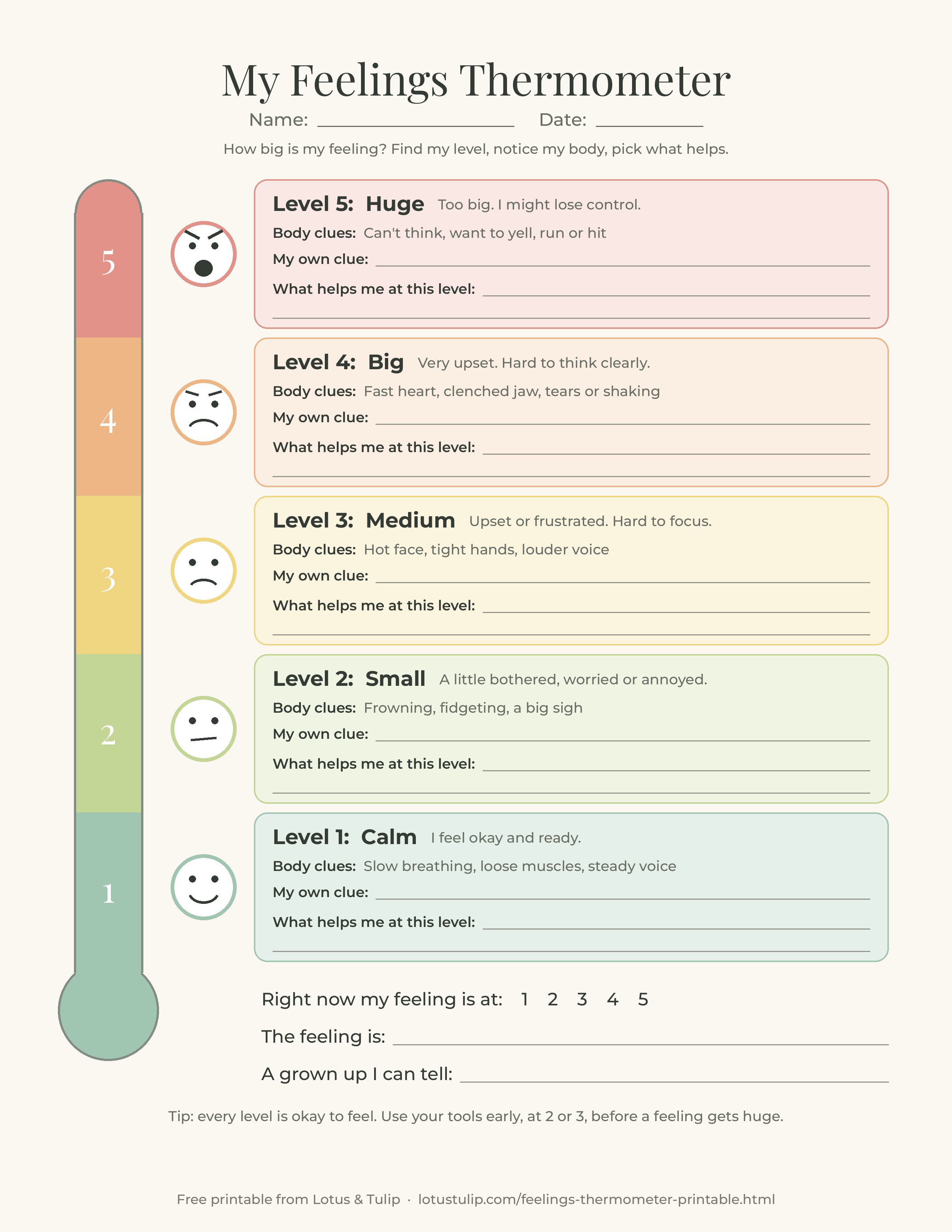
This free printable has a 5 level thermometer with color bands and faces, from Level 1 Calm to Level 5 Huge. Each level has a kid friendly description, printed body clues, a blank for the child's own clue, and lines for "what helps me at this level". At the bottom: "right now my feeling is at", the name of the feeling, and a grown up I can tell. It works as a feelings thermometer or an anger thermometer for kids, in individual sessions, small groups, classrooms and at home. Print one per child, or laminate it and use a dry erase marker.
Download the free feelings thermometer (PNG, US Letter, 300 dpi)
Free anger management starter pack: Need an anger version? The free anger management worksheets starter pack includes the anger thermometer from our paid anger set for kids and teens, plus the anger iceberg, stop, think, choose, a cool-off menu, a cool-down plan and a support and safety page.
Related resources
- Feelings wheel printable for kids (free)
- Anger iceberg worksheet (free printable)
- Coping skills list for kids (free printable menu)
- 5 4 3 2 1 grounding worksheet (free printable)
- All kids and teens counseling resources
FAQ
What is a feelings thermometer?
A feelings thermometer is a visual scale, shaped like a thermometer, that helps kids and teens rate how big a feeling is, usually from 1 to 5 or 0 to 10. Each level has a color, a label and often body clues, so the child can notice a feeling early and choose a coping tool that fits.
What is an anger thermometer for kids?
An anger thermometer is a feelings thermometer used for anger. It helps kids see that anger builds in steps, from a little annoyed to very angry, and spot their warning signs before they reach the top. The free printable on this page works as an anger thermometer.
Should I use a 1 to 5 or a 0 to 10 scale?
For younger children, 3 to 5 levels with colors and faces are easier. Older kids, teens and adults often prefer 0 to 10 because it allows finer ratings, which is useful for tracking change before and after a coping skill.
Is a feelings thermometer the same as the Zones of Regulation?
No. The Zones of Regulation is a separate, published curriculum created by Leah Kuypers that sorts feelings and alertness into four colored zones. A feelings thermometer is a general rating scale that many counselors use on its own. This free printable is an independent Lotus & Tulip design and is not affiliated with any curriculum.
What age is this feelings thermometer for?
It is designed for kids from about age 5 to young teens. Younger children can point to the faces and colors with an adult, and older kids can write their own body clues and coping tools.
Is this feelings thermometer printable free?
Yes. It is free to print for use with your own clients, students, children or yourself. Please link to this page rather than re-uploading the file.