
Kids and teens · New baby and big siblings for kids 2 to 12 · Updated 2026-11-15
New baby and big sibling worksheets for kids: how to prepare your child for a new baby, what research shows and a free big sibling plan

Ages 5 to 11: Kids Feelings and Social Skills Worksheets, incl. feelings detective, body clues, a feelings thermometer, a coping skills menu and a calm down plan Holiday 20% off: about $11.04, was $14 (EUR 12) · fillable PDF, instant digital download
Buy on EtsyTry it free first: download a fillable sample (feelings thermometer and calm-down plan, PDF, 240 KB). Type into it on screen, then get the full pack. No email needed.
For parents of a growing family: Parenting Worksheets: Calm and Connected, 30 pages on labeled praise, clear directions, calm consequences and routine charts Holiday 20% off: about $9.20, was $12 (EUR 10) · instant digital download
Buy on EtsyKids and teens bundle: Kids and Teens Worksheets Bundle (feelings, anger, self esteem, social anxiety) Holiday 20% off: about $22.08, was $28 (EUR 24) · 80 pages, instant digital download
Buy on EtsyYour three year old pats your growing belly and says "baby" one minute, then asks you to send the baby back the next. Or your seven year old, who begged for a little brother, goes quiet when the crib arrives. Becoming a big sibling is one of the most common changes in childhood, and one of the most mixed: love, pride, curiosity, jealousy and worry often show up in the same afternoon.
This guide is for parents, caregivers, teachers, school counselors and therapists helping children about 2 to 12 get ready for a new baby, and settle in afterward. It covers new babies by birth, adoption and foster placement. It explains how children of different ages tend to react, what research shows (honestly, including its limits), what big sibling worksheets can and cannot do, eight kinds of activities, nine steps to prepare your child before and after the baby arrives, age and need adaptations, notes for school, common mistakes and three short examples. It ends with a free 2 page printable: My Big Sibling Map and My Big Sibling Plan. If your children are already older and fighting, see the sibling rivalry worksheets for kids; this page is about the arrival itself.
When to talk with a professional: some clinginess, tears, baby talk and toilet accidents in the first weeks are common and usually pass. Talk with your child's pediatrician, school counselor or a child therapist if your child keeps trying to hurt the baby, if distress, aggression, sleep or eating problems last for weeks or keep getting worse, or if a child who was developing well loses skills and does not regain them. Always supervise young children around a baby, and never let a child carry, feed or bathe the baby without an adult right there. Parents matter too: if you are pregnant or have a new baby and feel overwhelmed, anxious or low, you can call or text the National Maternal Mental Health Hotline at 1-833-TLC-MAMA (1-833-852-6262), and talk with your own doctor. If anyone talks about wanting to die or hurting themselves, call or text 988 (the 988 Suicide and Crisis Lifeline). If anyone is in immediate danger, call 911.
Download the free new baby and big sibling worksheets for kids (PDF, 2 pages, US Letter)
Direct download, no email or sign up. See the pages first. Clingy at goodbyes since the baby came? See the separation anxiety worksheet for kids. Big feelings with no words yet? Try the feelings wheel printable.
How children react to a new baby
For parents, a new baby is usually long planned and deeply wanted. For an older child it can feel like a change that happened to them: less lap, less time, more waiting, and a lot of visitors who look straight past them to the crib. The American Academy of Pediatrics (AAP) notes that a child's personality shapes how they respond, but age gives useful clues.
- Toddlers, about 1 to 2: may not understand much about what a new sibling means, but they pick up on your mood and notice when you have less time for them.
- Preschoolers, about 2 to 4: are still learning to share and may feel they have to compete for your attention. Changes in routine are especially hard at this age, and the AAP says some regression, such as toilet accidents or asking for a bottle, is normal after the birth.
- School age children, 5 and older: are usually less threatened by a new baby than younger children, the AAP notes, but they may resent the attention the baby gets and miss their old place in the family.
Mixed feelings are the rule, not a warning sign. A child can be proud to hold the baby and jealous of the same baby an hour later. The goal is not to prevent those feelings, but to help children name them and find better ways to get what they need.
What the research shows, honestly
Research on the "transition to siblinghood" mostly follows small or medium samples of families from late pregnancy through the baby's first year, and much of it relies on parents' reports. It describes what tends to happen and what helps, but there are no trials of worksheets like the ones on this page.
It is common, and it is not a crisis for most children. Nearly 80% of children in the United States have at least one sibling, so welcoming a baby is a normal part of childhood. A major review of 30 studies found no support for the idea that a new sibling causes a developmental crisis for most children. The clearest change was a drop in children's affection and responsiveness toward their mothers; findings for sleep problems, anxiety, aggression and regression were mixed. Children varied widely: for some the birth was a time of disruption, for others a time of growing up, and for others little changed at all (Volling, 2012).
Early reactions are real, and often short lived. In a classic study of 40 families in Cambridge, England, with firstborns aged 18 to 43 months, mothers were interviewed two to three weeks after the birth. Twenty four of the 40 children had become more tearful, 23 more clinging and 11 more withdrawn. Twenty eight mothers noticed signs of regression: mild ones such as occasional baby talk or wanting to be carried in 15 children, and a definite step back, such as in toilet training or insisting on being fed, in 13. Yet 25 of the 40 children also showed at least some sign of being more grown up, most often more independence (Dunn, Kendrick and MacNamee, 1981). Observations in the same families found less maternal attention and play with the firstborn and more confrontations after the birth (Dunn and Kendrick, 1980).
Most children settle within months. The largest study so far followed 241 U.S. families from late pregnancy to 12 months after the birth of a second child, with firstborns aged 1 to 5. Most children had low levels of behavior problems throughout and showed little change, or even fewer problems, over time. Children who had more problems after the birth were mostly the ones who had more problems before it. Only aggression showed a sudden rise from pregnancy to one month after the birth, and it faded by four months (Volling and colleagues, 2017). An earlier study of 41 families also found that the kind of reaction shifts over the first year: imitating the baby and confrontations early on, more anxiety around four months, and more conflict with the baby at 8 and 12 months as the baby becomes more mobile and independent (Stewart and colleagues, 1987). In a U.S. national survey sample of children aged 3 to 5, a sibling's birth was followed by a temporary rise in behavior problems and lower self worth, with larger effects for children in low income families (Baydar, Hyle and Brooks-Gunn, 1997).
What helps. In the Cambridge study, mothers who talked with their older child about the baby as a person, with feelings, needs and wants of their own, had children who interacted more positively with the baby at 8 and 14 months (Dunn and Kendrick, 1982, as summarized by Kramer and Ramsburg, 2002). In a study of 30 firstborns aged 3 to 5, children whose friendships before the birth involved more positive play, more pretend play and fewer unmanaged conflicts had more positive interactions with their sibling at 6 and 14 months (Kramer and Gottman, 1992). In the 241 family study, a child's temperament, how well parents worked together as a team (coparenting), parents' confidence and the parent and child bond best predicted how children adjusted (Volling and colleagues, 2017), and good coparenting softened the link between a difficult temperament and behavior problems (Kolak and Volling, 2013).
What this means for you. Expect a bumpy few weeks, not a lasting setback. Prepare your child honestly, keep big changes away from the birth, protect a little one on one time, talk about the baby as a person, work as a team with your partner or co parent, and keep supporting your child's friendships. Watch more closely if your child was already struggling before the baby came.
What big sibling worksheets can and cannot do
Big sibling worksheets give children a safe place for mixed feelings, a list of questions they may not know how to ask, and a role in the family that is not "the one who has to wait." They help adults hear what a child is actually worried about, which is often practical (Where will the baby sleep? Who will take care of me when you are at the hospital?) rather than deep. A special time tracker keeps the older child's needs visible during the busiest weeks.
They cannot make jealousy disappear, replace one on one time with a parent, or treat anxiety, aggression or developmental concerns. If your child is still very upset after a couple of months, or the professional box above applies, bring your notes to your pediatrician, the school counselor or a child therapist.
8 kinds of big sibling activities for kids
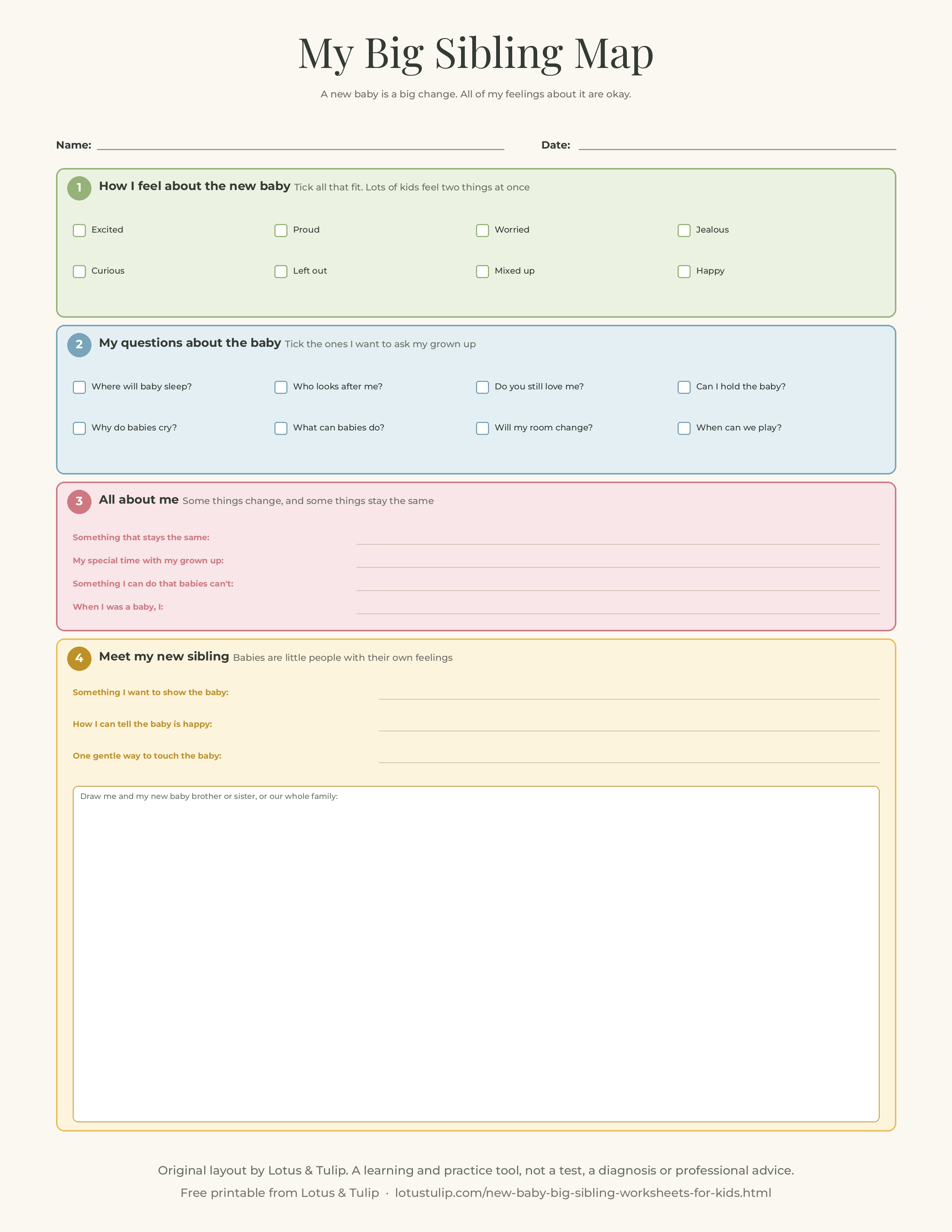
- Feelings check in. A checklist of feelings (page 1 of the free printable) shows that being excited and jealous at the same time is normal, and gives quieter children a way to say how they feel without having to find the words.
- Question list. Children worry about things adults forget to explain. Ticking questions such as "Where will baby sleep?", "Who looks after me?" and "Do you still love me?" tells you what to answer first.
- When I was a baby. The AAP and MedlinePlus both suggest showing children their own baby photos and telling stories about when they were born. It helps children understand what babies need, and reminds them they were cherished in exactly the same way.
- Baby doll practice. Caring for a doll, feeding, rocking and diapering it, lets young children rehearse gentle hands and gives them "their" baby when the real one needs you.
- Meet the baby as a person. Wonder together: what is the baby looking at, what does that cry mean, what might make the baby smile? This builds on the Dunn and Kendrick finding that talking about the baby's feelings and wants goes with friendlier sibling relationships later.
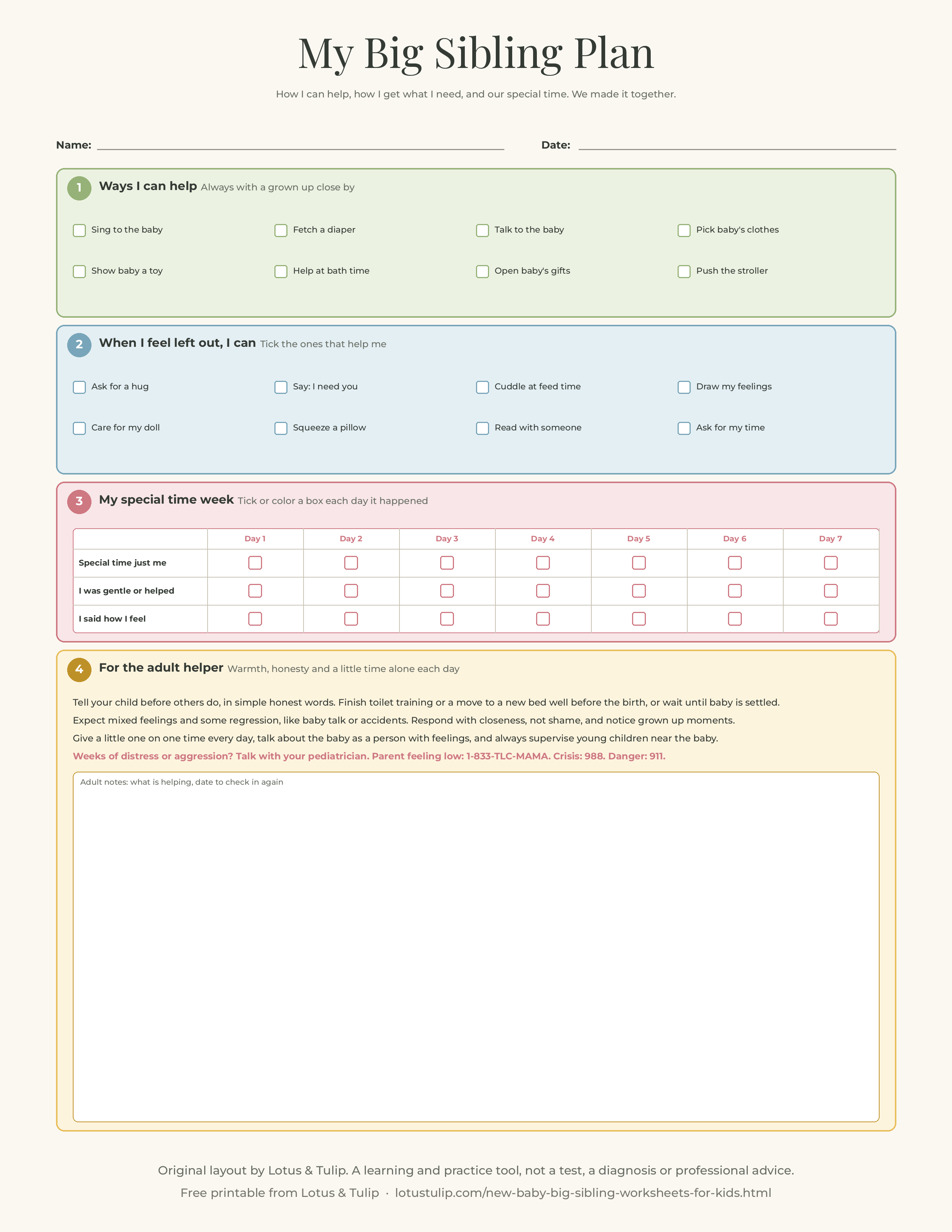
- Big sibling jobs. Choose small, safe jobs with an adult close by: singing to the baby, fetching a diaper, picking an outfit, showing the baby a toy, opening gifts. Page 2 of the printable has a helping checklist.
- Left out plan. Plan ahead for the moments when the baby needs you first. Children choose what they can do: ask for a hug, cuddle next to you at feeding time, draw their feelings or care for their own doll.
- Special time tracker. Track a few minutes of one on one time each day, plus moments of being gentle and moments of saying how they feel. Praise the effort, not only the outcome.
How to prepare your child for a new baby, step by step
- Tell them yourself, in simple honest words. MedlinePlus suggests telling your child before everyone around them is talking about it. Explain what is happening in words that fit their age, and link the due date to things they understand, such as "when it gets cold" or "after your birthday."
- Be honest about what babies are like. The AAP suggests explaining that the baby will be cute but will also cry, sleep a lot and take a lot of your time, and that it will be a while before the baby can play.
- Listen to every feeling. Expect excitement, worry, jealousy and anger, sometimes all in one evening. Name the feeling ("You wish it could just be us again") instead of correcting it. Page 1 of the printable helps children tick their feelings and questions.
- Time big changes well away from the birth. If you can, finish toilet training or a move from crib to bed before the baby arrives, or wait until the baby is settled, as the AAP advises. If your child is moving to a new room or bed, MedlinePlus suggests doing it weeks before the due date.
- Plan the birth or arrival days. Tell your child who will look after them while you are at the hospital or traveling to bring a child home, practice that arrangement if you can, and plan how and when they will meet the baby. Many hospitals offer sibling classes.
- Give them a real role. Let your child help get ready: choose a toy for the baby, help set up the baby's space, pick out clothes. After the arrival, invite safe jobs with an adult close by, and teach how to hold the baby while sitting down, only with you there.
- Protect one on one time. A few minutes every day of time that belongs only to your older child, with you or another close adult, matters more than big treats. Cuddle and read with your older child while you feed the baby, and ask visitors to say hello and spend a little time with your older child too.
- Respond to regression with closeness, not shame. Baby talk, accidents or wanting a bottle are usually a way of checking they are still loved. Give the comfort they ask for, notice grown up moments without demanding them, and avoid "act your age."
- Check in and review. Use the special time tracker for a week, then check in every week or two for the first few months. Work as a team with your partner or co parent, and talk with your pediatrician or the school counselor if your child is still very unhappy, aggressive or withdrawn after a couple of months.
How to adapt it by age and need
- Ages 2 to 3: keep it concrete and short. Read picture books about new babies, play with a baby doll, and use the feelings checklist by pointing. Expect more clinginess and some regression, and keep routines like bedtime as steady as you can.
- Ages 4 to 5: children can tick feelings and questions with help and love being given a "job." Rehearse what will happen on the day the baby comes, and who will pick them up from preschool.
- Ages 6 to 8: children can fill in most of the big sibling map themselves. Give real choices, like helping to choose the baby's name from a short list or decorating a welcome card, and keep their activities and playdates going after the birth.
- Ages 9 to 12: older children may worry about money, space, noise or losing their privacy, and may not say so. Ask directly, protect their time with friends, and avoid making them a regular babysitter. Helping should be a choice they enjoy, not a duty that replaces being a kid.
- Autistic children and children who need predictability: use a visual schedule or social story for the birth days and the first weeks at home, show photos of who will look after them, and let them get used to baby sounds and baby items early. Plan a quiet space they can go to when the house feels loud.
- Children with ADHD: expect impulsive moments around the baby, so set up supervision rather than relying on rules alone. Keep instructions short, practice gentle touch with a doll, and give active jobs, like fetching things, that use their energy well.
- Adoption and foster placement: the National Council For Adoption advises telling children early, including that timelines can be uncertain, reading adoption friendly books together and involving children in welcoming the new child, for example with a family photo book. A child who joins by adoption or foster care may be older, may have experienced loss or trauma and may need a lot of attention at first; tell your children that ahead of time, protect their one on one time, and ask your agency about sibling preparation and post placement support.
- A baby in the NICU or with health needs: children may be scared, or feel forgotten during long hospital stays. Explain in simple terms, ask the hospital about sibling visits or a child life specialist, and keep one trusted adult and the child's routine as steady as possible.
- Blended families and half or step siblings: a new baby can stir up questions about belonging. Reassure each child of their place in both homes, and coordinate the message with the other household where you can.
A new baby and school: notes for teachers and counselors
- Ask families to give you a heads up. Knowing a baby is due, or has just arrived, helps you read tiredness, tears or acting out with kindness rather than only as misbehavior.
- Expect short term changes. Sleep at home is often disrupted for the whole family. A child may be more tired, clingy at drop off, distracted or quick to cry for a few weeks. Keep classroom routines steady and offer a quiet job or a check in.
- Celebrate without spotlighting. Let a child share news or a photo if they want to, but do not assume every child is happy about the baby. Some feel mixed or left out.
- Use a small group or a book. A short counselor led group for new big siblings, or a read aloud about a new baby, helps children see they are not the only ones with mixed feelings.
- Look at the whole child. If problems last for months, or a child also faces a move, a separation or a loss, involve the family and the school team, and consider whether more support or an evaluation is needed.
- Mandated reporting. If a child's comments or behavior make you suspect abuse or neglect of the child or the baby, follow your district policy and your duties as a mandated reporter.
Common mistakes
- Promising a playmate. "You'll have someone to play with" sets up disappointment when the baby mostly sleeps, feeds and cries.
- Asking whether they want a brother or a sister. MedlinePlus advises against it, because a child who does not get their wish may feel let down.
- Changing everything at once. A new bed, a new room, toilet training and a new baby in the same month is a lot. Spread changes out.
- Shaming regression. "You're a big boy now" can make a child feel that being little, like the baby, is the only way to be loved.
- Turning the older child into a helper on duty. Helping should feel like a privilege, not a job that crowds out play, friends and time with you.
- Leaving children alone with the baby. Even loving hugs from a toddler can hurt a newborn. Supervise closely and teach safe ways to help.
Examples
- Mia, 3: started asking for a bottle and having accidents after her brother was born. Her parents gave her extra cuddles, let her feed her own baby doll while mom fed the baby, and noticed out loud when she used the potty. Within a few weeks the accidents stopped, and she started bringing the baby his blanket.
- Leo, 6: ticked "Left out" and "Do you still love me?" on his big sibling map. His dad started 15 minutes of Lego time with him every evening while the baby slept, and his mom read with him during feeds. On his special time tracker he colored every box in the first row by the end of the week.
- Ava, 9: her family adopted a four year old. Ava was excited, then hurt when her new sister took her toys and got most of her parents' attention. Her parents had told her ahead of time that this might happen, kept Saturday mornings just for her, and asked the agency for a sibling support group. Months later, Ava proudly taught her sister to ride a scooter.
Free printable: new baby and big sibling worksheets for kids
This printable is an original Lotus & Tulip layout. It is not an assessment and gives no score. Page 1, My Big Sibling Map, has a checklist of feelings about the new baby, questions to ask a grown up, an all about me section (something that stays the same, my special time, something I can do that babies can't, when I was a baby), meet my new sibling prompts that help children see the baby as a person, and a box to draw the family. Page 2, My Big Sibling Plan, has a checklist of safe ways to help, a when I feel left out plan, a special time week tracker for one on one time, being gentle or helping and saying how I feel, and notes for the adult helper, including when to get help.
Download the free new baby and big sibling worksheets for kids (PDF, 2 pages, US Letter)
Prefer single images? Page 1: My Big Sibling Map (PNG) · Page 2: My Big Sibling Plan (PNG)
Related resources
- Blended family worksheets for kids: when the new baby is a half sibling in a stepfamily, with a free blended family plan
- Bedwetting worksheets for kids: when a big sibling starts wetting the bed again after the baby arrives, with a free dry night plan
- Sibling rivalry worksheets for kids: when brothers and sisters fight, what research shows and a free sibling plan
- Separation anxiety worksheet for kids: for clinginess and hard goodbyes after a new baby
- Feelings wheel printable: help children find words for jealous, left out and proud
- Self esteem worksheets for kids: helping an older child feel valued for who they are
- Moving worksheets for kids: when a growing family also means a new home
- All counseling resources for kids and teens
FAQ
When should I tell my child we are having a baby?
Tell them yourself, before they overhear it from others, in simple honest words that fit their age. Young children have little sense of time, so link the due date to something they understand, such as a season or a holiday. Expect to repeat the conversation and answer the same questions many times.
Is it normal for my child to regress after the new baby arrives?
Yes. Baby talk, wanting to be carried, wanting a bottle or toilet accidents are common in the first weeks, and the AAP calls a little regression normal. In one classic study, 28 of 40 mothers noticed some regression two to three weeks after the birth. Respond with comfort rather than shame, praise grown up moments, and talk with your pediatrician if skills do not come back or the change lasts for months.
How long does it take a child to adjust to a new sibling?
For most children, the hardest part is the first few weeks to months. In a study of 241 families, most children showed little lasting change, and the rise in aggression some children showed after the birth had faded by four months. Children who were already struggling before the baby came may need more time and support.
My child is jealous of the new baby. What should I do?
Accept the feeling and set limits on the behavior: "You can be mad that the baby needs me, and you can't hit." Protect a few minutes of one on one time every day, involve your child in safe ways to help, and talk about the baby as a person with feelings. For conflict that continues as both children grow, see the sibling rivalry worksheets for kids.
How do I prepare my child for an adopted or foster sibling?
Talk early and honestly, including that timelines can be uncertain, read adoption friendly books, and let your child help welcome the new child, for example with a family photo book. Explain that a child who joins by adoption or foster care may need a lot of attention at first, keep your older child's one on one time, and ask your agency about sibling preparation and support after placement.
Should my older child visit the hospital or be there at the birth?
The AAP suggests having someone bring your older child to the hospital to meet the new sibling, so they feel part of the growing family. Check your hospital's visiting rules and sibling classes. Plan ahead who will look after your child during the birth, and practice that arrangement if you can.
What age are these new baby and big sibling worksheets for?
They are designed for children about 2 to 12. Younger children can point, color and talk through the pages with an adult reading aloud. Children 6 to 12 can fill in most of the big sibling map and plan themselves. Parents, teachers, school counselors and therapists can use them at home, in class or in sessions.
Sources
- American Academy of Pediatrics, HealthyChildren.org. Preparing your older child for a new baby: how to help siblings adjust.
- Baydar, N., Hyle, P., and Brooks-Gunn, J. (1997). A longitudinal study of the effects of the birth of a sibling during preschool and early grade school years. Journal of Marriage and the Family, 59(4).
- Beauvais-Godwin, L. (2013). Preparing children for the adoption of a sibling: recommendations for families considering intercountry adoption. Adoption Advocate No. 60. National Council For Adoption.
- Dunn, J., and Kendrick, C. (1980). The arrival of a sibling: changes in patterns of interaction between mother and first-born child. Journal of Child Psychology and Psychiatry, 21(2), 119 to 132.
- Dunn, J., and Kendrick, C. (1982). Siblings: Love, Envy, and Understanding. Harvard University Press.
- Dunn, J., Kendrick, C., and MacNamee, R. (1981). The reaction of first-born children to the birth of a sibling: mothers' reports. Journal of Child Psychology and Psychiatry, 22(1), 1 to 18.
- Health Resources and Services Administration. National Maternal Mental Health Hotline, 1-833-TLC-MAMA.
- Kolak, A. M., and Volling, B. L. (2013). Coparenting moderates the association between firstborn children's temperament and problem behavior across the transition to siblinghood. Journal of Family Psychology, 27(3), 355 to 364.
- Kramer, L., and Gottman, J. M. (1992). Becoming a sibling: "With a little help from my friends." Developmental Psychology, 28(4), 685 to 699.
- Kramer, L., and Ramsburg, D. (2002). Advice given to parents on welcoming a second child: a critical review. Family Relations, 51(1), 2 to 14.
- MedlinePlus (U.S. National Library of Medicine). Preparing children for pregnancy and a new baby.
- Stewart, R. B., Mobley, L. A., Van Tuyl, S. S., and Salvador, M. A. (1987). The firstborn's adjustment to the birth of a sibling: a longitudinal assessment. Child Development, 58(2), 341 to 355.
- Volling, B. L. (2012). Family transitions following the birth of a sibling: an empirical review of changes in the firstborn's adjustment. Psychological Bulletin, 138(3), 497 to 528.
- Volling, B. L. (2017). I. Introduction: understanding the transition to siblinghood from a developmental psychopathology and ecological systems perspective. Monographs of the Society for Research in Child Development, 82(3), 7 to 25.
- Volling, B. L., Oh, W., and Gonzalez, R. (2017). III. Stability and change in children's emotional and behavioral adjustment after the birth of a sibling. Monographs of the Society for Research in Child Development, 82(3), 46 to 52.
Lotus & Tulip is not affiliated with the researchers, programs, agencies or organizations named on this page. Names in the examples are invented. This page is educational and does not replace professional advice, diagnosis or treatment.