
Therapist marketing · Updated 2026-11-08
Holiday Social Media Posts for Therapists: December to January Ideas (with Free Printable)
Ready-made template kit: Therapist Holiday Instagram Templates Holiday 20% off: about $11.04, was $14 (EUR 12) · instant digital download
Buy on Etsy
Holiday social media posts for therapists have a harder job than most seasonal content. The rest of the feed is shouting "most wonderful time of the year" while many of the people who follow a counseling practice are bracing for an empty chair at the table, a tense drive home, a credit card bill or a long, dark January. A therapist's holiday post can quietly say "you are not the only one" without diagnosing anyone, promising anything or turning grief into marketing.
This guide is written for US therapists, counselors, LPCs, LMFTs, social workers and psychologists in private or group practice who want a calm, ethical plan for Instagram and Facebook from December 1 to mid January. You will get what the research on holiday stress actually says (and what it does not), a seven week posting plan built on the real 2026 to 2027 calendar, 30 specific post ideas grouped by theme, adaptable captions, story and highlight ideas, a religion neutral approach to greetings, safe messaging rules for grief and suicide, how to announce holiday office hours and January openings without pressure, a nine step HowTo, mistakes, myths, three fictional examples, and a free three page US Letter printable: Holiday Posting Steps, a Holiday Content Planner and a Holiday Post Care Check with pocket cards.
If you are newer to posting as a clinician, start with our ethics checklist for therapist social media, then come back. This page sits beside our therapist Instagram content calendar, 40 Instagram post ideas for therapists, captions guide, stories guide and highlight covers guide. Those pages cover the whole year. This one covers the six or seven weeks when tone matters most.
We draw on published polls, government health pages and professional codes without claiming any affiliation or endorsement: the American Psychological Association's 2023 holiday stress poll, a 2014 NAMI survey, the National Institute of Mental Health page on seasonal affective disorder, the Annenberg Public Policy Center's long running work on the holiday suicide myth, the national Recommendations for Reporting on Suicide, the 2014 ACA Code of Ethics and the APA Ethical Principles of Psychologists and Code of Conduct. Full notes are below. The printable is an original Lotus and Tulip layout.
This guide is general marketing information, not legal, ethical or clinical advice. Your state licensing board, your professional code, HIPAA and any group practice or employer policy come first. Social media posts are education, not treatment, and an Instagram account is not a crisis service. If you or someone you know is thinking about suicide or self-harm, call or text 988 (Suicide and Crisis Lifeline) or text HOME to 741741 (Crisis Text Line). For immediate danger, call 911. Every crisis or grief post you publish should carry those numbers and say plainly that your account and inbox are not monitored for emergencies.
Why holiday posts are different for therapists
Most small businesses use December to sell. A therapy practice can mention availability, but its main holiday job is different: to be a steady, kind voice in a season that is loud and often painful. Three things make this season unusual.
The audience is mixed. On the same day, one follower is excited to host for the first time and another is spending a first holiday after a death, a divorce or an estrangement. A third does not celebrate any December holiday at all and is tired of being told how to feel. A post that works has to land safely for all three. That is why "the holidays" works better as a default than a single religious holiday, and why "you might" works better than "you will."
The stakes of tone are higher. A cheerful template that says "Happy holidays, take time to enjoy your loved ones!" can feel like a slap to someone whose loved ones are the problem, or are gone. A holiday post from a therapist is read through a clinical lens. People assume you chose every word on purpose.
Your availability changes. Many practices close for a few days, run reduced hours or have clinicians on leave. Clients and potential clients need to know when you are reachable, what to do in an emergency while you are away, and when new appointments open. Clear logistics posts are a form of care, and they are often the posts that do the most practical good.
What the research says about holiday stress (and what it does not)
It is tempting to fill holiday posts with statistics. A few solid numbers can help you plan, but most posts work better without them. Here is what holds up, and how to use it responsibly.
- Holiday stress is common, and money tops the list. In a poll of 2,061 US adults conducted for the American Psychological Association by The Harris Poll in November 2023, 89% said something causes them stress during the holiday season. The most common sources were money (58% named spending too much or not having enough to spend), finding the right gifts (40%) and missing family or loved ones (38%). Family conflict was named by 22%, and feeling left out or excluded by 20%. That tells you which themes deserve a post: money pressure, missing people and the pressure to make things special.
- Not everyone feels worse. In the same poll, 41% said their stress increases during the holidays, while 52% said it stays the same and 7% said it decreases. So a post that assumes everyone is miserable is as off as one that assumes everyone is joyful. "For some people" is accurate language.
- People already living with mental illness often report a harder season. In a NAMI survey of roughly 300 people with a diagnosed mental illness in November 2014, about 24% said the holidays make their condition "a lot" worse and 40% "somewhat" worse (64% combined; 292 people answered that question). It was a small, self selected online survey, so treat it as a signal, not a population estimate.
- Winter low mood and holiday blues are not the same thing. NIMH describes seasonal affective disorder (SAD) as a type of depression with a recurrent seasonal pattern. In most cases symptoms start in late fall or early winter and ease in spring and summer. NIMH also says winter-pattern SAD should not be confused with "holiday blues," which are linked to the stresses of a time of year rather than to daylight. A post can name both ideas and suggest talking to a health care provider about lasting mood changes. It should not hand out a diagnosis.
- The holiday suicide spike is a myth. The Annenberg Public Policy Center has tracked this for more than two decades. Using CDC data, it reports that December typically has the lowest average daily suicide rate of the year; in 2024 December ranked 12th of 12 months and the highest months were August and July. Repeating the myth is a safe messaging problem, not just a factual one. More on that in the safe messaging section below.
A practical rule: use research to choose your themes, not to decorate your slides. The Lantern Hours kit leaves statistics off the posts on purpose, because a number on a slide needs a source, an accurate date and a caveat that rarely fits. If you do quote a figure, give the source and year in the caption, and never round 38% up to "most people."
A seven week holiday posting plan (December 1 to January 15)
Two or three feed posts a week plus a few stories is plenty for most solo practices. The plan below follows the real 2026 to 2027 calendar: Thanksgiving falls on Thursday, November 26, 2026, Hanukkah begins at sundown on Friday, December 4 and ends on Saturday, December 12, the winter solstice is Monday, December 21, Christmas Day is Friday, December 25, Kwanzaa runs from December 26 to January 1, and New Year's Day 2027 is a Friday. Adjust for your own clients and your own closures.
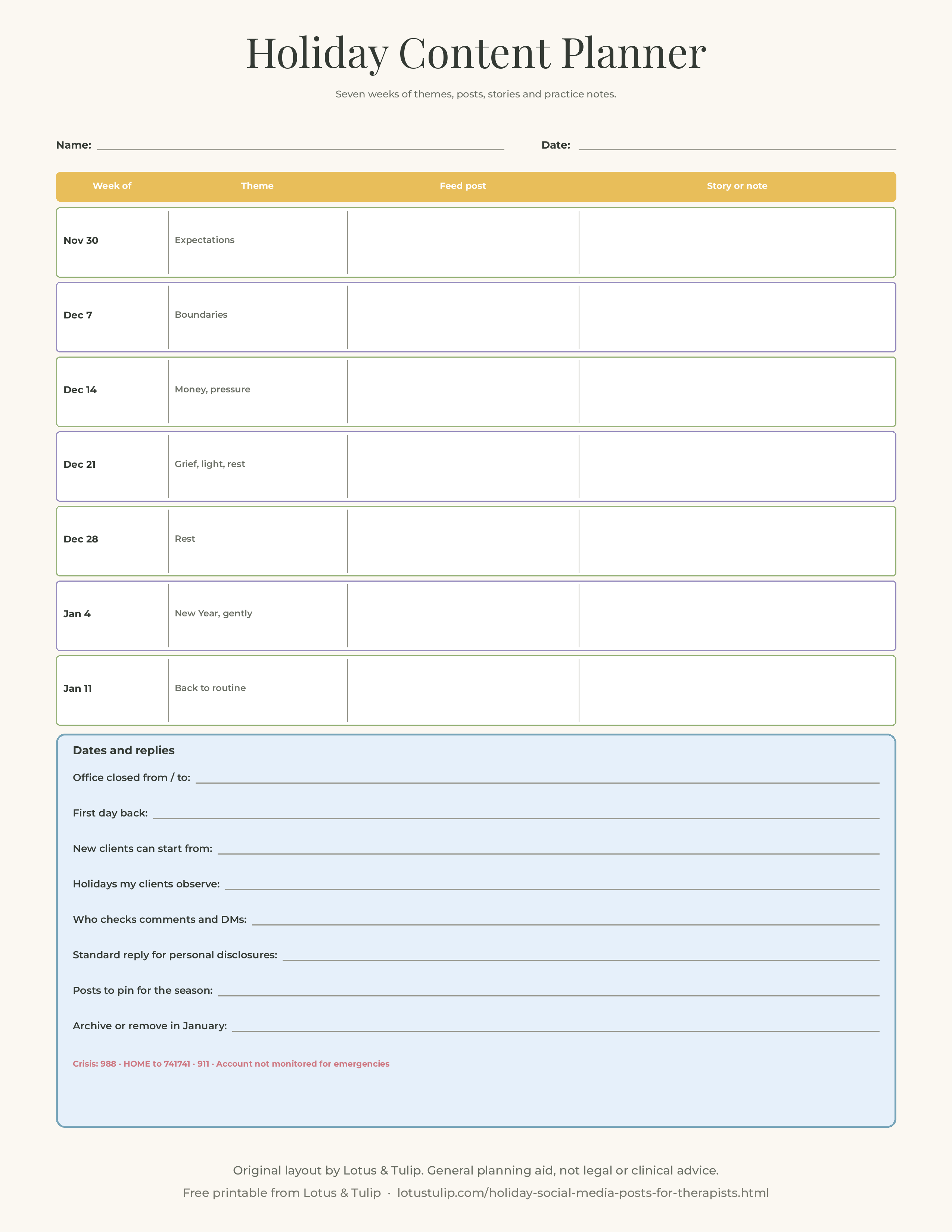
| Week | Main theme | Feed post ideas | Story or practice note |
|---|---|---|---|
| Week of Nov 30 | Setting expectations | "The holidays can be many things at once." Planning a gentler season. | Holiday hours announced early, with closure dates |
| Week of Dec 7 | Family and boundaries | Kind ways to say no. What a boundary is (and is not). | Poll: "Which part of the season takes the most energy?" |
| Week of Dec 14 | Money and pressure | Gratitude without pressure. Gifts are not a measure of love. | Reminder of last appointments before the break |
| Week of Dec 21 | Grief, light and rest | The empty chair. Ways to honor someone you miss. Shorter days. | Safety story: 988, HOME to 741741, 911; account not monitored |
| Week of Dec 28 | Rest and reflection | Rest is allowed. A comfort prompt for the in-between week. | Office closed story, with return date |
| Week of Jan 4 | New Year, gently | New Year without resolutions. Gentle intentions. | January availability, with how to book |
| Week of Jan 11 | Back to routine | Winter low mood and when to talk to a provider (NIMH based). | Question box: "What helped you get through December?" |
If you only have energy for five posts, choose these: holiday hours (late November), kind ways to say no (early December), grief at the holidays (mid December), a safety post with crisis numbers (the week before the 25th), and New Year without resolutions (first week of January). Pin the hours post and the safety post for the season; see our guide to pinned posts for therapists.
30 holiday post ideas for therapists, by theme
Each idea includes a sample opening line you can rewrite in your own voice. Keep them general. Nothing here should read as if it came from a client's session.
Expectations and holiday stress
- "The holidays can be many things at once." Joy, grief, tiredness and relief can share a single afternoon. Mixed feelings are normal, not a failure.
- Planning a gentler season. A short list: what matters most this year, what can be smaller, what can be skipped.
- The pressure to make it special. "You do not have to make this the best holiday ever. Good enough is allowed."
- Too much to do. A carousel with three questions: Does this need to happen? Does it need to be me? Does it need to be this week?
- Holiday myths vs facts. Myth: everyone else is having a perfect holiday. Fact: many people find this season stressful in some way.
Family, boundaries and saying no
- Kind ways to say no. "Thank you for thinking of me. I can't this year." "I'll come for dinner, and I'll head home at eight."
- What a boundary is (and is not). A boundary describes what you will do. It is not a rule for someone else. Link to our boundaries worksheets for therapists if you want a deeper resource on your site.
- Topics you can step away from. Bodies, weight, politics, relationship status and career questions. "You can change the subject or step outside for air."
- When family is complicated. Some people spend the holidays apart from family for safety or well-being. "Your holiday can look different and still be a good one."
- A plan for leaving early. Drive yourself, agree on a time in advance, have a friend you can text.
Grief and missing people
- The empty chair. "If someone is missing from your table this year, it makes sense that this season feels heavy."
- Ways to honor someone you miss. Cook their recipe, say their name, light a candle, look at photos, or choose not to do any of it this year.
- Grief does not follow the calendar. A first holiday after a loss is often hard. So is the fifth. There is no deadline.
- Other kinds of loss. Divorce, estrangement, infertility, a move, a job, health. Loss is wider than death.
- Supporting a grieving friend. "You don't need perfect words. 'I'm thinking of you and of them' is enough."
Loneliness and connection
- Alone is not the same as lonely. Some people enjoy a quiet holiday. Others feel the absence sharply. Both are allowed.
- Small connections count. A text, a walk, a call, a community meal or a volunteer shift.
- Feeling left out. Social media shows highlights. Muting accounts for a few weeks is a reasonable choice.
Money and gifts
- Gifts are not a measure of love. Spending limits, name draws and shared experiences are kind options. If money stress is high, our holiday budget guide may help readers on your website.
- Gratitude without pressure. Gratitude is something to notice, not a duty to perform when life is hard.
Winter, light and rest
- Shorter days. Many people feel lower energy as daylight shrinks. "If changes in mood or sleep last, talk with a health care provider." (Keep it to that. Do not list symptoms as a checklist.)
- Rest is allowed. Sleep, quiet and doing less are not laziness.
- A comfort prompt. "What is one small thing that helps you feel steadier on a hard day?" Invite people to answer privately or in a story question box, never in public comments about their health.
- The in-between week. The days between Christmas and New Year can feel shapeless. A gentle routine idea: get outside once, eat at regular times, go to bed near your usual hour.
New Year, gently
- New Year without resolutions. "You do not need a new you. You might want one gentle intention."
- Gentle intentions, not goals. Examples: "Call one friend a week." "Take my lunch break." "Ask for help sooner."
- Looking back kindly. Three prompts: what was hard, what helped, what you want more of.
Practice logistics and safety
- Holiday office hours. Exact closure dates, how to reach the practice, and what to do in an emergency while you are away.
- Booking for January. "New appointments open from January 5. Here is how to request a consultation." No countdowns, no "only two spots left."
- Safety post. "If you are in crisis, call or text 988 or text HOME to 741741. If you are in immediate danger, call 911. This account is not monitored for emergencies."
For more year round ideas in the same spirit, see 40 Instagram post ideas for therapists. For carousel layouts, see therapist Instagram carousel posts.
Holiday captions for therapists you can adapt
These are starting points. Rewrite them in your own words, check them against your board and code, and add your own practice details. Each one avoids diagnosis, outcome promises and testimonials.
- Mixed feelings: "This time of year can hold joy and heaviness in the same week. If you're feeling both, nothing is wrong with you. You're a person with a full history, in a season that asks a lot. General education, not individual advice."
- Saying no: "You can decline an invitation and still care about the person who sent it. 'Thank you so much for including me. I won't make it this year, and I'm sending love.' That's a complete answer."
- Boundaries at the table: "If a conversation turns to your body, your relationship or your job, you're allowed to change the subject, step outside or leave early. A boundary is what you will do, not what you make someone else do."
- Grief: "If someone you love is missing this year, the holidays can make that absence louder. You might keep a tradition, change it, or skip it. All of those can be ways of honoring them. If grief feels like too much to carry alone, talking with someone can help."
- Loneliness: "Some people choose a quiet holiday and love it. Some people are alone and wish they weren't. If you're in the second group, one small connection still counts: a message, a call, a walk with a neighbor."
- Money: "Gifts are one way to show love. They are not the measure of it. A spending limit, a name draw or time together are all real gifts."
- Shorter days: "Many people notice lower energy when the days get shorter. If changes in your mood, sleep or appetite last for weeks or get in the way of daily life, it's worth talking with a health care provider. General education, not a diagnosis."
- New Year: "No resolution required. If you want something to carry into January, try one gentle intention you can keep on an ordinary Tuesday."
- Holiday hours: "Our office will be closed from [dates] and reopens on [date]. Current clients: your clinician will share their own schedule. In an emergency, call 911. For crisis support, call or text 988 or text HOME to 741741. This account and our inbox are not monitored for emergencies."
- January openings: "We have openings for new clients from [date]. If you've been thinking about starting therapy, you're welcome to request a free 15 minute consultation through the link in our bio. There's no rush, and no pressure."
Only offer a free consultation if you actually do. For the structure behind these captions, see our captions for therapists guide.
Stories, highlights and pinned posts for the season
Stories are where most of the practical holiday information belongs, because they are quick to update and easy to save to a highlight. A simple holiday set looks like this:
- Safety story with 988, HOME to 741741 and 911, saved to a "Safety" or "Crisis" highlight for the whole season.
- Holiday hours story with exact dates, saved to an "Hours" highlight, then updated or removed in January.
- A poll that invites anonymous participation without disclosure, such as "Which part of the season takes the most energy? Travel / Hosting / Shopping / Rest." Avoid polls about symptoms, diagnoses or trauma.
- A question box for general questions ("What do you wish people knew about grief at the holidays?"). Answer only general questions publicly. If someone shares something personal, do not repost it; reply privately with your standard boundaries message and crisis resources.
- Office closed and back in January stories, so no one wonders why messages are not answered.
Six small highlight covers carry the season well: Holidays, Hours, Book, Rest, Grief and Safety. For design tips at thumbnail size, see our highlight covers guide. Update your link in bio so the first link is your contact or booking page and the second is a crisis resources page; our link in bio guide covers the order.
Religion neutral by default: inclusive holiday greetings
Your followers include people who celebrate Christmas, Hanukkah, Kwanzaa, the solstice, Diwali earlier in the fall, Lunar New Year later in the winter, or nothing at all. Many clients also have complicated relationships with faith and family traditions. A clear, warm default is "the holidays" or "this season." Then decide, consciously, whether you want to add specific greetings.
- If you post a specific greeting, keep it short and sincere, and post it on or near the actual date. Hanukkah 2026 begins at sundown on Friday, December 4. Kwanzaa runs December 26 to January 1.
- Do not rank holidays by how much attention they get. If you mark one, consider whether you are leaving out others your clients observe. Fewer, quieter greetings are better than an inconsistent set.
- Avoid assumptions about family. "Enjoy time with your family" excludes people who are estranged, grieving, far away or unsafe at home. "However you spend these days, we hope there's some rest in them" includes everyone.
- Skip cultural imagery you do not understand. A generic winter scene, a lantern or a candle avoids accidental mistakes. The Lantern Hours kit uses text and shapes only, with no photos, for this reason.
Safe messaging: suicide, grief and the holiday suicide myth
Every year some outlets repeat the idea that suicides rise during the holidays. They do not. The Annenberg Public Policy Center reports that, in CDC data, December usually has the lowest average daily suicide rate, and its 2023 national survey found that 4 in 5 adults wrongly picked December as the month with the most suicides. Annenberg also notes that the national Recommendations for Reporting on Suicide advise against promoting claims of seasonal increases that have no basis in fact, because of the documented risk of suicide contagion.
For a therapist's feed, that translates into a few plain rules:
- Do not post "suicide rates spike at the holidays." It is false, and it can make a struggling person feel that a crisis is expected.
- Do not describe methods, locations or details of any suicide or self-harm, even in a "warning signs" post.
- Use hope and help, not fear. Say that help is available and that people get through hard seasons. Give 988 (call or text), HOME to 741741 and 911.
- Say what your account is and is not. "This account is not monitored for emergencies" belongs on every safety post and in your bio or a highlight.
- Use person first, non-judgmental language. "Died by suicide," not "committed suicide." Avoid "successful" or "failed" attempts.
- Grief posts are not crisis posts, but they should still include a line such as "If grief feels unbearable or you are thinking about ending your life, call or text 988." For deeper clinical resources, see our grief and loss worksheets for therapists and safety plan worksheet (for use inside therapy, not as a social post).
If a follower discloses suicidal thoughts in your comments or DMs, follow your practice's written social media policy, which should already say how you respond: typically a brief, kind reply with crisis resources, no therapy over DM, and documentation if the person is a current client. If you do not have such a policy yet, write one before December.
Holiday office hours and January booking posts, without pressure
Logistics posts are the least glamorous and often the most useful. They prevent missed appointments, they tell current clients what to do if they need help while you are away, and they let potential clients plan a January start. A few ethics points keep them clean:
- Be specific. Give the exact dates you are closed and the date you return. "Closed for the holidays" without dates creates anxious messages.
- Do not create urgency. No countdowns, no "last chance" language, no implying that people must book now or miss out on getting better. A therapy practice is not a flash sale.
- Do not ask for testimonials or holiday reviews. The APA Ethics Code (Standard 5.05) says psychologists do not solicit testimonials from current therapy clients or others vulnerable to undue influence. Many licensing boards and other professional codes have similar limits. "Thank you for a year of trust" is fine. "Leave us a review for the holidays" is not.
- Keep client privacy absolute. No photos of gifts from clients, no "my clients taught me this year" stories, no office party pictures with schedules or files in view. The 2014 ACA Code of Ethics (H.6.d) asks counselors to take precautions to avoid disclosing confidential information through public social media.
- Keep personal and professional separate. ACA H.6.a says that counselors who keep both a professional and a personal social media presence create separate pages and profiles. Your family holiday photos belong on the personal one.
How to plan holiday social media posts, step by step
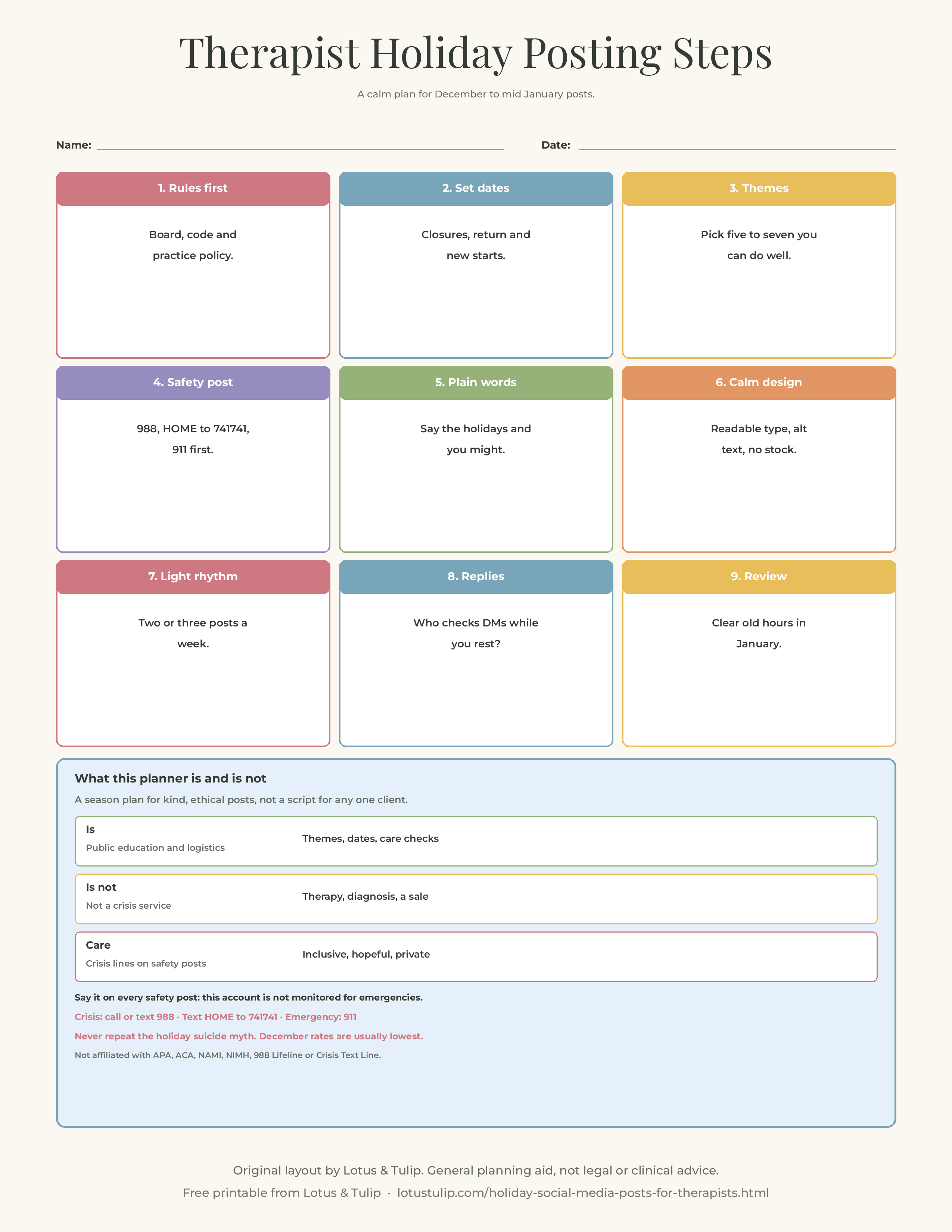
- Check your rules first. Read your state board's advertising rules, your professional code's social media sections and your practice policy. Note anything that limits testimonials, offers, credentials or how you mention services.
- Set your dates. Write down your closure days, reduced hours, return date and the first date new clients can start. Mark the holidays your clients actually observe.
- Choose five to seven themes. Use the plan above: expectations, boundaries, money, grief, rest, New Year and winter mood. Drop any theme you cannot write about with care.
- Draft the safety post first. Include 988 (call or text), HOME to 741741, 911 and "this account is not monitored for emergencies." Pin it or save it to a highlight before anything else goes out.
- Write in plain, inclusive language. Default to "the holidays," use "some people" and "you might," avoid diagnosing and avoid promises. End education posts with "General education, not individual advice."
- Design for calm. Use your normal fonts and colors, large readable type, generous space and no stock photos of happy families. Add alt text to each post.
- Schedule a light rhythm. Two or three feed posts a week, plus stories for hours and safety. Schedule ahead so you are not posting from your own holiday table.
- Plan how you will respond. Decide who checks comments and DMs during closures, what the standard reply is, and how you handle disclosures and crisis messages.
- Review in January. Remove outdated hours, archive the holiday highlight, note which posts people saved or shared, and write down what to change next year.
Which page or product fits which job
| Page or product | Best for | What it gives you |
|---|---|---|
| This guide and free printable | Planning the holiday season yourself | Themes, a seven week plan, captions, safe messaging and a 3 page planner |
| The Lantern Hours | Designed holiday posts ready to edit | 31 holiday slides, 8 stories, 6 highlight covers, 30 captions, Dec 1 to Jan 15 calendar |
| Bundle with Holiday Posts | A matching feed for the whole year | The Calm Practice plus The Lantern Hours |
| Therapist content calendar guide | Planning the rest of the year | A year round posting rhythm |
| Free therapist Instagram templates | Trying the style before buying | 5 editable posts and captions |
| Ethics checklist | Checking a post before it goes out | What therapists can and cannot post |
Tips that keep holiday posts kind
- Read each post out loud as if you had just lost someone. If it stings, rewrite it.
- Prefer verbs that give permission ("you can," "it's okay to") over verbs that give orders ("make sure you," "don't forget to").
- Keep one post a week that asks nothing of the reader: no link, no booking line, just a kind idea.
- Put crisis numbers in the image and the caption, because some people never open captions.
- Write alt text that describes the words on the slide, so screen reader users get the same message.
- Schedule posts before your break and turn off notifications while you are away. Modeling rest is part of the message.
- If your area has severe weather or a community tragedy, pause scheduled posts and check that their tone still fits.
Common mistakes
- Posting the holiday suicide myth. It is the most common error in December mental health content, and it runs against safe messaging guidance.
- Toxic positivity. "Choose joy!" and "Good vibes only" tell struggling people that their feelings are a choice they are getting wrong.
- Assuming everyone celebrates Christmas. Or that everyone has a family to go home to.
- Turning a closure into a sales event. Discounts on therapy around grief and loneliness can look like profiting from pain. If you offer anything, keep it modest and in line with your board's rules.
- Listing SAD symptoms as a self test. A checklist on a slide invites self diagnosis. Point to a provider instead.
- Disappearing without notice. Going silent for two weeks with no hours post leaves current clients unsure whether to worry.
- Sharing client gifts, cards or stories. Even with names removed, a client may recognize their own words or handwriting.
- Using statistics without dates or sources. "1 in 3 people hate the holidays" with no source is noise at best.
Myths about holiday mental health posts
- "Suicides go up at Christmas." False. December typically has the lowest average daily suicide rate in US data, per the Annenberg Public Policy Center's analysis of CDC figures.
- "Everyone is stressed at the holidays." Many people are, but in APA's 2023 poll 52% said their stress stays about the same and 7% said it decreases. Accuracy respects your readers.
- "Holiday blues and seasonal depression are the same thing." NIMH separates winter-pattern SAD, which relates to daylight, from the holiday blues, which relate to the stresses of a season.
- "A therapist account should post every day in December." Two or three thoughtful posts a week, plus clear hours and safety stories, is enough for most practices.
- "Holiday posts are just marketing." The best ones are public education and practical information. That they also show people how you think is a side effect, not the goal.
Three fictional examples
Dana, LPC in a small town practice. Last year Dana posted a bright "Merry Christmas from our family to yours!" photo. Two clients mentioned, gently, that it felt odd: one is Jewish, the other had just separated. This year Dana switched to a religion neutral default, posted a short Hanukkah greeting at sundown on December 4 and a Christmas greeting on the 25th, and kept family photos on her personal account. Her most saved post of the season was "Kind ways to say no," with three scripts on one slide.
Marcus, LMFT working with couples. Marcus wanted holiday content that fit couples work without implying every couple should be together for the holidays. He planned posts on visiting two families in one week, on deciding together what to skip, and on how to take a break from an argument at a relative's house. He added a line to his safety story with the National Domestic Violence Hotline alongside 988 and 911, and he did not post any "relationship goals" content in December.
Priya, psychologist in a group practice. Priya's practice had always closed from December 24 to January 2 without telling anyone online. This year she pinned an hours post on December 1 with the exact dates, the after hours instructions for current clients and crisis numbers, and a separate post in early January announcing openings for new clients from January 5, with no countdown. Front desk calls in the first week of January were calmer, because people already knew what to expect.
When not to post this way
- When you are in the middle of your own hard season. It is fine to schedule a light plan, or to post only hours and safety stories this year.
- When your employer or group practice controls social media. Follow their policy and route ideas through the person responsible.
- When a local tragedy has happened. Pause scheduled posts, acknowledge it simply if appropriate, and point to local and national resources.
- When your board rules are stricter than this guide. They win. This guide is general information.
- When someone is in crisis. A post is not an intervention. Call or text 988, text HOME to 741741, or call 911 for immediate danger.
Free 3 page holiday social media printable (US Letter)
Print it in November, fill it in over a coffee, and keep it next to your scheduling tool through mid January.
- Page 1: Therapist Holiday Posting Steps. Nine steps that match the HowTo above, what the planner is and is not, and crisis resources including 988, the Crisis Text Line and 911.
- Page 2: Holiday Content Planner. A seven row plan from the week of November 30 to the week of January 11, with columns for theme, feed post, story and practice note, plus fields for closure dates and your January return.
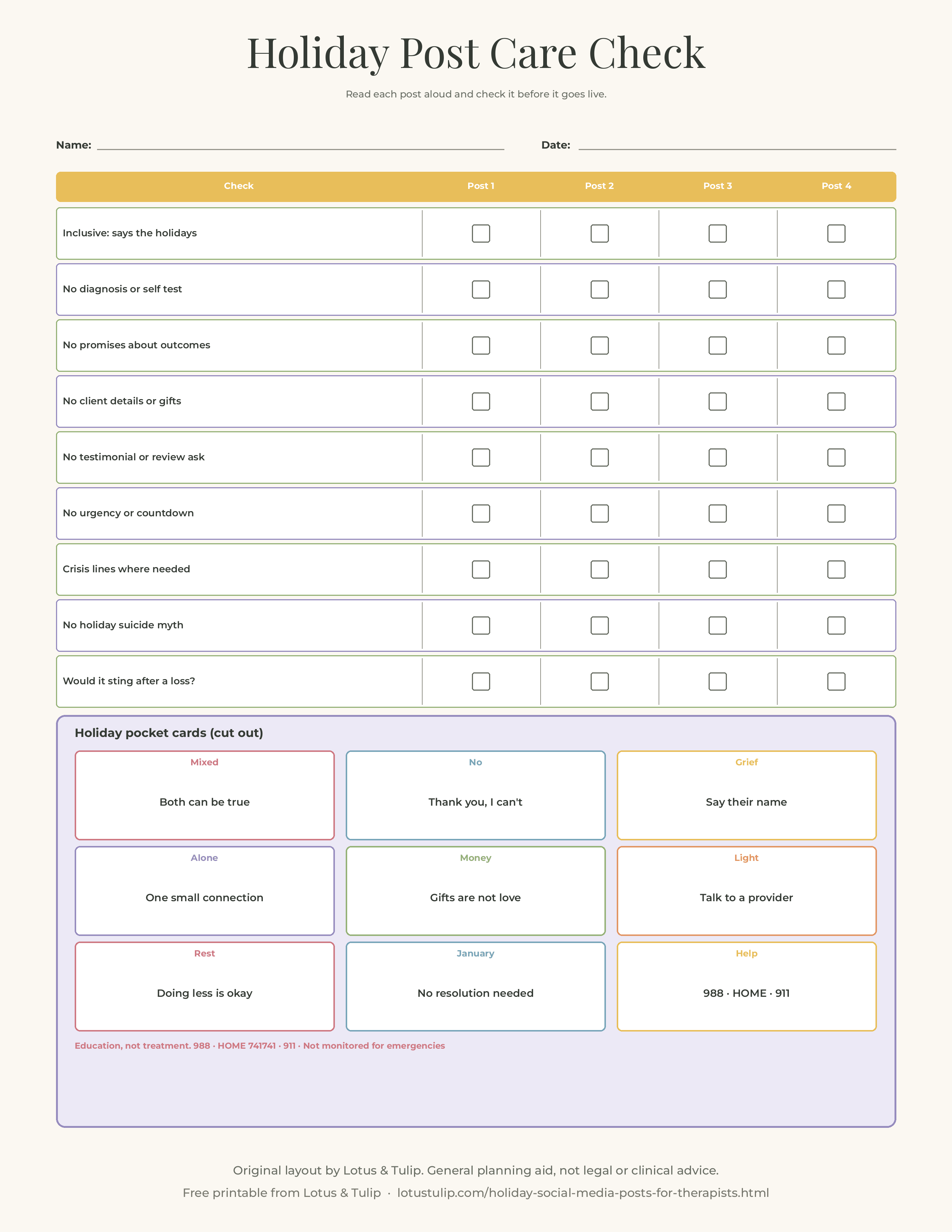
- Page 3: Holiday Post Care Check. A yes or no check for each post before it goes live (inclusive, no diagnosis, no promises, no client details, crisis line where needed), plus nine pocket cards to cut out.
Download free PDF · Page 1 PNG · Page 2 PNG · Page 3 PNG
Research notes (verified, with caveats)
- American Psychological Association. "Even a joyous holiday season can cause stress for most Americans." Press release, November 30, 2023, with the 2023 Holiday Stress Survey topline. Online poll by The Harris Poll for APA, November 14 to 16, 2023, 2,061 US adults; credible interval plus or minus 2.7 percentage points. 89% named at least one holiday stressor; 58% money (spending too much or not having enough), 40% finding the right gifts, 38% missing family or loved ones, 22% family conflict, 20% feeling left out or excluded. 41% said stress increases, 52% stays the same, 7% decreases. Caveat: an online opt-in panel with weighting, not a clinical study.
- National Alliance on Mental Illness. "Mental Health and the 'Holiday Blues'." Press release, November 21, 2014. About 300 participants, November 13 to 18, 2014; 292 answered the key question. About 24% of people with a diagnosed mental illness said the holidays make their condition "a lot" worse and 40% "somewhat" worse. Caveat: small, self selected sample.
- National Institute of Mental Health. Seasonal Affective Disorder. NIH Publication No. 23-MH-8138, revised 2023. SAD is a type of depression with a recurrent seasonal pattern; in most cases winter-pattern symptoms start in late fall or early winter. NIMH distinguishes winter-pattern SAD from holiday blues and advises talking to a health care provider or mental health specialist. Its page lists 988 and 911.
- Annenberg Public Policy Center of the University of Pennsylvania. "Lowest Suicide Rate Is in December but Some in Media Still Promote Holiday-Suicide Myth" and earlier annual analyses. Based on CDC data, December typically has the lowest average daily suicide rate; in 2024 December ranked 12th of 12 months, with August and July highest. A 2023 APPC survey found 4 in 5 US adults incorrectly chose December as the month with the most suicides.
- Recommendations for Reporting on Suicide (reportingonsuicide.org), developed by journalism, mental health, public health and suicide prevention organizations. Advises avoiding method details and sensational framing and including hope, warning signs and help such as the 988 Lifeline. Written for journalists; we apply its principles to clinician social media.
- American Counseling Association. 2014 ACA Code of Ethics, Section H.6 (Social Media): H.6.a Virtual Professional Presence (separate professional and personal pages and profiles where both exist) and H.6.d Use of Public Social Media (precautions to avoid disclosing confidential information).
- American Psychological Association. Ethical Principles of Psychologists and Code of Conduct, Standard 5.05 Testimonials: psychologists do not solicit testimonials from current therapy clients or other persons who are vulnerable to undue influence.
- 2026 dates: Thanksgiving Thursday, November 26; Hanukkah from sundown Friday, December 4 to Saturday, December 12 (Chabad.org); winter solstice Monday, December 21; Christmas Friday, December 25; Kwanzaa December 26 to January 1.
This page is not affiliated with or endorsed by the APA, ACA, NAMI, NIMH, the Annenberg Public Policy Center, the 988 Lifeline or Crisis Text Line. Our paid template kits are marketing tools for clinicians. They are not clinical interventions and have not been tested in any trial.
Holiday social media posts for therapists: FAQ
What should therapists post on social media during the holidays?
Focus on themes many people struggle with in December and January: mixed feelings, family boundaries, money pressure, grief and missing people, loneliness, rest, winter low mood and a gentle New Year. Add clear posts with your holiday office hours, how to book for January and a safety post with 988, HOME to 741741 and 911. Keep everything general, inclusive and free of diagnosis or promises.
How often should a therapist post in December?
Two or three feed posts a week plus a few stories is enough for most solo and small group practices. If you only manage five posts, choose holiday hours, kind ways to say no, grief at the holidays, a safety post and New Year without resolutions.
Should a therapy practice post "Merry Christmas"?
You can, but use "the holidays" as your default so the feed fits clients who celebrate other holidays or none. If you post specific greetings, keep them short, post them near the actual dates and think about whether you are marking some traditions and ignoring others.
Is it true that suicides increase during the holidays?
No. The Annenberg Public Policy Center, using CDC data, reports that December usually has the lowest average daily suicide rate of the year. Repeating the myth goes against safe messaging guidance. Instead, share hope and help: call or text 988, text HOME to 741741, or call 911 in an emergency.
How do I announce holiday office hours on Instagram?
Post the exact closure and return dates in late November, save them to an "Hours" highlight, and repeat them in a story the week before you close. Include what current clients should do while you are away, crisis numbers and the line "This account is not monitored for emergencies." Remove the post in January.
Can I offer a holiday discount on therapy?
Check your state board's advertising rules and your professional code first. Even where it is allowed, discounts framed around grief or loneliness can look like profiting from pain. Plain information about January availability and a free consultation, if you already offer one, is usually a better fit.
Are holiday Instagram templates for therapists editable in Canva?
The Lantern Hours kit is a set of editable PowerPoint files. You can import them into a free Canva account, open them in Google Slides, or edit them in PowerPoint. It is not a Canva template link. Fonts are free and included.
Is the free printable a copy of the paid holiday kit?
No. The free three page set is an original planning aid: posting steps, a seven week content planner and a post care check with pocket cards. The paid Lantern Hours kit contains designed posts, stories, highlight covers, captions and a dated calendar. The printable is not a preview of that kit.