
Therapist worksheets · Crisis planning · Updated 2026-11-05
Safety Plan Worksheet: Stanley-Brown Style Crisis Plan, How to Write One, and a Free Printable
Ready-made printable: Relapse Prevention Worksheets Holiday 20% off: about $9.20, was $12 (EUR 10) · instant digital download
Buy on Etsy
A safety plan worksheet is a short, personalized set of steps you can follow when thoughts of suicide or a crisis feel close. It is not a contract that forbids feelings. It is a collaborative map: warning signs, coping you can do alone, people and places that distract, people you can ask for help, professionals and crisis lines, ways to make the environment safer, and reasons for living. The best known clinical version is the Safety Planning Intervention developed by Barbara Stanley and Gregory K. Brown. This page is educational and is not affiliated with Stanley, Brown, or any hospital system.
You will learn how a safety plan differs from old no-suicide contracts, what the standard Stanley-Brown style elements are, how to fill one step by step, how adults and teens adapt it, how therapists and school counselors use it, common mistakes, and what the research honestly shows. You also get a free three page US Letter printable: My Safety Plan, a Crisis Contacts Card with an Internal Coping Menu, and an After a Hard Moment review with a weekly accuracy check.
If you are in crisis right now, stop reading worksheets and get help. In the US, call or text 988 (988 Suicide and Crisis Lifeline), text HOME to 741741 (Crisis Text Line), or call 911 if someone is in immediate danger. Stay with someone you trust if you can. This page cannot replace emergency care.
This guide is educational only. It is not therapy, not a clinical assessment, and not a substitute for care from a licensed clinician. A safety plan works best when built with a counselor, therapist, psychiatrist, or crisis worker who already knows you, or when you are actively seeking that care. Never use a worksheet as DIY treatment for acute risk.
Jump to the free safety plan printable (PDF) · How to write a safety plan, step by step · What the research says
What a safety plan is (and what it is not)
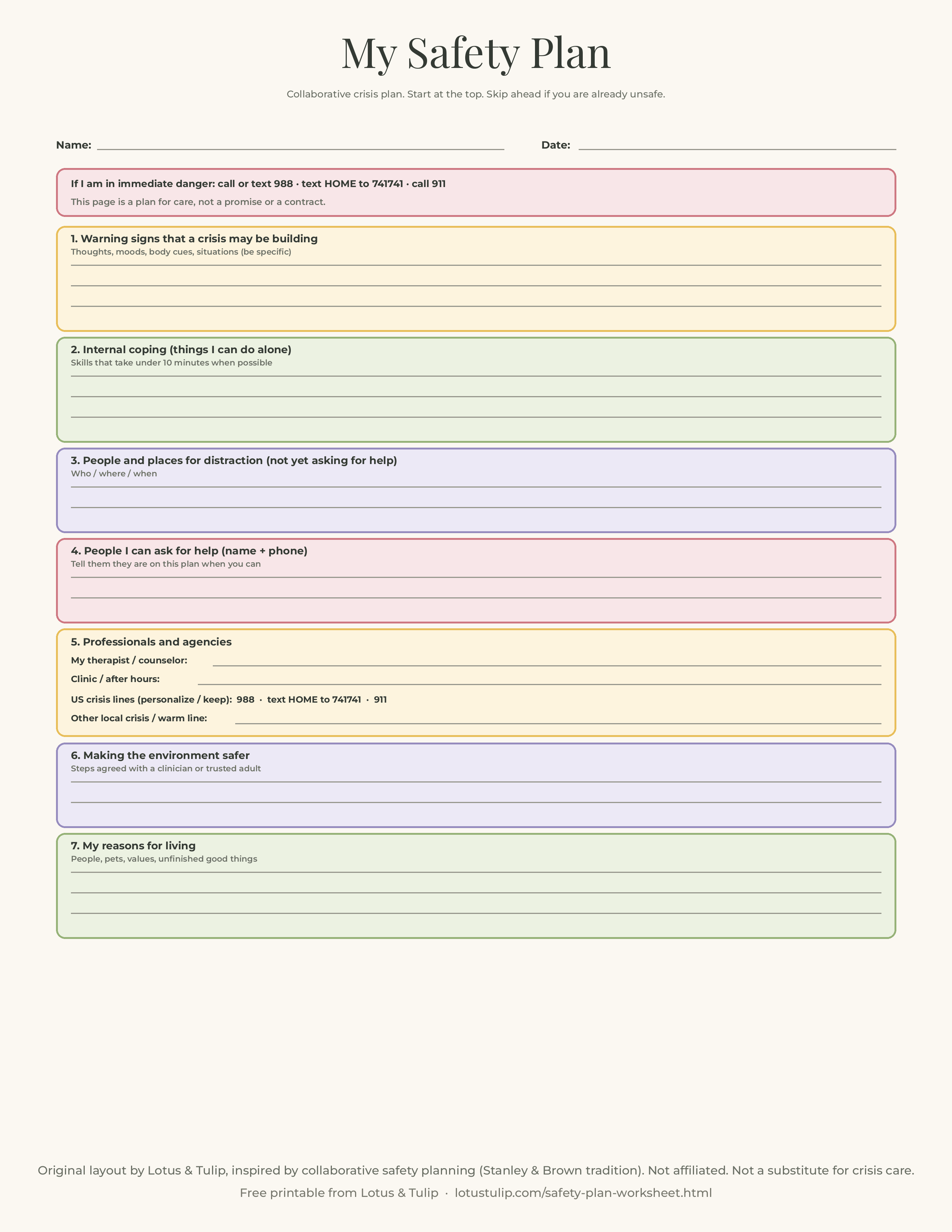
A safety plan is a brief, prioritized list of strategies and contacts for moments when suicidal thoughts rise or a crisis is forming. You write it when you are relatively steady, then keep a copy where you can reach it fast: phone photo, wallet card, fridge, counselor file. The Stanley-Brown Safety Planning Intervention (often shortened to SPI) walks through six core steps in a fixed order, from internal coping first up to professional help and means safety. Many clinics, VA settings, and emergency departments teach a version of this structure.
A safety plan is not:
- A no-suicide contract. Old "contracts for safety" asked people to promise they would not kill themselves. Research and clinical consensus moved away from those forms. A signature does not reduce risk, can shame people who already feel trapped, and may give clinicians false reassurance. Collaborative safety planning focuses on what you will do instead, not on a pledge.
- A full treatment plan. Treatment plans cover goals, interventions, and progress. A safety plan is a crisis tool that sits beside therapy. See our therapy treatment plan template for the broader document.
- A relapse prevention plan for substance use alone. Relapse plans share some DNA (warning signs, coping, supports), but a suicide safety plan is specifically about suicidal crises and means safety. Our relapse prevention plan worksheet covers lapse vs relapse for substances, depression, and anxiety.
- Permission to skip care. Filling a printable at home does not replace a risk assessment, hospitalization when needed, or ongoing therapy.
Think of the plan as a ladder you climb only as far as you need. Start with what you can do alone. If that is not enough, move to people and places. If that is not enough, call people who know how to help. If that is not enough, contact professionals and crisis services. In an emergency, skip ahead to 988, 741741, or 911.
What the research says (honestly)
Safety planning has a stronger evidence base than no-suicide contracts, with important caveats. Numbers below come from published trials and reviews. If a claim is uncertain, we hedge.
Stanley and Brown Safety Planning Intervention
Stanley and Brown described the Safety Planning Intervention as a brief, collaborative strategy for people at risk of suicide. The classic six step structure is: (1) recognize warning signs, (2) use internal coping strategies, (3) use social contacts and social settings as distraction, (4) contact family members or friends who may help resolve a crisis, (5) contact mental health professionals or agencies, and (6) reduce the potential for use of lethal means. Reasons for living are often woven in as motivation and meaning. Our free printable follows that spirit and credits Stanley and Brown; it is an original Lotus and Tulip layout, not their official form, and we are not affiliated with them.
Emergency department SPI with follow-up
In a large comparative study of suicidal patients treated in emergency departments (Stanley and colleagues, JAMA Network Open, 2018), the Safety Planning Intervention plus structured follow-up phone contacts (SPI+) was compared with usual care. Over six months, patients who received SPI+ had about 45 percent fewer suicidal behaviors (roughly 3.0 percent vs 5.3 percent), with an odds ratio of about 0.56. They also had more than double the odds of attending at least one outpatient mental health visit. That study supports SPI plus follow-up in ED settings. It does not prove that a free printable alone, without clinical contact, produces the same result.
Meta-analysis of safety planning type interventions
A 2021 meta-analysis in the British Journal of Psychiatry (Nuij and colleagues) pooled six studies of safety planning type interventions (SPTIs) with 3,536 participants. Relative risk of suicidal behavior was about 0.57 compared with control (95 percent CI about 0.41 to 0.80), which the authors summarized as roughly a 43 percent reduction, with a number needed to treat around 16. The same analysis did not find a significant effect on suicidal ideation. In plain language: plans may help reduce suicidal behavior for some people, while thoughts themselves may need other treatments (therapy, meds, social support). Evidence remains limited by study designs and heterogeneity.
What reviews still caution
Later systematic reviews generally support safety planning for reducing suicidal behavior and improving engagement with care, but they also note mixed findings on ideation, variable delivery (in person, app, self guided), and uneven methods. Quality and personalization of the plan matter. A vague sheet no one can find is not the same intervention as a clinical SPI with follow-up. Honest bottom line: safety planning is a recommended, evidence informed crisis tool in many guidelines. A printable is a practice aid. It is not a magic shield, and it is not enough by itself in acute high risk.
Standard Stanley-Brown style elements
Use these sections in order. Skip ahead only when risk is already high.
- Warning signs. Personal cues that a crisis is building: thoughts, moods, body sensations, behaviors, situations. Specific beats vague ("Sunday night alone after arguing" beats "feeling bad").
- Internal coping strategies. Things you can do alone without contacting another person: breathing, a short walk, music, a shower, grounding, prayer, journaling. Pair with skills from distress tolerance worksheets, 5 4 3 2 1 grounding, and DBT TIPP skills.
- People and social settings for distraction. Not yet "tell them I am suicidal." Just places and people that pull attention outward: a cafe, a gym class, a sibling's living room, a walk with a neighbor. The goal is to ride the wave without being alone with the urge.
- People I can ask for help. Named people who know you might call in a hard moment, with phone numbers. Ask them in advance when possible so the call is less scary.
- Professionals and agencies. Therapist, psychiatrist, clinic after hours line, local crisis team, plus national lines: 988, Crisis Text Line (HOME to 741741), and 911 for immediate danger.
- Making the environment safer. Practical steps to reduce access to lethal means during high risk periods, planned with a clinician or trusted adult when possible. This page will not list methods. Talk with a professional about what "safer" looks like for your household.
- Reasons for living. People, pets, values, unfinished projects, faith, future events. Keep the list concrete and personal. Self compassion work can soften shame that blocks this section; see the self compassion worksheet.
Some clinicians add a short "if I am already unsafe" box that points straight to emergency services. That is wise. Do not bury 988 at the bottom of a long paragraph.
How to write a safety plan, step by step
- Choose a calm enough moment and a helper if you can. Write with a therapist, counselor, crisis worker, or trusted adult when possible. If you start alone, plan to review it with a professional soon. Do not invent a plan in the middle of an active attempt.
- List your personal warning signs. Include thoughts, feelings, body cues, and situations. Aim for five to ten specific items. Cross check recent hard weeks with a mood tracker printable if you keep one.
- Fill internal coping first. Write three to five strategies you will actually use. Practice one when calm. If a skill needs a quiet body, note when it fails outside your window of tolerance.
- Add people and places for distraction. Include names, places, and hours if relevant. Avoid listing only people who are often unavailable.
- Name people you can ask for help, with numbers. Tell at least one person they are on your plan. Write backup contacts.
- List professionals, clinics, and crisis lines. Prefill 988, HOME to 741741, and 911, then add your own clinician and local resources. Keep numbers correct.
- Plan environment safety with guidance. Discuss means safety with a clinician or trusted adult. Write only the steps that apply to your home. Revisit this section after any change in risk.
- Write reasons for living in your own words. Keep them visible. Update when life changes. Pair with valued action from a behavioral activation worksheet when low mood is part of the picture.
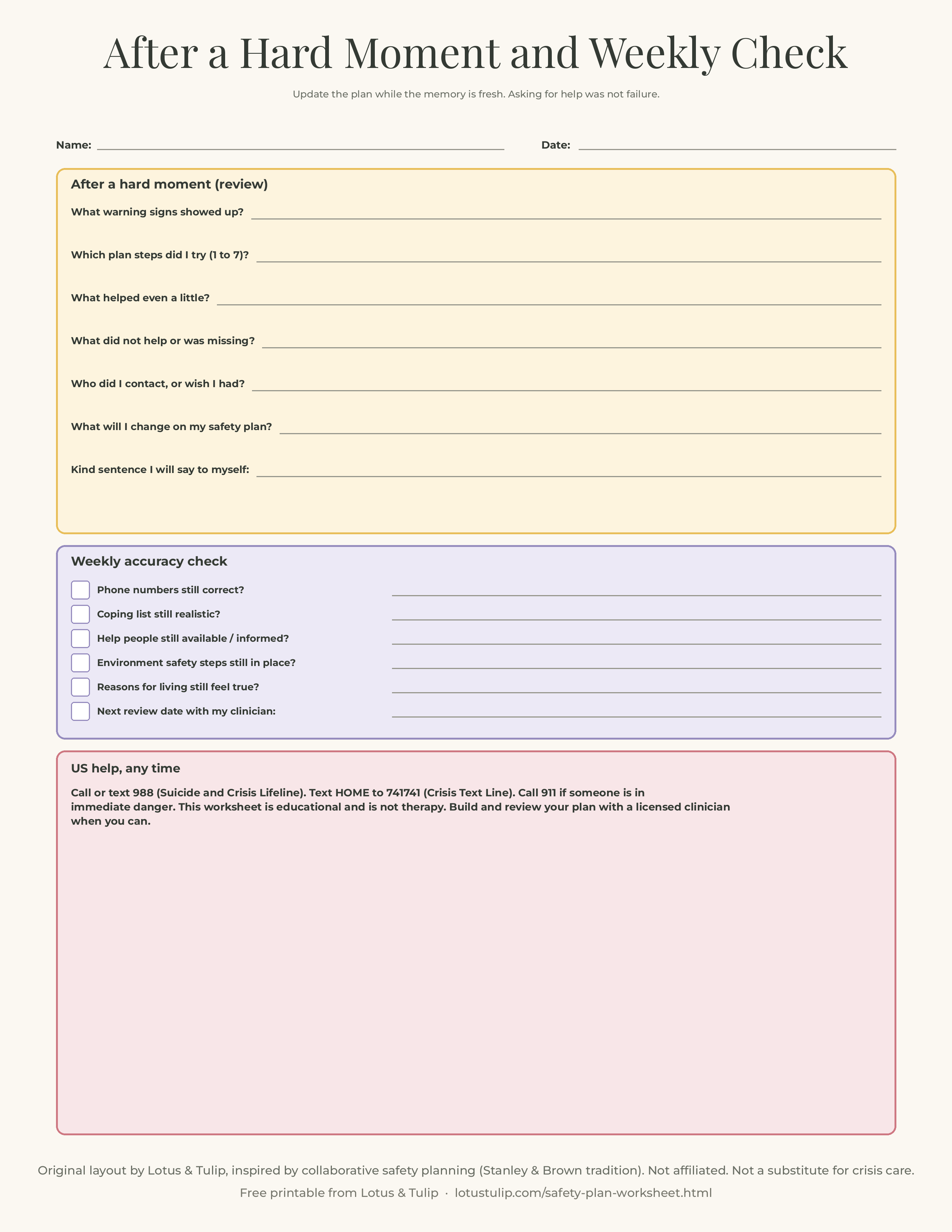
- Store copies, rehearse once, and set a review date. Photo the page, share a copy with your clinician, and check weekly that contacts and coping still fit. After a hard moment, use page 3 of the free printable to update what worked.
Keep one printed copy and one phone photo. If you share a copy with a trusted person, tell them what kind of help you want when you call. That short conversation in calm weather makes the crisis call less chaotic.
Adult and teen adaptations
Adults: Keep language plain and specific. Include workplace or caregiving constraints (who can watch kids if you go to the ED). If substances are involved, coordinate with a relapse plan so both sheets do not contradict each other. If intimacy or isolation is a driver, note which relationships help vs drain.
Teens: Privacy and trust matter. A teen may share a shorter version with parents and a fuller version with a counselor. School plans should list the counselor, nurse, and a safe adult on campus, plus after hours lines. Avoid public hallway displays of a suicide plan. Pair teen plans with coping skills worksheets for teens so skills practice is separate from crisis steps. Parents should not force a teen to perform hope they do not feel; invite honesty and keep 988 visible.
Younger children: Full Stanley-Brown style plans are usually for adolescents and adults. For younger kids, focus on feelings identification, calm corners, and adult led safety, not a child owned suicide plan sheet.
School counselor and therapist tips
- Build the plan collaboratively. The client's words beat clinician jargon.
- Start with internal coping so the first steps do not require someone else's phone to be answered.
- Verify every phone number in session.
- Document that a plan was created, where copies live, and when you will review it. Keep clinical risk notes in your chart, not only on the client's printable.
- In schools, follow district crisis protocols. A counselor worksheet never replaces calling parents, administration, or emergency services when risk is acute.
- Practice one coping step in session so the plan is not theoretical.
- Revisit after any crisis, hospitalization, med change, break up, or major loss.
- Watch for plans that only say "use willpower" or "just don't do it." Those are contracts in disguise. Replace them with actions.
How a safety plan fits with other tools
Safety plans handle imminent risk. Other worksheets handle day to day skill building:
- Distress tolerance and TIPP feed the internal coping section.
- 5 4 3 2 1 grounding is a fast sensory reset many people list first.
- Relapse prevention covers substance and mood lapse cycles that can raise suicide risk.
- Mood tracking helps spot warning sign patterns over weeks.
- Window of tolerance clarifies when coping will even work.
- Self compassion softens the shame that keeps people from calling for help.
- Behavioral activation rebuilds routine after the crisis wave passes.
Use the right tool for the moment. In acute danger, call 988 or 911 first. Worksheets wait.
Filling each section with useful detail
Vague plans fail under stress. Specific plans survive it. For warning signs, write the sentence your mind actually uses, not a clinical paraphrase. "I start drafting goodbye notes in my head" is more useful than "passive ideation." For internal coping, include how long the skill takes and where you do it: "cold water on both wrists at the kitchen sink for one minute" beats "self soothe." For distraction contacts, add whether text or call is better, and a backup if the first person does not answer. For help contacts, note what you want them to do: sit with you, drive you, or help you call 988. For professionals, include after hours instructions so you are not guessing at midnight. For environment safety, write only steps you and your clinician agreed on, in language that will still make sense when thinking is narrow. For reasons for living, mix people, values, and small unfinished goods: a pet's morning routine can matter as much as a five year dream.
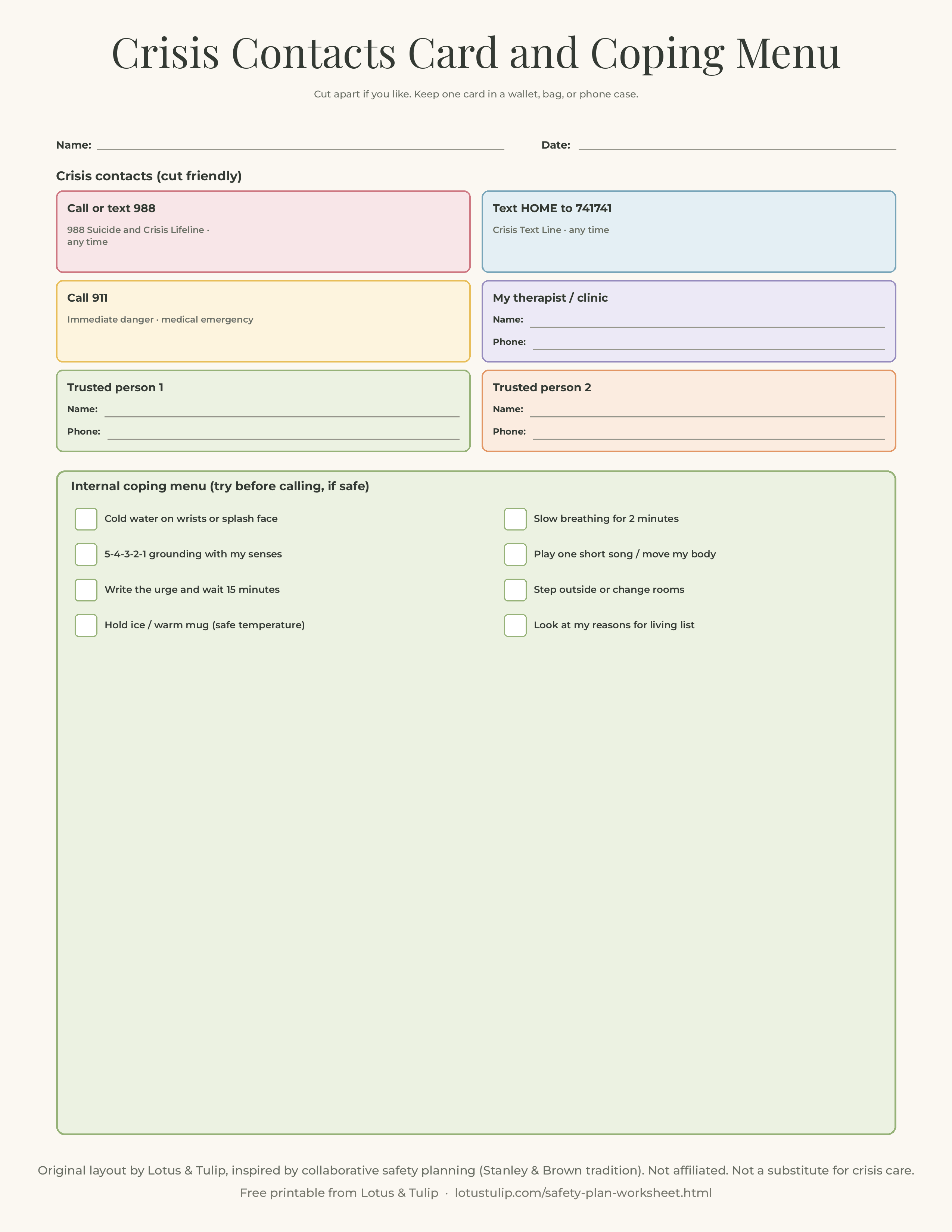
Review the plan out loud once. If a step requires supplies you do not own, change the step. If every contact lives in another time zone, add a local option. If you freeze when phones feel impossible, keep the Crisis Text Line step near the top of the professional section. The free printable's second page turns contacts and coping into cut friendly cards you can keep in a wallet or taped inside a journal.
Common mistakes
- Writing it only once and never updating. Numbers change. Coping that worked in spring may fail in winter.
- Listing people who do not know they are on the plan. Surprise midnight calls are harder for everyone.
- Skipping means safety because it feels awkward. That section exists for a reason. Discuss it with a professional.
- Making internal coping a fantasy list. "Run a marathon" is not a 2 a.m. skill. Prefer actions under ten minutes.
- Hiding the only copy. A plan in a locked drawer helps no one at 1 a.m.
- Using the plan as a substitute for treatment. Plans support care. They do not replace it.
- Shaming someone for needing step 5 or 6. Calling a professional is success, not failure.
- Turning reasons for living into pressure. "Think of your kids" can spike guilt. Keep reasons warm and chosen by the person.
A worked example (fictional)
Alex, 34, built a safety plan in outpatient therapy after a week of rising hopelessness. Warning signs: sleeplessness past 2 a.m., scrolling old conflict threads, the thought "everyone would be better off." Internal coping: cold water on wrists, a three song playlist, 5 4 3 2 1 grounding. Distraction: 24 hour grocery store walk, texting a coworker about a neutral show. Help contacts: sister Maya and friend Jordan, both warned in advance. Professionals: therapist number, clinic after hours line, 988, 741741, 911. Environment: agreed with the therapist on temporary changes at home (details kept private on this page). Reasons for living: dog Nova, finishing a night class, a spring trip already paid. Two weeks later Alex used steps 2 and 3 on a hard Thursday and did not need the ED. The plan did not erase depression. It gave a sequence when thinking narrowed.
When to get urgent help (read this twice)
Get urgent help if you have a plan and intent to act, if you cannot stay safe even for the next hour, if someone else is in danger, or if you have already hurt yourself. Call or text 988, text HOME to 741741, or call 911. Go to the nearest emergency department if you need to. If you are supporting someone else, stay with them if it is safe for you, remove immediate hazards with guidance from professionals when possible, and do not leave them alone with a lethal plan.
Outside the US, use your local emergency number and local crisis lines. This page focuses on US searchers and US resources.
Free safety plan worksheet (PDF)
The free safety plan worksheet has three pages in US Letter size:
- Page 1: My Safety Plan. Stanley-Brown style fillable sections for warning signs, internal coping, people and places for distraction, people for help, professionals and crisis lines (with 988, 741741, and 911 as examples to personalize), making the environment safer, and reasons for living.
- Page 2: Crisis Contacts Card and Internal Coping Menu. Cut friendly contact blocks plus a menu of solo skills to try before you call.
- Page 3: After a Hard Moment and Weekly Check. Review what you used, what helped, what to change, and a short weekly accuracy check so the plan stays true.
Download the free safety plan worksheet (PDF, 3 pages, US Letter)
Prefer single images? Page 1: My Safety Plan (PNG) · Page 2: Crisis Contacts and Coping Menu (PNG) · Page 3: After a Hard Moment Review (PNG)
Free to print for your own use and for use with your own clients, students, or groups. This is an original layout by Lotus & Tulip, inspired by collaborative safety planning in the tradition of Stanley and Brown. It is not an official Stanley-Brown form, not affiliated with those authors, and not a substitute for crisis care. Please link to this page rather than re-uploading the file.
Free trauma starter pack: Supporting a client after trauma? The free trauma worksheets for therapists starter pack adds a coping plan for hard moments (notice, name it, ground, soothe, reach out), a grounding toolkit, a window of tolerance page, a trigger map and a support and contacts page with 988 and 911 (8 pages, client use license, no email).
Related resources
- Telehealth across state lines: emergency planning by client location
- Duty to warn for therapists: Tarasoff, state laws, HIPAA and a free documentation worksheet
- Relapse prevention plan worksheet: warning signs and coping for substance use, depression, and anxiety.
- Distress tolerance worksheets: STOP, ACCEPTS, and crisis survival skills.
- Coping skills worksheets for teens: teen friendly skill menus.
- 5 4 3 2 1 grounding worksheet: fast sensory grounding.
- DBT TIPP skills worksheet: temperature, intense exercise, paced breathing, progressive relaxation.
- Mood tracker printable: spot patterns that feed warning signs.
- Behavioral activation worksheet: small actions after the crisis wave.
- Self compassion worksheet: kinder self talk when shame blocks help seeking.
- Window of tolerance worksheet: know when skills can land.
Sources
- Stanley, B., and Brown, G. K. (2012). Safety Planning Intervention: A brief intervention to mitigate suicide risk. Cognitive and Behavioral Practice, 19(2), 256 to 264. Foundational description of the six step collaborative safety plan. We are not affiliated with the authors.
- Stanley, B., Brown, G. K., Brenner, L. A., et al. (2018). Comparison of the Safety Planning Intervention with follow-up versus usual care of suicidal patients treated in the emergency department. JAMA Network Open, 1(2), e180252. SPI+ associated with about 45 percent fewer suicidal behaviors over six months and higher odds of outpatient follow-up.
- Nuij, C., van Ballegooijen, W., de Beurs, D., et al. (2021). Safety planning-type interventions for suicide prevention: meta-analysis. The British Journal of Psychiatry, 219(2), 419 to 426. Pooled relative risk of suicidal behavior about 0.57 (about 43 percent reduction; NNT about 16); no significant effect on ideation in that analysis.
- Later systematic reviews (for example in Archives of Suicide Research and related journals) generally support safety planning for behavior and engagement outcomes while noting heterogeneity and limits on ideation findings. Treat single study percentages as context, not guarantees for any one person.
- Clinical consensus has largely moved away from no-suicide contracts as a standalone risk reduction tool; collaborative safety planning is preferred in many contemporary protocols.
- Honest caveat: no major trial tests this three page Lotus and Tulip printable alone as a treatment. Evidence cited above refers to clinical safety planning interventions, often with follow-up. Acute risk requires live professional care.
- 988 Suicide and Crisis Lifeline, 988lifeline.org. Crisis Text Line, crisistextline.org.
Safety plan worksheet: FAQ
What is a safety plan worksheet?
A safety plan worksheet is a short fillable page that lists warning signs, coping steps, people and places that help, professionals and crisis lines, ways to make the environment safer, and reasons for living. It is meant for moments when suicidal thoughts or a crisis is rising, and it works best when written with a clinician.
How is a safety plan different from a no-suicide contract?
Old contracts asked people to promise they would not kill themselves. Safety plans instead list concrete steps and contacts. Research and clinical practice favor collaborative planning over promissory contracts, which can shame clients and give false reassurance.
Is this the official Stanley-Brown form?
No. This free printable is an original Lotus and Tulip layout inspired by the Stanley and Brown Safety Planning Intervention tradition. We credit those authors and are not affiliated with them. For clinical training materials, seek official SPI resources through appropriate professional channels.
Can a safety plan reduce suicidal behavior?
Some trials and a 2021 meta-analysis found safety planning type interventions associated with fewer suicidal behaviors (for example about a 43 percent relative risk reduction in that pooled analysis, and about 45 percent fewer behaviors in one large ED SPI+ study). Effects on suicidal ideation are less clear. Results vary, and a printable alone is not the same as a clinical intervention with follow-up.
What should I do if I am in crisis right now?
Stop using worksheets as your main tool. In the US, call or text 988, text HOME to 741741, or call 911 for immediate danger. Go to an emergency department if you need to. Reach a trusted person if you can stay safe doing so.
Can teens use a safety plan?
Yes, with adult and counselor support. Keep school versions aligned with campus protocols, list on-campus safe adults, and protect privacy. Pair the plan with teen coping skill practice rather than relying on willpower alone.
Can I print the free safety plan for clients or students?
Yes. The free PDF is an original Lotus and Tulip layout that you can print for your own use and for your own clients, students, or groups. Please link to this page instead of re-uploading the file. It is educational, not a substitute for crisis assessment or emergency care.