
Therapist marketing · Updated 2026-11-08
Instagram Post Ideas for Speech Therapists (with Free Printable)
Ready-made template kit: Speech Therapist Instagram Templates Holiday 20% off: about $22.08, was $28 (EUR 24) · instant digital download
Buy on Etsy
Instagram posts for speech therapists have a job that mental health therapist posts rarely face: they have to teach the public what a speech-language pathologist actually does, without turning a child video into marketing, without promising that anyone will start talking on a deadline, and without offering treatment in the comments. A parent scrolling at night may be worried about a late talker, a stutter, a feeding struggle or a grandparent who suddenly cannot find words. A careless caption can diagnose them in public, sell a result you cannot guarantee, or invite them to send a voice note so you can just take a listen. Good speech therapist content is calm, sourced and honest about the line between public education and an evaluation.
This guide is written for US licensed speech-language pathologists (SLPs) in private practice who work with children, adults or both, including people who also work in schools or hospitals and keep a professional Instagram for a side practice or community education. It covers what to post on Instagram as a speech therapist: content pillars that fit speech, language, fluency, voice, feeding and swallowing, AAC and adult medical work; 34 post ideas with original caption angles; how to talk about credentials (your state license and, if you hold it, the Certificate of Clinical Competence); how to handle photos of children; how to write about stuttering and milestones without overclaiming; how to post sudden speech-change information that points people to 911; a simple weekly rhythm; a 12 week planning overview; a nine step HowTo; mistakes; myths; three fictional examples; and a free three page US Letter printable: Speech Therapist Posting Steps, an SLP Content Planner and an SLP Post Care Check with pocket cards.
If you are newer to posting as a clinician, start with our general ethics checklist for therapist social media and our Instagram post ideas for therapists. Those pages are written for mental health therapists and counselors. This one is narrower on purpose. It covers questions that come up when your clients are children whose faces are easy to recognize, adults recovering from stroke or brain injury, families comparing your feed with cartoon speech therapy accounts, and readers who may be having a medical emergency rather than looking for a weekly session. Couples therapists have their own guide: Instagram post ideas for couples therapists. Holiday posts for clinicians live in holiday social media posts for therapists.
We draw on primary sources without claiming any affiliation or endorsement: the ASHA Code of Ethics (2023), ASHA Issues in Ethics statement on the Ethical Use of Social Media (updated 2024), ASHA Issues in Ethics statement on Public Announcements and Public Statements, ASHA page on the Effective Use of Social Media, ASHA Developmental Milestones for Birth to 5 Years, the CDC page on signs and symptoms of stroke, the NIDCD page on stuttering, the U.S. Department of Education overview of IDEA Parts C and B, and the Federal Trade Commission Guides Concerning Use of Endorsements and Testimonials in Advertising (16 CFR Part 255). Full notes are below. The printable is an original Lotus and Tulip layout.
This guide is general marketing information, not legal, ethical or clinical advice. Your state licensing board, the ASHA Code of Ethics if it applies to you, HIPAA if you are a covered entity, IDEA rules if you work in a school or early intervention program, and any employer policy come first. Social media posts are public education, not speech therapy, and an Instagram account is not a clinic or a crisis service. If you or someone near you has sudden trouble speaking, sudden weakness on one side, a drooping face, sudden trouble seeing, sudden loss of balance, or a sudden severe headache, call 911. Do not drive to the hospital. Speech therapy is not emergency care. Every safety post you publish should carry that message and say plainly that your account and inbox are not monitored for emergencies.
What this guide is and is not
It is a planning guide for public, educational Instagram content from a speech-language pathology practice. It helps you choose themes, write posts that stay inside your license and competence, explain how your practice works, and keep privacy and emergency information in view.
It is not legal advice. Advertising and title rules differ by state. Some boards restrict how you may describe specialties, fees, testimonials or telepractice. School and hospital employers often have separate social media policies that are stricter than anything in this guide. When in doubt, read your board rules or ask your liability insurer risk management line.
It is not clinical advice. Nothing here tells you how to assess a late talker, how to treat stuttering, how to manage dysphagia, or whether a particular child should be referred to early intervention. Those are clinical decisions that belong in your training, supervision and the evaluation room, not in a caption.
It is not a promise that posting will fill your caseload. Many SLPs get most referrals from pediatricians, schools, discharge planners, directories and word of mouth. Instagram can help a worried parent or adult understand what you do before they call, and it can correct common myths (an SLP is not only for speech sounds, bilingualism is not a delay, stuttering does not have a one day cure). That is a real benefit, and it is not the same as a guaranteed stream of new clients.
And it is not therapy for your followers. A feed can offer general information and a clear path to an evaluation. It cannot listen to a voice note, read a two year old vocabulary list in a DM, or tell someone "that sounds like apraxia."
Why speech therapists need different posts than mental health therapists
Mental health therapist Instagram often talks about feelings, skills and what therapy is like. Speech-language pathology Instagram has extra traps:
- Children are easy to identify. A classroom corner, a sibling in the background, a distinctive backpack or a parent caption can reveal a client even if you never say a name. ASHA Issues in Ethics statement on social media is blunt: posting a detail about a client, no matter how insignificant it seems, may allow others to identify that person and reveal that they are receiving treatment from you.
- Progress videos are tempting and risky. Before and after clips of a child speech are common on social media. They can also be a confidentiality breach, a subtle outcome promise ("this is what happens when you work with me") and, if the child cannot meaningfully consent, an ethical problem even when a parent is enthusiastic.
- Medical emergencies hide inside speech topics. Sudden trouble speaking or understanding speech is one of the CDC signs of stroke. A post about adult speech changes that does not tell people to call 911 is incomplete. Speech therapy itself is not emergency care.
- The public still thinks "speech teacher." Many readers do not know that SLPs also work on language, fluency, voice, cognitive-communication, AAC, and feeding and swallowing. Your feed has to teach the scope of the profession without sounding like a lecture or claiming every possible specialty you do not actually offer.
- Cure language is everywhere around you. Accounts promise to fix lisps, cure stuttering or get a toddler talking in 30 days. ASHA uses "Cure stuttering in just one day! Buy my book!" as its example of a social media ethics violation, because the clinician has no evidence for that claim. Principle I, Rule M of the 2023 Code says you may make a reasonable statement of prognosis, but you shall not guarantee, directly or by implication, the results of any treatment or procedure.
If your practice is mixed (for example you are an SLP who also posts mental health adjacent content, or you share an office with counselors), keep the two jobs visually and verbally separate. An SLP caption should not drift into diagnosing anxiety or ADHD. Stay inside the aspects of the professions that are within your professional practice and competence, which is Principle II, Rule A.
The ethics that actually shape an SLP feed
The ASHA Code of Ethics (2023) applies to ASHA members, people who hold the Certificate of Clinical Competence, and applicants for membership or certification. If that is you, the Code is not optional branding. Four clusters of rules do most of the work on Instagram.
Confidentiality (Principle I, Rules O and P)
Rule O requires you to protect the confidentiality and security of records. Rule P requires you to protect the confidentiality of information about persons served professionally. Disclosure is allowed only when it is legally authorized or required by law. ASHA social media ethics statement applies this to ordinary posts: a seemingly innocent comment, a partly redacted progress note photographed to show how far they have come, or a listserv question with too many details can all identify a client.
On Instagram that means: no client names, no initials that locals would recognize, no session anecdotes, no photos or videos of clients (especially children) unless you have specific written authorization that covers this exact use, and even then a long pause about whether the post is necessary. The safer default used in our own kit, and the one we recommend here, is not to show children faces or client images at all. Use original graphics, your own workspace without clients in it, or clearly fictional examples.
No guaranteed results (Principle I, Rule M)
The rule is short and easy to quote in a team handbook: "Individuals may make a reasonable statement of prognosis, but they shall not guarantee, directly or by implication, the results of any treatment or procedure." A caption that says "I will have your child speaking in eight weeks," a highlight named "Results," or a reel set to a triumphant song over a child new sounds can imply a guarantee even if you never wrote the word guarantee. Describe what you do, who you see and how to start. Leave outcomes in the evaluation room.
No therapy by caption or DM (Principle I, Rule N)
Rule N allows telepractice consistent with professional standards and state and federal regulations, "but they shall not provide clinical services solely by written communication." A thoughtful public caption is education. A back and forth in DMs about a specific child speech, a voice note screening, or a comment thread that turns into a mini evaluation is not. ASHA Effective Use of Social Media page gives the pattern to avoid: "DM me your child's symptoms, and I'll tell you what to do." The replacement line is simple: "That is a good question to bring to a licensed SLP who can evaluate your child. I cannot assess anyone over Instagram."
Honest public statements (Principle III, Rules A, C, E and F)
You shall not misrepresent your credentials, competence, education, training or experience (Rule A). You shall not misrepresent diagnostic information, services provided, results of services provided or products (Rule C). Statements to the public shall provide accurate information about the professions and your services (Rule E) and shall not contain misrepresentations when you advertise (Rule F). ASHA social media statement gives three everyday mistakes: calling a student or assistant by a title they do not hold, listing CCC on LinkedIn or Instagram when you have only applied for it, and claiming scholarly publications you do not have. "Most highly qualified in the city" is another example they flag when you have no basis for the comparison.
ASHA Issues in Ethics statement on public announcements adds that testimonials from clients should never be used without explicit permission, that clients must not be coerced (and coercion in a treating relationship can be subtle), and that the FTC endorsement rules may be stricter than ASHA guidance. If ASHA guidance is less restrictive than your board or the FTC, you follow the stricter rule.
The FTC Guides (16 CFR Part 255, revised July 26, 2023) still apply if you do post a review: endorsements must reflect honest opinions and experiences, you cannot imply that typical results match an unusual success, and you must disclose material connections. A parent who received free sessions in exchange for a review is not a typical client, and that has to be clear.
Photos, children and written permission
If you are a HIPAA covered entity, a photo or video that identifies a client is protected health information when it is tied to the fact that the person receives care from you. A written HIPAA authorization for marketing use is not the same as a parent sending a heart emoji under a story. ASHA Effective Use of Social Media page says to use generic examples or stock images and never to post client content without written, specific consent. Stock photos of smiling children create their own problem: they can imply typical results and they rarely look like the families you actually see. Original text and shape designs avoid both issues.
Even with written permission, ask whether the post is kind to the child in ten years. A video of a struggle that felt fine to a proud parent can be mortifying to a middle schooler who still lives in the same town. If you do accept a permitted photo, store the authorization, limit how long the post stays up, and never use a child image to argue that your method works.
The same caution applies to adult medical clients. A person with aphasia may agree in the moment and not fully grasp that the post will be public, shareable and permanent. When in doubt, do not post the person. Post the information.
Ten content pillars for a speech therapist Instagram
Pick five or six as your regular rotation. Always keep privacy and a safety post in the set. The others should match who you actually see. An adult outpatient clinician does not need a weekly toddler milestone carousel. A pediatric clinician who never treats swallowing should not post as if they do.
| Pillar | What it answers for the reader | Example angle |
|---|---|---|
| What an SLP does | "Is this only for kids who cannot say R?" | Speech, language, fluency, voice, cognition, AAC, feeding and swallowing; you list only the areas you serve |
| Speech or language | "What is the difference?" | Speech is how sounds are produced; language is how we understand and use words and sentences |
| Your first contact and first session | "What happens if I call?" | Who you see, what an evaluation involves, how long it takes, what to bring |
| Credentials and how to check them | "How do I know you are licensed?" | State license, how to look it up, what CCC-SLP means if you hold it, no extras you have not earned |
| Privacy | "Will my child appear on your Instagram?" | Your own practice habit: you do not post client images or stories |
| Milestones as a guide | "Should I be worried?" | ASHA chart is not a screening or diagnostic tool; missing one skill is not automatically a disorder |
| Home conversation tips | "What can we do while we wait?" | Talk, wait, read; do not turn every dinner into drill; this is not a home program |
| Fluency and stuttering | "Can you cure this?" | There is currently no cure; treatment exists; listening matters more than finishing the sentence |
| Adults, aphasia and sudden change | "Is this just aging?" | Sudden change is a 911 issue; everyday conversation tips for talking with someone who has aphasia |
| How to start (fees, online, area) | "Can I book?" | States you serve, in person or online, fee placeholders, early intervention and school paths when relevant |
Two extra pillars fit some practices and should stay off the feed of others: AAC (what it is, that AAC does not replace speech by magic or stop talking) and feeding and swallowing (questions to bring to an evaluation, never individual diet advice, and a clear line that choking or inability to breathe is 911).
34 Instagram post ideas for speech therapists, with caption angles
Each idea below is written so you can draft it without a client story. The sample lines are original starting points, not scripts you have to copy word for word. Add the closing line "General information, not a substitute for an evaluation by a licensed SLP" on any educational post, and add "This account is not monitored for emergencies" on any safety post.
About you and the profession
- What an SLP is. Angle: "A speech-language pathologist is a licensed clinician who assesses and treats communication and, when trained to do so, swallowing. We are not speech teachers, and we do not diagnose from a video."
- Speech or language. Angle: "Speech is the sounds, voice and fluency you hear. Language is the words, sentences and meaning underneath. A person can have a need in one, the other, or both. An evaluation is how we tell the difference."
- Who I see (and who I refer). Angle: "In this practice I see [children / adults / both] for [list]. I do not treat [list]. If that is what you need, I will help you find someone who does."
- How to check a license and certification. Angle: "You can look up a state license on your state board website. The CCC-SLP is ASHA Certificate of Clinical Competence. I show only the credentials I actually hold."
- What happens in an evaluation. Angle: "An evaluation is a structured look at communication (and swallowing, if that is part of the concern). It is not a pop quiz and it is not a promise of weekly therapy. Sometimes the result is development looks typical, here is what to watch."
- From first call to first session. Angle: "You will get a reply during office hours, a few forms, and a clear time window. If this is a sudden change in an adult speech, do not wait for a speech evaluation. Call 911."
- Online sessions. Angle: "I can see people online when I am licensed in the state where they are sitting, and when the concern is a good fit for telepractice. I cannot treat by caption, email or DM."
- Fees, with placeholders you must replace. Angle: "Evaluation and session fees are listed on my site. If I take insurance or superbill requests, I say so plainly. Instagram is not a quote."
- Your privacy habit. Angle: "You will not see clients on this account. I do not post faces, voices or session stories. If a review ever appears, it is only with written permission."
- Who does what on the care team. Angle: "SLPs work alongside pediatricians, ENTs, audiologists, occupational therapists, teachers and families. If hearing has not been checked, that comes first more often than people expect."
Children and families
- Milestones as a guide, not a test. Angle: "ASHA publishes communication and feeding milestones to help families know what to expect. ASHA says the charts are not a screening or diagnostic tool. Children develop across a range. If several skills are missing, new skills are not appearing, or skills have been lost, talk with your child doctor and consider an evaluation."
- Talking with your toddler, without turning play into drill. Angle: "Narrate what you are doing. Leave space for your child to take a turn. Read together in the language you are most comfortable using. You do not need special flashcards to have a conversation."
- Do not interrupt to correct every sound. Angle: "ASHA family tips include this one: do not interrupt your child to correct speech sounds. It is okay if some sounds are still developing. Model the sounds correctly when you talk."
- Languages at home. Angle: "Communicate with your child in the languages you are most comfortable using. Learning more than one language is not a speech or language disorder. If you have a concern, an SLP who understands bilingual development can help you sort typical bilingual patterns from a true language need."
- When your child stutters. Angle: "Many young children go through a period of disfluency. NIDCD notes that there is currently no cure for stuttering, and that treatments exist. A useful first step at home is to listen to what your child is saying, not how smoothly it comes out, and not to finish the sentence."
- Early intervention under age 3. Angle: "In the United States, infants and toddlers from birth through age 2 who qualify can receive early intervention under IDEA Part C, through your state program. You do not need to wait for a private evaluation if you are concerned. Ask your pediatrician or your state early intervention program how to refer."
- From age 3, the school path. Angle: "Children and youth ages 3 through 21 who qualify can receive special education and related services, including speech-language pathology, under IDEA Part B, through the local public schools. Private therapy and school services are not the same thing; some families use one, the other, or both."
- Summer and back-to-school booking. Angle: "If you want a fall evaluation slot, summer is when many private practices fill. This is logistics, not pressure, and it is not a claim that waiting will cause harm."
- Questions to ask before you book any SLP. Angle: "Are you licensed in my state? What is your experience with this concern? How do you involve families? How will we know if therapy is helping? What does a session look like?"
- Play and conversation at home. Angle: "A few minutes of face to face play usually beats a worksheet. Follow your child lead, add a word or two to what they say, and stop before everyone is tired. This is general conversation advice, not a treatment plan."
Fluency, AAC, voice and feeding
- Stuttering myths. Angle: "Stuttering is not caused by nervousness alone, and it is not something to snap out of. There is no one day cure. If an ad promises one, that is a reason to be cautious, not impressed."
- How to talk with someone who stutters. Angle: "Maintain natural eye contact, give time, and do not fill in words. Ask the person what feels respectful to them. Children notice when adults look away or hurry them."
- What AAC is. Angle: "AAC means augmentative and alternative communication: supported ways to communicate, from gestures and picture boards to speech-generating devices. It is a tool for communication, not a last resort you earn after other things fail."
- AAC does not stop speech. Angle: "Families often worry that a device will replace talking. An SLP can explain how AAC can support language and reduce frustration. Individual decisions belong in an evaluation, not in a comment thread."
- Voice care, kept general. Angle: "If your voice has changed suddenly, or you have pain, coughing blood, or trouble breathing, that is medical care first, not an Instagram tip. Ongoing hoarseness is something to mention to a physician. I treat voice only if that is inside my competence and caseload."
- Feeding and swallowing questions, not diets. Angle: "An SLP who works on feeding and swallowing looks at safety and skill, often with a physician. I will not diagnose a swallow from a video or tell you to change a child food based on a comment. Choking or any trouble breathing is 911."
Adults and community
- Sudden speech changes in adults. Angle: "Sudden confusion, trouble speaking, or difficulty understanding speech can be a sign of stroke. So can sudden numbness or weakness, especially on one side, sudden trouble seeing, sudden dizziness or loss of balance, and a sudden severe headache with no known cause. Call 911. Note the time symptoms started. Do not drive yourself." Use CDC B.E. F.A.S.T. check: Balance, Eyes, Face, Arms, Speech, Time.
- Talking with someone who has aphasia. Angle: "Reduce background noise, speak in short clear sentences, pause, and confirm that you understood. Do not pretend you followed if you did not. Aphasia affects language; it does not mean the person has lost intelligence."
- Speech therapy for adults. Angle: "Adults see SLPs after stroke or brain injury, for voice, fluency, cognitive-communication and swallowing, among other reasons. Age alone is not a reason to ignore a change, and a sudden change is not something to wait and see without medical care."
- Your area and who you can legally see. Angle: "I see people in [city or region] and, online, people located in the states where I hold a license. If you are sitting in a state I am not licensed in, I cannot treat you there."
- Office hours and holidays. Angle: "Here are this month hours and closures. Messages received outside these times are read on the next working day. This account is not monitored for emergencies."
- Gift cards, only if they match your real policy. Angle: "If you offer gift cards, say whether they expire and keep that statement accurate. Do not invent an expiry rule for a pretty template."
- National Speech-Language-Hearing Month (May). Angle: "May is National Speech-Language-Hearing Month in the United States (the observance ASHA led for decades as Better Hearing and Speech Month). It is a natural time to explain what SLPs do, share milestone resources with ASHA disclaimer, and remind people how to find licensed care. It is not a reason to post client stories."
- A thank you that does not ask for a public review. Angle: "Thank you to the families and adults who trust this practice. If you ever want to share feedback, you can do that privately. I will never ask a current client to post a review."
Six fuller caption examples you can adapt
These are original and written to be copied into a notes app, then edited with your real details. Replace every bracket. Do not add a client story to make them more human.
- Welcome: "Hello, I am [Name], a speech-language pathologist licensed in [states]. I work with [children / adults / both] on [areas you actually treat]. This account shares general information about communication and about how this practice works. It is not therapy, and it is not a place to send voice notes for an opinion. If you are looking for an evaluation, you are welcome to get in touch through the link in bio. General information, not a substitute for an evaluation by a licensed SLP."
- Speech or language: "People say speech therapy for almost everything we do, but speech and language are not the same. Speech is how we produce sounds, use our voice and manage fluency. Language is how we understand words, put sentences together and use communication with other people. A child who is hard to understand may have a speech sound need, a language need, both, or something else (including hearing). An evaluation is how we sort that out. I cannot sort it out from a comment. General information, not a substitute for an evaluation by a licensed SLP."
- Privacy: "A question I am glad people ask: will my child be on your Instagram? No. I do not post client photos, videos or session stories. You will see graphics, practice information and general education. If I ever share a written review, it will be only with specific written permission, and I will never ask a current client for one. Your care stays in the therapy room."
- Stuttering: "If your child is stuttering, you are not alone, and you did not cause it by being a nervous parent. The National Institute on Deafness and Other Communication Disorders says there is currently no cure for stuttering, and that a variety of treatments are available. A kind thing you can do today is listen to the message, not the bumps in it, and not jump in to finish the word. If you want to talk about an evaluation, I would rather hear from you through [booking path] than in a DM about symptoms. General information, not a substitute for an evaluation by a licensed SLP."
- Sudden change: "If an adult in your life suddenly has trouble speaking, understanding speech, smiling evenly, raising both arms, seeing clearly, or staying balanced, or has a sudden severe headache, treat it as an emergency. Call 911. The CDC groups these checks as B.E. F.A.S.T.: Balance, Eyes, Face, Arms, Speech, Time. Note when symptoms started. Do not drive. Speech therapy can be part of recovery later. It is not the first call to make in this moment. This account is not monitored for emergencies."
- Early intervention: "If you are concerned about a baby or toddler communication or feeding, you do not have to wait and wonder until preschool. In the U.S., IDEA Part C covers early intervention for eligible infants and toddlers from birth through age 2, through your state program. From age 3 through 21, eligible children and youth can receive special education and related services under IDEA Part B, including speech-language services through the public schools. Private practice is another path, not a replacement for knowing your public options. General information, not a substitute for an evaluation by a licensed SLP."
How to handle DMs, comments and just a quick listen
Write a standard reply and save it. You will need it more than once.
- The symptom dump: "Thank you for writing. I cannot assess a child or adult over Instagram, and I do not want to guess. If you would like to schedule an evaluation, here is how: [link]. If this is a sudden change in speech, face, arm strength, vision or balance, call 911."
- The voice note: "I know a short recording feels like a shortcut. I cannot use voice notes sent here to diagnose or plan treatment. An evaluation is the right next step if you are concerned."
- The other professional asking for a consult about a named student: "I cannot discuss a specific person in this inbox. If we have a signed release, please use the practice email listed on my site."
- The compliment that becomes a testimonial request from you: Do not turn a kind comment into "Would you mind repeating that in a Google review?" ASHA public announcement guidance warns that coercion in a treating relationship can be subtle. Let people offer feedback through a private channel if they want to.
Decide who checks comments and DMs, and how often. If it is only you, say so, and say that messages are read on working days. Never leave a medical disclosure sitting unanswered because you were off the clock without a public notice that the account is not monitored.
A weekly rhythm and a 12 week overview
Two or three feed posts a week is enough for most solo SLP practices. Daily posting is not a clinical duty. A sustainable pattern looks like this:
- One education post (speech vs language, milestones as a guide, stuttering, aphasia conversation tips).
- One practice post (who you see, how to book, fees, privacy, hours).
- Optional third post or a few stories (a question sticker that does not invite symptom dumps, a poll about office hours, a reminder of the pinned safety post).
A simple 12 week overview you can copy onto the free planner:
- Weeks 1 and 2. Welcome, what an SLP does, speech or language, who you see.
- Weeks 3 and 4. How to check a license, what an evaluation involves, privacy habit, how to book.
- Weeks 5 and 6. Pediatric: milestones as a guide (with ASHA "not a screening tool" line), talking with your toddler, do not correct every sound.
- Weeks 7 and 8. Fluency, AAC or bilingual language (pick what you actually treat), plus a reminder that DMs are not evaluations.
- Weeks 9 and 10. Adults: sudden speech changes and 911, talking with someone who has aphasia, adult speech therapy in general terms.
- Weeks 11 and 12. Fees and hours, questions to ask before booking, early intervention and school paths, then a thank you that does not solicit reviews. If you are posting in spring, week 12 can be National Speech-Language-Hearing Month. If you are posting in late summer, it can be back-to-school booking.
Pin three posts: the safety/911 post, the privacy post, and the how-to-book post. Highlights that match The Unhurried Word set work well for most practices: About, Services, Fees, Book, FAQ, Kids or Adults, Online, Area, Resources, Contact. Only use a Reviews highlight if you actually have written-permission reviews you are willing to stand behind.
May, October and other dates that fit an SLP feed
May is National Speech-Language-Hearing Month in the United States. ASHA led this public outreach month for more than fifty years under the name Better Hearing and Speech Month and now uses the newer name. It is a good month to explain the profession, point families to ASHA milestone resources (always with the disclaimer that they are not a screening or diagnostic tool), and remind people how to find licensed audiologists and SLPs. It is a poor month to post a flood of client transformations.
October includes International Stuttering Awareness Day on October 22. If you treat fluency, a careful post about listening, time and the fact that there is currently no cure is more useful than a success story. October is also AAC Awareness Month in many advocacy calendars; if AAC is inside your competence, explain what it is and what it is not.
December and January are when families look up office closures, gift certificates and whether to start after the holidays. Our separate guide to holiday social media posts for therapists is written for mental health practices; an SLP can borrow the logistics pieces (hours, gift cards that match your real policy, no pressure to be cheerful) and skip content that does not fit speech-language pathology.
How to plan Instagram posts as a speech therapist, step by step
- Check your rules first. Read the ASHA Code of Ethics if it applies to you, ASHA Issues in Ethics statement on social media, your state board advertising and title rules, HIPAA or school privacy rules if they apply, and any employer policy. Note anything on testimonials, credentials, fees and telepractice.
- Write down who you see. Children, adults or both; the areas inside your competence; the states you are licensed in; in person or online. Your posts should match this list exactly.
- Pick five or six pillars. Choose from the map above. Always include privacy and a safety post that points sudden speech, face, arm, vision or balance changes to 911.
- Draft the safety post first. Use the CDC stroke signs and B.E. F.A.S.T., tell people to call 911 and not to drive, and write "this account is not monitored for emergencies" and "speech therapy is not emergency care." Pin it and save it to a highlight.
- Write your credentials line. List only the license and certification you hold. If you have applied for the CCC but do not hold it yet, do not put CCC-SLP in your bio or on a welcome slide.
- Draft posts with sources and without guarantees. Short facts should point to ASHA, NIDCD, CDC or IDEA in plain language. End education posts with "General information, not a substitute for an evaluation by a licensed SLP." Never promise a cure or a timeline for talking.
- Design for calm and privacy. Use readable type, your own colors and no client photos. Skip children faces unless you have specific written authorization and a very good reason. Add alt text to every post.
- Schedule two or three posts a week. Map four weeks at a time on a planner, mixing education, practice information and one awareness or logistics post.
- Plan replies and review monthly. Write a standard reply that refuses symptom DMs and voice-note listens, decide who checks comments, and once a month remove outdated hours and run each live post through the care checklist.
Mistakes and myths
Common mistakes
- Before and after videos of children. Even with an enthusiastic parent, you are displaying a minor communication struggle to sell a service. They also function as an outcome promise.
- Cure, guarantee and in 30 days. These collide with Principle I, Rule M and with ASHA own social media example about curing stuttering in a day.
- Listing CCC-SLP before you have it. ASHA calls this out directly. Applied is not earned.
- Diagnosing in the comments. "That sounds like childhood apraxia" under a stranger video is an individual clinical statement you cannot support from a clip.
- Treating by DM. Principle I, Rule N does not allow clinical services solely by written communication. A saved reply protects you and the family.
- Milestones used as a pass or fail test. ASHA says its charts are not a screening or diagnostic tool. Quote that line whenever you share them.
- Framing an accent or dialect as a problem to fix. The Code non-discrimination rule explicitly includes culture, language, dialect and accent. Accent modification, when you offer it, is elective and must be described honestly, not as treatment of a disorder.
- Vague online availability. "Seeing clients everywhere" can imply you practice where you are not licensed. Telepractice follows the client location.
- Asking current clients for reviews. Permission, no pressure, and the FTC rules if you post what they write. Many SLPs choose not to request public reviews at all.
- Posting from a frustrating session. If the caption is coming from a specific afternoon with a specific family, wait a day and then write a general post instead, or write nothing.
Myths about speech therapist Instagram
- "Parents expect to see cute kids on an SLP feed." Parents also expect privacy. A clear privacy post often builds more trust than a montage.
- "You have to post every day to be found." Two or three careful posts a week, plus current highlights, is plenty for most private practices.
- "General tips are the same as a home program." A home program is individualized. Public tips should stay at the level of conversation, reading and not interrupting, and should say so.
- "If a parent consents in a text, the video is fine forever." You want specific written authorization that names the platform and the use, and you still need to judge whether the post is kind and necessary.
- "Hashtags like speechdelay are harmless." They can attract the people you hope to help, and they can also attract comments asking you to diagnose a child in public. Moderate them or choose plainer tags.
- "Instagram replaces a website or directory profile." It supports them. People still need a place to read your license, fees and contact details without logging into an app.
Three fictional examples
These practices and people are made up. They are here so you can see the decisions, not so you can guess at a real clinic.
- Ren, a pediatric SLP in a small city. A parent texts a 20 second clip of their four year old and writes "you can post this, everyone at preschool already knows." Ren thanks them, does not post the clip, and instead publishes a carousel on speech versus language with ASHA general-information line at the bottom. The parent later books an evaluation through the website. The clip never becomes marketing.
- Claudia, an adult medical SLP attached to an outpatient clinic. After a morning with a person who has aphasia, Claudia almost writes "had a breakthrough with my aphasia client today." She deletes the draft. Too many people in that clinic town would know who had an appointment that morning. She posts CDC stroke signs and B.E. F.A.S.T. instead, with 911 and the line that speech therapy is not emergency care. Two days later a colleague mentions that a patient spouse had screenshot the post after an episode at Sunday dinner and called an ambulance. Claudia cannot know whether the post caused that, and she does not claim it did. She keeps the safety post pinned.
- Sam, a school SLP with a small private practice on evenings. Sam school district forbids posting about students. On the private practice account, Sam almost answers a comment that names a student from the school. Instead Sam deletes the comment, messages the parent through the official school channel to explain they cannot discuss students on Instagram, and posts a general piece about IDEA Part B as one path families can ask the school about. The private practice bio lists only the states on Sam private license and says school questions go through the school.
How this compares with other kinds of professional posting
| Speech therapist Instagram | Mental health therapist Instagram | School or EI newsletter | |
|---|---|---|---|
| Main reader | Parents, adults, caregivers, referral sources | Prospective individual or couples clients | Families already connected to a program |
| Highest risk | Child images, implied cures, diagnosing from clips, missing 911 on sudden speech change | Client stories, outcome promises, crisis posts without resources | Student privacy under school and IDEA rules |
| Best regular posts | Scope of practice, speech vs language, privacy, milestones as a guide, fluency and aphasia education, how to book | What therapy is like, skills, fees, boundaries, safety resources | Program dates, how to request an evaluation, home conversation ideas approved by the program |
| Emergency line | 911 for stroke or choking; this account is not a clinic | 911, 988 and other crisis lines | Follow the school emergency and reporting procedures |
| Code close at hand | ASHA Code (2023) and social media ethics statement | ACA, APA, NASW or AAMFT, depending on license | Employer policy plus FERPA and IDEA |
When not to post
- When the only interesting part of the post is a specific client. If you cannot write it without that person, do not write it.
- When you want to answer a stranger "what does my child have?" Point them to an evaluation. Do not guess.
- When you are tired, angry or showing off. Wait a day.
- When you would need to promise results to make the post work. If the post only works with a before and after, it is the wrong post.
- When a sudden medical situation is unfolding in your own circle. Do not live-post a family stroke scare. Share the CDC signs later, in general language, if you still want to.
- When posting is crowding out actual rest or clinical work. A quiet feed with good highlights is fine. You can pause.
Free 3 page speech therapist Instagram printable (US Letter)
Print it, fill it in once a month, and keep it next to your scheduling tool. It works with any design tool or template set.
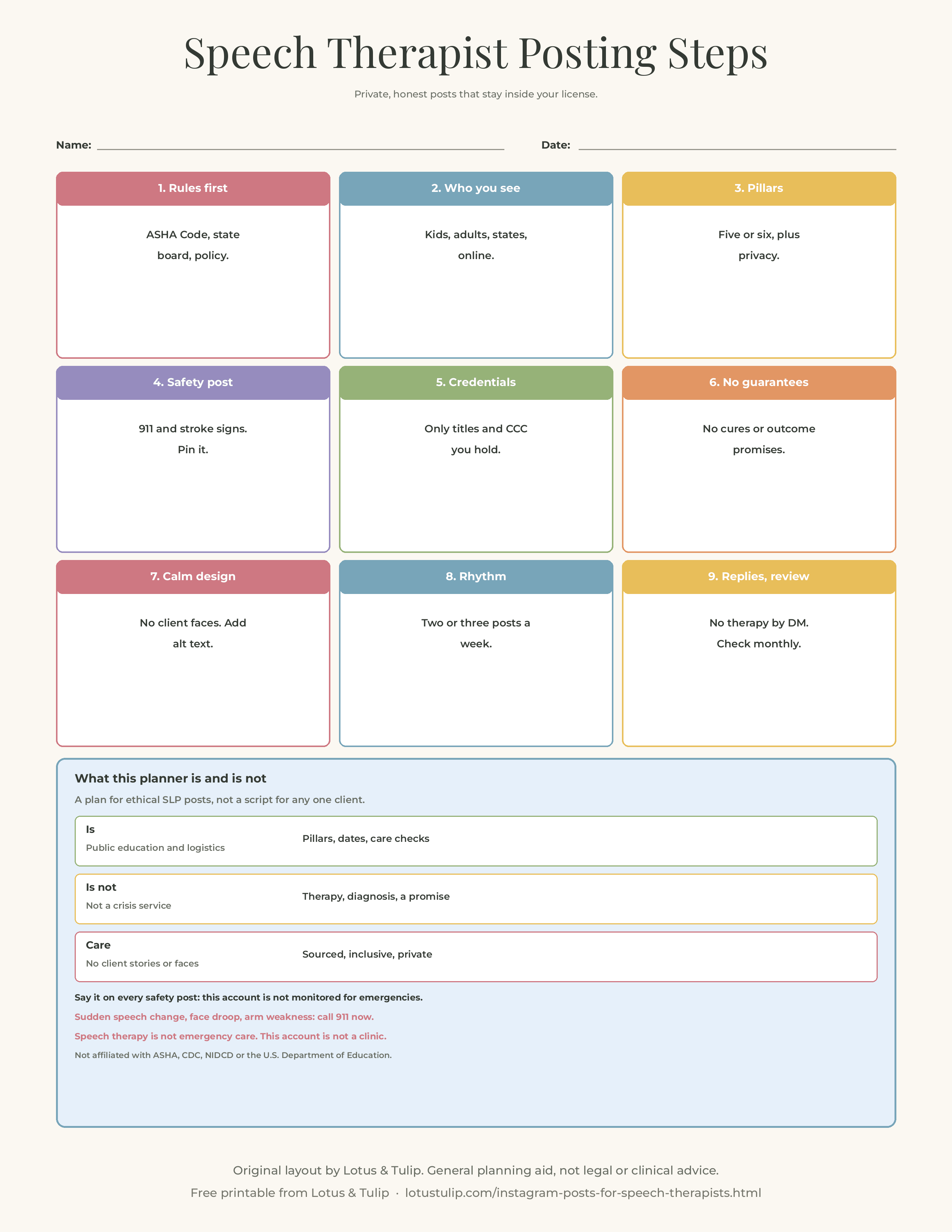
- Page 1: Speech Therapist Posting Steps. Nine steps that match the HowTo above, what the planner is and is not, and safety lines that point sudden speech, face or arm changes to 911.
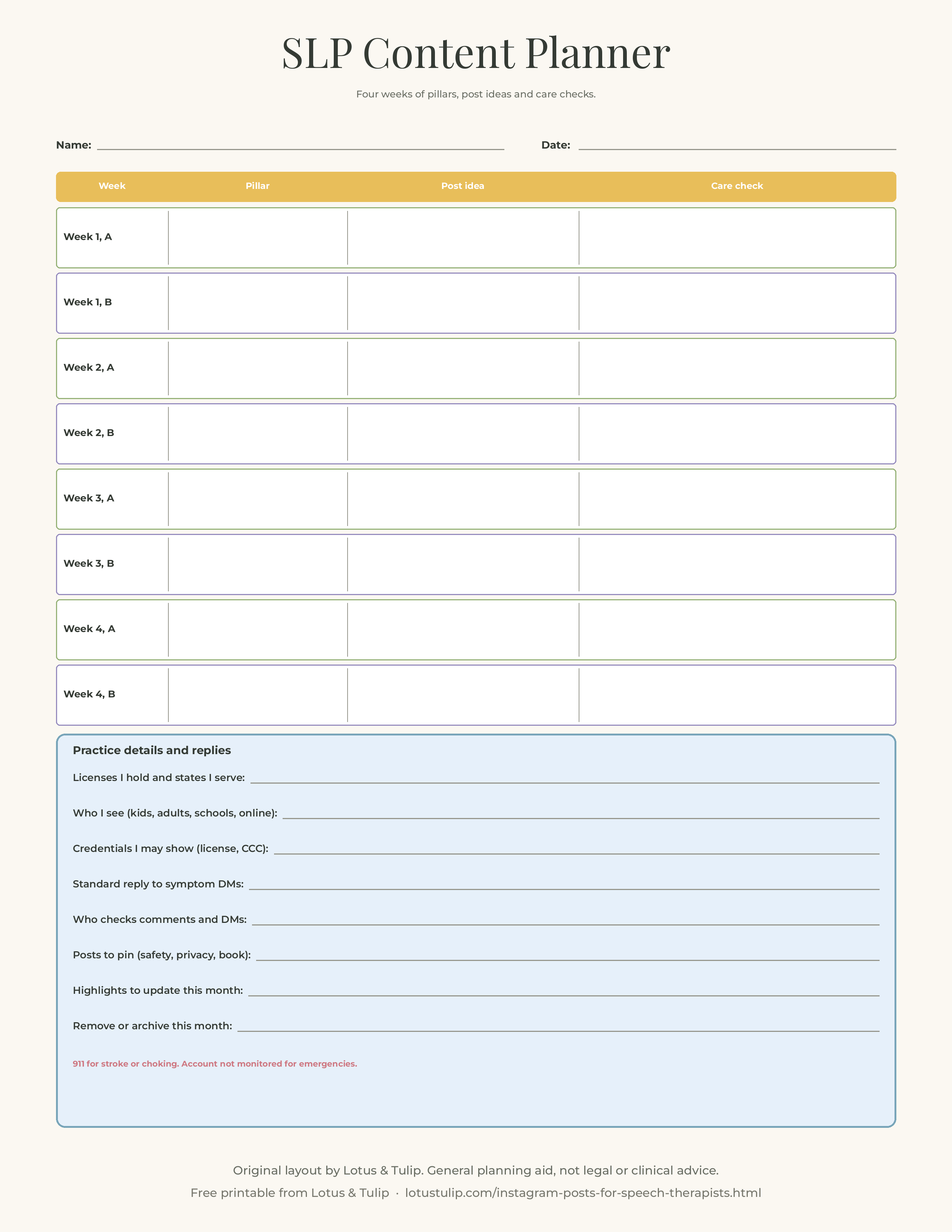
- Page 2: SLP Content Planner. Four weeks of posts with columns for pillar, post idea and care check, plus fields for your licenses and states, credentials you may show, your standard reply to symptom DMs, and the posts to pin.
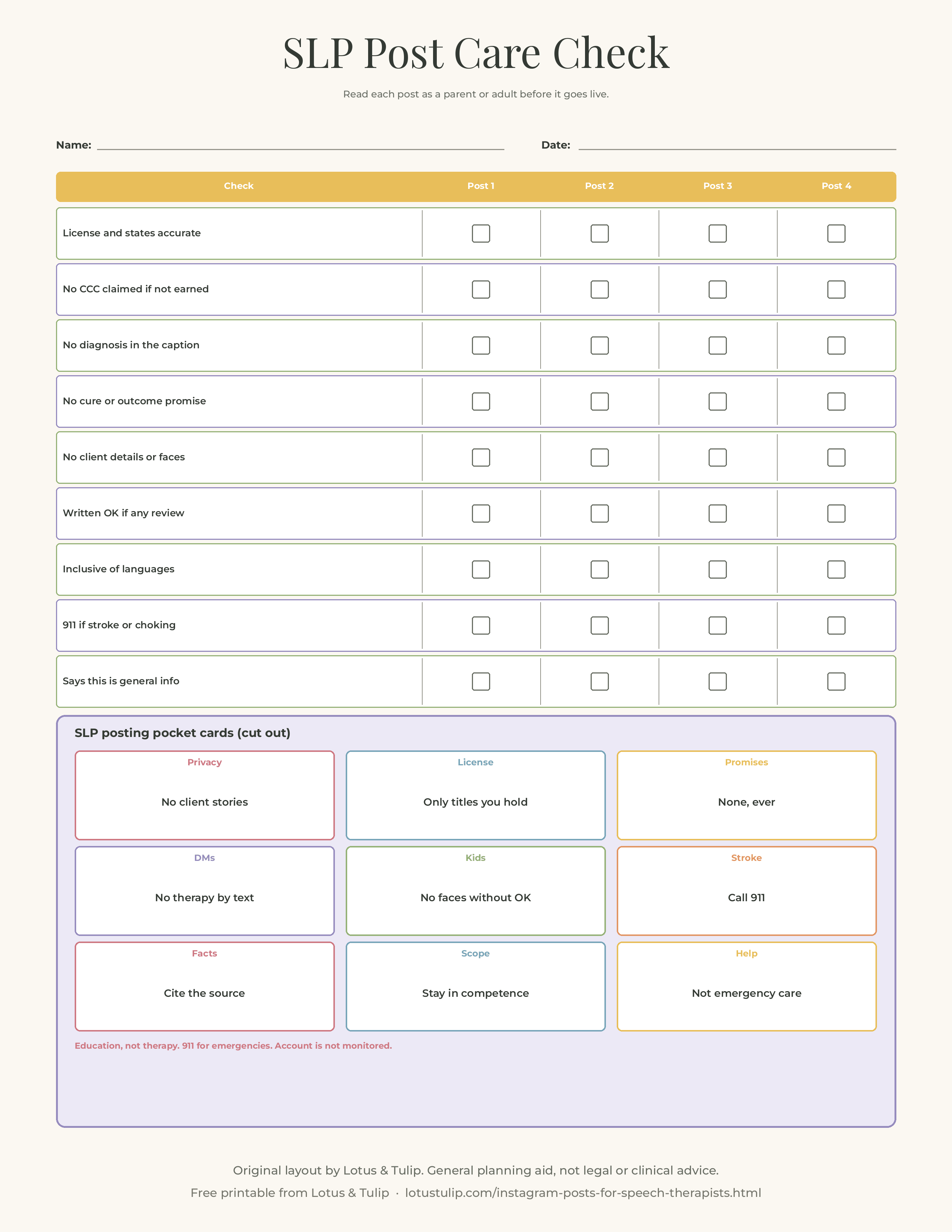
- Page 3: SLP Post Care Check. A yes or no check for up to four posts (license and states, no unearned CCC, no diagnosis, no cure language, no client details or faces, written permission if any review, inclusive of languages, 911 when relevant, general-information line), plus nine pocket cards to cut out.
Download free PDF · Page 1 PNG · Page 2 PNG · Page 3 PNG
Research notes (verified, with caveats)
- American Speech-Language-Hearing Association. Code of Ethics (2023), PDF at asha.org/siteassets/publications/code-of-ethics-2023.pdf. Quoted or closely paraphrased in this guide: Principle I, Rule M (reasonable prognosis; no guarantee of results, directly or by implication); Principle I, Rule N (telepractice permitted consistent with standards and law; "shall not provide clinical services solely by written communication"); Principle I, Rules O and P (confidentiality of records and of information about persons served); Principle II, Rule A (engage only in aspects of the professions within scope of practice and competence); Principle III, Rules A, C, E and F (no misrepresentation of credentials, of services or results, and of public statements when advertising). Terminology in the same document defines advertising as any form of communication with the public regarding services, therapies, research, products or publications, and defines misrepresentation as a statement that is false, erroneous or misleading.
- American Speech-Language-Hearing Association. Issues in Ethics: Ethical Use of Social Media (published 2024; originally 2020, updated for the 2023 Code), asha.org/practice/ethics/ethical-use-of-social-media/. Notes that posting distinctive personal information can breach confidentiality; that even a seemingly insignificant detail may identify a client; that a partly redacted treatment record posted to show progress is an example of a breach; and that "Cure stuttering in just one day! Buy my book!" is an example of prohibited misrepresentation. Also warns against listing CCC before it is earned and against unsupported "most highly qualified" claims.
- American Speech-Language-Hearing Association. Issues in Ethics: Public Announcements and Public Statements, asha.org/practice/ethics/public-announcements-and-public-statements/. Public communications include social media and blogs. Client or patient comments should never be used without explicit permission; clients must not be coerced, and coercion can be subtle in a treating relationship. FTC endorsement rules and state licensure laws may be stricter than ASHA guidance; follow the stricter standard.
- American Speech-Language-Hearing Association. Effective Use of Social Media, asha.org/practice/effective-use-of-social-media/. Advises against sharing client photos, names or identifiable stories without written, specific consent, and against offering individualized advice such as "DM me your child's symptoms."
- American Speech-Language-Hearing Association. Developmental Milestones: Birth to 5 Years, asha.org/public/developmental-milestones. Direct quote of the site disclaimer: "This is not a screening or diagnostic tool." The communication milestones page repeats that the milestones are not meant to be a screening or diagnostic tool and includes family tips such as communicating in the languages you are most comfortable using and not interrupting a child to correct speech sounds.
- American Speech-Language-Hearing Association news (April 29, 2024) and ASHA Journals Academy (May 2, 2024): May is National Speech-Language-Hearing Month, formerly Better Hearing and Speech Month. Missing one milestone does not necessarily mean a child needs an evaluation; lacking several skills, not learning new ones, or losing skills are reasons to talk with a pediatrician and consider an evaluation.
- Centers for Disease Control and Prevention. Signs and Symptoms of Stroke, cdc.gov/stroke/signs-symptoms/. Lists sudden trouble walking, dizziness, loss of balance or coordination; sudden trouble seeing; sudden numbness or weakness, especially on one side; sudden confusion, trouble speaking, or difficulty understanding speech; and sudden severe headache with no known cause. Instructs people to call 9-1-1, note the time symptoms began, and not drive to the hospital. Describes the B.E. F.A.S.T. check: Balance, Eyes, Face, Arms, Speech, Time.
- National Institute on Deafness and Other Communication Disorders. Stuttering, nidcd.nih.gov/health/stuttering. Direct wording used above: "Although there is currently no cure for stuttering, there are a variety of treatments available." The page also describes stuttering behaviors and notes that an SLP is the professional who diagnoses and treats voice, speech and language disorders. We have not repeated NIDCD prevalence statistics in the body of this guide.
- U.S. Department of Education. About IDEA, sites.ed.gov/idea/about-idea/. "Infants and toddlers, birth through age 2, with disabilities and their families receive early intervention services under IDEA Part C. Children and youth ages 3 through 21 receive special education and related services under IDEA Part B."
- Federal Trade Commission. Guides Concerning Use of Endorsements and Testimonials in Advertising, 16 CFR Part 255 (as revised July 26, 2023, 88 FR 48102), via eCFR. Sections 255.1 (endorsements must reflect honest opinions and experience), 255.2 (consumer endorsements and generally expected results) and 255.5 (disclosure of material connections).
This page is not affiliated with or endorsed by ASHA, CDC, NIDCD, the U.S. Department of Education or the FTC. Our paid template kits are marketing tools for clinicians. They are not clinical interventions and have not been tested in any trial. You stay responsible for what you post.
Instagram posts for speech therapists: FAQ
What should a speech therapist post on Instagram?
Focus on what prospective families and adults need to know: what an SLP does, the difference between speech and language, what an evaluation involves, how to check a license, your privacy habit, milestones presented as a guide rather than a test, general conversation tips, stuttering information that does not promise a cure, sudden speech-change signs that point to 911, how to start, and who you actually see. Keep a pinned safety post and a pinned privacy post.
How often should a speech therapist post?
Two or three feed posts a week is enough for most solo and small practices, plus occasional stories. If that is too much, post once a week and keep your Safety, Privacy and Book highlights current.
Can I share a client progress photo if a parent said it was okay in a text?
A casual text is a weak foundation. ASHA advises written, specific consent, and HIPAA (if it applies to you) has its own authorization rules for marketing uses. Even then, consider whether the post identifies the child to neighbors or classmates and whether it functions as an outcome promise. The safer habit is not to post client images at all.
Can I put CCC-SLP in my Instagram bio if my application is still in?
No. ASHA social media ethics statement lists claiming the Certificate of Clinical Competence before you have earned it as a form of misrepresentation under Principle III, Rule A. Show only the credentials you currently hold, and show your state license if you have one.
Is it ethical to say I can cure stuttering or get a late talker talking in 30 days?
No. Principle I, Rule M says you shall not guarantee results, directly or by implication. ASHA social media statement uses "Cure stuttering in just one day!" as an example of an ethics problem. NIDCD states that there is currently no cure for stuttering. Describe what you do and how to request an evaluation instead.
Should I answer parent questions about their child in DMs?
You can kindly refuse and point them to an evaluation. Principle I, Rule N says you shall not provide clinical services solely by written communication. ASHA also advises against "DM me your child's symptoms." Save a standard reply so you are not improvising when a worried parent writes at night.
Are speech therapist Instagram templates editable in Canva?
The Unhurried Word kit is a set of editable PowerPoint files. You can import them into a free Canva account, open them in Google Slides, or edit them in PowerPoint. It is not a Canva template link. The fonts, Playfair Display and DM Sans, are free and included.
Is the free printable a copy of the paid kit?
No. The free three page set is an original planning aid: posting steps, a four week content planner and a post care check with pocket cards. The paid Unhurried Word kit contains designed posts, stories, highlight covers, captions and a 12 week calendar. The printable is not a preview of that kit.