
Therapist marketing · Updated 2026-11-08
Instagram Post Ideas for Couples Therapists (with Free Printable)
Ready-made template kit: Couples Therapist Instagram Templates Holiday 20% off: about $22.08, was $28 (EUR 24) · instant digital download
Buy on Etsy
Instagram posts for couples therapists have to do something most therapist content never has to think about: speak to two people at once, often two people who are not getting along, without taking a side. A post about "your needs" can land as a weapon in the wrong hands. A post about repair can read as pressure to stay. A smiling stock couple can tell a person in a frightening relationship that this practice will not understand them. Good couples therapist content is calm, even handed, inclusive and honest about limits.
This guide is written for US licensed marriage and family therapists (LMFTs), marriage counselors, couples counselors, family therapists, and LPCs, social workers and psychologists who see couples and families in private or group practice. It is about what to post on Instagram as a couples therapist: the content pillars that fit relational work, 34 specific post ideas with caption angles, how to explain confidentiality and a secrets policy in plain public language, how to talk about conflict without blurring it into abuse, premarital and family content, holiday stress for partners, a simple weekly rhythm, a 12 week planning overview, a nine step HowTo, mistakes, myths, three fictional examples and a free three page US Letter printable: Couples Therapist Posting Steps, a Couples Content Planner and a Couples Post Care Check with pocket cards.
If you are newer to posting as a clinician, start with our general ethics checklist for therapist social media and our Instagram post ideas for therapists. Those pages are written for any therapist. This one is narrower on purpose. It covers the questions that only come up when the client is a relationship: two people who each have a right to privacy, partners who may disagree about whether to come at all, and the real chance that someone reading your feed is in a relationship that is not safe.
We draw on primary sources without claiming any affiliation or endorsement: the Revised AAMFT Code of Ethics (effective January 1, 2026), the 2014 ACA Code of Ethics, the APA Ethical Principles of Psychologists and Code of Conduct, the Federal Trade Commission's Guides Concerning Use of Endorsements and Testimonials in Advertising (16 CFR Part 255), the National Domestic Violence Hotline's public guidance on couples therapy and abuse, and the 988 Suicide and Crisis Lifeline. Full notes are below. The printable is an original Lotus and Tulip layout.
This guide is general marketing information, not legal, ethical or clinical advice. Your state licensing board, your professional code, HIPAA and any employer or group practice policy come first. Social media posts are public education, not therapy, and an Instagram account is not a crisis service. If you are in immediate danger, call 911. If you are thinking about suicide or are in emotional crisis, call or text 988 (Suicide and Crisis Lifeline) or text HOME to 741741 (Crisis Text Line). If you are experiencing abuse in a relationship, contact the National Domestic Violence Hotline: call 1-800-799-7233 or text START to 88788. Every safety post you publish should carry those numbers and say plainly that your account and inbox are not monitored for emergencies.
What this guide is and is not
It is a planning guide for public, educational Instagram content from a couples or family therapy practice. It helps you choose themes, write posts that are fair to every partner, explain how your practice works, and keep safety and privacy in view on every post.
It is not legal advice. Advertising rules differ by state and by license, and some boards have rules on credentials, titles, fees and testimonials that are stricter than any national code. When in doubt, read your board's rules or ask your liability insurer's risk management line.
It is not clinical advice. Nothing here tells you how to assess a couple, how to screen for violence, or whether a particular couple should be seen together. Those are clinical decisions that belong in your training, supervision and consultation, not in a marketing plan.
It is not a promise that posting will fill your caseload. Many couples therapists get most referrals from directories, insurance panels, other clinicians, word of mouth and search. Instagram can help people who already found you feel safe enough to call, and it can help them understand what couples therapy is before the first session. That is a real benefit, but it is a modest one, and it is not the same as a guaranteed stream of new clients.
And it is not therapy for your followers. A feed can offer general information, a kinder way to think about conflict and a clear path to help. It cannot assess anyone's relationship, and it should never try.
Why couples therapists need different posts than individual therapists
Most therapist Instagram advice assumes one reader with one set of feelings. Couples and family work breaks that assumption in at least six ways, and each one changes what you should post.
1. Your reader is often only half of the client
The person scrolling your feed at 11 at night may be the partner who wants therapy, while the person who needs convincing is asleep in the next room. Or both partners may follow you and read every post through the lens of last night's argument. Posts written to one person ("you deserve a partner who...") can be used as ammunition. Posts written to the relationship ("many couples notice...", "both partners can...") are safer and usually more accurate.
2. Neutrality is part of the service
Couples look for a therapist who will not take sides. If your feed regularly frames one gender, one role or one style of coping as the problem, a partner who sees themselves in that frame may refuse to come. Even handed language is not just politeness here. It is a preview of how you work.
3. Confidentiality is more complicated, and readers know it
People considering couples therapy often worry about secrets. Will the therapist tell my partner what I said on the phone? What if one of us has an individual session? The AAMFT Code of Ethics speaks to this directly (more on that below), and a calm public explainer of how your practice handles it is one of the most useful posts a couples therapist can make.
4. Some relationships should not be in couples therapy at all
Where there is ongoing abuse, couples therapy can raise the risk for the person being harmed. The National Domestic Violence Hotline says plainly that it does not encourage anyone in an abusive relationship to seek counseling with their partner, because abuse is not a relationship problem. A couples practice feed has a special duty not to present every hard relationship as something communication skills can fix.
5. Outcome promises are especially tempting, and especially risky
"Save your marriage" is a marketing phrase, not a clinical outcome. Some couples who come to therapy decide to stay together and some decide to separate, and both can be thoughtful outcomes. Posts that imply therapy will keep a couple together can mislead readers and may conflict with codes that require advertising to be true and accurate.
6. "Couples" covers many kinds of partners and families
Your followers include married and unmarried partners, same sex and different sex couples, engaged couples, blended families, co-parents who are no longer together, adult children and parents, and people in relationships your stock imagery may not reflect. Inclusive wording and design is not decoration. It tells people they are welcome before they ever call.
Ethics and safety special to couples and family work
The rules below are the ones that matter most for a couples or family practice feed. They sit on top of the general therapist social media basics in our ethics checklist. Read your own code in full; the summaries here are ours, and quoted wording is marked.
Two clients, two sets of rights: AAMFT Code Standard II
The Revised AAMFT Code of Ethics took effect on January 1, 2026. Its confidentiality standard is the clearest statement of why couples content needs extra care. Standard 2.2 says, in part: "When providing couple, family, or group treatment, the marriage and family therapist does not disclose information outside the treatment context without a written authorization from each individual competent to provide written authorization." It continues: "In the context of couple, family, or group treatment, the marriage and family therapist must not reveal any individual's confidences to others in the client unit without the prior written permission of that individual."
For Instagram, the practical meaning is simple. One partner's permission is never enough to post anything about a couple's work, and in practice there is almost never a good reason to post about a specific couple at all. Standard 2.1 also asks marriage and family therapists to explain the nature and limits of confidentiality at the outset of services, which is exactly why a general, public explainer of confidentiality fits so well on a couples practice feed. Standard 2.4 limits the use of client and clinical material in public presentations to cases with written authorization or where steps have been taken to protect identity. A post is a public presentation.
Never post about a specific couple, even "anonymously"
Couples are easier to identify than individuals. A post that says "a couple I saw this week argued about his mother's visit at Thanksgiving" might be recognized by the couple, by the mother, by a friend who heard the story, or by the partner who did not know the other one had told it. Changing names and ages is not enough when the details are vivid. Use invented, clearly fictional examples built from common patterns, label them as fictional, and keep them general. HIPAA protects health information that could identify a person, and your state's confidentiality law may go further. The safest default is no client stories at all.
Your secrets policy, explained in public language
Many couples therapists have a written policy on what happens if one partner shares something privately, for example in a phone call, a text or an individual session. Some practices use a "no secrets" approach, some hold individual confidences, and some use a limited approach where the therapist may ask the partner to share something within a set time. AAMFT 2.2 says individual confidences are not revealed to others in the client unit without that individual's prior written permission, so whatever your approach is, it needs to be written, explained and agreed before it can work.
A secrets policy post should not argue for one model. It should tell a curious reader that your practice has a written policy, that you will go over it at the start, and that they can ask about it before booking. Keep the details for your couples therapy informed consent form. The Gentle Accord kit has a confidentiality post with an editable line for your own written secrets policy for exactly this reason.
Testimonials and reviews
The AAMFT Code, Standard 9.2, says: "Marriage and family therapists do not solicit testimonials or endorsements from current clients or from other persons who are vulnerable to undue influence." The APA Ethics Code Standard 5.05 has the same core rule for psychologists ("Psychologists do not solicit testimonials from current therapy clients/patients or other persons who because of their particular circumstances are vulnerable to undue influence"). The 2014 ACA Code of Ethics, Standard C.3.b, goes further for counselors and includes former clients: counselors who use testimonials "do not solicit them from current clients, former clients, or any other persons who may be vulnerable to undue influence," and they discuss the implications with clients and obtain permission for any testimonial.
Couples add a twist: a testimonial from one partner speaks about the other partner too. Even an unsolicited, permitted quote can reveal that two people were in couples therapy. If you use any testimonial at all, the FTC endorsement guides (16 CFR Part 255) add that endorsements must reflect the honest experience of the endorser, that an advertiser needs support for what a testimonial implies about typical results, and that unexpected material connections must be disclosed. A quote like "therapy saved our marriage" implies a typical result no therapist can stand behind. Many couples therapists simply do not post testimonials, and that is a perfectly professional choice.
Accurate credentials and specialization
AAMFT Standard 9.1 asks marriage and family therapists to accurately represent affiliations, licensure, supervision status, degrees, competencies, training and experience. Standard 9.5 says they represent themselves as providing specialized services only after taking reasonable steps to ensure competence. On Instagram that means: show only licenses you actually hold, list the states where you are licensed if you offer online sessions, be clear if you are an associate or pre-licensed clinician under supervision, and do not call yourself a specialist in a model or population unless your training supports it. If you name a couples therapy method, say you use it or are trained in it in the way your training allows, and check any certification body's rules on how its name may be used.
Intimate partner violence: conflict is normal, abuse is not
This is the most important difference between a couples feed and any other therapist feed. The National Domestic Violence Hotline's page "Should I Go To Couples Therapy With My Abusive Partner?" says: "We at The Hotline do not encourage anyone in an abusive relationship to seek counseling with their partner. Abuse is not a relationship problem." It explains that an abusive partner may use what is said in therapy against their partner later, that couples counseling cannot fix the unequal power structure of an abusive relationship, and that a therapist who does not know about the abuse may believe the abusive partner.
For your feed, that leads to five rules:
- Do not present couples therapy as the answer to every relationship problem. Say clearly, somewhere easy to find, that couples therapy may not be right where there is ongoing abuse, and that individual support and advocacy services exist.
- Keep "conflict" and "abuse" visibly separate. Disagreement, irritation and even loud arguments can be part of ordinary relationships. Fear, control, threats, isolation, monitoring, financial control and physical harm are not "communication problems."
- Avoid posts that put responsibility for a partner's behavior on the reader ("if you just communicated better, they would not get so angry").
- Put the National Domestic Violence Hotline on every safety post: call 1-800-799-7233 or text START to 88788, with 911 for immediate danger. The Hotline's site also offers live chat.
- Do not publish prevalence statistics unless you have opened the source, can cite it on the post and are sure you are quoting it correctly. You do not need numbers to say that abuse is never the victim's fault and that help is available.
Remember that a person in an abusive relationship may share a phone, an account or a device with the person harming them. Posts about safety should not ask people to comment, tag their partner or share their story publicly.
No DM therapy, and say the account is not monitored for emergencies
Relationship content invites personal replies: "This is exactly my husband," "Should I leave?" "My wife read this and now she is furious." Decide in advance how you respond. A short, kind, standard reply that does not give advice, points to booking or to other resources, and gives crisis numbers protects both the reader and you. Do not diagnose, take sides, or carry on a running conversation in DMs. Put "This account is not monitored for emergencies" in your bio, on your safety post and in your highlights. The ACA Code (H.6.a and H.6.d) also asks counselors who keep both a professional and personal presence to keep them separate, and to take precautions to avoid disclosing confidential information through public social media.
Online sessions and state lines
If you post about online couples therapy, check that the wording does not imply you can see people in states where you are not licensed. AAMFT Standard 6.6 asks marriage and family therapists to follow all applicable laws regarding location of practice and not to use technology-assisted means for practicing in jurisdictions where they are not legally allowed to practice. A simple line such as "Online sessions for clients located in [your state] at the time of the session" is clearer than "online therapy anywhere." Couples sometimes live or travel in two different states, which makes this worth spelling out.
Family and minor clients
If you see families with children or teens, do not post photos of clients, children's artwork from sessions, or anything that could reveal a family's identity. Keep family content at the level of general education for parents and caregivers, and be careful not to undermine either parent in a co-parenting or separation context.
A content pillar map for a couples practice
Content pillars are the handful of themes you return to again and again. A couples practice needs different pillars from an individual practice, because the questions people ask before booking are different. Here are ten that cover most of what prospective couples and families want to know. You do not need all ten. Pick five or six that fit your practice, and rotate through them.
| Pillar | What it answers for the reader | Example angle |
|---|---|---|
| What couples therapy is and is not | "Is this for us, or only for couples on the edge?" | Couples therapy is not a referee or a verdict; it is a structured space to understand patterns |
| Your first session | "What actually happens? Will we be blamed?" | Paperwork, goals, how you make sure both partners get airtime |
| Confidentiality and your secrets policy | "Will you tell my partner what I said?" | We have a written policy; we go over it at the start; ask before you book |
| Conflict versus abuse | "Is our fighting normal, or is it something else?" | Conflict is part of relationships; fear and control are not; where to get help |
| Repair and reconnection | "What do we do after a bad argument?" | Repair is a skill; small attempts count; general tips, not prescriptions |
| Listening and talking | "Why do we keep having the same fight?" | Reflecting back before replying; time outs that both agree on in advance |
| Premarital counseling | "We are fine. Why would we see a therapist?" | Talking about money, families, roles and conflict before the wedding, not because something is wrong |
| Family sessions | "Can my teen or my parent come too?" | Who can attend, how family sessions differ from couples sessions |
| Fees, insurance and online sessions | "Can we afford this, and can we do it from home?" | Your real fees, whether couples therapy is billed to insurance in your practice, Good Faith Estimates for self-pay clients, the state you can serve |
| When couples therapy is not the right fit | "What if one of us is not ready, or it is not safe?" | Individual therapy first, separation counseling, and safety resources |
Two pillars on that list protect your practice as much as they help readers: confidentiality and conflict versus abuse. If you only manage a few posts a month, make sure those two exist, are easy to find, and are saved to highlights.
A note on fees: the No Surprises Act requires most providers to give uninsured or self-pay clients a Good Faith Estimate of expected charges on request or when scheduling. If you mention self-pay fees in a post, a short line that clients can ask for a Good Faith Estimate is accurate and reassuring. Check the CMS guidance for the exact timing rules that apply to you.
34 Instagram post ideas for couples therapists
Each idea below has a one line caption angle. They are starting points, written for public education, not scripts for any one couple. Rewrite them in your own voice, check them against your code and board rules, and end education posts with a line such as "General information, not a substitute for therapy."
What couples therapy is (and is not)
- Couples therapy is not a courtroom. "No one in this room is on trial, including you. My job is to help both of you understand the pattern you are caught in, not to decide who is right."
- You do not have to be in crisis to come. "Some couples come after a rupture. Many come because the same small argument keeps happening and they are tired of it."
- What a couples therapist does in the room. "I slow conversations down, make sure each of you is heard, and point out patterns that are hard to see from the inside."
- Who can come to couples therapy. "Married or not, any gender, newly together or decades in. If you are partners, you are welcome here."
- What an MFT is. "A licensed marriage and family therapist is trained to look at relationships and family systems, not just at one person. Here is what my license means in [state]."
Starting and the first session
- From first call to first session. A simple carousel: inquiry, short consult if you offer one, forms, first session, what you will ask about. Use your real process.
- "What if my partner is not sure?" "It is common for one partner to be more ready than the other. A first session can be a chance to see what it feels like, with no commitment beyond that hour."
- What to expect in the first session. "We will talk about what brings you in, what each of you hopes for, and how we will work. You will both get time to speak."
- Questions to ask a couples therapist before booking. "Are you licensed in my state? How do you handle individual sessions and secrets? What happens if one of us wants to stop?"
- How to check a therapist's license. "Your state licensing board has a public lookup. It takes two minutes, and it is a good habit with any provider, including me."
Confidentiality and the secrets policy
- Confidentiality has limits, and I tell you what they are. A plain list of common limits (safety, abuse of a child or vulnerable adult, court orders), worded to match your state and your consent forms.
- "What happens if I tell you something privately?" "Our practice has a written policy on individual information in couples work. I go over it with both of you before we begin. If it matters to you, ask before you book."
- Why I do not post about clients. "You will never see a story about a couple I work with here, not even with names changed. Your relationship is not content."
- Why I will not reply to reviews. "If you see a review of my practice online, I will not respond to it. Replying could confirm that someone is a client."
Conflict, safety and when to get other help
- Conflict is normal. Abuse is not. "Disagreement is part of being two different people. Fear, control and threats are not a communication problem. If you feel afraid of your partner, you deserve support and safety."
- The safety post. "In immediate danger: 911. Relationship abuse: National Domestic Violence Hotline, call 1-800-799-7233 or text START to 88788. Suicidal thoughts or emotional crisis: call or text 988. This account is not monitored for emergencies." Pin it.
- When couples therapy is not the right fit. "If there is ongoing abuse, if one partner is being pressured to attend, or if someone is in active crisis, couples sessions may not be the right first step. Individual support may come first."
- Taking a break in an argument. "A time out works best when you agree on it when you are calm: who calls it, how long, and when you come back."
Repair, listening and everyday connection
- Repair is a skill, not a mood. "After a hard conversation, a small repair attempt (a touch, a joke, 'can we try that again?') can matter more than getting the words perfect."
- Reflect before you reply. "Try saying back what you heard before you answer. 'So you felt left out when I made plans without asking. Did I get that right?'"
- Complaint versus criticism. "'I felt worried when you came home late without texting' is easier to hear than 'You never think about me.'"
- Same fight, different topic. "Many couples notice they are not really fighting about the dishes. A therapist can help you find the pattern underneath."
- Small daily check ins. "Five minutes a day to ask 'How was today, really?' without phones is a small, ordinary thing that many couples say they let slip."
- Different ways of showing care. "One partner may show care by doing, another by talking. Neither is wrong. Noticing the difference can soften a lot of arguments."
Premarital, family and life transitions
- Premarital counseling is not a red flag. "Talking about money, families, roles and how you handle conflict before the wedding is a sign of care, not a sign of trouble."
- Questions engaged couples often skip. A gentle carousel: money habits, holidays with two families, chores, children or no children, how you each handle stress. No answers, just prompts.
- Times families often reach out. "A new baby, a move, a teen pulling away, a parent moving in, a blended household. Change is a common reason to come, and you do not need to wait for a crisis."
- Couples versus family sessions. "In couples sessions the relationship is the client. In family sessions, more voices join. Here is who can come to each in my practice."
- Co-parenting after separation. "Some co-parents come to sessions together to plan, not to reunite. The focus can be the children and the logistics, kept calm and practical."
Practice logistics and seasons
- Fees and insurance, plainly. "My fee for a 50 minute couples session is $[fee]. [Whether you bill insurance for couples work.] Self-pay clients can ask for a Good Faith Estimate."
- Evening and online sessions. "Two schedules are harder to match than one. Here are my evening hours, and online sessions are available for clients located in [state]."
- Holiday office hours. "Our office is closed [dates]. Current clients: here is what to do while we are away. In an emergency, call 911 or call or text 988."
- Gift cards, only if you really offer them. "Some people give the gift of a session to a couple or family member. Check your state rules and practice policy, and do not let this replace a person's own choice to start therapy."
- Thank you, without a review ask. "Thank you to everyone who has trusted this practice. It means a lot." Nothing more. No "leave us a review."
Prefer more general therapist ideas as well? Our Instagram post ideas for therapists covers the wider set, and our carousel guide shows how to turn a list like the one above into a five slide carousel.
Caption angles you can adapt
A good couples caption usually does four things: names a common experience without blaming anyone, offers one small idea, makes clear it is general information, and gives a calm next step. Here are six fuller examples. They are original Lotus and Tulip examples written for this guide.
- Two readers at once: "If you are reading this and thinking of your partner, try reading it again and thinking of yourself. Most patterns take two people to keep going, and most can change when both people notice them. General information, not a substitute for therapy."
- The reluctant partner: "It is very common for one partner to want couples therapy more than the other. You can share what this practice is like, but please do not pressure. A first session is just a first session. If you are worried about safety at home, couples therapy may not be the right first step; the National Domestic Violence Hotline (1-800-799-7233, or text START to 88788) is free and confidential."
- Secrets policy: "A question I hear before people book: 'If I call you on my own, will you tell my partner?' Our practice has a written policy for individual information in couples work, and I go over it with both of you at the start. You are welcome to ask about it before you book."
- Repair after conflict: "Every couple argues. What often matters more is what happens after. A repair can be small: 'I am sorry I raised my voice,' 'Can we start over?' or just sitting down together again. General information, not a substitute for therapy."
- Premarital: "Planning a wedding is full of decisions about one day. Premarital counseling is a chance to talk about the days after: money, families, how you handle stress and what you each expect. No problem required."
- Safety footer for any safety post: "In immediate danger, call 911. For relationship abuse, call the National Domestic Violence Hotline at 1-800-799-7233 or text START to 88788. For suicidal thoughts or emotional crisis, call or text 988. This account and inbox are not monitored for emergencies."
For the mechanics of hooks, line breaks and hashtags, see our captions guide for therapists. For your bio line, see how to write a therapist Instagram bio; a couples practice bio benefits from naming who you see (couples, families, premarital) and your state.
Caption care checks for couples content
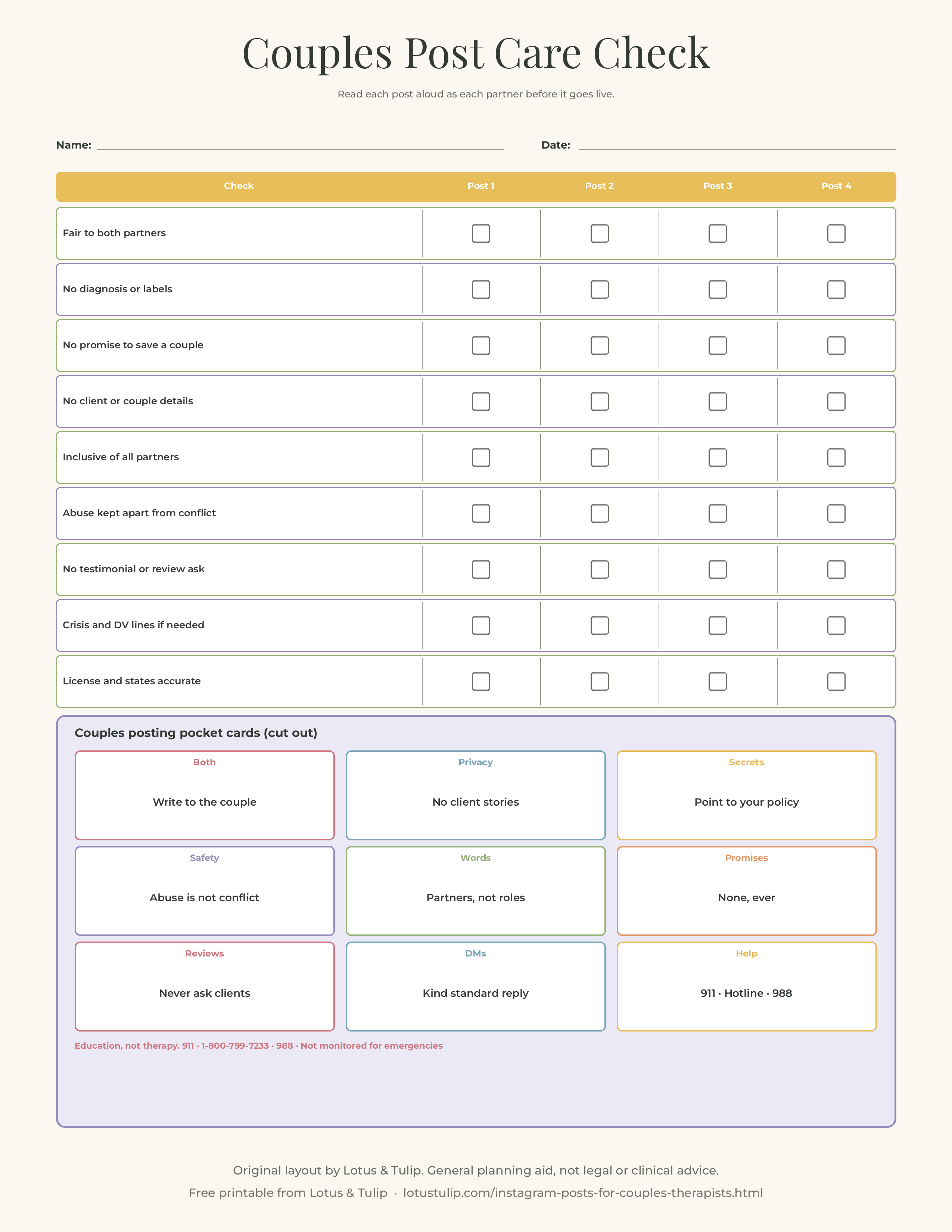
Read every post aloud before it goes live and ask these questions. They are also on page 3 of the free printable.
- Fair to both partners? Could either partner read this without feeling blamed or recruited against the other?
- No diagnosis. Does it avoid labeling a partner (narcissist, gaslighter, avoidant) or inviting readers to diagnose each other?
- No outcome promises. Does it avoid "save your marriage," "fix your relationship" or any suggestion that therapy guarantees a couple stays together?
- No client details. Is there nothing that could identify a couple or family, even with names changed?
- Inclusive. Does the wording work for married and unmarried partners, all genders and orientations, blended and chosen families?
- Abuse kept separate from conflict. If it touches on anger, control or fear, does it say that abuse is not a communication problem and give the Hotline?
- Crisis footer where needed. Safety, suicide or abuse content carries 911, 988, the Hotline and "not monitored for emergencies."
- No testimonial or review ask. No requests to current clients, no "tag your partner and tell us how we helped."
- Accurate credentials and state. Licenses, titles and online availability match what you actually hold.
- No stock couple as proof. No photos of happy couples implying results. Text designs, your office or nature are calmer and more honest.
A simple weekly rhythm (two or three posts a week)
Most solo couples therapists do not have time for daily posting, and they do not need it. A steady, light rhythm is more sustainable and looks more professional than bursts and silences.
| Day | Post type | Pillar examples |
|---|---|---|
| Monday or Tuesday | Education (single post or carousel) | Repair, listening, conflict versus abuse, premarital prompts |
| Wednesday or Thursday | Practice information | First session, secrets policy, fees, online sessions, family sessions |
| Friday (optional) | Gentle connection or myth vs fact | Small daily check ins, myths about couples therapy, a reflective question with no comment prompt |
| Any day | Stories | Office hours, a reminder of the safety highlight, a poll on a neutral topic |
If two posts a week is too much, post once a week and keep your highlights current. A thin feed with an excellent "Privacy," "Crisis" and "Book" highlight is better than a busy feed with none. Our highlight covers guide and pinned posts guide explain how to set those up, and our stories guide covers safe story stickers.
A 12 week planning overview
This overview is a way to sequence the pillars so that a new follower who scrolls back three months sees a complete picture of your practice. It is a planning frame, not a set of finished posts. Adjust the order to fit your season and your practice.
| Weeks | Focus | Make sure you post |
|---|---|---|
| 1 to 2 | Foundations | Welcome and who you see, what couples therapy is and is not, the safety post (pin it) |
| 3 to 4 | Getting started | First call to first session, questions to ask before booking, how to check a license |
| 5 to 6 | Trust | Confidentiality and its limits, your secrets policy explainer, why you do not post about clients |
| 7 to 8 | Conflict and repair | Conflict is normal and abuse is not, repair after an argument, agreed time outs |
| 9 to 10 | Seasons of life | Premarital counseling, times families reach out, couples versus family sessions |
| 11 to 12 | Practical details | Fees and insurance, evening and online sessions, when couples therapy is not the right fit, a thank you post |
After week 12, repeat the cycle with new angles and keep the safety, privacy and booking posts saved to highlights. For a full year rhythm across all therapist content, see our therapist Instagram content calendar.
Holiday and family season notes for couples therapists
The weeks from Thanksgiving to New Year put a particular kind of pressure on couples: two families, two sets of traditions, travel, money and very little time alone. In 2026, Thanksgiving falls on Thursday, November 26, Hanukkah runs from sundown on Friday, December 4 to Saturday, December 12, and Christmas is on Friday, December 25. Our holiday social media posts for therapists guide covers the full December to January plan, inclusive greetings, safe messaging and office hours. For a couples practice, add these angles:
- Whose family, which day? "Many couples negotiate where to spend the holidays. Deciding together, early, and treating it as a shared problem rather than a loyalty test can take some heat out of it."
- A plan before you arrive. "Agree on a signal for 'I need a break,' how long you will stay and how you will get home. Being a team in a busy room is easier with a plan."
- Different traditions. "Partners often bring different holidays, faiths or none. Neither set of traditions is the default."
- Gift and money pressure. "Spending disagreements are common in December. A budget agreed together beats a surprise in January."
- Grief and the empty chair. "If one of you is grieving this season, the other may not know what helps. Asking 'what would help today?' is often enough."
- Safety does not take a holiday. Repeat your safety post in December with the Hotline, 988 and 911, and note your closure dates. Do not suggest that more time together is always good for every relationship.
In February, Valentine's Day and National Marriage Week (which its organizers describe as celebrating marriage "each year from Feb 7th to the 14th") can be a natural moment for a repair or connection post. Keep the wording inclusive of unmarried partners, and avoid posts that make single followers or people in painful relationships feel left out.
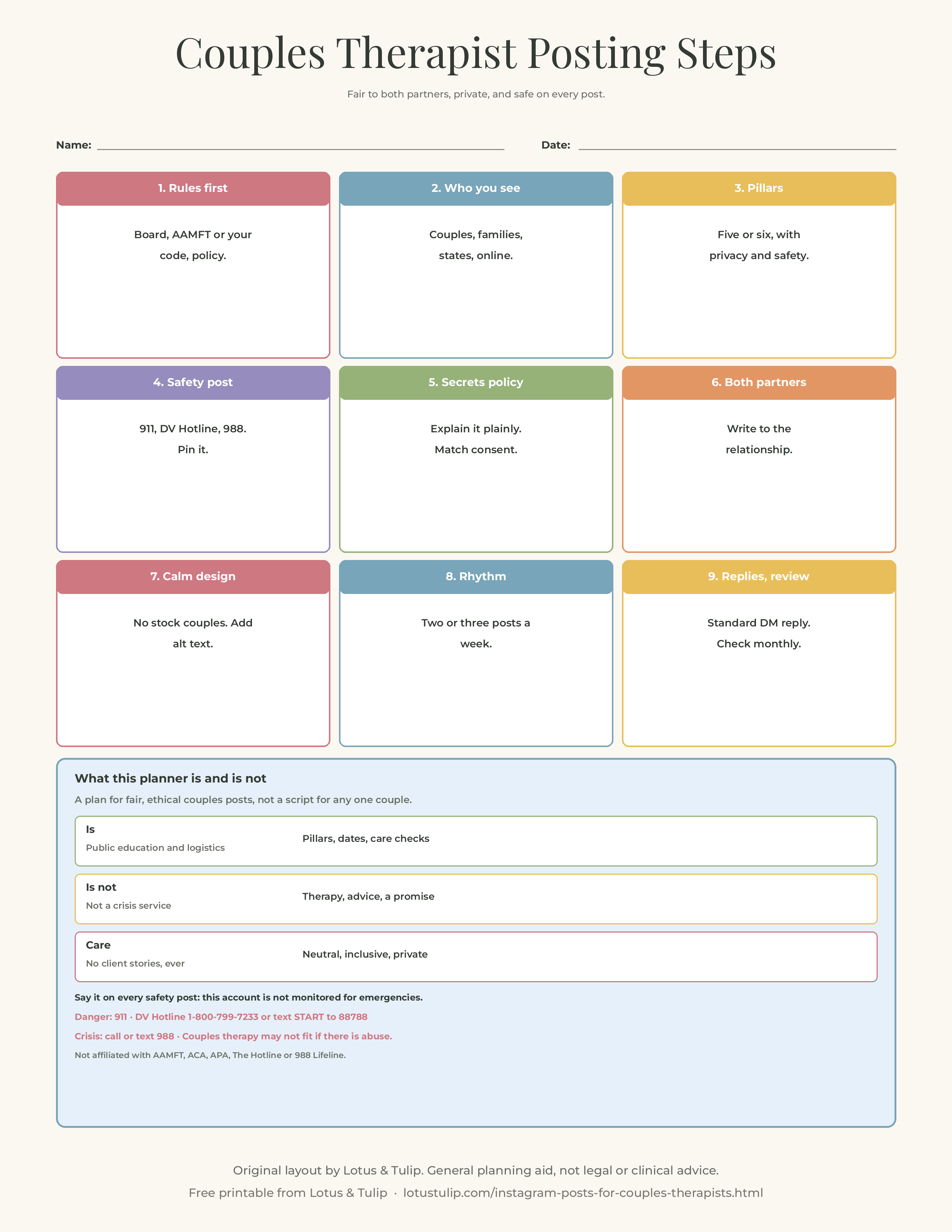
How to plan Instagram posts as a couples therapist, step by step
- Check your rules first. Read your state board's advertising rules, your professional code (the AAMFT Code for MFTs, or the ACA, APA or NASW code if that is your license) and any employer policy. Note anything on testimonials, titles, fees and online services.
- Write down who you see. Couples, families, premarital, co-parents, the states you are licensed in, in person or online. Your posts should match this list exactly.
- Pick five or six pillars. Choose from the map above. Always include confidentiality and conflict versus abuse.
- Draft the safety post first. Include 911, the National Domestic Violence Hotline (1-800-799-7233 or text START to 88788), 988 and "this account is not monitored for emergencies." Pin it and save it to a highlight.
- Write your secrets policy explainer. Describe in plain words that you have a written policy on individual information, that you review it at the start, and that people may ask before booking. Keep it consistent with your consent form.
- Draft posts in neutral, inclusive language. Write to the relationship, not to one partner. Use "partners," "many couples" and "both of you." Avoid diagnosis, labels and outcome promises.
- Design for calm. Use readable type, your own colors and no stock photos of happy couples. Add alt text to every post.
- Schedule two or three posts a week. Map four weeks at a time on a planner, mixing education, practice information and a gentle connection post.
- Plan replies and review monthly. Write a standard reply for personal disclosures and crisis messages, decide who checks DMs, and once a month remove outdated hours and check every post against the care list.
Mistakes and myths
Common mistakes
- Writing to one partner. "If your partner does not listen to you..." invites one reader to screenshot a post at the other. Write to both.
- Pop psychology labels. Posts that teach followers to label a partner as a narcissist or gaslighter can harm relationships and blur real abuse with ordinary conflict.
- "Save your marriage" marketing. It promises an outcome you cannot guarantee and ignores that separation can be a healthy outcome.
- Stock smiling couples. They suggest results, rarely reflect your real clients, and can feel alienating to people in pain.
- No safety post. A couples feed without the Hotline and 988 is missing its most important post.
- Client stories with names changed. Couples are easy to recognize. Use clearly fictional examples or none.
- Asking current clients for reviews. Barred by the AAMFT and APA codes and, for counselors, the ACA code extends this to former clients.
- Vague online availability. "Online therapy anywhere" can imply you practice where you are not licensed.
- Comment prompts on sensitive posts. "Tell us your worst fight" invites disclosures and puts people sharing a device at risk.
- Posting from your own argument. If a post is coming from your personal life, wait a day.
Myths about couples therapist Instagram
- "Couples content has to be romantic." The most useful posts are often practical: what happens in a first session, how confidentiality works, what to do after an argument.
- "You need to post every day." Two or three thoughtful posts a week with strong highlights is plenty for most solo practices.
- "Testimonials are the best proof." For couples work they carry extra privacy risk and code limits. Clear information about your training, process and policies builds trust without them.
- "Mentioning abuse will scare couples away." A calm line that couples therapy is not always the right fit signals that you take safety seriously, which many readers find reassuring.
- "Instagram replaces a directory profile or website." It supports them. Most people will still want a website or directory listing with your license, fees and contact details.
- "If it is general, it cannot be confidential." A "general" story with vivid details can still identify a couple. General means built from common patterns, not lightly disguised real cases.
Three fictional examples
These examples are invented. The names, practices and details are fictional and do not describe any real therapist or client.
Maren, LMFT, solo practice in a mid size city. Maren had posted sporadically for a year, mostly quotes over beach photos. She picked six pillars, wrote a pinned safety post and a secrets policy explainer first, and switched to two posts a week: one education post on Tuesday and one practice information post on Thursday. She replaced the beach photos with plain text designs in her practice colors. Three months later she had fewer new followers than she had hoped, but several people who booked mentioned that the first session post had helped a hesitant partner agree to come. She kept the rhythm and stopped checking follower counts weekly.
Dev, associate MFT under supervision in a group practice. Dev wanted to post about a couples therapy model he was training in. His supervisor and the practice's policy required associates to state their supervision status. He added "Associate MFT, supervised by [name and license]" to his bio, described the model as "a method I am training in" rather than claiming certification, and kept all fee and booking posts on the group practice's account rather than his own. His posts focused on listening and repair, and every carousel ended with "General information, not a substitute for therapy."
Rosa, family therapist with a premarital focus. Rosa's feed leaned heavily on wedding imagery, and a follower messaged to say it felt like the practice only wanted happy engaged couples. Rosa added posts on blended families, co-parenting and when couples therapy is not the right fit, rewrote "brides and grooms" as "engaged couples," and saved a Crisis highlight with the Hotline, 988 and 911. She kept her premarital pillar but no longer let it define the whole feed.
Which page or product fits which job
| Page or product | Best for | How it differs from this guide |
|---|---|---|
| This guide and free printable | Couples, marriage and family therapists planning their own posts | Two client confidentiality, secrets policy, abuse cautions, premarital and family pillars |
| Instagram post ideas for therapists | Any therapist looking for general ideas | Written for individual practice; no couples specific safety or secrets content |
| What therapists can post on social media | Checking any post against general ethics | A general checklist; this guide adds the couples and family layer |
| Holiday social media posts for therapists | December to January planning | A full holiday plan for all therapists; this guide adds couples holiday angles |
| Therapist Instagram feed aesthetic and Reels guide | Visual style and video | Design and format, not couples content |
| Communication exercises for couples | Exercises and worksheets for use with couples | Clinical handouts, not Instagram marketing |
| The Gentle Accord kit | A designed couples and family feed ready to edit | 60 posts, 12 stories, 12 highlight covers, 60 captions, 12 week calendar, safety and secrets policy posts |
| Free therapist Instagram templates | Trying a template style at no cost | 5 general therapist posts, not couples specific |
Other guides in this series: link in bio, stories, highlight covers, pinned posts and carousel posts.
When not to use social media this way
- When your employer or group practice controls marketing. Follow their policy and route posts through them.
- When you are in a small community where clients are easy to identify. Keep posts very general, or limit your presence to a directory profile and website.
- When you cannot keep up with DMs safely. If messages will sit unanswered for days, turn off DMs or use an auto reply with crisis numbers and booking information.
- When a post responds to a specific client, case or news story about a real couple. Wait, generalize, or skip it.
- When you are tempted to argue in the comments. Do not debate followers or other clinicians about a couple's situation. Hide or limit comments if needed.
- When you need to promise results to make the post work. If the post only works with a promise, it is the wrong post.
- When posting is affecting your own wellbeing. A quiet feed with good highlights is fine. You can pause.
Free 3 page couples therapist Instagram printable (US Letter)
Print it, fill it in once a month, and keep it next to your scheduling tool. It works with any design tool or template set.
- Page 1: Couples Therapist Posting Steps. Nine steps that match the HowTo above, what the planner is and is not, and safety lines with 911, the National Domestic Violence Hotline and 988.
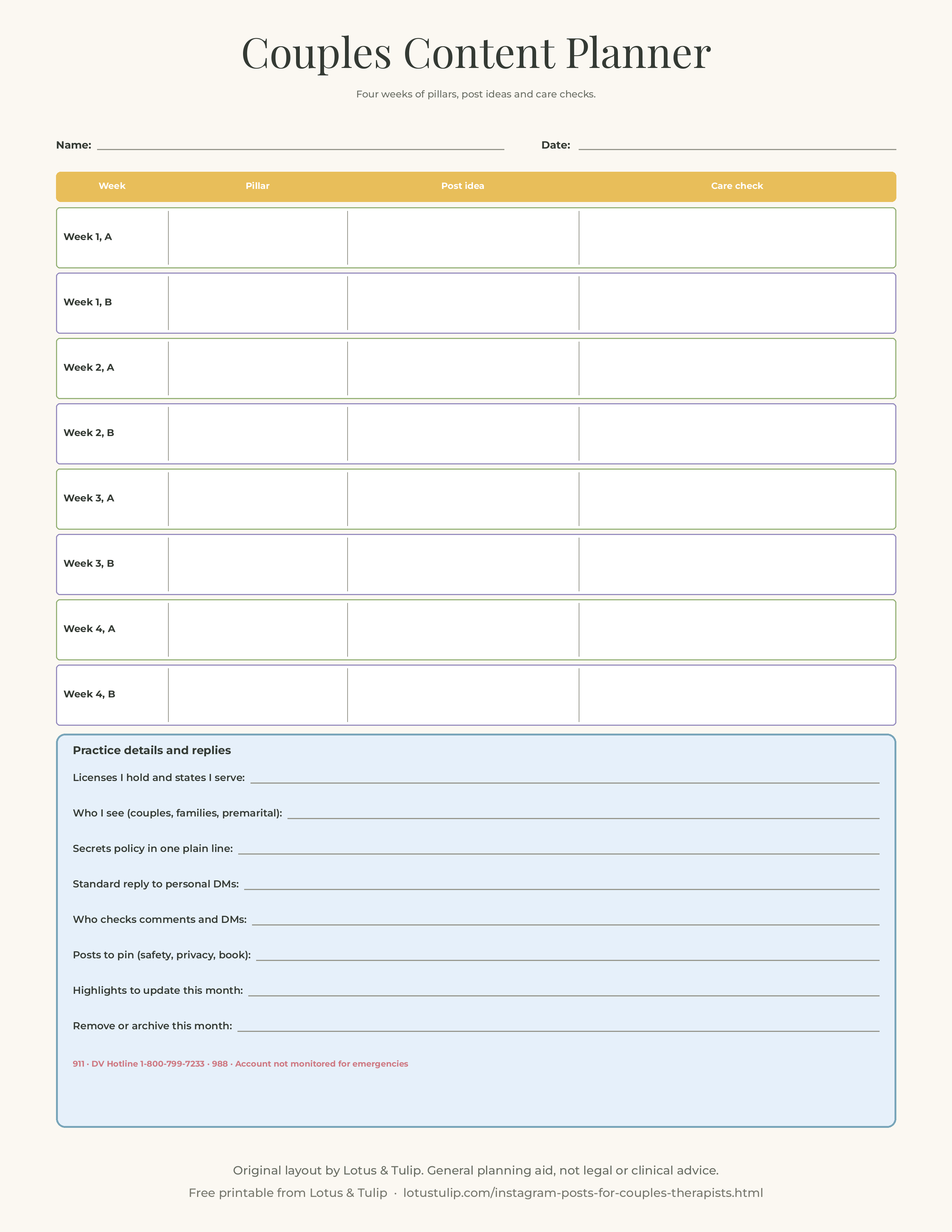
- Page 2: Couples Content Planner. Four weeks of posts with columns for pillar, post idea and care check, plus fields for your licenses and states, secrets policy summary, standard DM reply and the posts to pin.
- Page 3: Couples Post Care Check. A yes or no check for up to four posts (fair to both partners, no diagnosis, no promises, no client details, inclusive, abuse kept separate from conflict, crisis footer), plus nine pocket cards to cut out.
Download free PDF · Page 1 PNG · Page 2 PNG · Page 3 PNG
Research notes (verified, with caveats)
- American Association for Marriage and Family Therapy. AAMFT Code of Ethics, revised, effective January 1, 2026 (PDF on aamft.org). Standard 2.1 (Disclosing Limits of Confidentiality), 2.2 (Written Authorization to Release Client Information, including the couple, family or group treatment wording quoted above), 2.4 (Confidentiality in Non-Clinical Activities), 6.6 (Location of Services and Practice), 9.1 (Accurate Professional Representation), 9.2 (Promotional Materials: "do not solicit testimonials or endorsements from current clients or from other persons who are vulnerable to undue influence") and 9.5 (Specialization).
- American Counseling Association. 2014 ACA Code of Ethics. C.3.b Testimonials (no solicitation from current clients, former clients or others vulnerable to undue influence; discuss implications and obtain permission), H.6.a Virtual Professional Presence and H.6.d Use of Public Social Media.
- American Psychological Association. Ethical Principles of Psychologists and Code of Conduct, Standard 5.05 Testimonials, as quoted on APA's "Working with the media: professional considerations" page.
- Federal Trade Commission. Guides Concerning Use of Endorsements and Testimonials in Advertising, 16 CFR Part 255 (as revised July 26, 2023, 88 FR 48102), via eCFR. Sections 255.1 (endorsements must reflect honest opinions and experience), 255.2 (consumer endorsements and generally expected results) and 255.5 (disclosure of material connections).
- National Domestic Violence Hotline. "Should I Go To Couples Therapy With My Abusive Partner?" (thehotline.org): "We at The Hotline do not encourage anyone in an abusive relationship to seek counseling with their partner. Abuse is not a relationship problem." Hotline home page: call 1.800.799.SAFE (7233), text "START" to 88788, live chat, and 911 for immediate danger.
- 988 Suicide and Crisis Lifeline (988lifeline.org): call, text or chat 988. Crisis Text Line: text HOME to 741741 (as verified for our holiday guide on the same day).
- Centers for Medicare and Medicaid Services. No Surprises Act consumer and provider pages: providers must give uninsured or self-pay individuals a good faith estimate when they schedule care or ask for one (45 CFR 149.610). Check CMS guidance for timing and content rules.
- National Marriage Week, About Us (marriageweek.org): "celebrating marriage intentionally each year from Feb 7th to the 14th." The organizers describe a marriage focus; we suggest inclusive wording for all partners.
- 2026 dates: Thanksgiving Thursday, November 26; Hanukkah from sundown Friday, December 4 to Saturday, December 12 (Chabad.org, as used in our holiday guide); Christmas Friday, December 25.
We have not cited any prevalence statistics on intimate partner violence or couples therapy outcomes in this guide. This page is not affiliated with or endorsed by the AAMFT, ACA, APA, FTC, CMS, the National Domestic Violence Hotline, the 988 Lifeline, Crisis Text Line or National Marriage Week. Our paid template kits are marketing tools for clinicians. They are not clinical interventions and have not been tested in any trial.
Instagram posts for couples therapists: FAQ
What should a couples therapist post on Instagram?
Focus on what prospective couples and families need to know: what couples therapy is and is not, what happens in a first session, how confidentiality and your secrets policy work, the difference between conflict and abuse, repair and listening tips, premarital and family sessions, fees and online availability, and when couples therapy is not the right fit. Keep a pinned safety post with 911, the National Domestic Violence Hotline and 988.
How often should a couples therapist post?
Two or three feed posts a week is enough for most solo and small group practices, plus occasional stories. If that is too much, post once a week and keep your Privacy, Crisis and Book highlights current.
Can I share a story about a couple I worked with if I change the names?
It is safest not to. Couples are easy to recognize, and the AAMFT Code requires written authorization from each individual before information is disclosed outside the treatment context in couple or family work. Use clearly fictional examples built from common patterns instead.
How do I explain my secrets policy on Instagram?
Say that your practice has a written policy on information one partner shares individually, that you go over it with both partners at the start, and that people can ask about it before booking. Keep the details in your informed consent document and make sure the post matches it.
Can couples therapists post testimonials?
The AAMFT Code bars soliciting testimonials from current clients or others vulnerable to undue influence, the APA code has a similar rule, and the ACA code extends it to former clients for counselors. A couples testimonial also reveals something about the other partner. Many couples therapists choose not to post testimonials at all. If you do, follow your code, your board and the FTC endorsement guides.
Should a couples therapy practice post about domestic violence?
Yes, carefully. A calm post that says conflict is normal and abuse is not, that couples therapy may not be right where there is ongoing abuse, and that lists the National Domestic Violence Hotline (1-800-799-7233 or text START to 88788), 988 and 911 is one of the most important posts a couples practice can make. Do not invite comments or stories on it.
Are couples therapist Instagram templates editable in Canva?
The Gentle Accord kit is a set of editable PowerPoint files. You can import them into a free Canva account, open them in Google Slides, or edit them in PowerPoint. It is not a Canva template link. The fonts, Playfair Display and DM Sans, are free and included.
Is the free printable a copy of the paid kit?
No. The free three page set is an original planning aid: posting steps, a four week content planner and a post care check with pocket cards. The paid Gentle Accord kit contains designed posts, stories, highlight covers, captions and a 12 week calendar. The printable is not a preview of that kit.