
School counselors · Updated 2026-11-02
Small group counseling curriculum for anxiety: an 8 session plan (free printable)
Ready-made printable: Worry Group Curriculum Holiday 20% off: about $11.04, was $14 (EUR 12) · instant digital download
Buy on Etsy
An anxiety or worry group is one of the most requested small groups in elementary and middle school counseling, and one of the easiest to run well once you have a clear structure. This guide walks through who the group is for, how to set it up, a session by session outline you can adapt, activities that work with students, and how to show it made a difference. It ends with a free one page Worry Check In sheet you can print for every session.
This is educational information for school counselors and other qualified professionals. A psychoeducational group is not treatment for an anxiety disorder. Follow your district's policies on consent and referral, and refer students with severe or persistent symptoms to a mental health provider. In the US, anyone in crisis can call or text 988, the Suicide and Crisis Lifeline, or call 911 in an emergency.
Jump to the free Worry Check In sheet
Who an anxiety group is for
A school based worry group works best for students whose worry gets in the way of everyday school life but who can still take part in a group: the student who stops at the classroom door every morning, avoids raising a hand, asks for the nurse before tests, or melts down over small changes. It is usually not the right first step for a student in crisis, a student with severe panic or school refusal, or a student whose anxiety is mainly driven by something that needs a safety response, such as abuse or bullying. Those students need individual support and often an outside referral.
Good sources of referrals are teacher referral forms, parent requests, attendance and nurse visit patterns, and short screening check ins. Group by grade band where you can, because a second grader and a fifth grader need very different language.
Setting up the group
- Size: many school counselors keep anxiety groups small, often around 4 to 6 students, so everyone gets a turn to talk and practice.
- Length: 6 to 8 weekly sessions of about 30 minutes fits most elementary schedules; middle school groups can run slightly longer.
- Consent: send a family letter that explains the purpose of the group and follow your district's rules on parent or guardian permission (see our small group counseling permission slip guide for opt in vs opt out and a free letter).
- Timing: rotate the time slot or use lunch where possible so students do not miss the same class every week.
- Agreements: set group rules in the first session together, including what stays in the group and the limits of confidentiality in student friendly words.
- Data: plan a short pre and post check before you start, not after (see our small group pre and post assessment guide for item writing, scoring and a free results sheet).
A predictable session structure
Anxious students relax when they know what is coming. Using the same shape every week does a lot of the work for you:
- Check in (3 to 5 minutes): each student rates their worry today and names one body clue. The free sheet below is built for this.
- Calm skill (5 minutes): practice one breathing or grounding skill together, the same way each week, so it becomes automatic.
- Lesson (10 to 15 minutes): one idea per session, taught with a story, a picture or a short activity.
- Practice (5 to 10 minutes): a worksheet, role play or game that uses the idea.
- Brave step and close (3 minutes): each student picks one small thing to try before next week.
An 8 session outline you can adapt
- Welcome and what worry is. Group agreements, getting to know each other, and the idea that worry is a normal alarm that sometimes rings too loud.
- Body clues. Where students feel worry in their bodies (tummy, chest, hands, head) and why noticing early helps.
- Calm the body. Slow breathing with a longer breath out, muscle squeeze and release, grounding with the five senses. Students choose a favorite.
- Worry thoughts. Noticing "what if" thoughts and checking them: what is likely to happen, what would I tell a friend, what could I do if it did happen.
- Brave self talk. Writing short coping statements such as "I can do hard things" or "This feeling will pass", and practicing them out loud.
- Control and worry time. Sorting worries into what I can control and what I cannot, and trying a set worry time instead of worrying all day.
- Brave steps. Building a small step by step ladder toward something the student avoids, starting with the easiest step.
- Toolkit and celebration. Each student builds a personal coping plan, completes the post check, and gets a certificate.
The order matters: calm the body before tackling thoughts, and tackle thoughts before asking students to face what they avoid. The gradual approach in sessions 7 and 8 reflects the exposure based ideas used in cognitive behavioral therapy for anxiety, kept at a gentle, school appropriate level.
Activities that work with students
- Worry thermometer: a 0 to 5 scale students point to at check in. It gives you quick data and gives them words.
- Body clues map: students color where they feel worry on an outline of a body.
- Worry monster or worry box: younger students write or draw a worry and "feed" it to a box, then practice leaving it there until worry time.
- Thought detective: students look for evidence for and against a worry thought, like a detective collecting clues.
- Brave ladder: a paper ladder with the scariest step at the top and the smallest step at the bottom.
- Coping skill cards: a deck of calm ideas students can choose from. Our coping skills list for kids has 60 ideas sorted by category.
How to show the group helped
Counselors are often asked for outcome data. Keep it simple and consistent:
- A short student self rating before session 1 and after session 8, using the same questions both times.
- A teacher check on two or three observable behaviors, such as avoiding tasks, asking to leave class, or tears before tests.
- Weekly worry ratings from the check in sheet, which show trends without extra paperwork.
- Practical numbers your school already tracks, such as nurse visits or tardies, when they are relevant.
Share results in aggregate with staff and families, and use them to decide which students need a follow up check in or a referral.
Free Worry Check In sheet
This one page sheet has a worry thermometer from 0 to 5, a body clues checklist, a space for the calm tool the student used, and a brave step for the week. Print one per student per session, or keep a copy in each student's group folder. It is US Letter at print quality.
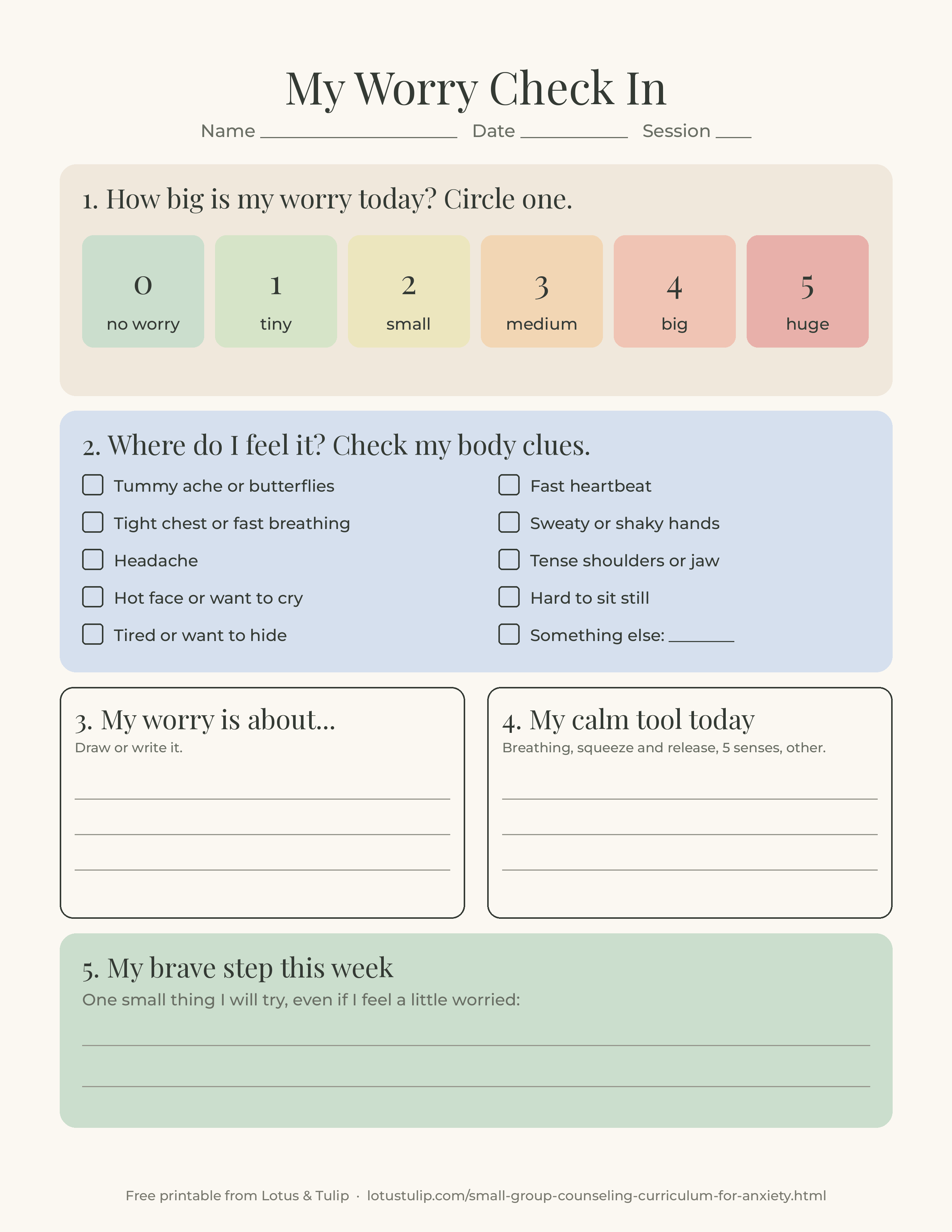
Download the free check in sheet (PNG, US Letter)
Free starter kit: Ready to start? The free small group counseling starter kit gives you session 1 of our Calm and Brave Worry Group (lesson plan and student page) with the teacher referral form, permission letter, group agreements and pre and post check (8 pages, no email).
Adapting by age
Kindergarten to grade 2: shorter sessions, more movement, picture based check ins, and simple names such as "big worry, small worry". Read alouds and puppets work well.
Grades 3 to 5: students can start to catch and check thoughts, keep a simple tracker and build a brave ladder with your help.
Middle school: focus on real pressures such as tests, friendships, social media and sleep. Students respond well to being treated as partners and to practical, private tools. Teens with social anxiety may also benefit from individual work; see our social anxiety worksheets for teens.
Related resources
- Small group counseling referral form: teacher, parent and self referral, screening and a free referral log
- Small group counseling pre and post assessment: how to write, give, score and report it, with a free survey and results sheet
- Small group counseling permission slip and parent letter, with a free letter, filled example and permission log
- All school counselor small group curriculums
- Worry group curriculum for elementary students
- Anxiety worksheets for therapists and counselors
- Coping skills cards for kids and teens
- Window of tolerance worksheet, with a free printable
FAQ
How many sessions should an anxiety small group have?
Many school counselors run 6 to 8 weekly sessions of about 30 minutes. That is enough time to teach body clues, calming skills, thought checking and brave steps, and to collect pre and post data, without pulling students from class for too long.
How many students should be in a worry group?
Smaller is usually better for anxious students. Groups of about 4 to 6 give each student time to share and practice. Very shy students may need a smaller group or some individual sessions first.
What topics should an anxiety group cover?
A common sequence is what worry is, body clues, calming the body, checking worry thoughts, brave self talk, what you can and cannot control, small brave steps, and a personal coping plan.
When should a student be referred instead of placed in a group?
Refer for individual or outside support when anxiety is severe, getting worse, causing school refusal or panic attacks, or comes with safety concerns. Follow your school's referral and safety procedures.
Is the Worry Check In sheet free?
Yes. The sheet on this page is free to print for your own students and groups. Please link to this page rather than re-uploading the file.