
School counselors · Updated 2026-11-10
Small Group Counseling Pre and Post Assessment: How to Write, Give, Score and Report a Pre/Post Survey (Free Printable)
Ready-made printable: Complete Small Group Counseling Bundle Holiday 20% off: about $29.44, was $37 (EUR 32) · instant digital download
Buy on Etsy
The last session of the worry group went well. Everyone made a toolkit, the certificates came out of the printer warm, and one student told you, unprompted, that she used balloon breathing before her spelling test. Then your principal asks, at the end of the week, the question every school counselor eventually hears: "How do you know the groups work?" A story about balloon breathing is real, and it matters. It is also not data, and it will not survive a budget meeting or a program review.
A pre and post assessment is the simplest honest answer to that question. You ask the same short set of questions before the group starts and again after it ends, you compare the two, and you look at a few pieces of school data you already have, such as attendance or office referrals. Done well, it takes about ten minutes of group time across eight weeks and gives you something concrete to show a principal, a teacher, a family or your advisory council. Done badly, it produces numbers that mean nothing: items kids cannot read, scales that every student fills in at the top on day one, surveys that ask about feelings at home and trip your district's consent rules, and a spreadsheet nobody ever opens.
This guide is for elementary, middle and high school counselors in the United States, and for school social workers and school psychologists who run counseling groups. It covers why pre and post data matters, with what the ASCA Ethical Standards for School Counselors (2022) and the ASCA National Model actually say, including the new data names in the fifth edition (2025): participation data, ASCA Student Standards data (formerly Mindsets & Behaviors data, often still called perception data) and achievement data (formerly outcome data); how perception data differs from attendance, behavior and grades; how to write five to ten student self rating items a child can actually read; how the format should change for kindergarten to grade 2, grades 3 to 5, and middle and high school; when to give the survey (before session 1, after the last session, and an optional follow up); a short teacher or parent rating version; consent and privacy rules that apply to surveys in some states; how to score the results and present them on one page without a statistics degree; a ten step process; a fully worked fictional example with real arithmetic; six scenarios; common mistakes; and a free three page printable: a blank pre and post survey, the same survey filled in for a fictional worry group, and a results summary sheet with a student log.
Jump to the free pre and post survey, filled example and results summary sheet
This is educational information for school counselors in the US. A pre and post survey for a counseling group is a program evaluation tool, not a diagnostic or screening instrument, and it is not a substitute for a validated measure when one is needed. Whether a group survey needs parent consent is decided by state law and district policy. The standards and documents quoted here were checked on November 10, 2026 against the ASCA Ethical Standards for School Counselors (2022), "The ASCA National Model: A Framework for School Counseling Programs, Fifth Edition" (2025) and ASCA's "Changes in the ASCA National Model Fifth Edition" summary, the ASCA RAMP templates page, the ASCA Student Standards: Mindsets & Behaviors for Student Success, 20 U.S.C. 1232h, Texas Education Code 26.009 as amended by S.B. 12 (2025) and Florida Statutes 1001.42(8)(c).
The short answer
- ASCA expects you to measure groups. Ethical Standard A.7.f asks school counselors to "use data to inform group topics, establish well-defined expectations and measure the outcomes of group participation," and A.7.g asks them to "reflect on group outcomes and determine adjustments that may improve future group interventions."
- Collect three kinds of data. Participation (who came, how many sessions, how long), the skills students report or show (ASCA Student Standards data, measured through pre and post assessments) and school data such as grades, attendance and discipline.
- Start from the skill, not the problem. Pick one or two ASCA behavior standards, turn each into a learning objective, and write items about what students can do: "I can use a calm tool when I feel worried," not "I feel anxious a lot."
- Keep it short. Five to ten items for most groups. Four to six for kindergarten to grade 2.
- Match the format to the age. Faces and read aloud items for K to 2, a three or four point scale for grades 3 to 5, a four point frequency scale and a scenario item or two for middle and high school.
- Give the same survey twice, the same way. Before or at the start of session 1, and at the end of the last session. Same items, same order, same scale, same instructions.
- Add an adult view. A four to six item teacher rating at referral and again after the group shows whether change is visible in class.
- Check the consent rules. In some states, a survey or check in can need signed parent consent on its own. Keep items about skills, and tell parents what you ask.
- Score it simply. Total per student, average per item, and the number of students at the top rating before and after. You do not need statistics software.
- Report on one page, honestly. Group results, not individual students, with a sentence about what the data can and cannot show and what you will change next time.
Why pre and post data matters for school counseling groups
There are three practical reasons to measure a group, and only one of them is about proving yourself to an administrator.
It tells you whether the group did what you planned. If students rate themselves higher on "I can use a calm tool" but no higher on "I can take a small brave step," that is useful. Maybe the brave ladder session was rushed, or the step was too big for third graders. ASCA's A.7.g, "reflect on group outcomes and determine adjustments that may improve future group interventions," is exactly this: the data is for you first.
It is part of the professional standard. The ASCA Ethical Standards (2022) say school counselors "collect and analyze participation, ASCA Mindsets & Behaviors and outcome data to determine the progress and effectiveness of the school counseling program" (A.3.f) and "share data outcomes with stakeholders" (A.3.g). The group section repeats the point for groups specifically: A.7.a ties group offerings to "student data; a referral process; and/or other relevant data," and A.7.f asks you to "measure the outcomes of group participation."
It protects the program. Small groups take time away from class, and teachers notice. A one page summary that shows participation, change in the skills you taught and any movement in attendance or referrals is the most persuasive thing you can bring to a conversation about schedules, staffing or a proposal to cut groups. ASCA's National Model calls this the Assess component: school counselors use data to show how students are different because of the program.
What the ASCA National Model calls the data, fourth vs fifth edition
ASCA published the fifth edition of the National Model in 2025, and it renamed two of the three data types. Many district templates, conference handouts and RAMP applications still use the fourth edition words, so it helps to know both. ASCA's RAMP templates page currently offers templates for applicants using either the fourth or the fifth edition.
| Fifth edition (2025) | Fourth edition (2019) and earlier names | What it answers | Group example |
|---|---|---|---|
| Participation data | Participation data (earlier: process data) | How many students took part, how often and for how long | 5 students, 8 sessions, 30 minutes each, 38 of 40 possible attendances |
| ASCA Student Standards data | Mindsets & Behaviors data (earlier: perception data) | Did students gain the knowledge and skills in the standards you targeted? | Average rating on "I can use a calm tool when I feel worried" rose from 1.4 to 2.6 on a 1 to 3 scale |
| Achievement data, with contributing factors data | Outcome data (achievement, attendance and discipline) | Did anything change in grades, test scores or promotion, and in factors that contribute to them, such as attendance and discipline? | Days absent for the group fell from 11 in the eight weeks before group to 7 during group |
The fifth edition defines ASCA Student Standards data as "the knowledge and skills students need for life-readiness as defined by the behavior standards from the ASCA Student Standards and measured through pre-/post-assessments." Achievement data is "the impact of the school counseling program on student data including" traditional grades, standards based grades, benchmark assessments, promotion rates, graduation rates and test scores. ASCA's summary of changes explains the rename: there "was confusion about what is considered an 'outcome,'" so achievement is now the third data type, and attendance rates, discipline rates, systemic barriers, and student and education partner perspectives are grouped as contributing factors data (formerly "supplemental data").
For small groups, the fifth edition adds a separate Small Group Plan and Data Report: one document for all sessions of a group that monitors participation, ASCA Student Standards and achievement data, and "includes space for attendance and discipline data (baseline and final) when appropriate." The fourth edition used the Classroom and Small-Group Results Report for the same purpose, and the Closing-the-Gap Action Plan/Results Report for gap goals; in the fifth edition, the closing the gap report becomes the Achievement Gap Plan and Data Report. Whichever edition your district uses, the pre and post survey on this page feeds the same box: the skills data, before and after. Our small-group plan and data report guide shows where each result goes on the fifth edition template, with a filled example.
Perception data vs outcome data, in plain words
Whatever you call them, the difference matters. A pre and post self rating tells you what students believe they know and can do. That is valuable and it is the part a group most directly changes. It is also self report: students may rate themselves higher at the end because they like you, because they know what you hope to hear, or because they now understand the words. School data, such as absences, nurse visits, office referrals, missing assignments or grades, is harder to move and slower, but it does not depend on how a child feels about a survey.
A strong group report uses both and claims neither too much. "Students reported more confidence using calm tools, and their teacher noticed it in class" is a claim your data can support. "The group reduced anxiety" is not: you did not measure anxiety, and a group survey is not a clinical measure.
Start with the standard and the objective, then write the items
Good items come from a clear chain: one or two ASCA behavior standards, a few student learning objectives that make each standard concrete, and then one or two items per objective. The ASCA Student Standards: Mindsets & Behaviors for Student Success list six mindset standards and three groups of behavior standards: learning strategies (B-LS), self-management skills (B-SMS) and social skills (B-SS). In the fifth edition, the focus of data collection is on the behavior standards; ASCA's November 2025 newsletter article "Manage: Approaching the Work and Using Templates" says "The mindsets are best understood as byproducts of students attaining the behavior standards."
For a starting set of items organized by standard (M 1 to 6, B-LS, B-SMS and B-SS), with answer keys for the knowledge items, see our ASCA mindsets and behaviors pre and post survey item bank.
| Group topic | Example behavior standard | Learning objective | Pre and post item |
|---|---|---|---|
| Worry | B-SMS 7. Effective coping skills | Students will use one calm body tool when they notice worry | "I can use a calm tool when I feel worried." |
| Anger and self regulation | B-SMS 2. Self-discipline and self-control | Students will name their early anger signals and choose a cool down tool | "I notice when I start to get angry." "I can cool down before I act." |
| Social skills | B-SS 2. Positive, respectful and supportive relationships with students who are similar to and different from them | Students will use a joining in script at recess | "I know how to ask to join a game." |
| Self esteem | B-SMS 5. Perseverance to achieve long and short-term goals | Students will use a kind self talk phrase after a mistake | "When I make a mistake, I can say something kind to myself." |
| Changing families | B-SMS 10. Ability to manage transitions and adapt to change | Students will name two adults they can talk to about changes | "I know two grown ups I can talk to when things change." |
| Middle school stress or study skills | B-LS 3. Time-management, organizational and study skills | Students will break a big assignment into steps with dates | "When I have a big assignment, I break it into smaller steps." |
| Friendship (upper elementary or middle school) | B-SS 8. Advocacy skills for self and others and ability to assert self, when necessary | Students will use an I statement in a conflict | "I can tell a friend how I feel without being mean." |
Notice that every item describes something a student can learn in eight short sessions. None of them asks about symptoms, diagnoses or family life. That is better measurement, because it matches what you taught, and it is safer, because surveys about mental health or family problems trigger consent rules in some states and in federally covered programs (more on that below).
How to write 5 to 10 items a student can actually read
A child who cannot read an item will guess, copy a neighbor or fill in the middle face for everything. ASCA's standard on assessment, A.14.d, asks counselors to "consider the student's developmental age, language skills, home language and competence level when determining an assessment's appropriateness." In practice, these rules do most of the work:
- One idea per item. "I can calm down and tell an adult" is two items. If a student can do one but not the other, the answer means nothing.
- Use "I can" and "I know" statements. They describe skills, read easily, and point to something you will teach. Avoid questions with "why."
- Use the words from your lessons. If the group says "calm tool," the item says "calm tool," not "self regulation strategy." But teach the word in session 1 or write the item so it does not depend on vocabulary the student has not met yet: "I can do something to help my body feel calm" works on day one.
- Short and concrete. Aim for under about twelve words, everyday words, and a situation the child knows: "at recess," "before a test," "when I make a mistake."
- No negatives, no double negatives. "I do not get upset when I lose" is hard to rate. "I can stay calm when I lose a game" is easy.
- Keep all items pointing the same way. Survey designers sometimes reverse items to catch careless answers, but for young children a reversed item is mostly a source of confusion. Write every item so a higher rating means more of the skill.
- Skills, not problems or family. "I can use a calm tool when I feel worried," not "I worry about my parents." The first is what you teach. The second is a mental health and family question with consent implications.
- Add one knowledge item. An open item such as "Write or draw one calm tool you can use" is scored right or not yet, and is harder to inflate than a rating. Older students can get a short scenario: "Your friend is ignoring you at lunch. What could you do?"
- Keep the same items, order and scale both times. If you fix a confusing item after the pre survey, you can no longer compare that item.
- Pilot one item. Read the items to one student who is not in the group, or ask a teacher. If the student hesitates or asks "what does that mean," rewrite it.
| Weak item | Problem | Better item |
|---|---|---|
| I feel anxious a lot. | Symptom, not skill; mental health question; may need consent | I can use a calm tool when I feel worried. |
| I can identify my triggers and apply coping strategies. | Two ideas; adult vocabulary | I know what makes me start to feel angry. |
| I don't hit people when I'm mad. | Negative wording; describes misbehavior | I can cool down before I act. |
| My family is getting along better. | Family question; not something the group controls | I know two grown ups I can talk to when things change. |
| I am a good friend. | Vague; everyone says yes on day one | I know how to ask to join a game at recess. |
| Group helped me. | Only makes sense after group; leading | Ask it only in the post survey as an open question: "What helped you most?" |
K to 2, grades 3 to 5, middle and high school: what changes
| Kindergarten to grade 2 | Grades 3 to 5 | Middle and high school | |
|---|---|---|---|
| Number of items | 4 to 6 | 6 to 8 | 8 to 10, plus 1 or 2 scenario items |
| Response scale | Three faces (not yet, sometimes, yes) or a thumbs up, sideways, down | Three faces or a three or four point scale with words | Four point frequency scale (never, sometimes, often, almost always) or agreement scale |
| Who reads | You read every item aloud, one at a time, and everyone answers together | You read aloud; strong readers may go ahead | Students read on their own; offer read aloud quietly to anyone who wants it |
| Open item | "Draw one thing that helps you feel calm" | "Write or draw one calm tool you can use" | A short scenario: "What would you do if..." |
| Practice item | Yes, always: "I like ice cream" with the faces, so they learn the format | Helpful for the first survey | Usually not needed |
| Names or codes | Name, collected by you | Name or a code you assign | A code helps honesty; keep the key separately |
| Time needed | 5 to 7 minutes | About 5 minutes | 5 to 8 minutes |
Kindergarten to grade 2. Young children tend to answer "yes" to almost everything, especially to an adult they like. You get more honest answers with fewer items, a practice item, concrete situations ("when I am mad at recess") and a pause after each item so no one copies the child next to them. Show the three faces large on the board and say what each one means each time: "Not yet means I can't do this yet. Sometimes means I can do it some of the time. Yes means I can do it most of the time." Color coding helps, but make the faces differ in shape too, so the page still works in black and white and for students with color vision differences. For K to 2, the teacher rating is often the more informative half of your data.
Grades 3 to 5. Most students can handle a three or four point scale with words under each option. Three options give clean, easy data for small groups. Four options with no middle, such as not yet, a little, mostly, yes, push students to commit, which some counselors prefer. Whichever you pick, use it for every group you run, so results can be compared across groups and years.
Middle and high school. Teens are more likely to rate honestly when they believe the survey is about the group and not about them. Say so: "This helps me see if the group is teaching useful things. It is not a grade and it does not go in your file." A code instead of a name, collected in a folder, helps. Add one or two short scenario items scored by you, because teens can describe what they would do in a situation even when they are wary of rating themselves.
When to give the pre and post survey
| When | What to give | Why |
|---|---|---|
| At referral, before the group starts | Teacher rating (and parent rating, if you use one) | Gives a baseline from the adult who sees the student most, before the student meets you |
| Start of session 1, after the welcome and agreements | Student pre survey | Before any teaching, but after students know who you are and why they are there |
| Same week as session 1 | Pull baseline school data (absences, referrals, nurse visits, missing work) for the agreed window | So you have a fair "before" figure |
| Last session, before the celebration | Student post survey with the same items, plus an open "What helped most?" | Students are focused; once the certificates and snacks appear, attention is gone |
| Within a week after the group ends | Teacher rating again, same items | Shows whether change is visible in class |
| Optional: 4 to 6 weeks later | Short follow up: the same student items, or 2 or 3 of them, plus a teacher check in | Shows whether skills lasted without the group |
| At the end of the grading period or semester | Final school data for the same length of window | Gives the "after" figure for attendance, discipline or grades |
Some counselors give the pre survey at the end of session 1 instead of the start, once students understand the topic. That is fine if you do it the same way every time. Avoid giving the pre survey in an individual screening meeting before the group: students answer differently alone with you than in the group setting where they will take the post survey.
Students who miss the first or last session. Catch them in the next day or two, individually, with the same instructions. If a student joins at session 3, give the pre survey then and note it. If a student never takes the post survey, leave them out of the before and after comparison, and say in your report how many students you compared.
A retrospective option. Some evaluators use a "then and now" post survey, asking students at the end to rate both how they were before group and how they are now. It can help when students did not understand the items at the start. It also has its own biases, because students may underrate the past to show growth. If you use it, keep it in addition to, not instead of, a real pre survey, and label it clearly in your report.
How to give the survey so the answers mean something
- Say why. "This helps me find out if our group teaches useful things. There are no right or wrong answers, and it is not a grade."
- Read the items aloud for anyone below about grade 4, and offer it to anyone older.
- Do the practice item first with young children, out loud.
- Spread students out or use a folder as a screen so no one copies.
- Do not explain items differently the second time. If you clarified "calm tool" in the pre survey, use the same words in the post survey.
- Do not hint. "Remember what we learned about calm tools?" before the post survey will raise the scores and lower the meaning.
- Collect the pages yourself, straight into a folder.
- Let a student pass on an item. Count it as missing, not as a low score.
A teacher or parent rating version
An adult rating adds a second view and, unlike self report, describes behavior someone else can see. Keep it short, because teachers are busy and a long form comes back half done or not at all.
- Four to six items describing visible behavior that matches your objectives: "Uses a calm tool when upset," "Starts tasks without many reassurance questions," "Joins in class or group activities," "Asks for help when needed."
- A frequency scale with a time frame: "In the past two weeks, how often does this student..." with rarely, sometimes, often, almost always (1 to 4). Use the same scale and time frame both times.
- The same rater both times where possible. A different teacher after a schedule change is a different ruler.
- Behavior, not diagnosis. "Seems worried" is fine as an observation. "Has anxiety" is not a teacher rating item.
- Two blank lines: "What have you noticed?" and "Anything you would like me to know?"
- Parent version, if you use one: the same items reworded for home ("Uses something to calm down when upset"), in the family's preferred language, with a return envelope or a reply option in the school app. Return rates are often low, so treat parent ratings as a bonus, not your main data, and do not leave a student out of the group because the form did not come back.
Many group curricula include a teacher referral form with ratings. If you give the same rating items again after the group, the referral form becomes your teacher pre rating, and you do not need a separate form. The small group counseling referral form guide covers how to write those behavior items and has a free referral form with a frequency scale and a referral log.
Consent, privacy and the rules that apply to surveys
A pre and post survey looks harmless, and if it asks only about skills, it usually is. But some laws treat surveys and check ins as their own activity, and district policies vary. Before your first group of the year, check three things.
- State law. In Texas, Education Code 26.009, as amended by S.B. 12 effective September 1, 2025, requires written parent consent before a district employee conducts a "psychological or psychiatric examination or test," and defines one as "a method designed to elicit information regarding an attitude, habit, trait, opinion, belief, feeling, or mental disorder," "including a method that is presented or characterized as a survey, check-in, or screening or is embedded in an academic lesson." The consent "must be signed by the parent and returned to the district," and "a child may not participate in the activity unless the district receives the parent's signed written consent." In Florida, Statutes 1001.42(8)(c) say that before administering a student well-being questionnaire or health screening form to a student in kindergarten through grade 3, the district "must provide the questionnaire or health screening form to the parent and obtain the permission of the parent." Other states have their own rules; check yours.
- Federal PPRA, in covered programs. The Protection of Pupil Rights Amendment (20 U.S.C. 1232h(b)) requires prior written parent consent before a student is required, as part of an applicable federally funded program, to take a survey revealing information in eight protected areas, including "mental or psychological problems of the student or the student's family" and "critical appraisals of other individuals with whom respondents have close family relationships." ASCA standard B.1.e asks school counselors to "adhere to the Protection of Pupil Rights Amendment when using universal screeners, surveys or needs assessments by informing parents/guardians prior to their use in accordance with school district policies and local, state and federal law."
- District policy. Many districts cover group surveys in the same consent form as the group. If yours does, say so in the parent letter: "At the start and end, students fill in a short check on how they use the skills. I am happy to show it to you." The small group counseling permission slip guide has sample wording and a free letter that includes this line.
Records. A completed survey with a student's name, kept in your files, is likely an education record under FERPA (34 CFR 99.3 defines education records as records "directly related to a student" and "maintained by an educational agency or institution"), which parents can ask to see. Write items you would be comfortable showing a parent, keep completed surveys in a secure folder with your group records, and follow your district's retention rules. ASCA A.3.c asks counselors to "use data-collection tools adhering to standards of confidentiality," and A.14.g to "take reasonable steps to prevent others from misusing the information."
When a survey reveals a concern. Even a skills survey can surface something, such as a drawing or open answer about being hurt at home. Read every page the same day. Treat a concerning answer like any other disclosure and follow your mandated reporting and risk procedures. A survey is never a reason to wait until the data is analyzed.
How to score a pre and post survey
You do not need statistics for a group of five. You need a consistent way to turn faces into numbers and three simple summaries.
- Assign numbers. Not yet = 1, sometimes = 2, yes = 3. For a four point scale, 1 to 4. Leave skipped items blank, not zero.
- Total per student. Add the ratings. With eight items on a 1 to 3 scale, totals run from 8 to 24. Record pre total, post total and change.
- Average per item. Add all students' ratings on item 1 and divide by the number of students who answered it. Do the same for each item, pre and post. This is the number ASCA's templates ask for, and it shows which skills moved.
- Count students at the top. For each item, how many students chose "yes" before and after. "0 of 5 students said yes to 'I can use a calm tool' before group; 3 of 5 did after" is often clearer to a principal than an average.
- Score open items. Right or not yet, with a simple rule decided in advance: "names any real calm tool" = yes.
- Compare only matched students. Use students who took both surveys. Say how many.
- Look at the group as a whole. Report group averages. Individual results are for your planning and follow up, not for the report.
Percent change, if your template asks for it. Percent change = (post average minus pre average) divided by pre average, times 100. From 13.0 to 18.6 is (18.6 minus 13.0) divided by 13.0, about a 43 percent increase. Be aware that percent change looks larger when the starting number is small, and say what the scale was.
Ceiling effects. If most students choose "yes" on the pre survey, the item cannot show growth. That usually means the item is too easy, too vague, or the students are telling you what they think you want to hear. Rewrite it for next time, and lean on the teacher rating and school data this time.
Achievement and contributing factors data: attendance, behavior, grades
Pick one or two school data points that the group could plausibly influence and that your school already records. For a worry group, that might be absences and nurse visits. For an anger group, office referrals or classroom removals. For a study skills group, missing assignments or a course grade. Then:
- Use the same length window before and after: for example, the eight school weeks before session 1 and the eight weeks of the group, or the first quarter and the second quarter.
- Use group totals or averages, not individual records, in anything you share.
- Watch for calendar effects. December has fewer school days and more absences. State testing weeks raise nurse visits. Compare windows of similar length and, where possible, similar times of year.
- Do not claim cause. Five students, eight weeks and no comparison group cannot prove the group caused a change. Say "during the group, absences for the group fell from 11 days to 7 days," not "the group cut absences by 36 percent."
How to present the results on one page
A good group summary fits on one page and answers four questions: who took part, what changed in the skills, what changed in school data, and what you will do next. Principals, teachers and advisory councils read the first two lines and the chart; families need a kind, short version; your own file needs the details.
- Participation line: "Calm and Brave worry group, grades 3 and 4, 5 students, 8 sessions of 30 minutes, 38 of 40 possible attendances (95 percent)."
- Skills line: "Average self rating across 8 skills rose from 13.0 to 18.6 out of 24. All 5 students rated themselves higher after group."
- The strongest item and the weakest: "The biggest gain was in using a calm tool (1.4 to 2.6 out of 3). Knowing an adult at school to go to for help did not improve (2.0 to 1.8)."
- Adult view: "Teacher ratings across 4 behaviors rose from 7.4 to 10.4 out of 16."
- School data: "Absences for the group were 11 days in the 8 weeks before group and 7 days during group; nurse visits were 14 and 7."
- Honest limits: "Small group, self report and no comparison group, so these results show change during the group, not proof of cause."
- Next steps: "Next time: add a session on finding a safe adult at school, and send a 4 week follow up check."
A simple bar chart, with two bars per item (before and after) and the scale shown on the axis, says more than a paragraph. Keep the vertical axis starting at the bottom of your scale and label it, so a 0.4 change does not look like a mountain. ASCA's RAMP page links to graph development tips for Excel, Google Sheets, PowerPoint and Canva for the fifth edition.
Protect students in small groups. With five students, "one student did not improve" can identify a child to anyone who knows the group. Report group averages and counts, leave out names and codes, and do not share results by student with teachers beyond what each teacher needs for their own student.
Sharing with families. ASCA A.14.f asks counselors to "provide interpretation, in the student's preferred language, of the nature, purpose, results and potential impact of assessment/evaluation measures in terms students and parents/guardians can understand." A two sentence note works: "Sam rated himself higher on 6 of the 8 skills we practiced, especially using a calm tool. A skill to keep practicing at home is taking one small brave step."
Reflect and adjust: using the results
A.7.g asks you to "reflect on group outcomes and determine adjustments that may improve future group interventions." The most useful questions are short:
- Which items moved, and which lessons taught them?
- Which items did not move? Was the lesson too short, too abstract, or was the item unclear?
- Did any item start near the top? Rewrite it.
- Do teacher ratings agree with student ratings? If students report big gains and teachers see none, the skill may not be transferring to class; add a teacher tip sheet or a classroom practice step.
- Did any student go down? Look at that student individually, with care: a lower post rating can mean more honest self awareness, a hard week, or a need for more support.
- What will you keep, cut and add next time?
How to run a small group pre and post assessment, step by step
- Pick the standards. Choose one or two ASCA behavior standards that match the group's purpose, such as B-SMS 7 effective coping skills for a worry group. The small group lesson plan template guide shows how to give each session one standard and an objective that links to an item.
- Write the objectives. Turn each standard into two to four concrete learning objectives your sessions will teach.
- Write the items. Five to ten "I can" or "I know" statements, one idea each, plus one open or scenario item, at the right reading level.
- Choose the scale and format. Three faces for K to 2 and most elementary groups, or a four point frequency scale for older students. Keep it the same for all your groups.
- Check consent and tell families. Confirm your state and district rules for surveys, and mention the check in the parent letter with an offer to show it.
- Collect the baselines. Teacher rating at referral and school data for a defined window before the group starts.
- Give the pre survey in session 1. Read aloud as needed, use the practice item, and collect the pages yourself.
- Give the post survey in the last session. Same items, same order, same instructions, before the celebration (see the last session and termination activities guide), and ask the teacher for the post rating within a week.
- Score and summarize. Student totals, item averages, counts at the top rating, teacher averages and school data for the same length window.
- Report, reflect and follow up. Share a one page group summary, note what you will change, and check in with any student whose results or open answers worry you.
A worked example (fictional): the Calm and Brave worry group
Maple Hollow Elementary is a fictional public elementary school. J. Rivera, the school counselor, runs an eight session worry group, "Calm and Brave," for five students in grades 3 and 4, 30 minutes a week. The targeted standard is B-SMS 7, effective coping skills. Signed parent consent, which covers the group and the pre and post check, is on file for all five. The student survey has eight items rated not yet (1), sometimes (2) or yes (3):
- I know worry is a normal feeling.
- I can name where I feel worry in my body.
- I can use a calm tool when I feel worried.
- I can tell a worry thought from a fact.
- I can say something brave and kind to myself.
- I can tell what I can and cannot control.
- I can take a small brave step.
- I know an adult at school I can go to for help.
| Item | Pre average (1 to 3) | Post average (1 to 3) | Change | Students at "yes", pre then post |
|---|---|---|---|---|
| 1. Worry is a normal feeling | 1.8 | 2.8 | +1.0 | 0 then 4 |
| 2. Where I feel worry in my body | 1.4 | 2.4 | +1.0 | 0 then 2 |
| 3. Use a calm tool | 1.4 | 2.6 | +1.2 | 0 then 3 |
| 4. Worry thought or fact | 1.8 | 2.2 | +0.4 | 0 then 1 |
| 5. Brave and kind self talk | 1.4 | 2.2 | +0.8 | 0 then 1 |
| 6. What I can and cannot control | 2.0 | 2.8 | +0.8 | 0 then 4 |
| 7. Take a small brave step | 1.2 | 1.8 | +0.6 | 0 then 0 |
| 8. An adult at school for help | 2.0 | 1.8 | minus 0.2 | 0 then 0 |
Student totals (out of 24): MH-07 went from 12 to 19, MH-11 from 14 to 20, MH-14 from 11 to 15 (attended 6 of 8 sessions), MH-19 from 15 to 21 and MH-22 from 13 to 18. The group average rose from 13.0 to 18.6, a change of 5.6 points. All five students rated themselves higher after the group.
Teacher ratings (four behaviors, 1 to 4, out of 16) rose from an average of 7.4 at referral to 10.4 a week after the group. School data: the five students had 11 days absent and 14 nurse visits in the eight school weeks before the group, and 7 days absent and 7 nurse visits during the eight weeks of the group. Participation was 38 of 40 possible attendances.
What J. Rivera concludes. The calm body tools and the "normal feeling" teaching landed well. Separating worry thoughts from facts and taking brave steps moved less; both are harder skills, and the brave ladder session ran short. The help seeking item went slightly down, driven by one student whose rating dropped from "sometimes" to "not yet." J. Rivera checks in with that student individually, learns that her favorite aide moved schools, and helps her name two new adults. For the next worry group, she adds a short "my safe adults" activity in session 2 and splits the brave ladder across two sessions. The report to the principal includes the participation line, the chart, the teacher and attendance figures, and a sentence about the limits of a five student, self report comparison.
Six real world scenarios
1. Everyone said yes on day one. Your second grade friendship group rated every item "yes" in session 1. The items are not useless, but they cannot show growth. Use the teacher rating and recess referral data for this group, and for next time, write more concrete items ("I know what to say to join a game") and add a practice item and a short explanation of "not yet."
2. Scores went down. A middle school student's post total is lower than her pre total. Before you worry about the group, ask her. Students often rate themselves higher at the start, before they understand what a skill really looks like. A lower post rating can reflect more honest self awareness. It can also mean a hard week or a need for more support. Check in, and note what you learn.
3. The Texas district. You work in Texas and the district's SB 12 guidance treats any feelings check in as a psychological test. Your group consent form covers the group but not the survey. Ask your district office whether the group form can name the pre and post check, or whether a separate signed consent is needed. Until you have the signed consent your district requires, do not give the survey to that student, even if the student is in the group. The Texas SB 12 guide explains sections 26.009 and 26.0083(h) and includes a consent planner.
4. The principal wants a percent. Your template asks for percent change. Give it, with the scale and the numbers it came from: "Average skill rating rose from 13.0 to 18.6 out of 24 (about 43 percent)." A bare "43 percent improvement" invites the question "improvement in what?"
5. A student missed the post survey. He moved schools after session 7. Leave him out of the before and after comparison, and report "4 of 5 students completed both surveys" or similar. Do not use his pre score in the pre average and leave it out of the post average; that compares two different groups.
6. A concerning drawing. On the K to 2 pre survey, a kindergartner draws herself hiding under a bed when asked to draw something that helps her feel calm, and says a grown up at home yells and hits. That is a disclosure, not a data point. Follow your district's child abuse reporting procedure that day (ASCA A.12.a asks school counselors to report "all suspected cases of child abuse and neglect," noting "certainty is not required, only reasonable suspicion"). The survey can wait.
Common pre and post assessment mistakes
- Measuring something you did not teach. If no session covers help seeking, an item about it can only show noise.
- Too many items. Twenty items for nine year olds produce tired, random answers by item twelve.
- Symptom and family questions. They measure what a group cannot change in eight weeks, and they can trigger consent rules.
- Changing the survey between pre and post. Even a small wording change breaks the comparison for that item.
- Coaching before the post survey. Reviewing the answers right before the post survey inflates the result.
- Giving the post survey at the party. Do it before the certificates, not after.
- Comparing unmatched students. Only compare students who took both surveys.
- Claiming cause from a small group. Report change during the group, and name the limits.
- Sharing individual results. In a group of five, any individual detail can identify a child.
- Collecting data and never using it. If nothing changes in how you run the next group, the survey was paperwork. Write one next step every time.
Free printable: small group pre and post survey, filled example and results summary sheet
The free printable has three US Letter pages. Page 1 is a blank pre and post survey: student name or code, group, grade, pre date and post date; how to read and explain the faces; a practice item; eight blank "I can" lines, each with a set of three faces (not yet, sometimes, yes) for before group and another for after group; an open item for each survey ("Write or draw one thing that helps you" before, and "What helped you most?" after); a short teacher or parent rating strip with four blank behavior lines rated rarely, sometimes, often or almost always, before and after; and a counselor scoring box for pre total, post total and change. Page 2 is the same survey filled in for one student in the fictional Maple Hollow worry group. Page 3 is a group results summary sheet: participation data, an item by item table with pre and post averages, change and the number of students at "yes," a student log by code with sessions attended, pre and post totals, adult rating totals and follow up, a school data table with baseline and final figures for same length windows, and space for what the data shows, its limits, and next steps.
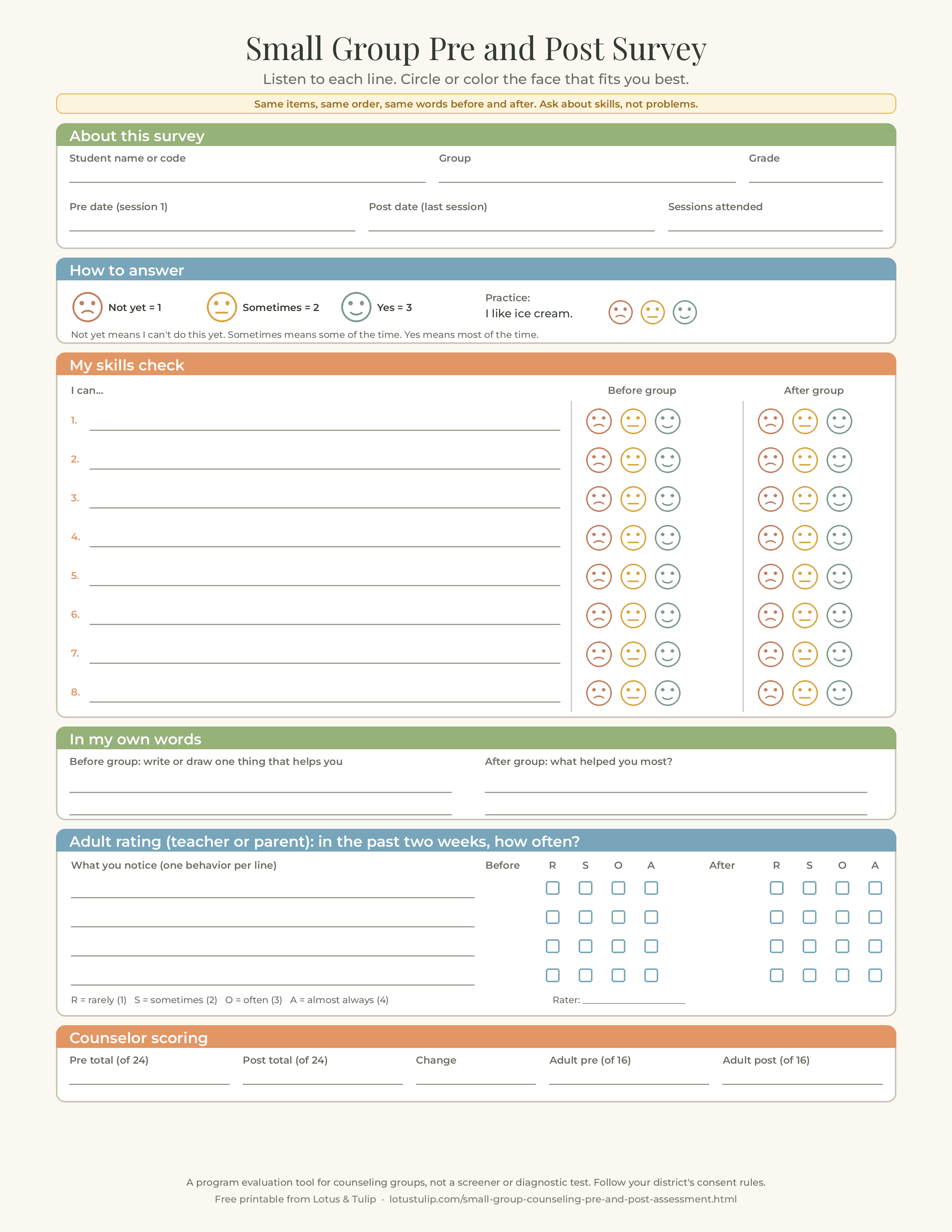
Download the free pre and post survey, example and results sheet (PDF, 3 pages)
Free starter kit: Want a ready made kid friendly check? The free small group counseling starter kit includes the pre and post self check from our worry group (eight "I can..." items with faces), with a referral form, permission letter, agreements and a session 1 lesson plan (8 pages, no email).
Prefer single images? Page 1: blank pre and post survey (PNG) · Page 2: filled fictional example (PNG) · Page 3: group results summary sheet and student log (PNG)
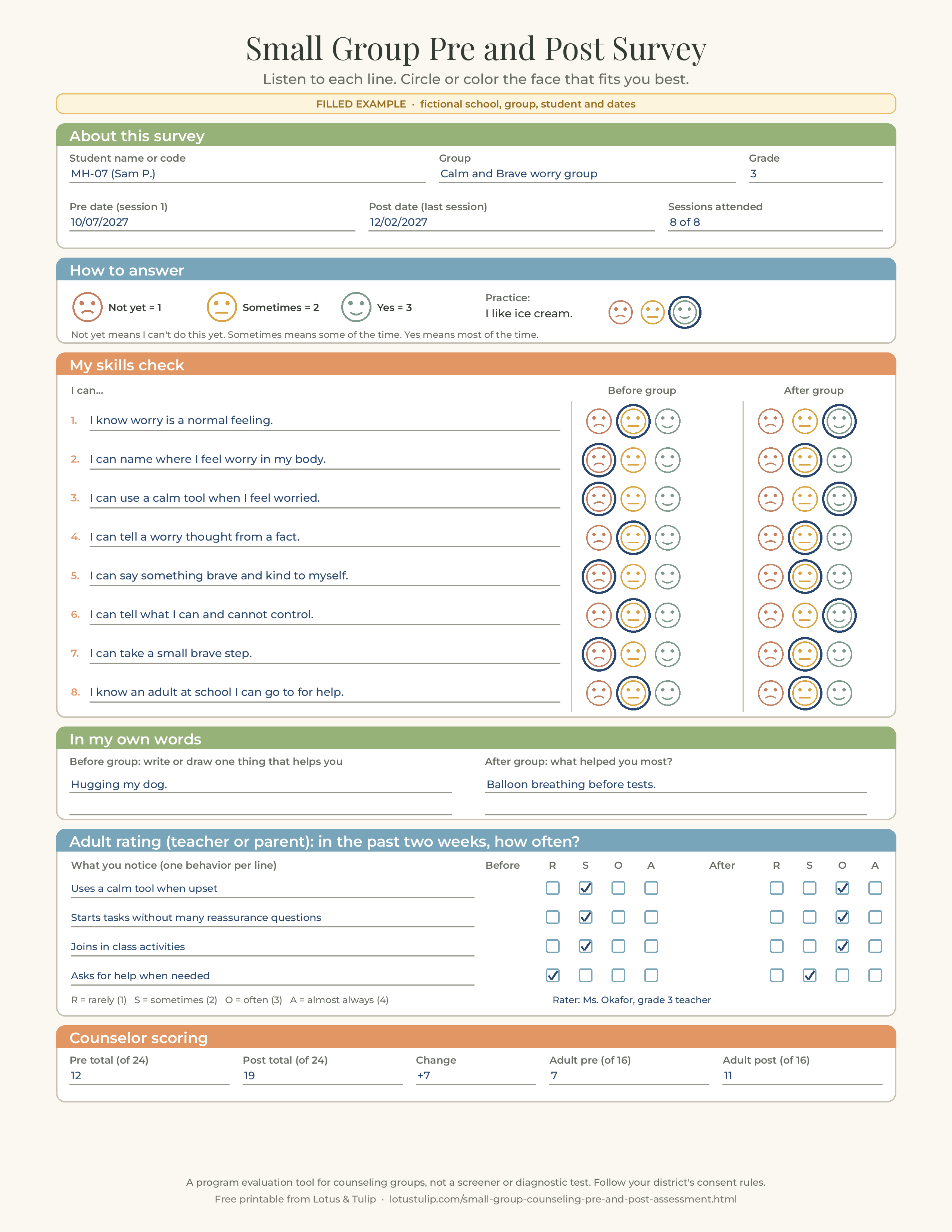
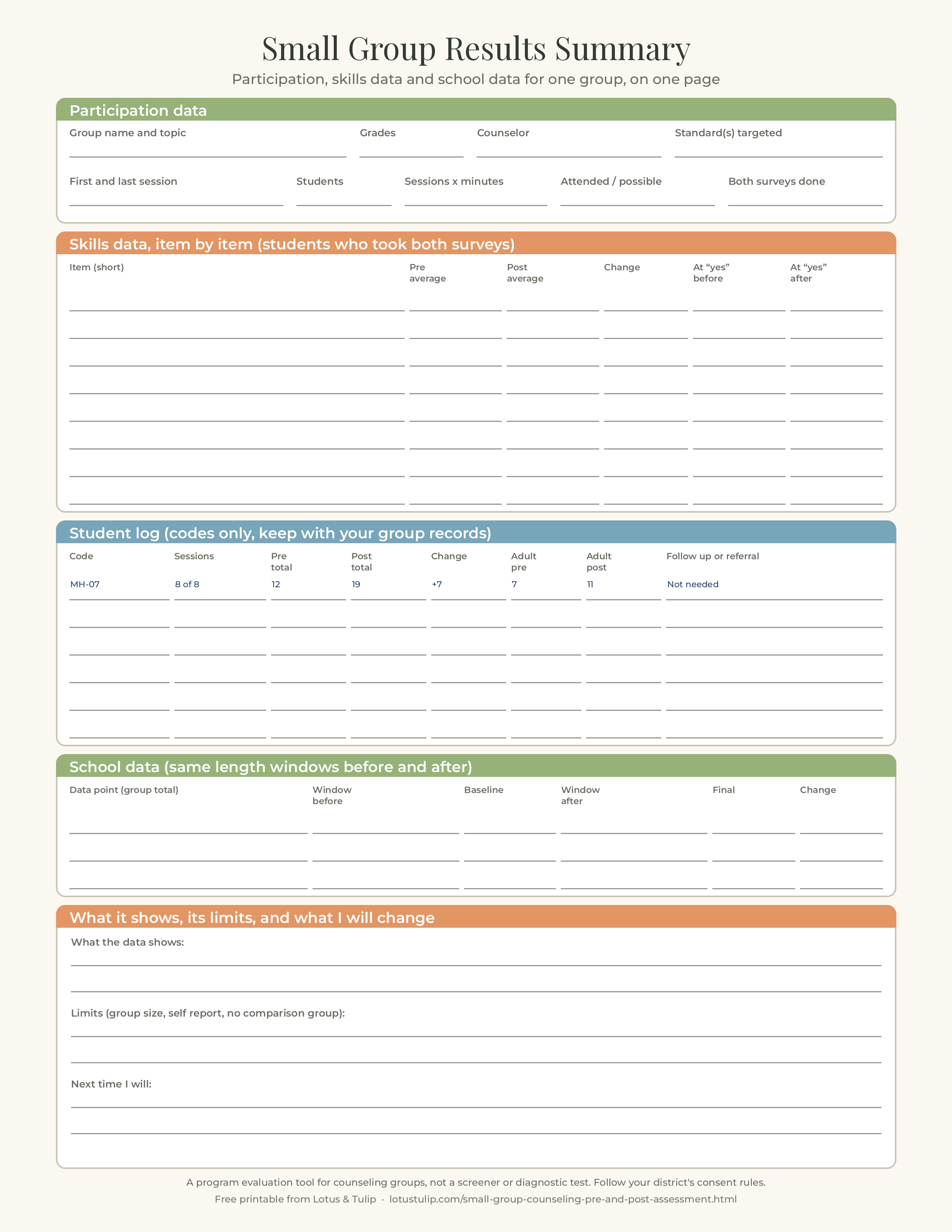
Free to print and use in your own school. Please link to this page rather than re-uploading the file. This survey is a program evaluation tool for counseling groups. It is not a validated instrument, a screener or a diagnostic tool, and it does not replace your district's policies on consent, records and mandated reporting.
Related resources
- ASCA mindsets and behaviors pre and post survey questions: item bank for all 36 standards and free survey builder
- ASCA small-group plan and data report: RAMP Section 6, filled example and free planner
- Texas SB 12 and school counselors: parental consent for small groups, surveys and check ins, with a free consent planner
- Small group counseling for attendance: 8 session plan, activities and data log
- School counselor advisory council agenda, minutes and filled example
- Small group counseling termination activities: last session plan and follow up log
- Small group counseling progress notes and attendance tracker
- School counselor needs assessment for small groups: teacher survey and tally sheet
- All school counselor small group curriculums
- Small group counseling lesson plan template and 8 session planning map
- Small group counseling permission slip and parent letter
- Small group counseling referral form: teacher, parent and self referral, screening and a free referral log
- Group therapy note template and examples
- Full year elementary small group counseling: plan the year
- Small group counseling curriculum for anxiety: an 8 session plan
- Social skills small group activities
- Anger management small group activities
- Self esteem small group activities
- Divorce small group activities
- K-2 coping skills group activities
- Middle school stress group activities
- Icebreaker activities for counseling groups
Sources: American School Counselor Association, ASCA Ethical Standards for School Counselors (2022), standards A.3.c, A.3.f, A.3.g, A.7.a, A.7.f, A.7.g, A.12.a, A.14.d, A.14.f, A.14.g and B.1.e; American School Counselor Association (2025), The ASCA National Model: A Framework for School Counseling Programs, Fifth Edition (data categories and definitions); ASCA, "Changes in the ASCA National Model Fifth Edition" (Small Group Plan and Data Report, Achievement Gap Plan and Data Report, contributing factors data); ASCA RAMP "Templates and Tools" page (fourth and fifth edition templates, graph tips); ASCA Student Standards: Mindsets & Behaviors for Student Success (behavior standards B-LS, B-SMS, B-SS); Eric Sparks, "Manage: Approaching the Work and Using Templates," ASCA newsletter, November 2025 (mindsets as byproducts, rechecked November 11, 2026); 20 U.S.C. 1232h(b); 34 CFR 99.3; Texas Education Code 26.009 as amended by S.B. 12, 89th Legislature, effective September 1, 2025; Florida Statutes 1001.42(8)(c), 2026 text. All checked on November 10, 2026. The worked example and all names, codes and numbers in it are fictional.
FAQ
What is a pre and post assessment in small group counseling?
It is a short survey students complete before a counseling group starts and again after it ends, using the same items, so the counselor can see whether students' knowledge and skills changed. In the ASCA National Model, fifth edition (2025), this is ASCA Student Standards data, "measured through pre-/post-assessments"; the fourth edition called it Mindsets & Behaviors data, and older materials call it perception data.
How many questions should a small group pre and post test have?
Five to ten items for most groups: four to six for kindergarten to grade 2, six to eight for grades 3 to 5, and eight to ten plus one or two scenario items for middle and high school. Each item should match something the group teaches, and one open or knowledge item makes the data harder to inflate.
When should I give the pre and post survey?
Give the pre survey at the start of session 1, after the welcome and group agreements but before teaching, and the post survey in the last session, before the celebration. Give a teacher rating at referral and again within a week after the group. A short follow up check four to six weeks later is optional but shows whether skills lasted.
How do I measure small group counseling outcomes besides a survey?
Use school data the group could plausibly influence, such as absences, nurse visits, office referrals, missing assignments or grades, for windows of the same length before and during or after the group. The fifth edition of the ASCA National Model calls grades and test scores achievement data and attendance and discipline contributing factors data. Report group totals and avoid claiming the group caused the change.
Do I need parent consent for a pre and post survey?
It depends on your state and district. Texas defines a psychological test to include a survey, check in or screening and requires signed parent consent. Florida requires parent permission before a well being questionnaire for students in kindergarten through grade 3. Under PPRA, required surveys in covered federally funded programs that reveal protected information, such as mental or psychological problems of the student or family, need prior written consent. Keep items about skills and mention the survey in your parent letter.
How do I report pre and post results to my principal?
On one page: participation (students, sessions, minutes, attendance), the change in average skill ratings with the scale, the biggest and smallest gains, teacher ratings, any school data for the same length windows, a sentence on limits, and one or two next steps. A simple before and after bar chart per item helps. Report group results only, never individual students.