
School counselors · Updated 2026-11-10
Small Group Counseling Permission Slip and Parent Letter: What to Include, Opt In vs Opt Out Consent, Sample Wording (Free Printable)
Ready-made printable: Complete Small Group Counseling Bundle Holiday 20% off: about $29.44, was $37 (EUR 32) · instant digital download
Buy on Etsy
Every school counselor knows this moment. The referral list for the fall worry group has eleven names on it, the schedule is finally set, and the only thing between you and session one is a piece of paper that has to go home in a backpack and come back signed. Half of the slips come back in three days. Two come back with "No" circled and a phone number. One comes back signed by a parent who, it turns out, does not have the right to make school decisions under a custody order. Three never come back at all, and one of those students is the one the teacher was most worried about.
The permission letter is the least glamorous part of running a group, and it is also where most of the avoidable trouble starts. A letter that names the group "Anxiety Group" can embarrass a child at the kitchen table. A letter that promises "everything your child says stays private" promises something no school counselor can deliver. A notice that only lets parents opt out may be fine in one district and plainly unlawful in the next state over, where the law now says a child may not take part until a signed form is back in the school's hands.
This guide is for elementary, middle and high school counselors in the United States, and for school social workers and school psychologists who run counseling groups. It covers what a small group counseling permission slip and parent letter should contain and why; what the ASCA Ethical Standards for School Counselors (2022) and ASCA's position statement on group counseling actually say about informing parents and getting consent, quoted where the wording matters; the difference between notification, opt out (passive) consent, opt in (active) consent and student assent; why the answer to "do I need a signed slip?" depends on your state and district, with two verified state examples (Texas, which since September 1, 2025 requires signed parent consent for psychological treatment and for check ins and screenings, and Florida); what the federal Protection of Pupil Rights Amendment does and does not cover; FERPA basics for the slip and your group records; custody and separated parents; how to explain the limits of group confidentiality to parents and to children in different words; how to name sensitive groups kindly; a ten step process; a full sample letter for a fictional school; six real world scenarios; common mistakes; and a free three page printable: a blank parent letter with a tear off permission slip, the same letter filled in, and a counselor checklist with a roster and permission tracking log.
Jump to the free permission letter, filled example and tracking log
This is educational information for school counselors in the US. It is not legal advice. Whether a counseling group needs signed parent consent, a notice with a chance to opt out, or only notification is decided by state law, district policy and sometimes the funding source, and it is changing in several states. Check your district's board policy and ask your district's legal counsel or student services office before you rely on any form. The standards and laws quoted here were checked on November 10, 2026 against the ASCA Ethical Standards for School Counselors (adopted 1984, most recently revised 2022), the ASCA position statement "The School Counselor and Group Counseling" (reviewed 2026), the eCFR text of 34 CFR Part 99 (FERPA) and 34 CFR 98.4 (PPRA), the text of 20 U.S.C. 1232h, Texas Education Code chapter 26 as amended by S.B. 12 (2025) and Florida Statutes 1001.42(8)(c) (2026).
The short answer
- ASCA expects you to tell parents. Standard A.7.d says school counselors "inform parents/guardians of student participation in and the purpose of the small group." That is the floor, everywhere.
- Whether you need a signature is a legal and policy question, not an ethics one. Some states and districts require signed opt in consent before a child joins a counseling group; others allow a notice with a chance to opt out. Texas now requires a signed, returned form for psychological treatment, which it defines to include work with a group.
- When in doubt, use opt in. A signed slip is never wrong ethically, it protects the student's place in the group if a parent later objects, and it starts a conversation with the family. The cost is that some students who would benefit never get the slip back, so plan a follow up call.
- Say what the group is for, in plain words. Purpose, number of sessions, how often, how long, how many students, when it meets, and what students will do.
- Do not promise total privacy. ASCA A.7.h asks you to communicate confidentiality as a group norm while recognizing that "confidentiality for students in small groups cannot be guaranteed." Tell parents the limits: harm to self or others, suspected abuse or neglect, and legal requirements.
- Explain privacy twice: once in parent language in the letter, and once in kid language in the first session, the same way every time.
- Mention any pre and post check. A short feelings or skills check can count as a "survey, check-in, or screening" under some state laws and as a questionnaire under PPRA rules for covered programs. Say what it asks and offer to show it. Our pre and post assessment guide shows how to keep items about skills.
- Name the group kindly. "Calm and Brave" or "Changing Families," not "Anxiety Group" or "Divorce Group." The letter travels through hallways and kitchens.
- Know who can sign. Under FERPA either parent has full rights unless the school has a court order, statute or legally binding document that specifically revokes them, and ASCA asks you to follow custody documents. Read what is on file.
- Ask the student too. ASCA A.2.c asks for assent appropriate to the student. A child who does not want to be in a group should not be made to attend.
- Track every slip. Letter sent, reminder sent, reply, assent. No student starts without the reply your policy requires.
Notification, opt out, opt in and assent: four different things
Much of the confusion about group permission comes from using "consent" for four different things. They are not interchangeable, and your district may require one, two or all of them.
| Term | What it means in practice | What the parent does | What happens if the slip never comes back |
|---|---|---|---|
| Notification | You tell the family that their child is taking part and what the group is for | Reads the letter, may call with questions | The child takes part; the letter is a courtesy and an ethical duty, not a gate |
| Opt out (passive) consent | You notify the family and give them a clear way and time to say no | Returns the slip only to refuse, or calls | Silence counts as agreement after the deadline, if your policy allows it |
| Opt in (active) consent | A parent or guardian must sign and return a form before the child can join | Signs and returns the slip to agree | The child does not join until a signed slip arrives |
| Student assent | The student agrees to take part after an explanation they can understand | Nothing; this is between you and the student | Not applicable; ask the student directly, ideally before session 1 |
The ASCA Ethical Standards use "informed consent" in a specific way, mainly about students. The glossary defines informed consent as "assisting students in acquiring an understanding of the limits of confidentiality, the benefits, facts and risks of entering into a counseling relationship." Standard A.2.b asks you to "inform students of the purposes, goals, techniques, rules and procedures under which they may receive counseling," including "informed consent and clarification of the limits of confidentiality." A.2.c then recognizes that informed consent "requires competence, voluntariness and knowledge on students' part" and can be difficult to obtain from younger students, so the counselor "should make attempts to gain assent appropriate to the individual student (e.g., in the student's preferred language)."
So even where a parent signs, the student still needs an age appropriate explanation and a real chance to say yes or no. And even where no signature is legally required, parents still need to be told. The permission letter is the tool that does the parent half; the first session's group agreements do the student half.
What ASCA actually says about groups and parents
Two ASCA documents matter here: the Ethical Standards for School Counselors, last revised in 2022, and the position statement "The School Counselor and Group Counseling," adopted in 1989 and most recently reviewed in 2026. Neither requires a signed permission slip. Both expect parents to be informed and students to understand what they are joining.
Standard A.7, Group Work
Section A.7 lists twelve expectations for group work. These are the ones that shape the permission letter:
- A.7.a: offer small group counseling "based on individual student, school and community needs; student data; a referral process; and/or other relevant data." Your letter can say how students were chosen, in general terms.
- A.7.b: "Provide equitable access to participation in groups, including alleviating physical, language and other obstacles." A letter only in English, or only sent through an app some families never open, is an obstacle.
- A.7.c: "Assess student needs to determine if participating in the group is appropriate for the student." Screen first, then send the letter.
- A.7.d: "Inform parents/guardians of student participation in and the purpose of the small group." This is the core parent duty.
- A.7.e: "Facilitate short-term groups." Your letter should give a clear number of sessions and an end point.
- A.7.h: "Communicate the aspiration of confidentiality as a group norm, while recognizing and working from the protective posture that confidentiality for students in small groups cannot be guaranteed."
- A.7.i: "Select topics for groups with the clear understanding that some topics are not suitable for groups in schools (e.g., incest survivorship, eating disorders, dating violence) and accordingly take precautions to protect members from harm as a result of interactions with the group."
- A.7.l: "Provide necessary follow-up and/or referrals to additional resources for group members." Your letter can say you will contact the family if a student needs more than a group can offer.
Responsibilities to parents and guardians, B.1
- B.1.b and B.1.c: respect "the rights and responsibilities of custodial and noncustodial parents/guardians," recognizing that all parents, custodial and noncustodial, "are vested with certain rights and responsibilities for their children's welfare by virtue of their role and according to law."
- B.1.e: "Adhere to the Protection of Pupil Rights Amendment when using universal screeners, surveys or needs assessments by informing parents/guardians prior to their use in accordance with school district policies and local, state and federal law."
- B.1.h: "Inform parents/guardians of the confidential nature of the school counseling relationship between the school counselor and student, while recognizing parents/guardians have inherent legal rights to student information."
- B.1.k: "Follow the directions and stipulations of the legal documentation in divorce, separation or custody cases, maintaining focus on the student. Adhere to clear boundaries and a position of neutrality when working with parents/guardians."
Two standards in B.2 (responsibilities to the school) also apply to the letter itself: B.2.j asks counselors to advocate for "vetted, bilingual/multilingual translators to represent languages used by families in the school community," and B.2.p asks them to use inclusive language and "ensure students and stakeholders have access to materials in their preferred languages when possible."
The position statement on group counseling
ASCA's position statement, reviewed in 2026, is the clearest single paragraph on group consent ASCA has published. It says school counselors "have a responsibility to screen potential group members and obtain informed consent," that "informed consent should include the group's purpose and goals, limits to confidentiality and information regarding voluntary participation," and that "best practices include informing parents/guardians of student participation in and the purpose of the small group and student agreement to participate, following school and district policy." It also says that when students "require long-term counseling or services requiring family therapy, school counselors make referrals to appropriate community resources."
Read together, those give you a checklist for the letter: purpose and goals, voluntary participation, limits to confidentiality, a short term timeline, and a statement that you follow school and district policy. The phrase "following school and district policy" is ASCA telling you that the signature question is answered locally.
Opt in or opt out? What actually decides it
There is no single national rule that every counseling group needs a signed slip. Three layers decide it: federal law for certain activities and funded programs, state law, and district policy. The strictest one that applies wins.
Federal: the Protection of Pupil Rights Amendment (PPRA)
PPRA (20 U.S.C. 1232h) is often cited as "the reason we need permission slips," but it is narrower than people think. Section 1232h(b) says no student shall be required, "as part of any applicable program," to submit to a survey, analysis or evaluation that reveals information about eight protected areas, including "mental or psychological problems of the student or the student's family" and "critical appraisals of other individuals with whom respondents have close family relationships," without the prior written consent of the parent of an unemancipated minor. The eight areas are political affiliations or beliefs, mental or psychological problems, sex behavior or attitudes, illegal, anti-social, self-incriminating or demeaning behavior, critical appraisals of close family members, legally recognized privileged relationships, religious practices or beliefs, and income.
The Department of Education's regulation at 34 CFR 98.4 goes further for programs covered by that part: no student "shall be required, as part of any program specified in 98.1 (a) or (b), to submit without prior consent to psychiatric examination, testing, or treatment, or psychological examination, testing, or treatment, in which the primary purpose is to reveal information concerning" a list of similar areas, and it defines psychological treatment as "an activity involving the planned, systematic use of methods or techniques that are not directly related to academic instruction and that is designed to affect behavioral, emotional, or attitudinal characteristics of an individual or group." "Prior consent" for an unemancipated minor means "prior written consent of the parent or guardian."
What that means for a small group: whether PPRA applies depends on which federal program, if any, funds the activity and on the primary purpose of the activity. Many ordinary school counseling groups are not run "as part of" a covered program, and a skills group's primary purpose is not to reveal information about family problems. But a group funded through a federal grant, or a pre and post questionnaire that asks about feelings at home, can bring it into play. ASCA's glossary notes that schools receiving federal funding that use a universal screener asking "even one question from one of the eight protected areas" must obtain active consent if the screener is required and passive consent if it is voluntary. This is a question for your district, not something to decide on your own. The practical lesson: keep your pre and post check about skills ("I can use a calm tool when I feel worried") rather than about family problems, and tell parents what it asks.
State law: two verified examples
Texas (opt in, by statute). Senate Bill 12 of the 89th Legislature rewrote Texas Education Code 26.009, effective September 1, 2025. A district employee or contractor "must obtain the written consent of a child's parent" before they may "conduct a psychological or psychiatric examination or test, or psychological or psychiatric treatment," with exceptions for child abuse reporting under section 38.004 and for special education requirements. The definitions are broad. A psychological examination or test is "a method designed to elicit information regarding an attitude, habit, trait, opinion, belief, feeling, or mental disorder," "including a method that is presented or characterized as a survey, check-in, or screening or is embedded in an academic lesson." Psychological treatment is "the planned, systematic use of a method or technique that is designed to affect behavioral, emotional, or attitudinal characteristics of an individual or group." And subsection (a-2) says written consent "must be signed by the parent and returned to the district. A child may not participate in the activity unless the district receives the parent's signed written consent to that activity."
Notice two details. First, the Texas definition of treatment closely tracks the federal PPRA regulation but leaves out the federal phrase "not directly related to academic instruction," so it reaches further. Second, the definition of a test explicitly includes check ins, which is why many Texas districts now treat a pre and post skills check as needing the same signed consent as the group. The same bill added section 26.0083, which directs the Texas Education Agency to adopt a procedure for districts to notify parents of "any change in services provided to or monitoring of the student related to the student's mental, emotional, or physical health or well-being," and says that before a district administers "a student well-being questionnaire or health screening form" it must give the parent a copy and obtain consent in the manner provided by 26.009(a-2). Some Texas districts have published their own lists of which services are opt in and which are opt out under SB 12; follow yours. For the full Texas picture, including TEA's proposed rule, parent notification timelines and the 2026 court status, see the Texas SB 12 guide for school counselors.
Florida (notification and the right to decline). Florida Statutes 1001.42(8)(c) requires each district to adopt procedures for "notifying a student's parent if there is a change in the student's services or monitoring related to the student's mental, emotional, or physical health or well-being," and says district personnel "may not discourage or prohibit parental notification of and involvement in critical decisions affecting a student's mental, emotional, or physical health or well-being." At the beginning of the school year, each district "shall notify parents of each health care service offered at their student's school and the option to withhold consent or decline any specific service." Before administering a well-being questionnaire or health screening form to a student in kindergarten through grade 3, the district "must provide the questionnaire or health screening form to the parent and obtain the permission of the parent." The statute allows procedures that permit withholding information from a parent only where "a reasonably prudent person would believe that disclosure would result in abuse, abandonment, or neglect." In practice, Florida counselors should expect their district to require at least notification for a new group, and many districts require signed consent; the K to 3 rule makes a signed slip the safe choice for any pre and post check with young children.
Other states have their own parental rights or student privacy statutes, and several have changed in the last few years. Do not assume what was true when you trained is still true. Search your state's education code for "parental consent" and "psychological," read your board policy, and ask your district office which form it wants you to use.
District policy: usually the deciding layer
Most districts have a board policy on counseling services and parental consent, and many student services departments publish a standard group permission form. If your district has one, use it, and use the free printable here only for the parts it lacks (the kid friendly privacy wording, the tracking log, the checklist). If your district has no written rule, choose opt in for any group that is clinical in flavor (worry, anger, grief, divorce, self esteem, social skills for students with significant needs) and write down that you did.
| Situation | Safer default | Why |
|---|---|---|
| Your state requires written consent for psychological treatment, testing or check ins (Texas) | Opt in, signed and returned before session 1 | The statute says the child may not participate until the district has the signed form |
| District policy requires signed permission for counseling groups | Opt in | Policy controls; the slip is your record that you followed it |
| District allows passive consent for groups, and the group is a skills group | Opt out notice with a clear deadline, or opt in if you prefer | Allowed, but follow up with families who do not respond |
| A pre and post questionnaire asks about feelings, family or mental health | Opt in, and show parents the questionnaire | May be a check in or screening under state law, or a protected area survey under PPRA in covered programs |
| Group is funded by a federal grant | Ask the grant coordinator; usually opt in | PPRA and grant terms may apply |
| Grief, divorce or another sensitive topic | Opt in, plus a phone call before the letter if you can | Families want to know exactly what will and will not be discussed |
| Classroom lesson for every student, not a group | Follow your district's rule for core curriculum | Different rules often apply to whole class instruction; Texas, for example, defines a test to include methods embedded in a lesson |
FERPA basics for permission slips and group records
The Family Educational Rights and Privacy Act (FERPA) shapes three things: who can sign, who can see the slip and your group notes, and what happens to them.
- A signed permission slip in a school file is usually an education record. Under 34 CFR 99.3, education records are records that are "directly related to a student" and "maintained by an educational agency or institution." A slip with a student's name that you keep in the counseling office fits that definition.
- Either parent has FERPA rights. 34 CFR 99.4 says a school "shall give full rights under the Act to either parent, unless the agency or institution has been provided with evidence that there is a court order, State statute, or legally binding document relating to such matters as divorce, separation, or custody that specifically revokes these rights." FERPA defines "parent" to include "a natural parent, a guardian, or an individual acting as a parent in the absence of a parent or a guardian."
- Parents can inspect education records. 34 CFR 99.10 requires the school to comply with a request to inspect and review "within a reasonable period of time, but not more than 45 days after it has received the request."
- Sole possession notes are different. Records "kept in the sole possession of the maker," "used only as a personal memory aid," and "not accessible or revealed to any other person except a temporary substitute for the maker of the record" are excluded from the definition of education records. ASCA standard A.13.c asks counselors to "recognize the difficulty in adhering to FERPA's definition of sole-possession records," and A.13.d warns that sole possession records and case notes "can be subpoenaed unless there is a specific state statute for privileged communication expressly protecting student/school counselor communication." Once a note is shared, put in a shared system or used for a team decision, treat it as an education record.
- Rights transfer at 18. When a student becomes an "eligible student," meaning they have "reached 18 years of age" or attend a postsecondary institution, FERPA rights "transfer from the parents to the student" (34 CFR 99.5). In high school, an 18 year old senior signs for themselves under FERPA, though your district may still want parents informed.
- Write about other students carefully. A group note in one student's file that names other group members puts other children's information in that file. Use initials or codes for other members, and record the group's content once in a group log rather than in every child's file, following district guidance. ASCA A.13.e reminds counselors that electronic communications about students, "even without using student names," are likely to create student records.
Keep the signed slips in one place for each group, attached to the roster, so you can show who agreed and when. That is also what you will need if a parent later says they never gave permission.
Separated parents, custody orders and who signs
Under FERPA either parent keeps record rights unless a legal document specifically revokes them, and ASCA asks counselors to respect the rights of custodial and noncustodial parents and to "follow the directions and stipulations of the legal documentation in divorce, separation or custody cases." Put together, a sound practice looks like this:
- Check the file before you send the letter. If the registrar or front office has a custody order or parenting plan on file, read the parts about educational decisions, counseling or mental health care, and access to information.
- One signature is usually enough unless your district, your state, or the order says otherwise. Some orders give one parent the exclusive right to consent to psychological care; others require joint decisions. If the order is unclear, ask your administrator or district counsel before the student starts.
- Send to both households when both have rights. For a changing families group in particular, sending the letter only to the parent who picks the child up can look like taking sides. Many counselors send the same letter to both addresses on file.
- Stay neutral in the wording. "Changing Families helps students whose families are going through changes, such as a move between two homes" is neutral. "Helps children cope with their parents' divorce" names an event one parent may dispute.
- Do not let the group become evidence. If a parent asks you to report on what their child said about the other parent, explain your role and the limits of confidentiality, and loop in your administrator. ASCA A.2.i asks counselors to "request of the court that disclosure not be required" when a counselor's testimony or case notes are subpoenaed if release "may potentially harm a student or the counseling relationship."
- Foster care and kinship care. FERPA's definition of parent includes "an individual acting as a parent in the absence of a parent or a guardian." For students in foster care, ask your district's foster care liaison who signs consent for counseling services, because state rules and agency policies differ.
Confidentiality in a group: parent words and kid words
A counseling group is different from individual counseling in one important way: you control what you do with what students share, but you cannot control what four other ten year olds do with it. ASCA A.7.h asks you to present confidentiality as an "aspiration" and a "group norm" while working from the "protective posture" that it "cannot be guaranteed." Your letter should say the same thing, without making the group sound dangerous.
The limits you should name
- Harm to self or others. ASCA A.9.a: school counselors "inform parents/guardians and school administration when a student poses a serious and foreseeable risk of harm to self or others," and "even if the danger appears relatively remote, parents/guardians must be notified."
- Suspected abuse or neglect. ASCA A.12.a: school counselors "report to the proper authorities, as mandated by the state, all suspected cases of child abuse and neglect, recognizing that certainty is not required, only reasonable suspicion."
- Threats and harm by others. ASCA A.9.e asks counselors to report to administration or appropriate authorities when a student discloses a threat to another person's well being, which may include "verbal abuse, physical abuse, sexual abuse, dating violence, bullying or harassment."
- Legal requirements. ASCA A.2.f: keep information confidential "unless legal requirements demand confidential information be revealed or a breach is required to prevent serious and foreseeable harm to the student or others."
- Other group members. You will ask students to keep each other's words private, and you cannot guarantee they will.
- Parents' rights. ASCA B.1.h: inform parents of the confidential nature of the counseling relationship "while recognizing parents/guardians have inherent legal rights to student information." In some states, such as Texas and Florida, statutes also require districts to notify parents of changes in services related to a student's well being.
Parent wording that works
"I ask everyone in the group to keep what others say private, and I keep what your child shares private too. There are limits: I will act and contact you or the right people if a student may be hurt or may hurt someone, if I suspect abuse or neglect (I am required to report it), or if the law or a court requires it. I cannot promise that every child will always keep group talk private, so I teach students to share only what they are comfortable sharing. You are always welcome to ask me how your child is doing."
Notice what that wording does not say. It does not say "everything is confidential." It does not say "I will tell you everything your child says," either, which would make the group pointless for many students. It tells the parent they can ask, which is true, and leaves room for you to share how a child is doing without reporting every word.
Kid wording that works
ASCA A.2.e asks counselors to "explain the limits of confidentiality in developmentally appropriate terms through multiple methods." For elementary students, one or two sentences, repeated at the start of every session for the first few weeks, work better than a speech:
- K to 2: "What we say in group stays in group. If someone might get hurt, I tell a grown up who can help."
- Grades 3 to 5: "What we say in group stays in group. I keep your words private too, unless someone might get hurt. Then I tell a grown up who can help keep everyone safe."
- Middle and high school: "I keep what you say here private, with a few exceptions: if you or someone else might be hurt, if I am worried about abuse, or if a law or court makes me share. I will ask all of you to keep each other's stories in this room, but I cannot promise everyone will, so share what feels okay to share."
Pair the words with a rule students help write in session 1 ("Keep it private"), and add "It is okay to pass" so no one feels they have to disclose anything. ASCA A.2.h adds that if a breach is necessary, counselors should "use the most appropriate and least intrusive method" and, as appropriate, engage the student "in a discussion about the method and timing of the breach."
Choose the topic and the students before the letter goes home
The letter should never be the first time you think about whether a student belongs in the group. ASCA asks you to screen (A.7.c) and to avoid topics that are not suitable for school groups (A.7.i, which names "incest survivorship, eating disorders, dating violence" as examples). Before you send anything:
- Talk to the student briefly. Explain the group in a sentence, ask if they would like to try it, and note their answer. A student who clearly does not want to come is not a good fit right now.
- Check the mix. Two students in active conflict, or a student who has bullied another student in the group, can make the group unsafe. A.7.i asks you to "take precautions to protect members from harm as a result of interactions with the group."
- Check for need beyond a group. A student with frequent panic attacks, self harm, or a recent loss with complicated grief may need individual support or a referral first. ASCA A.1.e asks counselors to support families "in obtaining outside services if students need long-term clinical/mental health counseling."
- Check that the topic is a school topic. Skills for worry, anger, friendship, confidence, family change, grief, study habits and transitions are typical school group topics. Trauma processing, eating disorders and dating violence disclosure groups are not.
How to name sensitive groups
The name on the letter is the name a sibling will read aloud, the name a parent might mention to a neighbor, and sometimes the name a student is teased with. A kind name is not euphemism; it describes the skills, not the problem.
| Avoid on the letter | Kinder name | Plain purpose line for parents |
|---|---|---|
| Anxiety Group | Calm and Brave | Handling worry, calming the body and taking small brave steps |
| Anger Management Group | Cool Down Crew | Noticing anger early and choosing a cool down tool |
| Divorce Group | Changing Families | Support for students whose families are going through changes |
| Grief Group | Remembering Together | Support for students after the death of someone important to them |
| Low Self Esteem Group | Shine Bright | Noticing strengths, handling mistakes and kind self talk |
| Bullying Victims Group | Stand Strong | Speaking up, finding safe adults and building confidence |
| Social Skills Deficit Group | Friendship Builders | Joining in, taking turns, reading cues and solving friendship problems |
Be honest in the purpose line. Parents should not discover at session 4 that "Friendship Builders" was a group about a specific incident. And for a grief group, ASCA's emphasis on accurate information to parents (B.1.j) argues for saying plainly that the group is for students after a death, while keeping the group name gentle.
What to include in a small group counseling permission letter
| Element | Why it belongs | Sample wording |
|---|---|---|
| Student name and a greeting to the parent or guardian | Makes it personal and avoids generic letters going to the wrong family | "Dear parent or guardian of ____," |
| Group name and plain purpose | ASCA A.7.d: inform parents of participation and purpose | "The group is called Calm and Brave and it helps students with handling worry..." |
| Why the student was invited, in general terms | Reduces worry that the child is in trouble; ASCA A.7.a ties groups to data and referrals | "Students are invited because the group could help them build skills, not because they are in trouble." |
| That groups are part of the school counseling program | Signals a normal school service, not therapy | "Small groups are a regular part of our school counseling program." |
| Number of sessions, frequency and length | Short term groups (A.7.e); families can see the end point | "We will meet 8 times, about once a week, for 30 minutes." |
| Meeting time and whether it rotates | Parents and teachers worry about missed instruction | "Thursdays, at a different time each week." |
| Group size | Helps parents picture it | "There will be 5 students." |
| What students will do | Informed consent includes techniques (A.2.b) | "We learn through short lessons, games, drawing and talk." |
| Any pre and post check or questionnaire | May need consent under state law or PPRA in covered programs; B.1.e | "At the start and end, students fill in a short check on how they use the skills. I am happy to show it to you." |
| Confidentiality and its limits | A.7.h, A.9.a, A.12.a, B.1.h | See the parent wording above |
| Voluntary participation and the right to stop | ASCA position statement: "information regarding voluntary participation" | "Taking part is your choice. You can say no, or stop at any time." |
| Return date and how to reply | Needed for opt in and opt out alike | "Please return the slip by ____." |
| Contact details and best way to reach you | Families with questions should be able to ask before deciding | "Questions? Contact me at ____." |
| Reply options: yes, no, call me first | A third option keeps undecided parents in the conversation | "Please call me before I decide." |
| Parent name, signature, date, phone or email, best time | Your record of consent and a way to follow up | Fields on the slip |
| Preferred language | A.7.b and B.2.p on language access | "Language we prefer: ____" |
| Optional note from the parent | Parents often know what helps and what to avoid | "Anything you would like me to know (optional)." |
| Counselor use: reply logged, student assent | Shows the slip was received and the student agreed (A.2.c) | "Reply logged on ____. Student asked and agreed on ____." |
What to leave out: diagnoses or clinical language ("your child's anxiety disorder"), the names of other students, specific incidents that led to the referral, and anything that sounds like a promise of results ("this group will fix your child's worry"). If there is something specific to discuss, call the parent instead of writing it in a letter that may be read by others.
Sample small group counseling permission letter (fictional, full)
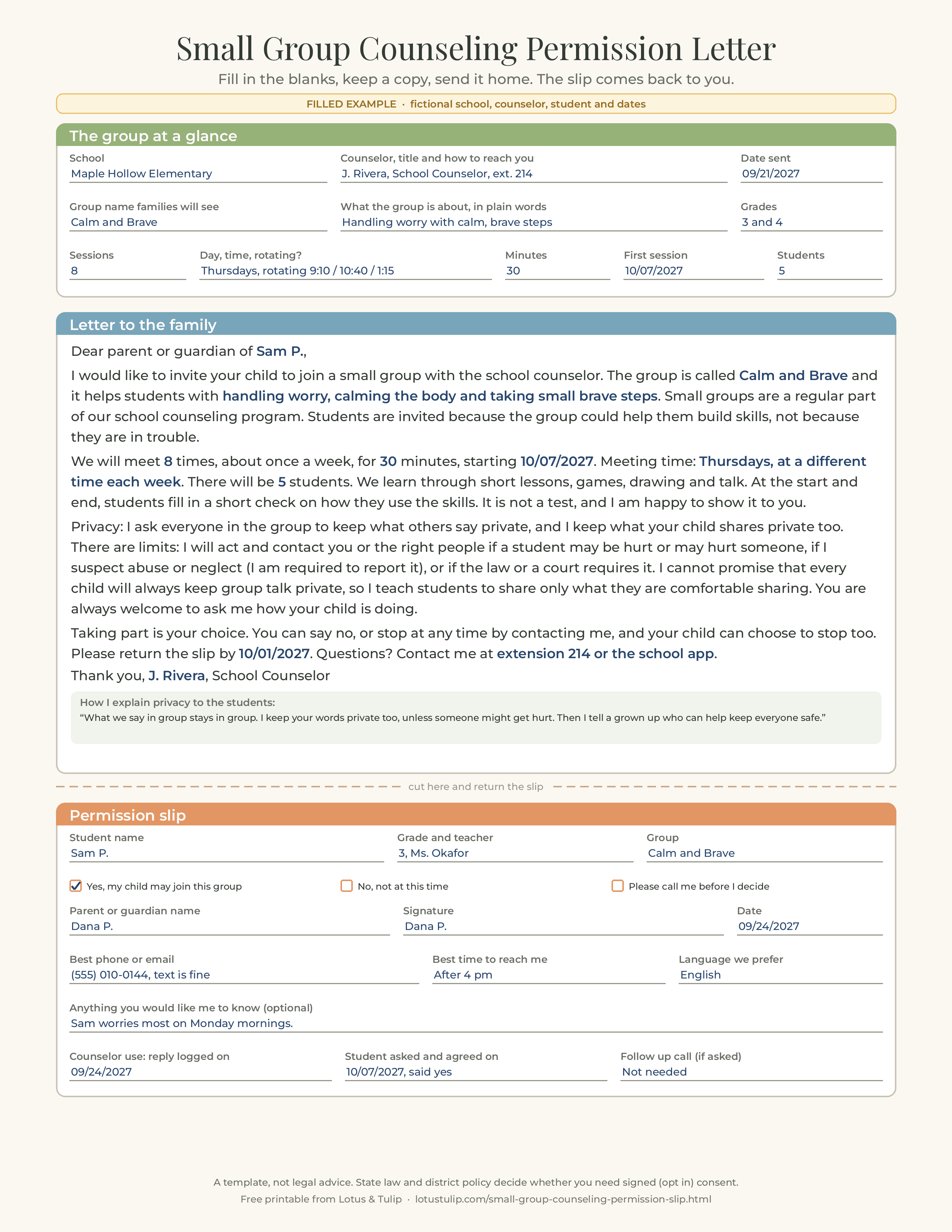
Maple Hollow Elementary is a fictional public elementary school. J. Rivera, the school counselor, is starting an eight session worry group for five students in grades 3 and 4. The district allows either opt in or opt out for skills groups, but J. Rivera uses opt in for every group. Here is the full letter; page 2 of the free printable shows the same letter filled in on the form.
Dear parent or guardian of Sam P.,
I would like to invite your child to join a small group with the school counselor. The group is called Calm and Brave and it helps students with handling worry, calming the body and taking small brave steps. Small groups are a regular part of our school counseling program. Students are invited because the group could help them build skills, not because they are in trouble.
We will meet 8 times, about once a week, for 30 minutes, starting October 7. Meeting time: Thursdays, at a different time each week, so your child does not miss the same class every week. There will be 5 students. We learn through short lessons, games, drawing and talk. At the start and end, students fill in a short check on how they use the skills, such as "I can use a calm tool when I feel worried." It is not a test, and I am happy to show it to you.
Privacy: I ask everyone in the group to keep what others say private, and I keep what your child shares private too. There are limits: I will act and contact you or the right people if a student may be hurt or may hurt someone, if I suspect abuse or neglect (I am required to report it), or if the law or a court requires it. I cannot promise that every child will always keep group talk private, so I teach students to share only what they are comfortable sharing. You are always welcome to ask me how your child is doing.
Taking part is your choice. You can say no, or stop at any time by contacting me, and your child can choose to stop too. Please return the slip by October 1. Questions? Contact me at extension 214 or the school app.
Thank you,
J. Rivera, School CounselorPermission slip: Student name ____. Grade and teacher ____. Group: Calm and Brave. [ ] Yes, my child may join this group. [ ] No, not at this time. [ ] Please call me before I decide. Parent or guardian name ____. Signature ____. Date ____. Best phone or email ____. Best time to reach me ____. Language we prefer ____. Anything you would like me to know (optional) ____.
If your district allows opt out: a notice version
If your district permits passive consent for this kind of group, change the last paragraph and the slip, and keep everything else:
"Taking part is your choice. If you do not want your child to join, please return the slip below or contact me by October 1. If I do not hear from you by then, your child will begin the group on October 7. You can also stop at any time by contacting me, and your child can choose to stop too." Slip: "[ ] Please do not include my child in this group. [ ] Please call me, I have questions."
Do not use this version in a state or district that requires signed consent. And even where it is allowed, call or message the families who have not replied a few days before the start date. An unanswered notice is not the same as an informed parent.
A short reminder note
"Hello, this is J. Rivera, the school counselor at Maple Hollow. I sent home a letter about a small group called Calm and Brave that I would like to invite Sam to join. I have not received the slip yet. I am happy to answer any questions, and I can send another copy. The group starts October 7. You can reach me at extension 214."
When a parent says no
Respect it, log it, and keep the door open. A brief call or note works: "Thank you for letting me know. Sam will not be part of the group. If anything changes, or if you would like to talk about other ways I can support Sam at school, please reach out." Do not pressure, and do not run a "group" with the student informally at lunch to get around a refusal.
How to set up small group counseling permission, step by step
- Check the rule. Read your district's board policy on counseling services and parental consent, and check your state's education code. Decide opt in or opt out, and write down which and why.
- Screen and invite the students. Use referrals and data (the small group referral form guide has a free form and referral log), talk with each student briefly, and check the group mix and whether the topic is suitable for a school group.
- Plan the group details. Name, plain purpose, number of sessions, day, rotating times, length, size, start date and any pre and post check.
- Check custody and contact information. Look for orders or legal documents on file, confirm addresses and preferred languages, and decide whether to send to more than one household.
- Write the letter. Fill in the blanks, use the parent privacy wording, include voluntary participation and your contact details, and add the reply options.
- Translate and deliver. Use your district's translation service where you can, send the letter the way the family actually receives school mail, and keep a copy.
- Log and follow up. Record the date sent, send a reminder a few days before the deadline, and call families who have not replied or who asked for a call.
- Get the student's assent. Before or at session 1, explain the group and the limits of confidentiality in kid words, and let the student say yes or no.
- Start only with the reply you need. No student joins without the reply your policy requires. Keep the slips with the roster.
- Close the loop. At the end, send a short note home about what the group covered and any follow up or referral, and store or purge records as your district requires.
Six real world scenarios
1. The slip that never comes back. A fourth grader the teacher is most worried about has no reply after a week. In an opt in district, the student cannot start. Call the parent, offer to send a new copy or meet at pickup, and ask whether another language would help. If you cannot reach anyone, document your attempts and talk with your administrator about other support you can offer within policy, such as a check in during individual counseling if your district allows it.
2. The noncustodial parent calls. A father who does not live with his daughter calls, upset that he heard about the changing families group from her. FERPA gives him full rights unless a document revokes them. Check the file. If nothing restricts his rights, explain the group's purpose, offer him the same letter, and note the call. If an order restricts his rights, follow it and involve your administrator.
3. The questionnaire question. Your new anxiety group includes a pre and post check with items about feelings at home. In Texas, that is likely a "check-in" or "screening" under 26.009 and needs signed consent; under PPRA, if the group is part of a covered federal program, a question about family problems is in a protected area. Rewrite the items so they ask about skills, not family problems, show the check to parents, and get the consent your district requires.
4. The student who changes her mind. A sixth grader's mother signed, but at session 2 the student says she does not want to come anymore. Talk with her privately about why. If she still wants to stop, let her, tell the parent, and offer another kind of support. Parent consent permits participation; it does not require it.
5. The disclosure in group. In session 5, a student mentions something that gives you reasonable suspicion of abuse. Follow your state's reporting law and your district's procedure (ASCA A.12.a). Afterward, check on the rest of the group, and remind everyone of the privacy rule without discussing the disclosure. Your letter already told parents this limit existed.
6. The senior who is 18. A high school senior who turned 18 is joining a stress group. Under FERPA, rights have transferred to her as an eligible student, so she signs. Many districts still ask counselors to inform parents; follow your policy, and tell the student what you will share with her parents before you share it.
Common permission slip mistakes
- Promising total confidentiality. "Everything said in group is confidential" is not true and contradicts ASCA A.7.h.
- Labeling the child. "Your child has been identified as having anxiety" is a diagnosis school counselors do not make (ASCA A.1.f: school counselors "do not diagnose").
- Using passive consent where the law requires active consent. In Texas, a child may not participate in covered activities without the signed form.
- Forgetting the pre and post check. A feelings questionnaire can need its own consent. Mention it, and offer to show it.
- Sending only one household a letter in a changing families group. Check custody documents and send to both parents with rights where your district allows it.
- English only letters. ASCA A.7.b and B.2.p call for language access. Use district translators where possible.
- No clear end date. Groups are short term. Say how many sessions and when it starts.
- No tracking. Without a log, a student can slip into session 1 without the reply you need, or a "no" can be missed.
- Skipping the student's assent. A signed slip does not mean the student wants to be there.
- Specific incidents in the letter. Keep details for a phone call; letters travel.
Free printable: small group counseling permission letter, filled example, checklist and roster log
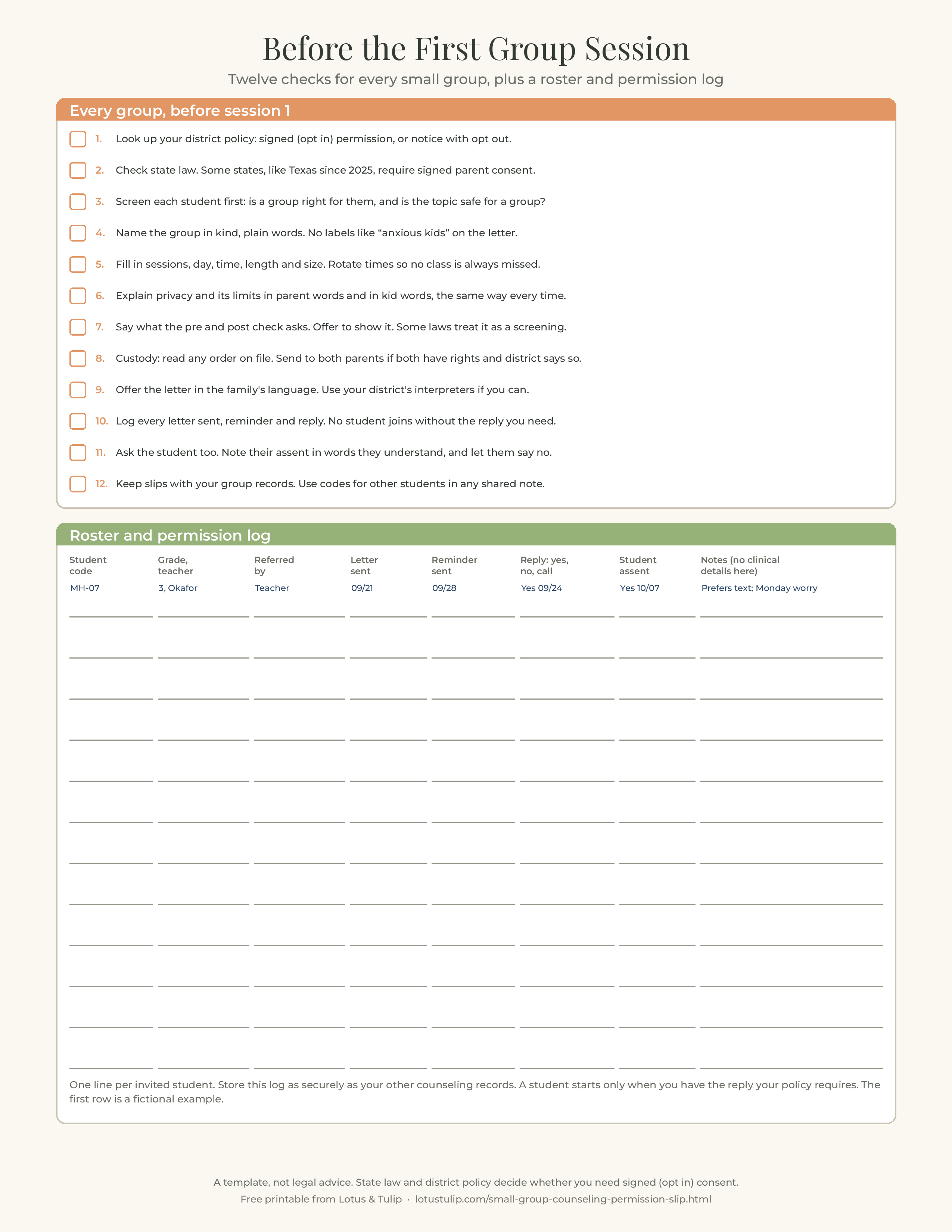
The free printable has three US Letter pages. Page 1 is a blank small group counseling permission letter: the group at a glance (school, counselor and how to reach you, date sent, the group name families will see, what the group is about in plain words, grades, number of sessions, day and time and whether it rotates, minutes, first session and number of students); a letter to the family with blanks for the student's name, group name, purpose, schedule, size and return date, the parent privacy wording with its limits, a statement that taking part is voluntary and can stop at any time, and your contact details; a box with the kid friendly privacy sentence you will use in group; and a tear off permission slip with student, grade and teacher, group, three reply options (yes, no, please call me before I decide), parent or guardian name, signature, date, best phone or email, best time to reach you, preferred language, an optional note, and a counselor use line for the date the reply was logged, the date the student agreed, and any follow up call. Page 2 is the same letter filled in for the fictional Maple Hollow Elementary worry group. Page 3 is a twelve point checklist for every group before session 1 and a roster and permission log with columns for student code, grade and teacher, who referred the student, letter sent, reminder sent, reply, student assent and notes.
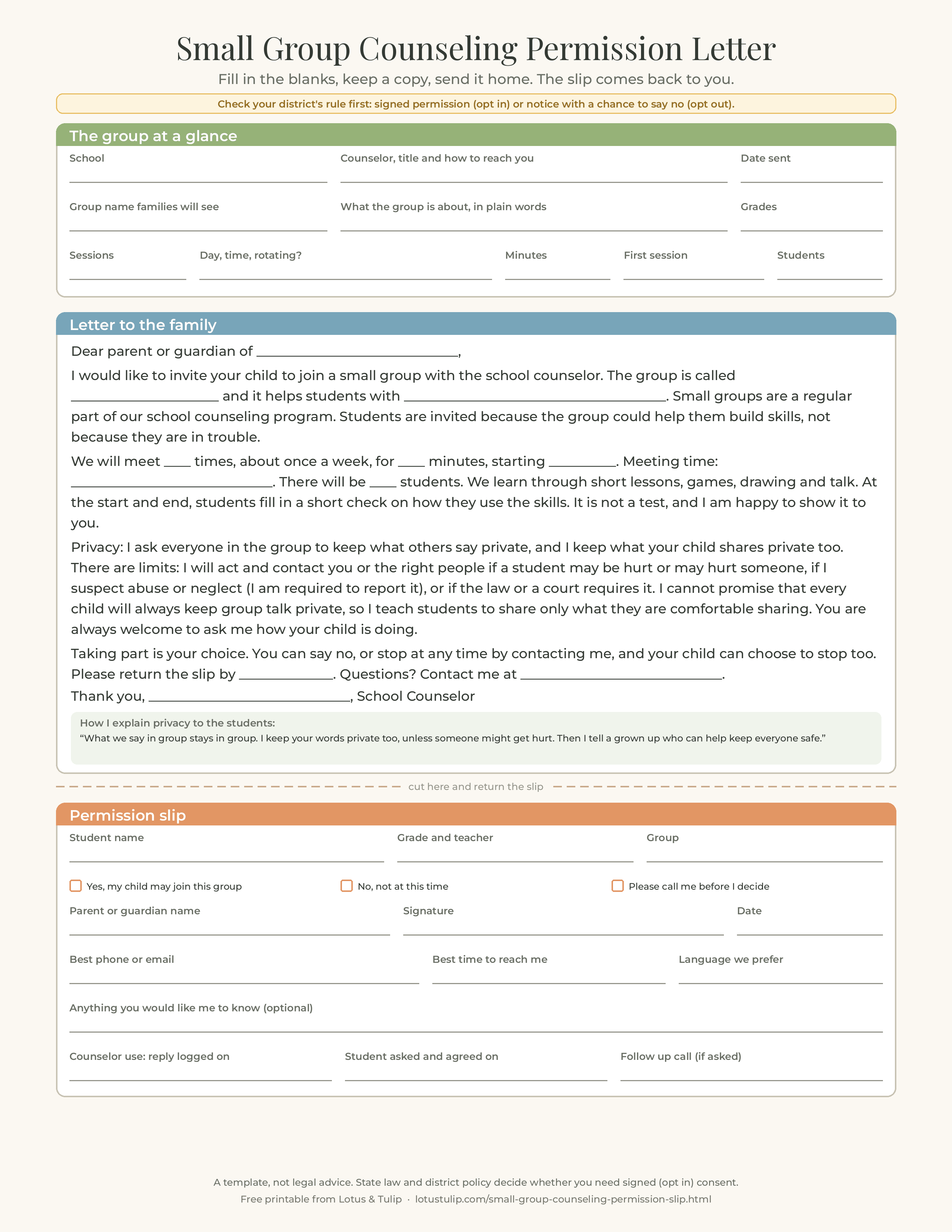
Download the free permission letter, example and roster log (PDF, 3 pages)
Free starter kit: Running a worry or anxiety group? The free small group counseling starter kit has a permission letter already worded for an eight session worry group, plus a teacher referral form, group agreements, a pre and post check and a full session 1 lesson plan (8 pages, no email).
Prefer single images? Page 1: blank letter and permission slip (PNG) · Page 2: filled fictional example (PNG) · Page 3: counselor checklist and roster and permission log (PNG)
Free to print and use in your own school. Please link to this page rather than re-uploading the file. If your district has its own permission form, use it and add only what it lacks. This letter does not reflect any particular state's law, it is not legal advice, and it does not replace your district's policy on consent, confidentiality and mandated reporting.
Related resources
- Texas SB 12 and school counselors: parental consent for small groups, surveys and check ins, with a free consent planner
- All school counselor small group curriculums
- Small group counseling lesson plan template and 8 session planning map
- Small group counseling referral form: teacher, parent and self referral, screening and a free referral log
- Small group counseling pre and post assessment: how to write, give, score and report it, with a free survey and results sheet
- Full year elementary small group counseling: plan the year, with a free printable
- Small group counseling curriculum for anxiety: an 8 session plan
- Social skills small group activities
- Divorce small group activities
- Anger management small group activities
- Self esteem small group activities
- K-2 coping skills group activities
- Girls friendship group activities
- Middle school stress group activities
- Icebreaker activities for counseling groups
- Group therapy note template and examples
Sources: American School Counselor Association, ASCA Ethical Standards for School Counselors (adopted 1984; revised 1992, 1998, 2004, 2010, 2016, 2022), standards A.1.e, A.1.f, A.2.b, A.2.c, A.2.e, A.2.f, A.2.h, A.2.i, A.7.a to A.7.e, A.7.h, A.7.i, A.7.l, A.9.a, A.9.e, A.12.a, A.13.c to A.13.e, B.1.b, B.1.c, B.1.e, B.1.h, B.1.j, B.1.k, B.2.j and B.2.p, and the glossary entries for informed consent, sole-possession records and universal screener; ASCA position statement "The School Counselor and Group Counseling" (adopted 1989; revised 1993, 2002, 2008; reviewed 1999, 2008, 2014, 2020, 2026); 34 CFR 99.3 (education records, eligible student, parent), 99.4, 99.5 and 99.10, eCFR text as in effect on November 1, 2026; 34 CFR 98.4; 20 U.S.C. 1232h(b); Texas Education Code 26.009 and 26.0083, as amended and added by S.B. 12, 89th Legislature, effective September 1, 2025 (text from the Texas Legislature's statutes PDF for chapter 26); Florida Statutes 1001.42(8)(c), 2026 text on flsenate.gov. All checked on November 10, 2026. State law and district policy change; verify before relying on them.
FAQ
Do school counselors need parent permission for small group counseling?
It depends on your state and district. The ASCA Ethical Standards require school counselors to "inform parents/guardians of student participation in and the purpose of the small group" (A.7.d), but they do not require a signature. Some states require one: in Texas, since September 1, 2025, a district must have a parent's signed, returned consent before psychological treatment, which the statute defines to include planned work designed to affect behavioral or emotional characteristics of a group. Many districts require signed permission by policy. Check your board policy, and use opt in when in doubt.
What is the difference between active and passive consent for counseling groups?
Active (opt in) consent means a parent must sign and return a form before the child can join. Passive (opt out) consent means parents are notified and given a way and a deadline to refuse, and the child joins if no refusal arrives. Notification alone tells the family without a way to block participation. Student assent is the student's own agreement, which ASCA asks you to seek in any case.
What should a small group counseling permission slip include?
The group's name and plain purpose, the number of sessions, how often and how long, when it meets, group size, what students will do, any pre and post check, the limits of confidentiality, that participation is voluntary and can stop at any time, a return date, your contact details, reply options (yes, no, call me first), the parent's name, signature, date and contact details, and the family's preferred language.
Can I promise parents that group counseling is confidential?
No. ASCA A.7.h asks you to present confidentiality as a group norm while recognizing that "confidentiality for students in small groups cannot be guaranteed." Tell parents you keep what their child shares private, except when someone may be hurt, when you suspect abuse or neglect, or when the law requires disclosure, and that you cannot guarantee other students will keep group talk private.
Which parent signs the permission slip if parents are divorced?
Under FERPA (34 CFR 99.4) either parent has full rights unless the school has a court order, statute or legally binding document that specifically revokes them, and ASCA B.1.k asks counselors to follow custody documents. Usually one parent with rights may sign. Read any order on file, follow it, and consider sending the letter to both households when both have rights, especially for a changing families group.
Does a pre and post survey in a group need separate consent?
Sometimes. Texas defines a psychological test to include a survey, check in or screening, so it needs signed consent. Florida requires parent permission before a well being questionnaire for students in kindergarten through grade 3. Under PPRA, surveys in covered federally funded programs that ask about protected areas, such as mental or psychological problems of the student or family, need prior written consent. Keep items about skills, show parents the check, and follow your district's rule.