
School counselors · Updated 2026-11-10
Small Group Counseling Referral Form: Teacher, Parent and Self Referral, What to Ask, Screening and a Referral Log (Free Printable)
Ready-made printable: Complete Small Group Counseling Bundle Holiday 20% off: about $29.44, was $37 (EUR 32) · instant digital download
Buy on Etsy
It is the third week of school. A sticky note on your door says "Can you see Jordan? He's struggling." A second grade teacher stops you in the hallway about a girl who cries every morning. A parent leaves a voicemail about her son's friendships. Two notes come through the student request box, one of them unsigned. By Friday you have eleven names, four of them on scraps of paper, and no clear idea which students need a worry group, which need a friendship group, which need something a group cannot give, and which ones you have already forgotten.
A small group counseling referral form fixes most of that. It turns hallway requests into the same short set of facts for every student: who is asking, what the concern is, what the adult actually sees and how often, what has already been tried, and what the student is good at. It gives you a way to sort referrals into groups that fit, to notice students who need more than a group, and to reply to the person who referred, which is the step most referral systems skip. It also protects students, because a well designed form asks for observations and not diagnoses, rumors or family details that do not belong in a school file.
This guide is for elementary, middle and high school counselors in the United States, and for school social workers and school psychologists who run counseling groups. It covers what a referral form is for, and how a referral into a group differs from the "referrals" the ASCA National Model, fifth edition (2025) lists as an indirect service; what the ASCA Ethical Standards for School Counselors (2022) and ASCA's position statement on group counseling (reviewed 2026) say about referral processes, screening and consent, quoted where the wording matters; the five pathways a referral can come from (teacher, parent, student self referral, other staff and data review) and why relying on one is unfair to some students; what to include on the form, field by field; how to write concern areas and behavior items an adult can rate honestly; separate wording for teacher, parent and student versions, including a picture friendly self referral for young children; FERPA basics and "need to know"; consent and state rules, with Texas S.B. 12 as a verified example; screening, sorting referrals into groups, wait lists and closing the loop; a ten step process; a fully worked fictional example; six scenarios; common mistakes; and a free three page printable: a blank referral form, the same form filled in for a fictional student, and a counselor referral intake log with screening questions and a group sorting sheet.
Jump to the free referral form, filled example and referral log
This is educational information for school counselors in the US. It is not legal advice. Referral, records and consent rules are set by state law and district policy, and they are changing in several states. Check your district's board policy and ask your student services office before you rely on any form. The standards and laws quoted here were checked on November 10, 2026 against the ASCA Ethical Standards for School Counselors (adopted 1984, most recently revised 2022), the ASCA position statement "The School Counselor and Group Counseling" (reviewed 2026), "The ASCA National Model: A Framework for School Counseling Programs, Fifth Edition" (2025), the eCFR text of 34 CFR Part 99 (FERPA), 20 U.S.C. 1232h (PPRA) and Texas Education Code chapter 26 as amended by S.B. 12 (2025).
The short answer
- A referral is a request, not a placement. The form asks the counselor to consider a student for support. The counselor meets the student, screens for fit and decides, with the family, whether a group, individual check ins, a consult or an outside resource is the right next step.
- ASCA expects a referral process. Ethical Standard A.7.a asks school counselors to offer small group counseling "based on individual student, school and community needs; student data; a referral process; and/or other relevant data."
- Use more than one pathway. Accept referrals from teachers, families, other staff and students themselves, and review school data such as attendance and discipline. Teacher referrals alone tend to find the students whose struggles are loud and miss the ones whose struggles are quiet.
- Ask for observations, not labels. "Asks to see the nurse with a stomachache before tests, about three times a week" is useful. "Has anxiety" is a diagnosis the referrer is not in a position to make and you should not record as fact.
- Keep it to one page. Student and referrer details, concern areas to tick, four to eight behaviors with a frequency rating, what has been tried, strengths, and a counselor use box.
- Add what has been tried. It tells you whether classroom (Tier 1) supports have happened, and it saves the student from repeating strategies that did not work.
- Screen every student before a group. ASCA A.7.c asks you to "assess student needs to determine if participating in the group is appropriate for the student," and ASCA's position statement says school counselors "have a responsibility to screen potential group members and obtain informed consent."
- Tell families and follow your consent rules. A.7.d asks you to "inform parents/guardians of student participation in and the purpose of the small group." Some states, such as Texas, now require signed parent consent before services or check ins.
- Treat the form as a record. A referral form you keep is likely an education record under FERPA. Share it only with school officials who have a legitimate educational interest, and keep sensitive details out of it.
- Close the loop. Reply to every referrer within a few school days, even when the answer is "not a group right now," without sharing what the student told you.
What a small group referral form is, and what it is not
In everyday school language, "referral" means two different things, and the difference shapes the form.
A referral in. A teacher, parent, staff member or student asks the school counselor to see a student. That is what a small group referral form handles. It is the front door to your direct services: small group counseling, individual counseling and classroom support.
A referral out. The counselor connects a student and family with more intensive help outside the school counseling program, such as a community mental health provider, the district's school based therapy partner, a pediatrician or a crisis service. The ASCA National Model, fifth edition (2025), lists this kind of referral as an indirect student service: school counselors "connect students and families with more intensive resources for life-readiness and academic success," aligned with MTSS Tier 2 and Tier 3 strategies. The Ethical Standards cover referrals out in section A.6, including providing "multiple referral options or the district-vetted list of referrals options" so the counselor does not "indicate an endorsement or preference for one individual or practice" (A.6.b).
A good referral form serves the first purpose and leaves room for the second. Sometimes the right answer to a referral in is a referral out: the student needs weekly therapy, a medical check or a special education evaluation, not an eight session skills group. That is why the counselor use box on the free form includes "community resource list" and "SST or MTSS team" next to "small group."
A referral form is also not:
- A screener or diagnostic tool. It records what one adult sees. It does not measure anxiety, depression or attention problems, and it should never be scored to decide whether a student "has" something.
- A discipline referral. Office referrals are about rule breaking and consequences. A counseling referral is about support. Keep them on different forms, and do not let a counseling referral become a way to remove a student from class.
- An emergency system. A form in a mailbox may sit until tomorrow. Any concern about safety, self harm or abuse needs a person, right now. Print that on the form.
- A promise. A referral does not guarantee a group place. Say so on the form so teachers and families are not surprised when you recommend something else.
Why a referral process matters: what ASCA says
The ASCA Ethical Standards for School Counselors (2022) mention referrals in the group work section and expect several things around them. In section A.7, school counselors:
- "Offer culturally sustaining small-group counseling services based on individual student, school and community needs; student data; a referral process; and/or other relevant data" (A.7.a).
- "Provide equitable access to participation in groups, including alleviating physical, language and other obstacles" (A.7.b).
- "Assess student needs to determine if participating in the group is appropriate for the student" (A.7.c).
- "Inform parents/guardians of student participation in and the purpose of the small group" (A.7.d).
- "Use data to inform group topics, establish well-defined expectations and measure the outcomes of group participation" (A.7.f).
- "Select topics for groups with the clear understanding that some topics are not suitable for groups in schools (e.g., incest survivorship, eating disorders, dating violence)" (A.7.i).
- "Provide necessary follow-up and/or referrals to additional resources for group members" (A.7.l).
Section A.6 adds the collaborative side. School counselors "collaborate with all relevant stakeholders, including students, school faculty/staff and parents/guardians, when students need assistance, including when early warning signs of student distress are identified" (A.6.a), and "provide internal and external service providers with accurate and meaningful data necessary to adequately assess, counsel and assist students" (A.6.g). A referral form is one of the simplest ways to make that collaboration consistent.
ASCA's position statement "The School Counselor and Group Counseling" (adopted 1989, reviewed most recently in 2026) puts the expectation plainly: "School counselors have a responsibility to screen potential group members and obtain informed consent. Informed consent should include the group's purpose and goals, limits to confidentiality and information regarding voluntary participation." It also says "data should be used to determine group topics and outcomes of group participation," and that "when students require long-term counseling or services requiring family therapy, school counselors make referrals to appropriate community resources."
Put together, the referral form is the first step in a chain: referral, screening, consent, group, measurement, follow up. If the first link is a sticky note, the rest of the chain is harder to defend.
Five referral pathways, and why you need more than one
Most schools run on teacher referrals, and teachers are a vital source: they see students for hours every day and notice change. But a system that depends on one pathway will miss students. A student who worries quietly and does every assignment may never be referred by a busy teacher. A student whose struggles show up at home but not at school may only be visible to a parent. A middle schooler may want help with a friendship problem and never tell an adult. ASCA A.7.b, "provide equitable access to participation in groups," is a reason to open several doors.
| Pathway | What it catches well | What it can miss | How to make it work |
|---|---|---|---|
| Teacher referral | Changes in classroom behavior, work completion, peer interaction, visible worry or frustration | Quiet, compliant students; concerns that show up at home or online; students the teacher sees briefly | A one page form, a short faculty meeting explainer, and examples of what to refer for (and what not to) |
| Parent or guardian referral | Changes at home, family transitions, sleep, worry before school, friendship hurts the child talks about at home | Families who do not know groups exist, who do not read English, or who distrust school | A short family version in the languages your families use, on the website or school app, plus a line in the newsletter and at conferences |
| Student self referral | What the student actually wants help with; issues adults do not see | Young children who cannot write yet; students who fear being seen asking | A private request box or digital form, a picture version for K to 2, and a promise that you will follow up |
| Other staff | Nurse visits, lunch and recess conflict, bus problems, attendance patterns, specials teachers' views | Usually little, but staff may not know they can refer | Invite nurses, aides, specialists and front office staff to use the same form |
| Data review | Patterns no one person sees: rising absences, multiple office referrals, failing grades, nurse visit counts | The reason behind the pattern | Review attendance, discipline and grade data at set points in the year, then meet the students and contact families |
The ASCA National Model, fifth edition, groups attendance and discipline as contributing factors data, and grades and test scores as achievement data. Reviewing them at the start of each grading period is a fair way to find students for groups without waiting for an adult to notice. It also links your groups to the data your school already cares about, which makes them easier to defend.
A note on universal screeners: some districts use a schoolwide social emotional or mental health screener and route students to groups from the results. That is a separate process with its own consent rules. The ASCA Ethical Standards glossary notes that schools receiving federal funding that use a universal screener asking even one question from one of the eight protected areas under the Protection of Pupil Rights Amendment "must obtain active consent from parents/guardians if a student is required to complete the screening and passive consent if the screening is voluntary." A referral form is not a screener, but if your district screens, the referral process and the screener should feed the same intake log so you see every student once.
What to include on a small group referral form
A referral form has one job: give you enough to decide what to do next, without asking the referrer to write an essay or to share things that do not belong in a school record. These are the fields that earn their space.
| Field | Why it is there | Tip |
|---|---|---|
| Student name, grade, teacher or homeroom | So you can find the student and see the schedule | Leave out student ID numbers unless your district requires them |
| Date of referral | Tracks how long students wait, and lets you reply on time | Log it the day it arrives, not the day you read it |
| Referred by, role, and how to reach them | So you can ask a follow up question and close the loop | Ask for a phone extension or the school app rather than a personal number |
| Who is referring (teacher, parent, student, staff, data) | Lets you see which pathways work and which do not | Count them each term; if self referrals are zero, the box may be invisible |
| Areas of concern, tick boxes | Quick sorting into likely group topics | Ask the referrer to circle the main one; ten to twelve options is plenty |
| What you notice: four to eight behaviors | Gives you observations instead of labels | One behavior per line, in words a parent could read |
| How often: rarely, sometimes, often, almost always | Shows how strong the concern is, and gives you a baseline | Use a time frame, such as "the past two weeks" |
| When or where it happens most | Points to triggers and to the setting where help is needed | "Before tests," "at recess," "Monday mornings" are all useful answers |
| How long it has been going on, and the trend | A new change after a family event is different from a pattern since kindergarten | Better, worse or about the same |
| What has been tried, and how it went | Shows whether classroom supports came first, and avoids repeating what failed | Tick boxes plus one line for "what helped, even a little" |
| Strengths and interests | Helps you build the group and connect with the student; balances a page about problems | Make this a required field |
| Anything else I should know | Room for context that matters to the decision | Prompt for facts, not rumors, and keep family details brief |
| Safety line | Makes clear the form is not for emergencies | Print it in a box the referrer cannot miss |
| Counselor use: received, student met, family contacted, referrer replied | Your own accountability for each step | Dates only; keep your notes elsewhere |
| Counselor use: decision | Small group, individual check ins, consult, SST or MTSS team, community resources, not at this time | One decision per referral, even if it changes later |
| Counselor use: group name, permission sent and back, start date | Connects the referral to the consent process | No student starts until the reply your policy requires is in |
Leave off what you will not use. A field for "diagnosis," "medications" or "family history" invites information that a teacher should not be recording and that you do not need to decide on a group. If a parent shares a diagnosis in conversation, you can note that the family has outside providers without writing the diagnosis on a form that may be read by others.
Concern areas that map to the groups you run
The concern area tick boxes do two jobs: they let a busy adult describe the concern in two seconds, and they let you sort referrals into likely groups. Match them to the groups you can actually offer, plus a few that signal a need for something else. A typical elementary list:
- Worry, stress or nervousness
- Anger or calming down
- Friendships or social skills
- Self esteem or confidence
- Family change (divorce, separation, a move, a new sibling)
- Grief or loss
- Peer conflict or being left out
- Organization or study habits
- Test worry
- Attendance or getting to school
- New student or transition
- Other, with a short line
Middle and high school lists often add academic motivation, time management, online and group chat conflict, and transitions such as starting middle school or planning after graduation. Avoid tick boxes for topics ASCA says are not suitable for school groups, such as eating disorders or dating violence (A.7.i). Those are not group referrals. If a referrer is worried about one of them, they should talk to you directly, and your next step is individual support, a safety process or a referral out.
Wording matters here too. Families and students may see the form. "Worry, stress or nervousness" is kinder and more accurate than "anxiety." "Calming down" is better than "anger problems." "Friendships or social skills" is better than "social deficits."
How to write behavior items an adult can rate honestly
The "what you notice" lines are where a referral form becomes useful or useless. If a teacher writes "seems off," you know very little. If the teacher writes "asks to see the nurse with a stomachache before tests, often," you know what to ask the student, where to look in school data, and what might change if a worry group helps.
- Describe what the student does or says. Something you could see or hear: "puts head down and stops working when a task is new," not "has low self esteem."
- One behavior per line. "Yells and throws things" is two behaviors with different meanings.
- Include at least one strength. "Asks for help when stuck" or "uses a calm strategy on his own" tells you what to build on, and gives the student something to grow on the post rating.
- Add the setting. When and where tells you about triggers: transitions, tests, recess, Monday mornings, after weekends at the other parent's home.
- Use a time frame. "In the past two weeks" keeps ratings grounded in recent behavior, not reputation.
- Avoid labels and guesses about causes. "Because of his parents' divorce" is a guess. "Has talked about moving between two homes" is a fact.
| Weak line | Problem | Better line |
|---|---|---|
| Has anxiety | Diagnosis; not observable; the referrer is not qualified to make it | Asks "what if" or reassurance questions before tasks |
| Bad attitude | Judgment, not behavior; not useful for planning | Refuses to start work when asked, about once a day |
| Probably ADHD | Diagnostic guess; belongs in an evaluation process, not a group referral | Leaves seat often during independent work |
| Family stuff going on | Vague, and invites gossip | Has said he is moving between two homes this month |
| Is mean to other kids | Broad label | Has had three recess conflicts this week, mostly about game rules |
| Needs help with everything | Not specific enough to choose a group | Freezes on timed work and new math units |
The topic specific teacher referral forms in many group curricula already list eight behaviors for one topic, such as "seems worried or nervous," "asks many what if or reassurance questions" and "visits the nurse or asks to go home" for a worry group. A general referral form, like the free one on this page, leaves the lines blank so it works for any concern. Both approaches work. Use a topic form when you already know the group; use a general form as the front door.
The frequency scale: rarely, sometimes, often, almost always
A four point frequency scale with no middle option, rated for the past two weeks, is simple and works well for teachers and parents. It does three things. It shows how strong the concern is, so you can tell a student who "sometimes" worries from one who "almost always" does. It shows the spread across behaviors, so you can see whether the concern is narrow (only tests) or broad (tests, mornings, recess, new tasks). And it gives you a baseline.
That last point is easy to miss. If you ask the same adult to rate the same behaviors with the same scale after the group, the referral form becomes your teacher pre rating, and you do not need a separate form. The small group counseling pre and post assessment guide shows how to score and report teacher ratings alongside student self checks, including a worked example where teacher ratings across four behaviors rose from an average of 7.4 to 10.4 out of 16.
Two cautions. First, ratings from different adults are not comparable: a strict teacher and a relaxed one will rate the same behavior differently. Compare a student's ratings with themselves over time, from the same rater, not with other students. Second, a frequency rating is not a diagnostic score. Do not add up referral ratings to rank students or to decide who "really" needs help. Use them as a starting point for your conversation with the student.
"What has been tried" is the most underused section
Many referral forms skip this, and many referrals arrive as a first step rather than a next step. Asking what has been tried does three things.
- It fits MTSS. In a multitiered system of supports, classroom strategies (Tier 1) usually come before small groups (Tier 2). The ASCA National Model, fifth edition, describes Tier 2 as interventions "for some students," including small group and individual counseling, referrals, and consultation and collaboration with education partners. If nothing has been tried at Tier 1, a quick consult with the teacher may help faster than a group.
- It avoids repeating what failed. If a break pass made things worse, you want to know before you suggest it again.
- It shows what helped, even a little. A morning check in that helps a bit is a clue about what the student needs, and a strength to build on.
Offer tick boxes for common steps (talked with the student, contacted the family, seat or schedule change, calm corner or break pass, check in with a trusted adult, classroom behavior plan, asked the SST or MTSS team) and one line for "what helped, even a little, and what did not?" Do not make a referral conditional on a long list of interventions. A student in real distress should be seen whatever has or has not been tried.
Teacher, parent and student versions
One form can serve every pathway, as the free printable does, with a "this referral comes from" line. Many counselors also keep short versions for families and students, because a page full of tick boxes written for teachers is not the friendliest thing to hand a parent or a nine year old.
Teacher referral form
Teachers need speed. A form that takes more than five minutes will come back half done, or not at all. Keep it to one side of one page, put it where teachers already work (a paper tray in the staff room, a link in the staff newsletter, a shortcut on the shared drive), and tell them what happens after they send it.
Explain the referral process once, early in the year, in a few minutes at a faculty meeting. Cover four things: what groups you plan to run and when; what to refer for and what to bring to you in person instead; that you will meet the student and contact the family before anything is decided; and that you will reply within a few school days but will not share what the student tells you. A short sample of the wording you might put at the top of the teacher form:
"Use this form to ask me to meet with a student you are concerned about. Describe what you see and hear, not a diagnosis. I will meet the student, talk with the family, and decide on the best next step, which may be a group, individual check ins, ideas for your classroom, or another support. I will let you know within a few school days that I have seen the student. If a student may be unsafe or may have been hurt, do not use this form: come and find me or an administrator now."
Parent or guardian referral form
Families often know first when something changes: a child who stops sleeping before school, who cries about a friend, who has just moved between two homes. Many do not know they can ask the school counselor for help, so tell them, in the newsletter, on the website, at back to school night and at conferences.
- Shorter and warmer. Student name, grade and teacher, your name and how to reach you, what you are noticing at home, how long it has been going on, what has helped, and what your child enjoys.
- Plain words. "My child worries a lot before school" is a fine answer. Do not ask parents to rate frequency on a scale unless they want to.
- In the family's language. ASCA A.7.b asks you to alleviate "language and other obstacles." Use your district's translation and interpreter services, and offer to talk by phone with an interpreter instead of a written form.
- Several ways to send it. Paper to the front office, a message in the school app, or a phone call to your extension. A form that can only be returned online leaves out families without reliable internet.
- Explain the next step. "I will call you to talk about what might help. Groups are one option. Taking part is your choice."
Sample wording for the top of a family form:
"If you are worried about your child, you can ask the school counselor for help. Tell me what you are noticing and what your child enjoys. I will call you to talk about next steps, which might include a small group with other students working on the same skills, a few check ins with me, or ideas for home and school. You can also call me at extension 214 or send a message through the school app."
Student self referral form
Self referral is the pathway most likely to find what adults miss, and the easiest to get wrong. Students will only use it if it is private, simple and followed up quickly.
| Kindergarten to grade 2 | Grades 3 to 5 | Middle and high school | |
|---|---|---|---|
| Format | A half page with pictures: "I want to talk to the counselor" and three or four faces or pictures to circle | A short slip: name, teacher, "I would like to talk about" with a few tick boxes and a line | A short paper slip or a digital form with limited access; name, grade, best time to meet, a few topics and "other" |
| Topics shown | Feeling worried, feeling mad, friends, my family, something else | Worry, anger, friends, family changes, school work, something else | Stress, friends, family, school work, future plans, something else |
| How it reaches you | Teacher sends it, or a box outside your door at child height | A box outside your office, or the teacher sends it sealed | A box, a digital form, or a pass request; whichever students actually use |
| Urgency question | "Do you need to talk today?" with a yes and no picture | "Do you need to talk today? Yes or no" | "Is this urgent? If you are not safe right now, tell any adult now" |
| How fast you respond | Same or next school day | Within a day or two | Within a day or two; same day for "urgent" |
Sample wording for a grades 3 to 5 self referral slip: "I would like to talk to the school counselor. Name, teacher. I would like to talk about: worry, feeling mad, friends, changes in my family, school work, something else. Do I need to talk today? Yes, no." Keep a clear line at the bottom: "If you are not safe right now, tell a grown up right away."
Two cautions. A self referral form that asks students to describe their feelings in detail can look like a check in or survey, which some state laws now treat as needing parent consent (see the Texas section below). Keep it to a request to talk, with a topic, and gather the rest in conversation. And a digital form is only private if access is limited: check who can see the responses, and make sure no one else receives a copy.
Other staff and data based referrals
Nurses, aides, specialists, coaches and front office staff see students in places teachers do not. Invite them to use the same teacher form. Nurses in particular see patterns of visits that can point to worry or avoidance.
For data based referrals, decide in advance what you will look at and when: for example, at the end of each grading period, students with a set number of absences, office referrals or failing grades. Then meet each student and contact the family, as with any referral. Do not send a letter home that says "your child was identified by our data," which can feel like being flagged. Say what you noticed and offer help: "I noticed Maya has missed several mornings this month and wanted to check in about how school is going."
Privacy, FERPA and "need to know"
A completed referral form contains personal information about a student and often about a family. Treat it with the same care as your other counseling records.
- A referral form you keep is likely an education record. Under 34 CFR 99.3, education records are records that are "directly related to a student" and "maintained by an educational agency or institution." A form with a student's name in your files fits that definition, which means parents generally have the right to inspect it. Write, and ask referrers to write, nothing you would not be comfortable with a parent reading.
- Sole possession notes are different. FERPA excludes records "kept in the sole possession of the maker," "used only as a personal memory aid," and "not accessible or revealed to any other person except a temporary substitute for the maker of the record." ASCA A.13.c asks counselors to "recognize the difficulty in adhering to FERPA's definition of sole-possession records." A referral form written by a teacher and sent to you is not a sole possession note.
- Sharing inside the school. FERPA allows disclosure without consent "to other school officials, including teachers, within the agency or institution whom the agency or institution has determined to have legitimate educational interests" (34 CFR 99.31(a)(1)(i)(A)). That is why you can discuss a referral with the referring teacher. It does not mean every staff member may see it. ASCA A.2.m asks counselors to "advocate for appropriate safeguards and protocols so highly sensitive student information is not disclosed accidentally to individuals who do not have a need to know such information."
- Where forms go. Not in a shared mailbox, an open tray or a spreadsheet everyone on staff can open. A locked drop box outside your office or a digital form with access limited to counseling staff works better.
- Codes in shared logs. On your intake log and group sorting sheet, use codes or initials when the sheet might be seen by others, such as an administrator scheduling groups. Keep the key with your counseling records.
- Retention. Follow your district's records retention schedule. Do not destroy forms on your own timeline, and do not keep them forever in a desk drawer.
What not to write on a referral form: diagnoses the referrer has guessed, rumors, details about another student, family conflict beyond what matters for the referral, and anything about immigration status, religion or other sensitive personal matters that are not needed to decide on support. If a teacher writes something like this, you do not have to copy it into your notes, and you can gently coach the teacher for next time.
Consent: the referral, the conversation and the group
Three steps are often confused. A teacher filling in a referral form about what they see is usually not, by itself, a counseling service to the student. A counselor meeting the student to talk about the referral, and the group that may follow, are services. Consent rules attach to the services, and they vary by state and district.
- ASCA. Informing parents about group participation and purpose is an ethical expectation (A.7.d), and the position statement describes informed consent that includes "the group's purpose and goals, limits to confidentiality and information regarding voluntary participation," with student agreement to participate, "following school and district policy." The small group counseling permission slip guide covers opt in and opt out consent in detail, with a sample letter.
- Texas (verified example). Texas Education Code 26.009, as amended by S.B. 12 effective September 1, 2025, requires written parent consent before a district employee conducts "a psychological or psychiatric examination or test, or psychological or psychiatric treatment." A test is defined as "a method designed to elicit information regarding an attitude, habit, trait, opinion, belief, feeling, or mental disorder," "including a method that is presented or characterized as a survey, check-in, or screening or is embedded in an academic lesson," and the consent "must be signed by the parent and returned to the district" before the child participates. A teacher's referral about observed behavior is filled in by an adult, not given to the child, but a student self referral form that asks about feelings, or a screening conversation, may fall inside that definition. S.B. 12 also added section 26.0083, which directs the Texas Education Agency to adopt a procedure for districts to notify parents of "any change in services provided to or monitoring of the student related to the student's mental, emotional, or physical health or well-being." Texas counselors should ask their district how referrals, screening meetings and self referral forms are handled under these rules.
- Other states and districts. Some require signed opt in consent before any ongoing counseling; others allow a notice with a chance to opt out; some distinguish a one time meeting from ongoing services. Know your district's rule before the first referral of the year, and build it into your process: for example, "contact the family before the screening meeting" or "contact the family after the screening meeting and before the group."
- PPRA in covered programs. The Protection of Pupil Rights Amendment (20 U.S.C. 1232h(b)) requires prior written parent consent before a student is required, as part of an applicable federally funded program, to take a survey revealing information in protected areas, including "mental or psychological problems of the student or the student's family." A referral form completed by an adult is not a student survey, but a required student questionnaire attached to a referral could be. Keep student facing forms to a request to talk.
Whatever your rules, families should never learn from their child that a teacher "sent them to the counselor." A short call or message soon after you receive the referral, explaining that you will be checking in and why, builds trust and is required in some places.
When a referral is about safety
Referral forms sit in boxes and inboxes. Concerns about safety cannot wait for them. Print a clear line on every version of the form, and repeat it at the faculty meeting: if a student may be unsafe, may hurt themselves or someone else, or may have been hurt, do not use the form; find the counselor or an administrator now and follow your reporting duty.
- Read every referral the day it arrives, or have a backup who does on days you are out. A referral that mentions self harm, threats, abuse or neglect becomes a same day response.
- Harm to self or others. ASCA A.9.a asks school counselors to "inform parents/guardians and school administration when a student poses a serious and foreseeable risk of harm to self or others," after careful consultation, noting that "even if the danger appears relatively remote, parents/guardians must be notified." Follow your district's risk assessment process.
- Suspected abuse or neglect. ASCA A.12.a asks school counselors to report "all suspected cases of child abuse and neglect," noting "certainty is not required, only reasonable suspicion." Teachers are mandated reporters under state law, and in many states telling the counselor does not replace a teacher's own duty to report. Follow your state law and district procedure.
- Self referrals marked urgent. See the student that day. If you cannot, make sure another counselor, the school psychologist or an administrator does.
After the referral: meeting and screening the student
A referral tells you what an adult sees. The screening conversation tells you what the student sees, whether a group is right, and which group. ASCA A.7.c and the position statement both make screening a responsibility, not an option.
Keep the first meeting short, warm and about the student, not the referral. In elementary school, ten to fifteen minutes is plenty. Explain who you are in plain words, say that a teacher or family member thought they might like some help with something, and ask open questions: "How is school going? What is the best part of your day? What is the hardest part?" Then describe the group in a way that sounds like an invitation: "I have a group of four or five kids who are learning tricks for when worry shows up. We play games and practice calm tools. Would you like to try it?"
Use the screening questions on page 3 of the free printable as a checklist:
- Does the student want to join, in their own words? Groups work best with willing members. A reluctant student can be offered a first session to try, with a real option to stop.
- Is this a skills need a short group can help with? Groups are "planned, goal-focused, evidence-based and short-term in nature," in the words of ASCA's position statement. A student in crisis, or one who needs long term therapy, needs something else first.
- Is the topic safe for a school group? Some topics are not suitable for groups (A.7.i). Some students should not share their story with peers, such as a student with a recent trauma or a family situation that other children might repeat.
- Is there any safety, harm or abuse concern? If yes, act on it first. A group can wait.
- Will the mix work? Similar age (usually within about two grades), a balance of quieter and more talkative students, at least one student who can model the skill, and not two students who are in active conflict with each other.
- Can the student attend? Rotate session times so no student always misses the same core class, and check with the teacher about classes to avoid.
- Is consent in place? No student starts until you have the reply your state and district require.
Some students are a better fit for individual check ins first, especially students who are very shy, very upset or new to the school. Others are better served by a consult with the teacher about classroom strategies. And some referrals lead to a team process: a student support team (SST) or MTSS meeting, a request for a special education evaluation through the district's process, or a referral out to community providers using your district's vetted list (ASCA A.6.b). The counselor use box on the free form lists these options so that "not a group" is still a clear decision with a next step.
Sorting referrals into groups
By October, many elementary counselors have more referrals than group places. A simple intake log and a sorting sheet make the choices visible and fair.
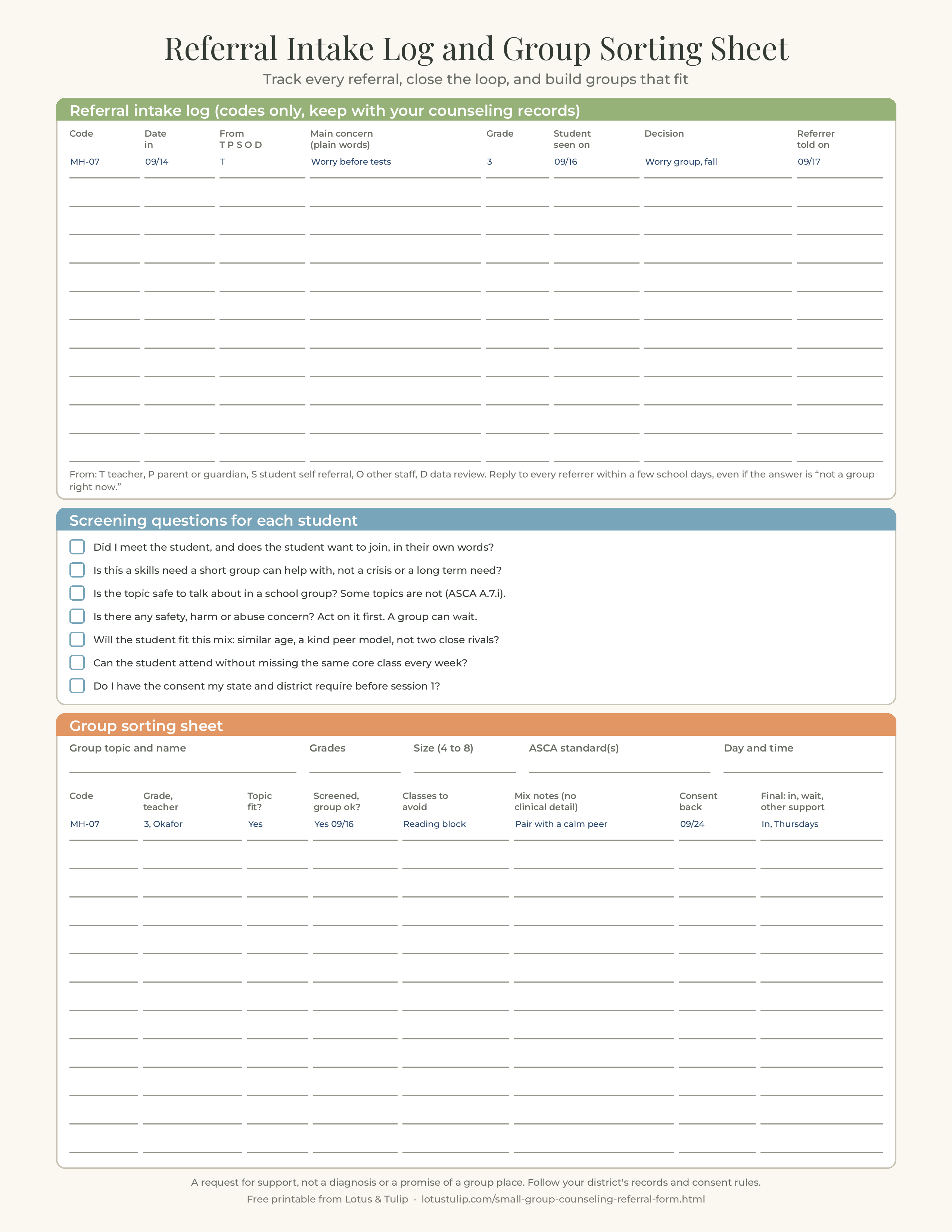
- Log every referral the day it arrives, with a code, date, pathway, main concern in plain words, grade, the date you saw the student, your decision and the date you replied to the referrer. The log on page 3 of the free printable has these columns.
- Sort by topic, then by grade band. Four to eight students is the usual size range in schools; many elementary counselors aim for four to six. Smaller groups are better for younger students and for heavier topics such as grief.
- Look for clusters. A start of year needs assessment tells you which topics to expect. If six students in grades 3 and 4 have worry before tests as the main concern, that is your next worry group. If two students have very different needs, they may each fit a different group or individual support.
- Plan the schedule with teachers. Note classes to avoid for each student and rotate the time slot each week if you can.
- Keep a wait list, and tell people about it. A student who does not fit this round may fit the next one. Offer an interim step, such as a weekly check in or a classroom strategy, so waiting is not doing nothing.
- Watch your pathway counts. At the end of each term, count referrals by pathway, grade and concern. If almost every referral comes from three teachers, or no self referrals arrive, adjust how you share the process. If one group of students is referred far more or less often than others, look at why, with care; ASCA A.7.b asks for equitable access.
| Time of year | Referral task |
|---|---|
| Before school starts | Update the form, the family version and the self referral slip; check your district's consent rules for the year; set up the intake log |
| First two to three weeks | Explain the process at a faculty meeting; put a note in the family newsletter; set out the self referral box |
| Weeks three to six | Collect referrals and review attendance and nurse data; meet and screen students; form fall groups |
| End of each grading period | Data review for new referrals; check the wait list; count referrals by pathway |
| Midyear | Second round of groups; remind staff and families that referrals are open |
| Spring | Transition referrals for students moving to a new school; final round of groups; review the year's log for next year's group plan |
Closing the loop with the referrer
Teachers stop referring when referrals disappear into a black hole. The fix is a short reply within a few school days, every time, that confirms you acted without sharing what the student told you.
- To a teacher: "Thanks for the referral for Sam. I have met with him and talked with his family. He will be joining a small group that starts October 7, on Thursdays at a different time each week. I will send you the schedule. Something that may help in class: a quiet check in before tests."
- When it is not a group: "Thanks for the referral for Ava. I have met with her and talked with her family. A group is not the right fit right now, and I will be checking in with her individually. Please keep letting me know what you notice."
- To a parent: "Thank you for calling about Leo. I met with him today. He would like to join a friendship group, and I am sending home a permission letter with the details."
- To a student who self referred: see them, and tell them what happens next in words they understand: "Thanks for letting me know. Let's meet again on Tuesday."
What not to share: what the student said in the screening meeting, family details, or anything about other students. If a teacher needs specific information to support the student in class, share only that, with the student's and family's understanding where possible. ASCA B.2.a asks counselors to "develop and maintain professional relationships and systems of communication with faculty, staff and administrators to support students." A reliable reply is the simplest way to do it.
How to set up a small group referral process, step by step
- Check the rules. Read your district's policy on counseling consent and records, and your state law, before the first referral of the year. Decide when families are contacted: before the screening meeting, after it, or both.
- Plan your groups. Use last year's referral log and school data to choose the topics and grade bands you will offer this year, so the concern areas on the form match real groups.
- Make the forms. One general referral form for teachers and staff, a short family version in the languages your families use, and a self referral slip for students, each with the safety line.
- Open several pathways. A staff tray or limited access digital form, a family link and a newsletter note, a self referral box at student height, and a data review date each grading period.
- Explain the process. Five minutes at a faculty meeting: what to refer for, what to bring to you in person, what happens next and when you will reply.
- Log each referral the day it arrives. Code, date, pathway, main concern, grade. Read it for safety concerns first.
- Contact the family and meet the student. In the order your district requires. Use the screening questions, and listen to what the student wants.
- Decide and record the next step. Small group, individual check ins, consult with the referrer, SST or MTSS team, community resource list, or not at this time.
- Get consent and form the group. Send the permission letter, log replies, check the mix and schedule, and keep a wait list.
- Close the loop and review. Reply to every referrer within a few school days, use the referral ratings as the teacher baseline for your pre and post data, and count referrals by pathway each term.
A worked example (fictional): from referral to group at Maple Hollow Elementary
Maple Hollow Elementary is a fictional public elementary school. J. Rivera is the school counselor. In the first week of school she explains the referral process at a faculty meeting, puts a note in the family newsletter with her extension, and sets a self referral box outside her office at child height.
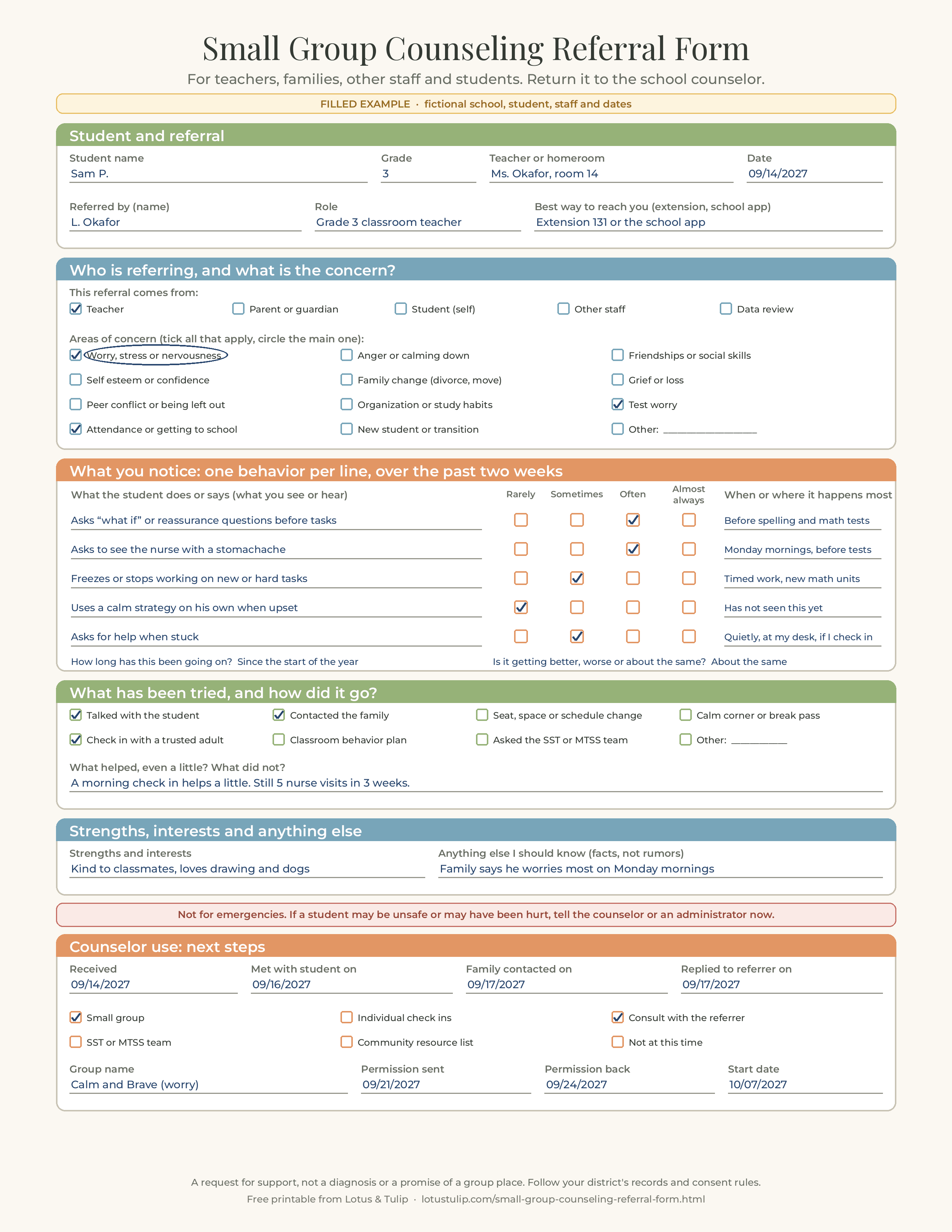
The referral. On September 14, Ms. Okafor, a grade 3 teacher, sends a referral for Sam P. She ticks "worry, stress or nervousness" (circled as the main concern), "test worry" and "attendance or getting to school." Under what she notices over the past two weeks, she writes five behaviors and rates each one: asks "what if" or reassurance questions before tasks (often, before spelling and math tests); asks to see the nurse with a stomachache (often, Monday mornings and before tests); freezes or stops working on new or hard tasks (sometimes, timed work and new math units); uses a calm strategy on his own when upset (rarely, she has not seen this yet); asks for help when stuck (sometimes, quietly, if she checks in). It has been going on since the start of the year and is about the same. She has talked with Sam, called his family and set up a morning check in with a classroom aide, which helps a little, but he has still visited the nurse five times in three weeks. His strengths: he is kind to classmates and loves drawing and dogs. His family has told her he worries most on Monday mornings.
The log and the safety read. J. Rivera reads the referral the same day. Nothing in it suggests a safety concern. She logs it as MH-07, from a teacher, main concern "worry before tests," grade 3.
The family and the student. District policy asks counselors to contact the family before ongoing services. On September 16 she meets Sam for twelve minutes. He tells her his tummy hurts "when there's a test and I don't know all the answers," and that he likes the idea of a group with "calm tricks." On September 17 she calls his parent, Dana P., who says Sam has always been a worrier and that Monday mornings are hardest. They agree a worry group is worth trying. The same day J. Rivera replies to Ms. Okafor: she has seen Sam, talked with his family, and he will likely join a small group this fall; a quiet check in before tests may help in the meantime.
The group. By the end of September she has six referrals with worry as the main concern in grades 3 and 4. She screens each student and leaves one out of the group, a grade 4 student whose worry is about a recent family crisis and who needs individual support and a community referral first. The other five form the Calm and Brave worry group. The permission letter goes home on September 21, Sam's family returns it on September 24, and the group starts on October 7, on Thursdays at a rotating time so no one always misses reading.
The data. Ms. Okafor's referral ratings become the teacher baseline. After the eighth session, J. Rivera asks her to rate the same four classroom behaviors again. The pre and post assessment guide follows this same fictional group through the student self check, the teacher rating and attendance and nurse visit data. The permission slip guide shows the letter that went home.
The loop. At the end of the first grading period, J. Rivera counts her referrals: 23 in total, 15 from teachers, 4 from families, 2 self referrals and 2 from a data review of nurse visits. She notes that only two of her eleven classroom teachers have referred any students who were quiet rather than disruptive, and plans a five minute reminder at the next staff meeting about worry that does not look like trouble.
Six real world scenarios
1. The sticky note. A teacher leaves a note: "Please see Jordan, he's struggling." Thank the teacher, hand them the form or send the link, and ask one question in person: "What are you seeing?" If the answer raises a safety concern, act now. Otherwise, the form gives you what you need to decide.
2. The diagnosis on the form. A referral says "Has ADHD and anxiety, needs a group." You do not have to repeat the labels in your notes. Ask the teacher what they see in class, meet the student, and talk with the family. If the family mentions outside providers, you can note that the student has outside support, and ask for a release of information if you need to coordinate (ASCA A.6.f).
3. Too many referrals for one group. You have fourteen referrals for a friendship group with room for six. Screen all fourteen. Group by grade band and need, form the first group, offer a second group later in the year, and give the others an interim step: a lunch bunch, a classroom lesson on joining in, or a teacher consult. Tell every referrer what happens next.
4. The parent who wants a group, and the child who does not. A mother calls asking for her daughter to join the divorce group. Her daughter tells you she does not want to talk about her family with other kids. Respect the student's view: offer individual check ins, explain to the parent why a group may not be the best fit right now, and leave the door open for later.
5. The unsigned self referral. A note in the box says "I need to talk about something bad at home" with no name. Check the handwriting against your class lists only if you can do it quickly and discreetly; talk to the teachers of likely grades; and consider a short, general classroom reminder that students can come and see you any time. Follow your district procedure for anonymous concerns, and if you learn who it is, see the student the same day.
6. The Texas district. You work in Texas, where S.B. 12 requires signed parent consent before psychological tests, including check ins and screenings, and before treatment. Your district's guidance says the screening meeting with a student counts as a service. Contact the family and get the signed consent your district requires before you meet the student about the referral, except where the law allows otherwise, such as reporting suspected abuse. Until then, a teacher can still use the referral form to describe what they see.
Common referral form mistakes
- No form at all. Sticky notes and hallway requests get lost, and students who are referred twice by different people get seen once or not at all.
- Asking for diagnoses. A "diagnosis" field invites guesses that do not belong in a school record.
- Too long. A three page referral form comes back half done. One page, front only.
- Teacher only. Without family, self and data pathways, quieter students and home based concerns are missed.
- No safety line. A form in a tray is not an emergency system. Say so on the page.
- Treating a referral as a placement. Every student is screened. Not every referral leads to a group.
- Forms in an open tray or shared folder. Referral forms are sensitive records. Limit who can see them.
- No reply to the referrer. If teachers never hear back, they stop referring.
- Forgetting the family. Families should hear about a referral from you, not from their child, and many districts require contact before services.
- Never looking at the log. Referral counts by pathway, grade and concern tell you which groups to run next term and who your process is missing.
Free printable: small group counseling referral form, filled example and referral log
The free printable has three US Letter pages. Page 1 is a blank referral form for teachers, families, other staff and students: student name, grade, teacher and date; referred by, role and the best way to reach you (an extension or the school app); who the referral comes from (teacher, parent or guardian, student, other staff or data review); twelve concern area tick boxes with a prompt to circle the main one; five "what you notice" lines, each rated rarely, sometimes, often or almost always, with when or where it happens most; how long it has been going on and whether it is getting better or worse; what has been tried, with eight tick boxes and a line for what helped; strengths and interests and anything else; a safety line; and a counselor use box with dates received, student met, family contacted and referrer replied, six next step options, the group name, permission dates and start date. Page 2 is the same form filled in for Sam P., a fictional grade 3 student at Maple Hollow Elementary. Page 3 is a counselor referral intake log with eleven rows (code, date, pathway, main concern, grade, date seen, decision and date the referrer was told), seven screening questions for each student, and a group sorting sheet with topic, grades, size, ASCA standards, schedule and a row for each candidate (topic fit, screening, classes to avoid, mix notes, consent and final decision).
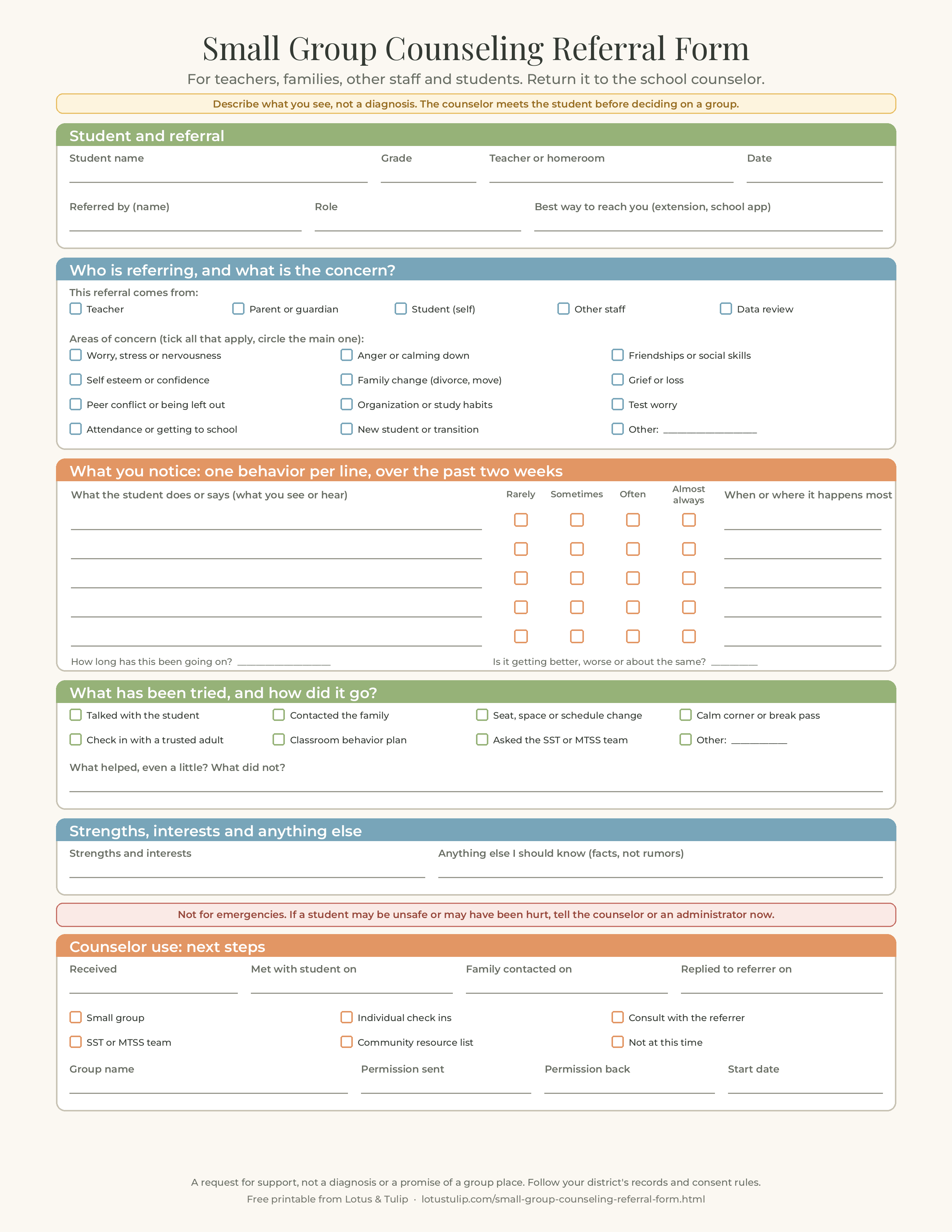
Download the free referral form, example and referral log (PDF, 3 pages)
Free starter kit: Need a topic specific version? The free small group counseling starter kit has a worry group teacher referral form with eight observation ratings, plus a permission letter, agreements, a pre and post check and a full session 1 lesson plan (8 pages, no email).
Prefer single images? Page 1: blank referral form (PNG) · Page 2: filled fictional example (PNG) · Page 3: referral intake log, screening questions and group sorting sheet (PNG)
Free to print and use in your own school. Please link to this page rather than re-uploading the file. This form records what an adult or student notices and asks for support. It is not a screener, a diagnostic tool or an emergency system, and it does not replace your district's policies on consent, records, risk assessment and mandated reporting.
Related resources
- Texas SB 12 and school counselors: parental consent for small groups, surveys and check ins, with a free consent planner
- School counselor needs assessment for small groups: teacher survey and tally sheet
- All school counselor small group curriculums
- Small group counseling lesson plan template and 8 session planning map
- Small group counseling permission slip and parent letter
- Small group counseling pre and post assessment
- Full year elementary small group counseling: plan the year
- Small group counseling curriculum for anxiety: an 8 session plan
- Group therapy note template and examples
- Social skills small group activities
- Anger management small group activities
- Self esteem small group activities
- Divorce small group activities
- Girls friendship group activities
- Icebreaker activities for counseling groups
Sources: American School Counselor Association, ASCA Ethical Standards for School Counselors (2022), standards A.2.m, A.6.a, A.6.b, A.6.f, A.6.g, A.7.a to A.7.d, A.7.f, A.7.i, A.7.l, A.9.a, A.12.a, A.13.c and B.2.a, and the glossary entry for universal screener; ASCA position statement "The School Counselor and Group Counseling" (adopted 1989; revised 1993, 2002, 2008; reviewed 1999, 2008, 2014, 2020, 2026); American School Counselor Association (2025), The ASCA National Model: A Framework for School Counseling Programs, Fifth Edition (indirect student services, referrals, MTSS tiers, contributing factors data); 34 CFR 99.3 and 99.31(a)(1) (eCFR, current as of November 2026); 20 U.S.C. 1232h(b); Texas Education Code 26.009 and 26.0083 as amended by S.B. 12, 89th Legislature, effective September 1, 2025. All checked on November 10, 2026. The worked example and all names, codes, dates and numbers in it are fictional.
FAQ
What should a small group counseling referral form include?
Student name, grade and teacher; the date; who is referring and how to reach them; concern area tick boxes with the main concern circled; four to eight observable behaviors rated rarely, sometimes, often or almost always over the past two weeks, with when or where they happen; how long it has been going on; what has been tried and what helped; strengths and interests; a line saying the form is not for emergencies; and a counselor use box for dates, the decision and the consent steps.
Who can refer a student for small group counseling?
Teachers, parents and guardians, other staff such as nurses and aides, and students themselves, plus counselors reviewing school data such as attendance and discipline. ASCA Ethical Standard A.7.a ties groups to student needs, student data and "a referral process," and A.7.b asks for equitable access, so using several pathways helps you find students a single pathway would miss.
Does a referral mean the student will be in a group?
No. A referral asks the counselor to consider the student. The counselor meets the student, screens for fit as ASCA A.7.c and the group counseling position statement expect, talks with the family, and decides on the best next step, which may be a group, individual check ins, a consult with the teacher, a team process or a referral to community resources.
Do I need parent permission before I see a referred student?
It depends on your state and district. ASCA asks counselors to inform parents of group participation and its purpose. Some states, such as Texas since September 1, 2025, require signed parent consent before psychological tests, including check ins and screenings, and before treatment. Check your district policy and build family contact into your referral process.
Is a referral form part of the student's education record?
Usually, yes. Under FERPA, 34 CFR 99.3, records directly related to a student and maintained by the school are education records, which parents can generally inspect. Sole possession notes are an exception, but a form a teacher sends you is not one. Share referrals only with school officials who have a legitimate educational interest, and keep diagnoses, rumors and sensitive family details off the form.
How do I get teachers to use the referral form?
Keep it to one page, put it where teachers already work, explain the process in five minutes at a faculty meeting, and reply to every referral within a few school days, even when the answer is not a group. Teachers keep referring when they see that referrals lead to action.