
Counseling worksheets · Updated 2026-11-03
Circle of control worksheet: how to teach "what I can control and what I can't" to kids, teens and adults (free printable)
Ready-made printable: Worry Group Curriculum Holiday 20% off: about $11.04, was $14 (EUR 12) · instant digital download
Buy on Etsy
A circle of control activity is one of the simplest tools a counselor, teacher, therapist or parent can use with someone who is worried. You draw a circle, put what the person can control inside it and what they cannot control outside it, and then plan one small step from the inside. It sounds almost too simple, yet it gives a worried mind two things it badly needs: a way to sort the problem and a next move. This guide explains where the idea comes from, gives sorted examples for kids, teens and adults, a step by step lesson or session plan, scripts, adaptations, common mistakes and an FAQ. It ends with a free one page "My Circle of Control" worksheet on US Letter paper.
This is educational information for counselors, teachers, therapists, parents and other helpers. It is not a substitute for clinical care. In the US, anyone in crisis can call or text 988, the Suicide and Crisis Lifeline, or call 911 in an emergency.
Jump to the free circle of control worksheet
What the circle of control is
The circle of control sorts any worry or problem into parts:
- In my control: my own actions, words, effort, choices, how I treat myself and others, and whether I ask for help.
- I can influence: things I can affect but not decide alone, such as a grade, a friendship, a team result or how a conversation goes.
- Outside my control: other people's choices and feelings, the weather, the past, the news, a diagnosis, decisions made by adults or bosses.
The point is not to stop caring about the outer circle. The point is to notice where effort can actually make a difference, put energy there, and use a calming or accepting step for the rest. Many classroom versions use only two circles (can and can't control). The free worksheet below uses three zones, because the middle "influence" ring helps older kids, teens and adults avoid both extremes: thinking they control everything, or thinking they control nothing.
Where the idea comes from
The idea is old, and several traditions arrive at it from different directions:
- Stoic philosophy. The Enchiridion of Epictetus, a short handbook of his teaching compiled by his student Arrian in the second century, opens with the line "Some things are in our control and others not" (Elizabeth Carter's translation). Epictetus listed our own opinions, aims, desires and actions as in our control, and body, property, reputation and office as not. This is often called the dichotomy of control.
- Stephen Covey. In The 7 Habits of Highly Effective People (1989), Habit 1, "Be Proactive", contrasts a Circle of Concern (everything we care or worry about) with a smaller Circle of Influence (the things we can actually do something about). Covey argued that people who focus on their Circle of Influence tend to see it grow, while focusing on the Circle of Concern tends to shrink it. Most school "circle of control" posters are a simplified version of this model.
- The Serenity Prayer. The familiar lines about accepting what cannot be changed, changing what can, and knowing the difference are credited to the theologian Reinhold Niebuhr and date to the early 1930s. They are widely used in recovery groups.
- Cognitive behavioral therapy and problem solving. CBT approaches to worry often separate problems a person can act on from hypothetical "what if" worries they cannot solve right now. Problem solving training, described by Thomas D'Zurilla and Marvin Goldfried in "Problem solving and behavior modification" (Journal of Abnormal Psychology, 1971), breaks solvable problems into defining the problem, generating options, choosing one and checking how it went. The circle of control is a friendly front door to that process: the inside of the circle is where problem solving happens, and the outside is where acceptance, coping and letting go come in.
The circle of control itself is a teaching tool, not a formal therapy with its own research base. It works best as part of a wider plan for worry, stress or anxiety.
Examples sorted for kids, teens and adults
| Worry | In my control | I can influence | Outside my control |
|---|---|---|---|
| Kids: "It might rain on field day." | Packing a raincoat, choosing an indoor game, my attitude | Asking the teacher about a backup plan | The weather, the principal's decision |
| Kids: "My friend played with someone else." | Asking to join, playing with another friend, being kind | Whether we play together tomorrow | Who my friend chooses today, how they feel |
| Kids: "My parents are arguing." | Telling a grown up I trust how I feel, using my calm down spot | Very little, and that is okay | What adults decide, their feelings, their arguments |
| Teens: "I might fail the chemistry test." | Study plan, sleep, going to office hours, asking for notes | My grade, how the teacher sees my effort | Which questions are on the test, other students' scores |
| Teens: "People are talking about me online." | Not replying in anger, blocking, reporting, telling an adult, logging off | What close friends believe | What other people post or think |
| Teens: "I didn't make the team." | Asking the coach for feedback, practicing, trying another activity | Next season's result | The coach's decision this year |
| Adults: "There may be layoffs at work." | Updating my resume, doing solid work, checking my budget, talking to my manager | How my work is seen, my network | Company decisions, the economy |
| Adults: "My teenager is struggling." | How I listen, staying calm, making time, finding a counselor | Whether my teen opens up, family routines | My teen's choices and feelings, their friends |
| Adults: "Waiting for medical test results." | Writing down questions, asking someone to come with me, sleep and meals | How quickly the office calls back if I follow up | The result, the lab's timing |
Notice that the inside column is always about actions and choices, not outcomes. "Getting an A" is not in anyone's direct control; "studying 30 minutes a night" is.
A step by step lesson or session plan (20 to 30 minutes)
- Name the worry (3 minutes). Ask for one specific situation, not "everything". Write it in box 1. With a group, use a shared example first, such as "a big test on Friday".
- Brain dump (5 minutes). List every part of the worry on scrap paper or sticky notes: the facts, the what ifs, the people involved.
- Sort (7 minutes). Move each item into the inner circle, the influence ring or the outside area. Ask "Is this something I do, say or choose?" If yes, it goes inside. If someone else decides it, it goes outside or in the ring.
- Check the inner circle (3 minutes). Many people leave the inner circle almost empty at first. Prompt: "What could you do in the next day, even something small? Who could you ask?"
- Pick one next step (4 minutes). Choose one action from the inner circle and write it in box 3 with a when. Small and specific beats big and vague: "Ask Ms. Lopez for the review sheet at lunch on Tuesday."
- Choose a calm step for the rest (3 minutes). Tick a coping step in box 4 for the outside items: slow breathing, talking to someone, writing it down and setting it aside, moving, or a short phrase like "This is not mine to fix."
- Follow up. Next session or the next day, ask: "Did you take your step? What happened to the worry when you did?" This is where the learning sticks.
Scripts you can use
- Introducing it to kids: "Some things are like a remote control that we are holding, and some things are like the TV channel in another room. Let's put the things we are holding in the middle circle."
- When a child is stuck on an outside worry: "You really care about that. It's not yours to fix, though. What is one thing in your circle you could do right now?"
- For teens: "Let's split this into what's on you, what you can nudge, and what you can't touch. Where do you want to spend your energy this week?"
- For adults: "If we put your energy into the outer circle for a week, what would change? And if we put it into the inner circle?"
- Parents at bedtime: "Let's put tomorrow's worry on paper. What can you do about it tomorrow? Great. The rest can wait outside the circle while you sleep."
Adaptations
- Younger kids (K to 2): use two circles only, pictures instead of words, and a sorting game with cards or drawings: "Can I control it? Thumbs up or thumbs down." Keep examples concrete: my hands, my voice, my choices versus the weather, other kids, grown up decisions.
- Anxiety: keep the next step very small and pair it with a calming skill. If the outside list is long and repetitive, that is a sign to add a planned worry time or a worry log rather than more sorting. Be careful not to turn reassurance seeking into a ritual of re-sorting the same worry.
- Small groups and classrooms: draw a giant circle on chart paper or with a hula hoop on the floor. Students sort example cards together, then complete their own sheet privately. Avoid asking students to share personal worries out loud.
- Teens and adults: use the influence ring seriously. Many real problems live there, and the useful question is "What is my part?"
- Grief, illness or trauma: when much of what happened was truly outside the person's control, go slowly. The inner circle may hold only self care, asking for support and how they want to remember someone. That is enough.
Common mistakes
- Using it to dismiss feelings. "You can't control it, so stop worrying" usually backfires. Validate first, then sort.
- Putting outcomes in the inner circle. "Win the game" or "make her like me" are not in anyone's control. Rewrite them as actions.
- Blaming the person for things outside their control. Children in unsafe or chaotic homes can hear "focus on what you control" as "it's your fault". Make clear what adults are responsible for, and follow your reporting duties if a child discloses harm.
- Stopping at the sort. The value is in the next step and the follow up. Without box 3, it is just a list.
- Ignoring the middle ring. Two circles are fine for little kids, but teens and adults often get more from naming what they can influence.
Free circle of control worksheet
This one page "My Circle of Control" worksheet is an original Lotus & Tulip design. It starts with a line for what is on your mind. The middle section has two concentric circles with writing lines: an inner circle for what is in my control and a ring for what I can influence, with the shaded area around them for things outside my control. Below, a "What I will do next" box plans one small step with a when, and a calm step box offers five coping choices plus your own for the things you can't control. The footer includes the 988 line. It prints on US Letter.
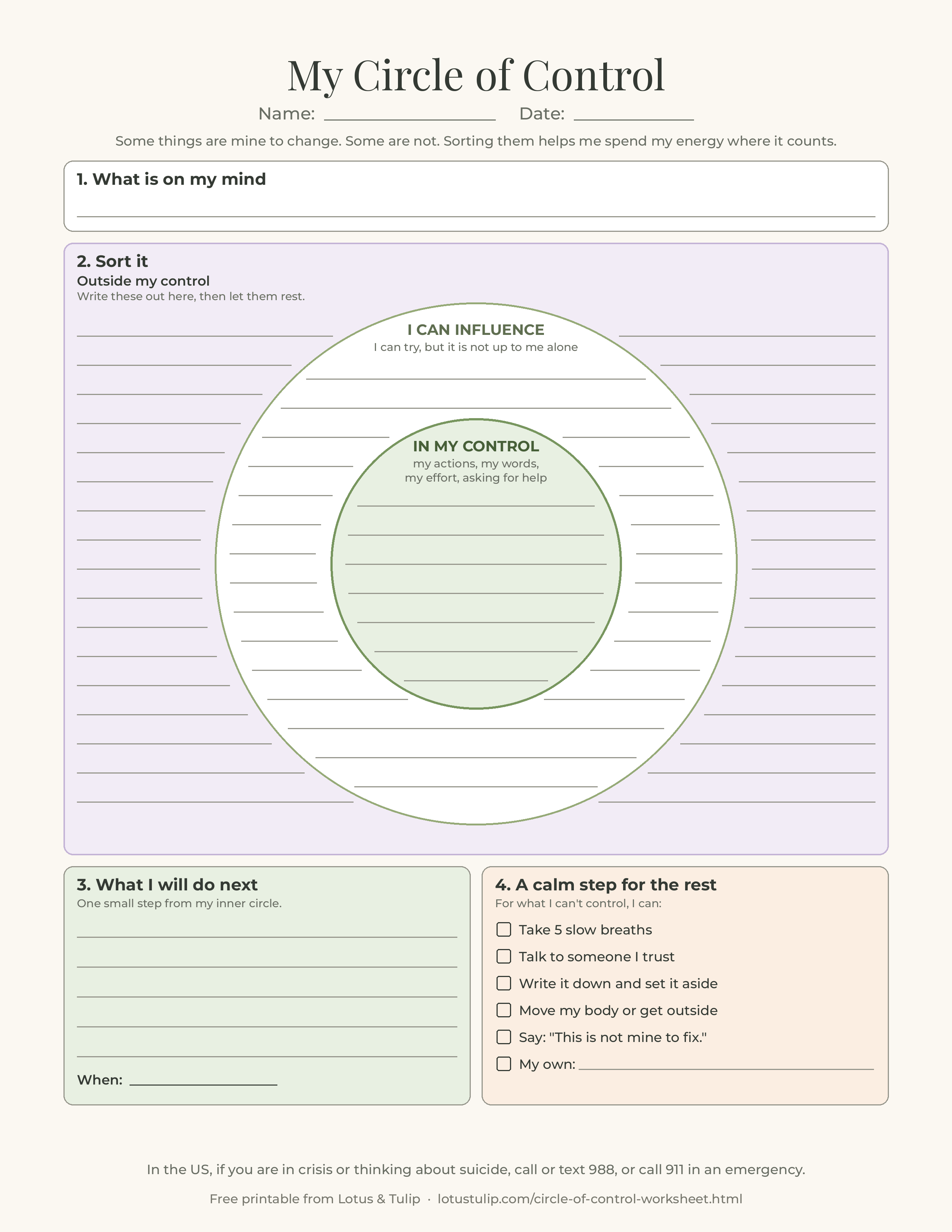
Download the free circle of control worksheet (PNG, US Letter)
Free to print for use with your own students, clients, children or yourself. Please link to this page rather than re-uploading the file. This worksheet is an independent tool and is not affiliated with or endorsed by FranklinCovey or the publishers of The 7 Habits of Highly Effective People.
Related resources
- How to run an anxiety small group, with a free worry check in sheet
- Coping skills list for kids (free printable)
- Cognitive distortions worksheet (free printable)
- 5 4 3 2 1 grounding worksheet (free printable)
- Feelings thermometer printable (free)
FAQ
What is a circle of control worksheet?
It is a page with a circle, or circles, where a person sorts a worry into what they can control, what they can influence and what is outside their control, then plans one small action from the inside of the circle.
Who created the circle of control?
No single person. The idea goes back to the Stoic philosopher Epictetus, whose Enchiridion opens with the difference between what is and is not in our control. The modern circles model comes mainly from Stephen Covey's Circle of Concern and Circle of Influence in The 7 Habits of Highly Effective People (1989).
What are examples of things I can control?
Your own actions, words, effort, choices, how you treat yourself and others, how you prepare, and whether you ask for help. Other people's choices, the weather, the past and most outcomes are outside your control.
How do you teach the circle of control to kids?
Use two circles, concrete examples and a sorting game with cards or a hula hoop. Ask "Is this something I do, say or choose?" Then help the child pick one small thing to do and one calm down step for the rest.
Does the circle of control help with anxiety?
It can be a helpful first step because it separates solvable problems from what if worries and points to an action. It is not a treatment on its own. For ongoing or severe anxiety, work with a licensed mental health professional.
Is this circle of control worksheet free?
Yes. It is free to print for use with your own students, clients, children or yourself. Please link to this page rather than re-uploading the file.