
Therapist worksheets · Updated 2026-11-03
Cognitive distortions worksheet: a list of thinking traps and how to teach them (free printable)
Ready-made printable: CBT Worksheets for Therapists Fillable PDF, 20 pages: thought record, exposure ladder, activity logs, coping cards and 0 to 10 rating scales
Holiday 20% off: about $11.04, was $14 (EUR 12) · instant digital download
Try it free first: download a fillable sample (thought record and evidence for and against, PDF, 105 KB). Type into it on screen, then get the full pack. No email needed.

Cognitive distortions, often called thinking traps or unhelpful thinking styles, are the habits of thought that make a hard situation feel worse than the facts support. Teaching clients to spot them is one of the first skills in cognitive behavioral therapy. This guide covers where the idea comes from, a plain language list of the common distortions with examples, how to teach them to adults and teens, a step by step way to use the worksheet in session, common mistakes and an FAQ. It ends with a free one page cognitive distortions worksheet on US Letter paper.
This is educational information for therapists, school counselors and other helpers, not a substitute for clinical training, supervision or a treatment plan. In the US, anyone in crisis can call or text 988, the Suicide and Crisis Lifeline, or call 911 in an emergency.
Jump to the free cognitive distortions worksheet
What cognitive distortions are
A cognitive distortion is a predictable error in how a person interprets what happens. Everyone makes these errors sometimes. They become a clinical target when they are frequent, rigid and tied to strong emotions such as depression, anxiety, shame or anger. The point of naming them is not to tell a client they are "thinking wrong." It is to give them a short label they can use to step back from a thought and ask whether it is the whole picture.
Where the idea comes from
Aaron Beck described cognitive distortions in his early research on depression, including the paper "Thinking and depression: I. Idiosyncratic content and cognitive distortions" (Archives of General Psychiatry, 1963). His original list was short, and more categories appeared in Cognitive Therapy of Depression by Beck, Rush, Shaw and Emery (Guilford, 1979). Beck's student David Burns made the idea widely known with the list of ten cognitive distortions in his self help book Feeling Good: The New Mood Therapy (1980), written in everyday language. Most lists in use today, including the one below, are adaptations of these.
A list of common cognitive distortions, with examples
- All or nothing thinking. Seeing things in only two categories. "If I don't get an A, I've failed."
- Overgeneralization. Treating one event as a never ending pattern, often with words like always and never. "I got turned down. Nobody ever wants me."
- Mental filter. Focusing on one negative detail and filtering out the rest. Ten kind comments and one critical one, and only the critical one is remembered.
- Disqualifying the positive. Explaining away good things so they do not count. "They only said that to be nice."
- Jumping to conclusions. Reaching a negative conclusion without enough evidence. Two common forms are mind reading ("She thinks I'm boring") and fortune telling ("This is going to go terribly").
- Magnification and minimization. Blowing up mistakes or problems and shrinking strengths and successes. Catastrophizing is the extreme form: "If I mess up this presentation, my career is over."
- Emotional reasoning. Treating a feeling as proof. "I feel stupid, so I must be stupid."
- Should statements. Rigid rules about how oneself or others must behave. Turned inward they bring guilt and shame; turned outward they bring anger and resentment.
- Labeling. Summing up a whole person with one word after one event. "I'm a loser," or "He's a jerk."
- Personalization and blame. Taking responsibility for things outside one's control, or putting all the blame on someone else. "My parents argued because I didn't clean my room."
The free worksheet below splits jumping to conclusions into mind reading and fortune telling, because clients find those two easier to spot separately, and leaves a blank box for a trap the client names in their own words.
How to teach thinking traps
1. Start with a real moment, not the list
Ask for a recent time the client felt a strong emotion. Find the thought that went with it before introducing any labels. Ten definitions up front can feel like a test.
2. Introduce two or three traps at a time
Pick the ones that fit the client's thought, explain them in a sentence and ask which sounds familiar. Add more over the following sessions.
3. Label without judging
Frame traps as habits of a brain under stress, not flaws. A light tone helps: some clients like giving their most common trap a nickname.
4. Weigh the evidence
Spotting the trap is the start. Next ask what supports the thought, what does not, and what they would say to a friend in the same spot.
5. Build a balanced thought
The goal is a thought that is fair and believable, not forced positivity. "I stumbled in one part of the presentation, and most of it went fine" works better than "It was perfect." Rate how strongly they believe the original thought before and after, from 0 to 100, so change is visible.
6. Practice between sessions
Ask for one worksheet in the coming week, ideally filled in close to the moment. Review it together next time.
Scripts you can use
Adults: "When we're stressed, our minds take shortcuts. They're fast, but they're not always accurate. Let's look at that thought like a detective would and see which shortcut it might be."
Teens: "Your brain sometimes acts like a hype announcer for the worst possible outcome. Here's a list of the tricks it uses. Which ones have you caught it doing this week?"
When a client says "but it's true": "It might be partly true. We're not trying to prove you wrong. We're checking whether the thought is the whole story or just the loudest part of it."
Adaptations
- Kids: use simpler names and pictures, such as "the magnifying glass" for magnification or "the crystal ball" for fortune telling, and practice with made up characters before personal examples.
- Teens: use school, friendship and social media examples, and let them pick which traps to learn first.
- Groups: read short scenarios aloud and have members call out which trap they hear, then rewrite the thought together.
- Anxiety: fortune telling and catastrophizing are usually central; pair the worksheet with behavioral experiments that test the prediction.
- Depression: watch for mental filter, disqualifying the positive and labeling, and pair thought work with activity scheduling.
- Telehealth: share the worksheet on screen and fill it in together, then send the PDF or image for homework.
Common mistakes
- Arguing with the client. Guided questions work better than telling someone their thought is irrational.
- Forced positive thinking. A replacement thought the client does not believe will not hold.
- Treating every negative thought as a distortion. Some thoughts are accurate. Then the work is problem solving or acceptance, not reframing.
- Using labels as criticism. "That's just catastrophizing" can feel dismissive. Validate the feeling first.
- Too many categories too soon. Mastery of a few traps beats a memorized list.
Free cognitive distortions worksheet
This one page "Catch the Thinking Trap" worksheet is an original Lotus & Tulip design. The top half lists eleven common thinking traps in plain language, each with a tick box, plus a blank box for one in the client's own words. The bottom half walks through the situation, the thought with a 0 to 100 belief rating, evidence for, evidence against and a more balanced thought with a new belief rating. The footer includes the 988 line. It prints on US Letter.
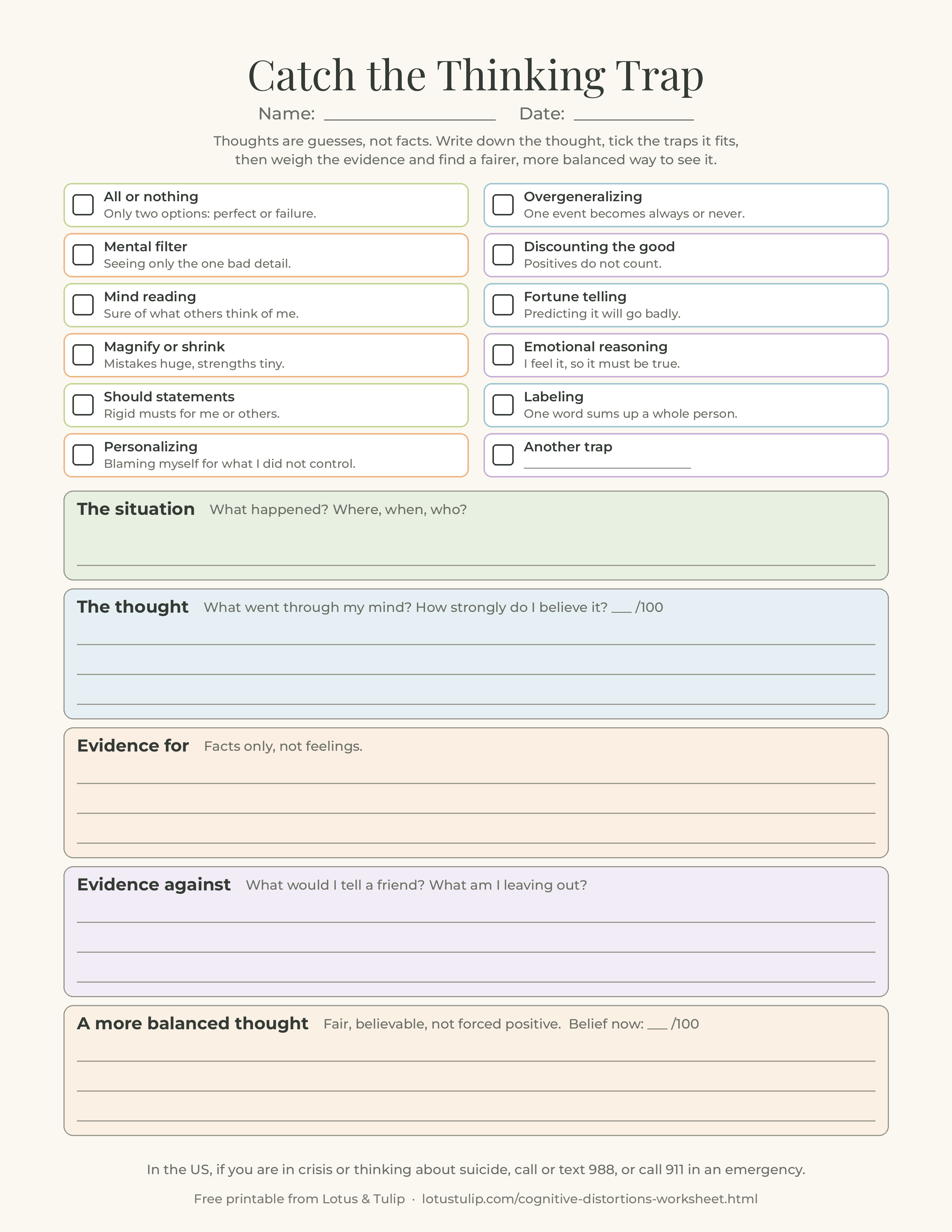
Download the free cognitive distortions worksheet (PNG, US Letter)
Free self esteem starter pack: Working with kids or teens? The free self esteem worksheets starter pack includes a thinking traps about me page (name calling, mind reading, comparing, all or nothing, filtering the good out, fortune telling) plus five more pages from our paid self esteem set.
Free CBT starter pack: Want more pages for the same session? The free CBT worksheets starter pack adds a common thinking traps page with 12 patterns, plus five more real worksheets from our CBT set (8 pages, client use license, no email).
Free to print for use with your own clients, students or yourself. Please link to this page rather than re-uploading the file.
Related resources
- Rumination worksheet: stop overthinking loops by switching from why to how (free printable)
- CBT thought record worksheet (free printable)
- Behavioral activation worksheet (free printable)
- 5 4 3 2 1 grounding worksheet (free printable)
- Anger iceberg worksheet (free printable)
- All therapist worksheets: CBT, DBT and ACT
- Catastrophizing worksheet: a deeper look at one distortion, with worst, best and most likely outcomes and a free 2 page PDF
FAQ
What are cognitive distortions?
They are common, predictable errors in thinking, such as all or nothing thinking, mind reading or catastrophizing, that make situations seem worse than the evidence supports. Aaron Beck described them in his research on depression in the 1960s, and they are a core target in cognitive behavioral therapy.
How many cognitive distortions are there?
There is no single official number. The best known list is the ten distortions David Burns published in Feeling Good in 1980. Other lists split or combine categories, for example treating mind reading and fortune telling separately or adding catastrophizing as its own item.
What is the difference between a cognitive distortion and a thinking trap?
They mean the same thing. "Thinking trap" and "unhelpful thinking style" are plainer names that many therapists use with clients, especially kids and teens.
How do you challenge a cognitive distortion?
Name the thought, identify which trap it fits, look at the evidence for and against it, ask what you would say to a friend, and write a more balanced thought you actually believe. Rating belief before and after shows whether it helped.
Can kids learn cognitive distortions?
Yes, with simpler names, pictures and made up examples. Many school counselors teach a few thinking traps at a time in small groups or classroom lessons.
Is this cognitive distortions worksheet free?
Yes. It is free to print for use with your own clients, students or yourself. Please link to this page rather than re-uploading the file.