
Therapist worksheets · Compassion fatigue, secondary traumatic stress and self care for helpers · Updated 2026-11-13
Compassion fatigue worksheet: how it differs from burnout and vicarious trauma, what research shows, and how to care for the carer step by step (free printable)
When the caseload keeps growing: Boundaries Worksheets for Therapists, for limits, wording for saying no and the guilt that follows Holiday 20% off: about $9.20, was $12 (EUR 10) · instant digital download
Buy on EtsyTo reconnect with why you do this work: ACT Worksheets for Therapists, incl. values, defusion and committed action pages Holiday 20% off: about $9.20, was $12 (EUR 10) · fillable PDF, instant digital download
Buy on EtsyTry it free first: download a fillable sample (values compass and unhooking from thoughts, PDF, 259 KB). Type into it on screen, then get the full pack. No email needed.
A full caseload: Therapist Worksheets Mega Bundle (8 packs incl. CBT, anxiety, DBT, ACT, grief and ADHD) Holiday 20% off: about $35.88, was $45 (EUR 39) · fillable PDFs for all 8 packs plus 160 printable pages, instant digital download
Buy on EtsyA client's story follows you home and plays again at 2 am. You notice you flinch before certain sessions, or that you have stopped feeling much at all when someone tells you something terrible. You check the locks twice now. You still care about your clients, but caring has started to cost more than it gives back.
This guide is for therapists, counselors, social workers, nurses, crisis workers and anyone whose job means listening to suffering. It explains what compassion fatigue is, how it differs from burnout and vicarious trauma, what research says about risk and protection, nine practical steps, common mistakes and examples. It ends with a free 2 page printable: My Compassion Fatigue Map, which helps you notice the signs and name the kind of strain, and My Care for the Carer Plan, which turns that into changes to your load, your support and your recovery.
Download the free compassion fatigue worksheet (PDF, 2 pages, US Letter)
Direct download, no email or sign up. See the pages first.
What compassion fatigue is
It is the cost of caring. The term was first used in print by the nurse Carla Joinson in 1992, writing about nurses worn down by their work. The traumatologist Charles Figley took it up in his 1995 book Compassion Fatigue, where he used it as a friendlier name for secondary traumatic stress: the natural behaviors and emotions that come from knowing about a traumatizing event experienced by someone else, the stress of helping or wanting to help a traumatized or suffering person. In a 2002 paper Figley described it as a form of caregiver burnout among psychotherapists, driven by empathy and emotional investment in people who are suffering.
It is not a diagnosis. Compassion fatigue is not a disorder in the DSM or ICD. It is a way of naming a real and common occupational hazard. Some of its symptoms overlap with burnout, depression and PTSD, and the fifth edition of the DSM made clear that repeated exposure to the details of other people's trauma through work can lead to impairing PTSD symptoms that need treatment (Hensel and colleagues, 2015). If symptoms are strong or lasting, that is a reason to see a clinician, not to push through.
It is not a sign you are bad at the work. Figley's point was the opposite: the empathy that makes you good at helping is also what exposes you to the strain. That is why the answer is structure and support, not caring less.
Compassion fatigue, burnout and vicarious trauma: what is the difference?
These terms are often used interchangeably, but they describe different things, and the fix is different for each.
- Burnout builds slowly from chronic workload and a work setting that blocks good work. In Beth Hudnall Stamm's Professional Quality of Life model, burnout is linked with hopelessness and difficulty doing your job effectively, with a gradual onset. It can happen in any job, not only in helping. Our burnout worksheet covers it in depth.
- Secondary traumatic stress comes from work related exposure to other people's traumatic events. Stamm describes its symptoms as usually rapid in onset and tied to a particular event: fear, trouble sleeping, images of the event popping into your mind and avoiding reminders. Figley also noted that, compared with burnout, it can arrive suddenly with little warning but tends to have a faster recovery.
- Vicarious trauma is a slower change in how you see yourself and the world. Lisa McCann and Laurie Anne Pearlman introduced the term in 1990 to describe how long term exposure to clients' traumatic material can disrupt a therapist's cognitive schemas: beliefs, expectations and assumptions about self and others. Later summaries of their theory list the areas most often affected as safety, trust, esteem, intimacy and control (Trippany, White Kress and Wilcoxon, 2004).
Stamm's model puts these together. Professional quality of life has a positive side, compassion satisfaction, the pleasure you get from doing your work well, and a negative side, compassion fatigue, which has two parts: burnout and secondary traumatic stress. Her Professional Quality of Life Scale (ProQOL), now in its fifth version, measures compassion satisfaction, burnout and secondary traumatic stress with 30 self report items. It is free to use as long as it is credited, unchanged and not sold, and its own guidance says it is not a diagnostic tool. Our worksheet is not the ProQOL and gives no score; if you want the validated measure, use the original from ProQOL.org.
What the research says
- It is common. In a survey of nearly 300 social workers, Brian Bride (2007) found that 40 percent thought about their work with traumatized clients without meaning to, 55 percent met at least one PTSD symptom criterion and about 15 percent met all three core criteria in the week before the survey, based on self report. A systematic review of 71 studies by Cavanagh and colleagues (2020) found compassion fatigue in every group of healthcare providers studied, with prevalence that varied widely between studies.
- Exposure and support matter more than demographics. A meta-analysis by Hensel and colleagues (2015) of 38 studies looked at 17 possible risk factors for secondary traumatic stress among professionals working with trauma survivors. Small but significant links were found for the volume of trauma cases (r = .16), how often you see them (r = .12), the share of your caseload that is trauma work (r = .19) and having a personal trauma history (r = .19). Support was protective: work support (r = -.17) and social support (r = -.26). Age and other demographics seemed less important. The effects are small, so no single factor decides who struggles, but they point at things you can change: caseload mix and support.
- Interventions are promising but the evidence is young. Cocker and Joss (2016) reviewed 13 intervention studies, 10 of them with nurses, with 671 participants in total. Seven reported a significant improvement after the intervention in burnout (four studies) or secondary traumatic stress (three). The authors called the evidence relatively recent and asked for more research.
Put together: notice the signs early, name which kind of strain it is, change what you can about your exposure, build real support, mark the end of the helping day and protect what still makes the work meaningful. If symptoms are severe or do not improve, get professional help for yourself.
How to use a compassion fatigue worksheet, step by step
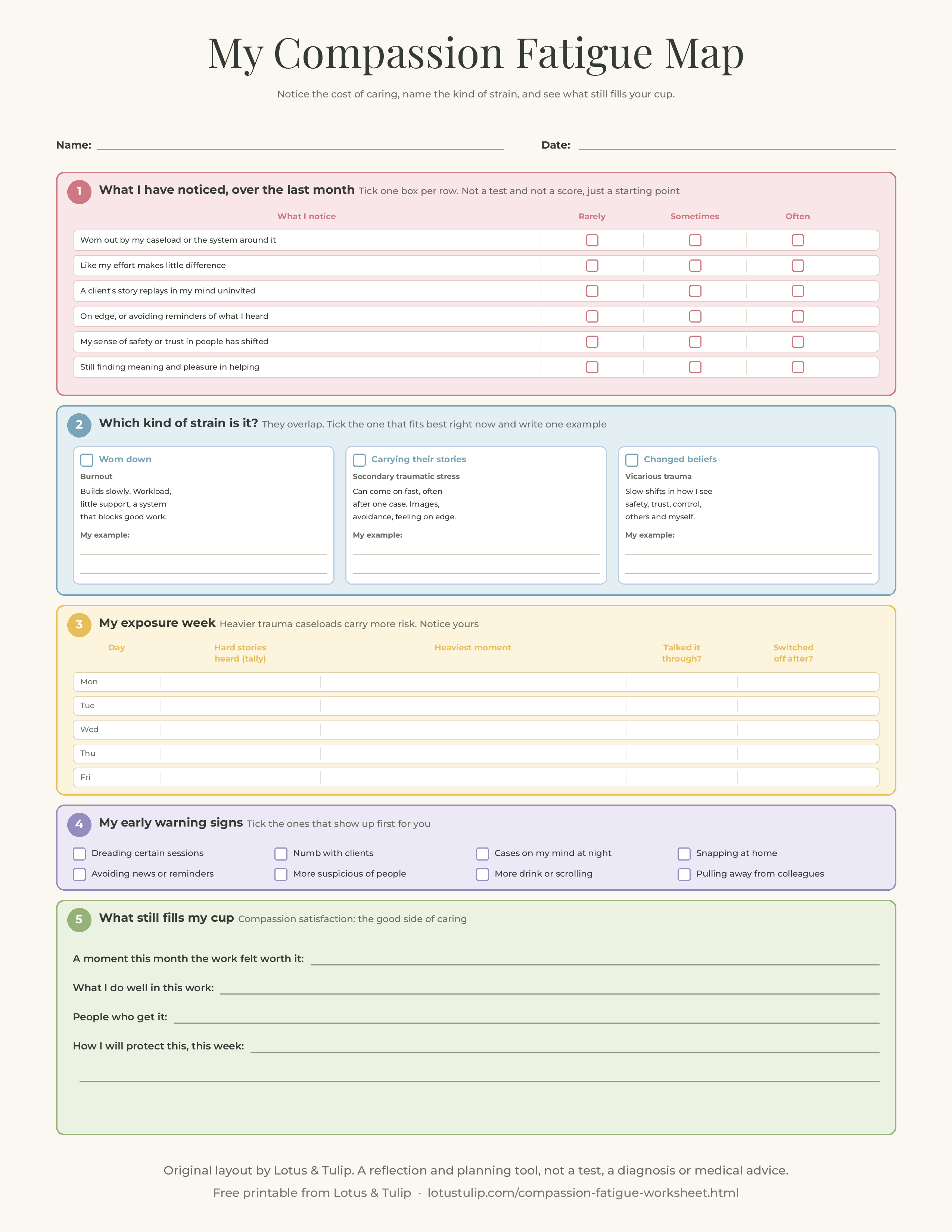
- Notice what has been happening. On page 1, tick how often over the last month you have felt worn out by your caseload, felt your effort makes little difference, had a client's story replay uninvited, felt on edge or avoided reminders, noticed a shift in your sense of safety or trust, and still found meaning in helping. This is not a score and not a diagnosis; it is a way to name what is happening.
- Name the kind of strain. Tick the box that fits best: worn down (burnout), carrying their stories (secondary traumatic stress) or changed beliefs (vicarious trauma). Many helpers tick more than one. Write one concrete example for each you tick, such as "the custody case last Tuesday" or "I no longer let my kids walk to school alone".
- Look for compassion satisfaction too. The last row on the first section asks whether you still find meaning and pleasure in helping. If that row is often, it is a strength to protect. If it is rarely, that is important information in its own right.
- Track one exposure week. For five working days, tally how many hard stories you heard, write the heaviest moment, and tick whether you talked it through and whether you switched off afterwards. Patterns show up fast: the day with four trauma sessions back to back, the week with no consultation at all.
- Tick your early warning signs. Mark the signs that show up first for you, such as dreading certain sessions, feeling numb with clients, cases on your mind at night or pulling away from colleagues. These are your signal to act before things get worse.
- Write what still fills your cup. Note one moment this month when the work felt worth it, what you do well and who gets it. Then write one way you will protect that this week.
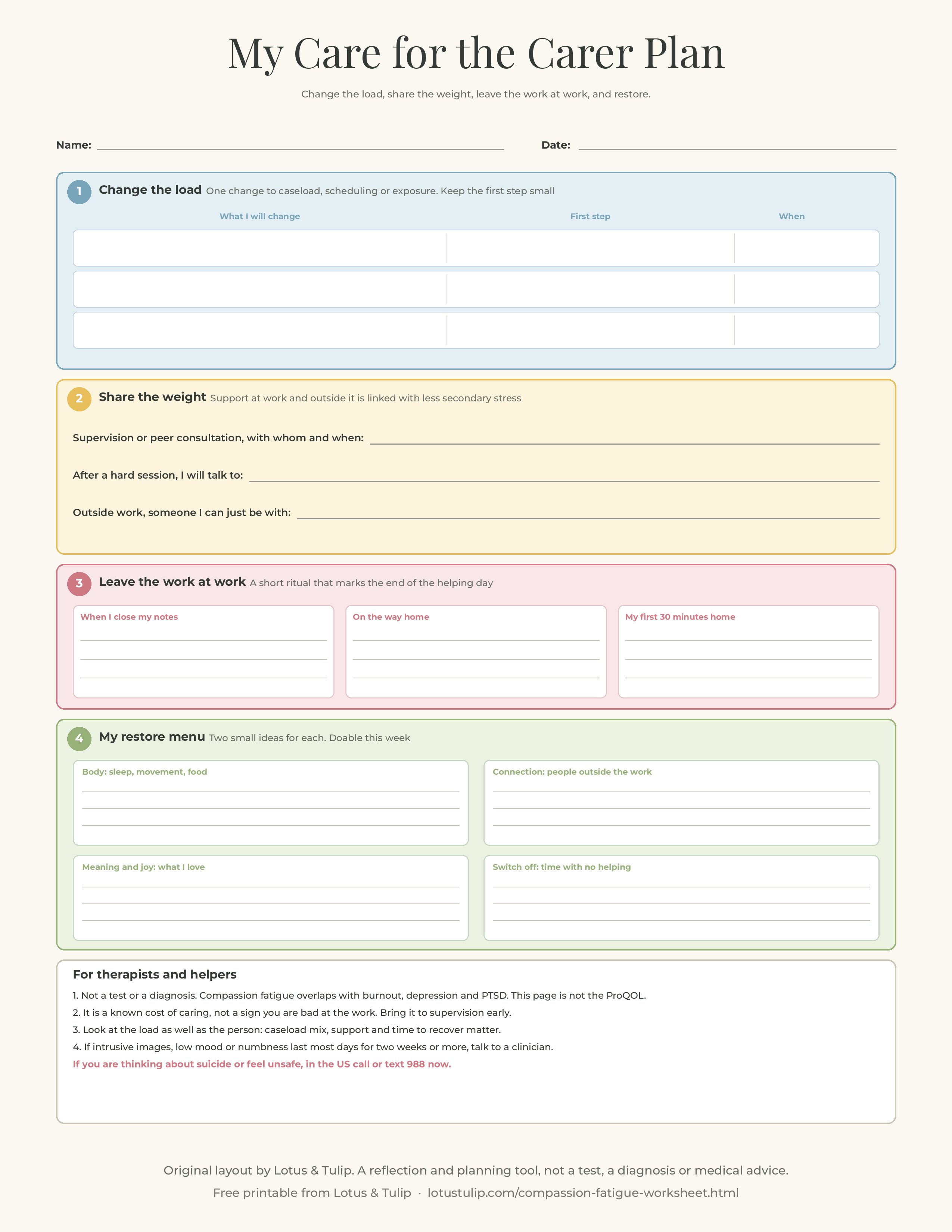
- Change the load. On page 2, plan one change to your caseload, scheduling or exposure with a small first step and a date. Examples: no more than two trauma processing sessions in a row, a 10 minute gap after the heaviest client, capping new intakes for a month. The healthy boundaries worksheet helps with the wording if someone else controls your schedule.
- Share the weight. Write who you will use for supervision or peer consultation and when, who you can talk to after a hard session (within confidentiality), and someone outside work you can simply be with. Support was one of the clearest protective factors in the research.
- Leave the work at work and restore. Plan a short ritual for when you close your notes, on the way home and in your first 30 minutes home. Then fill the restore menu with two small ideas each for body, connection, meaning and joy, and time with no helping at all. Review the plan in two weeks.
When guilt about limits is the hard part, the self compassion worksheet is a good companion. When exhaustion has turned into low mood and pulling away from everything, see a clinician and consider the behavioral activation worksheet as a starting point.
Common mistakes
- Treating it as a personal failing. Compassion fatigue is a known occupational hazard of helping work. Hiding it from supervisors and colleagues usually makes it heavier, not lighter.
- Calling everything burnout. If the problem is intrusive images after one case, a vacation alone will not fix it. If the problem is a system that blocks good work, debriefing alone will not fix it. Name the kind of strain first.
- Caring less as the solution. Numbing out can feel protective, but it is often a sign of the problem rather than a fix, and clients notice. Aim for limits and recovery, not detachment from clients.
- Dropping the things that restore you. When caseloads grow, helpers often cut exercise, friends, hobbies and their own therapy first. Those are often what keeps compassion fatigue from deepening.
- Ignoring signs of PTSD or depression. If intrusive memories, avoidance, low mood or numbness last most days for two weeks or more, or affect your life outside work, talk to a doctor or therapist of your own.
Examples
- The trauma therapist: Noticed client stories replaying at night and dread before Thursday sessions. Her map showed mostly carrying their stories, and her exposure week revealed four trauma processing sessions back to back every Thursday. Her one change was spreading them across the week with a short break after each. She booked fortnightly peer consultation and started a closing ritual of writing her notes, then saying one sentence out loud to mark the end of the day.
- The child protection social worker: Felt worn down and also more suspicious of every adult around her own children. She ticked both worn down and changed beliefs. With her supervisor she named the shift in her sense of safety, asked for a temporary cap on new investigations and added a weekly walk with a friend outside the field, where work was off the table.
- The hospice nurse: Felt numb with families and wondered if she had stopped caring. Her map showed a high compassion satisfaction row despite the numbness, so the meaning was still there. She restarted the choir she had dropped, used the team's debrief after deaths instead of skipping it, and kept a short note of one moment each week when the work felt worth it.
Free compassion fatigue worksheet
This free printable is an original Lotus & Tulip layout on US Letter, in our own wording. It is not the ProQOL or any other published questionnaire, and it does not give a score. Page 1, My Compassion Fatigue Map, has a what I have noticed check (rarely, sometimes, often), a which kind of strain section for burnout, secondary traumatic stress and vicarious trauma with an example line, a five day exposure week tracker, an early warning signs checklist and lines for what still fills your cup. Page 2, My Care for the Carer Plan, has a change the load table with first step and when, a share the weight section for supervision and support, a leave the work at work ritual, a restore menu with four boxes and short notes for therapists and helpers.
Download the free compassion fatigue worksheet (PDF, 2 pages, US Letter)
Prefer single images? Page 1: my compassion fatigue map (PNG) · Page 2: my care for the carer plan (PNG)
Free to print for yourself, your team or your supervisees. Please link to this page rather than re-uploading the file. A reflection and planning tool, not a test, a diagnosis or a substitute for therapy or medical care. In the US, call or text 988 in a mental health crisis.
Related resources
- Burnout worksheet: the three signs, six areas of work life and a recovery plan
- Self care plan template: make room for rest in the week
- Self compassion worksheet: meet your own limits with kindness
- Healthy boundaries worksheet: scripts for saying no without over explaining
- Free trauma worksheets for therapists: starter pages for the clients whose stories you carry
- All therapist worksheets: CBT, DBT, ACT and more
FAQ
What is a compassion fatigue worksheet?
A compassion fatigue worksheet is a structured page that helps helpers notice the emotional cost of their work, tell burnout, secondary traumatic stress and vicarious trauma apart, and plan changes to their load, support and recovery. This one also asks about compassion satisfaction, the meaning and pleasure that protect helpers.
What is the difference between compassion fatigue and burnout?
Burnout builds slowly from workload and a work setting that blocks good work, and it can happen in any job. Compassion fatigue is specific to helping people who suffer. In Stamm's Professional Quality of Life model it includes burnout plus secondary traumatic stress, which comes from exposure to other people's trauma and can start suddenly after a particular case.
Is vicarious trauma the same as secondary traumatic stress?
They overlap but are not the same. Secondary traumatic stress describes PTSD like symptoms such as intrusive images, avoidance and feeling on edge. Vicarious trauma, a term from McCann and Pearlman (1990), describes a slower change in a helper's beliefs about safety, trust, esteem, intimacy and control after long exposure to clients' trauma.
What are the signs of compassion fatigue?
Common signs include exhaustion, feeling your work makes no difference, client stories replaying in your mind, dreading certain sessions, avoiding reminders, feeling numb or detached, irritability, poor sleep and pulling away from colleagues. None of these alone means you have compassion fatigue, and strong or lasting symptoms deserve a professional assessment.
Is there a test for compassion fatigue?
The most widely used measure is the Professional Quality of Life Scale (ProQOL 5), a free 30 item self report measure with subscales for compassion satisfaction, burnout and secondary traumatic stress, available from ProQOL.org. It is not a diagnostic tool. This worksheet is a reflection and planning tool, not a test.
Is this compassion fatigue worksheet free?
Yes. It is free to print for yourself, your team or your supervisees. Please link to this page rather than re-uploading the file.
Sources
- Bride, B. E. (2007). Prevalence of secondary traumatic stress among social workers. Social Work, 52(1), 63 to 70.
- Cavanagh, N., Cockett, G., Heinrich, C., and colleagues. (2020). Compassion fatigue in healthcare providers: A systematic review and meta-analysis. Nursing Ethics, 27(3), 639 to 665.
- Cocker, F., and Joss, N. (2016). Compassion fatigue among healthcare, emergency and community service workers: A systematic review. International Journal of Environmental Research and Public Health, 13(6), 618.
- Figley, C. R. (Ed.). (1995). Compassion fatigue: Coping with secondary traumatic stress disorder in those who treat the traumatized. New York: Brunner/Mazel.
- Figley, C. R. (2002). Compassion fatigue: Psychotherapists' chronic lack of self care. Journal of Clinical Psychology, 58(11), 1433 to 1441.
- Hensel, J. M., Ruiz, C., Finney, C., and Dewa, C. S. (2015). Meta-analysis of risk factors for secondary traumatic stress in therapeutic work with trauma victims. Journal of Traumatic Stress, 28(2), 83 to 91.
- Joinson, C. (1992). Coping with compassion fatigue. Nursing, 22(4), 116 to 122.
- McCann, I. L., and Pearlman, L. A. (1990). Vicarious traumatization: A framework for understanding the psychological effects of working with victims. Journal of Traumatic Stress, 3(1), 131 to 149.
- Stamm, B. H. (2010). The Concise ProQOL Manual (2nd ed.). Pocatello, ID: ProQOL.org.
- Trippany, R. L., White Kress, V. E., and Wilcoxon, S. A. (2004). Preventing vicarious trauma: What counselors should know when working with trauma survivors. Journal of Counseling and Development, 82(1), 31 to 37.