
Therapist worksheets · Self care · Updated 2026-11-04
Self care plan template and self care worksheet: how to build a plan you will actually use, with a free printable
Ready-made printable: Depression and Behavioral Activation Worksheets for Therapists Holiday 20% off: about $9.20, was $12 (EUR 10) · instant digital download
Buy on Etsy
Most people know what helps them feel better. Sleep, a walk, a real meal, a friend who listens. The problem is rarely knowledge. It is that the helpful things disappear first when life gets busy, and they are hardest to restart when you are already worn out. A self care plan fixes that by deciding, ahead of time and on paper, what you will protect, what you will do when you notice you are running low, and who you will reach for when self care is not enough. This guide is for adults and teens who want a simple plan, and for US therapists, counselors and school counselors who use self care worksheets with clients and students. It covers what self care actually means, the six areas most plans use, what the evidence does and does not say, a step by step way to write a plan, 36 ideas sorted by area, a filled example, versions for students and for clinicians, and the point where a self care plan should hand over to a safety plan or professional help. It ends with a free three page printable: a self care check in, a one page self care plan template and a weekly tracker.
Jump to the free self care plan template
What is self care?
The World Health Organization defines self care as "the ability of individuals, families and communities to promote health, prevent disease, maintain health, and cope with illness and disability with or without the support of a health worker." That definition is much wider than bubble baths. It includes everyday habits, managing a health condition, taking medication as prescribed, and knowing when to seek care.
The US National Institute of Mental Health (NIMH) puts it in plainer words: self care means "taking the time to do things that help you live well and improve both your physical health and mental health." NIMH adds that self care can help you manage stress, lower your risk of illness and increase your energy, and that "even small acts of self-care in your daily life can have a big impact."
Two features of these definitions matter for planning. First, self care is active: it is something you do, on purpose, not something that happens to you. Second, it explicitly includes getting support. Asking for help is part of self care, not a sign that self care failed.
What self care is not
Self care has become a marketing word, and that has blurred it. A useful plan avoids four common misunderstandings.
- It is not only treats. Comfort activities have a place, but a plan that is all treats skips the less glamorous basics that carry most of the weight: regular sleep, food, movement, medical appointments, paying a bill before it becomes a crisis.
- It is not avoidance. Scrolling for three hours to avoid a hard email feels like rest in the moment and usually leaves you more tired. A good test is how you feel an hour later, not during.
- It is not a replacement for treatment. NIMH notes that self care can support treatment and recovery if you have a mental illness. Support is the key word. A plan does not treat depression, anxiety or trauma on its own.
- It is not a fix for an impossible load. If you are caring for a sick parent while working two jobs, no morning routine will make that sustainable. In that case the most important self care step may be asking for practical help, saying no, or changing the load itself.
The six areas of self care
There is no single official list of self care areas. Different authors use five, six, seven or eight. The six below are a practical way to make sure a plan is not lopsided. You do not need to work on all six at once; the point is to notice which ones you are neglecting.
- Body. Sleep, food, water, movement, medication, medical and dental care, rest when sick.
- Mind. Breaks from screens and news, learning something, quiet time, managing unhelpful thoughts, reading or puzzles.
- Emotions. Noticing and naming feelings, letting yourself cry or laugh, journaling, therapy, coping skills for hard moments.
- People. Time with people who are good for you, asking for help, limiting time with people who drain you, community.
- Purpose. Values, faith or spirituality if that fits you, nature, creativity, volunteering, the things that make life feel meaningful.
- Practical life. Money, home, work boundaries, appointments, planning the week, the small admin tasks that become stress when ignored.
The American Counseling Association uses a similar spread in its own ethics code, which says counselors "engage in self-care activities to maintain and promote their own emotional, physical, mental, and spiritual well-being." The worksheet below uses all six areas, with room for you to define each one in your own words.
What does the research say?
It is worth being honest here. There is little research on "self care plans" as a single intervention, and much of the self care advice online is opinion. What we do have is solid evidence for many of the individual building blocks, plus some research on self care among mental health professionals.
- Sleep. The CDC recommends 7 or more hours a night for adults aged 18 to 60, 8 to 10 hours for teens aged 13 to 17, and 9 to 12 hours for children aged 6 to 12. The CDC lists reduced stress and improved mood among the benefits of enough sleep, and recommends a consistent bedtime and wake time and turning off devices at least 30 minutes before bed.
- Movement. The Physical Activity Guidelines for Americans (2nd edition, 2018) recommend that adults get 150 to 300 minutes of moderate intensity activity a week, plus muscle strengthening on 2 or more days, and that children and teens aged 6 to 17 get 60 minutes or more a day. NIMH notes that "just 30 minutes of walking every day can boost your mood" and that small amounts add up.
- Connection, priorities and gratitude. NIMH's own self care list includes eating regular meals and staying hydrated, making sleep a priority, trying a relaxing activity, setting goals and priorities (including saying no to new tasks when you are taking on too much), practicing gratitude, challenging negative and unhelpful thoughts, and staying connected with friends or family who can give emotional support and practical help.
- Self care for clinicians. In 2017, Katherine Dorociak, Patricia Rupert and colleagues developed a 21 item measure of professional self care with 422 licensed psychologists in Illinois, published in the Journal of Counseling Psychology and now called the Self-Care Assessment for Psychologists. They found five factors: professional support, professional development, life balance, cognitive awareness and daily balance. Higher scores on each factor were linked to lower burnout, less perceived stress and greater life satisfaction. That is correlation, not proof that self care causes those outcomes, but it is a useful map for therapists building their own plan.
The practical takeaway: a plan built on basics with good evidence (sleep, movement, connection, realistic priorities) is a better bet than a plan built on whatever is trending.
How to make a self care plan, step by step
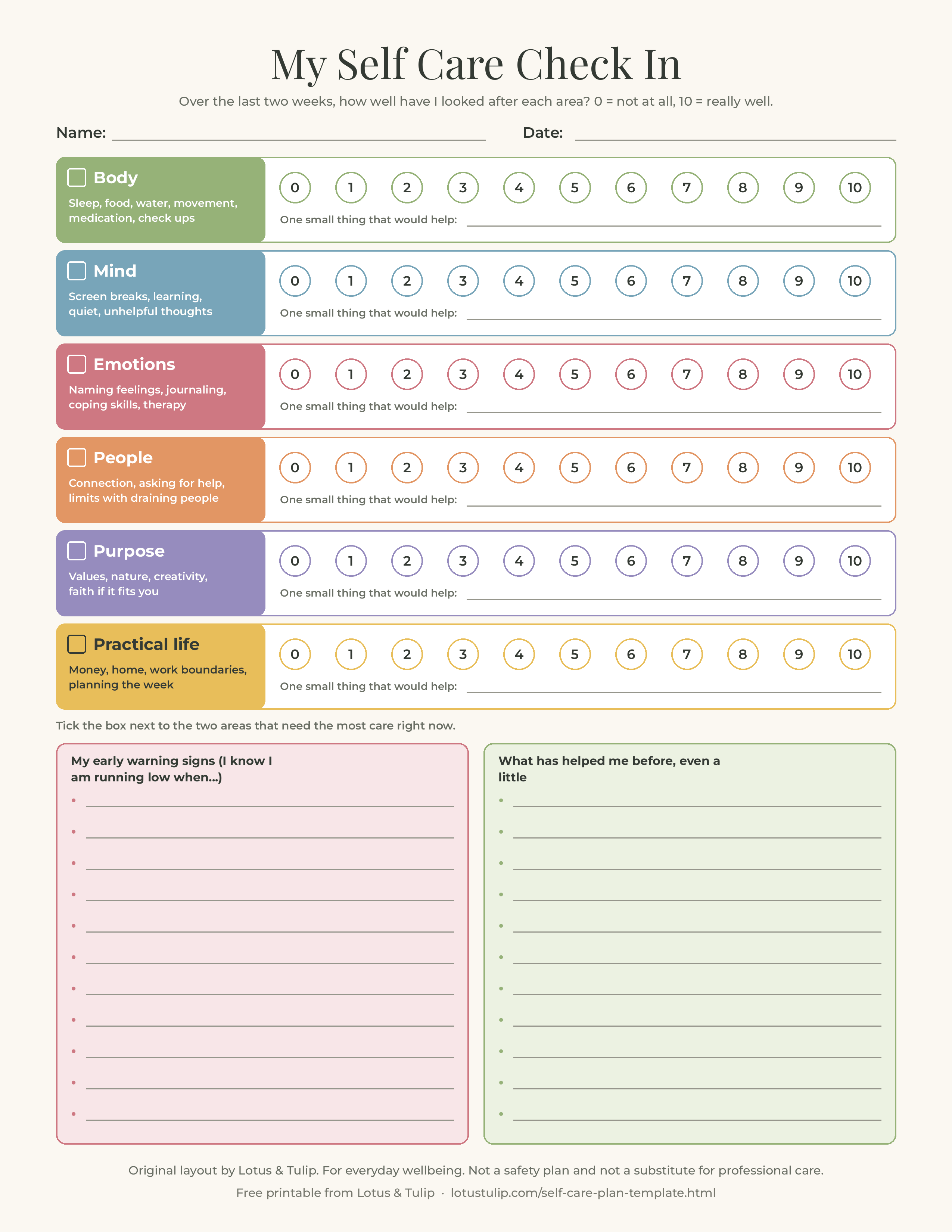
- Check in honestly. Rate each of the six areas from 0 to 10 for how well you have been looking after it over the last two weeks. Do not aim for perfect scores. You are looking for the one or two areas that have slipped the most.
- Notice your warning signs. Write down three to five early signs that you are running low. Common ones are sleeping badly, snapping at people, skipping meals, cancelling plans, doom scrolling, or dreading things you usually enjoy. These are your cue to use the plan.
- List what already helps. Before adding anything new, write what has helped you in the past, even a little. Your own track record is the best evidence you have.
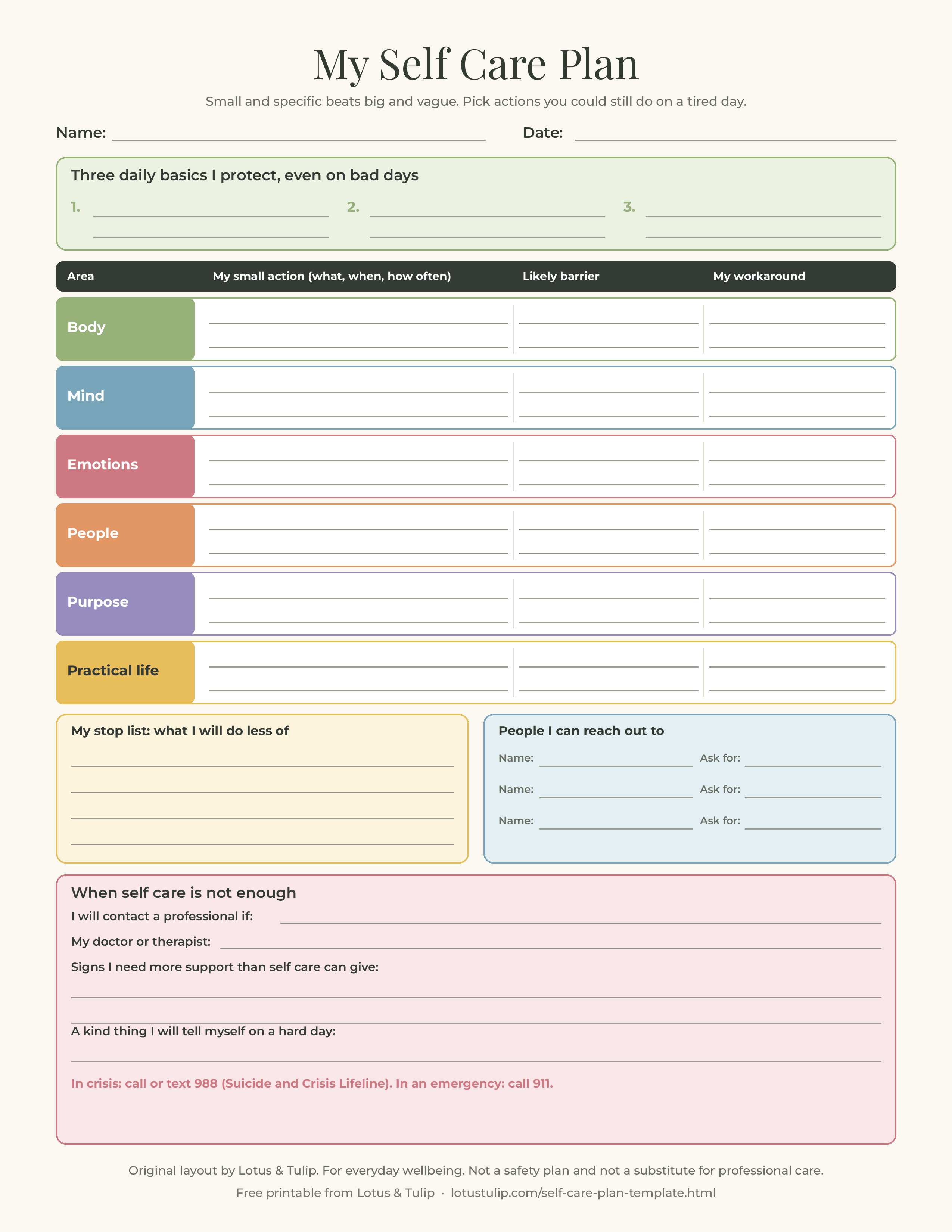
- Protect three daily basics. Choose three non negotiables you will protect even on bad days, such as a regular wake time, one proper meal and ten minutes outside. Keep them small enough to do when you are tired.
- Pick one small action per area. For the areas that scored lowest, choose one specific action. "Exercise more" is a wish. "Walk around the block after lunch on Monday, Wednesday and Friday" is a plan.
- Plan for barriers. For each action, write the most likely thing that will stop you and what you will do instead. If it rains, walk the stairs at work. If you are too tired to cook, have a frozen meal ready.
- Write a stop list. Self care is also about what you remove. Name one or two things that drain you that you can reduce this week, such as late night phone use or one optional commitment.
- Name your people and your limits. Write two or three people you can reach out to, and what you would ask them for. Add the point where you will contact a professional, and keep the 988 Suicide and Crisis Lifeline on the page.
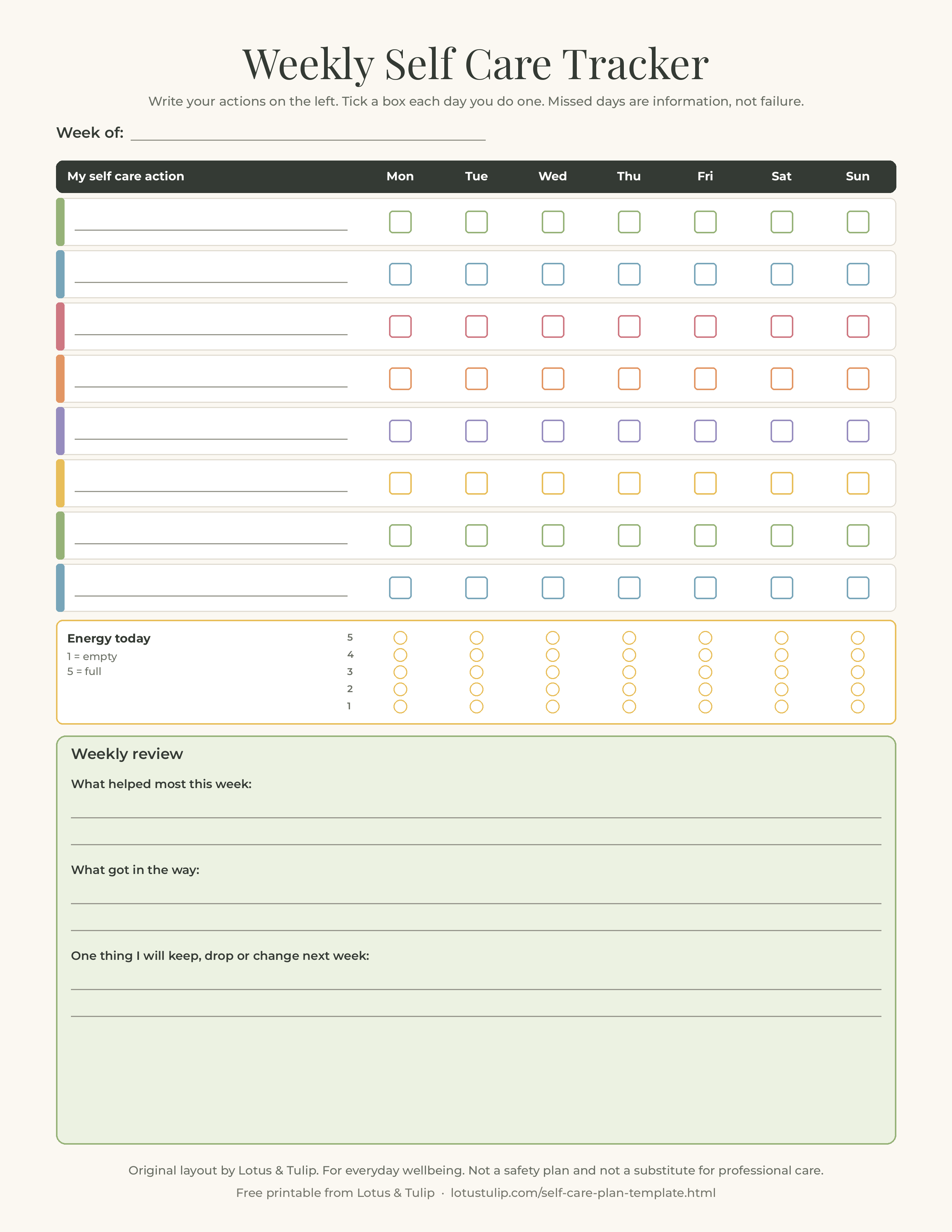
- Track for a week, then review. Tick off actions on the weekly tracker and rate your energy each day. At the end of the week, keep what helped, drop what did not and adjust. A self care plan is a draft you revise, not a test you pass.
Self care ideas by area
Use these as a menu, not a checklist. Pick what fits your life, budget and energy.
Body
- Set a regular wake time, even on weekends
- Put your phone out of reach 30 minutes before bed
- Keep a water bottle where you can see it
- Eat breakfast or a mid morning snack instead of running on coffee
- Take a 10 minute walk after a meal
- Stretch for five minutes when you get up from your desk
Mind
- Have one screen free hour each evening
- Check the news once a day instead of all day
- Read a few pages of a book for fun
- Do a crossword, puzzle or game that uses your brain in a calm way
- Write a short to do list so tasks stop circling in your head
- Catch one unhelpful thought and write a more balanced one
Emotions
- Name your feeling in one word, out loud or on paper
- Write for five minutes about what is on your mind
- Let yourself cry if you need to
- Watch something that makes you laugh
- Use a grounding exercise like 5 4 3 2 1 when anxiety spikes
- Try slow breathing with a longer out breath
People
- Text one friend to say you are thinking of them
- Schedule a regular call with someone who is good for you
- Ask for one specific piece of practical help
- Eat one meal a week with other people
- Say no to one request you do not have capacity for
- Spend less time with someone who leaves you drained
Purpose
- Spend 20 minutes outside in a park or green space
- Write down three values that matter to you and one action for each
- Do something creative with no goal: draw, cook, garden, play music
- Volunteer for an hour
- Pray, meditate or attend a service if faith is part of your life
- Keep a short gratitude list, being specific
Practical life
- Spend 15 minutes on a Sunday planning the week
- Open the mail and pay one bill
- Clear one surface at home
- Set an end time for work and close the laptop
- Turn off work notifications outside working hours
- Prepare tomorrow's clothes or lunch the night before
A filled self care plan example
Here is a short fictional example of how the template looks when filled in. Jordan is a 34 year old ICU nurse working 12 hour shifts.
- Check in scores: Body 3, Mind 5, Emotions 4, People 2, Purpose 6, Practical life 4. The lowest areas are body and people.
- Warning signs: eating vending machine food on shift, sleeping through days off, not answering texts, feeling numb after work.
- Three daily basics: pack a real meal before each shift; same wake time on days off, within an hour; ten minutes outside before or after work.
- Body action: two 20 minute walks on days off. Barrier: exhausted after night shifts. Workaround: walk on the second day off, not the first.
- People action: a standing Sunday call with a sister. Barrier: rotating shifts. Workaround: agree a backup time by text.
- Stop list: scrolling in bed after night shifts; picking up extra shifts more than once a month.
- When it is not enough: if the numb feeling lasts more than two weeks, call the employee assistance program and book a doctor's visit. In crisis, call or text 988.
Notice what the example does: it is short, specific, built around Jordan's real schedule, and honest about barriers. That is what makes a plan usable.
Self care plan for students and teens
Teens benefit from the same structure, with a few changes. Keep the language concrete and their own. Let them choose the actions; a plan an adult writes for a teen rarely gets used. Focus on sleep, since the CDC recommends 8 to 10 hours for 13 to 17 year olds and phones in the bedroom are a common barrier. Include school stress: planning homework, asking a teacher for help, taking breaks while studying. Make the people section specific, with one adult at school and one at home they could talk to. School counselors can use the check in and plan in a classroom lesson, an advisory period or a small group on stress, and keep a copy, with the student's agreement, for follow up.
For younger children, simplify to three areas (my body, my feelings, my people) and use pictures. A coping skills list for kids is often a better starting point at that age.
Self care for therapists and counselors
Clinicians are often good at helping clients with self care and poor at doing it themselves. The ACA Code of Ethics frames self care as part of professional responsibility, so counselors can "best meet their professional responsibilities." The APA Ethics Code (Standard 2.06) asks psychologists to take appropriate measures when personal problems could interfere with their work, such as getting professional consultation or assistance.
The five factors from the Dorociak study translate well into a therapist's self care plan:
- Professional support: consultation groups, supervision, colleagues you can debrief with.
- Professional development: training that energizes you, not only the hours you need for license renewal.
- Life balance: relationships and activities that have nothing to do with work.
- Cognitive awareness: noticing your own stress reactions, countertransference and early signs of burnout.
- Daily balance: breaks between sessions, a manageable caseload, ending notes on time.
You can use the same free template below for yourself by renaming the six areas or adding these five factors in the blank lines.
How to use a self care worksheet in therapy
A self care plan fits naturally into many kinds of therapy. In cognitive behavioral and behavioral activation work, it turns vague goals into scheduled actions. In relapse prevention, warning signs and the plan form the early part of a longer prevention plan. In trauma work and burnout recovery, it supports stabilization. A few practical tips:
- Complete the check in together in session, then let the client draft the plan as homework.
- Start with the areas the client cares about, not the areas you think matter most.
- Review the weekly tracker at the start of the next session with curiosity, not grading. A blank tracker is information about barriers.
- Revisit the plan when circumstances change: a new job, a move, a new baby, a loss.
- Keep a copy in the chart if the client agrees, and update it as part of treatment planning.
Common mistakes
- Making the plan too big. Ten new habits in week one usually means none by week three. Start with three basics and one action per weak area.
- Writing goals instead of actions. "Be less stressed" is an outcome. "Leave work by 5:30 on Tuesdays" is an action.
- Skipping barriers. Plans fail at predictable points. Naming them in advance is one of the most useful parts of the worksheet.
- Only adding, never removing. Sometimes the best self care is doing less.
- Treating a missed day as failure. Self care is something you return to, not a streak you protect.
- Using a self care plan instead of a safety plan. If someone is having thoughts of suicide or self harm, they need a safety plan and professional support, not a self care list.
When self care is not enough
Self care helps with everyday stress and supports recovery, but it has limits. NIMH advises seeking professional help if you have severe or distressing symptoms that have lasted 2 weeks or more, such as difficulty sleeping, changes in appetite or unplanned weight changes, difficulty getting out of bed because of mood, difficulty concentrating, loss of interest in things you usually enjoy, being unable to complete usual tasks, or feelings of irritability, frustration or restlessness. A primary care provider is a good first stop and can refer you to a mental health professional.
A self care plan is also different from a safety plan. A safety plan, such as the Safety Planning Intervention described by Barbara Stanley and Gregory Brown in 2012, is a written, prioritized list of warning signs, coping strategies, people and places for distraction, people to ask for help, professionals and crisis lines, and steps to make the environment safer. It is built with a clinician for times of suicidal crisis. If that is where you or a client are, use a safety plan, not this worksheet.
Safety note: If you or someone you know is struggling or having thoughts of suicide, call or text the 988 Suicide and Crisis Lifeline at 988 or chat at 988lifeline.org. It is free, confidential and available 24 hours a day. In a life threatening emergency, call 911. This guide and worksheet are educational and are not a substitute for professional care.
Free self care plan template (printable PDF)
This free printable is an original Lotus & Tulip design, sized for US Letter paper. It has three pages:
- Page 1: self care check in. Rate the six areas (body, mind, emotions, people, purpose, practical life) from 0 to 10, circle the two that need the most care, list your early warning signs and what has helped before.
- Page 2: my self care plan. Three daily basics, one small action per area with a likely barrier and a workaround, a stop list, the people you can reach for, and a "when self care is not enough" box with 988 and 911.
- Page 3: weekly self care tracker. Seven days with space for up to eight actions, a daily energy rating from 1 to 5, and a short weekly review: what helped, what got in the way, what to change next week.
Download the free self care plan template (PDF, 3 pages, US Letter)
Prefer single images? Page 1: self care check in (PNG) · Page 2: self care plan (PNG) · Page 3: weekly tracker (PNG)
Free to print for your own use and for use with your own clients or students. Please link to this page rather than re-uploading the file. Not a safety plan and not a substitute for professional care.
Related resources
- Stress management worksheet for adults (free printable): sort your stressors and plan daily resets
- Compassion fatigue worksheet (free printable): self care for therapists and helpers who carry other people's stories
- Burnout worksheet (free printable): when work stress needs more than self care
- Behavioral activation worksheet (free printable)
- Sleep hygiene worksheet (free printable)
- Healthy boundaries worksheet (free printable)
- ACT values worksheet (free printable)
- Window of tolerance worksheet (free printable)
- 5 4 3 2 1 grounding worksheet (free printable)
Sources
- World Health Organization. WHO guideline on self-care interventions for health and well-being, 2022 revision.
- National Institute of Mental Health. Caring for Your Mental Health (nimh.nih.gov, last reviewed April 2026).
- Centers for Disease Control and Prevention. About Sleep (cdc.gov).
- US Department of Health and Human Services. Physical Activity Guidelines for Americans, 2nd edition (2018).
- Dorociak, K. E., Rupert, P. A., Bryant, F. B., and Zahniser, E. (2017). Development of a Self-Care Assessment for Psychologists. Journal of Counseling Psychology, 64(3), 325 to 334.
- American Counseling Association. 2014 ACA Code of Ethics, Section C introduction.
- American Psychological Association. Ethical Principles of Psychologists and Code of Conduct, Standard 2.06.
- Stanley, B., and Brown, G. K. (2012). Safety Planning Intervention: a brief intervention to mitigate suicide risk. Cognitive and Behavioral Practice, 19(2), 256 to 264.
FAQ
What should a self care plan include?
A useful self care plan includes a quick check in across areas like body, mind, emotions, people, purpose and practical life, your early warning signs, a few daily basics you protect, one small specific action for each area that needs care, likely barriers and workarounds, things to cut back on, people you can reach out to, and when to get professional help, including the 988 Lifeline.
What are the six areas of self care?
There is no single official list, but a common practical set is body (physical), mind (mental), emotions, people (social), purpose (spiritual or meaning) and practical life (money, home, work boundaries). Using several areas keeps a plan from focusing only on one kind of care.
How do I make a self care plan?
Rate each area from 0 to 10, write down your warning signs and what has helped before, choose three daily basics, pick one small specific action for your lowest areas, plan for barriers, name what you will cut back on and who you can reach out to, then track for a week and adjust.
Is a self care plan the same as a safety plan?
No. A self care plan is for everyday wellbeing and stress. A safety plan, such as the Stanley and Brown Safety Planning Intervention, is a structured plan made with a clinician for suicidal crisis. Anyone having thoughts of suicide should use a safety plan and get professional help, and can call or text 988.
How do therapists use self care worksheets with clients?
Therapists often complete the check in with a client in session, assign the plan as homework, and review the weekly tracker at the next session. Self care plans fit into behavioral activation, relapse prevention, stress management and burnout work, and are revised as the client's circumstances change.
Can teens use a self care plan?
Yes. Teens do best when they choose their own actions and use their own words. Sleep, phone use, school stress and naming one trusted adult at home and at school are good focus points. School counselors can use the worksheet in lessons, advisory or small groups.
Is this self care plan template free?
Yes. It is free to print for your own use and for use with your own clients, students or children. Please link to this page rather than re-uploading the file.