
Therapist worksheets · Self compassion · Updated 2026-11-05
Self Compassion Worksheet: Exercises, Self Compassion Break and a Free Printable
Ready-made printable: Self Esteem Worksheets for Kids and Teens Holiday 20% off: about $9.20, was $12 (EUR 10) · instant digital download
Buy on Etsy
Self compassion is the practice of meeting your own pain with kindness, a sense of shared humanity, and clear awareness, instead of with harsh judgment or denial. Kristin Neff's research framework (self kindness, common humanity, and mindfulness) is the version most therapists and counselors in the US teach. It is not the same as self esteem, self pity, or forcing a positive spin. It is a skill you can practice on a hard Tuesday afternoon, not a personality trait you either have or do not.
This guide is for therapists, counselors, adults practicing on their own, teens, and the parents or school counselors who support them. It covers what self compassion is and is not, the three components, the self compassion break, concrete exercises (how would you talk to a friend, a short compassionate letter, a carefully framed soothing touch option), adaptations for teens, tips for clinicians, common mistakes, what the research honestly shows, and when the work feels too hard. You also get a free three page US Letter printable: a Self Compassion Break worksheet, a How Would I Talk to a Friend? page, and a week practice log with a US safety box.
Lotus & Tulip is not affiliated with Kristin Neff, the Center for Mindful Self-Compassion, or the Mindful Self-Compassion (MSC) program. This page is an original educational guide and printable layout. For Neff's official materials and courses, see self-compassion.org.
Jump to the free self compassion worksheet (PDF) · Self compassion break · How to practice it, step by step
What self compassion is
Neff (2003) defined self compassion as treating yourself with the same care you would offer a good friend who is suffering. Her Self-Compassion Scale and later writing organize the construct into three pairs of opposites:
- Self kindness versus self judgment. Warmth, support, and understanding toward yourself when things go wrong, instead of harsh criticism, contempt, or "I should have known better" looping.
- Common humanity versus isolation. Remembering that struggle, failure, and imperfect days are part of being human, instead of feeling uniquely defective or alone in the pain.
- Mindfulness versus over identification. Holding the painful experience in balanced awareness: noticing it clearly without either stuffing it down or getting swept away by the story.
Those three pieces work together. Kindness without mindfulness can become avoidance. Mindfulness without kindness can become cold observation. Common humanity without the other two can sound like "everyone suffers, so stop complaining." The practice is the combination.
Neff and Christopher Germer later built the Mindful Self-Compassion (MSC) program around these ideas, blending mindfulness training with specific self compassion practices. MSC is a structured course. This article and printable are not a replacement for MSC, therapy, or crisis care. They are a clear starter map you can use in session, in a group, or on your own between appointments.
What self compassion is not
People often confuse self compassion with softer sounding ideas that behave differently in real life. Naming the differences protects the practice from becoming either fluff or self attack in disguise.
- Not self pity. Self pity shrinks the world to "poor me" and often increases isolation. Self compassion widens the frame: this hurts, and other people hurt too, and I can respond with care.
- Not self esteem. Self esteem is an evaluation of worth, often comparative ("Am I good enough? Better than average?"). Self compassion does not require you to be above average, successful today, or feeling proud. You can practice it on a day when self esteem is low. For related work on kids' and teens' sense of worth, see our self esteem worksheets for kids. That page is about strengths and realistic self regard. This page is about how you treat yourself when it hurts.
- Not toxic positivity. "Just be grateful" or "everything happens for a reason" can shut down real pain. Mindfulness in Neff's model means acknowledging suffering first. Kindness comes after the truth is on the table, not instead of it.
- Not laziness or giving up. People worry that kindness will make them soft or unmotivated. Evidence and clinical experience usually point the other way: harsh self criticism often fuels avoidance, rumination, and giving up. A kind but honest tone supports repair and next steps.
- Not the same as positive self talk slogans. Realistic, kind self talk overlaps with self compassion, but the full practice also includes common humanity and mindfulness. Our positive self talk worksheet is a helpful companion when the main stuck point is the inner voice wording. Use both rather than treating them as twins.
The three components, in plain language
1. Self kindness
Self kindness is the tone. It sounds like the voice of a steady friend: "This is hard. Of course you are upset. What would help a little right now?" It is not fake cheer. It can include firmness ("I will not send that text while I am this angry") without contempt ("I am such an idiot for even wanting to").
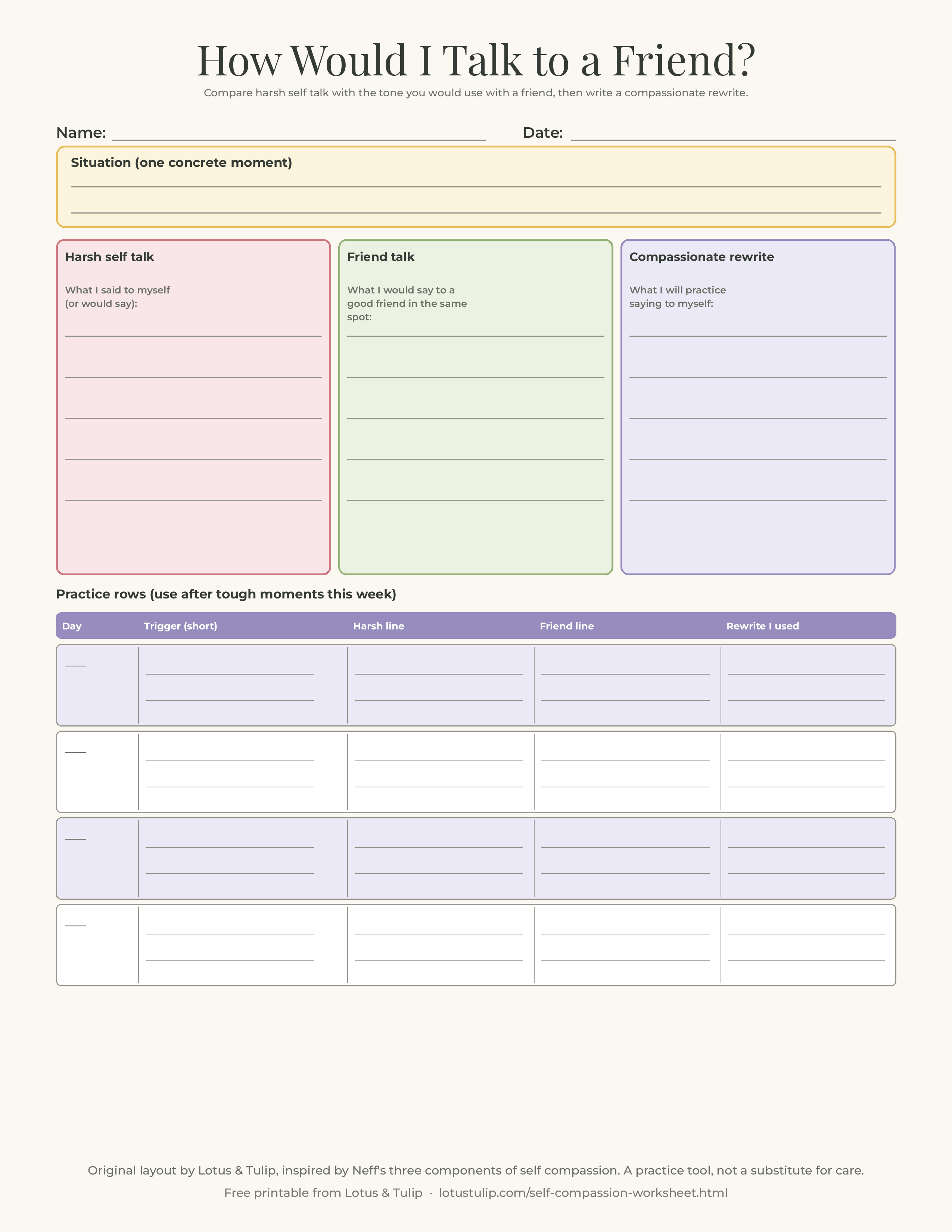
Clinically, self kindness often starts as a rewrite of the first automatic line. Clients write the harsh line, then write what they would say to a friend, then practice saying a shorter kind line to themselves. Page 2 of the free printable is built for that.
2. Common humanity
Common humanity answers the lonely thought "only I mess up like this." It does not erase responsibility. It places the struggle in a larger human pattern: people forget, people snap when exhausted, people feel jealous, people fail exams, people lose jobs, people grieve. The sentence can be as simple as "Other people feel this too" or "Being human includes days like this."
For teens, common humanity is especially useful after social media comparison. The feed is curated. Everyone's hard nights are mostly invisible. Naming that fact is part of the practice, not a lecture about "real life."
3. Mindfulness
Mindfulness here means noticing the moment of suffering without drowning in it or pretending it is fine. A short label helps: "This is stress." "This is shame." "This is disappointment." Body cues matter too: tight chest, hot face, heavy limbs. Mindfulness is the opposite of rumination's endless replay and the opposite of numbing out.
If clients already use DBT or ACT skills, bridge rather than restart. Radical acceptance helps when fighting the facts is the stuck point. Mindfulness What and How skills and distress tolerance skills help when arousal is too high for reflective worksheets. Self compassion sits beside those tools: once the moment is noticed, the question becomes "How do I treat myself inside this moment?"
The self compassion break
The self compassion break is Neff's short, portable practice. In one hard moment, you touch all three components with a few phrases. Exact wording varies. A common sequence looks like this:
- Mindfulness: "This is a moment of suffering." (Or: "This hurts." "This is stressful.")
- Common humanity: "Suffering is part of being human." (Or: "Other people feel this too." "I am not alone in this.")
- Self kindness: "May I be kind to myself." (Or: "May I give myself what I need." A hand on the heart or a kind phrase you chose in advance.)
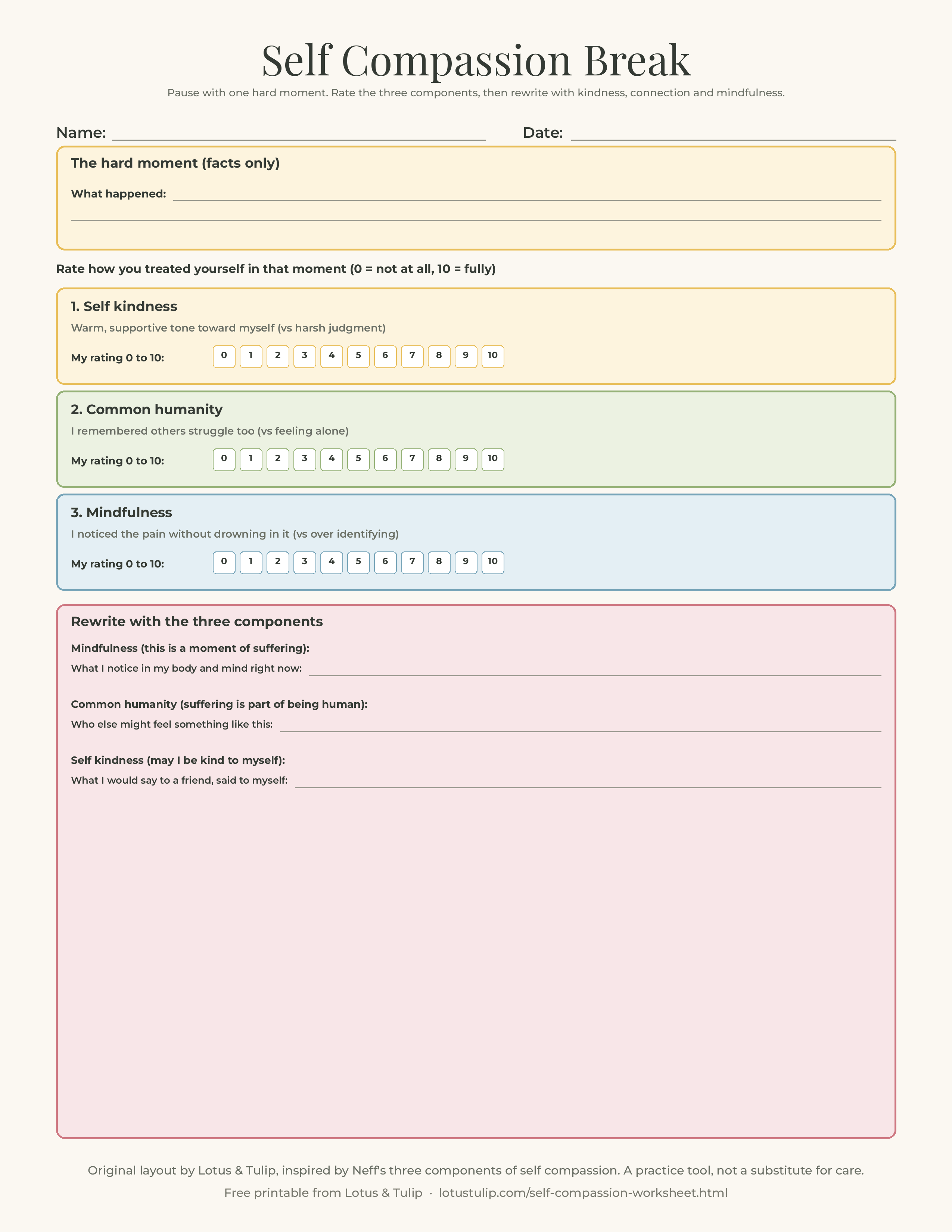
The break is meant to be brief enough to use at a desk, in a parked car, or between classes. It is not a 20 minute meditation. Page 1 of the free printable walks through one hard moment, rates the three components 0 to 10, and rewrites the moment with the three phrases.
Tip for first practice: write the three phrases on a card before you need them. Under stress, people forget wording. A prewritten card beats improvising while shame is loud.
Self compassion exercises you can actually use
Below are practice formats that map cleanly onto worksheets and session plans. Pick one or two. Depth beats collecting every exercise on the internet.
How would you talk to a friend?
This is often the fastest door in. Ask the person to describe a recent hard moment, write the harsh self talk, then write what they would say to a close friend in the same situation. The gap is usually obvious. The last step is a compassionate rewrite they are willing to practice saying to themselves. Keep the rewrite believable. "I am perfect and everything is fine" will bounce off. "I am hurting, and I can take this one step at a time" lands.
Compassionate letter (short)
Write a brief letter to yourself from the perspective of a wise, caring friend who knows the full story. Include: what happened, what was hard, what makes sense about the reaction, and one kind next step. Limit it to half a page so it stays doable. Some people prefer typing. Others prefer handwriting. Either is fine.
Compassionate friend imagery
Some MSC inspired practices invite you to imagine a compassionate figure (a mentor, a grandparent, a fictional guide, a future wiser self) and hear what they would say. This is optional. For clients who dislike imagery, skip it and stay with phrases and the friend talk exercise. Never force an image of a real person who was unsafe.
Soothing touch, carefully framed
A hand on the heart, a hand on the cheek, or arms crossed in a gentle self hug can calm the body for some people. For others, especially after trauma, touch can feel unsafe or activating. Always offer it as optional. Ask permission in session. Offer alternatives: a warm mug, a soft object, feet on the floor, a weighted blanket if available. Never present touch as mandatory for "doing self compassion right."
Softening the inner critic without a war
Many clients try to silence the inner critic by arguing with it. That can escalate. A self compassionate stance often sounds like: "I hear the critic. It is trying to protect me from failure or rejection. I still choose a kinder tone for the next hour." Pair this with cognitive tools when beliefs are rigid: our core beliefs worksheet and cognitive distortions worksheet help examine "I am worthless" style claims with evidence, while self compassion changes the emotional climate in which that work happens.
Link to daily care
Self compassion is not only phrases. It shows up as sleep, food, asking for help, and keeping a plan after a hard day. A simple self care plan template can hold the practical side so the kindness is not only mental.
How to practice self compassion, step by step
- Name one hard moment. Pick a specific recent episode, not your whole personality. Write a short factual label ("Tuesday after the meeting feedback").
- Rate the three components. On a 0 to 10 scale, how much self kindness, common humanity, and mindfulness did you show yourself in that moment? Honesty matters more than a high score.
- Write the harsh line. Capture the actual self talk, not a cleaned up version.
- Write the friend line. What would you say to a good friend in the same spot? Keep it specific and warm.
- Build a compassionate rewrite. Shorten the friend line into something you can say to yourself. Check that it includes at least a nod to kindness and, when possible, common humanity.
- Run a self compassion break. Use the three phrases: this is a moment of suffering; suffering is part of being human; may I be kind to myself. Say them slowly once or twice.
- Add one kind action. Drink water, step outside, text a safe person, eat something, stop the doom scroll for ten minutes. Kindness includes behavior.
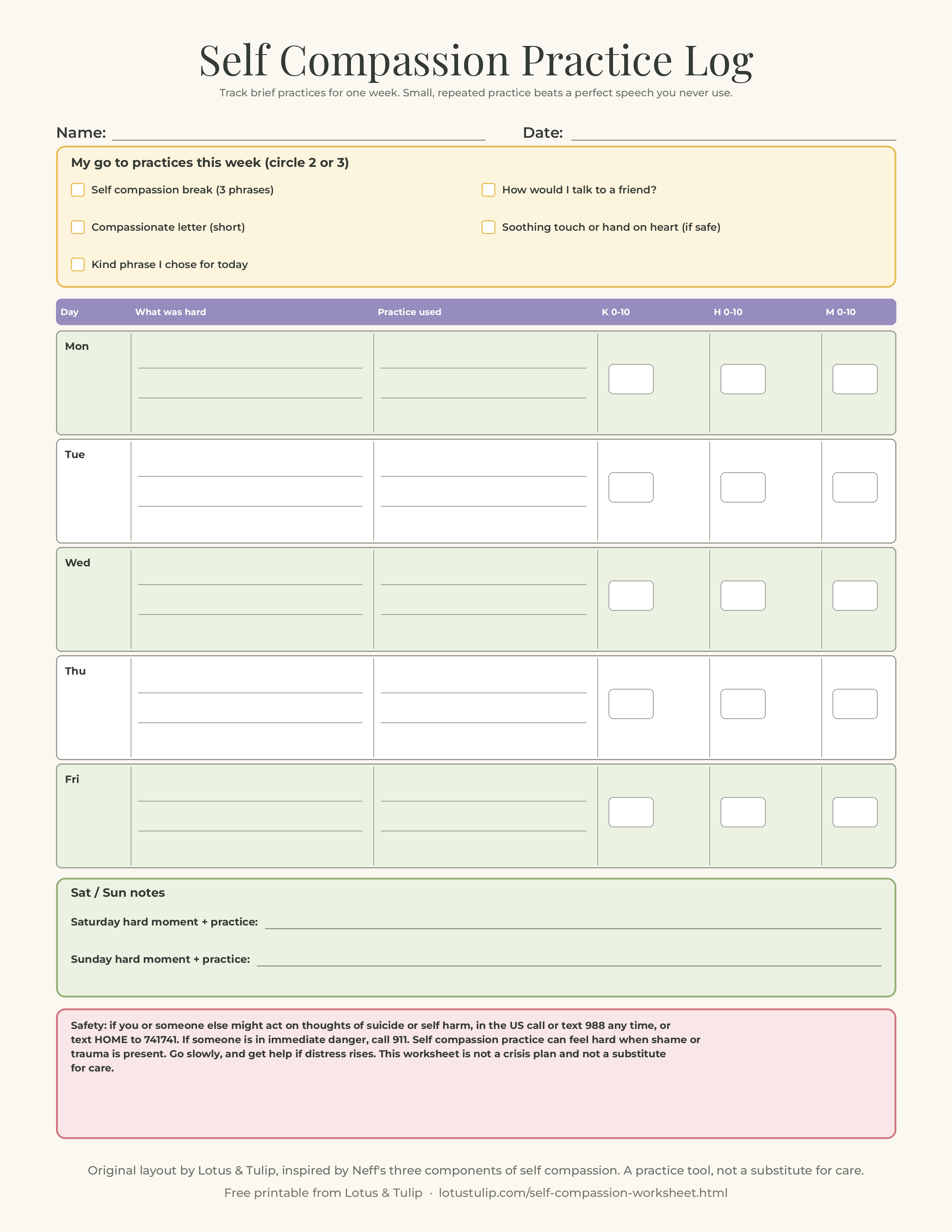
- Log it. On the practice log, note the day, what was hard, which practice you used, and rough 0 to 10 ratings again. Patterns teach more than one perfect page.
- Review weekly with curiosity. Look for repeating triggers and repeating kind moves that helped. Adjust phrases so they sound like you, not like a poster.
Self compassion for teens
Teens often hear "be nice to yourself" as adult fluff, especially if peers reward toughness or sarcasm. Translate the ideas into their world:
- Use concrete situations: a bad grade posted, a left out group chat, a sports mistake, a parent fight, a comparison spiral after scrolling.
- Lead with the friend question. Most teens can be kinder to a friend than to themselves within seconds.
- Keep phrases short enough to remember between classes.
- Watch for shame collapse ("I am just toxic / annoying / worthless"). Separate the moment from the identity. Common humanity helps: lots of teens feel this; it does not mean the label is true.
- Invite caregivers carefully. Some parents push positivity and accidentally shut down feelings. Coach caregivers to validate first, then support a kind next step.
School counselors can use page 2 in a short individual check in or as a group warm up. Do not require sharing harsh self talk aloud in a group. Private writing with optional sharing is safer.
For therapists and counselors
- Introduce self compassion after some emotion regulation capacity exists. If the client is in acute crisis, stabilize first. Phrases alone will not hold a flashback or a suicide crisis.
- Model a mild example of your own (a small work stumble) before asking for a high shame target. This reduces the sense of being judged.
- Track whether the client's "kind" rewrite is actually kindness or a new demand ("I must be zen about this"). Redirect to warmth plus honesty.
- For trauma survivors, go slowly. Self kindness can unlock grief and anger that were held by self blame. Pace, ground, and coordinate with the overall treatment plan.
- Coordinate language with existing modalities: CBT (thoughts and beliefs), DBT (mindfulness, emotion regulation, distress tolerance), ACT (defusion and values), compassion focused therapy if that is your frame.
- Homework should be tiny. One logged break three times a week beats a vow to "be compassionate forever."
- Document informed consent language that this is a skills practice, not a substitute for risk assessment or higher care.
Common mistakes
- Using kindness as a bypass. Skipping the mindfulness step and jumping to "it's fine" is avoidance, not self compassion.
- Turning the practice into a new performance. "I did the break wrong" is the critic wearing a yoga outfit. Return to warmth.
- Confusing self compassion with dropping all standards. You can keep values and repair plans while dropping contempt.
- Forcing soothing touch. Optional means optional.
- Only practicing when calm. The skill is for hard moments. Start with medium hard moments, not the worst memory of your life, then build.
- Ignoring body and sleep. A kind phrase plus no food and three hours of sleep is an uphill fight. Pair with PLEASE style basics and a real self care plan.
- Debating the critic for an hour. Notice, thank it for trying to protect you, choose the kind next sentence, move your feet.
What the research says (honestly)
Self compassion research has grown quickly. That is good news and a reason for careful reading. Many studies are correlational. Intervention trials exist and often show small to moderate benefits. Effect sizes vary by outcome and study quality. Self compassion is not a cure all, and it can feel hard or even threatening for people with deep shame or trauma histories. Pace matters.
- Neff (2003) and the Self-Compassion Scale. Neff's early papers defined the three component model and introduced the Self-Compassion Scale (SCS) to measure the construct. The SCS and its short form are widely used. Like any self report scale, scores reflect how people see themselves, not a lab assay of kindness.
- Neff and Germer, Mindful Self-Compassion. MSC is an eight week (plus retreat style variants) training that teaches mindfulness and self compassion practices together. Program research suggests participants often increase self compassion and reduce some distress measures. Results depend on attendance, practice, and sample. Lotus & Tulip is not affiliated with MSC.
- MacBeth and Gumley (2012). Their meta-analysis examined self compassion and psychopathology across studies and reported a large average correlation in the direction of higher self compassion with lower psychopathology (their pooled correlation was about r = -.54). Correlation is not causation. People who are less depressed may also find it easier to be kind to themselves. Still, the association is robust enough that clinicians notice it in the room.
- Zessin, Dickhauser, and Garbade (2015). This meta-analysis linked self compassion with well-being, with a moderate average correlation (about r = .47 in their overall estimate). Again, correlational patterns can reflect shared factors (personality, current mood, support). They still support the idea that self compassion tracks with feeling better, not only with "being nice."
- Ferrari and colleagues (2019). This meta-analysis of randomized controlled trials of self compassion interventions (27 RCTs in their set) found meaningful average gains in self compassion (they reported a large Hedge's g around 0.75 for self compassion outcomes) and benefits on depression, anxiety, and stress in the moderate range, with larger effects on rumination and some eating related outcomes in the studies that measured them. Group formats often outperformed purely individual or self guided formats in their comparisons. Effects are averages across heterogeneous programs. A three page printable is not the same as an eight week MSC course or a full therapy protocol.
Bottom line for practice: teach self compassion as a skill with a research base and clear limits. Do not promise that a worksheet will remake personality, erase trauma, or replace treatment for major depression, PTSD, or eating disorders. Do expect many clients to feel a bit more able to stay with hard moments without as much self attack, especially with repetition and support.
When it is hard, and when to get help
Some people feel worse before they feel steadier. Contact with old shame can open grief. If practice leads to panic, dissociation, or rising urges to self harm, stop the exercise, ground, and use your safety plan or contact a professional. Self compassion should not be a white knuckle endurance test.
- In the US, call or text 988 (988 Suicide and Crisis Lifeline) any time for suicidal thoughts or emotional crisis.
- Text HOME to 741741 to reach the Crisis Text Line.
- Call 911 if someone is in immediate danger.
If you are supporting a teen, take talk of wanting to die, self harm, or giving away possessions seriously. Contact a qualified professional the same day. A worksheet is not a crisis plan.
For acceptance of facts that cannot change, see radical acceptance. For day to day care structure, see the self care plan template.
Free self compassion worksheet (PDF)
The free self compassion worksheet has three pages in US Letter size, written for teens and adults:
- Page 1: Self Compassion Break. Space for the hard moment, 0 to 10 ratings of self kindness, common humanity and mindfulness, and a rewrite using the three components.
- Page 2: How Would I Talk to a Friend? Columns for harsh self talk, friend talk and a compassionate rewrite, plus practice rows for the week.
- Page 3: Self Compassion Practice Log. A week log for brief practices, with a US safety box listing 988, text HOME to 741741, and 911.
Download the free self compassion worksheet (PDF, 3 pages, US Letter)
Prefer single images? Page 1: Self Compassion Break (PNG) · Page 2: How Would I Talk to a Friend? (PNG) · Page 3: Self Compassion Practice Log (PNG)
Free to print for your own use and for use with your own clients, students, or groups. This is an original layout by Lotus & Tulip, inspired by Neff's three component model and not a copy of MSC or Neff's proprietary handouts. Please link to this page rather than re-uploading the file. We are not affiliated with Kristin Neff or the Center for Mindful Self-Compassion.
Free grief starter pack: Want more real pages? The free grief worksheets for therapists starter pack adds grief waves, the many feelings of grief, two sides of coping, memories and what I carry, a plan for hard days and a support and safety page from our paid grief and loss set (8 pages, client use license, no email).
Related resources
- Character strengths worksheet: notice what is already right with you, with a free strengths map and plan
- Body image worksheet for adults: a kinder, accurate reply to harsh thoughts about your body, with a free printable
- Forgiveness worksheet for adults: what forgiveness is and is not, with a free 2 page printable
- Compassion fatigue worksheet: for therapists and helpers worn down by caring, with a free care for the carer plan
- Impostor syndrome worksheet: meeting "I am a fraud" with kindness and evidence, with a free practice plan
- Self-esteem worksheets for adults: why a fair, steady view beats a high score, with a free evidence log
- Inner child worksheet: noticing old feelings and needs, with a free reparenting plan
- Positive self talk worksheet: flip harsh lines into realistic, kind wording.
- Self esteem worksheets for kids: strengths and realistic self regard for younger clients.
- Core beliefs worksheet: examine deep "I am..." claims with evidence.
- Cognitive distortions worksheet: name thinking traps that feed self attack.
- Self care plan template: turn kindness into sleep, food, help and recovery actions.
- Radical acceptance worksheet: stop fighting facts that cannot be changed.
Sources
- Neff, K. D. (2003). Self-compassion: An alternative conceptualization of a healthy attitude toward oneself. Self and Identity, 2(2), 85 to 101.
- Neff, K. D. (2003). The development and validation of a scale to measure self-compassion. Self and Identity, 2(3), 223 to 250.
- Neff, K. D., and Germer, C. K. (2013). A pilot study and randomized controlled trial of the Mindful Self-Compassion program. Journal of Clinical Psychology, 69(1), 28 to 44.
- Germer, C. K., and Neff, K. D. (2019). Teaching the Mindful Self-Compassion Program: A Guide for Professionals. Guilford Press.
- MacBeth, A., and Gumley, A. (2012). Exploring compassion: A meta-analysis of the association between self-compassion and psychopathology. Clinical Psychology Review, 32(6), 545 to 552.
- Zessin, U., Dickhauser, O., and Garbade, L. (2015). The relationship between self-compassion and well-being: A meta-analysis. Applied Psychology: Health and Well-Being, 7(3), 340 to 364.
- Ferrari, M., Hunt, C., Harrysunker, A., Abbott, M. J., Beath, A. P., and Einstein, D. A. (2019). Self-compassion interventions and psychosocial outcomes: A meta-analysis of RCTs. Mindfulness, 10, 1455 to 1473.
- 988 Suicide and Crisis Lifeline, 988lifeline.org. Crisis Text Line, crisistextline.org.
- Official Neff resources: self-compassion.org (we are not affiliated).
Self compassion worksheet: FAQ
What is a self compassion worksheet?
A self compassion worksheet is a structured page that helps you practice meeting a hard moment with kindness, common humanity and mindfulness. The free printable here includes a Self Compassion Break, a How Would I Talk to a Friend? exercise and a week practice log.
What is the self compassion break?
The self compassion break is a short practice from Kristin Neff's model. You acknowledge suffering (mindfulness), remember that struggle is part of being human (common humanity), and offer yourself kindness (a phrase and sometimes an optional soothing gesture).
How is self compassion different from self esteem?
Self esteem is an evaluation of worth, often comparative. Self compassion is how you treat yourself when you are hurting. You can practice self compassion on days when self esteem feels low, because it does not require you to feel proud or above average.
Does self compassion make people lazy or selfish?
Evidence and clinical experience usually suggest the opposite. Harsh self criticism often fuels avoidance and rumination. A kind, honest tone supports repair, responsibility and next steps. Self compassion is not an excuse to harm others or drop your values.
Can teens use a self compassion worksheet?
Yes, especially with concrete situations and the friend talk exercise. Keep phrases short, allow private writing, and watch for shame based identity labels. School counselors can use the pages in brief check ins or groups with optional sharing.
What does the research say about self compassion?
Correlational meta-analyses (for example MacBeth and Gumley 2012, Zessin et al. 2015) link higher self compassion with lower psychopathology and higher well-being. Intervention meta-analyses such as Ferrari et al. 2019 find average benefits on self compassion and on depression, anxiety and stress, often small to moderate depending on the outcome. Many studies are correlational, programs differ widely, and a printable is not the same as a full course or therapy.
Can I print the free self compassion worksheet for clients?
Yes. The free PDF is an original Lotus & Tulip layout you can print for your own use and for your own clients, students or groups. Please link to this page instead of re-uploading the file. We are not affiliated with Kristin Neff or MSC.