
Special education and visual supports · Updated 2026-11-03
First then board printable: how to use a first then board with kids (free printable)
Ready-made printable: Visual Schedule and Behavior Supports Holiday 20% off: about $6.44, was $8 (EUR 7) · instant digital download
Buy on Etsy
A first then board is one of the simplest visual supports you can make: two boxes, one picture in each. "First shoes on, then outside." It shows a child what is happening now and what good thing comes right after, so the request is clear without a long verbal explanation. This guide is for special education teachers, ABA and speech therapists, school counselors and parents of autistic children or kids who find transitions hard. It covers what a first then board is, when it helps, how to use it step by step, the mistakes that make it stop working, variations like first then next and token boards, and how it fits with a full visual schedule. It ends with a free two page first then board printable with picture cards.
Jump to the free first then board printable
What a first then board is
A first then board (also written first/then or first-then board) is a card or strip with two spaces side by side. The "First" space shows a task the child is asked to do. The "Then" space shows something the child enjoys, which they get as soon as the first task is done. You can use photos, simple drawings or written words, whatever the child understands best.
The idea behind it is old and well studied. Psychologist David Premack described in 1959 that a less preferred activity is more likely to happen when a more preferred activity follows it. Parents know this as "grandma's rule": first vegetables, then dessert. A first then board simply makes that deal visible.
Visual supports as a group are one of the evidence-based practices for autistic children and youth identified in the 2020 review by the National Clearinghouse on Autism Evidence and Practice (Steinbrenner et al., 2020), which lists first/then schedules among its examples. Reinforcement, the other half of how the board works, is on the same list. That does not mean a board fixes every hard moment, but it is a reasonable, low cost first step that many teams use.
When a first then board helps
- Transitions. Moving from something fun to something less fun ("first clean up, then snack") or leaving a place.
- Non preferred tasks. A worksheet, a speech drill, brushing teeth or putting shoes on.
- Children who process pictures more easily than words. Including many autistic children and kids with language delays, and children who stop listening once a sentence gets long.
- Moments when talking makes it worse. When a child is upset, pointing to a picture is calmer than repeating an instruction.
- Building toward a full schedule. A two step board is often the first visual a child learns before moving to a longer schedule.
It is less useful when the child is already in a full meltdown. At that point the goal is safety and calm, not task completion. Come back to the board once they are regulated. Our calm down corner guide has ideas for that part.
How to use a first then board, step by step
- Find a "then" that the child really wants. Watch what they choose on their own, or offer two or three options and let them pick. A sticker they do not care about will not carry the board. Rotate choices so the reward stays interesting.
- Keep the "first" short and doable. Start with a task the child can finish in a minute or two, such as "two puzzle pieces" or "shoes on", not "the whole worksheet". Early success teaches how the board works.
- Teach it when things are calm. Try a few easy practice rounds with very short tasks so the child learns the pattern before you use it in a hard moment.
- Show it and say it in few words. Point to each picture: "First shoes. Then outside." Use the same words every time.
- Keep the board in view. Leave it where the child can see it while they do the task, so they can check what comes next.
- Follow through right away. As soon as the first task is done, point to "then" and give it. If the reward comes late or does not come at all, the board loses its meaning fast.
- Add a clear finish. Turn over or remove the "first" card when it is done, or move it to an "all done" spot. Seeing the task disappear is part of the reward.
- Fade over time. As the routine becomes easy, make the first task a bit longer, move from a separate reward to natural ones ("first math, then recess"), use words instead of pictures, or move to a written list. The goal is less adult support, not a board forever.
Examples for home, school and therapy
| Setting | First | Then |
|---|---|---|
| Morning at home | Shoes on | Car music |
| Bedtime | Brush teeth | Book with a parent |
| Classroom | Three math problems | Blocks for five minutes |
| Speech therapy | Five word cards | Bubbles |
| Playroom | Clean up the cars | Snack |
| Community outing | Grocery store | Playground |
Notice that the "then" in most examples is short too. Five minutes of blocks, then the next first then pair, keeps the day moving.
Common mistakes
- A "then" the child does not actually want. The board only works if the reward matters to that child today.
- A "first" that is too long. If the child cannot reach the reward, they learn the board means waiting forever. Shrink the task and build up.
- Changing the deal halfway. "Actually, also clean your room" teaches the child the board cannot be trusted.
- Only using it for hard things. Use it for easy wins too, so the board is not a signal that something bad is coming.
- Using it as a threat. "First stop crying, then iPad" puts a feeling, not a task, in the first box. Put a concrete action there, and help with the feeling separately.
- Too much talking. Long explanations next to the board cancel out the visual. Point, say a few words, wait.
- Pictures the child does not recognize. If an icon means nothing to the child, use a photo of the real object or place, or write the word for readers.
Variations: first then next, token boards and more
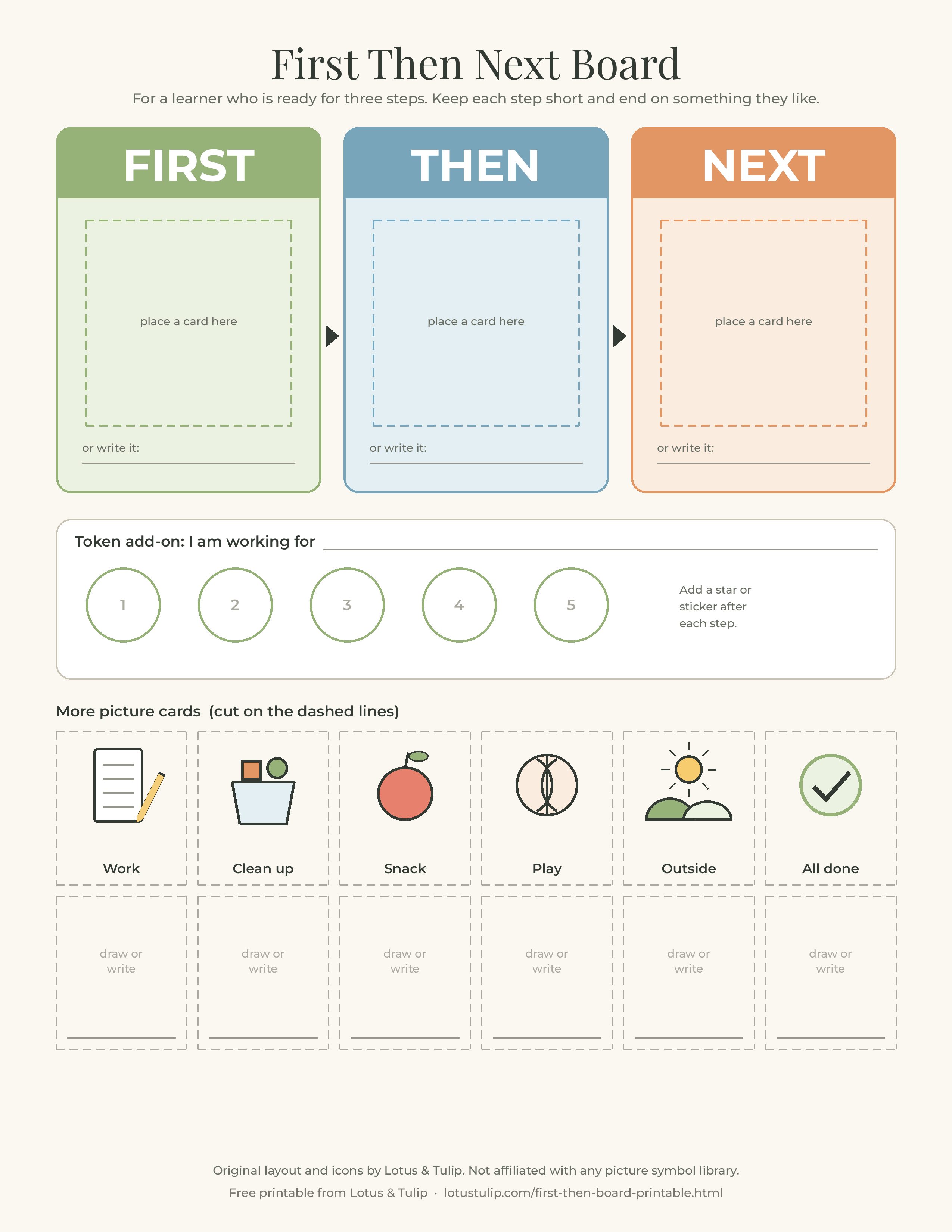
- First then next. Three spaces instead of two, once the child handles two steps well: "First work, then snack, next play." Many teams put the preferred activity last so the sequence ends well.
- Token add-on. For a longer task, the child earns tokens (stars, stickers, smiles) toward the "then", for example five tokens for five small steps. Show the reward at the top of the token strip so the goal stays visible.
- Now and next. Some teams prefer "now" and "next" wording when the second item is not a reward but simply what happens after, which helps with neutral transitions.
- Choice in the "then". Let the child pick the reward card before starting. Choosing builds buy in.
- Written version. For readers and older students, a sticky note with "First: 10 minutes reading. Then: free choice" does the same job without pictures.
How a first then board fits with a visual schedule
A first then board covers the next two moments. A visual schedule covers the whole morning or day: arrival, circle, work, snack, recess, and so on, usually as a vertical strip of picture cards that the child checks off or moves to an "all done" pocket. The two work well together. The schedule answers "what happens today?", and when a single step on it is hard, a first then board zooms in on that one step and the reward right after it. Many children start with first then, move to a short three or four card schedule, and then to a full day schedule.
A change card ("change", "wait" or "surprise") helps when the plan has to shift. Show the change on the schedule before it happens instead of just removing a card, so the visual stays honest.
Free first then board printable
This free printable is an original Lotus & Tulip design, with its own simple icons. Page 1 is a first then board with a large "First" space and a large "Then" space (place a card or write it in), plus 12 picture cards (work, clean up, shoes on, brush teeth, book, music, snack, play, outside, screen time, bubbles, blocks) and 6 blank cards to draw or write on. Page 2 is a first then next board with a five step token strip ("I am working for") and more picture and blank cards. Print on card stock, laminate if you like, and add hook and loop dots to the boxes and the back of each card.
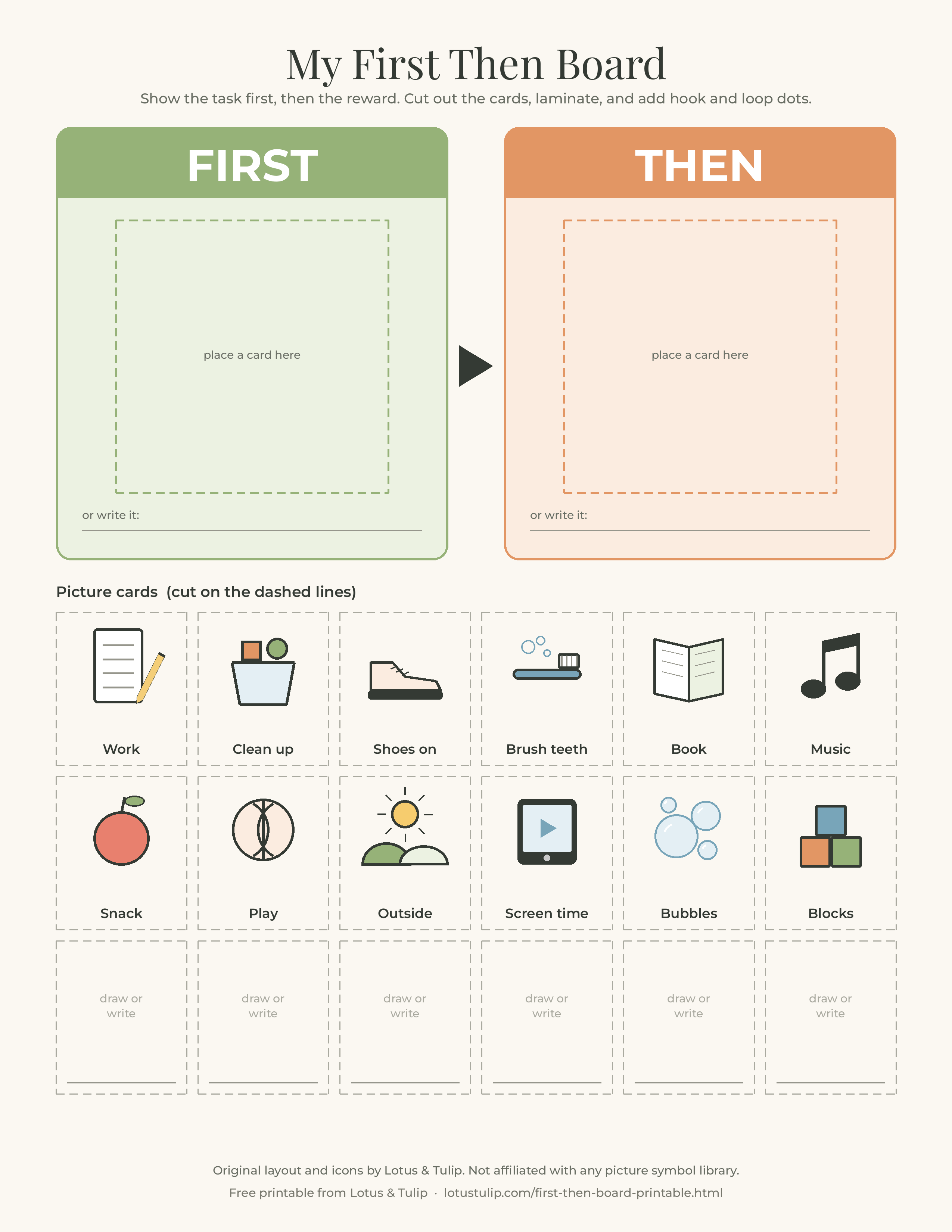
Download the free first then board (PDF, 2 pages, US Letter)
Prefer single images? Page 1: first then board and cards (PNG) · Page 2: first then next board with token strip (PNG)
Free to print for use with your own students, clients or children. Please link to this page rather than re-uploading the file. A general visual support, not a substitute for an individual plan from your child's team.
Related resources
- Break card printable: how to teach an I need a break card (free break cards and break plan)
- Calm down corner ideas (free calm down steps printable)
- Coping skills list for kids (free printable)
- Daily check in for students (free printable)
- Feelings thermometer printable (free printable)
FAQ
What is a first then board?
A first then board is a simple visual support with two spaces: "First" shows a task the child is asked to do, and "Then" shows a preferred activity that comes right after. It makes the order of events and the reward visible.
What age is a first then board for?
It is most often used with toddlers, preschoolers and elementary age children, and with older autistic learners or students with language delays who benefit from visuals. Older students can use a written first then note instead of pictures.
Is a first then board ABA?
First then boards are widely used in ABA programs because they pair a visual cue with reinforcement, but they are not limited to ABA. Teachers, speech and occupational therapists, school counselors and parents use them too.
What should go in the "then" box?
Something the child truly wants at that moment and that you can give right away, such as a short play activity, a snack, bubbles, a favorite book or a few minutes of screen time. Let the child choose when possible and rotate options.
What if the child refuses the first task?
Make the first task smaller, check that the reward is still motivating, and keep your words short. Do not give the reward without the task, but do not turn it into a standoff either. If refusals are frequent, talk with the child's teacher, BCBA or therapist about an individual plan.
Is this first then board printable free?
Yes. It is free to print for use with your own students, clients or children. Please link to this page rather than re-uploading the file.