
Special education and visual supports · Updated 2026-11-12
Break card printable: how to teach an "I need a break" card (free break cards and break plan)
Full kit: Visual Schedule and Behavior Supports, 23 pages with 16 communication cards including I need a break Holiday 20% off: about $6.44, was $8 (EUR 7) · instant digital download
Buy on EtsyA break card is a small picture card a child hands over, taps or points to when they need a short pause from a task. It gives the child a clear, safe way to say "this is too much right now" instead of crying, refusing, running or throwing the work. This guide is for special education teachers, ABA therapists and RBTs, speech and occupational therapists, school counselors and parents. It covers what a break card is, why it works, when it is the right tool and when it is not, how to teach it step by step, how to keep breaks short and get back to work, common mistakes and examples for the classroom and home. It ends with a free 2 page printable: break cards in three sizes, help, wait and all done cards, a break choice board, a break timer and a break is over card.
Download the free break cards (PDF, 2 pages, US Letter)
Direct download, no email or sign up. See the pages first.
What a break card is (and what it is not)
A break card is a communication tool. The child gives the card, or taps it on the desk, and an adult answers by allowing a short, planned break: a few minutes in a set spot with a calm activity and a timer. When the timer ends, the child comes back to the task. The card replaces a behavior that was doing the same job less safely, such as pushing the work away, hiding under the table, screaming or leaving the room.
A break card is not a reward, a punishment or a time out. The child is not sent away; they ask, and the request is honored. It is also not a permanent exit from hard work. The break is short, and the return to the task is part of the routine from the very first day.
Why break cards work: what the research says
Teaching a child to ask for a break is a form of functional communication training (FCT). Edward Carr and V. Mark Durand described the approach in 1985 ("Reducing behavior problems through functional communication training", Journal of Applied Behavior Analysis). For children whose problem behavior was a way to escape difficult tasks, they taught a phrase that brought help ("I don't understand"), and the problem behavior dropped. The idea is simple: if a behavior gets the child something they need, teach an easier, clearer way to ask for the same thing.
FCT has since become one of the most studied function based treatments for problem behavior. Jeffrey Tiger, Gregory Hanley and Jennifer Bruzek reviewed 91 FCT studies in "Functional communication training: A review and practical guide" (Behavior Analysis in Practice, 2008). Their guidance matches what works with break cards in practice: find out why the behavior happens, pick a request that is easy to make and easy for adults to recognize, honor it every time at first, and only then slowly build tolerance for waiting and for doing a little more work before the break.
For autistic children and youth, both functional communication training and visual supports are on the list of 28 evidence based practices in the 2020 report from the National Clearinghouse on Autism Evidence and Practice (Steinbrenner et al., 2020). A printed break card combines the two. That does not make it a fix for every behavior. It is a well supported first tool when it matches the reason for the behavior, and it works best when every adult uses it the same way.
When a break card is the right tool, and when it is not
A break card fits best when problem behavior shows up around demands: a worksheet, a writing task, a noisy room, a long circle time, a hard speech target. The behavior gets the child out of the task, so a break request gives them a better way to get the same pause.
If the behavior is mainly about getting attention, a toy, a turn or a favorite activity, a break card does not match. The child needs a different request instead, such as "Help please", "Look at me", "My turn" or "Can I have it?" The help card on the free printable covers one of these. When you are not sure why a behavior happens, or the behavior is dangerous or frequent, ask your BCBA, school psychologist or the child's team for a functional behavior assessment before choosing a replacement.
In schools, access to breaks is a common accommodation in IEPs and 504 plans. If a student has one, write down the details: how the student asks, how long a break lasts, where it happens, what the student can do, and how they return. Written details keep every adult consistent, which is what makes the card work.
How to teach a break card, step by step
- Know why the behavior happens. Look at when it starts. If it starts right after a demand and ends once the task is removed, a break card is a good match. If not, choose a different request (see above).
- Choose the form of the request. A card the child hands to you, a card on the desk they tap, a small card on a lanyard, a sign, an AAC button or the words "Break, please". Pick something the child can do quickly, even when upset, and that every adult will notice.
- Plan the break before you teach it. Decide where breaks happen, how long they last (often 1 to 3 minutes to start), and offer two to four calm choices like a book, music, building or calm breaths. Have a visual timer ready.
- Teach it when the child is calm. Start with an easy task. Before any problem behavior, prompt the request (point to the card or guide the hand), then give the break right away. Repeat this several times a day so the child gets many quick practice turns.
- Honor every request at first. Even if the child asks 20 seconds into the task, give the break. In the beginning the card has to work every time, faster and more reliably than the old behavior.
- Keep the break short, calm and predictable. Set the timer, say little, and let the child use one of the planned choices. A break that is quiet and pleasant, but not the most exciting part of the day, makes coming back easier.
- End every break the same way. When the timer ends, show the break is over card and go back to the same task. Make the first step after a break small and easy, and give specific praise for coming back: "You took a break and came back. Nice work."
- Fade your prompts. Move from guiding the child's hand, to pointing at the card, to simply waiting with the card in view. The goal is that the child asks without help, before they get overwhelmed.
- Slowly build work before breaks. Only once the child asks reliably and calmly, start to ask for a little more first: "Two more problems, then break", using a first then board or a short token board. Also practice the wait card with short, easy waits. Increase in small steps and go back a step if the old behavior returns.
Requested breaks and scheduled breaks
Some children cannot yet ask in time, or they ask constantly. Planned breaks on a schedule can help alongside the card. Many teams use both.
| Requested break (break card) | Scheduled break | |
|---|---|---|
| Who starts it | The child, by giving or tapping the card | The adult or the visual schedule |
| Teaches | A communication skill the child can use anywhere | Predictability and a steady pace through the day |
| Good for | Children whose behavior helps them escape tasks | Long work blocks, very busy days, children who wait too long to ask |
| Watch for | Asking so often that little work happens (time to build work before breaks) | Breaks that come too late to prevent a meltdown |
Common break card mistakes
- Saying "not now" in the early days. If the card only works sometimes, the child goes back to the behavior that always worked. Honor every request until the skill is solid.
- Teaching it in the middle of a meltdown. Practice when the child is calm. During a meltdown, focus on safety.
- Breaks that are too long or too fun. Ten minutes on a tablet makes the return to work very hard. Keep breaks short, calm and on a timer.
- No return routine. If the task disappears after the break, the card becomes a way to skip work. Return to the same task, with an easier first step if needed.
- Different rules with different adults. Write the break plan down and share it with every adult, including specials teachers, paraprofessionals and substitutes.
- Card out of reach. A card in a drawer cannot be used. Keep it on the desk, on a lanyard or on the visual schedule.
- Building work too fast. Jumping from no work to ten problems before a break brings the old behavior back. Add work in small steps.
- Using the card for every reason. If the behavior is about attention or a toy, teach a request for that, not a break.
Break card examples for the classroom and home
| Setting | What it looked like before | Break plan | Return |
|---|---|---|---|
| Writing block, grade 2 | Tears and ripping the paper after a few minutes | Taps the desk card; 2 minutes with a book at the back table | Break is over card, writes one sentence with a sentence starter |
| Resource room math | Pushes work off the desk | Hands over the card; 2 minutes of building blocks with a sand timer | Two easy problems first, then the next part of the page |
| Speech therapy session | Leaves the table during articulation drills | Presses a "break" button on the AAC device; 1 minute of bubbles | Three more target words, then the planned game |
| Middle school class | Puts head down and refuses to talk | Places the small "Break, please" card on the corner of the desk; 3 minutes in the hallway seat or counselor's office, agreed in the 504 plan | Returns, checks in with a thumbs up, picks up with the next question |
| Homework at home | Arguing and slamming the book | Hands the card to a parent; 3 minutes of music in the bedroom doorway | Back to the same page, parent reads the first question aloud |
Notice that every plan names the place, the length and the way back. That is what makes the card predictable for the child and the adults.
Break cards, calm down corners and token boards: which one when
These tools work together. A break card is how a child asks for a pause. A calm down corner is one place the break can happen, with calming tools and steps. A token board or a first then board helps the child stay with a task a little longer once breaks are working. A visual schedule can show planned breaks across the day. Many children use a break card on the desk, a schedule on the wall and a token board for the hardest block of the day.
Free break card printable
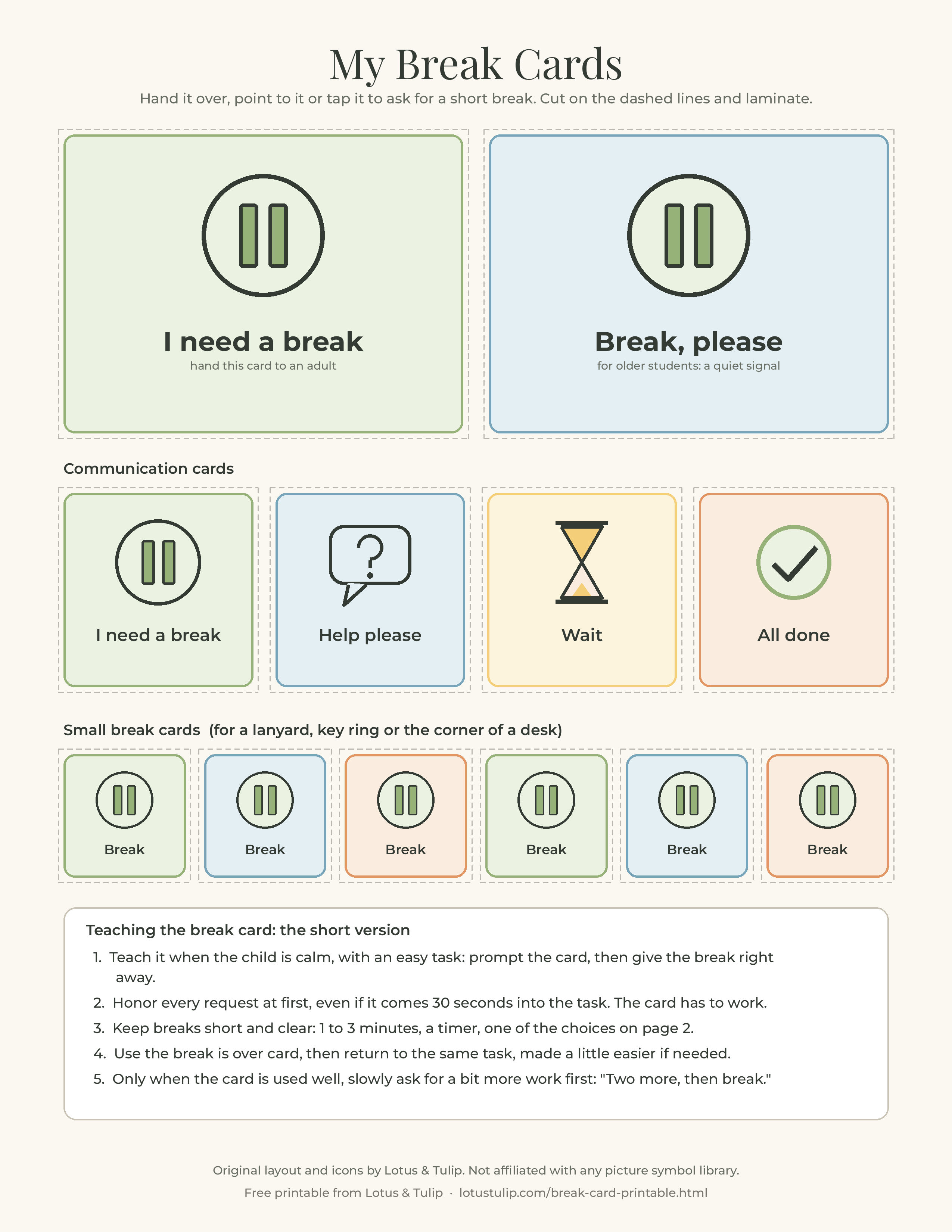
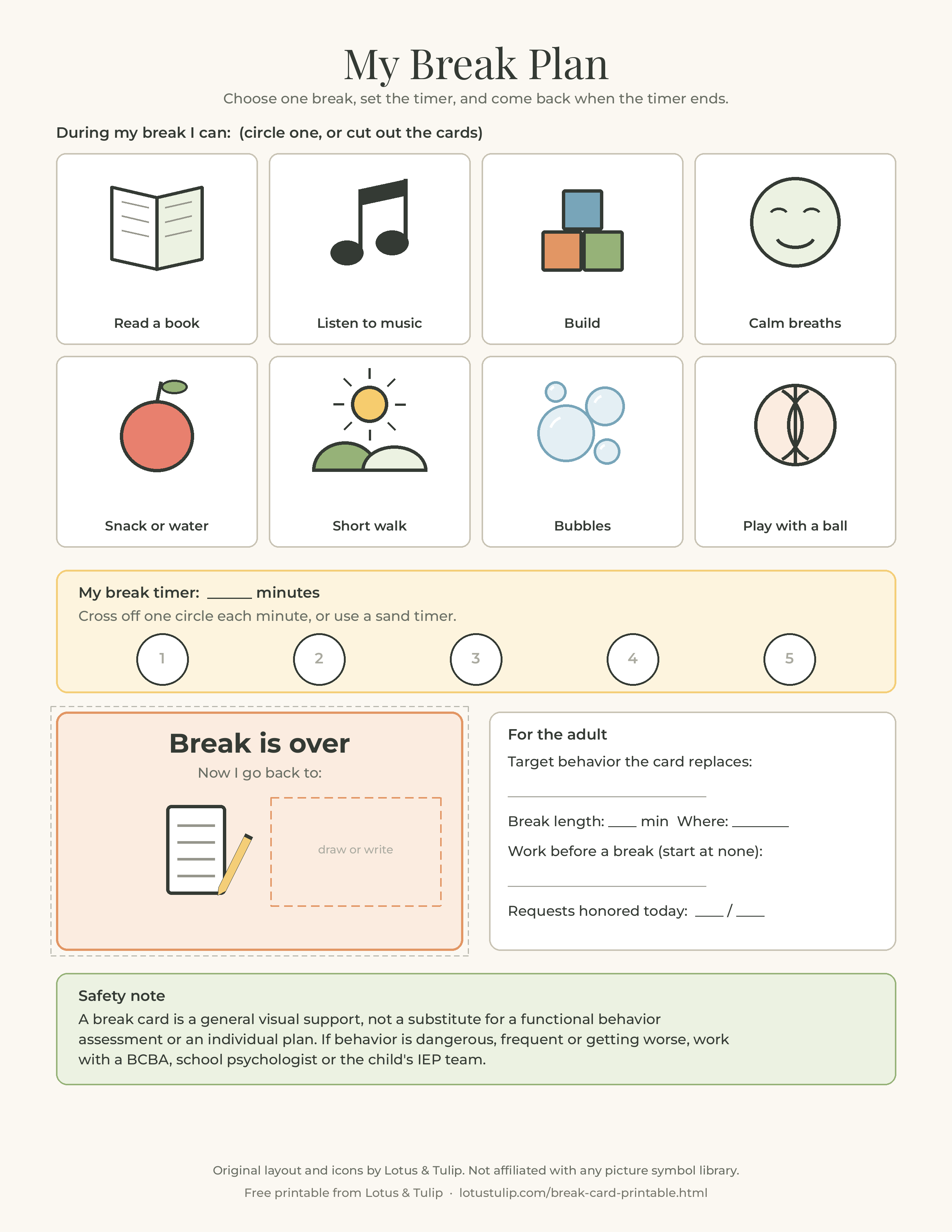
This free printable is an original Lotus & Tulip design with its own simple icons, on US Letter. Page 1 has two large break cards ("I need a break" for younger children and "Break, please" for older students), four communication cards (I need a break, help please, wait, all done), six small break cards for a lanyard or desk and a short teaching guide. Page 2 is a break plan: a choice board with eight calm break options, a break timer to cross off minute by minute, a break is over card with space to draw or write the task, notes for the adult and a safety note.
Download the free break cards (PDF, 2 pages, US Letter)
Prefer single images? Page 1: break cards and communication cards (PNG) · Page 2: break plan, timer and break is over card (PNG)
Print on card stock and laminate. Free to print for use with your own students, clients or children. Please link to this page rather than re-uploading the file. A general visual support, not a substitute for a functional behavior assessment or an individual plan from the child's team.
Related resources
- Behavior contract for students: a free contract template and weekly point tracker
- Calm down corner ideas (free calm down steps printable)
- Token board printable (free 3, 5 and 10 token boards)
- First then board printable (free picture cards)
- Free visual schedule printable
- Breathing exercises for kids (free breathing cards)
FAQ
What is a break card?
A break card is a picture card a child hands over, taps or points to when they need a short pause from a task. An adult honors the request with a brief, planned break, usually a few minutes with a timer, and then the child returns to the task.
Is a break card an accommodation in an IEP or 504 plan?
Access to breaks, often with a break card, is a common accommodation in IEPs and 504 plans. The plan should say how the student asks, how long a break lasts, where it happens and how the student returns, so every adult handles it the same way.
What if a child asks for a break all the time?
In the early days that is expected, and it is better than the old behavior. Once the child asks reliably, slowly ask for a little work before each break, for example with a first then board, and add scheduled breaks. Increase in small steps and go back a step if problem behavior returns.
How long should a break be?
Short and predictable. Many teams start with 1 to 3 minutes on a visual or sand timer. Older students may have a set 3 to 5 minute break written into their plan. The return to the same task is part of every break.
Is a break card ABA?
Teaching a break request is a form of functional communication training, which comes from applied behavior analysis. Special education teachers, speech and occupational therapists, school counselors and parents use break cards too. For dangerous or frequent behavior, work with a BCBA or the child's team.
Is this break card printable free?
Yes. It is free to print for use with your own students, clients or children. Please link to this page rather than re-uploading the file.