
Counseling worksheets · Updated 2026-11-03
Calm down corner ideas: how to set up a calm corner at school or home (free calm down steps printable)
Ready-made printable: Coping Skills Cards for Kids and Teens Holiday 20% off: about $5.52, was $7 (EUR 6) · instant digital download
Buy on Etsy
A calm down corner is a small, cozy spot where a child can choose to take a break, use a calming tool, and then rejoin the class or the family. Done well, it teaches children a skill they keep for life: noticing a big feeling and doing something about it before it turns into a meltdown. Done badly, it becomes a time out chair with pillows. This guide is for teachers, school counselors, special education teams, child therapists and parents. It covers the one rule that matters most, what to put in the corner (and what to leave out), how to teach it step by step, ideas sorted by age, how to handle the common problems, and an FAQ. It ends with a free one page "My Calm Down Steps" printable on US Letter paper.
Jump to the free calm down steps printable
Rule number one: it is a break, not a punishment
The National Center for Pyramid Model Innovations (NCPMI), a federally funded center that supports social emotional teaching in early childhood, puts this first in its guide to a "Cozy Corner": the space is not a time out space, and children should not be forced to go there. They choose to visit, take a break and calm down. That only works if adults have taught the children what the corner is for, how to use it and what happens when they come back.
The reason matters. Children learn to regulate their feelings with an adult before they can do it alone. A 2015 report for the federal Office of Planning, Research and Evaluation (Murray, Rosanbalm and colleagues, Self-Regulation and Toxic Stress) describes this as co-regulation: warm, responsive adults who provide support, coaching and modeling so a child can understand, express and manage their thoughts, feelings and behavior. A calm corner is a tool for that process, not a replacement for it. The adult still checks in.
Where to put a calm down corner
- Visible to you, private for them. NCPMI's advice: you should be able to see the child, but the spot should feel a little tucked away. A bookshelf, a small tent or the corner behind a reading rug works well.
- Away from the busiest traffic. Not next to the door, the sink or the pencil sharpener.
- Small on purpose. One child at a time is the usual design, which keeps it calm and stops it becoming a social spot.
- At home: a beanie bag in a quiet corner of the living room, a pillow nook under a loft bed, or a basket that can travel. It does not need to be in the child's bedroom, and some families prefer it in a shared room so an adult is close.
What to put in a calm down corner
Fewer, well taught tools beat a full sensory shop. Start with four or five, then rotate.
| Type of tool | Examples | Why it helps |
|---|---|---|
| Something to sit on | Beanbag, floor cushion, small rug | Signals "this is a resting place" |
| Breathing visuals | Breathing cards, a pinwheel, a picture of "smell the flower, blow out the candle" | Slow breathing is easier to remember with a picture |
| Hands busy | Stress ball, putty, fidget, a soft toy to hug | Gives the body something to do |
| Quiet focus | Calm down cards, coloring sheets, a picture book, an "I spy" bottle | Shifts attention away from the trigger |
| Feelings check | A feelings chart or feelings thermometer | Helps the child name the feeling before and after |
| A way to come back | A sand timer (3 or 5 minutes), the calm down steps poster | Makes the break predictable and time limited |
Leave out: screens, anything that turns the corner into the most exciting place in the room, items that can be thrown hard, and tools you have not taught yet. For children with sensory needs, ask an occupational therapist which sensory items suit that particular child.
How to teach the calm down corner, step by step
- Introduce it when everyone is calm. Show the corner at circle time or at the kitchen table, not in the middle of a meltdown. NCPMI suggests opening it first like a learning center so children can explore every tool.
- Teach feeling words. Mad, sad, worried, frustrated, calm. A child has to notice a feeling before they can use the corner for it.
- Teach the steps. Keep them short and the same every time: notice my feeling, go to the calm corner, choose a calm tool, use it until the timer ends or I feel calmer, check in, go back. The free printable below shows these steps.
- Model it yourself. "I'm feeling frustrated. I'm going to take three slow breaths." Children copy what adults do far more than what they say.
- Practice on good days. Role play: one child pretends to feel upset, walks to the corner, uses a tool and comes back. Make it a little game.
- Agree on a signal. A card, a hand sign or a simple "I need a break" lets a child ask without a scene.
- Always check in afterwards. Praise the break ("You noticed you were upset and you took care of yourself"), then ask briefly what happened and what helped. Problem solving comes after calming, not during it.
Calm down corner ideas by age
| Age | Ideas that tend to work |
|---|---|
| Preschool and kindergarten (about 3 to 5) | Picture based steps, a soft toy, a sand timer, two or three tools only, an adult nearby. NCPMI's Turtle Technique (recognize the feeling, stop your body, go into your "shell" and take three deep breaths, come out when calm) is a good fit at this age. |
| Early elementary (about 6 to 8) | Calm down cards to choose from, a feelings thermometer, coloring and breathing cards, a short "how do I feel now?" check. |
| Upper elementary (about 9 to 11) | Let students help design and name the space. Add journaling prompts, a coping skills list and a simple sign out sheet. |
| Middle and high school | Call it a reset space or calm space. Headphones with calm music (where school policy allows), grounding cards, a water bottle and a quick return plan. Teens care a lot about privacy, so keep it low key. |
| Home | A family "calm basket" with the child's favorite three tools, and a parent who sometimes uses it too. |
Common problems and what to do
- Everyone wants to go at first. NCPMI notes this novelty effect is normal and usually fades. If a child keeps choosing the corner to escape one activity, look at that activity: is it too hard, too long, or less interesting than the corner?
- Two children want it at once. Use a timer and a waiting spot, or treat it as a sign the whole class needs a short movement or breathing break.
- A child stays too long. Use a sand timer and a clear coming back step, then check in.
- A child refuses to go. Do not force it. Offer the tool where they are ("Do you want the squeeze ball here?") and stay calm and close.
- It still feels like time out. Check your language. "Go to the calm corner" said in an angry voice is a punishment. "Would a break in the calm corner help?" is an offer.
- Behavior is unsafe or very frequent. A calm corner is a universal support. Children with frequent intense outbursts often need an individual plan with the school counselor, school psychologist or behavior team, and a visual schedule can help too.
Free calm down steps printable
This one page "My Calm Down Steps" printable is an original Lotus & Tulip design. It shows five simple steps (notice my feeling, go to my calm spot, choose a calm tool, use it until I feel calmer, check in and go back), a grid of eight calm tool choices with check boxes, a "How big is my feeling?" 1 to 5 scale for before and after, a line for the child's own idea, and a box for the adult to write the agreed signal and time limit. Print it on US Letter, laminate it, and post it in the corner or keep it in a calm basket.
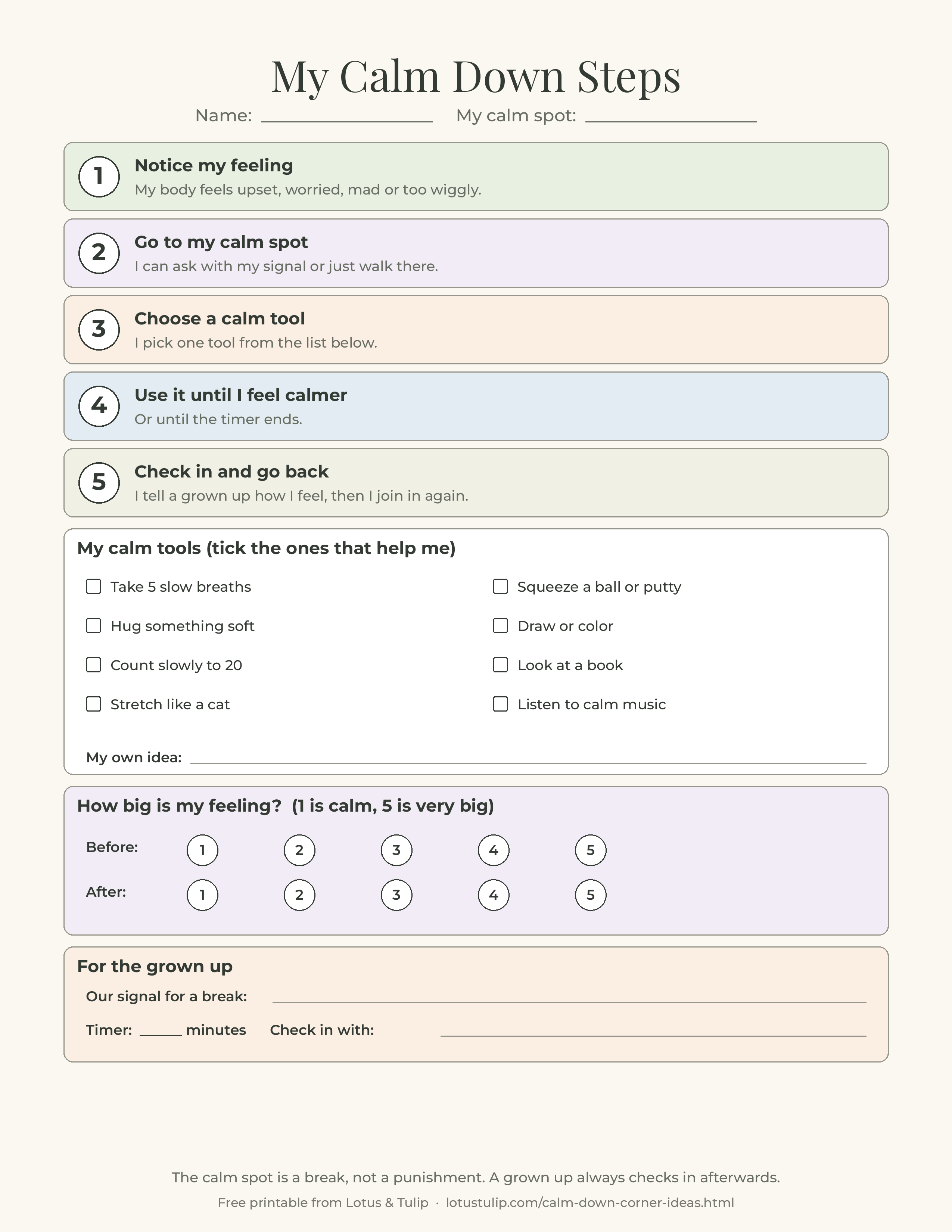
Download the free calm down steps printable (PNG, US Letter)
Free anger management starter pack: Setting up a calm down corner for an angry child? The free anger management worksheets starter pack adds a cool-off menu of 24 coping skills and a cool-down plan from our paid anger set, plus an anger thermometer, the anger iceberg, stop, think, choose and a support and safety page.
Free to print for use with your own students, clients or children. Please link to this page rather than re-uploading the file.
Related resources
- Sensory processing activities for kids: too much, too little and seeking, with a free sensory map and day plan
- Interoception activities for kids: how to teach body clues (free worksheet and check-in plan)
- Break card printable: how to teach an I need a break card (free break cards and break plan)
- Coping skills list for kids (free printable)
- Feelings thermometer printable (free printable)
- Feelings wheel printable for kids (free printable)
- 5 4 3 2 1 grounding worksheet (free printable)
- Circle of control worksheet (free printable)
FAQ
What is a calm down corner?
A calm down corner is a small, comfortable space in a classroom or home where a child can choose to take a short break, use a calming tool such as breathing cards or a stress ball, and then rejoin the group once they feel calmer.
Is a calm down corner the same as time out?
No. A time out removes a child as a consequence. A calm down corner is a break the child chooses, taught in advance, with an adult who checks in afterwards. The National Center for Pyramid Model Innovations says children should not be forced to go there.
What should I put in a calm down corner?
Start small: something soft to sit on, breathing visuals, one or two hand fidgets, calm down cards or a book, a feelings chart and a sand timer. Leave out screens and anything that makes the corner more exciting than the classroom.
How long should a child stay in the calm corner?
Many teachers use a 3 to 5 minute sand timer, then a quick check in. Adjust for the child's age and needs, and always end with a clear coming back step.
Do calm corners work for teenagers?
Yes, with older students it usually works better as a low key "reset space" with grounding cards, music where allowed and a quick return plan. Let teens help design it and protect their privacy.
Is this calm down printable free?
Yes. It is free to print for use with your own students, clients or children. Please link to this page rather than re-uploading the file.