
Counseling worksheets · Updated 2026-11-03
Daily check in for students: how to run an emotional check in that actually helps (free daily check in sheet)
Ready-made printable: Kids Feelings and Social Skills Worksheets for Counselors and Therapists Fillable PDF, 20 pages: feelings thermometer, calm down plan, friendship skills check, kind words cards and more
Holiday 20% off: about $11.04, was $14 (EUR 12) · instant digital download
Try it free first: download a fillable sample (feelings thermometer and calm-down plan, PDF, 240 KB). Type into it on screen, then get the full pack. No email needed.

A daily emotional check in takes a minute or two. Students notice how they feel, say what they need, and a trusted adult reads it and follows up with the few who need more. It is one of the simplest ways to build social emotional skills into a normal school day, and it helps adults spot a struggling student before a hard morning turns into a hard day. This guide is for teachers, school counselors, special education teams and child therapists. It covers what a check in is (and is not), five ways to run one, check in questions by age, how to follow up, privacy, common mistakes and an FAQ. It ends with a free one page weekly "My Daily Check In" sheet on US Letter paper.
Jump to the free daily check in sheet
What a daily check in is for
The Collaborative for Academic, Social, and Emotional Learning (CASEL) groups social and emotional learning into five areas: self-awareness, self-management, social awareness, relationship skills and responsible decision-making. A daily check in mostly practices the first two. Naming a feeling ("I feel worried") is self-awareness. Choosing what would help ("I need a short break") is self-management. Doing it every day, in the same simple way, is what turns it into a habit.
It also gives adults information. A student who writes "tired, energy 1, need a snack" three days in a row is telling you something worth a quiet conversation.
What a check in is not
- Not a mental health screening. A feelings chart cannot diagnose anything. Formal screening is a separate process run by trained staff with parent communication and a plan for results.
- Not a behavior point card. Check-In/Check-Out (CICO) is a different, structured Tier 2 intervention used in schools that run Positive Behavioral Interventions and Supports (PBIS). In CICO, a student meets an adult each morning, carries a daily progress report on which teachers rate the school's 3 to 5 behavior expectations on a 0 to 2 scale, and checks out at the end of the day. An emotional check in is a whole class routine about feelings and needs, and nobody gets graded on how they feel.
- Not something to show the class. Feelings belong to the student. Keep individual answers private.
Five ways to run a daily check in
| Method | How it works | Best for |
|---|---|---|
| Paper check in sheet | Each student keeps a weekly sheet in a folder and fills in one row each morning (and afternoon, if you like). You skim the folders while they start work. | Grades 1 to 8, small groups, counseling caseloads |
| Feelings chart with private pockets | Students drop a card with their name into the pocket that matches their feeling. Only the adult looks inside. | Pre-K to grade 2 |
| Sticky note or index card | Students write a feeling word and a 1 to 5 number, fold it and hand it in at the door. | Middle and high school, quick days |
| Digital form | A short form with two or three questions, filled in on a school device. | Older students in 1:1 device classrooms, if your district allows it |
| Thumb or fist to five | Students hold up a number at once with eyes closed, or show it only to you. | Very quick whole group reads, never for personal details |
Whatever you choose, keep it the same every day. Predictability is the point.
Daily check in questions by age
| Age | Questions that tend to work |
|---|---|
| Pre-K and kindergarten | Which face is like me today? Is my body calm or wiggly? Do I need a hug, a break or a drink of water? |
| Grades 1 to 3 | How do I feel right now? How full is my energy, 1 to 5? What do I need to have a good morning? |
| Grades 4 to 6 | What is one word for how I feel? What is on my mind today? Is there anything I want an adult to know? |
| Middle and high school | Rate your day so far from 1 to 5. What is one thing that would help today? Do you want a check in with me or the counselor? (yes / not today) |
Two or three questions is enough. Long surveys get rushed answers.
How to start, step by step
- Teach the feeling words first. Start with six (happy, okay, tired, worried, sad, mad) and add more over the year. A feelings wheel helps older students find a more exact word.
- Model it. Fill in your own check in out loud for the first week: "I feel a bit tired. My energy is a 3. I need my coffee and a calm start."
- Pick one time. Arrival, morning meeting or the start of first period works for most classes. An afternoon check out is a nice addition, not a must.
- Tell students who reads it. "I read every sheet. If you check 'talk to an adult', I will find you today." Then keep that promise.
- Follow up quietly. A short, private "I saw your check in. Want to tell me about it?" is enough for most students.
- Look for patterns weekly. One bad day is normal. Several low days in a row, a sudden change, or "talk to an adult" more than once is worth a conversation with the student, and possibly the school counselor.
Following up: what to do with the answers
- "I'm good" and high energy: nothing to do, a smile is fine.
- Tired or hungry: water, a snack if your school has them, a seat near the window, a gentler start.
- Worried, sad or mad: a private word, a short break, or a calming tool. The calm down corner guide and the coping skills list for kids have ideas.
- "Talk to an adult": follow up the same day, even if only to schedule a time.
- Anything about safety: if a student writes or says something about self harm, abuse, or someone hurting them, follow your school's crisis and reporting procedures right away and involve the school counselor or administrator. In the US, the 988 Suicide and Crisis Lifeline is available by call or text at 988.
Privacy and trust
Students will only be honest if it feels safe. Keep sheets in folders, not on the wall. Do not read answers aloud or compare students. Tell families what the routine is and why. If you use a digital form, check your district's rules about collecting student data before you start, and never collect more than you need.
Common mistakes
- Asking and never following up. Students stop answering honestly if nothing happens.
- Treating "sad" as a problem to fix. All feelings are allowed. Sometimes the right response is "Thanks for telling me. I'm here if you want to talk."
- Making it a public display. A chart with names that everyone can see turns feelings into gossip.
- Skipping the teaching. A check in only works when students have words for feelings and know what each "I need" option means.
- Too many questions. Keep it to a minute.
Free daily check in sheet
This one page "My Daily Check In" sheet is an original Lotus & Tulip design. It covers one school week: a feelings key with six simple faces (happy, okay, tired, worried, sad, mad), then a row for each day from Monday to Friday with space to write or draw a morning feeling, a 1 to 5 energy scale, five "I need" check boxes (I'm good, a short break, talk to an adult, water or snack, help with work) and an afternoon feeling. A box at the bottom asks for one good thing from the week. Print it on US Letter, keep one per student in a folder, and swap in a fresh sheet each Monday.
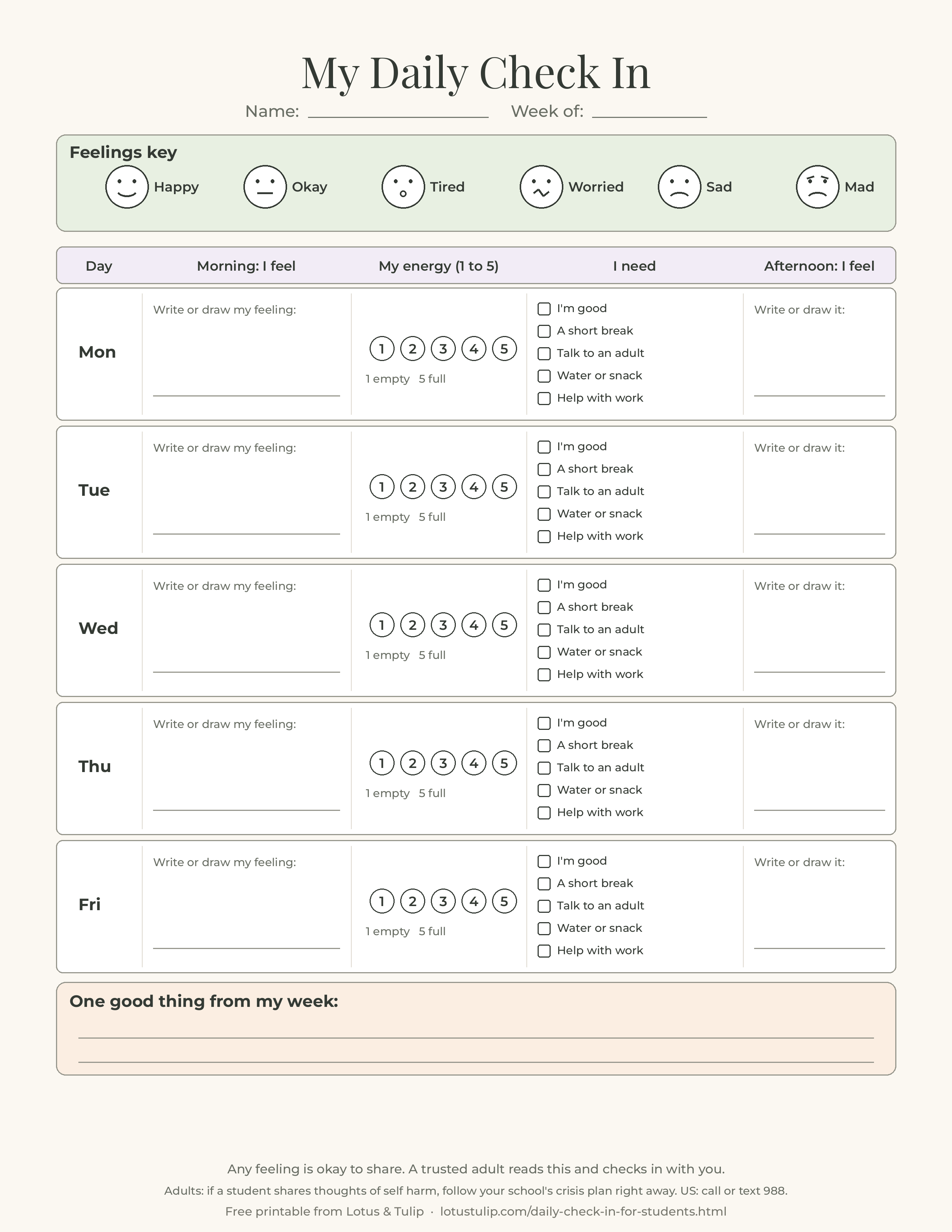
Download the free daily check in sheet (PNG, US Letter)
Free to print for use with your own students, clients or children. Please link to this page rather than re-uploading the file.
Related resources
- Self-monitoring checklist for students: when the goal is staying on task, a free self-check sheet and weekly graph
- Behavior contract for students: pair a daily check in with one clear goal and a point tracker
- Feelings thermometer printable (free printable)
- Feelings wheel printable for kids (free printable)
- Calm down corner ideas (free calm down steps printable)
- Coping skills list for kids (free printable)
- Circle of control worksheet (free printable)
FAQ
What is a daily check in for students?
A daily check in is a short routine, usually at the start of the school day, where students note how they feel and what they need, and a trusted adult reads the answers and follows up privately with students who need support.
Is a daily emotional check in the same as Check-In/Check-Out (CICO)?
No. CICO is a structured Tier 2 PBIS intervention for selected students, with a daily progress report on which teachers rate behavior expectations. An emotional check in is a whole class routine about feelings and needs, and it is not scored.
What questions should I ask in a check in?
Keep it to two or three: how do you feel, how much energy do you have from 1 to 5, and what do you need today. Older students can add whether they want to talk to an adult.
How long should a daily check in take?
About one to two minutes for students. The adult then needs a few minutes to skim the answers and plan quick follow ups.
What if a student writes something worrying?
Follow up the same day. If it involves self harm, abuse or safety, follow your school's crisis and reporting procedures immediately and involve the school counselor or an administrator. In the US, the 988 Suicide and Crisis Lifeline is available by call or text.
Is this daily check in sheet free?
Yes. It is free to print for use with your own students, clients or children. Please link to this page rather than re-uploading the file.