
Therapist marketing · Updated 2026-11-09
Instagram Post Ideas for Estheticians (with Free Printable)
Ready-made template kit: Esthetician Instagram Templates Holiday 20% off: about $22.08, was $28 (EUR 24) · instant digital download
Buy on Etsy
Instagram posts for estheticians sit in one of the most crowded, most filtered and most overclaimed corners of the internet. The person who finds your profile has usually seen a hundred glowing close-ups that day, half of them edited, many of them selling a serum with a promise. They are a little wary: Is this person actually licensed? What happens in a facial? Will it sting? What is that peel going to do to my skin? Is this a spa, a medspa or a doctor's office? At the same time, the algorithm rewards dramatic before and after reels, "erase your acne" captions and product hauls with discount codes. Your state board, the FDA's line between cosmetics and drugs, the FTC's rules on endorsements and reviews, and the clients who trust you with their faces reward the opposite: your real license and title, plain words about what a facial involves, no promised results, no drug claims for cosmetic products, no before and after photos used as proof, and a feed that reads as calm, careful and professional.
This guide is written for US estheticians and the small businesses around them: solo licensed estheticians, skin care studios and facial rooms, suite renters, estheticians who work inside a dermatology or plastic surgery practice, spa teams that offer facials alongside massage, mobile and event estheticians, front desk staff who run a studio account, and social media managers who post for a skin care business. It covers what to post on Instagram as an esthetician: why the job is different from beauty influencer content, what a state esthetician license, a master esthetician license and the new licensure compacts actually mean and how to show them honestly, why "medical esthetician" is a risky phrase, how scope of practice limits what you can advertise, the FDA's cosmetic versus drug line and the words that cross it, why before and after photos carry FTC and privacy risk and what consent looks like, the FTC rules on testimonials, reviews, affiliate codes and fake followers, client privacy and when HIPAA applies, safety posts built on FDA and AAD guidance, sourced public education on cleansing, sunscreen, patch testing, exfoliation and skin checks, prices, memberships and gift cards, ten content pillars, 34 post ideas with original caption angles, six fuller captions, DM scripts that refuse to diagnose by message, a two or three posts a week rhythm and a 12 week overview, the dates that suit a skin care feed, a nine step HowTo, mistakes, myths, three fictional examples, two comparison tables, when not to post, research notes and a free three page US Letter printable: Esthetician Posting Steps, an Esthetician Content Planner and an Esthetician Post Care Check with pocket cards.
If you share a building or clients with other practitioners, neighboring pages may help: Instagram post ideas for massage therapists covers the massage side of a spa, esthetician client forms explains intake, consent and photo release paperwork, and holiday social media posts for therapists has a December and January calendar that adapts well to a gift card season. This page stays with the questions estheticians tend to face: how to look credible without before and after photos, how to educate without diagnosing strangers, how to sell retail products without making drug claims, and how to keep a feed that no one could mistake for a medical practice unless it is one.
What this guide is and is not
This is a practical content guide for licensed estheticians in the United States. It is not legal advice, it is not medical advice and it does not replace your state's cosmetology or esthetics law, your board's rules, your medical director's policies if you work in a medical practice, or your liability insurer's guidance. Esthetics is regulated state by state, usually by a board of cosmetology or barbering and cosmetology, and the lines between esthetic services and medical procedures are drawn differently in different states. Read your own rules before you post, and treat every example below as a starting point you check against them.
Every factual statement here was checked against a primary or official source: the Bureau of Labor Statistics Occupational Outlook Handbook, the FDA's cosmetics, sunscreen and complaint reporting pages, the American Academy of Dermatology (AAD), the California Board of Barbering and Cosmetology and the California Code of Regulations, the Texas Department of Licensing and Regulation (TDLR), the Virginia Board for Barbers and Cosmetology, the National-Interstate Council of State Boards of Cosmetology (NIC), the Cosmetology Licensure Compact and the Council of State Governments, HHS HIPAA guidance and the FTC's endorsement guides, health products compliance guidance and consumer review rule. Where a source was only seen through search results rather than opened in full, or was checked in our research the day before, the research notes at the end say so. We used no industry survey figures, no wage figures and no claims about what any facial or ingredient "proves."
The post ideas, captions and fictional studios are original to this page. They are examples of tone and structure, not scripts to copy word for word. Your clients, your state and your style should change them.
Why posting as an esthetician is different from beauty influencer content
A beauty influencer can post a glowing selfie, a serum and a promise. An esthetician posting the same way runs into problems that other creators never face, for five reasons.
First, your title is a state license. The BLS Occupational Outlook Handbook says skincare specialists must complete a state-approved cosmetology or esthetician program and then pass a written and practical exam to get a state license, and that licensing requirements vary by state. That makes "licensed esthetician" a regulated description, not a style. In many states, using a license title you do not hold, or advertising services outside your license, is something a board can act on, and your Instagram profile is part of how you advertise.
Second, your services sit right next to medicine. BLS says estheticians evaluate the skin, recommend products and refer clients to a dermatologist for serious skin problems. A few steps away from a facial are procedures that only physicians or people working under their delegation may perform in many states: injections, lasers, medium and deep peels and anything that goes below the epidermis. A caption that blurs that line ("we treat acne," "laser-level results," "medical-grade peel") can advertise a service you are not allowed to provide.
Third, the products you use and sell are regulated by what you claim. The FDA says whether a product is a cosmetic or a drug is decided by its intended use, and that intended use can be established by claims in advertising, on the internet and in other promotional materials. The same moisturizer can be a cosmetic in one caption and an unapproved drug in another. Estheticians who sell retail or private label products need to know this line better than almost anyone on Instagram.
Fourth, much of the profession is self-employed and part-time. BLS says some skincare specialists are self-employed (29 percent in its industry table), that part-time work is common, that schedules may include evenings and weekends, and that those who run their own salons also arrange their own advertising. You are probably your own marketing department, standing most of the day. Two or three thoughtful posts a week beats a daily reel you cannot sustain.
Fifth, your audience includes regulators, physicians and referral partners. BLS lists offices of physicians and offices of other health practitioners among the industries that employ skincare specialists. A dermatologist deciding whether to refer to you, a medspa owner deciding whether to hire you, and a board investigator reviewing a complaint will all scroll your feed. Post as if all of them are reading, because sometimes they are.
Esthetician licenses, master estheticians, compacts and how to show them honestly
Credentials are the first thing a careful new client checks and the first thing a board looks at. Getting them right on Instagram is simple once you know the landscape.
Licensing varies by state
BLS describes the basic pattern: a state-approved cosmetology or esthetician program, then a written and practical state exam, with requirements that vary by state and continuing education available in many states. Training hours, exam content, renewal periods and which services are included all differ. Virginia, for example, lists 600 hours in a licensed Virginia school (or a registered apprenticeship or equivalent training) plus written and practical exams for an esthetician license. Other states set different hours. Do not post "estheticians train for X hours" as if it were national. Name your own state, or link your board.
National exams, state licenses
Many states use examinations developed by the National-Interstate Council of State Boards of Cosmetology (NIC), which offers national theory, practical and written practical exams for esthetics among other fields, administered by states and testing companies with NIC's authorization. Passing an exam is a step toward a license; the license itself comes from your state. "Nationally licensed esthetician" is not a thing. There is no national esthetics license.
Master esthetician and other advanced titles
A few states have a second tier. Virginia's Board for Barbers and Cosmetology, for example, issues a master esthetician license that requires holding a Virginia esthetician license, completing 600 hours of master esthetics training (or an equivalent route) and passing written and practical exams. Some other states have advanced licenses under their own names. If your state issues an advanced license and you hold it, use that exact title with the state. If your state does not issue one, do not borrow the title from a state that does, and never let an advanced course certificate read like a license.
"Medical esthetician" and "medical-grade"
These are some of the most common phrases on esthetician profiles and some of the riskiest. Texas is a clear example of why. TDLR's medical spa guidance says that regardless of a facility's name (salon, medical office, medspa, medispa and so on), an esthetician may provide the services within the scope of the esthetician license, and that other medspa services such as botox and filler injections, body cavitation and contouring, laser-assisted skin treatments and medical-grade facial treatments are medical treatments that must be provided under the order and delegation of a licensed physician. Working in a medical office does not change what your esthetician license covers. On Instagram, "licensed esthetician working in [Dr. Name]'s dermatology practice" is accurate. "Medical esthetician" on its own can suggest a medical license that does not exist in your state, and "medical-grade facial" can advertise a medical treatment. Check your state's rules and your employer's policy before you use either.
Licensure compacts: what is real in 2026
Clients who travel and estheticians near a state border sometimes ask whether one license covers several states. Two separate interstate compacts are relevant, and it is easy to get them wrong.
- The Cosmetology Licensure Compact covers cosmetologists. It reached its seventh member state in June 2024, its commission first met in October 2024, and in September 2026 the Arizona Barbering and Cosmetology Board announced that it had become the first state to issue multistate cosmetology licenses. It does not cover a standalone esthetician license, and multistate licensees must still follow the scope of practice rules of the state where they work.
- The Esthetics Licensure Compact covers estheticians. The Council of State Governments lists Alabama, Kansas and Virginia as members (all joined in 2026). It needs seven member states before its commission can form, so it is not yet issuing anything.
Until your board says otherwise, assume you may only practice where you hold a license, and do not advertise services in a state where you are not licensed. A short, accurate post about the compacts can be genuinely useful to colleagues, as long as you date it and link the official compact pages.
How to show credentials on your profile
- Name, title and state. "[Name], licensed esthetician, [State] license #[number]" is clear, and it is a format a new client can check against your board's lookup.
- Use only the title your state gives you. Esthetician, master esthetician, cosmetologist, or a combined license such as Texas's manicurist and esthetician: use the one on your license.
- Link the board lookup. Pin a "How to check your esthetician's license" post that links to your board's license search. It costs nothing and earns more trust than any testimonial.
- Training is not a license. A brand's peel training, a device certification or an advanced course is worth mentioning ("I've completed [brand] training in [service]"), but it does not expand your scope. If your state does not allow a service, a certificate does not make it legal.
- Say where you work, not what you are not. "Licensed esthetician at [Practice], a dermatology office" is honest. A white coat photo, a stethoscope prop or "skin doctor" in your bio is not.
Scope of practice: what an esthetician can advertise
You may only advertise what you are licensed to do, and that list changes at state lines. Two state examples show how specific the rules can be.
California
The California Board of Barbering and Cosmetology describes esthetics as giving facials, applying makeup, applying eyelashes, removing hair by waxing or tweezing and providing skin care, and says a California esthetician cannot use medium-grade or medical-grade skin exfoliants, use any type of laser, remove hair with light waves, or remove skin tags or moles. California's regulations go further. Title 16, section 991 treats as an invasive procedure any product, device, machine or technique that removes, destroys, cuts or pierces the skin beyond the epidermis, and lists examples including electricity that visibly contracts muscle, substances that require a medical license to purchase, metal needles (other than electrolysis needles), abrasion below the epidermis and removing skin with a razor-edged tool. Section 992 says only the epidermis may be removed, only to improve appearance, and only with over-the-counter products not sold for physician use. The Board's consumer handout on chemical exfoliation says cosmetologists and estheticians are limited to light or superficial chemical exfoliation and that medium or deep peels require a dermatologist.
Texas
TDLR's scope of practice guide says a licensed Texas esthetician can perform or advertise beautifying and cleansing treatments of the face, neck, shoulders or arms, facial treatments, body hair removal, eyelash extensions and massage of the scalp, neck, shoulders, arms or face, and cannot perform or advertise hair, nail, beard or shaving services. Its medspa page explains that estheticians may perform microdermabrasion only to the extent it removes dead cells from the epidermis without reaching the dermis, may perform light or superficial peels but not medium or deep peels (which it calls medical procedures regulated by the Texas Medical Board), and that an esthetician license does not authorize lasers for hair removal or skin resurfacing, or injections.
Other states and devices
BLS mentions wax, lasers or other approved treatments for hair removal, which reflects that some states allow certain devices under specific rules, while California and Texas do not allow lasers under an esthetician license. That variation is exactly why a nationally copied caption can be legal in one state and a violation in the next. Before you post about any device (LED, microcurrent, radio frequency, microneedling, dermaplaning, lasers, plasma), confirm that your state allows it under your license, under what supervision, and with what training. If you cannot find a clear yes from your board, leave the device out of your advertising.
What that means on Instagram
- Advertise services, not diagnoses. "Facial for oily skin" describes a service. "Acne treatment" can describe a medical treatment and a drug claim at once.
- Keep depth words out. "Deep," "medical-grade," "dermal," "clinical strength" and "resurfacing" signal procedures beyond the epidermis in many states.
- Do not advertise what a colleague does under a physician. If your practice offers injectables or lasers delivered by a nurse or physician, say who provides them. Do not let an esthetician account imply you provide them.
- Refer in public. "For moles that change, rashes that won't settle or acne that hurts, see a board-certified dermatologist. I'm happy to work alongside your dermatologist's plan." This is good care and good marketing.
Cosmetic or drug? The FDA line that every caption crosses or doesn't
The single most common way an esthetician's feed drifts into trouble is not a bad photo. It is a sentence about what a product or service will do. The FDA's page "Is It a Cosmetic, a Drug, or Both?" is the clearest guide.
The definitions
Under the Federal Food, Drug, and Cosmetic Act, cosmetics are articles applied to the body for cleansing, beautifying, promoting attractiveness or altering the appearance. Drugs are articles intended to diagnose, cure, mitigate, treat or prevent disease, or to affect the structure or any function of the body. FDA says intended use decides which one a product is, and that intended use can be established by claims on labeling, in advertising, on the internet or in other promotional materials, by consumer perception and by ingredients with well-known therapeutic uses. FDA gives examples of claims that make a product a drug even if it is marketed as a cosmetic, including claims that a product will restore hair growth, reduce cellulite, treat varicose veins, increase or decrease the production of melanin in the skin, or regenerate cells.
Some products are both
FDA says moisturizers and makeup marketed with sun protection claims are cosmetic and drug products, and sunscreens are regulated as drugs in the US. FDA also lists acne medications among the over-the-counter drug categories covered by monographs. That means "this SPF moisturizer protects your skin from the sun" is a drug claim the product must be labeled for, and "this cleanser treats acne" is a drug claim the cleanser must be labeled and allowed to make. Stick to what the product's own label says, especially for sunscreen and acne products.
"Cosmeceutical," "hypoallergenic" and other words with no legal meaning
FDA says the law does not recognize "cosmeceuticals" as a category and that the term has no meaning under the law. FDA also says there are no federal standards or definitions for "hypoallergenic," that the term means whatever a particular company wants it to mean, and that there is no such thing as a cosmetic that can be guaranteed never to cause an allergic reaction. Neither word is a reason to skip a patch test.
Words to watch in captions
| Usually a cosmetic description | Often reads as a drug or medical claim |
|---|---|
| Cleanses, hydrates, softens the look of, smooths the feel of | Treats, heals, cures, prevents, clears acne |
| Brightens the appearance of skin, evens the look of skin tone | Lightens melanin, stops pigment production, fades melasma |
| Gentle exfoliation of dead surface cells | Resurfaces, regenerates cells, repairs the skin barrier, rebuilds collagen |
| A calm facial for oily or dry skin | Acne treatment, rosacea treatment, eczema facial |
| Fragrance free (if the label says so) | Hypoallergenic, safe for all skin, non-irritating |
| Sunscreen claims exactly as printed on the Drug Facts label | "Waterproof," "all day protection," "no need to reapply" |
This table is a starting point, not a legal opinion. Context matters: FDA looks at intended use as a whole, and state boards and the FTC look at the overall impression too. If a caption only works because of a medical verb, rewrite it.
Services count too
Service claims are judged by truth in advertising standards and by your board, not only by FDA. A post that promises "clear skin in three facials" makes a health claim you cannot substantiate. "A calm facial for oily skin, with home care that fits your routine. For acne that hurts or scars, see a dermatologist" is honest and still sells the facial.
Before and after photos: consent, typical results and editing
Before and after photos are the content most esthetician marketing courses push hardest. They are also where three sets of rules meet: the FTC, privacy and your board. If you decide to use them at all, use them carefully. The Morning Basin kit deliberately contains none.
The FTC treats them as testimonials about results
The FTC's Endorsement Guides (16 CFR 255.2(b)) say an ad featuring a consumer's experience on a key attribute will likely be read as representing what consumers will generally achieve. If you cannot substantiate that the result is typical, the ad should clearly and conspicuously disclose the generally expected performance in the depicted circumstances, and you must be able to back that up. The Guides' own example is a "before" and "after" weight loss ad. The FTC's Health Products Compliance Guidance adds that testimonials reporting results more dramatic than users can generally expect are likely to be deceptive and that disclaimers like "results not typical" do not cure the deception. For an esthetician, a dramatic before and after of a client's breakout clearing reads as "this is what my facials do for skin like yours." If that is not what most clients see, the photo misleads even if it is real.
Editing, lighting and filters
A claim can be made by a picture. Different lighting, angles, makeup, distance or a filter between the "before" and the "after" changes what the image says. If you post comparison photos, use the same light, angle, distance and camera settings, no makeup in either, no filters or retouching, and state the time between photos and what was done. If you would not be comfortable showing your board the unedited files, do not post the edited ones.
Consent is more than a yes in the treatment room
- Get written permission first, separate from treatment consent. A client should be able to say no to photos and still get the same service. A dedicated photo and social media release, signed before any photo is taken, makes that clear.
- Be specific. Say where photos may be used (your Instagram, website, ads), whether the face will be shown, whether the client will be named or tagged, and how long you will keep using them.
- Make withdrawal easy. Tell clients how to ask you to take a photo down, and do it promptly.
- Crop out identifiers you do not need. Tattoos, jewelry, backgrounds and eyes can identify someone even when the face is cropped.
- Keep minors off the feed. Even with a parent's permission, teenage skin photos are a privacy and safeguarding risk that rarely belongs on a public feed.
- If you work in a medical practice, follow its HIPAA policy. Full-face photos are among HIPAA's listed identifiers, so photos taken there may be protected health information (see the privacy section below).
Testimonials, reviews, product deals and the FTC
Esthetician marketing advice often says "post your best client reviews" and "share your affiliate code." The FTC's rules make both more complicated than they sound, and your state may add its own limits.
Testimonials must be supported, not just sincere
Under 16 CFR 255.2(a), an ad using consumer endorsements about a product's performance is read as a claim that the product works for that purpose, so the advertiser needs the same substantiation it would need to make the claim directly, and consumer endorsements themselves are not competent and reliable scientific evidence. The FTC's Health Products Compliance Guidance says the same in plain words: it is not enough that a testimonial reflects the honest experience of the endorser. A review saying "her peel cleared my melasma" is a drug and medical claim made through someone else's mouth. Reposting it is risky even if every word is true.
Reviews: invite everyone, reward no one for sentiment
The FTC's Rule on the Use of Consumer Reviews and Testimonials (16 CFR Part 465, 2024) makes several practices violations outright:
- Writing, creating or selling fake reviews or testimonials, including ones that misrepresent the reviewer's experience (465.2).
- Giving compensation or incentives in exchange for, or conditioned on, reviews expressing a particular sentiment, positive or negative (465.4). "Free brow wax for a five star review" is exactly this.
- Reviews or testimonials by officers or managers without a clear disclosure of their relationship, and soliciting undisclosed reviews from employees or relatives in certain situations (465.5).
- Using unfounded legal threats, intimidation or knowingly false public accusations to suppress reviews (465.7).
- Buying or selling fake followers, likes or views to misrepresent influence for a commercial purpose (465.8).
The Endorsement Guides add that inviting only happy clients to post reviews can be deceptive, while inviting every client is fine. The simple, compliant habit: send every client the same short "We'd value an honest review" message, or none.
Brand deals, free products and affiliate codes
Skin care brands court estheticians constantly, with free products, wholesale discounts, education trips and affiliate codes. Under 255.5, a material connection, which includes payment, free products, discounts, commissions or other benefits, must be disclosed clearly and conspicuously when your audience would not expect it. Part 465 defines clear and conspicuous for social media as unavoidable: not something a viewer has to click or hover to see. In practice, that means not hidden behind "more," not only in your bio and not in faint text. "Ad," "Paid partnership" or "[Brand] sent me this serum for free" in the first line works. If you post an affiliate or discount code that earns you money, say so. If you are a brand's educator or ambassador, say so on every post about that brand.
You are an expert endorser
When a licensed esthetician recommends a product, the FTC treats the recommendation as an expert endorsement, which must reflect a real exercise of that expertise (255.3). "I've used this cleanser in my treatment room for a year and like that it rinses clean without a tight feeling" is fine. "This serum fixes hyperpigmentation" is a drug claim you cannot make, whoever says it.
Client privacy, HIPAA and replying to reviews
Many estheticians assume HIPAA does not apply to them, and many are right. But privacy still matters for everyone, and the safest feed treats every client's information as confidential.
When HIPAA applies
HHS explains that a health care provider is a HIPAA covered entity only if it transmits health information electronically in connection with a transaction for which HHS has adopted a standard, such as electronic insurance claims. A cash-only day spa or solo studio is usually not a covered entity. An esthetician employed by a dermatology or plastic surgery practice that bills insurance electronically is working for one, and BLS lists offices of physicians among the employers of skincare specialists. If you are unsure, use the HHS covered entity guidance and ask your practice's privacy officer.
If HIPAA applies, HHS's marketing guidance says that, with limited exceptions, the Privacy Rule requires an individual's written authorization before using or disclosing protected health information for marketing. HIPAA's de-identification standard lists full-face photographs and comparable images among the identifiers, so a patient's face photo from that practice is protected information. In 2019, HHS announced a $10,000 settlement and corrective action plan with a Dallas dental practice over social media replies to patient reviews that disclosed patients' information. The lesson travels well beyond dentistry: never confirm in public that a reviewer is a client.
Even when HIPAA does not apply
State privacy and consumer protection laws may still apply, and clients assume discretion. In practice:
- No client photos, names, tags, location check-ins or stories without written permission, and even then think twice.
- No "today's client had the worst congestion I've ever seen" stories. Even anonymous, they can identify someone in a small town.
- No screenshots of messages, intake forms or skin analysis notes, even blurred.
- No extraction videos of identifiable clients, however popular the format.
- Reply to every review, good or bad, in the same neutral style: "Thank you for taking the time to share this. We'd welcome a call at the studio."
Safety posts: reactions, patch tests, skin checks and 911
Most facials are uneventful, and your feed should say so without pretending risk is zero. A short, sourced safety post earns trust and protects clients.
If a product causes a reaction (FDA)
FDA's guidance on cosmetic problems says the first step is to stop using the product and contact your health care provider, and the second is to report the problem to FDA. FDA asks people to report reactions such as a rash, redness, burn, hair loss, infection or any other unexpected reaction, and product problems such as a bad smell, color change or signs of contamination, through MedWatch online, a paper Form 3500B, or by calling 1-888-SAFEFOOD (1-888-723-3366) and choosing option 4. For a life-threatening reaction, FDA's emergency guidance is to call 911 first. On your feed, add your own clear line: "Swelling of the lips, tongue or throat, or trouble breathing? Call 911 now. Don't message us."
FDA also notes that under the Modernization of Cosmetics Regulation Act of 2022 (MoCRA), the "responsible person" whose name is on a cosmetic label must report serious adverse events to FDA within 15 business days. If you sell a private label line with your studio's name on the label, ask your manufacturer and an advisor what that means for you before you post about it.
Patch testing new products (AAD)
AAD recommends testing a new product on a quarter-sized spot where it won't be rubbed off, such as the underside of the arm or the bend of the elbow, twice a day for seven to 10 days, using the normal amount; leaving wash-off products like cleansers on for about five minutes or as directed; and, if a reaction such as red, itchy or swollen skin develops, gently washing it off and not using it again, with a dermatologist visit if the reaction is severe. AAD also notes that some ingredients, such as retinol and glycolic acid, can cause temporary irritation, particularly on sensitive skin. This is one of the most useful, most shareable posts a skin care studio can make.
Skin checks and the ABCDEs (AAD)
Estheticians see skin up close, often more regularly than anyone else in a client's life. You cannot diagnose, but you can encourage a dermatologist visit. AAD's ABCDEs of melanoma are asymmetry, an irregular or poorly defined border, varied color, a diameter usually larger than about 6 millimeters when diagnosed (though melanomas can be smaller) and evolving size, shape or color, and AAD advises seeing a board-certified dermatologist for any spot that is new, different from others, or changing, itching or bleeding. A calm skin check reminder post, with AAD named, is helpful and squarely within scope. Never post "this looks like" about a client's or follower's spot.
Aftercare without promises
If you post aftercare, keep it general and match it to what you actually tell clients: be gentle, skip exfoliating products for the period you recommend, use sunscreen as the label directs, and contact you or a doctor if anything feels severe, unusual or doesn't settle. Do not call peeling, redness or breakouts after a treatment "purging" or proof that it "worked" unless a source you can name says so for that product.
"Not emergency care"
Every skin care account should have one pinned line: "This account isn't monitored for emergencies. In an emergency, call 911." It takes ten seconds to write and matters most on the one night someone needs it. Some studios add the 988 Suicide and Crisis Lifeline (call, text or chat 988) to a safety highlight, because clients sometimes share heavy things in the treatment chair.
Public skin care education you can source and stand behind
Education posts are the backbone of a trustworthy skin care feed. Each of these topics has a primary source you can name on the slide.
How to wash your face (AAD)
AAD's "Face washing 101" recommends a gentle, non-abrasive cleanser without alcohol, lukewarm water, fingertips rather than a washcloth or sponge, no scrubbing, patting dry with a soft towel, moisturizer if skin is dry or itchy, and limiting washing to twice a day and after sweating. It is simple, practical and almost everyone does at least one step differently.
How to choose and use sunscreen (AAD and FDA)
AAD recommends a sunscreen labeled broad spectrum, SPF 30 or higher and water resistant, and notes that water resistance lasts 40 or 80 minutes. FDA's sunscreen page says to apply 15 minutes before sun exposure, that an average adult needs at least one ounce (about a shot glass) to cover the body, to reapply at least every two hours and more often when swimming or sweating, that no sunscreen is "waterproof," that spray sunscreens should never be applied directly to the face, and that a sunscreen without an expiration date should be considered expired three years after purchase. Notice that AAD and FDA give different minimum SPF numbers (AAD recommends 30 or higher; FDA's tips say 15 or higher). If you post a number, name the source it came from.
How to exfoliate safely (AAD)
AAD's "How to safely exfoliate at home" (updated February 2026) says exfoliation isn't for everyone, that the method should suit your skin type, that prescription retinoids and products with retinol or benzoyl peroxide can make skin more sensitive, to apply scrubs or chemical exfoliators gently in small circles for about 30 seconds and rinse with lukewarm water, never to exfoliate open cuts, wounds or sunburned skin, to follow with moisturizer, and that people with darker skin tones, or who get dark spots after burns, bites or breakouts, should avoid strong chemical or mechanical exfoliation because it can lead to more pigmentation. That last point is one of the most valuable things an esthetician can say on Instagram, where aggressive exfoliation trends spread fast.
Cosmetic or drug labels, explained (FDA)
FDA says over-the-counter drugs carry a "Drug Facts" label and that combination products list drug ingredients as "Active Ingredients" followed by cosmetic "Inactive Ingredients." A carousel on how to read a label (Drug Facts with active ingredients, as on a sunscreen, versus an ingredient list alone on a cosmetic) helps clients shop wisely and shows that you know the rules.
"Hypoallergenic" and "fragrance free" (FDA and AAD)
FDA says "hypoallergenic" has no federal definition. AAD suggests products labeled "fragrance free" for people who react to fragrance, and cautions that "unscented" or botanical products may still contain fragrance-related ingredients. A myth vs fact post on these labels is helpful and makes no claims at all.
Questions to ask before you book
A practical list: Are you licensed in this state, and can I look it up? What does this facial include, and how long is it? Which products do you use, and can I patch test them? What should I avoid before and after? What does it cost, and is there a cancellation fee? Who do you refer to if something needs a dermatologist? Turn that into a carousel and it is useful even to people who never book with you.
Prices, memberships, retail, cancellations and gift cards
Money posts are among the most saved and shared on any service feed, because clients hate guessing. They also need care, because every price post is an advertisement.
- Post real prices. Service, length and price, add-ons, and any consultation fee. Price placeholders in a template are only a starting point; check your numbers every month.
- Memberships without pressure. "A monthly facial membership saves $X per visit; cancel with [notice]" is fine. "Lock in before midnight" pressures people into a recurring charge. If you sell recurring memberships, state the price, billing frequency and how to cancel plainly, and check the cancellation and auto-renewal rules in your state.
- Retail and home care. Recommend products the way you would in the room, with no pressure and no drug claims. If a brand pays you commission or gives you perks for promoting it, that is a material connection to disclose when you promote it.
- Cancellation policy. State it calmly, with your notice period and fee, and include an exception for illness and for skin reactions. A client with a new rash or cold sore should feel safe canceling.
- Gift cards. Under the federal gift card rule (12 CFR 1005.20, part of Regulation E), funds on gift certificates and store gift cards generally cannot expire sooner than five years after issue or last load, and some states give more time. Do not post "use it by March" on a gift card promotion unless you have checked federal and state rules.
- Tipping. Customs vary by setting, and many medical practices do not accept tips. Say your policy in one sentence.
Esthetician, dermatologist, medspa provider, cosmetologist, lash artist and massage therapist
Clients mix these up constantly, and a clear "who does what for your skin" post is one of the most useful things you can share, especially if you work in a spa or medical practice. Keep it factual and generous to the other professions.
| Professional | What they typically do | What to say on your feed |
|---|---|---|
| Esthetician | State-licensed skin care: cleansing, facials, light exfoliation, hair removal, product advice; refers serious skin problems to a dermatologist (BLS) | "I'm a licensed esthetician. I don't diagnose skin conditions. I'll tell you when something needs a dermatologist." |
| Dermatologist | Physician who diagnoses and treats skin, hair and nail conditions, including skin cancer | "Changing moles, painful acne, rashes that won't settle: your dermatologist leads. I'm happy to work alongside their plan." |
| Medspa physician, nurse or PA | Medical treatments such as injectables and laser procedures, provided or delegated under medical licenses (TDLR describes this for Texas) | "Injectables and lasers at our practice are provided by [title], not by me." |
| Cosmetologist | Hair, nails and skin services under a cosmetology license, which in many states includes facials | "Hair and nails are with our cosmetologists. Facials are with me." |
| Lash artist | Eyelash extensions and lash services, licensed differently from state to state | "Lash extensions are with [name], who holds [license]." |
| Massage therapist | Licensed body massage; a separate license in most states | "Body massage at our spa is with our licensed massage therapist." |
If you share a building or an account with these colleagues, agree on how each of you describes the others, and never let a shared account imply that a facial is part of a medical treatment plan unless it is.
Ten content pillars for an esthetician's Instagram
Pick five or six of these for any month, plus safety. If you cannot say something true and sourced under a pillar this month, skip it.
- Who you are and your license. Your name, title, state, license number, years in practice and why you chose skin care.
- Your room and your visit. Your space, lighting, hygiene, music options, accessibility and parking, what happens step by step.
- Services and menu. What each facial includes, how long it takes and who it suits, without condition claims.
- Fees, booking and policies. Prices, memberships, cancellation, gift cards, how to book.
- Sourced education. AAD and FDA facts in their own words, with the source on the slide.
- Labels and ingredients. Cosmetic or drug, Drug Facts, "hypoallergenic," "fragrance free," what an ingredient list shows.
- Myth vs fact. "Waterproof" sunscreen, "tingling means it's working," "more exfoliation is better," "estheticians are dermatologists."
- Safety. Patch testing, what to do about a reaction, the ABCDEs, 911, not emergency care.
- Aftercare and home care. General aftercare, sunscreen habits, why you recommend fewer products, not more.
- Community and gratitude. Dermatologists and colleagues you refer to, local partners, awareness months, holiday hours and thank-you posts.
34 Instagram post ideas for estheticians, with caption angles
Each idea has a short caption angle you can rewrite in your own voice. None of them needs a client photo, a testimonial, a before and after or a result promise.
About you and the studio
- Welcome and your approach. "I'm [name], a licensed esthetician in [state], license #[number]. My facials are unhurried, and my advice is simple: fewer products, used well."
- Why I became an esthetician. One honest paragraph about what drew you to skin care, without implying you heal or fix people.
- A tour of the room. Your chair or bed, lighting, how you clean between clients, where you keep products. "Here's exactly where you'll be."
- What's on the menu. Each facial with length and price, one line each, no condition claims.
- Accessibility and getting here. Stairs, parking, bed height, fragrance-free options if you offer them.
- Who I refer to. "If something needs a dermatologist, I'll tell you. That's part of my job."
Your first facial
- Your first facial, step by step. Consultation and forms, cleanse, skin analysis, the facial itself, aftercare chat, rebooking only if you want it.
- What a facial can include. Cleansing, exfoliation, steam, extractions (if you offer them), mask, massage of the face and neck, moisturizer and SPF.
- How to prepare. Tell me about new medications, retinoids, recent sunburn or waxing, and any reactions to products.
- Speaking up during a facial. "Too warm, too firm, stinging, need a break: just say so. I'll check in too."
- Talk or quiet. "Chatty or silent are both perfect."
- First-timer FAQ. Do I need to remove makeup? Will extractions hurt? Can I wear makeup after? Your honest answers.
- Questions to ask before you book. License, products, patch tests, price, cancellation, who you refer to.
Fees, booking and logistics
- Facial menu and add-ons. Clear prices, no countdowns.
- Booking and cancellation policy. Notice period, fee, and "please cancel if you're sick or have a new skin reaction, no fee."
- Running late. "If you're late, we'll still end on time so the next client isn't kept waiting. Here's why."
- New client openings. A simple, true announcement: dates and how to book.
- Gift cards. How to buy, what they cover, how long they last (check federal and state rules).
- Holiday hours and closures. A plain, pinned story.
- Memberships, plainly. Price, frequency, how to cancel.
Education, sourced
- How to wash your face. AAD's six steps, with "General information, not medical advice."
- Choosing a sunscreen. Broad spectrum, SPF 30 or higher, water resistant (AAD).
- Sunscreen myths. No sunscreen is waterproof; reapply at least every two hours; never spray on the face (FDA).
- How to patch test. AAD's quarter-sized spot, twice daily for seven to 10 days.
- Exfoliation, gently. AAD's tips, including caution for darker skin tones and while using retinoids.
- Cosmetic or drug? How to spot a Drug Facts label (FDA).
- Myth vs fact: "hypoallergenic." FDA: no federal definition. Patch test anyway.
- Know your ABCDEs. AAD's melanoma warning signs and "see a board-certified dermatologist."
Safety, community and gratitude
- Reacting to a product? Stop, wash off, call your doctor; trouble breathing or swelling of the lips or throat means 911; report to FDA.
- How to check your esthetician's license. Link your board's lookup and explain what the result shows.
- A dermatologist or local partner shout-out. Someone you genuinely refer to; disclose any referral arrangement.
- National Healthy Skin Month or Skin Cancer Awareness Month. A sourced AAD post in November or May.
- Thank you, quietly. A general thank-you to clients that names no one.
- Ask me anything. A stories question sticker, answered with general information only.
Six fuller caption examples you can adapt
1. Welcome post.
"Hi, I'm [Name], a licensed esthetician in [City, State], license #[number]. I opened [Studio] because I wanted a calm room where people can get an unhurried facial and honest, simple skin care advice without being sold a shelf of products. Every visit starts with a short conversation about your skin and your routine. If something needs a dermatologist, I'll tell you. You can check my license at [board lookup link]. Booking link in bio. General information, not medical advice."
2. Your first facial, step by step.
"New to facials? Here's what happens in my room. We start with a few questions about your skin, any medications and any past reactions. I'll cleanse your skin and take a close look under good light. Then the facial itself: [your steps]. You can ask me to stop, slow down or skip anything at any time. At the end, I'll suggest one or two things for home, and you're never expected to buy them. That's it."
3. Sunscreen myths.
"Three sunscreen facts from the FDA that surprise people. One: no sunscreen is waterproof. 'Water resistant' means it was tested to stay effective for 40 or 80 minutes while swimming or sweating. Two: reapply at least every two hours, more often if you're swimming or sweating. Three: never spray sunscreen directly on your face. Source: FDA, Sunscreen: How to Help Protect Your Skin from the Sun. General information, not medical advice."
4. Patch testing.
"Before you put a new product on your face, test it. The American Academy of Dermatology suggests a quarter-sized spot on the underside of your arm or the bend of your elbow, twice a day for seven to 10 days, using the amount you'd normally use. Red, itchy or swollen? Gently wash it off and don't use it again. If a reaction is severe, see a dermatologist. Source: AAD. General information, not medical advice."
5. Reacting to a product?
"A quick safety post. If a product irritates your skin, stop using it and gently wash it off. If the reaction is bad or doesn't settle, contact your doctor or a dermatologist. Swelling of your lips, tongue or throat, or trouble breathing? Call 911 now. You can also report reactions to cosmetics to the FDA through MedWatch or 1-888-SAFEFOOD (option 4). This account isn't monitored for emergencies."
6. Cancellation policy, kindly.
"Our cancellation policy: please give us [24] hours' notice so someone else can use your time. Late cancellations and no-shows are charged [amount]. Two exceptions, always: if you're sick, or if your skin is suddenly irritated, sunburned or has a cold sore, cancel and we'll reschedule. No fee for that, ever."
DM and comment replies that keep boundaries kind and clear
Save these as quick replies. Each one refuses to diagnose by message, protects privacy and routes people to the right place.
- "Is this spot something to worry about?" (with a photo). "Thank you for asking, but I can't assess spots by photo, and I don't diagnose skin conditions. Please see a board-certified dermatologist, especially if a spot is new, changing, itching or bleeding."
- "What should I use for my acne?" "I can't give advice without seeing your skin and hearing about your routine. If your acne hurts, scars or is getting you down, a dermatologist is the right first stop. If you'd like a facial, here's my booking link and we'll talk at your consultation."
- "Can you do Botox, laser or a deep peel?" "That isn't within my esthetician license in [state]. [If true: 'Those treatments at our practice are with [title].'] I'm happy to book you a facial."
- "Can I get a facial while pregnant or on [medication]?" "Please check with your health care provider first, especially about peels and active ingredients. If they're happy for you to book, I'll adapt your facial and ask a few extra questions at your consultation."
- A client mentions their skin condition in a public comment. Do not reply with details. "Thanks for your message. I'll send you a DM." Then move to private, or better, to the phone.
- A negative review. "We take every concern seriously and would welcome a call at the studio at [number]." No confirmation they were a client, no details.
- "My skin is burning after a product." "I'm sorry. Please gently wash it off and stop using it. If it's severe or not settling, contact your doctor. If you have swelling of the lips or throat or trouble breathing, call 911 now. This account isn't monitored for emergencies."
A sustainable rhythm and a 12 week overview
BLS notes that skincare specialists spend most of their day standing and that schedules often include evenings and weekends. Your content plan should respect that. Two or three feed posts a week, batched in one quiet hour, is enough to keep a profile current. Stories can carry same-day openings and hours.
| Weeks | Focus | Example posts |
|---|---|---|
| 1 to 2 | Foundations | Welcome and license, room tour, first facial step by step, pinned safety post |
| 3 to 4 | Services and fees | Facial menu, what a facial can include, cancellation policy, memberships |
| 5 to 6 | Everyday skin care | How to wash your face, choosing a sunscreen, sunscreen myths |
| 7 to 8 | Labels and products | Cosmetic or drug, "hypoallergenic" myth, fragrance free versus unscented |
| 9 to 10 | Safety and care | Patch testing, reacting to a product, exfoliation gently, ABCDEs |
| 11 to 12 | Community | Who does what for your skin, dermatologist shout-out, gift cards, thank-you post |
Repeat the cycle with fresh wording. Your best evergreen posts (first facial, license check, patch test, safety) can be reshared every few months, with a note if anything has changed.
Dates for a skin care feed
- November: National Healthy Skin Month. AAD runs National Healthy Skin Month in November, focused on everyday skin care, sun protection and skin self-exams. A natural fit for face washing, moisturizing and skin check posts.
- December gift season. Gift card posts, holiday hours, last appointments of the year. Check gift card rules before you set any expiry.
- January. New client openings, your booking policy and gentle routine resets, without "new year, new face" pressure.
- May: Skin Cancer Awareness Month. AAD marks Skin Cancer Awareness Month in May and Melanoma Monday early in the month (May 4 in 2026), and promotes free SPOTme skin cancer screenings. Share AAD's ABCDEs and its screening locator.
- Summer. Sunscreen reapplication, water resistance and "no such thing as waterproof," straight from FDA.
- October 15: National Esthetician Day. Holiday calendars list it on October 15. It is an informal day rather than an official observance, so use it for a warm "what a licensed esthetician is" post rather than a hard sale.
- Your own anniversaries. Studio opening date, license anniversary, a new service. These are true, personal and never trend-dependent.
How to plan Instagram posts as an esthetician, step by step
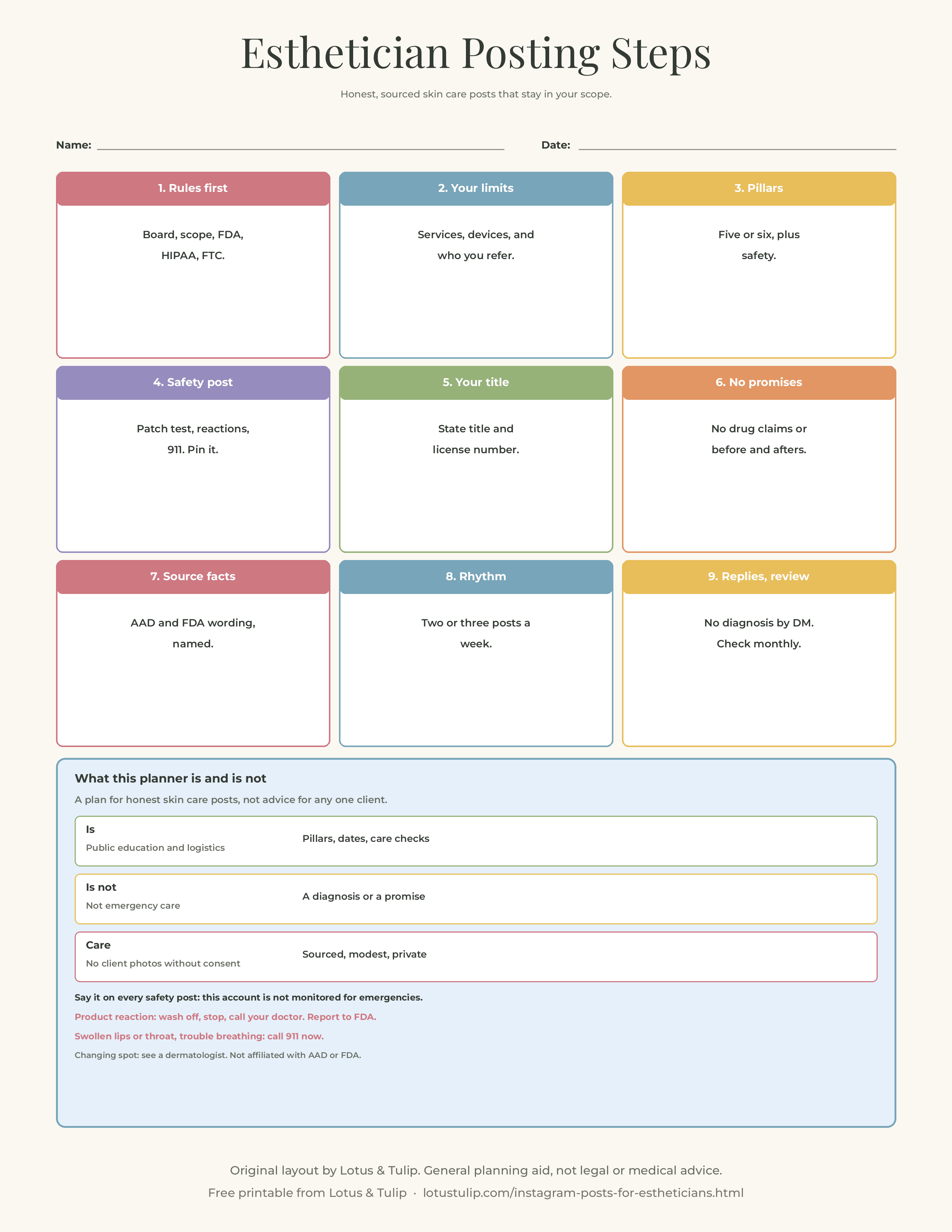
- Read your rules first. Open your state's esthetics or cosmetology law and board rules, your employer's policy if you work in a medical practice, FDA's cosmetic or drug guidance, HHS HIPAA guidance if your employer bills insurance electronically, and the FTC endorsement guides and review rule. Note anything about titles, license numbers, devices, peels and testimonials.
- List your services and your limits. Write down the services your license allows that you are trained in, the devices you may use, and the situations you send to a dermatologist, a doctor or 911.
- Choose five or six pillars, plus safety. Use the ten pillars above as a menu. If you cannot say something true and sourced under a pillar this month, skip it.
- Write and pin a safety post. Include how to patch test, what to do about a reaction, call 911 for swelling of the lips or throat or trouble breathing, see a dermatologist for changing spots, and the line that your account is not monitored for emergencies.
- Audit your title and license. Your state's exact title, license number, board lookup link, no "medical esthetician" or "skin doctor" unless your state and role truly support it, and training named as training.
- Ban drug claims, before and afters and testimonials from the draft stage. If a post needs "treats," "heals," "clears," a result photo or a client's review about a condition to work, rewrite it or delete it.
- Source every skin fact. Use AAD and FDA wording, name the source on the slide and add "General information, not medical advice. See a dermatologist for skin conditions."
- Set a two or three posts a week rhythm. Batch captions on a quiet morning. Schedule only what has passed the care check. Leave room for stories about openings and hours.
- Prepare replies and review monthly. Save DM and review replies that refuse diagnosis by message, never confirm who is a client and route people to booking, a dermatologist or 911. Once a month, update prices and hours, check disclosures on any brand posts, and run every live post through the care check on page 3 of the free printable.
Mistakes and myths
Common mistakes
- "Medical esthetician" with no medical license behind it. In many states it can suggest a license or scope you do not have.
- Advertising out-of-scope services. Lasers, injectables, deep peels or microneedling where your state does not allow them under your license, even as "coming soon."
- Drug verbs on cosmetic products. "Treats acne," "heals the barrier," "stops melanin" on a cosmetic is a drug claim.
- Before and afters as proof. Unrepresentative or edited comparisons mislead, and the FTC says "results not typical" does not fix that.
- Reposting reviews that mention conditions. "Cured my rosacea" becomes your claim the moment you share it.
- Review discounts. "Free add-on for a five star review" is an incentive conditioned on sentiment.
- Hidden brand deals. Free products, wholesale perks and affiliate codes need a clear disclosure in the post itself.
- Extraction videos and client close-ups. Even with permission, they can identify someone, and they rarely make a nervous client feel safe.
- Diagnosing in comments. "That's definitely fungal acne" to a stranger is a diagnosis by message.
- Copying another state's rules. A device or peel that is legal for a colleague in another state may not be legal for you.
- Posting outdated prices or hours. An old menu frustrates people more than no menu at all.
- Posting every day until you burn out. You stand all day. Protect your energy.
Myths about esthetician Instagram
- "You need before and after photos to grow." You need clarity and trust. A carousel that answers "what happens at my first facial" can do more for bookings than a dramatic comparison.
- "Testimonials are the best social proof." For skin results they carry FTC, privacy and board risks. Your license, your policies and your consistent, calm voice are social proof too.
- "If the brand says it, I can say it." You are responsible for your own claims. A brand's drug claim becomes yours when you repeat it.
- "Hypoallergenic means safe for sensitive skin." FDA says the term has no federal definition. Patch test anyway.
- "Working in a doctor's office expands my scope." In Texas, for example, TDLR says your esthetician license covers the same services regardless of the facility's name.
- "A disclaimer fixes any claim." A disclaimer does not rescue a misleading claim, and the FTC says "results not typical" style lines do not cure deceptive testimonials.
Three fictional examples
These studios are invented. They show how the same principles fit different businesses.
Ana, solo studio in a salon suite. Ana rents a suite in a busy salon building. Her bio says "licensed esthetician, [State] #[number]" with a link to the board lookup. She pins three posts: "Your first facial, step by step," "How to patch test a new product" and a safety post with what to do about a reaction, 911 and "not monitored for emergencies." Twice a week she posts one sourced education carousel (AAD or FDA wording, source on the last slide) and one practical post (menu, cancellation, gift cards). She stopped posting before and afters after realizing her favorite one came from a client who had started a prescription from her dermatologist at the same time. Instead, she sends every client the same review invitation.
Marcus, esthetician in a dermatology practice. Marcus works in a practice that bills insurance electronically, so every patient detail is protected health information, including face photos. He never calls himself a "medical esthetician"; his bio says "licensed esthetician at [Practice]." He and the physicians agreed on a "who does what for your skin" post so patients understand which services are his and which are medical. He posts from the practice account only after the privacy officer checks it, never replies to reviews himself, and when a brand offered him free products to post about, he declined because the practice does not allow staff endorsements.
Priya, mobile facials and bridal events. Priya travels to homes and wedding venues. Her feed explains what a mobile facial includes, how she cleans her kit, how far ahead to book before an event and why she always patch tests new products for brides well before the day. She never posts photos of identifiable guests. When a bride asked her to promise "flawless skin by the wedding," she offered "calm, prepared skin and a plan for the week before" instead. She checks her state's rules on providing services outside a licensed establishment before every new kind of event.
How this guide compares with neighboring articles
| Guide | Written for | What it covers that this page leaves aside |
|---|---|---|
| This page: Instagram posts for estheticians | Estheticians, skin care studios, facial rooms, medical practice estheticians | Esthetician licenses and compacts, scope of practice, FDA cosmetic or drug claims, before and after consent, patch testing, sunscreen and exfoliation education, ABCDEs, National Healthy Skin Month |
| Instagram posts for massage therapists | Massage therapists, massage studios, spa massage teams | Massage licenses and the MBLEx, draping and boundaries, detox claims, blood clot warning signs |
| Esthetician client forms | Estheticians setting up paperwork | Intake, skin health questionnaires, consent, photo release and treatment records in detail |
| Instagram posts for chiropractors | Chiropractors and chiropractic clinics | DC degree and titles, spinal manipulation, stroke warning signs |
| Instagram posts for personal trainers | Trainers, studios, online coaches | Certifications, screening and medical clearance, fitness before and after posts |
| Holiday social media posts for therapists | Any clinical or wellness feed in December and January | A week by week seasonal calendar and winter hours posts |
Use the neighboring pages for layout ideas (bios, highlights, pinned posts, carousels). Come back here when the question is about esthetician licenses, scope, product claims, photos or skin safety.
Honest esthetician post versus overclaiming post
| Topic | Honest esthetician post | Overclaiming post |
|---|---|---|
| Results | "Here's what happens in a facial and how we'll plan it together." | "Three facials and your acne is gone." |
| Products | "A gentle cleanser I like because it rinses clean." | "This serum heals your skin barrier and stops dark spots." |
| Title | "[Name], licensed esthetician, [State] #[number]." | "Medical skin specialist," no license in sight. |
| Scope | "Light peels only. Deeper peels are for your dermatologist." | "Medical-grade deep peel, no doctor needed." |
| Photos | "No client photos here. Your skin is your business." | "Swipe to see her skin transformation!" |
| Sunscreen | "Reapply at least every two hours (FDA)." | "Our waterproof SPF lasts all day." |
| Reviews | "We invite every client to leave an honest review." | "Free add-on for every five star review." |
| Safety | "Swelling of the lips or trouble breathing? Call 911. We're not emergency care." | "Burning means it's working. Push through." |
When not to post
- During a facial. Your client deserves your full attention. Film your empty room before or after, never during.
- When a trend relies on extractions, filters or dramatic transformations. Skip it, however many views it gets.
- When you cannot find a primary source. If AAD, FDA, your board or a quality study does not say it, leave it out.
- When a brand wants a post before you've used the product. Endorsements must reflect real use and honest opinion.
- When a service isn't clearly within your state's scope. Ask your board first; advertise later.
- Right after a difficult client interaction. Vague posts about "a client today" can identify someone and read as unprofessional.
- When you're exhausted. A missed week does no harm. A careless post can.
Free 3 page esthetician Instagram printable (US Letter)
Print it, fill it in once a month, and keep it next to your booking system. It works with any design app or template set.
- Page 1: Esthetician Posting Steps. Nine step cards that match the HowTo above, what the planner is and is not, and safety lines for reactions, 911, changing spots and "not emergency care."
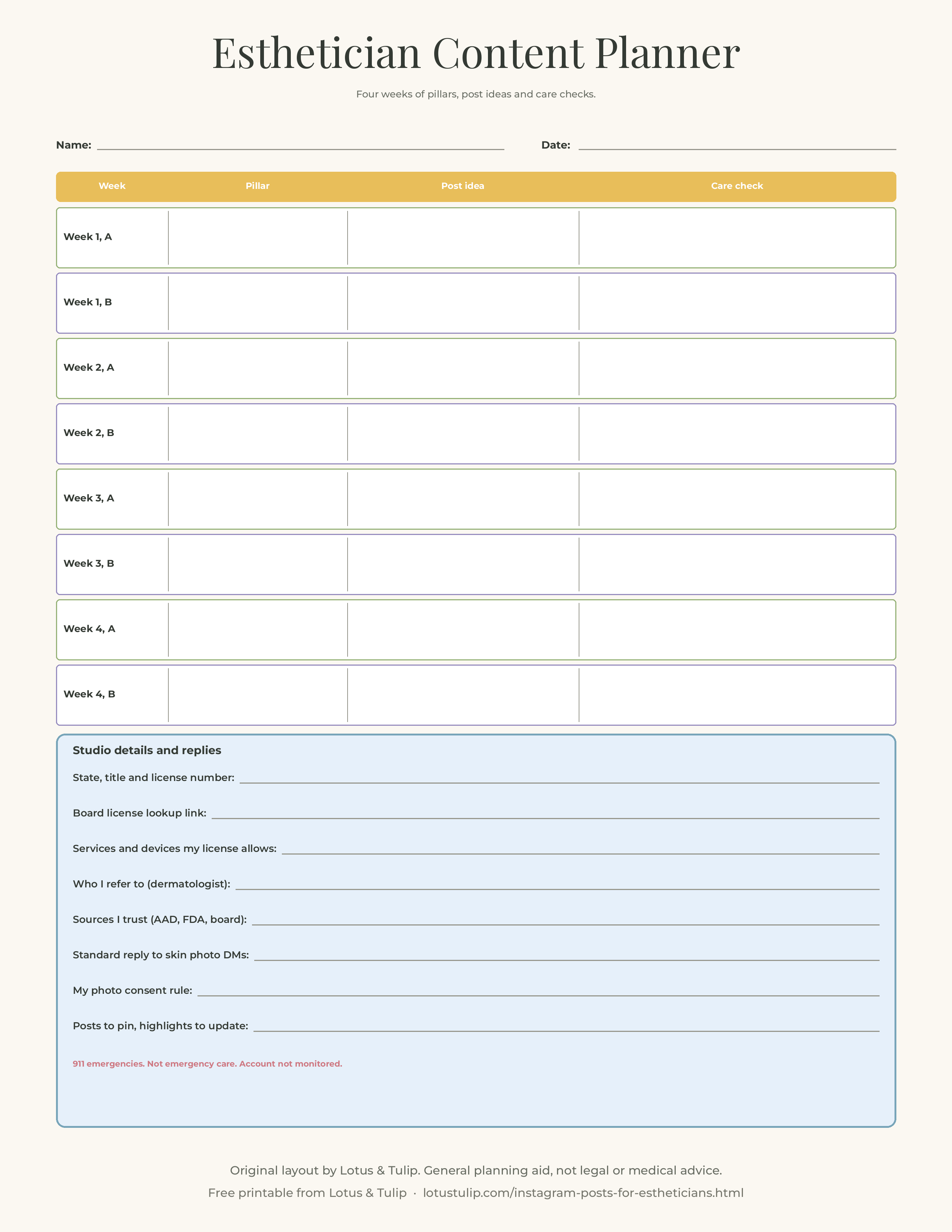
- Page 2: Esthetician Content Planner. Four weeks of posts (two per week) with columns for pillar, post idea and care check, plus fields for your state, title and license number, your board's lookup link, services and devices your license allows, who you refer out, sources you trust, your standard reply to skin photo DMs, your photo consent rule, posts to pin and highlights to update.
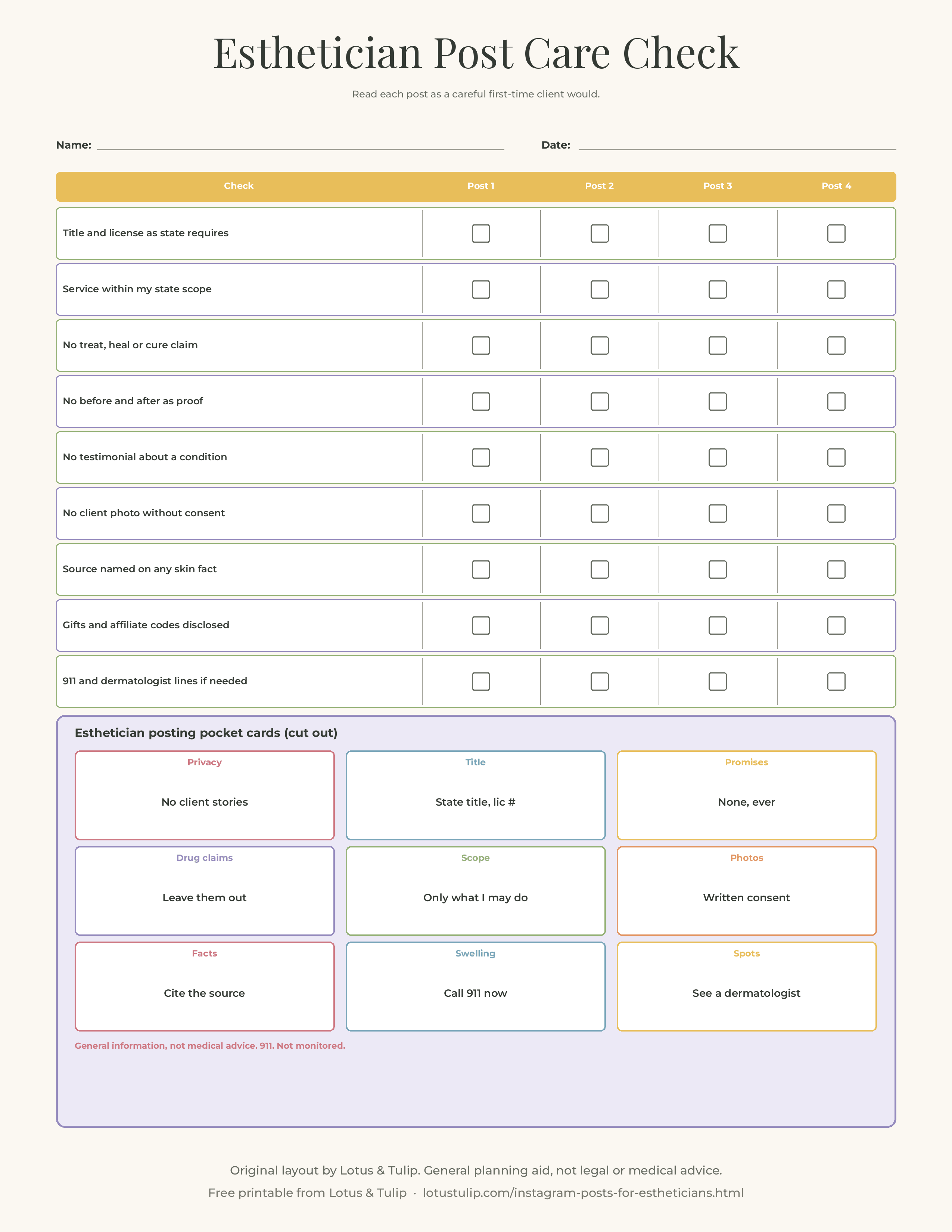
- Page 3: Esthetician Post Care Check. A yes or no check for up to four posts (title and license as your state requires, service within your state's scope, no treat, heal or cure claim, no before and after used as proof, no testimonial about a condition, no client photo without written consent, source on any skin fact, gifts and affiliate codes disclosed, 911 and dermatologist lines if needed), plus nine esthetician posting pocket cards to cut out.
Download free PDF · Page 1 PNG · Page 2 PNG · Page 3 PNG
Research notes (verified, with caveats)
Sources below were opened or checked through search during this writing session on November 9, 2026, unless marked as checked on November 8, 2026 for our previous article. Where we relied on search results rather than the full page, we say so.
- US Bureau of Labor Statistics. Occupational Outlook Handbook, Skincare Specialists, bls.gov/ooh/personal-care-and-service/skincare-specialists.htm, last modified October 29, 2026, opened this session. Duties (evaluate skin, recommend products, refer serious skin problems to a dermatologist; hair removal with wax, lasers or other approved treatments); state-approved program and written and practical state exam; requirements vary by state; continuing education; employers including offices of physicians and other health practitioners; 29 percent self-employed; part-time common; standing most of the day; salon owners arrange advertising. We did not use wage or projection figures.
- US Food and Drug Administration. Is It a Cosmetic, a Drug, or Both? (Or Is It Soap?), opened this session. Definitions; intended use established by claims in advertising and on the internet; example drug claims; cosmetic and drug combinations including sun protection claims; "cosmeceutical" has no meaning under the law; acne medications and sunscreens among OTC monograph categories; Drug Facts labeling.
- FDA. "Hypoallergenic" Cosmetics, opened this session. No federal standards or definitions; no cosmetic guaranteed never to cause a reaction.
- FDA. Sunscreen: How to Help Protect Your Skin from the Sun, opened this session. Apply 15 minutes before; at least one ounce for the body; reapply at least every two hours; no waterproof sunscreen; water resistant 40 or 80 minutes; never spray on the face; three year rule without an expiration date; regulated as drugs in the US; tips say SPF 15 or higher.
- FDA. How to Report a Cosmetic Product Related Complaint (What's New dated March 11, 2026), opened this session. Stop using and contact a health care provider; MedWatch, Form 3500B, 1-888-SAFEFOOD option 4; MoCRA serious adverse event reporting by the responsible person within 15 business days. FDA's When and Where to Report Emergencies page (call 911 first for life-threatening reactions), via search.
- American Academy of Dermatology. How to select a sunscreen; Face washing 101; How to test skin care products (last updated 8/10/21); How to safely exfoliate at home (last updated 2/6/26); What to look for: ABCDEs of melanoma; all opened this session. National Healthy Skin Month (November) and Skin Cancer Awareness Month (May; Melanoma Monday May 4, 2026; SPOTme screenings), via search.
- California Board of Barbering and Cosmetology. Esthetics consumer publication and Chemical Exfoliation Safety Tips, via search this session; California Code of Regulations, Title 16, sections 991 (invasive procedures) and 992 (skin exfoliation), via search. Used as one state example.
- Texas Department of Licensing and Regulation. Esthetician Scope of Practice Guide and Medical Spas page, both opened this session. Allowed and not allowed services; medspa services requiring physician order and delegation; microdermabrasion and peels limited to the epidermis; no lasers or injections under an esthetician license. Used as one state example.
- Virginia Board for Barbers and Cosmetology. Summary of Virginia Licensing Requirements, Master Esthetician application and 18VAC41-70-20, via search this session. 600 hours for an esthetician license; master esthetician license requiring a Virginia esthetician license, 600 hours of master training or an equivalent route, and written and practical exams.
- National-Interstate Council of State Boards of Cosmetology. NIC Exam Types, nictesting.org, opened this session. National theory, practical and written practical exams including esthetics and advanced practice esthetics, administered by states and testing companies with NIC authorization.
- Cosmetology Licensure Compact, cosmetologycompact.gov (home page and Compact Commission page), via search this session; Arizona Barbering and Cosmetology Board announcement of September 10, 2026, as reported by GL Solutions and Hoodline, via search. Seventh state June 2024, first commission meeting October 2024, first multistate cosmetology licenses issued by Arizona in September 2026; covers cosmetologists only (also noted in Hawaii Board of Barbering and Cosmetology minutes, via search).
- Council of State Governments National Center for Interstate Compacts. Esthetics Licensure Compact, compacts.csg.org, opened this session. Members Alabama, Kansas and Virginia (joined 2026). The seven state activation threshold was seen via search (Associated Skin Care Professionals and third party summaries).
- HHS Office for Civil Rights. Guidance on de-identification (45 CFR 164.514(b)(2), full-face photographs and comparable images among Safe Harbor identifiers), via search this session. Covered Entities and Business Associates and Marketing guidance (45 CFR 164.501, 164.508(a)(3)) and the Elite Dental Associates resolution agreement (2019, $10,000), checked November 8, 2026.
- Federal Trade Commission. Guides Concerning Use of Endorsements and Testimonials in Advertising, 16 CFR Part 255 (2023): section 255.2 via eCFR search this session; sections 255.3 and 255.5 checked November 8, 2026. Health Products Compliance Guidance (2022), via search this session (testimonials need substantiation, "results not typical" does not cure deception, before and after example).
- Federal Trade Commission. Rule on the Use of Consumer Reviews and Testimonials, 16 CFR Part 465 (89 FR 68077, August 22, 2024), eCFR, opened this session. Sections 465.1(c), 465.2, 465.4, 465.5, 465.7 and 465.8.
- Federal gift card rule, 12 CFR 1005.20 (Regulation E), checked November 8, 2026. Funds generally must last at least five years after issue or last load; some states give more time.
- 988 Suicide and Crisis Lifeline, 988lifeline.org, checked November 8, 2026. Call, text or chat 988.
- National Esthetician Day, October 15, as listed on third party holiday calendars via search. Not an official observance.
This page is not affiliated with or endorsed by the AAD, FDA, BLS, HHS, the FTC, NIC, the Council of State Governments, either licensure compact, any state board or any professional association. We used no industry survey statistics. Our paid template kits are marketing tools for skin care and wellness businesses. They are not clinical guidance or treatment tools. You stay responsible for what you post.
Instagram posts for estheticians: FAQ
What should an esthetician post on Instagram?
Focus on what a careful new client needs: who you are, your state title and license number, how to look up a license, what happens at a first facial, your menu, prices and policies, sourced education from AAD and FDA (face washing, sunscreen, patch testing, gentle exfoliation, skin checks), and a pinned safety post covering reactions, 911 and a note that your account is not monitored for emergencies. Leave out drug claims, before and afters used as proof and testimonials about conditions.
How often should an esthetician post on Instagram?
Two or three feed posts a week is enough for most solo estheticians and small studios, plus stories for openings and hours. Once a week is fine if your menu, booking, FAQ and safety posts are current. Batch your content in one quiet session rather than posting daily.
Can estheticians post before and after photos?
Check your state rules and your employer's policy first. If you post them, get written permission with a separate photo release, use identical lighting and angles with no filters or retouching, and remember that the FTC treats them as testimonials about results: if a result is not what clients generally achieve, the post should clearly say what is typical, and "results not typical" is not enough. Many estheticians leave before and afters off Instagram entirely.
Can I say a facial or product treats acne?
Be careful. FDA says claims to treat or prevent disease, or to affect the structure or function of the body, make a product a drug, and acne medications are regulated as over-the-counter drugs. Describe services and cosmetics by what they do to the look and feel of skin, repeat drug claims only exactly as a properly labeled drug product states them, and refer painful, scarring or persistent acne to a dermatologist.
Can I call myself a medical esthetician?
Only if your state and your role clearly support it. States license estheticians, and in Texas, for example, TDLR says an esthetician may provide the services within the esthetician license whatever the facility is called, while medical treatments need a physician's order and delegation. "Licensed esthetician at [Practice], a dermatology office" is accurate and safer.
Can I offer a discount for a five star review?
No. The FTC's consumer review rule (16 CFR 465.4) prohibits incentives conditioned on a review expressing a particular sentiment. Invite every client to leave an honest review, and do not reward the content of the review.
Does HIPAA apply to estheticians?
Only if you are a covered entity or work for one. HHS says a health care provider is covered only if it transmits health information electronically in a standard transaction, such as electronic insurance claims. Most day spas and solo studios are not covered, but estheticians in dermatology or plastic surgery practices that bill insurance often work for a covered entity, where full-face photos count as identifiers. Either way, never confirm who is a client or share client details online.
Is the free printable a copy of the paid kit?
No. The free three page set is an original planning aid: posting steps, a four week content planner and a post care check with pocket cards. The paid Morning Basin kit contains designed posts, stories, highlight covers, captions and a 12 week calendar. The printable is not a preview of that kit.