
Therapist marketing · Updated 2026-11-08
Instagram Post Ideas for Massage Therapists (with Free Printable)
Ready-made template kit: Massage Therapist Instagram Templates Holiday 20% off: about $22.08, was $28 (EUR 24) · instant digital download
Buy on Etsy
Instagram posts for massage therapists have a harder job than most wellness content. The person who finds your profile is often tired, sore or stressed, and a little unsure: Is this a real, licensed practice? What happens in the room? Will I have to undress? Can I ask for lighter pressure? What does it cost, and do I tip? At the same time, the feed sits next to spa giveaways, "flush your toxins" reels, before and after posture photos and, in some places, ads for businesses that are not massage at all. The algorithm rewards close-up body shots, dramatic claims and trending sounds. Your state board, the FTC, the AMTA and ABMP codes of ethics and the clients who trust you on your table reward the opposite: your real title and license, plain words about what a session involves, no promised outcomes, no detox talk, no testimonials that imply typical results, and a feed that is clearly, calmly professional.
This guide is written for US massage therapists and the small businesses around them: solo licensed massage therapists, mobile and chair massage businesses, massage studios and group practices, therapists who rent a room in a chiropractic or physical therapy clinic, spa teams that offer massage alongside skin care, front desk staff who run a studio account, and social media managers who post on a massage practice's behalf. It covers what to post on Instagram as a massage therapist: why the job is different from wellness influencer content, what a state license, the MBLEx and voluntary board certification mean and how to show them honestly, why some states want your license number in every ad, how to talk about pain, stress and research without overclaiming, why detox and "release toxins" posts are a trap, how to write about draping, consent and boundaries so the feed reads as clinical and safe, safety posts built on NCCIH's risk wording, CDC's blood clot warning signs, 911 and 988, the FTC rules on testimonials, reviews and fake followers, client privacy and when HIPAA applies, replying to online reviews without disclosing anything, sourced public education, prices, packages, tips and gift cards, ten content pillars, 34 post ideas with original caption angles, six fuller captions, DM scripts that keep boundaries kind and clear, a two or three posts a week rhythm and a 12 week overview, the dates that suit a massage feed, a nine step HowTo, mistakes, myths, three fictional examples, two comparison tables, when not to post, research notes and a free three page US Letter printable: Massage Posting Steps, a Massage Content Planner and a Massage Post Care Check with pocket cards.
If you share clients or a building with other clinicians, neighboring pages may help: Instagram post ideas for chiropractors covers the chiropractic side of a shared clinic, Instagram post ideas for physical therapists covers rehab and movement education, and Instagram post ideas for personal trainers covers the trainers many massage clients also see. Holiday social media posts for therapists has a December and January calendar that adapts well to a gift card season. This page stays with the questions massage therapists tend to face: how to look credible without testimonials or body photos, how to educate without diagnosing strangers, how to explain prices, packages and tips without pressure, and how to keep a feed that no one could mistake for anything other than professional massage therapy.
What this guide is and is not
This is a practical content guide for licensed massage therapists in the United States. It is not legal advice, it is not medical advice and it does not replace your state practice act, your board's advertising rules, your local business license or your liability insurer's guidance. Massage law varies more from state to state than almost any other health profession: some states license, one has voluntary certification, one uses registration, a few leave it to cities and counties, and several have specific advertising rules. Read your own rules before you post, and treat every example below as a starting point you check against them.
Every factual statement here was checked against a primary or official source during this writing session: the Bureau of Labor Statistics Occupational Outlook Handbook, the National Center for Complementary and Integrative Health (NCCIH), the Federation of State Massage Therapy Boards (FSMTB), the National Certification Board for Therapeutic Massage and Bodywork (NCBTMB), the American Massage Therapy Association (AMTA) and Associated Bodywork and Massage Professionals (ABMP) codes of ethics, AMTA's client guidance, the Florida Statutes, CDC blood clot guidance, HHS HIPAA guidance and the FTC's endorsement guides and consumer review rule. Where a source was only seen through search results rather than opened in full, the research notes at the end say so. We used no survey figures from trade associations and no claims about what massage "proves."
The post ideas, captions and fictional practices are original to this page. They are examples of tone and structure, not scripts to copy word for word. Your clients, your state and your style should change them.
Why posting as a massage therapist is different from wellness influencer content
A wellness influencer can post a sunrise, a smoothie and a promise. A massage therapist posting the same way runs into problems that other creators never face, for five reasons.
First, the title is regulated in most of the country. The BLS Occupational Outlook Handbook says most states regulate massage therapy and require massage therapists to have a license or certification, and NCCIH notes that in states that regulate it, therapists must get a license or certification before practicing. That means words like "licensed," "LMT," "massage therapist" and sometimes even "massage" are not just branding. In many states they are terms you may only use if you hold the right credential, and a board can act on how you use them online.
Second, your work involves touch, undressing and privacy. AMTA's guidance for clients describes undressing to your level of comfort, the therapist leaving the room while you change, and draping that covers everything except the part being massaged. A feed that shows bare skin, uses suggestive language or blurs the line between relaxation and something else can confuse new clients, attract the wrong inquiries and, in some states, break advertising law. The careful, clinical tone that may feel "boring" in a reel is exactly what tells a nervous first-timer that your room is safe.
Third, the evidence is real but modest. NCCIH describes research on massage for low-back pain, neck and shoulder pain, knee osteoarthritis, headaches, fibromyalgia and supportive cancer care, and in most cases uses words like "may," "short-term," "weak," "low" or "not strong." Many massage posts online claim far more than that. Your feed can honestly say clients often come in for stress and muscle tension and that research on some kinds of pain is promising but limited. It cannot honestly say massage cures, fixes, detoxes or heals.
Fourth, much of the profession is self-employed and part-time. BLS says many massage therapists are self-employed, that part-time work is common and that schedules vary, and that self-employed therapists in particular spend time on notes, marketing, booking and other business tasks. You are probably your own marketing department, so a plan has to fit around sessions and a body that needs rest. Two or three thoughtful posts a week beats a daily reel you cannot sustain.
Fifth, your audience includes regulators, referral partners and employers. BLS lists offices of chiropractors and offices of other health practitioners among the industries that employ massage therapists. A chiropractor, physical therapist or spa manager deciding whether to rent you a room or refer to you will scroll your feed. So will a board investigator if a complaint ever comes in. Post as if all of them are reading, because sometimes they are.
State licenses, the MBLEx, board certification and how to show them honestly
Credentials are the first thing a careful new client checks and the first thing a board looks at. Getting them right on Instagram is simple once you know the landscape.
Licensing varies by state
BLS says massage therapists typically need a state-issued license or must register with the state, that requirements vary but typically include graduation from an approved program and passing an exam, and that some states also require a background check, liability insurance or CPR certification, along with continuing education and periodic renewal. NCCIH describes the same basic pattern. The FSMTB's Regulated States table shows how wide the variation is: minimum education hours from 500 to 1,000, different continuing education hours and different renewal periods. In that table, most jurisdictions list a license, California lists voluntary certification and Vermont lists registration. Kansas, Minnesota and Wyoming do not appear in the table, and FSMTB notes that local county or municipal ordinances may apply in states that do not regulate massage therapy. FSMTB itself warns that some states are changing their education hours and tells readers to verify with each state board, so do not quote a number from a third party table on your feed. Link to your own board instead.
The MBLEx and state exams
The Massage and Bodywork Licensing Examination (MBLEx) is run by the FSMTB. FSMTB describes it as the national entry-level licensure exam, used for licensure in 46 of the 49 regulated jurisdictions, including the District of Columbia, Puerto Rico and the US Virgin Islands. In FSMTB's table, Hawaii and New York use their own state exams, and California and Vermont list no exam required. FSMTB is also clear that passing the MBLEx is only one step toward licensure: the license itself comes from your state board or agency. On Instagram, this means "MBLEx passed" is not a credential to display in place of a license, and "nationally licensed" is not a thing. There is no national massage license.
Voluntary board certification
The National Certification Board for Therapeutic Massage and Bodywork (NCBTMB) offers Board Certification (BCTMB), a voluntary credential. NCBTMB describes requirements that include a current state license in a licensing state, passing its Board Certification Exam, a background check and agreeing to its standards of practice and code of ethics, with renewal every two years. FSMTB explains the difference plainly: the MBLEx is a licensing exam that states mandate, while certification exams are voluntary credentials. If you hold board certification, you can say so, named with its issuer. If you do not, do not use the letters, and never let a certification read like a license.
Interstate practice and the massage compact
Clients who travel, therapists who work events across state lines and mobile therapists near a border sometimes ask whether one license covers several states. The Interstate Massage Compact (IMpact), supported by FSMTB, is designed to allow a multistate license, but as of 2026 it was not yet operating: the compact's own June 2026 update said more states needed to enact the uniform model legislation before the compact commission could form, and FSMTB later reported that Ohio was no longer connected to it. Until your board says otherwise, assume you may only practice where you hold a license, and do not advertise sessions in a state where you are not licensed.
Some states want your license number in every ad
Florida is a clear example. Florida Statutes section 480.0465 says each licensed massage therapist or massage establishment must include the license number in any advertisement of massage therapy services in any advertising medium, explicitly including the internet, and that the ad must also include the establishment's physical address and the telephone number given to the state, with an exception for owners operating more than five locations in Florida. The Florida Board of Massage Therapy's advertising rule (64B7-33.001) repeats the license number requirement and defines advertising medium to include computer transmission and the internet. Other states have their own versions. If your state has a rule like this, the safest reading is that your Instagram bio, your boosted posts and your promotional posts are advertisements. Put the license number in your bio and on promotional graphics, and check with your board how they read it for ordinary posts.
How to show credentials on your profile
- Name, title and state. "[Name], licensed massage therapist, [State] license #[number]" is clear, and it is the format a new client can check.
- Use only the title your state gives you. If your state uses "LMT," "LMP," "CMT," "registered" or another term, use that one. If you are in a city that licenses massage but your state does not, say exactly that.
- Link the board lookup. Pin a "How to check a massage license" post that links to your board's lookup page. It costs you nothing and earns more trust than any testimonial.
- Name voluntary credentials with their issuer. "Board Certified in Therapeutic Massage and Bodywork (NCBTMB)" is honest. A string of letters a client cannot decode is not.
- Training is not a credential. Continuing education in a technique is worth mentioning ("I've completed training in [technique] from [provider]"), but a weekend course is not a specialty or a certification unless the issuer says so. ABMP's code commits members to provide only treatments and techniques they are fully trained in and to avoid using trademarks and symbols of a system or group without authentic affiliation.
- Association membership is not a license. AMTA's Rules of Ethics forbid using AMTA membership, its name or logo in any unauthorized, improper or misleading way, and ABMP's code asks members to use its logo appropriately. "Member of AMTA" or "ABMP member" is fine if true. "AMTA approved therapist" is not a thing.
Scope and claims: stress, tension and pain research, said modestly
The most common way a massage feed gets into trouble is not a bad photo. It is a sentence that promises more than massage can deliver. Both major professional associations put this in writing. AMTA's Rules of Ethics require members to be truthful in advertising and marketing and to refrain from misrepresenting their services, charges, credentials, training, experience, ability or results. ABMP's code asks members to acknowledge the limitations of massage and bodywork by refraining from exaggerating its benefits throughout their marketing. The FTC applies the same idea to every advertiser: health claims need support, and testimonials do not count as scientific evidence.
What NCCIH says, in its own words
NCCIH's "Massage Therapy: What You Need To Know" (last updated May 2019) is the clearest neutral summary for a US audience. Its wording is the safest wording to borrow:
- Low-back pain: several evaluations found only weak evidence that massage may be helpful. An AHRQ evaluation found evidence for chronic low-back pain but rated the strength of evidence low, and a 2015 review found short-term improvements but "very little confidence" because study quality was low.
- Neck and shoulder pain: massage may be helpful, but the benefits may only last a short time.
- Knee osteoarthritis: the small amount of research suggests it may have short-term benefits in relieving knee pain.
- Headaches: only a small number of studies, with results that are not consistent.
- Fibromyalgia: massage may help some symptoms if it is continued for long enough.
- Cancer: with appropriate precautions, massage can be part of supportive care for people who want to try it, but the evidence that it relieves pain and anxiety is not strong, and therapists may need to modify techniques.
Notice the verbs: may, short-term, weak, not strong, not consistent. Those are the words that keep a post honest. "Research on massage for neck pain suggests it may help for a short time (NCCIH)" is a responsible post. "Massage fixes neck pain" is not.
What you can say confidently
You can describe your service with confidence because it is your service: what happens in a session, how long it lasts, what you ask in the intake, what styles you offer, how you check pressure, what you charge and how to book. You can say clients often come to you for stress, relaxation and muscle tension, because that is a description of your clients rather than a health claim. You can say massage is "one way some people choose to unwind" without claiming it treats anything. And you can say what NCCIH says, with NCCIH named.
Detox, toxins and lactic acid
"Massage flushes toxins" and "drink water to flush out the lactic acid we released" are probably the most repeated massage claims online, and they are exactly the kind of statement the codes warn about. NCCIH's massage page does not list detoxification as a benefit at all. If you want to cover the topic, the honest version is a myth vs fact post: offering water after a session is a kind habit, and the "toxins" story is not something the sources support. Cite a source you have actually read, such as a hospital or university page on lactic acid, and keep the tone friendly rather than mocking. Many clients have heard the toxin story from previous therapists and you do not want them to feel foolish.
Conditions, diagnosis and scope
BLS describes massage therapists talking with clients about symptoms, medical history and goals and evaluating where the body is tense or painful. That is assessment for a session, not a medical diagnosis. ABMP's code commits members to refer clients to another provider if they need work beyond the therapist's capabilities or beyond the capacity of massage, and to refer and wait for physician approval if they suspect an undiagnosed condition for which massage may be inappropriate. On Instagram, that means: no posts that "diagnose" a posture photo, no "you have a rotated pelvis" reels, no posts that tell people to skip a doctor, and no statements about organs, hormones or internal conditions. NCCIH's own first tip for consumers is not to use massage therapy to postpone seeing a health care provider about a medical problem. That line makes an excellent pinned post.
Specialty massage: prenatal, oncology, lymphatic and sports
BLS notes that some programs concentrate on modalities such as sports, rehabilitative or oncology massage, and that different populations, such as athletes or pregnant women, require different techniques. If you offer these services, describe your training and your adaptations, and invite clients to talk with their health care provider first. Avoid outcome language ("reduces swelling," "boosts immunity," "speeds recovery") unless a source you can name says exactly that, in those words, for that population. Lymphatic drainage in particular is a popular topic in 2026, and AMTA itself published consumer material on it during its awareness week. If you post about it, quote the source's own careful wording and say who it is and is not for.
Professional boundaries, draping and why your feed must read as clinical
This section is uncomfortable to write, but every massage therapist knows why it matters. Some inquiries are not about massage. Some businesses that call themselves massage are fronts for something else, and anti-trafficking organizations such as Polaris have written publicly about illicit massage businesses. Legitimate therapists spend real energy proving the difference, and your Instagram can either help or hurt.
What the codes and the law say
- AMTA Rules of Ethics: members must refrain from any sexual conduct or sexual activities involving clients in the course of a massage therapy session.
- ABMP code: members commit to refrain from and prevent behaviors that may be considered sexual in their practice and to uphold standards that desexualize massage, and to respect client dignity through appropriate and skilled draping.
- Florida law as an example: section 480.0465 prohibits a massage therapist, establishment owner, employee or anyone they direct from placing an advertisement that states prostitution, escort or sexual services are available, and from placing any online ad on a website known for advertising those services. Other states have their own rules, and many cities regulate massage establishments too.
What that means for your posts
- No bare-skin glamour shots. Show your room, your table made up with linens, your hands on a draped shoulder, your chair at a workplace event, or no photo at all. The kit approach of text and shapes, with no body photos, is a deliberate choice.
- Clinical, warm language. Words like "intake," "draping," "pressure," "comfort," "consent," "session" and "license" signal a professional practice. Avoid words that a reader could take as innuendo, including in hashtags, emojis and trending sounds. Read every caption once as a stranger with bad intentions would, and once as a nervous first-timer would.
- Post your draping and privacy policy. AMTA tells clients they can undress to their level of comfort, that the therapist leaves the room while they change, and that only the area being massaged is uncovered. Saying this on your feed reassures clients and filters out the wrong inquiries at the same time.
- Publish a clear inquiry policy. For example: "We offer therapeutic massage only. Inappropriate messages end the conversation and may be reported." Keep it short and calm.
- Keep booking on a professional system. Route inquiries to an online booking page or a business phone number with an intake form, rather than negotiating sessions in DMs.
If you see something wrong
If you see signs that someone in your area may be trafficked, the National Human Trafficking Hotline takes reports 24 hours a day at 1-888-373-7888, or by text to 233733. Do not confront anyone or investigate yourself. If someone is in immediate danger, call 911. You may not want this on your public feed, but every massage business owner should know the number.
Massage therapist, physical therapist, chiropractor, esthetician and personal trainer
Clients mix these up constantly, and a clear "who does what" post is one of the most useful things you can share, especially if you work inside a clinic. Keep it factual and generous to the other professions.
| Profession | What they typically do | What to say on your feed |
|---|---|---|
| Massage therapist | Manipulates soft tissues and joints with hands, forearms and other techniques; talks about history and goals; documents sessions (BLS) | "I'm a licensed massage therapist. I don't diagnose conditions. I'll ask about your health and refer you if something needs a medical look." |
| Physical therapist | Licensed clinician who evaluates movement problems and designs rehabilitation plans | "If you're recovering from an injury or surgery, your PT leads the plan. I'm happy to coordinate if you ask me to." |
| Chiropractor | Doctor of chiropractic, licensed by the state, often using spinal manipulation and other musculoskeletal care | "Chiropractors and massage therapists often work together. We each work within our own license." |
| Esthetician | Skin care professional (facials, skin treatments); licensing rules vary by state | "Facials and skin treatments are done by our licensed esthetician. Massage sessions are with me." |
| Personal trainer | Coaches exercise and strength; certification varies by provider | "Training builds strength; massage is time on the table. Many clients do both." |
| Physician or nurse practitioner | Diagnoses and treats medical conditions | "New, severe or unexplained pain? See your doctor first. Massage can wait." |
BLS lists offices of chiropractors and offices of other health practitioners among the industries that employ massage therapists, so many readers of this page share a building with exactly these colleagues. If you do, agree with them on how each of you describes the others, and never let a shared clinic account imply that massage is part of a medical plan unless it is.
Safety posts: risks, blood clot warning signs, 911 and 988
Massage is a low-risk service, and your feed should say so honestly without pretending risk is zero. A short, sourced safety post earns trust and protects clients.
The honest risk wording
NCCIH says the risk of harmful effects from massage therapy appears to be low, but that there have been rare reports of serious side effects, such as a blood clot, nerve injury or bone fracture, and that some of those cases involved vigorous techniques such as deep tissue massage or people at increased risk of injury, such as elderly people. That is a fair, calm paragraph to quote nearly word for word. It explains why you ask health questions at intake, why you adjust pressure and why you sometimes say "let's check with your doctor first."
Blood clot warning signs (CDC)
Because a blood clot is among the rare serious risks NCCIH names, and because it is something every client should recognize anyway, CDC's warning signs make a useful safety post. CDC says the most common signs of deep vein thrombosis (DVT) in the affected leg or arm are swelling, pain or tenderness, warmth, and redness or discoloration, that about half of people with DVT have no symptoms, and that anyone with these signs should see a doctor as soon as possible. CDC lists signs of a pulmonary embolism (PE) as difficulty breathing, a faster than normal or irregular heartbeat, chest pain or discomfort that usually worsens with a deep breath or coughing, coughing up blood, and very low blood pressure, lightheadedness or fainting, and says to seek medical help immediately. On your feed, add your own clear line: "Trouble breathing or chest pain? Call 911 now. Don't message us."
At intake, many therapists ask about recent surgery, long periods of immobility, clotting problems and medications. If a client describes a swollen, painful leg, the professional move is to postpone and refer. A post that explains why you sometimes postpone a session is a kindness, not a sales risk.
Soreness after a session
Many clients feel a little tender after deeper work, and many feel nothing but relaxed. If you post about after-session soreness, keep it modest: "Some people feel mild soreness for a day or so after deeper pressure. Tell us if anything feels severe, unusual or doesn't settle, and check with your doctor." Do not call soreness "detox," "release" or proof that a session "worked."
Mental health crises
People sometimes share heavy things on the table or in DMs, especially in stressful seasons. You are not a counselor, and your feed should never suggest that massage treats depression or anxiety. What you can do is share the 988 Suicide and Crisis Lifeline: in the US, anyone can call, text or chat 988, 24 hours a day, free and confidential. Put it in your safety highlight.
"Not emergency care"
Every massage account should have one pinned line: "This account isn't monitored for emergencies. In an emergency, call 911. In crisis, call or text 988." It takes ten seconds to write and it matters most on the one night someone needs it.
Comfort, consent and speaking up: the posts new clients need most
For many first-time clients, the barrier is not price or time. It is not knowing what will happen. AMTA's "What to Expect at Your Massage Session" page gives you a ready, sourced outline for a whole series of reassuring posts. In AMTA's words, clients can expect a health intake conversation about medical conditions and expectations; to be draped with a sheet, towel or blanket so only the area being massaged is exposed; an explanation of the massage and techniques before it starts; the right to decide whether there is conversation, music or quiet; the right to consent to the techniques and pressure and to ask for adjustments at any time; and the right to stop a massage and report anything they feel is inappropriate. AMTA also notes that a table session usually lasts 30 to 90 minutes, that chair massage is done clothed without oil or lotion and typically lasts 10 to 30 minutes, and that tips may be appreciated depending on the setting but are not required.
ABMP's code adds informed consent from the therapist's side: members commit to recognize a client's right to determine what happens to their body, to fully inform clients of choices and policies, and not to provide massage without informed consent to the session plan.
That gives you at least six strong, honest posts: what happens at intake, draping and privacy, how to ask for more or less pressure, music and talking, "you can stop at any time," and chair versus table massage. None of them makes a health claim, all of them can cite AMTA, and together they answer the questions that keep people from booking.
Testimonials, reviews, fake followers and the FTC
Massage marketing advice often says "post your best client reviews." The FTC's rules make that more complicated than it sounds, and your state may add its own limits. Here is what the federal rules actually say.
Testimonials must be honest and typical, or say what is typical
The FTC's Guides Concerning Use of Endorsements and Testimonials in Advertising (16 CFR Part 255, updated in 2023) say that an ad using consumer endorsements about a product's performance is read as a claim that the product works for that purpose, so the advertiser must have the same substantiation it would need to make the claim directly, and consumer endorsements themselves are not competent and reliable scientific evidence (255.2(a)). An endorsement about a key attribute will likely be read as representing what consumers will generally achieve; if you cannot back that up, you must clearly disclose what people can generally expect (255.2(b)). The FTC also says disclaimers such as "results not typical" are unlikely to be effective. For a massage therapist, a review saying "my migraines are gone after three sessions" is a health claim made through someone else's mouth. Reposting it is risky even if every word is true.
Reviews: invite everyone, reward no one for sentiment
The FTC's Rule on the Use of Consumer Reviews and Testimonials (16 CFR Part 465, 2024) makes several practices violations outright:
- Writing or buying fake reviews or testimonials, including ones that misrepresent the reviewer's experience (465.2).
- Giving compensation or incentives conditioned on a review expressing a particular sentiment, positive or negative (465.4). "Ten dollars off your next session for a five star review" is exactly this.
- Reviews by officers or managers without clear disclosure of their relationship, and soliciting undisclosed reviews from staff or relatives in certain situations (465.5).
- Using legal threats, intimidation or false accusations to suppress reviews (465.7).
- Buying or selling fake followers, likes or views to misrepresent influence for a commercial purpose (465.8).
The Endorsement Guides add that advertisers should not suppress, boost or edit reviews in a way that distorts what consumers think (255.2(d)), and that inviting only happy clients to post can be unfair or deceptive, while inviting all recent clients is fine even if you say you hope they had a good experience (255.2 Example 11). The simple, compliant habit: send every client the same short "We'd value an honest review" message, or none.
Brand deals, free products and affiliate codes
Massage therapists get offers from oil, lotion, tool and table brands. Under 255.5, a material connection, which includes payment, free products, discounts, affiliate commissions or other benefits, must be disclosed clearly and conspicuously when your audience would not expect it. Under the guides' definition of clear and conspicuous, on social media the disclosure should be unavoidable, so not hidden behind "more," not only in your bio, and not in faint text. "Ad," "Paid partnership" or "[Brand] sent me this oil for free" in the first line works. If you post an affiliate link, say you earn a commission.
Expert endorsements
If you recommend a product as a massage professional, the FTC treats you as an expert endorser, and your recommendation must reflect a real exercise of that expertise (255.3). "I've used this lotion for six months in my practice and like that it's unscented" is fine. "This foam roller fixes sciatica" is a health claim you cannot support.
Client privacy, HIPAA and replying to reviews
Many massage therapists assume HIPAA does not apply to them, and many are right. But privacy rules still apply to everyone, and the safest feed treats every client's information as confidential.
When HIPAA applies
HHS explains that a health care provider is a HIPAA covered entity only if it transmits any information in an electronic form in connection with a transaction for which HHS has adopted a standard, such as electronic insurance claims. A cash-only massage practice that never bills insurance electronically may not be a covered entity. A massage therapist working inside a chiropractic or physical therapy clinic that bills insurance electronically, or billing insurance yourself, may well be covered or working for someone who is. Use the HHS covered entity decision tool and ask your clinic if you are unsure.
If HIPAA does apply, HHS's marketing guidance says that, with limited exceptions, the Privacy Rule requires an individual's written authorization before using or disclosing protected health information for marketing. In 2019, HHS announced a $10,000 settlement and corrective action plan with a Dallas dental practice over social media replies to patient reviews that disclosed patients' health information. A dental office is not a massage studio, but the lesson travels: do not confirm that a reviewer is a client, and never mention their sessions, health, payments or anything else about them.
Even when HIPAA does not apply
AMTA's principles ask members to acknowledge the confidential nature of the professional relationship and respect each client's right to privacy within the constraints of the law. ABMP's code commits members to keep client communication and information confidential and not to share client information without written consent, within the limits of the law. Your state may also have privacy and consumer protection laws. In practice:
- No client photos, names, tags, location check-ins or stories without written permission, and even then think twice.
- No "today's client had the tightest shoulders I've ever felt" stories. Even anonymous, they can identify someone in a small town.
- No screenshots of messages or intake forms, even blurred.
- Reply to every review, good or bad, with the same neutral style: "Thank you for taking the time to share this. We'd welcome a call at the studio."
Public massage education you can source and stand behind
Education posts are the backbone of a trustworthy feed. Each of these topics has a primary source you can name on the slide.
What massage therapy is
NCCIH says massage therapy involves manipulating the soft tissues of the body and is used to help manage a health condition or enhance wellness. BLS describes therapists applying pressure to manipulate soft tissues and joints, using hands, fingers, forearms, elbows and sometimes feet. Either is a fine one-line definition for an About post.
Massage styles, explained
NCCIH says the most common form in Western countries is Swedish or classical massage, the core of most training programs, and names sports massage, clinical massage for specific goals, and traditions from Eastern cultures such as Shiatsu and Tuina. BLS mentions Swedish, deep tissue and sports massage as common modalities. A "massage styles explained" carousel can describe what each feels like in your practice, without claiming one style treats anything.
How long sessions last
AMTA and BLS both say table massage usually lasts 30 to 90 minutes. BLS mentions chair massage as short as 5 to 10 minutes; AMTA says seated massages typically last 10 to 30 minutes. Use your own menu, but these ranges help first-timers plan.
How popular massage is
NCCIH reports that national survey data show 10.9 percent of US adults used massage therapy in 2022, more than double the 4.8 percent in 2002. That is one of the few usage figures from a federal source, and it can anchor a "you're not the only one" post for nervous first-timers.
Questions to ask before you book
NCCIH suggests asking about the therapist's training, experience and credentials, the number of sessions that might be needed, cost and insurance coverage, and talking with a health care provider if you are unsure whether massage is right for you. Turn that list into a carousel and you have a post that is useful even to people who never book with you.
How to check a license
FSMTB advises consumers to make sure of their massage therapist's licensure status before booking. Link your own board's license lookup in a pinned post.
Taking care of the therapist
BLS notes that giving massages is physically demanding, that repetitive motion problems and fatigue are the most common injuries, and that therapists can limit risk with good body mechanics, properly spaced sessions, exercise and regular massage themselves. A post about why you schedule breaks between clients is honest and helps clients respect your booking limits.
Prices, packages, tips, cancellations and gift cards
Money posts are among the most saved and shared on any service feed, because clients hate guessing. They also need care, because every price post is an advertisement under your state's rules.
- Post real prices. Session length and price, mobile or travel fees, chair massage event rates. AMTA's ethics rule against misrepresenting "charges for services" applies; so does ABMP's commitment to set fair fees and practice honesty in marketing.
- Explain tipping plainly. AMTA says tips may be appreciated depending on the environment but are not required. If your clinical setting does not accept tips, say so. If you do accept them, say they are optional.
- Packages without pressure. "A package of three sessions saves $X" is fine. "Book 10 now before the price goes up tonight" pressures people into a service they may not need, and countdown tactics fit poorly with a health service.
- Insurance and HSA questions. Coverage varies by plan and state. Say only what you actually accept, and tell clients to check with their plan; never promise reimbursement.
- Cancellation policy. State it calmly, with your notice period and fee, and include an exception for illness. A client who is sick should feel safe canceling.
- Gift cards. Under the federal gift card rule (12 CFR 1005.20, part of Regulation E), funds on gift certificates and store gift cards generally cannot expire sooner than five years after issue or last load, and some states give more time. Do not post "use it by March" on a gift card promotion unless you have checked federal and state rules.
Ten content pillars for a massage therapist's Instagram
Pick five or six of these for any month, plus safety. If you cannot say something true and sourced under a pillar this month, skip it.
- Who you are and your license. Your name, title, state, license number if required, years in practice and why you chose massage.
- Your room and your visit. Your space, linens, table, music options, accessibility and parking, what happens step by step.
- Comfort and consent. Draping, pressure, speaking up, stopping at any time, music or quiet.
- Styles and services. What each service is, how long it lasts and who it suits, without health claims.
- Fees, booking and policies. Prices, packages, tipping, cancellation, gift cards, how to book.
- Sourced education. NCCIH, AMTA and FSMTB facts in their own words, with the source on the slide.
- Myth vs fact. Toxins and lactic acid, "no pain no gain," "deep tissue means it has to hurt," "massage replaces a doctor."
- Safety. When to postpone, CDC blood clot signs, 911, 988, not emergency care.
- Chair, mobile and workplace massage. Event logistics, clothed seated sessions, what a company needs to provide.
- Community and gratitude. Local partners, colleagues you refer to, National Massage Therapy Awareness Week, holiday hours and thank-you posts.
34 Instagram post ideas for massage therapists, with caption angles
Each idea has a short caption angle you can rewrite in your own voice. None of them needs a client photo, a testimonial or a health promise.
About you and the studio
- Welcome and your approach. "I'm [name], a licensed massage therapist in [state], license #[number]. My sessions are calm, unhurried and built around what you tell me at the start."
- Why I became a massage therapist. One honest paragraph about what drew you to the work, without implying you heal people.
- A tour of the room. Table, linens, temperature, lighting, where you change in private. "Here's exactly where you'll be."
- What's on the menu. Your services with lengths and prices, one line each, no claims.
- Accessibility and getting here. Stairs, parking, table height adjustments, side-lying options, scent-free options if you offer them.
- Who I refer to. "If something needs a medical look, I'll tell you and suggest you see your doctor, PT or chiropractor. That's part of my job."
Comfort and your first visit
- Your visit, step by step. Intake, I step out, you undress to your comfort, you get under the sheet, we check in, I step out again at the end.
- Draping and privacy. "Only the area I'm working on is uncovered. Everything else stays draped."
- Speaking up during a session. "More pressure, less pressure, skip an area, warmer room: just say so. I'll ask too."
- You're in charge of your session. "You can stop at any time, for any reason, and you don't have to explain."
- Music, talking or quiet. AMTA says it's your choice. "Chatty or silent are both perfect."
- How to prepare. Arrive a few minutes early, tell me about allergies to oils or lotions, mention recent surgery or new health changes.
- First-timer FAQ. Do I have to undress fully? (No.) Will it hurt? (It shouldn't; tell me.) Do I tip? (Your policy.)
Fees, booking and logistics
- Session and package fees. Clear prices; "package savings" without countdowns.
- Tipping, explained. Your policy in one sentence, plus AMTA's note that tips are appreciated in some settings but not required.
- Booking and cancellation policy. Notice period, fee, and "please cancel if you're sick, no fee."
- Running late. "If you're late, we'll still end on time so the next client isn't kept waiting. Here's why."
- New client spaces. A simple, true opening announcement: dates and how to book.
- Gift cards. How to buy, what they cover, how long they last (check federal and state rules).
- Holiday hours and closures. A plain, pinned story.
Education, sourced
- Massage styles explained. Swedish, deep tissue, sports and any others you offer, as NCCIH and BLS describe them.
- What chair massage is. Clothed, no oil, usually 10 to 30 minutes (AMTA).
- What the research says, carefully. NCCIH's wording on neck pain or low-back pain, with "may" and "short-term" kept in.
- Myth vs fact: toxins. "Massage flushes toxins." Fact: that story isn't supported by the sources we use. Water is still a nice idea.
- Myth vs fact: pain. "Deep tissue has to hurt to work." Fact: pressure should be within your comfort; tell me.
- Is massage right for me today? NCCIH's tip: don't use massage to postpone seeing a health care provider about a medical problem.
- Know the blood clot signs. CDC's DVT and PE signs, see a doctor promptly, chest pain or trouble breathing means 911.
- How to check a massage license. Link your board's lookup and explain what the result shows.
Community and gratitude
- Workplace and event chair massage. What you need from the host: space, outlet, sign-up sheet, time per person.
- Taking care of the hands that take care of you. Why you schedule breaks (BLS on repetitive motion and fatigue).
- A local partner shout-out. A neighboring business you genuinely like; disclose any deal or referral arrangement.
- National Massage Therapy Awareness Week. In late October; a post about what your profession is and how to find a licensed therapist.
- Thank you, quietly. A general thank-you to clients that names no one.
- Ask me anything. A stories question sticker, answered with general information only.
Six fuller caption examples you can adapt
1. Welcome post.
"Hi, I'm [Name], a licensed massage therapist in [City, State], license #[number]. I opened [Studio] because I wanted a calm, unhurried room where people can rest for an hour without being sold anything. Every session starts with a short conversation about your health and what you'd like from the hour, and you can change your mind about pressure, music or anything else at any time. You can check my license at [board lookup link]. Booking link in bio. General information, not medical advice."
2. Draping and privacy.
"New to massage? Here's how privacy works in my room. I'll step out while you undress to whatever level feels comfortable. You'll lie under a sheet and blanket, and only the area I'm working on is uncovered. When we're done, I'll step out again so you can dress in private. If anything about this doesn't feel right, tell me before we start, or at any point during. You're always in charge of your session."
3. Myth vs fact on toxins.
"Myth: massage 'flushes toxins' or lactic acid out of your muscles. Fact: that story is common in spas, but it isn't supported by the sources we rely on, and NCCIH's guide to massage doesn't list detox as a benefit. Why do therapists offer water afterward? Because it's a kind thing to do after an hour lying still in a warm room. Enjoy it. You don't need it to 'finish' your massage. Source: NCCIH, Massage Therapy: What You Need To Know. General information, not medical advice."
4. What the research says about neck pain.
"Many people book a massage for a stiff neck. What does research say? NCCIH summarizes it this way: massage may be helpful for neck or shoulder pain, but the benefits may only last a short time. That's an honest picture, and it's why I won't promise you a fix. If neck pain is new, severe or worrying you, please see a doctor first. Source: NCCIH. General information, not medical advice."
5. Blood clot signs.
"A quick safety post. CDC lists swelling, pain or tenderness, warmth and redness or discoloration in a leg or arm as common signs of a deep vein clot (DVT), and says to see a doctor as soon as possible. Trouble breathing, chest pain that's worse with a deep breath, coughing up blood, a racing heartbeat or fainting can be signs of a clot in the lungs: seek help immediately, call 911. If you have any of these before an appointment, please don't come in. Call your doctor, and we'll reschedule with no fee. This account isn't monitored for emergencies."
6. Cancellation policy, kindly.
"Our cancellation policy: please give us [24] hours' notice so someone else can use your time. Late cancellations and no-shows are charged [amount]. One exception, always: if you're sick, cancel and stay home. There's no fee for that, ever. Thank you for helping us keep the schedule fair for everyone."
DM and comment replies that keep boundaries kind and clear
Save these as quick replies. Each one refuses to diagnose by message, protects privacy and routes people to the right place.
- "Can you fix my sciatica?" "I'm sorry you're dealing with that. I can't assess anything by message, and I don't promise to fix conditions. If it's new or getting worse, please see your doctor first. If you'd like to book a session, the link is in my bio and we'll talk about it at intake."
- "What should I do for my back pain?" "I wish I could help by DM, but I can't give advice without seeing you, and I'm not a diagnosing clinician. Your doctor or PT is the right first stop. I'm happy to see you for a session once they've checked it."
- "Is massage safe while pregnant?" "Please check with your health care provider first. If they're happy for you to book, I'll ask a few extra questions at intake and adapt the session. Here's my booking link."
- "Do you do 'extras'?" or any inappropriate message. "We offer professional therapeutic massage only. This conversation is ending." Then block and, if your state or platform allows, report.
- A client message that mentions their health in a public comment. Do not reply with details. "Thanks for your message. I'll send you a DM." Then move the conversation to private, or better, to the phone.
- A negative review. "We take every concern seriously and would welcome a call at the studio at [number]." No confirmation they were a client, no details.
- Someone in distress. "I'm really sorry you're going through this. I'm not able to help by message. If you're in crisis, please call or text 988 any time. If you're in danger, call 911."
A sustainable rhythm and a 12 week overview
BLS notes that because of the strength and endurance massage requires, many therapists cannot work 8 hours a day, 5 days a week. Your content plan should respect the same limit. Two or three feed posts a week, batched in one quiet hour, is enough to keep a profile current. Stories can carry same-day openings and hours.
| Weeks | Focus | Example posts |
|---|---|---|
| 1 to 2 | Foundations | Welcome and license, room tour, visit step by step, pinned safety post |
| 3 to 4 | Comfort | Draping and privacy, speaking up, you're in charge, music or quiet |
| 5 to 6 | Services and fees | Menu, styles explained, chair massage, tipping and cancellation |
| 7 to 8 | Education | NCCIH research wording, myth vs fact on toxins, how to check a license |
| 9 to 10 | Safety and care | Blood clot signs, when to postpone, why I take breaks, questions to ask before you book |
| 11 to 12 | Community | Workplace chair massage, partner shout-out, gift cards, thank-you post |
Repeat the cycle with fresh wording. Your best evergreen posts (visit step by step, draping, license check, safety) can be reshared every few months, with the date of the original clear if anything has changed.
Dates for a massage feed: late October, December and January
- National Massage Therapy Awareness Week (late October). AMTA's awareness week is held in late October; in 2026 it ran October 25 to 31 and marked its 30th year, with AMTA using the hashtag #NMTAW. Good posts for the week: what a licensed massage therapist is, how to check a license, what to expect at a first session and a thank-you to colleagues. Check AMTA's site each year for the dates and any member toolkit.
- December gift season. Gift card posts, holiday hours, last sessions of the year. Check gift card rules before you set any expiry.
- January. New client spaces, your booking policy, a gentle "rest is allowed" message without diet or New Year body language.
- Your own anniversaries. Studio opening date, license anniversary, a new service. These are true, personal and never trend-dependent.
How to plan Instagram posts as a massage therapist, step by step
- Read your rules first. Open your state practice act and board advertising rules, any city or county massage ordinance, the AMTA or ABMP code if you are a member, HHS HIPAA guidance if you bill insurance electronically or work in a clinic that does, and the FTC endorsement guides. Note anything about license numbers in ads, titles, testimonials and prohibited wording.
- Name who you see and what you refer. List the clients you serve, the services and styles you are trained in, and the situations you send to a doctor, a PT, a chiropractor or 911.
- Choose five or six pillars, plus safety. Use the ten pillars above as a menu. If you cannot say something true and sourced under a pillar this month, skip it.
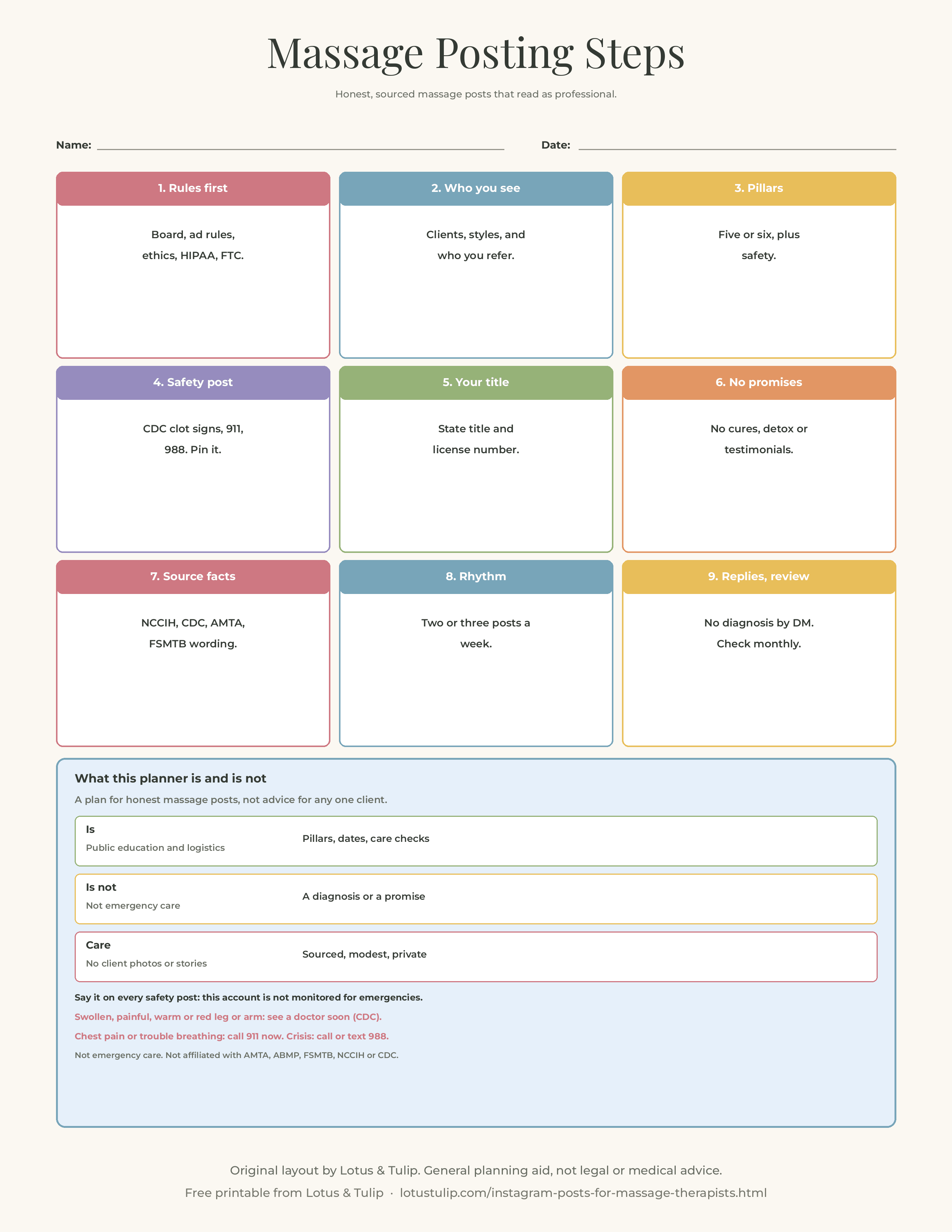
- Write and pin a safety post. Include when to postpone, CDC blood clot signs, call 911 for chest pain or trouble breathing, call or text 988, and the line that your account is not monitored for emergencies. Put a copy in a highlight.
- Audit your title and license. Your state's exact title, license number where required, board lookup link, voluntary credentials named with their issuer and no association logos used as endorsements.
- Ban cures, detox and testimonials from the draft stage. If a post needs a health promise, a toxin claim, a client review about a condition or a body photo to work, rewrite it or delete it.
- Source every health fact. Use NCCIH, CDC, AMTA or FSMTB wording, keep the source's own verbs (may, short-term, low), name the source on the slide and add "General information, not medical advice."
- Set a two or three posts a week rhythm. Batch captions on a quiet morning. Schedule only what has passed the care check. Leave room for stories about openings and hours.
- Prepare replies and review monthly. Save DM and review replies that refuse diagnosis by message, never confirm who is a client, end inappropriate conversations and route people to booking, their doctor, 911 or 988. Once a month, update prices and hours, check disclosures on any brand posts, and run every live post through the care check on page 3 of the free printable.
Mistakes and myths
Common mistakes
- Leaving the license number off in a state that requires it. If your state is like Florida, your promotional posts and bio are advertising. Add the number.
- Using a title you don't hold. "LMT" in a state that uses another title, "therapist" alone in a way that implies a different license, or "certified" when you mean "trained."
- Detox and toxin language. Including in hashtags and stock captions from template sites.
- Reposting reviews that mention conditions. "Cured my migraines" is your health claim the moment you share it.
- Review discounts. "$10 off for a five star review" is an incentive conditioned on sentiment.
- Body-focused photos. Bare backs, oil close-ups and anything that could be read the wrong way attract the wrong inquiries.
- Client stories. Even anonymous ones. Small communities recognize people.
- Diagnosing in comments. "Sounds like your piriformis!" to a stranger is a diagnosis by message.
- Hidden brand deals. Free oils or tools you rave about need a clear disclosure in the post itself.
- Promising coverage. "Insurance covers massage" is not true for everyone. Say what you accept and tell people to check their plan.
- Posting the wrong hours. An outdated hours highlight frustrates people more than no highlight at all.
- Posting every day until you burn out. Your body is your instrument. Protect it.
Myths about massage therapist Instagram
- "You need reels of yourself massaging people to grow." You need clarity and trust. A text carousel that answers "what happens at my first massage" can do more for bookings than a reel of oiled skin.
- "Testimonials are the best social proof." For health services they carry FTC, privacy and board risks. Your license, your policies and your consistent, calm voice are social proof too.
- "Everyone says massage detoxes, so it's fine." Repetition does not make a claim true, and the codes ask you not to exaggerate benefits.
- "HIPAA doesn't apply to massage, so privacy doesn't matter." HIPAA may or may not apply to you, but both major association codes and your clients' trust require confidentiality anyway.
- "A national exam means a national license." There is no national massage license. You practice under your state's license.
- "Health disclaimers fix any claim." A disclaimer does not rescue a misleading claim. The FTC says "results not typical" style disclaimers are unlikely to work for testimonials.
Three fictional examples
These practices are invented. They show how the same principles fit different businesses.
Marisol, solo studio in a mid-size city. Marisol rents a quiet room above a bookstore. Her state requires her license number in ads, so it sits in her bio and on every promotional graphic. She pins three posts: "Your first massage, step by step," "Draping and privacy" and a safety post with CDC blood clot signs, 911 and 988. Twice a week she posts one education carousel (NCCIH wording, source on the last slide) and one practical post (menu, tipping, cancellation). She stopped reposting reviews after one praised her for "curing" a client's headaches. Instead, she sends every client the same review invitation, whatever their session was like.
Dev, mobile and workplace chair massage. Dev travels to offices and events with a massage chair. His feed explains what chair massage is (clothed, no oil, short sessions), what a host needs to provide and how to book a corporate day. He never posts photos of identifiable employees, even with permission, because a manager's request is not the same as each employee's free consent. When a company asked him to post "stress-free staff, guaranteed," he offered "Fifteen minutes of quiet in a busy week" instead. He notes his license state on every event post and does not book events in a state where he is not licensed.
Hannah, massage therapist in a chiropractic clinic. Hannah works in a clinic that bills insurance electronically, so she treats every client detail as protected health information. She and the chiropractors agreed on a "who does what" post so clients understand that her sessions are massage, not chiropractic care. She posts from the clinic account only after the office manager checks it against the clinic's HIPAA policy, and she never replies to reviews herself. Her favorite post is a myth vs fact carousel about toxins, which she wrote in friendly language because many of her clients had heard the claim from earlier therapists.
How this guide compares with neighboring Instagram articles
| Guide | Written for | What it covers that this page leaves aside |
|---|---|---|
| This page: Instagram posts for massage therapists | Massage therapists, bodyworkers, massage studios, mobile and chair massage | State licenses, MBLEx and board certification, license numbers in ads, detox claims, draping and boundaries, NCCIH evidence wording, CDC blood clot signs, tipping, gift cards, National Massage Therapy Awareness Week |
| Instagram posts for chiropractors | Chiropractors and chiropractic clinics | DC degree and titles, spinal manipulation, stroke warning signs, Medicare chiropractic coverage |
| Instagram posts for physical therapists | PTs and PTAs | Physical therapy licensing, direct access, rehab education and medical red flags from the PT side |
| Instagram posts for personal trainers | Trainers, studios, online coaches | Certifications, screening and medical clearance, heat safety, before and after posts |
| Instagram posts for dietitians | RDs, RDNs and nutrition practices | Nutrition credentials, supplements, food allergy safety |
| Holiday social media posts for therapists | Any clinical or wellness feed in December and January | A week by week seasonal calendar and winter hours posts |
| Instagram post ideas for therapists and therapist Instagram bio | Mental health clinicians | Counseling themes and general bio and caption craft |
Use the general therapist pages for layout ideas (bios, highlights, pinned posts, carousels). Come back here when the question is about massage licenses, claims, boundaries or safety.
Honest massage post versus overclaiming post
| Topic | Honest massage post | Overclaiming post |
|---|---|---|
| Results | "Here's what happens in a session and how we'll decide on pressure together." | "One session and your pain is gone." |
| Detox | "Water after a massage is a kind habit. The toxin story isn't supported by our sources." | "Flush out toxins and lactic acid today." |
| Evidence | "NCCIH says massage may help neck pain for a short time." | "Science proves massage cures neck pain." |
| Title | "[Name], licensed massage therapist, [State] #[number]." | "Body healer and pain specialist," no license in sight. |
| Clients | "No client photos or stories here. Your session is private." | "Look how relaxed she is after her session!" |
| Packages | "A three session package saves $X. No pressure." | "Only 2 hours left to lock in 10 sessions!" |
| Reviews | "We invite every client to leave an honest review." | "$10 off for every five star review." |
| Safety | "Chest pain or trouble breathing? Call 911. We're not emergency care." | "Leg swollen and sore? Book a deep tissue session to work it out." |
When not to post
- During a session. Your client deserves your full attention. Film your empty room before or after, never during.
- When a trend relies on bodies or innuendo. Skip it, however many views it gets.
- When you cannot find a primary source. If NCCIH, CDC, AMTA, FSMTB or a quality study does not say it, leave it out.
- During a local health scare. Share official public health guidance, your updated policies and nothing that links massage to immunity or protection.
- Right after a difficult client interaction. Vague posts about "a client today" can identify someone and read as unprofessional.
- When you're exhausted. A missed week does no harm. A careless post can.
- When a brand wants a review before you've used the product. Endorsements must reflect real use and honest opinion.
Free 3 page massage therapist Instagram printable (US Letter)
Print it, fill it in once a month, and keep it next to your booking system. It works with any design app or template set.
- Page 1: Massage Posting Steps. Nine step cards that match the HowTo above, what the planner is and is not, and safety lines for postponing, CDC blood clot signs, 911, 988 and "not emergency care."
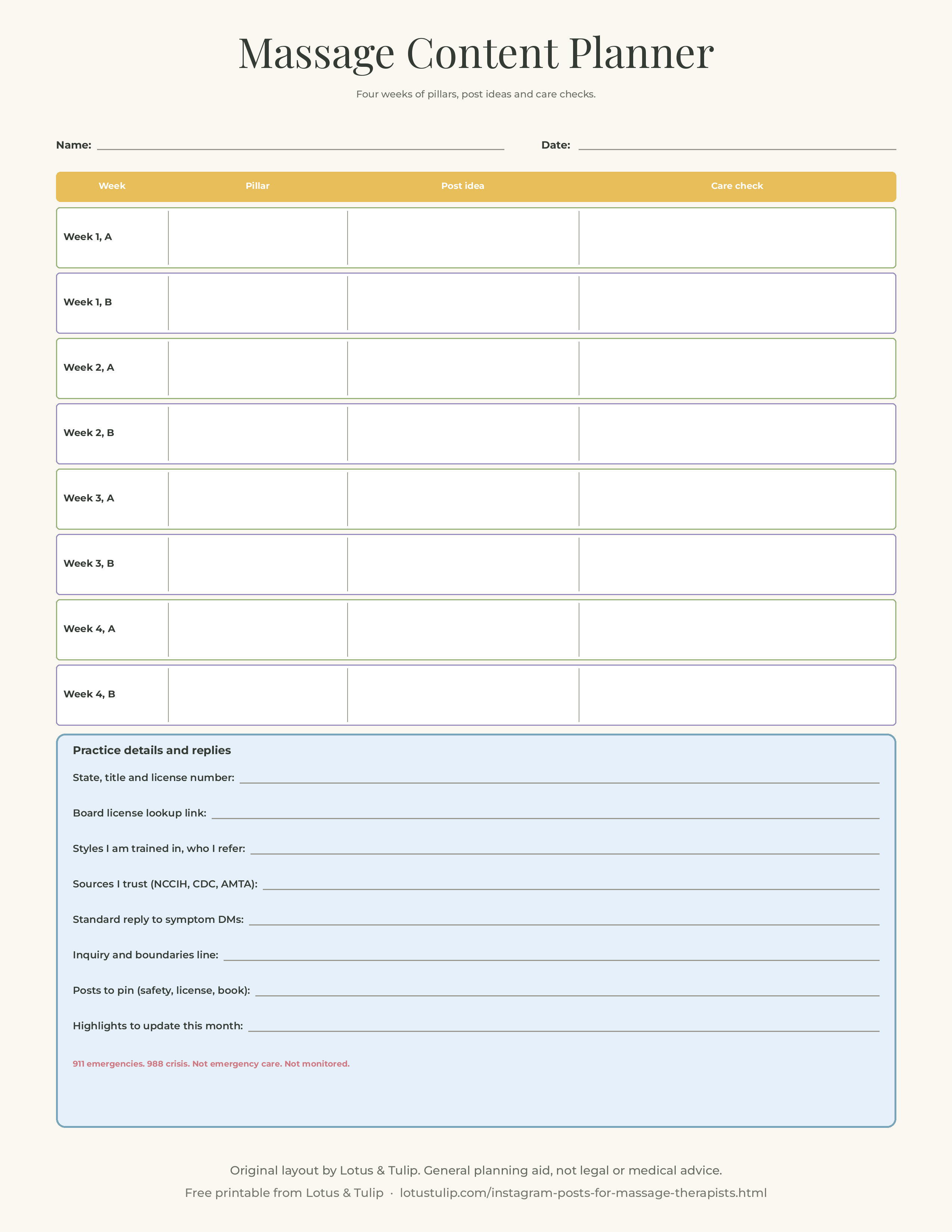
- Page 2: Massage Content Planner. Four weeks of posts (two per week) with columns for pillar, post idea and care check, plus fields for your state, title and license number, your board's lookup link, services you are trained in and who you refer out, sources you trust, your standard reply to symptom DMs, your inquiry and boundaries line, posts to pin and highlights to update.
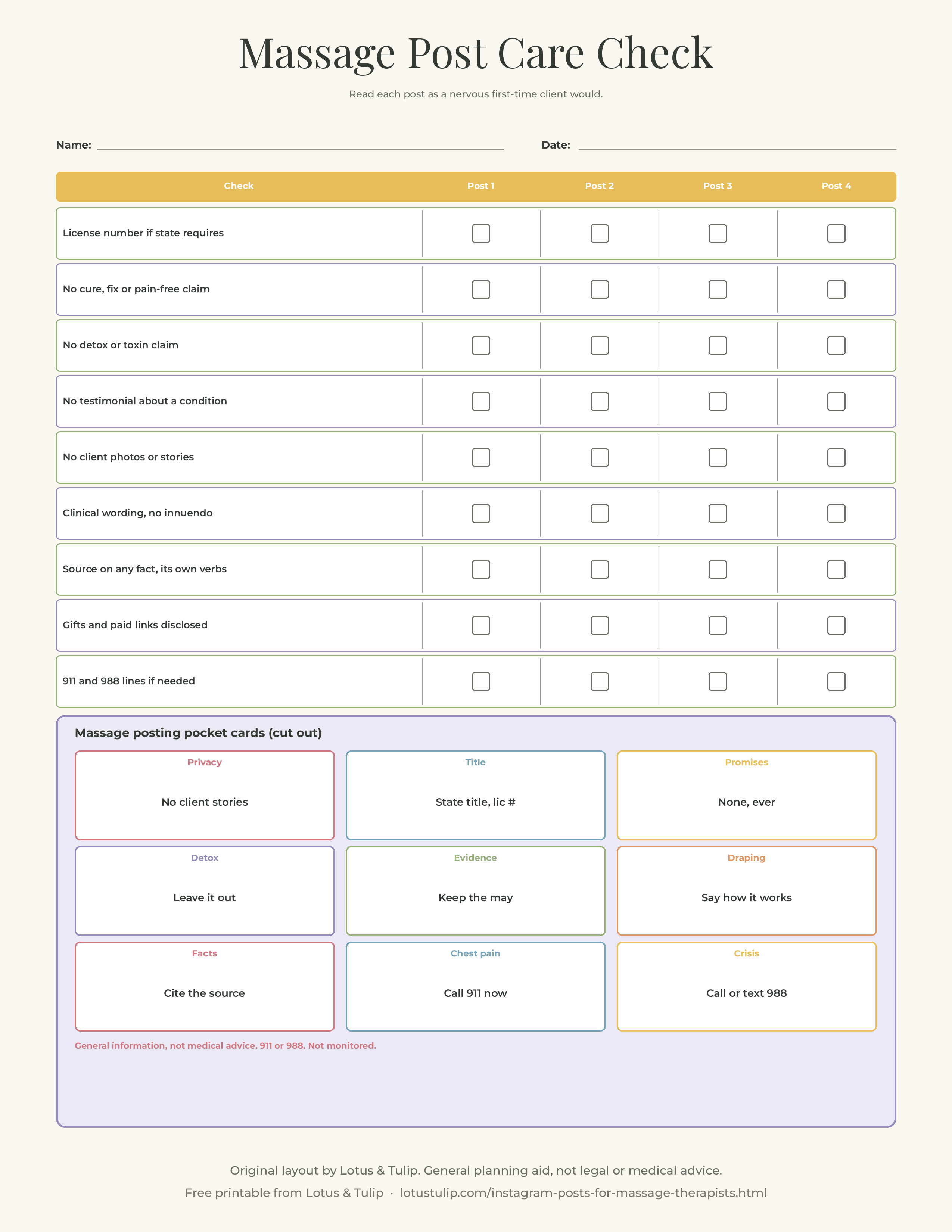
- Page 3: Massage Post Care Check. A yes or no check for up to four posts (license number if your state requires it, no cure, fix or pain-free claim, no detox or toxin claim, no testimonial about a condition, no client photos or stories, clinical wording and no innuendo, source on any fact with its own verbs, gifts and paid links disclosed, 911 and 988 lines if needed), plus nine massage posting pocket cards to cut out.
Download free PDF · Page 1 PNG · Page 2 PNG · Page 3 PNG
Research notes (verified, with caveats)
Every source below was opened or checked through search during this writing session on November 8, 2026. Where we relied on search results rather than the full page, we say so.
- US Bureau of Labor Statistics. Occupational Outlook Handbook, Massage Therapists, bls.gov/ooh/healthcare/massage-therapists.htm, last modified August 27, 2026, opened this session. Duties, tools and session lengths; many self-employed and part-time; work settings including offices of chiropractors and other health practitioners; injury risks and prevention; most states regulate and require a license or certification; typical requirements (approved program, exam, possibly background check, liability insurance, CPR, continuing education, renewal). We did not use wage or projection figures.
- National Center for Complementary and Integrative Health. Massage Therapy: What You Need To Know, nccih.nih.gov, last updated May 2019, opened this session. Definition; Swedish, sports, clinical, Shiatsu and Tuina; 10.9 percent of US adults used massage in 2022 versus 4.8 percent in 2002; evidence wording for low-back, neck and shoulder, knee osteoarthritis, headache, cancer and fibromyalgia; risks low with rare serious reports (blood clot, nerve injury, fracture); state regulation (NCCIH says 45 states and DC); tips including not postponing medical care. NCCIH and FSMTB count regulated jurisdictions slightly differently, so we say "most states."
- Federation of State Massage Therapy Boards. Regulated States table (fsmtb.org/regulated-states), Examination page and MBLEx FAQs, via search this session. Education hours, CE and renewal vary; California voluntary certification, Vermont registration; Hawaii and New York state exams; MBLEx used in 46 of 49 regulated jurisdictions; MBLEx is a licensing exam while certification exams are voluntary; consumers advised to check licensure. FSMTB notes some states are increasing education hours.
- Interstate Massage Compact. IMpact 2026 Legislative Session Update (June 1, 2026), massagecompact.org, opened this session, and an FSMTB news item (July 2026) on Ohio no longer being connected to IMpact, via search. The compact was not yet operating in 2026.
- National Certification Board for Therapeutic Massage and Bodywork. Board Certification pages, ncbtmb.org, via search this session. Voluntary BCTMB credential; state license where applicable, exam, background check, standards and code of ethics; renewal every two years.
- American Massage Therapy Association. Code of Ethics (effective May 1, 2010), Core Documents page, via search this session, with matching text on AMTA chapter sites. Principles (confidentiality, professional image, do no harm) and Rules of Ethics 1 to 4 (scope and law; no sexual conduct; truthful advertising without misrepresenting services, charges, credentials, training, experience, ability or results; no misleading use of AMTA membership or logo). Applies to AMTA members.
- American Massage Therapy Association. What to Expect at Your Massage Session, amtamassage.org, opened this session. Intake, privacy and draping, chair massage clothed without oil (10 to 30 minutes), table massage 30 to 90 minutes, tips appreciated but not required depending on environment, client rights to consent, adjust pressure and stop. We did not use AMTA's consumer survey percentages.
- American Massage Therapy Association. National Massage Therapy Awareness Week, AMTA news page and AMTA social posts via search this session: October 25 to 31, 2026, the 30th year, #NMTAW. Third party calendars describe it as the last full week of October; check AMTA each year.
- Associated Bodywork and Massage Professionals. ABMP's Code of Ethics for Massage Therapists, abmp.com, via search this session. Commitments to honest representation of qualifications and not exaggerating benefits in marketing, referral, draping and dignity, informed consent, confidentiality, boundaries and desexualizing massage, and honesty in business and fees. Applies to ABMP members.
- Florida Statutes section 480.0465 (2026), flsenate.gov and leg.state.fl.us, and Florida Administrative Code rule 64B7-33.001, via search this session. License number in any advertisement including the internet; address and phone requirement with a multi-location exception; prohibition on ads offering sexual services and on ads on sites known for them. Used as one state example only.
- Centers for Disease Control and Prevention. About Venous Thromboembolism (Blood Clots), cdc.gov/blood-clots/about, opened this session. DVT signs (swelling, pain or tenderness, warmth, redness or discoloration), about half with no symptoms, see a doctor as soon as possible; PE signs and seek medical help immediately.
- 988 Suicide and Crisis Lifeline, 988lifeline.org. Call, text or chat 988; available 24/7; free and confidential.
- National Human Trafficking Hotline, humantraffickinghotline.org, and Polaris pages on illicit massage businesses, via search this session. 1-888-373-7888, text 233733, 24/7.
- HHS Office for Civil Rights. Covered Entities and Business Associates (content last reviewed August 21, 2024) and Marketing guidance (45 CFR 164.501, 164.508(a)(3); content last reviewed July 26, 2013), hhs.gov, both opened this session. Providers are covered entities only if they transmit information electronically in a standard transaction; written authorization generally required for marketing uses of PHI. Elite Dental Associates resolution agreement (2019), hhs.gov, via search this session: $10,000 and a corrective action plan over social media review replies that disclosed patient information.
- Federal Trade Commission. Guides Concerning Use of Endorsements and Testimonials in Advertising, 16 CFR Part 255 (88 FR 48102, July 26, 2023), eCFR, opened this session. Sections 255.0(f), 255.1, 255.2 (including Examples 2, 9 and 11), 255.3 and 255.5.
- Federal Trade Commission. Rule on the Use of Consumer Reviews and Testimonials, 16 CFR Part 465 (89 FR 68077, August 22, 2024), eCFR, opened this session. Sections 465.2, 465.4, 465.5, 465.7 and 465.8.
- Federal gift card rule, 12 CFR 1005.20 (Regulation E), eCFR and CFPB consumer answer, via search this session. Funds generally must last at least five years after issue or last load; some states give more time.
This page is not affiliated with or endorsed by the AMTA, ABMP, FSMTB, NCBTMB, BLS, NCCIH, NIH, CDC, HHS, the CFPB, the 988 Lifeline, the National Human Trafficking Hotline, Polaris, any state board or the FTC. We used no trade association survey statistics. Our paid template kits are marketing tools for massage and wellness practices. They are not clinical guidance or treatment tools and have not been tested in any trial. You stay responsible for what you post.
Instagram posts for massage therapists: FAQ
What should a massage therapist post on Instagram?
Focus on what a nervous new client needs: who you are, your state title and license (with the number if your state requires it in ads), how to look up a license, what happens at a first session, draping and privacy, how to ask for more or less pressure, your services, prices, tipping and cancellation policy, sourced education from NCCIH, AMTA and FSMTB, and a pinned safety post with when to postpone, CDC blood clot signs, call 911, call or text 988, and a note that your account is not monitored for emergencies.
How often should a massage therapist post on Instagram?
Two or three feed posts a week is enough for most solo therapists and small studios, plus stories for openings and hours. Once a week is fine if your Book, Fees, FAQ, Comfort and safety posts are current. Massage is physically demanding work, so plan content in one batch rather than daily.
Do I need my license number on Instagram posts?
It depends on your state. Florida, for example, requires the license number in any advertisement of massage services, including on the internet. Other states have their own rules. Check your board's advertising rules; if in doubt, put the number in your bio and on every promotional post.
Can massage therapists post client testimonials?
Check your state rules first. Under the FTC endorsement guides, a testimonial about a key benefit will likely be read as what clients generally achieve, so it must be substantiated, and the FTC says "results not typical" disclaimers are unlikely to fix a misleading one. Testimonials that mention health conditions are the riskiest. Many therapists leave testimonials off Instagram and invite every client to leave an honest review instead.
Can I say massage removes toxins or helps with detox?
Leave it out. NCCIH's guide to massage does not list detoxification as a benefit, and both the AMTA and ABMP codes ask members not to misrepresent or exaggerate results. If you want to address the topic, a friendly myth vs fact post that explains why therapists offer water after a session is more honest and more useful.
Can I offer a discount for a five star review?
No. The FTC's consumer review rule (16 CFR 465.4) prohibits incentives conditioned on a review expressing a particular sentiment. Invite every client to leave an honest review, and do not reward the content of the review.
Does HIPAA apply to massage therapists?
Only if you are a covered entity or work for one. HHS says a health care provider is covered only if it transmits information electronically in connection with a standard transaction, such as electronic insurance claims. Many cash-only practices are not covered, but therapists in clinics that bill insurance often are. Either way, the AMTA and ABMP codes require confidentiality, so never confirm who is a client or share client details online, including in review replies.
Is the free printable a copy of the paid kit?
No. The free three page set is an original planning aid: posting steps, a four week content planner and a post care check with pocket cards. The paid Quiet Room kit contains designed posts, stories, highlight covers, captions and a 12 week calendar. The printable is not a preview of that kit.