
Therapist marketing · Updated 2026-11-08
Instagram Post Ideas for Chiropractors (with Free Printable)
Ready-made template kit: Chiropractor Instagram Templates Holiday 20% off: about $22.08, was $28 (EUR 24) · instant digital download
Buy on Etsy
Instagram posts for chiropractors are judged by two very different audiences at once. The first is the person in pain who finds your profile late at night: stiff neck, sore back, a little scared, scrolling past cracking videos, "this one adjustment fixed everything" reels and accounts that promise chiropractic will boost immunity, cure colic or end headaches forever. The second is the referral source and the regulator: the primary care physician, the physical therapist down the street, the payer reviewing your claims and the state board that licenses you. The algorithm rewards loud sounds, dramatic reactions and big promises. Your board, the FTC, the ACA Code of Ethics and the patients who trust you with their spine reward the opposite: an honest title, plain words about what chiropractic care involves, no promised outcomes, no patient testimonials that imply typical results, and a clear line between musculoskeletal care and claims about everything else.
This guide is written for US chiropractors and the small businesses around them: solo doctors of chiropractic, group and multi-discipline clinics, chiropractors who share space with physical therapists or massage therapists, wellness practices that offer chiropractic alongside other services, chiropractic assistants and front desk teams who run the clinic account, and social media managers who post on a clinic's behalf. It covers what to post on Instagram as a chiropractor: why the job is different from wellness influencer content, what the Doctor of Chiropractic degree, national boards and a state license mean and how to show them honestly, how to use the title doctor without confusing anyone, what chiropractors typically do and what the evidence does and does not support, why claims about non-musculoskeletal conditions are a trap, safety posts built on the CDC stroke warning signs and 911, soreness after a visit and informed consent, the FTC rules on testimonials, fake reviews and fake followers, the FTC warning letters some chiropractic clinics received during the pandemic, patient privacy and HIPAA, replying to online reviews without disclosing anything, sourced public education from NCCIH, Medicare.gov and CDC, self-pay rates, insurance, care plans, cancellations and gift cards, ten content pillars, 34 post ideas with original caption angles, six fuller captions, DM scripts that refuse diagnosis by message, a two or three posts a week rhythm and a 12 week overview, the dates that suit a chiropractic feed, a nine step HowTo, mistakes, myths, three fictional examples, two comparison tables, when not to post, research notes and a free three page US Letter printable: Chiro Posting Steps, a Chiro Content Planner and a Chiro Post Care Check with pocket cards.
If you share patients or a building with other clinicians, neighboring pages may help: Instagram post ideas for physical therapists covers rehab and movement education from the PT side, and Instagram post ideas for personal trainers covers the trainers your patients may move on to once they feel ready. The dietitian and occupational therapist guides round out the clinical side, and holiday social media posts for therapists has a December and January calendar that adapts well to a clinic. This page stays with the questions chiropractors tend to face: how to look credible without testimonials, how to educate without diagnosing strangers, how to explain care plans and costs without pressure, and how to keep a feed safe for the person reading it with a sudden headache at midnight.
We relied on primary sources and opened each one while writing: the Bureau of Labor Statistics Occupational Outlook Handbook profile for chiropractors, the National Center for Complementary and Integrative Health (NCCIH) pages "Chiropractic: In Depth" and "Spinal Manipulation: What You Need To Know," the American Chiropractic Association (ACA) Key Facts page and Code of Ethics, ACA's National Chiropractic Health Month pages for 2026, the Federation of Chiropractic Licensing Boards (FCLB) directory and CIN-BAD pages, the National Board of Chiropractic Examiners (NBCE) exam information, Texas Occupations Code section 104.003, Medicare.gov's chiropractic services page, the CDC page on signs and symptoms of stroke, 988lifeline.org, the HHS guidance on HIPAA and marketing and its 2019 resolution agreement with a dental practice over review replies, FTC staff warning letters to chiropractic clinics about COVID-19 claims, the federal gift card rule (12 CFR 1005.20) and the CFPB consumer answer on gift card expiration, the FTC Guides Concerning Use of Endorsements and Testimonials in Advertising (16 CFR Part 255) and the FTC Rule on the Use of Consumer Reviews and Testimonials (16 CFR Part 465). Notes are at the end. The printable is an original Lotus and Tulip layout.
This guide is general marketing information, not legal, medical, billing or insurance advice. Your state practice act and board rules, any advertising rules your board has adopted, your payer contracts, your malpractice carrier, HIPAA where it applies, the ACA Code of Ethics if you are a member and FTC law all come first. A social media post is public education and promotion. It is not an examination, it is not a diagnosis, it is not a treatment plan for a stranger and it is not informed consent. If someone has sudden numbness or weakness in the face, arm or leg, especially on one side, sudden confusion or trouble speaking, sudden trouble seeing or walking, or a sudden severe headache with no known cause, call 911 right away, as the CDC advises, and do not drive to the hospital. For a mental health or suicidal crisis, call or text 988. A chiropractic clinic is not emergency care. Every safety post you publish should repeat that message and say that your account and inbox are not monitored for emergencies.
What this guide is and is not
It is a planning guide for public, educational and promotional Instagram content from a chiropractor, a chiropractic clinic or a multi-discipline practice that offers chiropractic. It helps you choose themes, write captions that stay inside your license and your evidence, explain how visits, rates and insurance work, and keep safety and privacy information where people can find it.
It is not legal advice. Chiropractic scope of practice is set state by state, and many boards have their own rules on advertising, titles, free offers, testimonials and patient solicitation. NCCIH notes that the scope of chiropractors' practice, meaning the types of services they are allowed to provide, varies from state to state. A post that is fine in one state can be a problem in another. When in doubt, read your practice act and board rules, or ask your state association or a health care lawyer.
It is not clinical guidance. Nothing here tells you how to examine, image, manipulate or manage any patient. Those decisions belong in your training, your examination, your informed consent conversation and your collaboration with other clinicians. A public reel is not an individualized plan, and a comment thread is not a consultation.
It is not a promise that Instagram will fill your schedule. Many chiropractors still get most new patients from referrals, from existing patients, from search and from relationships with local physicians, physical therapists, trainers and employers. A good feed helps a nervous stranger understand what a first visit looks like, and it helps a physician or physical therapist feel comfortable sending a patient your way. That is a real benefit, and it is smaller than the "100 new patients a month" claims on courses that sell Instagram growth to clinics.
And it is not a stage for dramatic adjustments. A feed can explain the difference between manipulation and mobilization, show what happens at a first visit, list the stroke warning signs and describe your rates. It does not need audible cracks, screaming reactions or anyone's spine on camera to do that.
Why posting as a chiropractor is different from wellness influencer content
Most health and wellness Instagram advice is written for influencers, supplement brands and coaching businesses. Their incentives are reach, affiliate sales and subscriptions. A licensed chiropractor shares some of their tools, such as reels, carousels and clean design, but carries obligations that influencer advice ignores.
- The most viral format is the riskiest one. Adjustment videos with loud cavitation sounds and big reactions are some of the most watched chiropractic content online. They can suggest that a single dramatic moment equals a result, they show a patient's body and sometimes their face, and they teach viewers to expect a sound rather than a careful exam and a conversation. Many thoughtful clinics simply do not post them.
- Claims drift easily beyond the spine. Wellness culture invites posts about immunity, digestion, colic, ear infections, blood pressure and "nervous system resets." NCCIH says only a small amount of high-quality research has looked at spinal manipulation for conditions other than musculoskeletal problems, and that a 2021 review found no clear benefit in the six high or acceptable quality studies it identified. During the pandemic, FTC staff sent warning letters to chiropractic clinics whose posts said adjustments would strengthen immunity against COVID-19. The safest feed stays with musculoskeletal care and says so.
- People want a diagnosis in the comments. Followers ask "is this a pinched nerve," "should I get adjusted for my dizziness" or "can you tell what is wrong from this X-ray." Chiropractors diagnose, but they do it after a history and an examination, not from a photo or a sentence. On Instagram, your job is to invite people to book an exam or to see their physician, and to send emergencies to 911.
- Your degree is invisible, and so is your scope. Followers often do not know that chiropractors complete a doctoral program, pass national boards and hold a state license, or that the services a chiropractor may offer differ by state. A clear, honest credentials post, without attacking anyone, is one of the most trust-building things you can publish.
- Testimonials are the default proof, and they carry legal weight. "Swipe to see Sarah's story" is everywhere in clinic marketing. The FTC's endorsement guides say a consumer testimonial about a key benefit will likely be read as what people can generally expect. Unless that is true and substantiated, it misleads. The ACA Code of Ethics adds that doctors of chiropractic should not mislead patients into false or unjustified expectations of the results of treatment.
- Money is a sensitive topic. Prepaid care plans, insurance, Medicare and self-pay rates all generate questions. Clear, calm money posts build trust. Pressure posts, such as "only 3 spots left at this price" or a 40 visit plan pitched before the first exam, do the opposite.
The good news is that chiropractic content does not need drama to work. Calm, sourced explanations of what manipulation is, what soreness after a visit usually means, what Medicare covers and when to call 911 are exactly what many patients cannot find elsewhere, and they are what referral sources look for when they check your profile.
The DC degree, national boards, state licenses and how to show them honestly
The Bureau of Labor Statistics Occupational Outlook Handbook says chiropractors typically need a Doctor of Chiropractic (D.C.) degree, that completing a D.C. program typically takes about 4 years in addition to at least 3 years of undergraduate study, and that every state requires chiropractors to be licensed. It adds that licensing requirements vary by state but at a minimum all require completion of an accredited D.C. program and passing an exam, that states may also require a background check and state-specific law exams called jurisprudence exams, and that all states require practicing chiropractors to earn continuing education credits to keep their license. NCCIH's "Chiropractic: In Depth" says that to practice in the United States, chiropractors must earn a D.C. degree, pass the National Board of Chiropractic Examiners exam and have a state license, and that institutions awarding the D.C. degree are accredited by the Council on Chiropractic Education (CCE), which is recognized as an accrediting agency by the U.S. Secretary of Education. The ACA's Key Facts page describes the national boards as a series of four exams. That gives you an honest, sourced frame for a credentials post.
- Say what you hold, in plain words. "I'm a Doctor of Chiropractic, licensed in [state]" tells a reader more than a string of letters. Add the year and school only if you want to. Only list what is true today.
- Use the title doctor carefully. A doctor of chiropractic is a doctor, and many patients will call you Dr. [name]. What matters is that nobody is confused about which kind of doctor you are. Some states spell this out. Texas, for example, has a statute (Occupations Code section 104.003) on how a person licensed by its chiropractic board identifies the profession on signs, stationery and similar materials, with forms such as "chiropractor," "doctor of chiropractic" or "D.C." Check your own state's rule, and pair "Dr." with "chiropractor" or "DC" in your bio and welcome post.
- Point to the license lookup, not just your word. The FCLB's official directory lists chiropractic regulatory boards for every US state and territory, with links to each board's website, license verification, statutes and rules. A post that says "you can look up my license on the [state] board's website" is a confident, verifiable trust signal.
- Explain continuing education once. BLS says all states require continuing education to maintain a license. A short post on what you studied this year, in general terms, shows that you keep learning without implying a new specialty.
- Diplomate and postgraduate credentials. BLS notes that some chiropractors complete postgraduate programs leading to diplomate credentials in areas such as orthopedics, acupuncture and pediatrics. If you hold one, name it with the issuing body. If you completed a weekend seminar, describe it as a course you took, not as a specialty or certification. Some states have specific rules about advertising a specialty, so check before you use the word.
- Other services need their own authority. Acupuncture, nutrition counseling, massage and rehabilitative exercise are offered by some chiropractic clinics, and BLS mentions several of them. Whether you may provide them, and under what title, depends on your state. If a massage therapist on your team provides massage, say so, and use their title, not yours.
- Do not borrow other professions' titles. "Physical therapy," "physiotherapy," "medical doctor," "neurologist" and "dietitian" are protected or regulated terms in many states. ACA's Code of Ethics says doctors of chiropractic should never misrepresent their education, credentials, professional qualification or scope of clinical ability.
This is why The Still Axis kit prints no credentials on any slide and uses no "Dr." in its placeholders. It cannot know which state you practice in, what your board allows or which postgraduate credentials you hold. You type the title you actually hold into your bio and your welcome post, and the kit's "how to check your chiropractor" post gives your followers questions that apply to everyone, including you.
Scope and claims: musculoskeletal care, said modestly
The BLS profile lists what chiropractors typically do: review a patient's medical history and listen to their concerns, perform a physical examination to analyze posture, spine and reflexes, provide neuromusculoskeletal therapy that involves adjusting the spinal column and other joints, give additional treatments such as heat or cold, advise patients on health and lifestyle issues such as exercise and nutrition, and refer patients to other health care professionals if needed. It says chiropractors focus on pain in the back, neck and joints, with the goal of improving the body's motion and function. NCCIH describes a process similar to conventional medicine: an interview, a detailed health history, an examination, tests and a working diagnosis, then a management plan, treatment and monitoring. The ACA's Key Facts page says the conditions chiropractors treat include, but are not limited to, back pain, neck pain, pain in the joints of the arms or legs, and headaches. That is a good map for your feed: musculoskeletal education, what a visit involves, how you work with other clinicians and when to refer.
What the evidence supports, stated modestly
NCCIH's spinal manipulation page is a useful anchor because it is careful. For low-back pain, it says spinal manipulation is one of several nondrug approaches that may be used for acute and chronic low-back pain and may lead to small improvements in pain and function. For neck pain, it says spinal manipulation can be helpful for acute neck pain, and manipulation or mobilization can be helpful for chronic neck pain, while noting the evidence limitations. For headache, it describes reviews suggesting that spinal manipulation may reduce cervicogenic headache and, more tentatively, migraine days and intensity, with the migraine results called preliminary. For sciatica, it says manipulation is not widely used but may help, with study limitations.
Notice the verbs: may, can, small, modest, preliminary. Your captions should keep them. "Spinal manipulation is one of several nondrug options for low-back pain, and research suggests it may bring small improvements in pain and function for some people. Source: NCCIH" is honest. "Chiropractic fixes back pain" is not. If you quote research, quote what the source says, not what you wish it said, and do not turn a review into a promise for the person reading.
Claims about non-musculoskeletal conditions
This is the line that matters most. NCCIH says only a small amount of high-quality research has looked at spinal manipulation for conditions other than musculoskeletal problems, and that a comprehensive 2021 review identified only six studies of high or acceptable quality evaluating it for non-musculoskeletal conditions such as high blood pressure or menstrual cramps, none of which showed a clear benefit. That is why this guide, and The Still Axis kit, leave out posts that say or imply chiropractic treats or prevents infections, asthma, allergies, colic, ear infections, ADHD, digestive problems, blood pressure, fertility, immunity or "the whole nervous system."
The FTC has acted on exactly this kind of claim. In 2020 and 2021, FTC staff sent warning letters to chiropractic clinics whose websites and social media posts said that adjustments boosted the immune system against COVID-19 or that "regular chiropractic checkups help the body fight viruses." The letters said it is unlawful under the FTC Act to advertise that a product or service can prevent, treat or cure human disease unless you possess competent and reliable scientific evidence, including, when appropriate, well-controlled human clinical studies, and they told recipients to review all their other claims too. Instagram captions are advertising. Treat every health claim on your feed as something you would have to substantiate.
Subluxation language and Medicare
The word subluxation appears in one place where you cannot avoid it: Medicare. Medicare.gov says Part B covers only adjustments of the spine by a chiropractor to correct a subluxation, described there as when the spinal joints fail to move properly but the contact between the joints remains intact, when the chiropractor uses their hands or a device called an activator. If you post about Medicare, quote that wording and leave it there. Do not stretch it into claims that subluxations cause disease or that correcting them improves organ function, immunity or general health.
Children, pregnancy and older adults
Posts aimed at parents, pregnant patients and older adults deserve extra care. NCCIH says reports of serious adverse events from spinal manipulation during pregnancy are very rare but that there has not been much rigorous research, and it advises pregnant people interested in spinal manipulation to discuss potential risks and benefits with their health care provider. For children, stay with what you can stand behind: how you examine, how you work with the child's pediatrician, and what you do not treat. Never post that chiropractic care treats colic, ear infections, developmental conditions or behavior. For older adults, post about how you adapt care and how you coordinate with their physicians, and leave osteoporosis, anticoagulants and other individual risk factors for the exam room.
Chiropractor, physical therapist, massage therapist, osteopathic physician, trainer and primary care
Many people help others with pain and movement. A respectful comparison post builds trust and makes you the person other professionals are happy to refer to. A dismissive one makes you look insecure. Use plain, kind descriptions and check any legal claim against your own state.
- Chiropractor. A licensed doctor of chiropractic who takes a history, examines, forms a working diagnosis and provides care that often includes spinal manipulation, along with other manual and supportive treatments allowed in their state. BLS says chiropractors refer patients to other health care professionals when needed.
- Physical therapist. A licensed clinician who examines, diagnoses and treats movement problems through exercise, manual therapy and education. NCCIH notes that physical therapists also use spinal manipulation. Many patients see both, and the two can coordinate.
- Massage therapist. BLS describes massage therapists as treating clients by applying pressure to manipulate the body's soft tissues and joints. Most states license massage therapists separately. In a shared clinic, the massage therapist's license and title should appear on their own services.
- Osteopathic physician (DO). A fully licensed physician who may also use manipulation, as NCCIH notes. Not the same profession as chiropractic, and not a rival to disparage.
- Personal trainer. Coaches exercise and fitness, usually certified rather than licensed, and does not diagnose or treat injuries. A natural next step for many patients once they feel ready to train.
- Primary care physician. Coordinates the patient's overall health, prescribes medicines and orders tests. The right first call for new symptoms that are not musculoskeletal, and the right partner for most patients with complex health histories.
Comparison posts work best when they answer the reader's real question: "who should I see first?" For sudden stroke signs, chest pain or a serious injury, the honest answer is 911. For new symptoms that do not seem musculoskeletal, or anything that worries the patient beyond ordinary aches, the answer is usually their physician. For musculoskeletal back or neck pain, the answer may be a chiropractor, a physical therapist or a primary care physician, and a good feed says that all three can be reasonable starting points.
Safety posts: 911, stroke warning signs, soreness after a visit and 988
A chiropractic feed will be read by people with neck pain, headaches and dizziness, some of whom are having something more serious than a stiff neck. Plan your safety content before you need it.
Stroke warning signs and B.E. F.A.S.T.
The CDC's stroke signs page lists sudden trouble walking, dizziness, loss of balance or lack of coordination; sudden trouble seeing; sudden numbness or weakness in the face, arm or leg, especially on one side of the body; sudden confusion, trouble speaking or difficulty understanding speech; and sudden severe headache with no known cause. It says to call 911 right away if you or someone else has any of these symptoms. It also teaches B.E. F.A.S.T.: Balance loss, Eye (vision) changes, Face drooping on one side, Arm drifting downward, Speech slurred or strange, and Time to call 911 right away. CDC adds two practical points that belong on your post: note the time when symptoms first appear, and do not drive to the hospital or let someone else drive you; call 911 for an ambulance so treatment can begin on the way. If symptoms go away after a few minutes, CDC says it may have been a transient ischemic attack and to tell a health care team right away.
For Instagram, keep it short and faithful: "Sudden numbness or weakness on one side, confusion, trouble speaking, trouble seeing or walking, or a sudden severe headache? Call 911 right away. Don't drive yourself. Note the time symptoms started. Source: CDC. This clinic is not emergency care, and this account is not monitored for emergencies." Pin it. The Still Axis kit has a "when it's an emergency" post and story built on the same CDC signs.
Neck manipulation, artery tears and informed consent
NCCIH says a type of spinal manipulation that focuses on the neck has been linked to small, potentially dangerous tears in the artery walls of the neck, called cervical artery dissections, which are rare but can lead to a stroke. It notes that any sudden neck movement, such as in sports, whiplash or violent vomiting or coughing, may also increase the risk, that the available evidence suggests the incidence in people getting spinal manipulation is low, and that there is disagreement about whether manipulation can actually cause these tears. It concludes that patients need to be informed of this potential risk. NCCIH cites a 2014 scientific statement from the American Heart Association and American Stroke Association on this topic.
What this means for your feed: do not post "chiropractic is 100 percent safe," and do not post fear either. A calm post on how you take a history, why you ask about recent neck injury, sudden headaches and new neurological symptoms, and how you talk through risks and options before treatment shows the care that informed consent requires. ACA's Code of Ethics asks doctors of chiropractic to use shared decision-making and accurate information so the patient can make an informed choice regarding treatment options.
Soreness after a visit
NCCIH summarizes a 2017 review of 250 publications: mild to moderate side effects, most commonly increased pain or discomfort, stiffness or headache, often occur after spinal manipulation or mobilization, and most go away within 24 hours. Serious side effects have been reported but are very rare, and there are no accurate estimates of how often they occur. The likelihood of a serious side effect may be greater in people with underlying health problems, which is why NCCIH says it is important for practitioners to assess patients thoroughly and for patients to share their health conditions and medications. That is a complete, honest "soreness after a visit" post, and it is one of The Still Axis kit's topics. Add your own clinic line, such as "If something feels different from what we discussed, call us," and the CDC stroke signs with 911.
Mental health crises
People in chronic pain sometimes share more than their symptoms. If a message sounds like a mental health or suicidal crisis, the answer is call or text 988, or 911 for immediate danger. The 988 Lifeline website says people can call, text or chat with a counselor, that it is available 24/7, and that conversations are free and confidential. Do not invent other hotline numbers, and do not list a specialty helpline unless you have checked its official page recently.
"Not emergency care"
Every safety post should say that your clinic is not emergency care and that your account and inbox are not monitored for emergencies. It costs one line and it prevents the worst kind of misunderstanding: someone sending a DM about a sudden severe headache and waiting for you to open the clinic in the morning.
Testimonials, reviews, adjustment videos and the FTC
This is the section most chiropractic marketing courses skip, and it is the one most likely to matter. Two federal documents apply to small clinics: the FTC Guides Concerning Use of Endorsements and Testimonials in Advertising (16 CFR Part 255, revised in 2023) and the FTC Rule on the Use of Consumer Reviews and Testimonials (16 CFR Part 465, published in 2024). Your state board may have stricter advertising rules of its own, including rules that touch on testimonials, so read yours.
Testimonials must be honest and typical, or say what is typical
Section 255.1 says endorsements must reflect the honest opinions, findings, beliefs or experience of the endorser, and may not convey any express or implied representation that would be deceptive if the advertiser made it directly. Section 255.2 says an advertiser must have adequate substantiation for claims made through consumer endorsements, the same as if it made the claims itself, and that consumer endorsements themselves are not competent and reliable scientific evidence. It also says a testimonial about a key attribute of a product or service will likely be read as representing what consumers will generally achieve. If the advertiser cannot substantiate that, the ad should clearly and conspicuously disclose the generally expected performance. The FTC's examples also tested "results not typical" style disclaimers and concluded they are unlikely to be effective.
For a chiropractor, the practical reading is simple: "After six visits my migraines are gone" implies that your typical patient with migraines gets that result. You cannot substantiate that, and NCCIH calls the migraine research preliminary. Do not post it. That is why The Still Axis kit contains no testimonial slides and no cure, outcome or "pain-free" promises. If you want to thank patients, thank them in general words, and if a patient's own words appear anywhere, keep them to what they enjoyed about the visit, with written permission, and nothing about a result.
Adjustment videos
Filmed adjustments combine three risks in one clip: a patient's body and often their face (privacy), a dramatic sound or reaction that implies a result (typicality), and a technique shown to people who may try to copy it at home or ask a friend to "crack" their neck (safety). If you post technique content at all, consider an empty table, a model who is a staff member and not a patient, slow explanations of what you assess before any treatment, and a clear line that manipulation is a clinical procedure, not a home exercise.
Fake reviews, bought reviews, insider reviews and fake followers
Part 465 turns several common shortcuts into rule violations. Section 465.2 prohibits writing or creating fake or false consumer reviews or testimonials, including ones that misrepresent that the reviewer exists, used the service or had the experience described. Section 465.4 prohibits providing compensation or other incentives in exchange for, or conditioned on, reviews expressing a particular sentiment, positive or negative. So "free massage add-on for a five star review" is out; a general request to all patients to share an honest review is fine. Section 465.5 requires officers and managers to clearly disclose their relationship when they write reviews or testimonials about their own business, and covers testimonials from employees. Section 465.7 covers suppressing negative reviews through threats or misleading displays. Section 465.8 prohibits buying or procuring fake indicators of social media influence, such as bot followers or fake likes, when they misrepresent influence for a commercial purpose. The definition covers followers, likes, views, saves, shares and comments.
Brand deals, free products and affiliate codes
Section 255.5 says a connection between the endorser and the seller that might materially affect the weight or credibility of the endorsement, and that the audience would not reasonably expect, must be disclosed clearly and conspicuously. It names monetary payment and free or discounted products as examples, regardless of whether the advertiser requires an endorsement in return, and its examples include affiliate links. Pillows, braces, topical products, supplements and devices are common chiropractic affiliate offers. If you post one, put "Paid partnership," "Gifted" or "I earn a commission" in the visible part of the caption and on the image or video itself, not only on your profile page or behind a "more" link.
Supplements deserve a separate note. ACA's Code of Ethics asks doctors of chiropractic to use established best practices, current guidelines and standards of care when making clinical decisions about nutritional products. NCCIH advises patients to tell their chiropractor about any medications and dietary supplements they take, and, if the chiropractor suggests a supplement, to ask about interactions. A clinic feed that sells supplements with claims about disease belongs in the same category as the warning letters above. Many clinics keep supplement promotion off their professional account entirely.
Patient privacy, HIPAA, filming and replying to reviews
Chiropractic clinics handle health histories, examination findings, imaging, insurance details and treatment notes. Many are HIPAA covered entities because they bill insurance electronically. Your feed should show that you protect what patients share.
- Health information stays off the grid. No screenshots of intake forms, X-rays, posture scans, exam notes, appointment books or insurance cards, even with the name cropped. An X-ray is identifiable to the person in it and often to people who know them.
- HIPAA marketing rules. HHS guidance on the Privacy Rule says that, with limited exceptions, a covered entity needs an individual's written authorization before using or disclosing their protected health information for marketing. A patient photo, video or story on a clinic's Instagram is a use of that information. Get a proper written authorization, not a verbal "sure," and keep it on file.
- Replying to reviews. In 2019, HHS announced that a Dallas dental practice agreed to pay $10,000 and adopt a corrective action plan to settle potential HIPAA Privacy Rule violations involving disclosures of patients' protected health information on social media while responding to online reviews. The lesson travels: never confirm that someone is a patient, never mention their visits, care or bill in a public reply. "We take every concern seriously and would welcome a call at the clinic" is enough.
- Film patients only with written authorization, and only when it serves them. Let them review the clip, and honor a later request to remove it. Never film someone in pain, in a gown or visibly uncomfortable.
- Other patients are not your content. A phone on a tripod pointed at the front desk or an open treatment area publishes people who never agreed to be on your feed.
- Minors. No children's faces, names or care details without a parent or guardian's written authorization, and think twice even then.
ACA's Code of Ethics says doctors of chiropractic should preserve and protect the patient's confidential information, except as the patient directs or consents, or the law requires otherwise. When a grateful patient says "post my X-ray, I don't mind," thank them and think about the FTC section above before you do. A post about what they liked about the front desk, in their own words and with written authorization, is very different from a before and after scan that implies a result.
Public chiropractic education you can source and stand behind
These topics match The Still Axis kit's care and come from federal or professional sources we opened while writing. Cite the source on the slide or in the caption, keep numbers exactly as the source states them, and add "General information, not medical advice. Talk to your chiropractor."
Manipulation and mobilization, explained
NCCIH says spinal manipulation is a technique where practitioners use their hands or a device to apply a controlled thrust to a joint of the spine. The amount of force can vary, but the thrust moves the joint more than it would on its own. Spinal mobilization is different: it does not involve a thrust, it is performed within a joint's natural range of motion, and it can be controlled by the patient. NCCIH adds that most spinal manipulations are done by chiropractors, although other licensed professionals, including osteopathic physicians and physical therapists, also use the technique. NCCIH's chiropractic page says the manual methods chiropractors use range from stretching and sustained pressure to specific joint manipulations, usually delivered by hand with a quick and gentle thrust, with the purpose of improving joint motion and function. That is a clear, accurate two-slide carousel, and it is The Still Axis kit's "manipulation and mobilization explained" topic.
Where chiropractors often help
Use the ACA's own wording when you describe your focus: back pain, neck pain, pain in the joints of the arms or legs, and headaches. Pair it with the NCCIH framing that spinal manipulation is one of several options and that improvements in research are often small. That combination is both honest and appealing: here is what we see most often, here is what research suggests, and here is how we decide together whether it fits you.
Side effects, in plain words
Repeat the NCCIH summary rather than paraphrasing it into something softer or scarier: mild, short-lived side effects such as discomfort, stiffness or headache are common after manipulation or mobilization and most go away within 24 hours; serious side effects are very rare; people with underlying health problems may have higher risk, so share your conditions and medications. Patients find this reassuring because it is specific.
Medicare and chiropractic
Medicare.gov says Part B covers only adjustments of the spine by a chiropractor to correct a subluxation, by hand or with an activator device, and that Medicare does not cover other services or tests a chiropractor orders, including X-rays, massage therapy and acupuncture. After the Part B deductible, the patient pays 20 percent of the Medicare-approved amount. A Medicare post that says exactly this, plus "ask us before your visit what will and won't be covered," saves your front desk many conversations. It is one of The Still Axis kit's myth vs fact carousels. Do not quote a dollar figure for the deductible unless you check the current year's number on Medicare.gov the day you post.
Moving more
Many chiropractors encourage activity, and the CDC's adult activity overview gives you sourced numbers: at least 150 minutes of moderate-intensity activity a week, such as brisk walking, or 75 minutes of vigorous activity or an equivalent combination, plus muscle-strengthening activity on at least 2 days a week that works all major muscle groups. The CDC page on measuring intensity offers the talk test: during moderate activity you can talk but not sing, and during vigorous activity you cannot say more than a few words without pausing for breath. A "moving more" carousel built on these is general public health information. Avoid turning it into a specific exercise prescription for a condition you have not examined. The Still Axis kit's "moving more" and "effort levels" carousels work from the same CDC pages and include no specific exercises.
How to check your chiropractor
This is one of the kit's topics and one of the most generous posts you can make. NCCIH suggests that, before selecting a chiropractor, people ask about the chiropractor's education and licensure, tell the chiropractor about their health history, ask whether the chiropractor has specialized training or experience with their condition, ask how many sessions they will need and about typical out-of-pocket costs and insurance coverage, and tell the chiropractor about any medications and dietary supplements they take. Add one practical step of your own: look up the license on your state board's website, which the FCLB directory links to. Keep the questions neutral so they help readers evaluate you as fairly as anyone else.
Self-pay rates, insurance, care plans, cancellations and gift cards
Money posts are trust posts. A clear, current rates post prevents awkward conversations later and filters out people who would never book.
- Publish self-pay rates in plain numbers. First visit with exam, follow-up visit, and anything else that is commonly added. Say what the first visit includes and roughly how long it takes.
- Explain insurance without promising coverage. NCCIH notes that health insurance plans may cover chiropractic but that coverage may be partial rather than complete. Say which plans you are in network with today, that coverage varies by plan, and that your front desk can check benefits before the first visit.
- Medicare, said exactly. Use the Medicare.gov wording above. If you are not a Medicare provider, say so plainly.
- Care plans without pressure. If you offer visit packages or prepaid plans, describe what is included, how long they last, what happens if the patient stops early and whether unused visits are refunded. Recommend a plan only after an exam, and never as a countdown sale. ACA's Code of Ethics says doctors of chiropractic should not mislead patients into false or unjustified expectations of the results of treatment, and a large prepaid plan pitched to a stranger can do exactly that. Your board rules or state consumer law may also address prepaid care and refunds, so check yours.
- Write your cancellation policy kindly, and post it before you need it. The rule, the notice period, any fee and how to reschedule. The kit treats clinic details as your own policy, so you can change them to match yours.
- Free offers. "Free consultation" and "free X-ray" offers are common, and some states and payers have specific rules about free or discounted services, especially for patients with government insurance. Check your board rules and payer contracts before you advertise anything free.
- Gift cards follow federal rules. The federal gift card rule, 12 CFR 1005.20, says a gift certificate or store gift card generally cannot be sold with an expiration date unless the underlying funds last at least five years from issue (or from the last load for a store card), with required disclosures. The CFPB's consumer answer says gift card funds must be good for at least five years under federal law and that some state laws give more time. The Still Axis kit's gift card post states no expiry date. If your card does expire, read the rule and your state law first, and do not print "valid for 12 months."
Ten content pillars for a chiropractic Instagram
Pillars keep you from reinventing your account every Monday. Five or six would be enough. Ten gives you room to rotate without falling back on adjustment videos and trends.
- Who I am and how I practice. Your name, Doctor of Chiropractic, the state where you are licensed, the people you see most, how you work with other clinicians and the situations you refer.
- What a chiropractor does (and does not). History, exam, working diagnosis and a plan; musculoskeletal focus; what you refer to a physician, a physical therapist or another professional.
- Safety. CDC stroke signs and B.E. F.A.S.T., call 911 and do not drive yourself, call or text 988, and "this clinic is not emergency care; this account is not monitored for emergencies."
- Your first visits. Health history, examination, when imaging is or is not needed, consent and shared decisions, what to wear and bring.
- Techniques explained. Manipulation versus mobilization, the other manual methods you use, and why you choose one over another, without promising results.
- After a visit. Common short-lived soreness, what to tell you about, and when something is an emergency.
- Moving more. CDC weekly activity guidelines, the talk test, sitting less, general activity ideas without specific exercises for a condition.
- Time, money and policies. Self-pay rates, insurance, Medicare, care plans, cancellations, gift cards, holiday hours.
- Myths and honest evidence. "Chiropractors are not real doctors," "one adjustment fixes everything," "the pop is what matters," "Medicare covers everything." Always sourced, never mocking.
- Community and gratitude. New patient openings, October's National Chiropractic Health Month, a wellness talk at a local employer, thank-you posts that do not display patients.
Pin at least three posts: the safety post, a "how to check your chiropractor" or credentials post, and a first visit or booking post. Keep matching highlights (the kit's set includes About, Services, Rates, Book, FAQ, Visit, Team, Policies, Insurance, Myths, Moving and Gifts) so a new visitor can find what they need without scrolling a year of content.
34 Instagram post ideas for chiropractors, with caption angles
These are original planning ideas, not captions copied from any template kit. Adapt the wording to your clinic, your state's rules and your scope. Add "General information, not medical advice. Talk to your chiropractor." whenever a post teaches a health idea.
About you and the clinic
- Welcome, and what kind of doctor I am. Caption angle: Doctor of Chiropractic, licensed in [state], the people you see most, and how you work with physicians and physical therapists.
- My training in two sentences. Caption angle: a four year D.C. program after undergraduate study, national boards, a state license and yearly continuing education. Sources: BLS and NCCIH.
- Look up my license. Caption angle: here is our state board's license lookup. You can check any chiropractor this way, including me.
- Who does what in your care. Caption angle: chiropractor, physical therapist, massage therapist, primary care physician. A respectful map, not a turf war.
- Meet the team, without patients on camera. Caption angle: the front desk, the chiropractic assistant, the massage therapist with their own license, and the coffee machine.
- Why my feed has no testimonials or adjustment videos. Caption angle: your care is not my advertisement, and one person's experience is not a promise. Then point to your first visit post.
- When I refer you elsewhere. Caption angle: some symptoms need a physician first, and saying so is part of good chiropractic care.
Safety and your first visits
- Pinned emergency post. Caption angle: CDC stroke signs, B.E. F.A.S.T., call 911, don't drive yourself, note the time, and "this account is not monitored for emergencies."
- Your first visit, step by step. Caption angle: health history, an exam, a working diagnosis, options explained, and a plan you agree to before any treatment.
- Why I ask so many questions. Caption angle: NCCIH says thorough assessment matters because some health problems raise risk. Your answers shape your care.
- How to prepare. Caption angle: comfortable clothes, a list of medications and supplements, past imaging if you have it, and your questions.
- Soreness after a visit. Caption angle: NCCIH says mild soreness, stiffness or headache is common and usually gone within 24 hours. Call us if something feels different, and 911 for stroke signs.
- Consent is a conversation. Caption angle: we talk through options, benefits and risks, and you decide. You can say no to any technique.
- Questions to ask any chiropractor before you book. Caption angle: NCCIH's list: education and licensure, your health history, experience with your condition, number of visits, costs and insurance, medications and supplements.
Rates, insurance and logistics
- Self-pay rates, in plain numbers. Caption angle: first visit with exam, follow-up, and what each includes.
- Insurance, without promises. Caption angle: plans we take today, coverage varies, and we'll check your benefits before you come in.
- Medicare and chiropractic. Caption angle: Part B covers spinal adjustments to correct a subluxation; not X-rays, massage or acupuncture ordered by a chiropractor; 20 percent after the deductible. Source: Medicare.gov.
- Booking and cancellation policy, said kindly. Caption angle: the rule, the reason, and how to reschedule without guilt.
- New patient openings this month. Caption angle: days and times that are true today, and how the waitlist works.
- Gift cards. Caption angle: what a card covers, how to redeem it, and that the funds do not expire (if that is your policy).
- Holiday hours and closures. Caption angle: when you are closed and where emergencies go. Pair with the holiday social media posts for therapists page for a winter plan.
Education, sourced
- Manipulation versus mobilization. Caption angle: NCCIH: manipulation is a controlled thrust that moves a joint further than it would on its own; mobilization has no thrust and stays within natural range.
- Where chiropractors often help. Caption angle: ACA lists back pain, neck pain, pain in the joints of the arms or legs, and headaches.
- What research says about low-back pain, honestly. Caption angle: NCCIH says spinal manipulation is one of several nondrug options and may bring small improvements in pain and function.
- Neck pain and headaches, honestly. Caption angle: NCCIH's careful wording on neck pain and cervicogenic headache, including the evidence limits.
- The talk test. Caption angle: CDC says moderate activity lets you talk but not sing. A gentle way to move more without a program.
- How much activity adults need. Caption angle: 150 minutes moderate a week plus 2 days of muscle strengthening. Source: CDC.
- Myth versus fact: "The pop is what makes it work." Caption angle: the sound is not the goal; the goal is joint motion and function, and some techniques make no sound at all.
- Myth versus fact: "Chiropractors aren't real doctors." Caption angle: Doctor of Chiropractic degree, national boards, a state license; a different kind of doctor from an MD or DO, and proud of it.
- Myth versus fact: "Medicare covers everything a chiropractor does." Caption angle: it covers spinal adjustments to correct a subluxation, not X-rays, massage or acupuncture ordered by a chiropractor.
Community and gratitude
- National Chiropractic Health Month (October). Caption angle: ACA's 2026 theme was "Joint Efforts," focused on lifelong joint health. Share a mobility-friendly community walk or an open house.
- Wellness talks. Caption angle: you visit workplaces, schools or community groups to talk about desk setup and moving more, with no diagnosis on the day.
- Thank you to referral partners. Caption angle: thank the physicians, physical therapists and trainers you work with, in general words.
- Thank you to patients, without a testimonial slideshow. Caption angle: a simple thank-you for trusting the clinic, with no names, photos or results.
Six fuller caption examples you can adapt
These are original drafts. Replace bracketed details. Do not paste a patient's story, images or results into any of them.
- Welcome. "Hi, I'm [first name], a doctor of chiropractic licensed in [state], practicing at [clinic] in [city]. Most of the people I see come in with back pain, neck pain, sore joints or headaches. I take a full history and examine you before we decide anything together, and I refer to physicians and physical therapists when that's the better path. I don't post patient stories or promise results, because your care should be about you, not my feed. I can't give personal advice in comments or DMs, but I'm happy to explain a first visit. Booking link in bio. General information, not medical advice."
- Emergency. "Please save this. Sudden numbness or weakness in the face, arm or leg, especially on one side, sudden confusion or trouble speaking, sudden trouble seeing or walking, or a sudden severe headache with no known cause: call 911 right away. Don't drive yourself, and note the time the symptoms started. Source: CDC. This clinic is not emergency care, and this account is not monitored for emergencies. In a mental health crisis, call or text 988."
- Manipulation and mobilization. "Two words you might hear at your visit. Manipulation is a controlled thrust that moves a joint a little further than it would go on its own. Mobilization has no thrust, stays inside the joint's natural range, and you can control it. Chiropractors use both, and so do some physical therapists and osteopathic physicians. We'll always explain which we suggest and why, and you can say no to either. Source: NCCIH. General information, not medical advice. Talk to your chiropractor."
- After a visit. "Feeling a little sore after your visit? According to NCCIH, mild discomfort, stiffness or a headache is common after spinal manipulation or mobilization, and most of it settles within 24 hours. Serious side effects are very rare. If something feels different from what we talked about, call the clinic. If you notice any stroke signs, call 911. General information, not medical advice."
- Medicare. "Medicare question we hear every week. Medicare Part B covers adjustments of the spine by a chiropractor to correct a subluxation. It doesn't cover other services or tests a chiropractor orders, like X-rays, massage or acupuncture. After the Part B deductible, you pay 20 percent of the Medicare-approved amount. Source: Medicare.gov. Ask our front desk before your visit and we'll walk you through it."
- How to check your chiropractor. "Choosing a chiropractor? Good questions to ask anyone, including me: What is your education, and are you licensed in this state? What will you ask about my health history? Do you have experience with what I'm dealing with? How many visits do you expect, and what will it cost with my insurance? Should I tell you about my medications and supplements? (Yes.) You can also look up any chiropractor's license on the state board website. Source: NCCIH."
DM and comment replies that refuse diagnosis kindly
Save these where your whole team can find them, including the front desk. Edit for your voice. The goal is to be warm and boringly consistent.
- When someone describes symptoms and asks what is wrong. "I'm sorry you're dealing with that. I can't diagnose anything over messages, and I'd hate to guess wrong. An exam would let us look properly, or your physician is a good first stop. If anything is sudden or severe, like numbness on one side, trouble speaking or a sudden severe headache, please call 911 now."
- When someone sends an X-ray or MRI report. "Thanks for trusting me with this. Please don't send imaging or reports here; this inbox isn't a secure place for health information, and I can't interpret them without an exam. If you'd like to come in, bring them to your visit, and please keep your physician in the loop."
- When someone asks if chiropractic will help a non-musculoskeletal condition. "That's a fair question. My work focuses on muscles, joints and the spine, and I don't claim to treat [condition]. Your physician is the right person for that. If you also have back or neck pain, I'm happy to talk about a visit for that."
- When someone asks how many visits they will need. "Honestly, I can't say before an exam, and anyone who promises a number before meeting you is guessing. After the first visit I'll explain what I suggest, what it costs and how we'll know if it's helping. You can stop at any time."
- When someone asks about supplements. "I can't recommend supplements or doses over messages. Please ask your physician or pharmacist, especially if you take any medicines, and tell any clinician you see about everything you take."
- When a grateful patient offers a testimonial or wants to post their adjustment video. "That means so much. I keep my feed free of patient stories and adjustment videos, because one person's experience can feel like a promise to someone else. A kind, honest review on our listing is always welcome, in your own words, and you never have to mention your health."
- When someone leaves an angry public review. "Thank you for taking the time to share this. We take every concern seriously and would welcome a call at the clinic at [number]." Nothing else in public: no confirmation that they are a patient, no details of any visit and no argument.
A sustainable rhythm and a 12 week overview
Two or three feed posts a week is enough for most solo chiropractors and small clinics. Daily posting usually leads to thinner captions, trend chasing and adjustment videos. The kit's 12 week calendar uses 3 posts a week. Stories can be lighter: today's hours, a closed sign for a snow day, a poll on whether people knew the difference between manipulation and mobilization, a reminder that the inbox is not for emergencies.
Here is a 12 week overview you can repeat or rearrange. It is an original planning sketch, not a copy of any paid calendar.
- Weeks 1 and 2. Who you are, your training explained, how to look up your license, and the pinned emergency post.
- Weeks 3 and 4. First visit step by step, how to prepare, why you ask so many questions, and consent as a conversation.
- Weeks 5 and 6. Self-pay rates, insurance, Medicare, cancellation policy and new patient openings.
- Weeks 7 and 8. Techniques explained: manipulation versus mobilization, the other manual methods you use, and soreness after a visit.
- Weeks 9 and 10. Where chiropractors often help and what research says, stated modestly, plus moving more and the talk test.
- Weeks 11 and 12. Myths and a review: run every live post through the care check, delete anything that overclaimed, update rates, insurance, hours and highlights.
If October or January falls inside a block, swap the order rather than doubling your posting rate. A steady month beats fifteen posts in one week and silence for the next three.
Dates for a chiropractic feed: October and January
October is National Chiropractic Health Month. ACA describes National Chiropractic Health Month as a nationwide observance held each October. Its 2026 theme was "Joint Efforts," focused on joint health over a lifetime, with a campaign toolkit of logos, key messages, social media graphics and captions at acatoday.org/NCHM and the hashtag #JointEfforts. ACA's quick-start guide suggests options from simply posting the logo on October 1 to giving a community talk. Check the toolkit each year for the new theme before you post, and use ACA's materials as written, without adding outcome claims of your own.
January. New year interest in moving more and booking overdue care is real, and The Still Axis kit includes a January visits post. Keep it honest: openings, how a first visit works, insurance benefits resetting for some plans (say "check your plan," not "your benefits reset"), and "start where you are." Skip resolution statistics unless you have an official source.
Other dates, such as a local race, a school sports physical season or a community health fair, are fine when they match the people you serve. Do not attach official themes to observances you have not checked, and do not imply that ACA or any agency endorses your clinic.
How to plan Instagram posts as a chiropractor, step by step
- Read your rules first. Open your state practice act and board advertising rules, your payer contracts, your malpractice carrier's guidance, the ACA Code of Ethics if you are a member, HIPAA marketing guidance and the FTC endorsement guides. Note anything about testimonials, titles, free offers, specialties and patient images.
- Name who you see and what you refer. List the people you actually treat, the conditions you focus on, the services your state allows you to offer, and the situations you send to a physician, a physical therapist or 911.
- Choose five or six pillars, plus safety. Use the ten pillars above as a menu. If you cannot say something true and sourced under a pillar this month, skip it.
- Write and pin an emergency post. Include the CDC stroke signs and B.E. F.A.S.T., call 911, do not drive yourself, note the time, call or text 988, and the sentence that your clinic is not emergency care and your account is not monitored for emergencies. Put a copy in a highlight.
- Audit your title and credentials. Doctor of Chiropractic and the state where you are licensed, any diplomate credential named with its issuer, and "Dr." always paired with "chiropractor" or "DC." Remove seminar names that look like specialties and any titles your state protects for other professions.
- Ban testimonials, cures and countdowns from the draft stage. If a post needs a patient story, an adjustment video, a claim about a non-musculoskeletal condition, a "pain-free" promise or a limited-time care plan to work, rewrite it or delete it.
- Source every health fact. Use NCCIH, CDC, Medicare.gov or ACA wording, keep the source's own verbs (may, small, modest), name the source on the slide, and add "General information, not medical advice. Talk to your chiropractor."
- Set a two or three posts a week rhythm. Batch captions on a quiet morning. Schedule only what has passed the care check. Leave room for a story if your hours change.
- Prepare replies and review monthly. Save DM and review replies that refuse diagnosis by message, never confirm who is a patient and route people to booking, their physician or 911. Once a month, update rates, insurance and hours, check disclosures on any partnership posts, and run every live post through the care check on page 3 of the free printable.
Mistakes and myths
Common mistakes
- Patient testimonials about results. The FTC says a testimonial about a key benefit will likely be read as typical. "My migraines are gone" is a claim you would have to substantiate.
- "Results not typical" disclaimers. The FTC says this kind of disclaimer is unlikely to fix a misleading testimonial.
- Claims about immunity, infections, colic or organ function. NCCIH found no clear benefit for non-musculoskeletal conditions in the best available studies, and FTC staff sent warning letters to clinics that claimed adjustments fight COVID-19.
- Adjustment videos with patients. Privacy, typicality and copycat safety risks in one clip.
- "Pain-free," "fix," "cure" and "realign your life." ACA's Code of Ethics says not to create false or unjustified expectations of the results of treatment.
- X-rays and posture scans on the feed. Identifiable health information, and a before and after scan implies a result.
- Replying to reviews with details. HHS settled with a dental practice that disclosed patient information while responding to online reviews.
- Free adjustments for five star reviews. Section 465.4 prohibits incentives conditioned on a particular sentiment. Ask everyone for an honest review instead.
- Buying followers or likes. Section 465.8 prohibits buying fake indicators of social media influence to misrepresent your influence for a commercial purpose.
- Undisclosed affiliate products. Pillows, braces and supplements with commission links are material connections under Section 255.5. Disclose them in the visible part of the post.
- Gift cards that expire in 12 months. Federal rules generally require gift card funds to last at least five years.
Myths about chiropractic Instagram
- "Chiropractic content only works with adjustment videos." Manipulation versus mobilization carousels, first visit explainers, honest Medicare posts and clear rates explain your value without anyone on the table.
- "A disclaimer at the end makes a claim okay." The impression comes from the whole post. If the post says chiropractic treats a condition the evidence does not support, a disclaimer does not change that.
- "Physical therapists and physicians are competition." They are referral partners, and BLS notes that chiropractors increasingly work with physicians and physical therapists through referrals and complementary care. Respectful posts make that relationship visible.
- "You must post daily to grow." Two or three careful posts a week, with current highlights, serve a clinic better than daily filler.
- "Bigger numbers mean more patients." Most clinics serve people within driving distance. A smaller, local, trusting audience books more first visits than a large anonymous one.
- "Instagram replaces a website." People still need a page with your license, location, rates, insurance, policies and contact details they can read without an app.
Three fictional examples
These people and clinics are invented. They show decisions, not real businesses.
- Ines, a solo chiropractor in a small Midwestern town. A follower comments that she has had "the worst headache of my life since this morning" and asks whether an adjustment would help. Ines replies within minutes with her saved message: this sounds like something to call 911 about now, and the clinic is not emergency care. Later that week she reposts her pinned CDC stroke signs post with B.E. F.A.S.T. She never mentions the commenter.
- Theo, who co-owns a chiropractic and physical therapy clinic. A pillow company offers him a 15 percent commission code. He checks the FTC guides, decides the pillow is one he already recommends in the exam room, and posts it once with "I earn a commission" at the start of the caption and on the image. A supplement brand then offers a "nervous system support" stack with an immunity claim. He declines, because he would have to substantiate that claim himself.
- Grace, the office manager for a three-doctor clinic. A longtime patient offers to film a video about how chiropractic "cured" her acid reflux. Grace thanks her and explains that the clinic does not post patient stories, and that the clinic does not claim to treat reflux. Instead, with written authorization, the clinic shares a short quote from the patient about how welcome the front desk makes her feel, with no health details. The next month Grace schedules a Medicare myth vs fact carousel and a "how to check your chiropractor" post that links the state board's license lookup.
How this guide compares with neighboring Instagram articles
| Guide | Written for | What it covers that this page leaves aside |
|---|---|---|
| This page: Instagram posts for chiropractors | Chiropractors, chiropractic clinics, multi-discipline practices | DC degree, national boards, state licenses and the title doctor, non-musculoskeletal claims and FTC warning letters, CDC stroke signs, neck manipulation and consent, soreness after a visit, Medicare Part B, review replies and HIPAA, October's chiropractic month |
| Instagram posts for physical therapists | PTs and PTAs | Physical therapy licensing, direct access, rehab education and medical red flags from the PT side |
| Instagram posts for personal trainers | Trainers, studios, online coaches | Certifications and USREPS, screening and medical clearance, heart attack and heat safety, before and after posts |
| Instagram posts for dietitians | RDs, RDNs and nutrition practices | Nutrition credentials, medical nutrition therapy, supplements, food allergy safety |
| Instagram posts for occupational therapists | OTs and OTAs | Daily living, children and sensory differences, splints, school OT |
| Holiday social media posts for therapists | Any clinical or wellness feed in December and January | A week by week seasonal calendar and winter hours posts |
| Instagram post ideas for therapists and therapist Instagram bio | Mental health clinicians | Counseling themes and general bio and caption craft |
Use the general therapist pages for layout ideas (bios, highlights, pinned posts, carousels). Come back here when the question is about chiropractic titles, claims, safety or Medicare.
Honest chiropractic post versus overclaiming post
| Topic | Honest chiropractic post | Overclaiming post |
|---|---|---|
| Results | "Here is how a first visit works and how we decide on care together." | "Pain-free in 12 visits, guaranteed." |
| Conditions | "We focus on back pain, neck pain, joint pain and some headaches." | "Adjustments boost immunity and fix digestion." |
| Evidence | "NCCIH says manipulation may bring small improvements in low-back pain." | "Science proves chiropractic beats everything." |
| Title | "Dr. [name], chiropractor, licensed in [state]." | "Dr. [name], spine and nerve specialist" with no DC in sight. |
| Patients | "No testimonials or adjustment videos here. Your care is not my ad." | "Watch her neck crack and her face light up." |
| Plans | "After your exam we'll explain options, costs and how we'll know it's helping." | "Lock in 36 visits today before the price goes up." |
| Reviews | "We invite every patient to leave an honest review." | "Free adjustment for every five star review." |
| Safety | "Sudden stroke signs? Call 911. We're not emergency care." | "Bad headache? DM me, I'll fit you in tomorrow." |
When not to post
- Mid-visit. Your patient is on the table and deserves your full attention. Film setup or empty-room content before or after, not during.
- When a trend asks you to crack someone on camera. Skip it. Your feed does not need to prove anything with a sound.
- When you cannot find a primary source. If NCCIH, CDC, Medicare.gov, ACA or a quality study does not say it, leave it out.
- During a health scare or outbreak. Do not connect chiropractic care to an infection, a vaccine or immunity. Share official public health guidance, your clinic's hours and any visitor policy, and nothing more.
- When a brand is paying and the post would not exist otherwise. If you go ahead, disclose clearly. If you hesitate, that is your answer.
- When a patient is in the frame without written authorization, or another patient is in the background.
- When your board rules, payer contract or employer policy says no. Follow it.
Free 3 page chiropractor Instagram printable (US Letter)
Print it, fill it in once a month, and keep it next to your scheduling system. It works with any design app or template set.
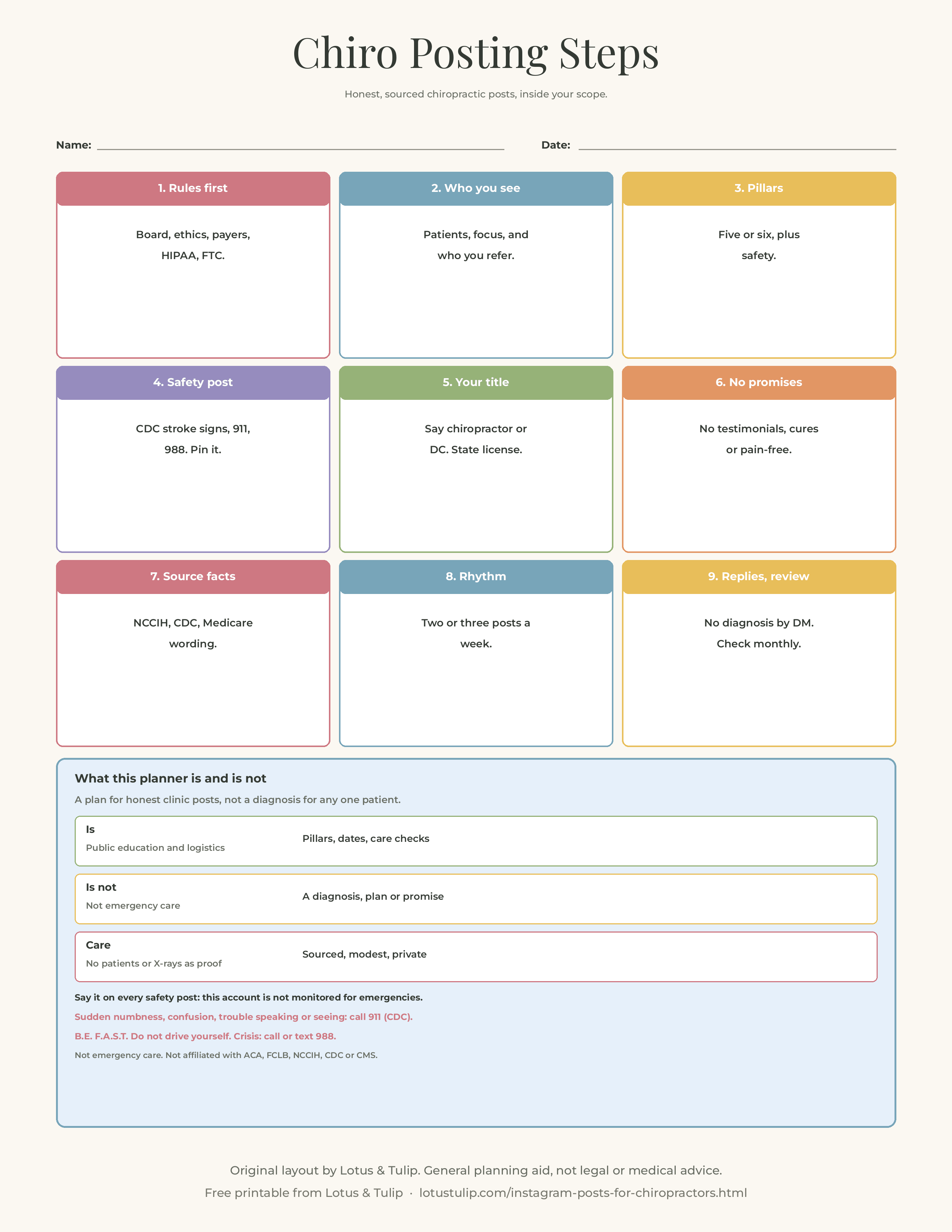
- Page 1: Chiro Posting Steps. Nine step cards that match the HowTo above, what the planner is and is not, and safety lines for 911, CDC stroke signs and B.E. F.A.S.T., not driving yourself, 988 and "not emergency care."
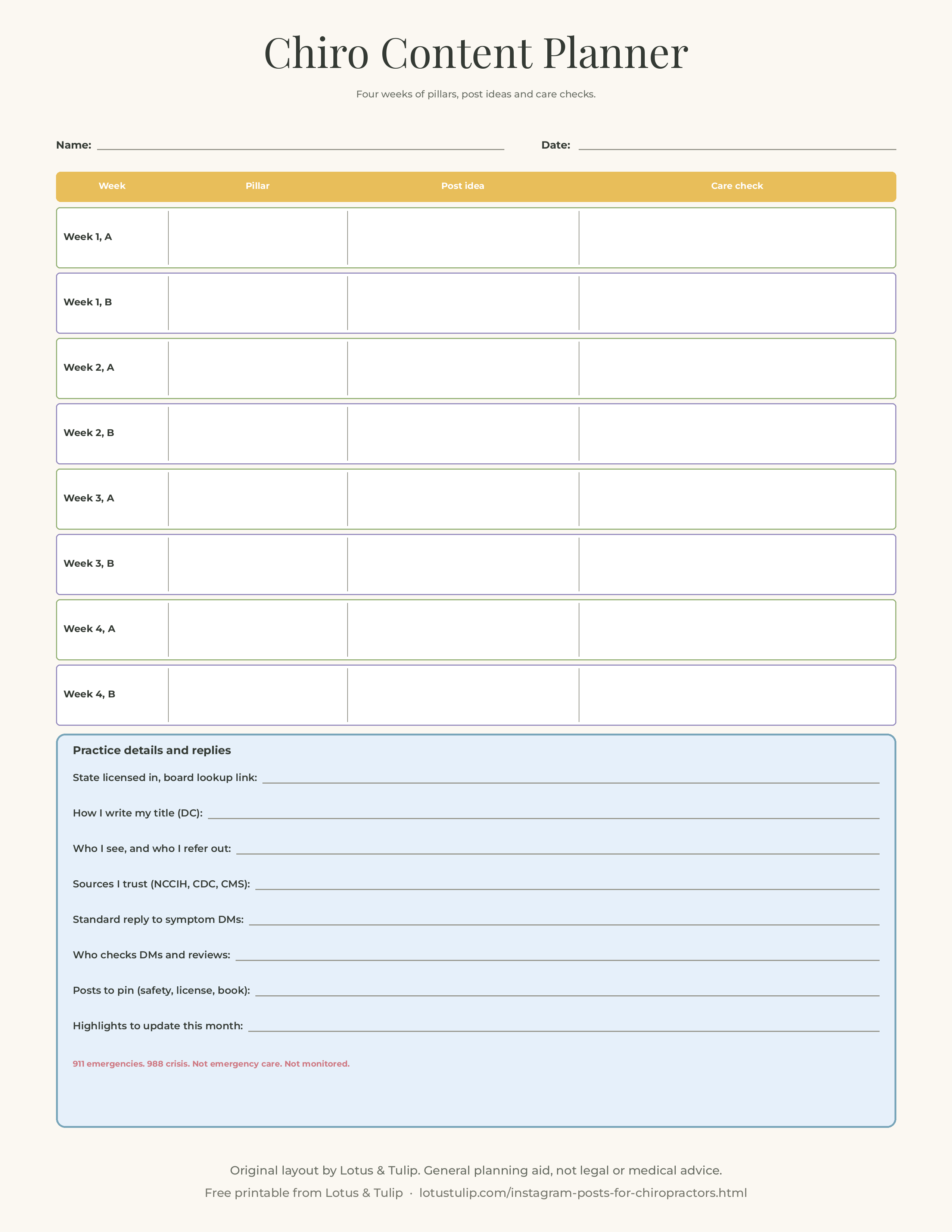
- Page 2: Chiro Content Planner. Four weeks of posts (two per week) with columns for pillar, post idea and care check, plus fields for the state where you are licensed and your board's lookup link, how you write your title, who you see and refer out, sources you trust, your standard reply to symptom DMs, who checks messages and reviews, posts to pin and highlights to update.
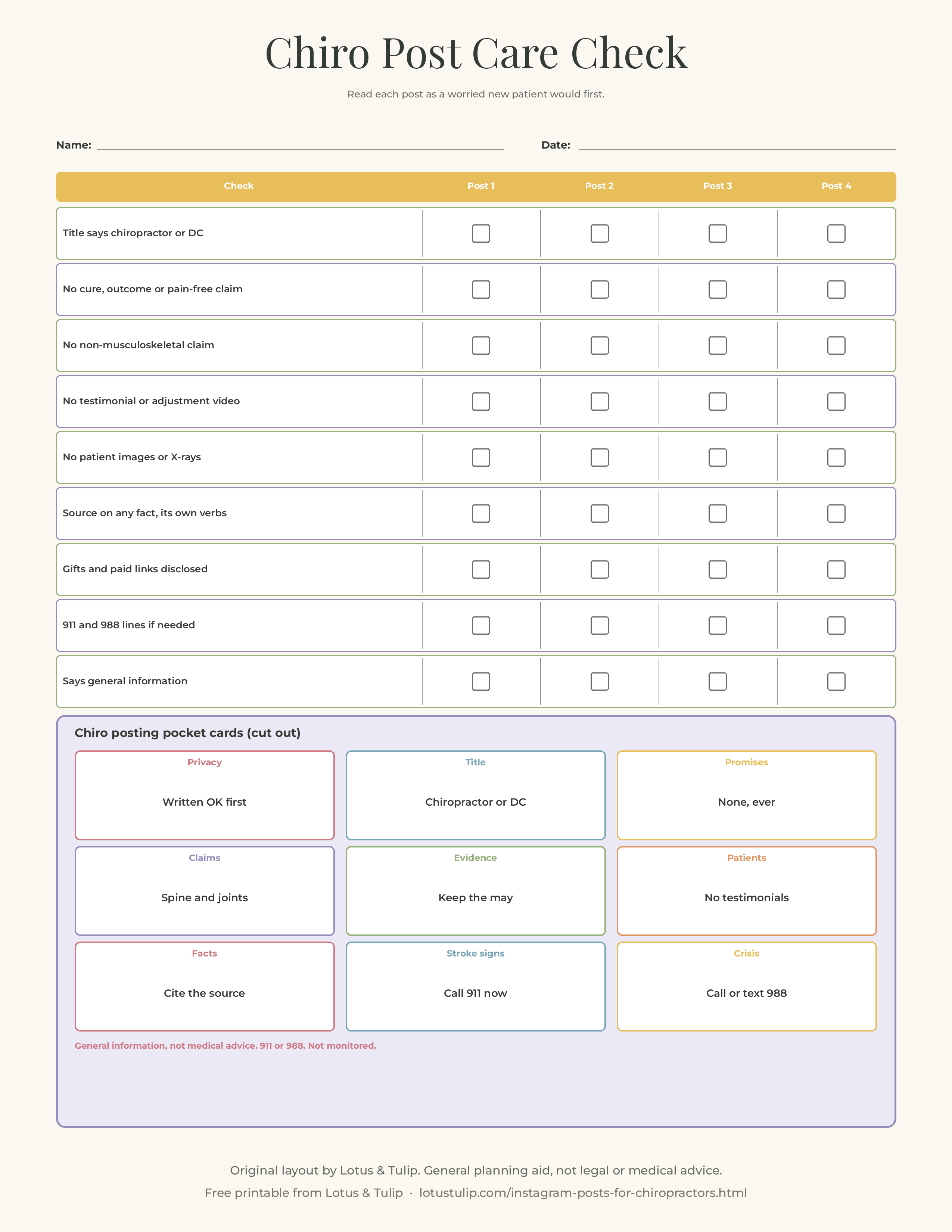
- Page 3: Chiro Post Care Check. A yes or no check for up to four posts (title says chiropractor or DC, no cure, outcome or pain-free claim, no non-musculoskeletal claim, no testimonial or adjustment video, no patient images or X-rays without written authorization, source on any fact with its own verbs, gifts and paid links disclosed, 911 and 988 lines if needed, says general information), plus nine chiropractic posting pocket cards to cut out.
Download free PDF · Page 1 PNG · Page 2 PNG · Page 3 PNG
Research notes (verified, with caveats)
- US Bureau of Labor Statistics. Occupational Outlook Handbook, Chiropractors, bls.gov/ooh/healthcare/chiropractors.htm, last modified August 27, 2026, opened this session. Duties (review history, physical examination of posture, spine and reflexes, neuromusculoskeletal therapy adjusting the spinal column and other joints, heat or cold, advice on exercise and nutrition, referral to other health care professionals); focus on pain in the back, neck and joints and on motion and function; D.C. degree typically about 4 years after at least 3 years of undergraduate study; every state requires a license; all require an accredited D.C. program and an exam, some add background checks and jurisprudence exams; all require continuing education; some complete postgraduate programs leading to diplomate credentials; chiropractors increasingly work with physicians and physical therapists through referrals and complementary care; massage therapist definition from the similar occupations table. We used no employment or wage figures.
- National Center for Complementary and Integrative Health. Chiropractic: In Depth (last updated April 2019) and Spinal Manipulation: What You Need To Know (last updated September 2022), nccih.nih.gov, opened this session. D.C. degree, NBCE exam and state license; CCE accreditation recognized by the U.S. Secretary of Education; continuing education in all states; scope varies by state; insurance coverage may be partial; history, exam, tests and working diagnosis; manipulation versus mobilization definitions; chiropractors, DOs and PTs use manipulation; evidence summaries for low-back pain, neck pain, headache and sciatica; 2021 review of six high or acceptable quality studies on non-musculoskeletal conditions with no clear benefit; 2017 review of 250 publications on side effects (mild, mostly gone within 24 hours; serious effects very rare, no accurate estimates); cervical artery dissection risk and the need to inform patients; pregnancy note; questions to ask before selecting a chiropractor. We used no utilization percentages.
- American Chiropractic Association. Key Facts and Figures About the Chiropractic Profession, acatoday.org, opened this session. Conditions treated include, but are not limited to, back pain, neck pain, pain in the joints of the arms or legs, and headaches; a series of four national board exams and a state license. We did not use ACA's satisfaction or comparative effectiveness figures.
- American Chiropractic Association. Code of Ethics, ratified by the ACA House of Delegates in 2023, acatoday.org/about/code-of-ethics, opened this session. Tenets III (no false or unjustified expectations of results; never misrepresent education, credentials, qualifications or scope), IV (confidential information), V (shared decision-making and informed choice), XI (truthful advertising, including social media; not misleading, deceptive or fraudulent; follow ACA's Advisory Guidance on Advertising and governmental rules) and XIV (best practices for nutritional products). Applies to ACA members; quoted here as a professional standard.
- American Chiropractic Association. National Chiropractic Health Month pages and 2026 announcements (May 20 and September 15, 2026), acatoday.org, via search this session. Held each October; 2026 theme "Joint Efforts"; toolkit at acatoday.org/NCHM; hashtag #JointEfforts; quick-start guide suggestions.
- Federation of Chiropractic Licensing Boards. Chiropractic Regulatory Boards directory and CIN-BAD pages, fclb.org, via search this session. Directory links to board websites, license verification, statutes and rules for US states and territories; CIN-BAD aggregates public board actions and Medicare/Medicaid exclusions, with public queries available for a fee.
- National Board of Chiropractic Examiners exam information, nbce.org, via search this session (one page timed out on direct fetch). Used only for the existence of the national board exams, which NCCIH and ACA also describe.
- Texas Occupations Code section 104.003, Required Identification, via search of statutes.capitol.texas.gov this session. Forms of identification for a person licensed by the Texas Board of Chiropractic Examiners. Used only as an example that states regulate how titles are shown; check your own state.
- Medicare.gov. Chiropractic services, medicare.gov/coverage/chiropractic-services, opened this session. Part B covers only adjustments of the spine by a chiropractor to correct a subluxation, by hand or activator; no other services or tests a chiropractor orders, including X-rays, massage therapy and acupuncture; 20 percent of the Medicare-approved amount after the Part B deductible.
- Centers for Disease Control and Prevention. Signs and Symptoms of Stroke, cdc.gov/stroke/signs-symptoms, dated May 19, 2026, opened this session. Sudden symptoms list; call 911 right away; B.E. F.A.S.T.; note the time; do not drive to the hospital; TIA advice. CDC adult activity overview and intensity pages as cited in our personal trainer guide earlier today (150 minutes moderate or 75 vigorous, 2 days of muscle strengthening, talk test).
- 988 Suicide and Crisis Lifeline, 988lifeline.org. Call, text or chat; available 24/7; free and confidential.
- HHS Office for Civil Rights. Marketing guidance under the HIPAA Privacy Rule (45 CFR 164.501, 164.508(a)(3)), hhs.gov, content last reviewed July 26, 2013, opened this session: with limited exceptions, written authorization is required before using or disclosing protected health information for marketing. Resolution agreement with Elite Dental Associates, Dallas, announced 2019 (page last reviewed October 2, 2019), opened this session: $10,000 and a corrective action plan over social media disclosures of patients' protected health information; details of the review replies via the HHS press release summary in search results.
- Federal Trade Commission staff warning letters about COVID-19 claims to chiropractic clinics (for example Freedman Chiropractic Center, New Jersey, February 5, 2021, and Active Lifestyle Clinic, Arizona, 2020), search.ftc.gov/system/files/warning-letters, via search this session. Claims that adjustments strengthen immunity against COVID-19; the FTC Act standard of competent and reliable scientific evidence for disease claims; instruction to review all other claims. Named here only as public FTC records, without any judgment on these clinics beyond what the letters state.
- Federal gift card rule, 12 CFR 1005.20 (Regulation E), and the CFPB consumer answer on prepaid and gift card expiration, as verified for our personal trainer guide earlier today. Funds generally must last at least five years; some states give more time.
- Federal Trade Commission. Guides Concerning Use of Endorsements and Testimonials in Advertising, 16 CFR Part 255 (88 FR 48102, July 26, 2023), via eCFR, as verified for our personal trainer guide earlier today. Sections 255.0 (clear and conspicuous, unavoidable on social media), 255.1 (honest opinions), 255.2 (substantiation; consumer endorsements are not competent and reliable scientific evidence; typicality; "results not typical" style disclaimers unlikely to be effective), 255.5 (material connections including free products and affiliate links).
- Federal Trade Commission. Rule on the Use of Consumer Reviews and Testimonials, 16 CFR Part 465 (89 FR 68077, August 22, 2024), via eCFR, as verified for our personal trainer guide earlier today. Sections 465.2 (fake or false reviews and testimonials), 465.4 (incentives conditioned on sentiment), 465.5 (insider reviews and testimonials), 465.7 (review suppression), 465.8 (fake indicators of social media influence).
This page is not affiliated with or endorsed by the ACA, FCLB, NBCE, CCE, BLS, NCCIH, NIH, CDC, CMS or Medicare, HHS, the CFPB, the 988 Lifeline, any state board or the FTC. We used no prevalence or utilization statistics. Our paid template kits are marketing tools for chiropractic and wellness practices. They are not clinical guidance or treatment tools and have not been tested in any trial. You stay responsible for what you post.
Instagram posts for chiropractors: FAQ
What should a chiropractor post on Instagram?
Focus on what prospective patients and referral sources need: who you are, that you are a doctor of chiropractic licensed in your state, how to look up a license, what a first visit involves, manipulation and mobilization explained, soreness after a visit, rates, insurance and Medicare, sourced education from NCCIH, CDC and Medicare.gov, and a pinned emergency post with the CDC stroke warning signs, call 911, do not drive yourself, call or text 988, and a note that your clinic is not emergency care and your account is not monitored for emergencies.
How often should a chiropractor post on Instagram?
Two or three feed posts a week is enough for most solo chiropractors and small clinics, plus occasional stories for hours and openings. Once a week is fine if your Book, Rates, Insurance, FAQ and safety posts are current.
Can chiropractors post patient testimonials?
Check your state board rules first. Under the FTC endorsement guides, a testimonial about a key benefit will likely be read as what patients generally achieve, so it must be substantiated, and the FTC says "results not typical" disclaimers are unlikely to fix a misleading one. If the clinic is a HIPAA covered entity, using a patient's story or image for marketing generally needs their written authorization. Many clinics simply leave testimonials off Instagram and invite every patient to leave an honest review instead.
Can I post adjustment videos?
You can, but they carry privacy, typicality and safety risks: they show a patient's body, imply that a dramatic moment equals a result and invite people to copy a clinical procedure at home. If you post technique content, use a staff model rather than a patient, explain what you assess first and say that manipulation is a clinical procedure, not a home exercise.
Can chiropractors say they treat conditions like headaches or ear infections?
Stay close to the evidence and your state's scope. ACA lists back pain, neck pain, pain in the joints of the arms or legs, and headaches among the conditions chiropractors treat, and NCCIH describes research on neck-related and other headaches with careful limits. For non-musculoskeletal conditions such as ear infections, colic, blood pressure or immunity, NCCIH says the best available studies showed no clear benefit, and the FTC has sent warning letters over unsupported disease claims. Leave those claims out.
Can I give a free adjustment in exchange for a review?
Not for a positive review. The FTC's consumer review rule (16 CFR 465.4) prohibits incentives conditioned on a review expressing a particular sentiment. Free services can also raise state board and payer rule questions. Invite every patient to leave an honest review, and do not reward the content of the review.
How should I reply to a negative online review?
Briefly, kindly and without any details. Do not confirm that the reviewer is a patient or mention their visits, care or bill. HHS settled with a dental practice in 2019 over disclosures of patient information on social media while responding to reviews. A reply such as "We take every concern seriously and would welcome a call at the clinic" protects the reviewer and you.
Is the free printable a copy of the paid kit?
No. The free three page set is an original planning aid: posting steps, a four week content planner and a post care check with pocket cards. The paid Still Axis kit contains designed posts, stories, highlight covers, captions and a 12 week calendar. The printable is not a preview of that kit.