
Therapist marketing · Updated 2026-11-08
Instagram Post Ideas for Personal Trainers (with Free Printable)
Ready-made template kit: Personal Trainer Instagram Templates Holiday 20% off: about $22.08, was $28 (EUR 24) · instant digital download
Buy on Etsy
Instagram posts for personal trainers compete in the loudest room on the app. Every scroll offers a shredded torso, a "30 day transformation," a supplement discount code, a split-screen before and after and a stranger promising that one weird move will fix your back. Prospective clients arrive nervous, sometimes embarrassed about where they are starting, sometimes hoping you will write them a meal plan in a DM by tonight. Gym managers, physical therapists and physicians who might refer to you arrive wanting to know whether you are safe, qualified and honest. The algorithm rewards shock, bodies and guarantees. Your certification, the FTC, your insurance and the people who trust you with their first squat reward the opposite: honest credentials, no promised outcomes, no client bodies used as proof, and a clear line between coaching exercise and giving medical or nutrition care.
This guide is written for US personal trainers and the small businesses around them: independent trainers who rent floor space, in-home and mobile trainers, small studio owners, online coaches, gym-employed trainers who post for their own following, and group fitness instructors who also train one to one. It covers what to post on Instagram as a personal trainer: why the job is different from influencer fitness content, what certification means and how to show it honestly, NCCA accreditation and the US Registry of Exercise Professionals, the line between exercise coaching and diagnosis, rehab or nutrition care, pre-exercise screening and medical clearance in plain words, safety posts for heart attack warning signs and heat illness, client privacy and filming in the gym, the FTC rules on testimonials, before and after posts, fake reviews and fake followers, sourced public education from the Physical Activity Guidelines for Americans and CDC, packages, cancellations and gift cards, ten content pillars, 34 post ideas with original caption angles, six fuller captions, DM scripts that refuse diagnosis and meal plans by message, a two or three posts a week rhythm and a 12 week overview, the dates that suit a training feed, a nine step HowTo, mistakes, myths, three fictional examples, two comparison tables, when not to post, research notes and a free three page US Letter printable: Trainer Posting Steps, a Trainer Content Planner and a Trainer Post Care Check with pocket cards.
If you share clients with clinicians, neighboring pages may help: Instagram post ideas for physical therapists covers rehab and movement education from the licensed side, and Instagram post ideas for dietitians covers nutrition care, which is where your meal plan questions should go. The occupational therapist and speech therapist guides round out the clinical side, and holiday social media posts for therapists has a December and January calendar that adapts well to a studio. This page stays with the questions trainers tend to face: how to look credible without showing bodies, how to teach without diagnosing, how to sell packages without promising results, and how to keep a feed safe for the beginner who is reading it at midnight.
We relied on primary sources and opened each one while writing: the Bureau of Labor Statistics Occupational Outlook Handbook profile for fitness trainers and instructors, the US Registry of Exercise Professionals (USREPS) credential list and FAQ, the American Council on Exercise (ACE) position on nutrition scope of practice for personal trainers, the American College of Sports Medicine (ACSM) 2015 paper updating its exercise preparticipation health screening recommendations, the HHS Office of Disease Prevention and Health Promotion page on the Physical Activity Guidelines for Americans, 2nd edition, the CDC pages on adult and older adult activity and on measuring activity intensity, the American Heart Association page on heart attack warning signs, the CDC NIOSH page on heat-related illnesses, 988lifeline.org, the federal gift card rule (12 CFR 1005.20) and the CFPB consumer answer on gift card expiration, ODPHP's National Physical Fitness and Sports Month page and the 2026 proclamation, the FTC Guides Concerning Use of Endorsements and Testimonials in Advertising (16 CFR Part 255) and the FTC Rule on the Use of Consumer Reviews and Testimonials (16 CFR Part 465). Notes are at the end. The printable is an original Lotus and Tulip layout.
This guide is general marketing information, not legal, medical, insurance or nutrition advice. Your certifying organization's code of ethics and scope of practice, your employer or gym policy, your liability insurance, any state or local rules where you work and FTC law all come first. A social media post is public education and promotion. It is not a health screening, it is not an exercise prescription for a stranger, it is not physical therapy and it is not a meal plan. If someone has chest discomfort, trouble breathing or other heart attack warning signs, call 911, as the American Heart Association advises. If someone shows signs of heat stroke such as confusion, slurred speech or loss of consciousness, call 911. For a mental health or suicidal crisis, call or text 988. Personal training is not emergency care. Every safety post you publish should repeat that message and say that your account and inbox are not monitored for emergencies.
What this guide is and is not
It is a planning guide for public, educational and promotional Instagram content from a personal trainer, a small studio or an online coach. It helps you choose themes, write captions that stay inside your certification and your competence, explain how your sessions and packages work, and keep safety and privacy information where people can find it.
It is not legal advice. Rules for fitness businesses vary by state and city, gyms have their own policies on filming and on promoting outside services, and your liability insurer may have opinions about what you publish. Advertising law, especially around testimonials and results, is federal and applies to small businesses as much as to big brands. When in doubt, read the rules or ask your insurer or a lawyer.
It is not exercise prescription. Nothing here tells you how to program for a client with heart disease, diabetes, a recent surgery, a pregnancy or an injury. Those decisions belong in your training, your screening process, the client's medical clearance where needed and your collaboration with their clinicians. A public reel is not an individualized program, and a comment thread is not a consultation.
It is not a promise that Instagram will fill your calendar. Many trainers still get most clients from the gym floor, from referrals and from word of mouth. A good feed helps a nervous stranger feel safe enough to book a first session, and it helps a physical therapist or physician feel comfortable telling a patient "you could work with this trainer once you are discharged." That is a real benefit, and it is smaller than the "fully booked in 30 days" claims on courses that sell Instagram growth to trainers.
And it is not a body showcase. A feed can explain the talk test, show what a first session looks like, describe how you coach a beginner and share the federal activity guidelines. It does not need anyone's abs, scale numbers or side-by-side photos to do that.
Why posting as a personal trainer is different from influencer fitness content
Most fitness Instagram advice is written for influencers, supplement brands and app companies. Their incentives are reach, affiliate sales and subscriptions. A trainer who works with real people in real rooms shares some of their tools, such as reels, carousels and clear design, but carries obligations they often ignore.
- Bodies are the default proof, and they are the riskiest proof. The most rewarded format in fitness is the transformation photo. The FTC's endorsement guides use before and after weight-loss pictures as a worked example of a testimonial that conveys "this is what you can expect." Unless you can show that the result is typical, the post misleads. It also teaches beginners to compare their body with a stranger's and quietly tells many readers that they are not your kind of client.
- People want a program, not an explanation. Followers ask "what should I do for my bad knee," "what is the best plan to lose 20 pounds" or "can you check my form from this video." A caption or DM that answers with a specific plan is individualized training for someone you have not screened, met or watched move in person.
- Pain and injury questions arrive daily. A trainer is often the first person a client tells about a sore shoulder. On Instagram, that turns into "what stretch fixes sciatica." Diagnosing and treating injuries is outside a trainer's scope. Your job on social media is to say "please see a physician or physical therapist," kindly and every time.
- Nutrition is one click away. Meal plans, macros, fat-loss diets and supplement stacks are some of the most requested and most monetized topics in fitness. ACE's position is that trainers can and should share general, nonmedical nutrition information from federal sources, and that individualized meal plans, nutrition counseling and supplement recommendations belong elsewhere. A feed that sells a "custom macro plan" with every package sits outside that line.
- Your credential is invisible to the public. Followers cannot tell a weekend online certificate from an NCCA-accredited certification, or a certified trainer from someone with a big following. A clear, honest explanation of what your certification means, without attacking anyone, is one of the most trust-building posts you can make.
- Brand deals are everywhere. Free shoes, discounted supplements, affiliate codes for equipment and app partnerships are normal in fitness. The FTC says material connections must be disclosed clearly and conspicuously, and it treats free products as a material connection even when no post is required in return.
The good news is that trainer content does not need drama to work. Calm, sourced explanations of how hard to work, what a first session involves and how to start safely are exactly what many beginners cannot find elsewhere, and they are what referral sources look for when they check your profile.
Certifications, NCCA accreditation and how to show them honestly
The Bureau of Labor Statistics Occupational Outlook Handbook describes the usual path into the job. It says that most fitness trainers or instructors have certification related to the area of fitness in which they specialize, that personal trainers usually must be certified before they begin working with clients or with members of a gym or health club, and that employers usually prefer to hire those with certification, although requirements vary by facility. It notes that many organizations offer certification, that some private companies offer certification in the types of classes they offer, and that most trainers or instructors also need certification in cardiopulmonary resuscitation (CPR), first aid and the use of automated external defibrillators (AED). That gives you an honest, sourced frame for a credentials post: the public deserves to know what yours is, who issued it and whether it is current.
- Name the certification and the organization. "Certified Personal Trainer" by itself tells a reader very little, because many organizations issue a credential with that name. Write the organization: for example, a CPT from ACE, ACSM, NSCA, NCCPT or NCSF, or the NSCA's Certified Strength and Conditioning Specialist (CSCS). Only list what you hold today.
- Explain accreditation in one sentence. Some certification programs are accredited by the National Commission for Certifying Agencies (NCCA). USREPS notes that NCCA also accredits certification programs for regulated health professionals such as dietitians and nurse practitioners, which is why it uses NCCA accreditation (or ISO 17024 compliance) as its bar. ACE's scope statement singles out trainers who hold an NCCA-accredited certification that provides basic nutrition information. If your certification is NCCA-accredited, you can say so plainly. If it is not, do not imply that it is.
- Point to a registry, not just your word. The US Registry of Exercise Professionals (USREPS) describes itself as a clearinghouse that lets employers, regulators and consumers verify current NCCA-accredited or ISO 17024-compliant exercise certifications from its member organizations. Its published list includes personal trainer credentials from ACE, ACSM, NCCPT, NCSF and NSCA, among others. USREPS says it displays only current certifications for a role on the registry, and that specialty credentials are not listed. A post that says "you can look me up on USREPS" is a confident, verifiable trust signal, as long as you are actually listed.
- CPR, first aid and AED. BLS says most trainers also need these certifications. Keep yours current and say so in your FAQ or About highlight. It reassures beginners and older clients.
- Specialty courses are not certifications. A weekend course in kettlebells, prenatal fitness or mobility can make you a better coach. Describe it as training you completed ("I have completed a course in coaching prenatal exercise"), not as a credential or a specialty that implies clinical expertise.
- Degrees are separate from certifications. A bachelor's degree in exercise science or kinesiology is worth mentioning if you hold one. BLS notes that employers may prefer trainers with associate or bachelor's degrees in related fields. Do not let a caption suggest a degree you have not completed.
- Protected words and clinical titles. Do not use "therapist," "physical therapy," "rehab specialist," "dietitian," "nutritionist" or "doctor" for yourself unless you hold that license or title. ACE's scope statement lists "promotion or identification of oneself as a 'nutritionist' or 'dietitian'" as outside the fitness professional's scope. Many state laws protect clinical titles, and the FTC's expert endorsement guide says that if an ad implies expertise, the endorser's qualifications must actually provide it.
This is why The Patient Rep kit never prints a credential on a slide. It cannot know whether you hold an NCCA-accredited CPT, a CSCS, a degree or none of those. You type the credential you actually hold into your bio and your welcome post, and the kit's "how to check your trainer" post gives your followers questions that apply to everyone, including you.
Scope: coaching exercise, not diagnosing, rehabbing or prescribing diets
The BLS profile lists what trainers typically do: demonstrate or explain exercises to minimize injuries and improve fitness, watch clients to ensure correct technique, provide options during workouts, monitor progress and adapt programs, explain and enforce safety rules, give clients information or resources about topics such as nutrition and lifestyle, and give emergency first aid if needed. It also points readers who want programs to help people recover from illness or injury to a different profile, exercise physiologists. That list is a good map for your feed: coaching, technique, progress, safety and general information are yours. Diagnosis and treatment of illness or injury are not.
Pain and injury
Keep pain posts general and route people to clinicians. "If something hurts in a way that worries you, stop and talk with your physician or a physical therapist" is a complete answer. "Here are three stretches for your herniated disc" is not, because it diagnoses (you accepted their label) and treats (you prescribed a remedy) for someone you have never assessed. Even a well-meant "try this for knee pain" reel will be used by readers with conditions you cannot see.
Screening and medical clearance
Screening before exercise is a strong topic for a trainer's feed because it shows care without fear. ACSM updated its exercise preparticipation health screening recommendations in 2015. The paper explains that the goals are to identify people who should receive medical clearance before starting an exercise program or increasing its frequency, intensity or volume, people with clinically significant disease who may benefit from medically supervised exercise, and people with conditions that may require exclusion from exercise until they are better controlled. The updated process focuses on a person's current physical activity level, known cardiovascular, metabolic or renal disease, signs or symptoms suggestive of such disease, and the desired intensity. It replaced older risk factor tallies with "medical clearance," defined as approval from a health care professional to engage in exercise, and it leaves the decision about any examination or test to the health care provider. The paper also says that physically active people who develop signs or symptoms of cardiovascular, metabolic or renal disease should stop exercising and seek medical clearance before resuming exercise of any intensity.
ACE's summary of the update describes the PAR-Q+ (Physical Activity Readiness Questionnaire for Everyone) as a form that can be used as a self-guided screening tool or as an additional element of screening for fitness professionals. For Instagram, translate all of this into one honest sentence: "Before your first session, I ask a short set of health questions. If anything suggests you should check with your doctor first, I will ask you to do that. It is not a hurdle; it is how we keep training safe." Do not post the algorithm as if followers can clear themselves, and do not imply that your screening replaces their clinician.
Nutrition
ACE's position statement on nutrition scope of practice says that personal trainers not only can but should share general, nonmedical nutrition information, and that it is within the scope of all fitness professionals to share dietary advice endorsed or developed by the federal government, especially the Dietary Guidelines for Americans and MyPlate. The same statement lists actions outside a fitness professional's scope, including individualized nutrition recommendations or meal planning beyond government guidelines, nutritional assessment, specific recommendations or programming for nutrient or caloric intake or specialty diets, nutrition counseling aimed at preventing, treating or curing a disease, recommending, prescribing, selling or supplying nutritional supplements to clients, and calling oneself a nutritionist or dietitian. ACE also notes that a trainer's nutrition-related scope is shaped by state policies and regulations, education and competencies.
That is a clear brief for your feed. Share federal guidance, talk about hydration and the general idea of eating enough to train, and refer individualized nutrition questions to a registered dietitian. A collaboration post with a dietitian you trust is a lovely, non-competitive way to answer the endless "what should I eat" questions without crossing a line. The Patient Rep kit follows the same rule: exercise coaching only, with no diet or supplement content.
Special populations
Older adults, people who are pregnant or postpartum, teenagers and people with chronic conditions or disabilities can all benefit from training, and the Physical Activity Guidelines have specific chapters for several of these groups. Posts about them should stay at the level of public guidance and include the line "talk with your health care provider about what fits you." If you have completed specific training for a population, say so accurately. If you have not, do not market to that group as a specialist.
Personal trainer, group instructor, strength coach, exercise physiologist, PT and dietitian
Many people help others move and feel better. A respectful comparison post builds trust and makes you the person other professionals are happy to refer to. A dismissive one makes you look insecure. Use plain, kind descriptions and check any legal claim against your own state.
- Personal trainer. BLS describes exercise trainers, also called personal fitness trainers, as working with individual clients or small groups, evaluating current fitness level, goals and skills, developing personalized training programs and monitoring progress. Usually certified; not a clinician.
- Group fitness instructor. BLS describes group instructors as organizing and leading group exercise classes, sometimes teaching prechoreographed routines created by fitness companies. Many hold a group instructor certification; some also train one to one.
- Strength and conditioning coach. Often works with athletes and teams, and may hold a credential such as the NSCA's CSCS or the CSCCa's SCCC, both on the USREPS list.
- Exercise physiologist and clinical exercise physiologist. BLS points readers interested in programs for people recovering from illness or injury to the exercise physiologist profile. ACSM offers Certified Exercise Physiologist and Certified Clinical Exercise Physiologist credentials, also on the USREPS list. They often work in medical or cardiac rehab settings.
- Physical therapist. A licensed clinician who examines, diagnoses and treats movement problems and injuries. Many trainers work with clients after they finish physical therapy. Neither replaces the other.
- Registered dietitian. A credentialed nutrition professional, licensed in many states, who provides nutrition assessment, counseling and, where allowed, medical nutrition therapy. The natural referral for meal plan and supplement questions.
Comparison posts work best when they answer the reader's real question: "who should I see first?" For pain after a fall, a new injury or symptoms during exercise, the honest answer is "your physician." For a return to the gym after physical therapy, the answer may be "a trainer who will coordinate with your PT." For what to eat, the answer is "a registered dietitian."
Safety posts: 911, heart attack warning signs, heat illness and 988
A training feed will be read by people who are about to exercise alone, often for the first time in years. Plan your safety content before you need it.
Heart attack warning signs
The American Heart Association's warning signs page says to call 911 if someone has any heart attack symptoms. It lists chest discomfort, usually in the center of the chest, that lasts more than a few minutes or goes away and comes back and can feel like uncomfortable pressure, squeezing, fullness or pain; discomfort in other areas of the upper body, including one or both arms, the back, neck, jaw or stomach; shortness of breath, with or without chest discomfort; and other possible signs such as breaking out in a cold sweat, nausea, a rapid or irregular heartbeat, feeling unusually tired and feeling lightheaded. The AHA also notes that symptoms may vary between men and women, and that women may have symptoms less typically associated with a heart attack, such as shortness of breath, nausea or vomiting, pain in the shoulder, back or arm, and unusual tiredness and weakness. It says calling 911 is almost always the fastest way to get lifesaving treatment.
For Instagram, keep it short and faithful: "Stop and call 911 if you have chest discomfort, pain in the arm, back, neck or jaw, shortness of breath, a cold sweat, nausea or lightheadedness during or after exercise. Do not wait to see if it passes. Source: American Heart Association. This account is not monitored for emergencies." Pin it. The Patient Rep kit has a "when to stop and get help" post and story built on the same AHA signs.
Heat illness
Outdoor bootcamps, summer runs and hot garage gyms make heat a real topic. The CDC's NIOSH page on heat-related illnesses describes heat stroke as the most serious heat-related illness, when the body can no longer control its temperature. Its listed symptoms include confusion, altered mental status or slurred speech, loss of consciousness, hot dry skin or profuse sweating, seizures and very high body temperature. Its first step is to call 911, then stay with the person, move them to a shaded, cool area, remove outer clothing and cool them quickly, for example with cold water, wet cloths or soaked clothing. Heat exhaustion symptoms on the same page include headache, nausea, dizziness, weakness, irritability, thirst and heavy sweating. That page is written for workers, so quote it as general heat safety, not as a coaching protocol.
A caption can say: "Training outside this week? Heat stroke is an emergency. Confusion, slurred speech, fainting or a seizure in the heat means call 911 and start cooling the person right away. Source: CDC." Then post your own hot-weather policy: when you move sessions indoors, shorten them or cancel.
Mental health crises
Clients tell trainers a lot. Followers may too. If a message sounds like a mental health or suicidal crisis, the answer is call or text 988, or 911 for immediate danger. The 988 Lifeline website says people can call, text or chat with a counselor, that it is available 24/7, and that conversations are free and confidential. Do not invent other hotline numbers, and do not list a specialty helpline unless you have checked its official page recently.
"Not emergency care"
Every safety post should say that your account and inbox are not monitored for emergencies. It costs one line and it prevents the worst kind of misunderstanding: someone sending a DM about chest pain and waiting for you to reply.
Before and after posts, testimonials, reviews and the FTC
This is the section most trainer marketing courses skip, and it is the one most likely to matter. Two federal documents apply to small fitness businesses: the FTC Guides Concerning Use of Endorsements and Testimonials in Advertising (16 CFR Part 255, revised in 2023) and the FTC Rule on the Use of Consumer Reviews and Testimonials (16 CFR Part 465, published in 2024).
Testimonials must be honest and typical, or say what is typical
Section 255.1 says endorsements must reflect the honest opinions, findings, beliefs or experience of the endorser, and may not convey any express or implied representation that would be deceptive if the advertiser made it directly. Section 255.2 says an advertiser must have adequate substantiation for claims made through consumer endorsements, the same as if it made the claims itself, and that consumer endorsements themselves are not competent and reliable scientific evidence. It also says a testimonial about a key attribute of a product will likely be read as representing what consumers will generally achieve. If the advertiser cannot substantiate that, the ad should clearly and conspicuously disclose the generally expected performance.
The FTC's own examples are about weight loss and before and after photos. One example says that simply featuring "before" and "after" pictures with a claim like "I lost 50 pounds in 6 months" is likely to convey that the experience is representative, so if people cannot generally expect that result, the ad is deceptive. Another example tested the familiar "results not typical" style disclaimers and concluded they are unlikely to be effective. Section 255.1(g) adds that using an image of someone other than the actual endorser is deceptive if it misrepresents a material attribute of the endorser, with an example of a weight-loss testimonial shown next to a picture of a much smaller person.
For a trainer, the practical reading is simple: a transformation post about one client implies that your typical client gets that result. Unless you can honestly state and substantiate what clients generally achieve, do not post it. That is why The Patient Rep kit contains no before and after posts and no weight-loss, fat-loss or guaranteed-result claims. Its client spotlight is a placeholder that tells you to use a real client's words only with written permission.
Fake reviews, bought reviews, insider reviews and fake followers
Part 465 turns several common shortcuts into rule violations. Section 465.2 prohibits writing or creating fake or false consumer reviews or testimonials, including ones that misrepresent that the reviewer exists, used the service or had the experience described. Section 465.4 prohibits providing compensation or other incentives in exchange for, or conditioned on, reviews expressing a particular sentiment, positive or negative. So "free session for a five star review" is out; a general request to all clients to share an honest review is fine. Section 465.5 requires officers and managers to clearly disclose their relationship when they write reviews or testimonials about their own business, and covers testimonials from employees. Section 465.7 covers suppressing negative reviews through threats or misleading displays. Section 465.8 prohibits buying or procuring fake indicators of social media influence, such as bot followers or fake likes, when they misrepresent influence for a commercial purpose. The definition covers followers, likes, views, saves, shares and comments.
Brand deals, free gear and affiliate codes
Section 255.5 says a connection between the endorser and the seller that might materially affect the weight or credibility of the endorsement, and that the audience would not reasonably expect, must be disclosed clearly and conspicuously. It names monetary payment and free or discounted products as examples, regardless of whether the advertiser requires an endorsement in return, and its examples include affiliate links and a free piece of equipment sent to an influencer. The definitions in Section 255.0 say that in social media the disclosure should be unavoidable, and the guides give examples of disclosures that fail: only on the profile page, hidden behind a "more" link, or in small low-contrast text that disappears in seconds. Put "Paid partnership," "Gifted" or "I earn a commission" in the visible part of the caption and on the image or video itself.
Supplements deserve a separate note. ACE's scope statement lists recommending, prescribing, selling or supplying nutritional supplements to clients as outside a fitness professional's scope. Many trainers simply keep supplement affiliates off their professional account.
Client privacy, filming in the gym and written permission
Trainers handle more private information than they often realize: health questionnaires, injury history, medications, body measurements, photos, schedules and home addresses for in-home sessions. Your feed should show that you protect it.
- Health information stays off the grid. No screenshots of intake forms, PAR-Q+ answers, heart rate logs, injury notes or progress measurements, even with the name cropped.
- Film clients only with written permission, and only when it serves them. A short clip of a client's deadlift can be a lovely coaching moment. Get written permission, let them review the clip, and honor a later request to remove it. Never film a client who is struggling, in pain or visibly uncomfortable.
- Other gym members are not your content. Check your gym's filming policy and keep strangers out of frame. A phone on a tripod pointed at a busy floor publishes people who never agreed to be on your feed.
- No minors without a parent or guardian's written permission, and think twice even then. Youth athletes deserve the same privacy as adults.
- No home addresses or routines. In-home and outdoor sessions reveal where people live and when they are alone. Blur street signs and house numbers, and post after the session, not during it.
- If you work inside a clinic, the clinic's privacy rules apply to you. If the clinic is a HIPAA covered entity, HHS guidance says that, with limited exceptions, using or disclosing protected health information for marketing requires the individual's written authorization.
When a happy client says "post my progress pics, I don't mind," thank them and think about the FTC section above before you do. A post about what they enjoyed in training, in their own words and with written permission, is very different from a body comparison that implies a result.
Public exercise education you can source and stand behind
These topics match The Patient Rep kit's care and come from federal or nonprofit sources we opened while writing. Cite the source on the slide or in the caption, keep numbers exactly as the source states them, and add "General information, not medical advice. Check with your doctor before starting a new program."
How much activity adults need
ODPHP's "Top 10 Things to Know" about the Physical Activity Guidelines for Americans, 2nd edition, says adults need at least 150 to 300 minutes of moderate-intensity aerobic activity, like brisk walking or fast dancing, each week to attain the most health benefits, and muscle-strengthening activity, like lifting weights or doing push-ups, at least 2 days each week. The CDC's adult overview adds that this can also be 75 minutes of vigorous-intensity activity or an equivalent combination, gives 30 minutes a day, 5 days a week as one example, and says muscle-strengthening activities should work all major muscle groups: legs, hips, back, abdomen, chest, shoulders and arms. It also says going beyond 150 minutes of moderate (or 75 minutes of vigorous) activity a week brings even more health benefits.
Any amount counts, and sitting less matters
ODPHP's summary says the first key guideline for adults is to move more and sit less, and that any amount of physical activity has some health benefits. It notes that the first edition counted only 10 minute bouts toward the guidelines, and that the second edition removed that requirement. That is the factual basis for a "short workouts still count" post, which is one of The Patient Rep's topics.
Older adults
The CDC's older adult overview says that adults 65 and older need at least 150 minutes of moderate-intensity aerobic activity each week (or 75 minutes vigorous, or an equivalent combination), at least 2 days of muscle-strengthening activities and activities to improve balance, with examples such as walking heel-to-toe or standing from a sitting position. It adds that people who have trouble meeting the recommendations should be as physically active as their abilities and conditions allow, and that some activity is better than none. ODPHP's summary says that for older adults, physical activity also lowers the risk of falls and injuries from falls. The kit's "strength after 65" carousel works from the same sources.
Young people and pregnancy
ODPHP's summary says youth ages 6 through 17 need at least 60 minutes of moderate-to-vigorous activity each day, plus activities that strengthen muscles and bones, and that preschool children ages 3 through 5 should be active throughout the day. The Physical Activity Guidelines also recommend at least 150 minutes of moderate-intensity aerobic activity a week during pregnancy and the postpartum period, and say that women who are pregnant should be under the care of a health care provider who can advise on adjusting activity. If you post about pregnancy, quote that and add "talk with your health care provider," rather than writing exercise lists for pregnant followers.
Moderate or vigorous: the talk test and the 0 to 10 scale
The CDC page on measuring activity intensity gives the talk test as a rule of thumb: a person doing moderate-intensity aerobic activity can talk, but not sing, and a person doing vigorous-intensity activity cannot say more than a few words without pausing for a breath. It also describes relative intensity on a 0 to 10 scale, where 0 is sitting and 10 is maximal effort: moderate is about 5 or 6, and vigorous begins at 7 or 8. For absolute intensity, it says activities of 3 to 5.9 METs are moderate and 6.0 METs or more are vigorous. Its examples of moderate activity include brisk walking (2.5 miles per hour or faster), recreational swimming, bicycling slower than 10 miles per hour on level ground, doubles tennis and general yard work. Its vigorous examples include jogging or running, swimming laps, singles tennis, jumping rope, bicycling faster than 10 miles per hour and heavy yard work. CDC also notes that an activity that is vigorous for a person of average fitness may only be moderate for a very fit person. This is the most useful carousel a trainer can post for beginners, and it is The Patient Rep's "moderate or vigorous" topic.
How to check your trainer
This is one of the kit's topics and one of the most generous posts you can make. Suggested questions for readers: What certification do you hold, from which organization, and is it current? Is it NCCA-accredited, and are you listed on USREPS? Are you certified in CPR, first aid and AED use? Do you ask health questions before the first session? What do you do if I mention pain or a medical condition? Are you insured? How do packages, cancellations and refunds work? Keep the questions neutral so they help readers evaluate you as fairly as anyone else.
Rates, packages, cancellations and gift cards, without legal advice
Money posts are trust posts. A clear, current rates post prevents awkward conversations later and filters out people who would never book.
- Say what a package includes. Number of sessions, length, location, whether a program between sessions is included, and how long sessions stay valid. Avoid "transformation package" or "12 week shred" language that implies a result.
- Write your cancellation policy kindly, and post it before you need it. The rule, the notice period, what happens to a missed session and how to reschedule. The kit treats studio details as your own policy, so you can change them to match yours.
- Refunds and pauses. Say what happens if a client gets injured, sick or moves away. A fair pause policy is a strong trust signal.
- Gift cards follow federal rules. The federal gift card rule, 12 CFR 1005.20, says a gift certificate or store gift card generally cannot be sold with an expiration date unless the underlying funds last at least five years from issue (or from the last load for a store card), with required disclosures. The CFPB's consumer answer says gift card funds must be good for at least five years under federal law and that some state laws give more time. The Patient Rep's gift card post states no expiry date. If your card does expire, read the rule and your state law first, and do not print "valid for 12 months."
- Online coaching across state lines. Online programming is common and convenient. Your certification, your insurance and any local rules still apply, and an online client still needs a screening process. Do not imply clinical services, and keep "clients nationwide" claims honest about what you provide.
Ten content pillars for a personal trainer Instagram
Pillars keep you from reinventing your account every Monday. Five or six would be enough. Ten gives you room to rotate without falling back on body shots and trends.
- Who I am and how I coach. Your name, the certification you actually hold and who issued it, where you train, the people you work with and the people you refer elsewhere.
- What a trainer does (and does not). Coaching, technique, progress and safety, and the difference between training and physical therapy, medical care or nutrition counseling.
- Safety. AHA warning signs and 911, heat illness, call or text 988, and "this account is not monitored for emergencies."
- Starting out. The first session step by step, health questions and medical clearance, what to wear and bring, how sore is normal versus when to stop.
- How hard is hard enough. The talk test, the 0 to 10 scale, moderate and vigorous examples, and why intensity is relative.
- Strength for everyone. Two days a week for all major muscle groups, strength without a gym, strength and balance after 65.
- Consistency over intensity. Short workouts still count, move more and sit less, keeping it going between sessions.
- Time, money and policies. Session menu, packages, cancellations, rescheduling, gift cards, holiday hours.
- Myths and marketing. Spot reduction, "no pain no gain," "you need a gym," "results in 30 days." Always sourced, never mocking.
- Community and gratitude. New client openings, National Physical Fitness and Sports Month, thank-you posts that do not display client bodies.
Pin at least three posts: the safety post, a "how to check your trainer" or credentials post, and a booking or first session post. Keep matching highlights (the kit's set includes About, Training, Rates, Book, FAQ, Classes, Clients, Policies, Strength, Myths, Safety and Gifts) so a new visitor can find what they need without scrolling a year of content.
34 Instagram post ideas for personal trainers, with caption angles
These are original planning ideas, not captions copied from any template kit. Adapt the wording to your business, your certification and your competence. Add "General information, not medical advice. Check with your doctor before starting a new program." whenever a post teaches a health idea.
About you and the job
- What actually happens in a first session. Caption angle: health questions, a conversation about goals, gentle movement to see where you are, and a plan you build together. No promise of a particular result.
- My certification, explained in two sentences. Caption angle: the credential, the organization, whether it is NCCA-accredited, and that readers can check USREPS. Only if true.
- CPR, first aid and AED: why I keep them current. Caption angle: BLS says most trainers need them. Here is when I last renewed.
- Who I work with, and who I refer. Caption angle: the people you actually train, plus examples of when you send someone to a physician, a physical therapist or a registered dietitian.
- A day in the studio, no clients on camera. Caption angle: setting up, cleaning equipment, writing programs, the quiet hour before the first session.
- Why my feed has no before and after photos. Caption angle: your body is not my advertisement, and one person's result is not a promise. Then point to your first session post.
- How I coach a nervous beginner. Caption angle: we start where you are, I explain every exercise, you can say no to anything, and we adjust as we go.
Safety and starting out
- Pinned safety post. Caption angle: AHA heart attack warning signs, call 911, call or text 988 in a mental health crisis, and "this account is not monitored for emergencies."
- When to stop and get help. Caption angle: chest discomfort, shortness of breath, lightheadedness or pain that worries you means stop. Source: AHA.
- Heat safety for outdoor sessions. Caption angle: CDC lists confusion, slurred speech and fainting in the heat as heat stroke signs. Call 911 and start cooling. Plus your own hot-weather policy.
- Why I ask health questions before we start. Caption angle: a short screening keeps training safe, and sometimes I will ask you to check with your doctor first. It is care, not a barrier.
- How to prepare for your first session. Caption angle: what to wear, water, any clearance from your doctor, a list of past injuries, and what you hope to feel able to do.
- Sore or hurt? A gentle guide. Caption angle: general muscle soreness after new exercise is common; sharp, worsening or worrying pain means stop and talk with your physician or a physical therapist. No diagnosis.
- Questions to ask any trainer before you book. Caption angle: certification, CPR and AED, health questions, insurance, what they do about pain, and how packages work.
Rates, policies and logistics
- Session menu, in plain numbers. Caption angle: one to one, small group, online, length and price. No "transformation" names.
- Packages: what is included. Caption angle: sessions, validity, programming between sessions, and pause rules.
- Booking and cancellation policy, said kindly. Caption angle: the rule, the reason, and how to reschedule without guilt.
- New client openings this month. Caption angle: days and times that are true today, and how the waitlist works.
- Gift cards for someone you love. Caption angle: what a card covers, how to redeem it, and that the funds do not expire (if that is your policy).
- Holiday hours and closures. Caption angle: when you are closed and where emergencies go. Pair with the holiday social media posts for therapists page for a winter plan.
- Online sessions: how they work. Caption angle: what equipment you need, how you check form on video, and that screening still applies.
Education, sourced
- The talk test. Caption angle: CDC says moderate means you can talk but not sing; vigorous means only a few words before a breath.
- The 0 to 10 effort scale. Caption angle: CDC puts moderate at about 5 or 6 and vigorous from 7 or 8, and notes intensity is relative to your fitness.
- How much activity adults need. Caption angle: 150 minutes moderate (or 75 vigorous) a week plus 2 days of strength for all major muscle groups. Source: HHS and CDC.
- Short workouts still count. Caption angle: the second edition of the guidelines dropped the old 10 minute bout requirement. Any amount has some benefit.
- Strength without a gym. Caption angle: body weight, bands and household items. A general idea, not a program for anyone's injury.
- Strength and balance after 65. Caption angle: CDC adds balance activities for older adults, such as heel-to-toe walking and standing up from a chair.
- Move more, sit less. Caption angle: the first key guideline for adults, and three ways to break up a long sitting day.
- Myth versus fact: "If it doesn't hurt, it doesn't work." Caption angle: effort and pain are different. Moderate effort counts, and pain is a reason to stop and check.
- Myth versus fact: "Strength training is only for young people." Caption angle: the guidelines recommend muscle strengthening for adults and older adults alike, adjusted to abilities and conditions.
Community and gratitude
- National Physical Fitness and Sports Month (May). Caption angle: ODPHP celebrates it every May. Invite readers to try a walk, a class or a first session.
- Who does what for your health. Caption angle: trainer, physical therapist, registered dietitian, physician. A respectful map, not a turf war.
- Client spotlight, done right. Caption angle: a client's own words about what they enjoy, with written permission, no body photos, no numbers and no implied result.
- Thank you, without a transformation slideshow. Caption angle: thank your clients and referral partners in general words.
Six fuller caption examples you can adapt
These are original drafts. Replace bracketed details. Do not paste a client's story or numbers into any of them.
- Welcome. "Hi, I'm [first name], a [the certification you actually hold, and the organization that issued it] trainer at [studio or area] in [city, state]. I work with [the people you actually train], in person and online. I don't post client bodies or promise results, because your training should be about you, not my feed. I can't give personal advice in comments or DMs, but I'm happy to talk about a first session. Booking link in bio. General information, not medical advice."
- Safety. "Please read this before your next workout. If you have chest discomfort, pain in your arm, back, neck or jaw, shortness of breath, a cold sweat, nausea or lightheadedness, stop and call 911. Don't wait to see if it passes. Source: American Heart Association. If you are in a mental health crisis, call or text 988. This account is not monitored for emergencies."
- Talk test. "Not sure how hard to work? Try the talk test. CDC says that during moderate activity you can talk but not sing, and during vigorous activity you can only say a few words before you need a breath. Both count. Start where you are. Source: CDC. General information, not medical advice. Check with your doctor before starting a new program."
- Weekly activity. "The federal guidelines suggest adults aim for at least 150 minutes of moderate activity a week, or 75 minutes of vigorous activity, plus muscle strengthening on 2 or more days that works all major muscle groups. That can be 30 minutes, 5 days a week, or shorter pieces through the day. Any amount has some benefit. Source: HHS Physical Activity Guidelines for Americans and CDC."
- First session. "Nervous about your first session? Here's what happens with me: a few health questions (sometimes I'll ask you to check with your doctor first), a chat about what you want to feel able to do, some easy movement so I can see where you're starting, and a plan we agree on together. You can say no to anything. Wear what you can move in and bring water."
- How to check your trainer. "Looking for a trainer? Good questions to ask anyone, including me: What certification do you hold, and from which organization? Is it current and NCCA-accredited? Are you certified in CPR and AED? Do you ask health questions before we start? What do you do if I mention pain? Are you insured? A good trainer will be glad you asked."
DM and comment replies that refuse clinical advice kindly
Save these where your whole team can find them. Edit for your voice. The goal is to be warm and boringly consistent.
- When someone asks what to do for pain or an injury. "I'm sorry you're dealing with that. I can't diagnose or treat pain, and I'd hate to guess wrong. Please talk with your physician or a physical therapist. Once you're cleared, I'd be glad to help you get back to training. If the pain is sudden or severe, or you have chest pain, call 911."
- When someone sends a form check video and asks for a program. "Thanks for sharing. I can't safely program for someone I haven't screened or watched in person, and one clip doesn't show the whole picture. If you'd like to work together, here's how a first session works: [link]."
- When someone asks for a meal plan or macros. "I don't write meal plans; that's a job for a registered dietitian, who can look at your health, medicines and preferences. I'm happy to share general federal guidance, and I can suggest a dietitian if you'd like."
- When someone asks about supplements. "I don't recommend supplements or doses. Please ask your doctor or pharmacist, especially if you take any medicines."
- When someone shares weight or body numbers and asks how fast they can change them. "Thanks for trusting me with that. I don't promise weight or body changes, because they depend on far more than training. What I can promise is a safe plan and a coach who shows up. If food or body thoughts are feeling hard, please talk with your doctor or a therapist, and call or text 988 if you're in crisis."
- When a happy client wants a transformation post. "That means so much. I keep my feed free of before and after photos, because one person's result can feel like a promise to someone else. Would you be up for a short quote, in your own words, about what you enjoy in our sessions? Only with your written OK."
- When a brand offers free gear for a post. "Thanks for thinking of me. I only post products I'd use anyway, and I always label gifts and partnerships clearly." If you go ahead, disclose the connection in the visible caption and on the image or video, as FTC Section 255.5 expects.
A sustainable rhythm and a 12 week overview
Two or three feed posts a week is enough for most solo trainers and small studios. Daily posting usually leads to thinner captions, trend chasing and body content. The kit's 12 week calendar uses 3 posts a week. Stories can be lighter: today's class times, a closed sign, a poll on whether people knew the talk test, a reminder that the inbox is not for emergencies.
Here is a 12 week overview you can repeat or rearrange. It is an original planning sketch, not a copy of any paid calendar.
- Weeks 1 and 2. Who you are, your certification explained, how to check your trainer, and the pinned safety post.
- Weeks 3 and 4. First session, how to prepare, why you ask health questions, and how you coach beginners.
- Weeks 5 and 6. Session menu, packages, cancellation policy and new client openings.
- Weeks 7 and 8. How hard is hard enough: the talk test, the 0 to 10 scale, moderate and vigorous examples.
- Weeks 9 and 10. Strength: 2 days a week, strength without a gym, strength and balance after 65, short workouts still count.
- Weeks 11 and 12. Myths and a review: run every live post through the care check, delete anything that overclaimed, update rates, hours and highlights.
If January or May falls inside a block, swap the order rather than doubling your posting rate. A steady month beats fifteen posts in one week and silence for the next three.
Dates for a training feed: January and May
January. New year interest in training is real, and The Patient Rep kit includes a January sessions post. Keep it honest: openings, how a first session works, and "start where you are." Skip resolution statistics unless you have an official source, and skip "new year, new body" framing.
May is National Physical Fitness and Sports Month. ODPHP says it celebrates National Physical Fitness and Sports Month each year in May, and its partner page offers resources for promoting it. The President proclaimed May 2026 as National Physical Fitness and Sports Month on May 5, 2026, published in the Federal Register as 91 FR 25477. The observance is a natural moment for a walk with clients, a free intro class or a post on the activity guidelines. Do not imply that ODPHP or the President's Council endorses your business.
Other dates, such as a local race, a school field day or a community health fair, are fine when they match the people you serve. Do not attach official themes to observances you have not checked.
How to plan Instagram posts as a personal trainer, step by step
- Read your rules first. Open your certifying organization's scope of practice and code of ethics, your gym or employer policy on filming and promotion, your liability insurance terms and the FTC endorsement guides. Note anything about testimonials, filming clients, nutrition or supplements.
- Name who you train and where. List the people you actually work with, where you train (studio, gym, homes, online), and the situations you refer to a physician, physical therapist or registered dietitian.
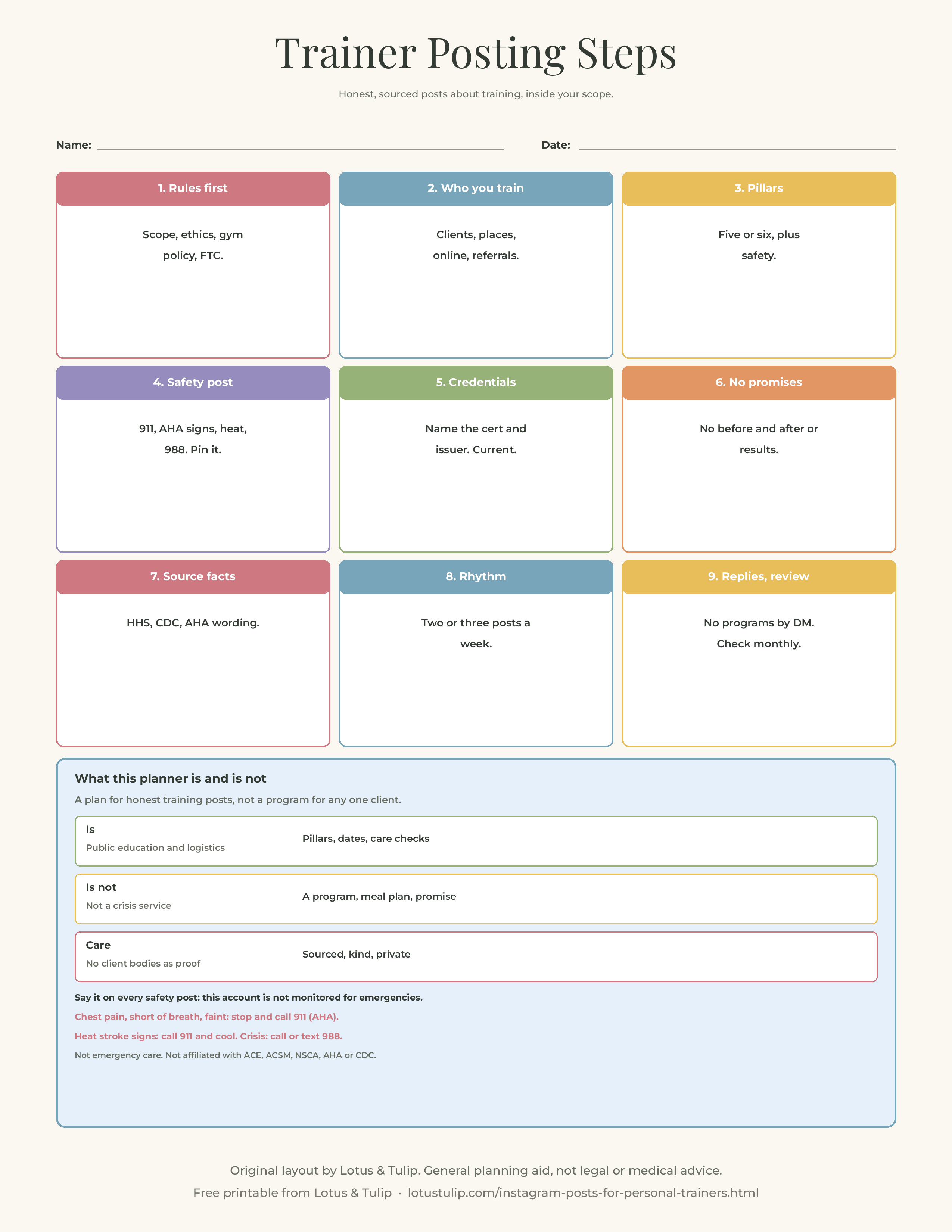
- Choose five or six pillars, plus safety. Use the ten pillars above as a menu. If you cannot say something true and sourced under a pillar this month, skip it.
- Write and pin a safety post. Include the AHA heart attack warning signs and 911, heat stroke and 911, call or text 988, and the sentence that your account is not monitored for emergencies. Put a copy in a Safety highlight.
- Audit your credentials. Keep only current certifications, named with the issuing organization, plus CPR, first aid and AED if current. Remove course names that look like certifications and any clinical titles you do not hold.
- Ban bodies, promises and plans from the draft stage. If a post needs a before and after photo, a weight-loss or result claim, a timeline, a meal plan or a supplement to work, rewrite it or delete it.
- Source every health fact. Use HHS, CDC or AHA wording, name the source on the slide, and add "General information, not medical advice. Check with your doctor before starting a new program."
- Set a two or three posts a week rhythm. Batch captions on a quiet morning. Schedule only what has passed the care check. Leave room for a story if your hours change.
- Prepare replies and review monthly. Save DM replies that refuse diagnosis, programs and meal plans by message and route people to booking, their own clinician or emergency services. Once a month, update rates and hours, check disclosures on any partnership posts, and run every live post through the care check on page 3 of the free printable.
Mistakes and myths
Common mistakes
- Before and after photos. The FTC uses them as an example of testimonials that imply typical results. Cropping the face does not solve privacy or typicality.
- "Results not typical" disclaimers. The FTC says this kind of disclaimer is unlikely to fix a misleading testimonial.
- "Drop 20 pounds in 30 days" and other result or timeline claims. No trainer can promise that to a stranger, and the claim needs substantiation like any other ad.
- Free sessions for five star reviews. Section 465.4 prohibits incentives conditioned on a particular sentiment. Ask everyone for an honest review instead.
- Buying followers or likes. Section 465.8 prohibits buying fake indicators of social media influence to misrepresent your influence for a commercial purpose.
- Undisclosed gifts and affiliate codes. Free shoes and commission links are material connections under Section 255.5. Disclose them in the visible part of the post.
- Injury advice in reels. "Fix your sciatica with this stretch" diagnoses and treats strangers. Route pain questions to clinicians.
- Selling meal plans or supplements with packages. ACE lists both as outside a fitness professional's scope.
- Filming other gym members. Check your gym's policy and keep strangers out of frame.
- Gift cards that expire in 12 months. Federal rules generally require gift card funds to last at least five years.
Myths about trainer Instagram
- "Fitness content only works with physique photos." Talk test carousels, first session explainers and honest rates posts explain your value without any body on screen.
- "A disclaimer at the end makes a program okay." The impression comes from the whole post. If the post is a personal program for someone you have not met, a disclaimer does not change that.
- "Physical therapists and dietitians are competition." They are your best referral sources, and you are theirs. Respectful posts make that relationship visible.
- "You must post daily to grow." Two or three careful posts a week, with current highlights, serve a training business better than daily filler.
- "Bigger numbers mean more clients." Most trainers serve people within driving distance or a small online roster. A smaller, local, trusting audience books more sessions than a large anonymous one.
- "Instagram replaces a website." People still need a page with your certification, location, rates, policies and contact details they can read without an app.
Three fictional examples
These people and studios are invented. They show decisions, not real businesses.
- Marisol, an in-home trainer who works mostly with adults over 60. A follower comments that her knee "clicks and aches on stairs" and asks for exercises. Marisol replies with her saved message suggesting a physician or physical therapist and offering a first session once the follower is cleared. That week she posts the CDC's older adult guidelines, including balance activities, with the "check with your doctor" line. She never mentions the commenter.
- Desmond, an online coach with a growing following. A supplement brand offers him a 20 percent commission code. He checks ACE's scope statement, sees that recommending or selling supplements to clients is outside it, and declines. A shoe company later sends him trainers for free. He wears them in one video and puts "Gifted by [brand]" at the start of the caption and on the video itself.
- Keiko, who owns a small strength studio. A longtime client offers a side-by-side photo "to show what you can do." Keiko thanks her and explains why the studio does not post before and after photos. Instead, with written permission, she shares the client's own sentence about deadlifting her grandchild's suitcase into the car, with no photo and no numbers. Later the studio posts a "how to check your trainer" carousel and links each coach's USREPS listing.
How this guide compares with neighboring Instagram articles
| Guide | Written for | What it covers that this page leaves aside |
|---|---|---|
| This page: Instagram posts for personal trainers | Personal trainers, small studios, online coaches | Certifications and USREPS, screening and medical clearance, AHA and heat safety, FTC rules on before and after posts, fake reviews and fake followers, the talk test and activity guidelines, gift cards, May fitness month |
| Instagram posts for physical therapists | PTs and PTAs | Licensed rehab, direct access, medical red flags, PT versus trainer from the clinical side |
| Instagram posts for dietitians | RDs, RDNs and nutrition practices | Nutrition credentials, medical nutrition therapy, food labels, food safety, supplements, food allergy safety |
| Instagram posts for occupational therapists | OTs and OTAs | Daily living, children and sensory differences, splints, school OT |
| Instagram posts for speech therapists | SLPs | Communication, swallowing, stuttering, sudden speech-change safety |
| Holiday social media posts for therapists | Any clinical or wellness feed in December and January | A week by week seasonal calendar and winter hours posts |
| Instagram post ideas for therapists and therapist Instagram bio | Mental health clinicians | Counseling themes and general bio and caption craft |
Use the general therapist pages for layout ideas (bios, highlights, pinned posts, carousels). Come back here when the question is about training, certification or exercise safety.
Honest trainer post versus overclaiming post
| Topic | Honest trainer post | Overclaiming post |
|---|---|---|
| Results | "Here is how a first session works and how we set goals together." | "Lose 20 pounds in 30 days or your money back." |
| Bodies | "No before and after photos here. Your body is not my ad." | "Swipe for 12 client transformations." |
| Credentials | "[Certification] from [organization], current. CPR and AED certified." | "Certified expert in rehab, nutrition and hormones." |
| Pain | "Pain that worries you? Stop and see your physician or a PT." | "This one stretch fixes sciatica." |
| Nutrition | "Federal guidance in general terms; meal plans come from a registered dietitian." | "Custom macro plan included with every package." |
| Reviews | "We invite every client to leave an honest review." | "Free session for every five star review." |
| Partnerships | "Gifted by [brand]" at the top of the caption and on the video. | "#ad" buried after 30 hashtags. |
| Safety | "Chest discomfort or shortness of breath? Stop and call 911. Not monitored for emergencies." | "DM me any time, I always answer." |
When not to post
- Mid-session. Your client paid for your attention. Film setup or empty-room content before or after, not during.
- When a trend asks you to show a body. Skip it. Your feed does not need to prove anything with abs.
- When you cannot find a primary source. If HHS, CDC, AHA or your certifying organization does not say it, and you cannot cite a quality source, leave it out.
- During a viral fitness panic. Wait until official guidance is clear. A calm post later beats a fast fear post now.
- When a brand is paying and the post would not exist otherwise. If you go ahead, disclose clearly. If you hesitate, that is your answer.
- When a client is in the frame without written permission, or a stranger is in the background.
- When your gym or employer policy says no. Follow it.
Free 3 page personal trainer Instagram printable (US Letter)
Print it, fill it in once a month, and keep it next to your scheduling tool. It works with any design app or template set.
- Page 1: Trainer Posting Steps. Nine step cards that match the HowTo above, what the planner is and is not, and safety lines for 911, heart attack warning signs, heat stroke, 988 and "not emergency care."
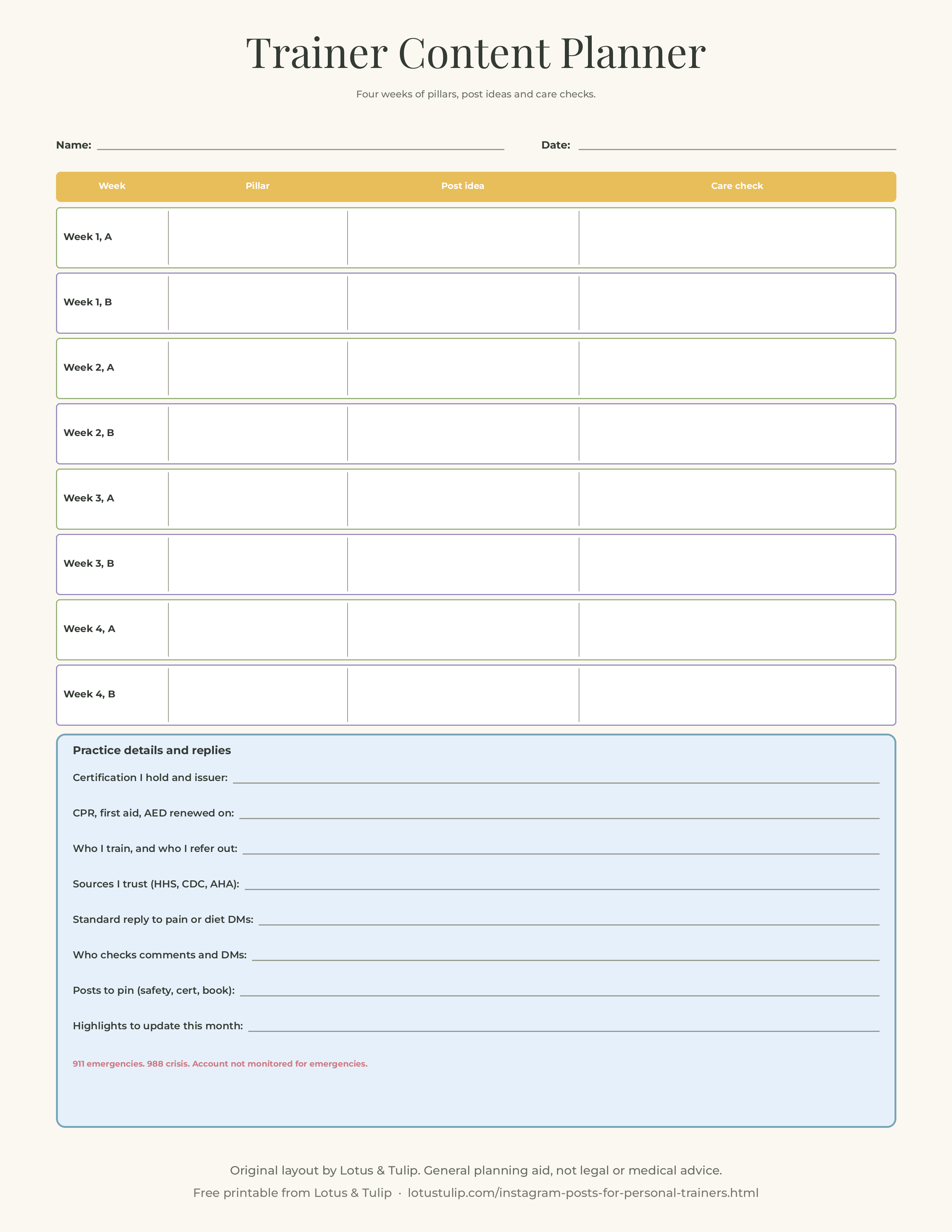
- Page 2: Trainer Content Planner. Four weeks of posts (two per week) with columns for pillar, post idea and care check, plus fields for the certification you hold and its issuer, CPR, first aid and AED renewal date, who you train and refer out, sources you trust, your standard reply to pain and meal plan DMs, who checks messages, posts to pin and highlights to update.
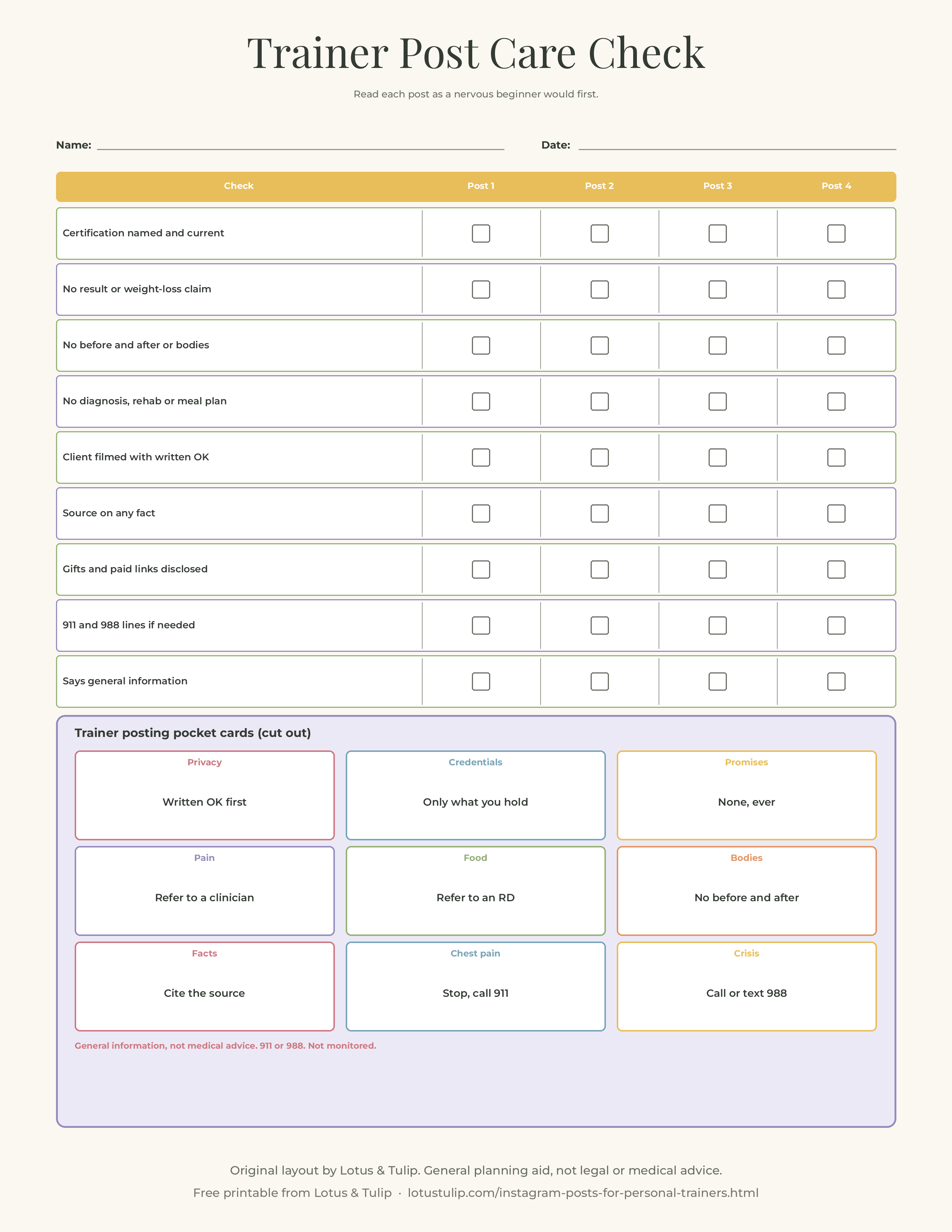
- Page 3: Trainer Post Care Check. A yes or no check for up to four posts (credential named and current, no result or weight-loss claim, no before and after or body as proof, no diagnosis, rehab or meal plan, client filmed only with written permission, source on any fact, gifts and paid links disclosed, 911 and 988 lines if needed, says general information), plus nine trainer posting pocket cards to cut out.
Download free PDF · Page 1 PNG · Page 2 PNG · Page 3 PNG
Research notes (verified, with caveats)
- US Bureau of Labor Statistics. Occupational Outlook Handbook, Fitness Trainers and Instructors, bls.gov/ooh, last modified August 27, 2026, opened this session. Duties (demonstrate exercises, watch technique, provide options, monitor progress, explain safety rules, give information or resources about nutrition and lifestyle, give emergency first aid); exercise trainers also called personal fitness trainers; most have certification; personal trainers usually must be certified before working with clients; employers usually prefer certification but requirements vary by facility; many organizations offer certification; most also need CPR, first aid and AED certification; programs for recovery from illness or injury are covered under the exercise physiologist profile. We used no employment or wage figures.
- United States Registry of Exercise Professionals (USREPS). Credentials list, certifying organizations page and FAQ, usreps.org, via search this session. Verification clearinghouse for current NCCA-accredited or ISO 17024-compliant exercise professional certifications from member organizations; personal trainer credentials listed from ACE, ACSM, NCCPT, NCSF and NSCA; strength coach credentials such as NSCA CSCS and CSCCa SCCC; ACSM Certified Exercise Physiologist and Certified Clinical Exercise Physiologist; specialty credentials are not listed; NCCA also accredits programs for other regulated health professionals such as dietitians and nurse practitioners.
- American Council on Exercise. Nutrition scope of practice position statement (acefitness.org expert article "Nutrition Scope of Practice: What You Can Do as a Personal Trainer" and ACE ProSource August 2013), via search this session. Trainers can and should share general nonmedical nutrition information, including the Dietary Guidelines for Americans and MyPlate; actions outside scope include individualized meal planning, nutritional assessment, specific intake or specialty diet programming, nutrition counseling to prevent, treat or cure disease, recommending, prescribing, selling or supplying supplements, and identifying oneself as a nutritionist or dietitian; scope also depends on state policies and regulations.
- Riebe D, et al. Updating ACSM's Recommendations for Exercise Preparticipation Health Screening. Medicine and Science in Sports and Exercise, November 2015, via search this session, plus ACE's February 2018 summary of the update. Goals of screening; medical clearance defined as approval from a health care professional to engage in exercise; the provider decides what evaluation is appropriate; physically active people who develop signs or symptoms of cardiovascular, metabolic or renal disease should stop and seek medical clearance; PAR-Q+ usable as self-guided screening or as an additional element for fitness professionals.
- HHS Office of Disease Prevention and Health Promotion. Top 10 Things to Know About the Second Edition of the Physical Activity Guidelines for Americans, odphp.health.gov, content last updated November 19, 2025, opened this session. Adults 150 to 300 minutes moderate aerobic activity weekly and muscle strengthening at least 2 days; youth 6 through 17 at least 60 minutes daily; children 3 through 5 active throughout the day; move more and sit less; any amount has some benefit; 10 minute bout requirement removed; older adults lower risk of falls. Pregnancy and postpartum recommendation (at least 150 minutes moderate aerobic activity a week, under a health care provider's care) from the Physical Activity Guidelines for Americans, 2nd edition, via search this session.
- Centers for Disease Control and Prevention. Adult Activity: An Overview (December 20, 2023), Older Adult Activity: An Overview (December 4, 2025) and How to Measure Physical Activity Intensity (December 4, 2025), cdc.gov/physical-activity-basics, opened this session. 150 minutes moderate or 75 minutes vigorous or a combination, plus 2 days of muscle strengthening for all major muscle groups; older adults add balance activities; talk test; 0 to 10 relative intensity scale (moderate 5 or 6, vigorous from 7 or 8); 3 to 5.9 METs moderate, 6.0 or more vigorous; activity examples.
- American Heart Association. Warning Signs of a Heart Attack, heart.org, last reviewed December 12, 2024, opened this session. Call 911 for any heart attack symptoms; chest discomfort; discomfort in arms, back, neck, jaw or stomach; shortness of breath; cold sweat, nausea, rapid or irregular heartbeat, unusual tiredness, lightheadedness; symptoms may differ in women.
- CDC National Institute for Occupational Safety and Health. Heat-related Illnesses, cdc.gov/niosh, March 3, 2026, opened this session. Heat stroke symptoms and first aid (call 911, stay with the person, move to a cool area, cool quickly); heat exhaustion symptoms. Written for workers; quoted here as general heat safety.
- 988 Suicide and Crisis Lifeline, 988lifeline.org, opened this session. Call, text or chat; available 24/7; free and confidential.
- Federal gift card rule, 12 CFR 1005.20 (Regulation E), via eCFR search result this session, and the CFPB consumer answer "If my prepaid card expires, do I lose my money?" Gift certificates and store gift cards generally cannot be sold with an expiration date unless funds last at least five years from issue or last load, with required disclosures; some states give more time.
- ODPHP. Celebrate National Physical Fitness and Sports Month with Physical Activity Resources, and the President's Council on Sports, Fitness and Nutrition page, odphp.health.gov, via search this session. National Physical Fitness and Sports Month is celebrated each May. Proclamation for May 2026 signed May 5, 2026, published at 91 FR 25477 (Federal Register, May 8, 2026).
- Federal Trade Commission. Guides Concerning Use of Endorsements and Testimonials in Advertising, 16 CFR Part 255 (88 FR 48102, July 26, 2023), via eCFR, opened this session. Sections 255.0 (definitions, clear and conspicuous, unavoidable on social media), 255.1 (honest opinions; images that misrepresent the endorser), 255.2 (substantiation; consumer endorsements are not competent and reliable scientific evidence; typicality; before and after weight-loss examples; "results not typical" style disclaimers unlikely to be effective), 255.3 (expert endorsements), 255.5 (material connections including free products and affiliate links).
- Federal Trade Commission. Rule on the Use of Consumer Reviews and Testimonials, 16 CFR Part 465 (89 FR 68077, August 22, 2024), via eCFR, opened this session. Sections 465.2 (fake or false reviews and testimonials), 465.4 (buying reviews conditioned on sentiment), 465.5 (insider reviews and testimonials), 465.7 (review suppression), 465.8 (fake indicators of social media influence).
- HHS guidance on HIPAA and marketing (45 CFR 164.508(a)(3)), as summarized in our dietitian guide; relevant only to trainers working inside a covered entity.
This page is not affiliated with or endorsed by ACE, ACSM, NSCA, NCCPT, NCSF, CSCCa, NCCA, USREPS, BLS, HHS, ODPHP, CDC, AHA, the CFPB, the 988 Lifeline, the President's Council on Sports, Fitness and Nutrition or the FTC. We used no prevalence statistics. Our paid template kits are marketing tools for fitness professionals. They are not exercise programs or clinical interventions and have not been tested in any trial. You stay responsible for what you post.
Instagram posts for personal trainers: FAQ
What should a personal trainer post on Instagram?
Focus on what prospective clients and referral sources need: who you are and the certification you actually hold, how to check a trainer, what a first session involves, why you ask health questions, rates, packages and policies, sourced education such as the talk test and the federal activity guidelines, and a pinned safety post with the AHA heart attack warning signs, 911, call or text 988, and a note that your account is not monitored for emergencies.
How often should a personal trainer post on Instagram?
Two or three feed posts a week is enough for most solo trainers and small studios, plus occasional stories for class times and openings. Once a week is fine if your Safety, Book, Rates and FAQ highlights are current.
Can I post client before and after photos if the client agrees?
Permission solves only part of the problem. The FTC endorsement guides say a testimonial about results will likely be read as typical, and use before and after weight-loss photos as an example. Unless you can substantiate and disclose what clients generally achieve, the post can mislead, and the FTC says "results not typical" disclaimers are unlikely to fix it. Many trainers share a client's own words about what they enjoy instead, with written permission and no body photos.
Can I give a free session in exchange for a review?
Not for a positive review. The FTC's consumer review rule (16 CFR 465.4) prohibits incentives conditioned on a review expressing a particular sentiment. You can invite every client to leave an honest review, and if you offer any incentive for reviews at all, it must not depend on the review being positive and should be disclosed.
Can personal trainers give nutrition advice on Instagram?
General advice, yes. ACE says trainers can and should share general, nonmedical nutrition information such as the Dietary Guidelines for Americans and MyPlate. Individualized meal plans, nutrition assessment, specific calorie or macro programming, specialty diets and supplement recommendations are outside a fitness professional's scope and belong with a registered dietitian. State rules also apply.
How should I show my certification in my bio?
Name the credential and the organization that issued it, for example a CPT from an NCCA-accredited program, and only list what is current. You can add CPR, first aid and AED certification if current, and invite people to verify you on USREPS if you are listed. Avoid clinical titles such as therapist or nutritionist unless you hold that license or title.
Do I need to disclose free gear or affiliate links?
Yes. FTC Section 255.5 says material connections such as payment, free or discounted products and affiliate commissions must be disclosed clearly and conspicuously when the audience would not expect them. On Instagram, put the disclosure in the visible part of the caption and on the image or video, not only in your bio or behind "more."
Is the free printable a copy of the paid kit?
No. The free three page set is an original planning aid: posting steps, a four week content planner and a post care check with pocket cards. The paid Patient Rep kit contains designed posts, stories, highlight covers, captions and a 12 week calendar. The printable is not a preview of that kit.