
Therapist marketing · Updated 2026-11-09
Instagram Post Ideas for Life Coaches (with Free Printable)
Ready-made template kit: Life Coach Instagram Templates Holiday 20% off: about $22.08, was $28 (EUR 24) · instant digital download
Buy on Etsy
Instagram posts for life coaches live in one of the noisiest corners of the platform. The person who finds your profile has probably scrolled past a dozen coaches that week promising a "six figure business," a "transformed life" or "freedom in 90 days," often with screenshots of client wins and a countdown to a price increase. They are curious, and they are wary: Is this person trained? Is coaching the same as therapy? What actually happens in a session? What will it cost, and can I get out of it? At the same time, the algorithm rewards exactly the posts that create problems: income screenshots, dramatic testimonials, "I healed my anxiety and you can too" reels and fake scarcity. The FTC, the ethics codes of coaching bodies, the state laws that protect therapy titles and the clients who trust you with their goals reward the opposite: an honest description of what coaching is and is not, no income or results promises, no therapy language, a clear crisis signpost, real prices and a calm, consistent feed.
This guide is written for US life coaches and the small businesses around them: solo life coaches, career and transition coaches, wellness and habit coaches, executive and leadership coaches who also coach individuals, coaches who run group programs and workshops, licensed therapists who also offer coaching, and the virtual assistants and social media managers who post for coaches. It covers what to post on Instagram as a life coach: why coaching marketing is different from influencer content, the fact that coaching is not a licensed profession in any US state and what that means for your credibility, ICF and other credentials and how to show them honestly, where coaching ends and therapy begins, the words that cross that line, the FTC's rules on results claims, earnings claims, testimonials and reviews, confidentiality, crisis and safety posts built around 988, prices, packages, discovery calls and cancellations, sourced education you can stand behind, ten content pillars, 34 post ideas with original caption angles, six fuller captions, DM scripts that keep boundaries clear, a two or three posts a week rhythm and a 12 week overview, dates that suit a coaching feed, a nine step HowTo, mistakes, myths, three fictional examples, comparison tables, when not to post, research notes and a free three page US Letter printable: Life Coach Posting Steps, a Life Coach Content Planner and a Life Coach Post Care Check with pocket cards.
If your work overlaps with other practitioners, neighboring pages may help: what therapists can post on social media covers the licensed side of the line, Instagram post ideas for personal trainers suits fitness and movement coaches, and how to write a therapist Instagram bio has bio structures that adapt well to coaching. This page stays with the questions life coaches tend to face: how to look credible in an unlicensed field, how to talk about change without promising it, how to sell packages without pressure, and how to keep a feed no one could mistake for therapy.
What this guide is and is not
This is a practical content guide for life coaches who market to clients in the United States. It is not legal advice, it is not mental health advice and it does not replace the advertising laws of your state, the FTC Act, the ethics code of any coaching body you belong to, the rules of a licensing board if you also hold a license, or the advice of a lawyer who knows your business. Coaching rules are unusual: there is no coaching license to check, but the laws around it (consumer protection, therapy title protection, earnings claims, subscriptions) still apply to everything you post. Treat every example below as a starting point you check against your own situation.
Every factual statement here was checked against a primary or official source: the Utah Office of Professional Licensure Review's November 2024 sunrise review of life coaching, the International Coaching Federation's (ICF) credential pages, Code of Ethics and its guide to referring a client to therapy, the Center for Credentialing and Education (CCE), the FTC's Endorsement Guides, its consumer review rule, its Notice of Penalty Offenses on money-making opportunities, its earnings claims rulemaking record and its 2026 Publishing.com order, the 988 Suicide and Crisis Lifeline, and the 2010 habit study by Lally and colleagues. Where a source was only seen through search results rather than opened in full, or was checked for our previous articles, the research notes at the end say so. We used no coaching industry survey figures, no income figures and no claims about what coaching "proves."
The post ideas, captions and fictional coaches are original to this page. They are examples of tone and structure, not scripts to copy word for word. Your clients, your niche and your voice should change them.
Why posting as a life coach is different from influencer content
A lifestyle influencer can post a morning routine and a big promise. A coach posting the same way runs into problems that other creators rarely face, for five reasons.
First, anyone can call themselves a coach. Utah's Office of Professional Licensure Review (OPLR) found in its November 2024 sunrise review that no state currently requires a license for life coaches, and it recommended against creating one. That openness is why coaching is accessible, and it is also why careful clients look harder at your feed. With no license number to check, your training, your honesty about limits and the consistency of what you post are the credibility signals people have.
Second, your work sits right next to therapy. The same OPLR review focused on coaches moving into the scope of licensed mental health therapists. In its scan of Utah life coaches' advertising, OPLR estimated that roughly 40 percent potentially operated in the regulated mental health therapy space, with some claiming to specialize in clients with mental health conditions or to "conquer" them. Coaching is unlicensed; diagnosing and treating mental health conditions is not. A caption that drifts from "goals" into "healing your trauma" can describe a licensed service you are not allowed to provide.
Third, the FTC has named coaching in its warnings about money claims. In October 2021 the FTC sent a Notice of Penalty Offenses concerning money-making opportunities to more than 1,100 businesses, including investment and business coaching companies, warning that false or misleading claims about earnings, including that represented profits are typical, could lead to civil penalties. If you coach people about careers, businesses or money, your feed is in the territory regulators watch.
Fourth, results are personal and hard to promise. Coaching outcomes depend on the client, their circumstances and the work they do between sessions. That makes every "clients get X" post a claim about typical results, which the FTC's Endorsement Guides treat seriously (more below).
Fifth, many of your followers arrive at a vulnerable moment. People look for a coach after a breakup, a layoff, a move, burnout or a big birthday. Some are really looking for therapy, and some are in crisis. A calm feed that explains what coaching is, points to 988 and does not pressure anyone into a package is not only ethical; it is what makes the right clients trust you.
Coaching credentials and how to show them honestly
Because there is no license, credentials do a lot of work on a coach's profile, and they are easy to overstate. Here is the landscape, and how to present it accurately.
No license, so say what you actually have
OPLR noted that the level of formal training among life coaches varies widely, and ProPublica's reporting on Utah (with The Salt Lake Tribune) put it plainly: life coaches are mostly unregulated across the US, and there is no universally accepted certification. "Certified life coach" can mean a weekend course, a year long accredited program or nothing at all. On Instagram, the honest move is specific: name the program, the credential and the body that issued it, and do not let a course certificate read like a license.
ICF credentials: ACC, PCC and MCC
The International Coaching Federation offers three credentials, and its own pages set out the core requirements:
- Associate Certified Coach (ACC): 60 or more hours of coach-specific education, 100 or more hours of coaching experience with at least eight clients (at least 75 hours paid), 10 hours of mentor coaching, a performance evaluation and a passing score on the ICF ACC Exam.
- Professional Certified Coach (PCC): 125 or more hours of coach-specific education, 500 or more hours of coaching experience with at least 25 clients (at least 450 paid), 10 hours of mentor coaching, a performance evaluation and the ICF Credentialing Exam.
- Master Certified Coach (MCC): holding or having held the PCC, 200 or more hours of coach-specific education, 2,500 or more hours of coaching experience with at least 35 clients (at least 2,250 paid), 10 hours of mentor coaching, a performance evaluation and the ICF Credentialing Exam.
Two details matter for your bio. The ICF Code of Ethics glossary says "ICF Certified" indicates ICF credentialed and applies only to people who hold an ICF credential such as ACC, PCC or MCC. And being an ICF member is not the same as holding an ICF credential. If you are a member working toward your ACC, "ICF member, working toward ACC" is accurate. "ICF certified coach" is not, until the credential is issued.
Other credentials
Other bodies issue coaching credentials too. For example, the Center for Credentialing and Education (CCE) offers the Board Certified Coach (BCC), which CCE says requires a bachelor's or graduate degree, CCE-approved coach training (the required hours depend on your degree and existing credentials), post-degree coaching experience, a professional endorsement and a passing exam. Many training schools also issue their own certificates. All of them are legitimate to mention, as long as you name the issuer and do not imply a government license.
Protected titles you may not use
The words that describe licensed mental health work are often protected by state law. Depending on the state, titles such as psychologist, licensed professional counselor, marriage and family therapist, clinical social worker and sometimes "therapist," "counselor" or "psychotherapist" on their own are reserved for people who hold the matching license. The details vary, so check your state's licensing statutes before you use any of them, including in hashtags and in your handle. A coach who calls themselves a "trauma therapist," a "mindset therapist" or a "relationship counselor" without a license is taking a real risk. "Life coach" and "career coach" are safe, accurate descriptions.
How to show credentials on your profile
- Name, niche and real credential. "[Name], ICF PCC, career transition coach" or "[Name], certified coach ([Program]), life coach for new parents" is clear and checkable.
- Name the issuer. Credentials without an issuer read like marketing. "Certified by [School]" or "ICF ACC" lets a careful client look you up.
- Link a way to check. If the body that issued your credential has a public directory and you are listed, link it. A pinned "How to check a coach's background" post earns more trust than any testimonial.
- Keep other roles separate and disclosed. The ICF Code of Ethics (standard 3.7) says it is the coach's responsibility to disclose when they are acting in a capacity other than coaching, for example as a therapist or mentor. If you also hold a license, say which hat you are wearing on each service.
- No borrowed authority. No "Dr." unless you hold a doctorate (and then say in what), no clinical aesthetic, no "as seen on" logos for a podcast that interviewed you once.
Coaching or therapy? Where the line sits, and how to post about it
This is the single most important boundary on a coaching feed, and the one most often blurred by marketing advice.
What coaching is
The ICF defines coaching as partnering with clients in a thought-provoking and creative process that inspires them to maximize their personal and professional potential. In practice, coaching is usually forward looking, built around goals the client chooses, and assumes the client is able to function and make their own decisions. The ICF's guide to referring a client to therapy offers an example scope statement for a coaching agreement: "Coaching is not therapy. I do not work on 'issues' or dig into the past."
What coaching is not
Coaching is not diagnosis or treatment of mental health conditions. OPLR's recommendations were to strengthen scope of practice language so it is clearer who is qualified to treat mental health conditions, and to support investigation and prosecution of bad actors. ProPublica's reporting described how, in Utah, regulators can cite life coaches for unauthorized practice when they diagnose clients or develop plans to manage mental health conditions. Other states have their own unlicensed practice laws. Whatever your state, the safe line on Instagram is simple: you can coach people who want to change something in their lives; you cannot advertise yourself as treating anxiety, depression, trauma, eating disorders, addiction or any other condition.
When to refer
ICF's referral guide says that when a client raises issues outside a coach's expertise or scope, it is the coach's ethical responsibility to help the client identify and access other resources, and it lists common mental health issues a coach could recognize as signs a client needs therapy: anxiety, depression, eating disorders, post-traumatic stress disorder, substance abuse or addiction, suicidal ideation and thought disorders. The ICF Code of Ethics (standard 4.3) asks coaches to stay alert to a shift in the value a client is getting and to explore a different professional or resource if appropriate. That makes a public "when coaching is not the right fit" post good ethics and good marketing.
Words to watch in captions
| Usually a coaching description | Often reads as therapy or a clinical claim |
|---|---|
| Goals, next steps, decisions, habits, accountability | Treatment, diagnosis, symptoms, healing, recovery |
| Building confidence for a career change | Curing anxiety, overcoming depression |
| Planning a calmer week, routines that fit your life | Managing your ADHD, trauma healing program |
| Clarifying what you want in relationships | Couples therapy, fixing your attachment wounds |
| Supporting the plan you've made with your therapist | "You don't need therapy, you need coaching" |
| Questions, reflection, practice between sessions | Inner child work or nervous system regulation offered as treatment |
This table is a starting point, not a legal opinion. Context matters: regulators look at the overall impression of your profile, your services page and your sales calls together. If a caption only works because of a clinical word, rewrite it.
If you are also a licensed therapist
Some therapists offer coaching to clients outside their licensed state or to people who do not need therapy. OPLR listed avoiding licensure requirements for treating clients in other states and avoiding insurance and billing restrictions among the reasons some therapists reported offering coaching. Be careful: your licensing board's rules may still apply to anything that looks like therapy, whatever you call it. Keep separate services, separate agreements and ideally separate accounts, and follow the ICF's guidance to disclose which role you are acting in. If you want your therapy account to stay strictly clinical and on brand, a dedicated therapist kit helps keep the two voices apart (see the box near the who does what table).
Results, income and "transformation" claims: what the FTC expects
The most common way a coaching feed drifts into trouble is not a bad photo. It is a sentence about what clients will get.
Results claims are typicality claims
The FTC's Endorsement Guides (16 CFR 255.2(b)) say an ad featuring a consumer's experience on a key attribute will likely be read as representing what consumers will generally achieve. If you cannot substantiate that the result is typical, the ad should clearly and conspicuously disclose the generally expected performance in the depicted circumstances, and you must be able to back that up. Under 255.2(a), testimonials about how well something works are treated as claims you need to substantiate yourself, the same as if you said them directly. "My client landed a dream job in six weeks" reads as "this is what my coaching does." If that is not what most clients experience, the post misleads even if the story is true.
Earnings claims carry extra risk
If you coach people about money, careers or businesses, take earnings claims seriously:
- The Notice of Penalty Offenses. The FTC's 2021 notice on money-making opportunities describes practices it found unlawful in earlier litigated cases, including false or misleading representations about profits or earnings, representations that represented profits are typical, falsely telling people they do not need experience to earn income, and telling them they must act immediately. Recipients included business and investment coaching companies. The FTC said being on the list did not suggest wrongdoing, but the notice describes what the agency treats as deceptive.
- The rulemaking is not final. The FTC published an advance notice on an earnings claims rule on March 11, 2022. The federal regulatory agenda says a proposed rule was publicly released on January 13, 2025 but never published in the Federal Register, lists the rule at the prerule stage and says the Commission is still evaluating options. Articles that say "coaching is now covered by the new FTC rule" are describing drafts. Deceptive earnings claims are already unlawful under existing law.
- A 2026 example. On July 2, 2026 the FTC approved a final order against Publishing.com, a company selling self-publishing programs, and its owners over earnings claims the FTC alleged were false or unsubstantiated, with a $1.5 million payment and limits on future earnings claims unless they have a written, reasonable basis for what is typical. It is a reminder that coaching and education programs are within the FTC's reach.
The simple rule for a feed: no income screenshots, no "six figure" or "replace your salary" promises, no "my clients make $X," and no lifestyle posts implying that coaching paid for the car. If a business coach wants to share numbers, that is a conversation for a lawyer and for written, typical-results data, not for a caption.
Health and wellness coaches
If your coaching touches health, fitness, food or sleep, health claims need competent and reliable evidence, and the FTC's Health Products Compliance Guidance says testimonials showing results that are more dramatic than people can generally expect are likely to be deceptive, and that "results not typical" style disclaimers do not cure the problem. Weight loss promises, "reverse" claims and "balance your hormones" captions are the classic risks.
"Transform your life" and other big promises
Not every vague promise is unlawful, but big promises sit badly with the ICF Code of Ethics, which asks coaches (standard 5.2) to make statements that are true and accurate about what they offer and about the potential value of coaching. "Life-changing" and "unlock your full potential" are tired; "guaranteed" and "in 90 days" are claims. A modest, specific promise (what happens in a session, how you work, what the client does) sells better to the clients you actually want.
Testimonials, reviews, affiliate links and the FTC
Coaching marketing advice says "post your client wins" and "share your favorite tools." Both are fine in principle and full of traps in practice.
Client wins are testimonials
A screenshot of a client's message saying "I got the promotion!" is a testimonial about results. Under the Endorsement Guides it is treated as your claim, and under the ICF Code of Ethics (standard 2.1, confidentiality) it is also client information. If you use any client story at all, get written permission for that specific post, remove anything identifying unless the client wants to be named, never edit their words, and ask yourself whether it represents what most clients experience. Many careful coaches leave client wins off Instagram entirely and let their method, policies and voice do the work.
Reviews: invite everyone, reward no one for sentiment
The FTC's Rule on the Use of Consumer Reviews and Testimonials (16 CFR Part 465, 2024) makes several practices violations outright:
- Writing, creating or selling fake reviews or testimonials, including ones that misrepresent the reviewer's experience (465.2).
- Giving compensation or incentives in exchange for, or conditioned on, reviews expressing a particular sentiment (465.4). "A free bonus session for a five star review" is exactly this.
- Reviews or testimonials by officers or managers without a clear disclosure of their relationship, and soliciting undisclosed reviews from employees or relatives in certain situations (465.5).
- Using unfounded legal threats, intimidation or knowingly false public accusations to suppress reviews (465.7).
- Buying or selling fake followers, likes or views to misrepresent influence for a commercial purpose (465.8).
The Endorsement Guides add that inviting only happy clients to post reviews can be deceptive, while inviting every client is fine. The simple habit: send every client the same short "I'd value an honest review" message at the end of an engagement, or none.
Affiliate links, partner coaches and referral fees
Coaches often recommend journals, apps, assessments, books and other coaches. Under 255.5, a material connection, which includes payment, free products, commissions or other benefits, must be disclosed clearly and conspicuously when your audience would not expect it. Part 465 defines clear and conspicuous on social media as unavoidable: not hidden behind "more," not only in your bio. "Affiliate link: I earn a commission" in the first line works. The ICF Code of Ethics (standard 3.8) separately asks coaches to disclose to clients any compensation or benefits received for referrals, so a referral fee from another coach or a program is something your clients should hear about from you.
You may be an expert endorser
When a coach with a stated credential recommends a book or tool as part of their expertise, the FTC treats the recommendation as an expert endorsement, which must reflect a real exercise of that expertise (255.3). "I use this weekly review template with clients because it takes ten minutes" is fine. "This journal will fix your procrastination" is a claim you cannot support.
Confidentiality, privacy and group programs
Coaches hear about careers, marriages, money and health. Clients assume discretion even when no privacy law requires it.
What the ICF Code says
The ICF Code of Ethics (in effect since April 1, 2025) asks coaches to maintain the strictest level of confidentiality with all parties (2.1), to have a clear agreement about what information is exchanged and how (2.2), to agree in advance with clients about what may need to be disclosed to authorities, such as illegal activity, information required by law, a valid court order or subpoena, or an imminent or likely risk of danger to self or others (2.3), and to store and dispose of records in a way that protects privacy and complies with applicable laws (2.4). Standard 2.5 extends those obligations to the technology you use, including AI tools. A short "what stays between us" post that explains those limits in plain words is one of the most useful posts a coach can make.
HIPAA usually does not apply, but discretion still does
HHS explains that a health care provider is a HIPAA covered entity only if it transmits health information electronically in connection with a transaction for which HHS has adopted a standard, such as electronic insurance claims. Most life coaches do not bill insurance and are not covered entities. A coach who works for or with a covered entity, such as a health system, may be working under its HIPAA policies, so ask. Either way, state privacy and consumer protection laws may apply, and the ICF Code applies to ICF members and credential holders.
Practical rules for a coaching feed
- No screenshots of client messages, even blurred, without written permission for that exact use.
- No "a client told me today" stories. In a niche, even anonymous details can identify someone.
- No photos or recordings from group sessions or workshops unless every participant agreed in writing, with a clear way to opt out without missing out.
- No tagging clients, and no confirming in comments that someone is a client.
- Reply to every review, good or bad, in the same neutral style: "Thank you for taking the time to share this. I'd welcome a conversation by email."
Safety posts: 988, 911 and "coaching is not crisis support"
Most coaching conversations are about everyday goals. But a coaching account will, sooner or later, receive a message from someone who is not okay. Plan for that day now.
988 and 911
The 988 Suicide and Crisis Lifeline offers free, confidential support 24 hours a day: call or text 988, or chat at 988lifeline.org. Spanish speakers can call 988 and press 2 or text AYUDA to 988. For immediate danger, call 911. Put both in a pinned post or a Safety highlight, and in your auto-reply if you use one.
"This account is not monitored for emergencies"
Every coaching account should have one pinned line: "Coaching is not therapy or crisis support. This account isn't monitored for emergencies. If you're thinking about suicide or are in crisis, call or text 988. In immediate danger, call 911." It takes a minute to write and matters most on the one night someone needs it.
Safety inside your agreement
The ICF's guidance on confidentiality describes safety limits, including concern for the safety of a client or others, and notes that a coach may have a legal obligation in some places to notify emergency services and an ethical obligation to contact the emergency contacts collected during contracting, as set out in the coaching agreement. Put that in your agreement, explain it on your discovery call, and post a short version publicly so no client is surprised.
Wellbeing content without crossing the line
You can still talk about stress, burnout and wellbeing on a coaching feed, as long as you stay general and point to licensed help. "If stress is affecting your sleep, appetite or ability to get through the day, talk to your doctor or a licensed therapist. Coaching can sit alongside that, not instead of it" is honest and kind.
Prices, packages, discovery calls, cancellations and gift sessions
Money posts are among the most saved on any service feed, because people hate guessing. In coaching they also attract the most pressure tactics, so they need the most care.
- Post real prices, or a real range. Session price, package length and total, what is included between sessions, and whether a discovery call is free. "DM me for pricing" makes careful clients leave.
- No fake scarcity. "Only two spots left" is fine if it is true and still true when people read it. The FTC's money-making notice lists falsely telling people they must act immediately among the practices it has found deceptive. Countdown timers that reset are a bad idea.
- Payment plans and recurring billing. If you charge monthly, say the amount, the billing date and how to cancel, plainly. The FTC's 2024 "click to cancel" amendments were vacated by the Eighth Circuit in July 2025, but the Restore Online Shoppers' Confidence Act (ROSCA) still requires clear disclosure of material terms before billing information is collected, express informed consent and a simple way to stop recurring charges for online subscriptions, and many states have their own automatic renewal laws. Check the rules that apply to you.
- Refunds and ending early. The ICF Code of Ethics (standard 1.2) asks coaches to respect all parties' right to end the coaching relationship at any point, subject to the agreement. State your refund policy plainly in the post and in the agreement.
- Discovery calls without pressure. Say what happens on the call, how long it is, and that there is no obligation. If you sell on the call, say that too. A call that turns into a high pressure close damages trust faster than any post can build it.
- Gift sessions and gift cards. Under the federal gift card rule (12 CFR 1005.20, part of Regulation E), funds on gift certificates and store gift cards generally cannot expire sooner than five years after issue or last load, and some states give more time. Check the rules before you post a gift session offer with an expiry date.
Public education you can source and stand behind
Education posts are the backbone of a trustworthy coaching feed. Each of these topics has a source you can name on the slide.
What coaching is, in the ICF's words
Quote the ICF definition and add one sentence about how you work. It is short, sourced and answers the first question most followers have.
How long habits take (Lally 2010)
Lally and colleagues' 2010 study in the European Journal of Social Psychology followed volunteers who each chose a daily eating, drinking or activity behavior. For participants whose data fit the model, the median time to reach 95 percent of their own plateau of automaticity was 66 days, with a range of 18 to 254 days, and missing one opportunity did not materially affect the habit forming process. That gives you two honest posts: "Habits don't take 21 days" and "Missing a day doesn't undo a habit." Say "in one study," because it is one study with a small sample.
Coaching, therapy, mentoring and consulting
A plain comparison of who does what (see the table below) helps followers choose the right support, even if that is not you.
How to check a coach's background
Ask what training they completed and who accredited it, whether they hold a credential and from which body, whether they belong to a body with an ethics code and a complaints process (the ICF runs an Ethical Conduct Review process for its members and credential holders), what their agreement says about confidentiality and ending early, and what they do if a client needs therapy.
Questions to ask before you hire a coach
What does a session look like? How long is the engagement, and what does it cost in total? What happens between sessions? What do you not work on? Who do you refer to? What is your cancellation and refund policy? Turn that into a carousel and it is useful even to people who never book with you.
Life coach, therapist, psychologist, mentor, consultant and trainer
Followers mix these up constantly, and a clear "who does what" post is one of the most useful things you can share. Keep it factual and generous to the other professions.
| Professional | What they typically do | What to say on your feed |
|---|---|---|
| Life coach | Unlicensed, goal focused partnership; may hold a credential such as an ICF ACC, PCC or MCC or a CCE BCC | "I'm a coach. I don't diagnose or treat mental health conditions. I'll tell you if therapy would serve you better." |
| Licensed therapist or counselor | State-licensed assessment and treatment of mental health conditions (license titles vary by state) | "For anxiety, depression, trauma or grief that's weighing on you, a licensed therapist leads. Coaching can sit alongside." |
| Psychologist or psychiatrist | Licensed psychologists assess and treat; psychiatrists are physicians who can prescribe | "Questions about medication or a diagnosis belong with your doctor or psychiatrist." |
| Mentor | Shares their own experience and advice in a field | "A mentor tells you what worked for them. A coach helps you work out what fits you." |
| Consultant | Analyzes a business problem and recommends or delivers a solution | "If you want someone to hand you the answer, you may want a consultant." |
| Personal trainer or health coach | Exercise programming and habit support; certifications vary | "For a training plan, see a qualified trainer. For medical questions, see your doctor." |
If you collaborate with any of these colleagues, agree on how each of you describes the others, and disclose any referral arrangement.
Ten content pillars for a life coach's Instagram
Pick five or six of these for any month, plus safety. If you cannot say something true and useful under a pillar this month, skip it.
- Who you are and your training. Your name, niche, real credential and issuer, and why you coach.
- How you work. What a session looks like, online or in person, how long, what happens between sessions.
- Who you help and who you don't. Your niche in plain words, and what you refer out.
- Fees, packages and policies. Prices, what is included, cancellation, refunds, gift sessions.
- Coaching vs therapy vs mentoring. The line, explained kindly and often.
- Sourced education. Habits, goal setting, reflection questions, with the source on the slide.
- Myth vs fact. "Habits take 21 days," "coaches are therapists," "a certificate is a license," "real coaches guarantee results."
- Safety and confidentiality. 988, 911, what stays between us and its limits.
- Prompts and reflection. Questions followers can answer for themselves, no DM required.
- Community and gratitude. Workshops, colleagues you refer to, International Coaching Week, holiday hours and thank-you posts.
34 Instagram post ideas for life coaches, with caption angles
Each idea has a short caption angle you can rewrite in your own voice. None of them needs a client screenshot, a testimonial, an income figure or a results promise.
About you and how you coach
- Welcome and your approach. "I'm [name], a [credential] coach for [niche]. You set the goals. I ask the questions, and I keep you honest about the next step."
- Why I became a coach. One honest paragraph about what drew you to coaching, without implying you rescue or fix people.
- My training, plainly. Program, hours, credential and issuer, and what you are still learning.
- Who I work with. Your niche in one sentence, with one example of a goal you help with.
- What I don't work on. "I don't treat anxiety, depression or trauma. If that's what's weighing on you, a licensed therapist is the right first step."
- Where sessions happen. Video, phone, walking sessions, an office; accessibility and time zones.
Your first sessions
- What happens on a discovery call. Length, questions you will ask, whether you sell on the call, no obligation.
- Your first month, step by step. Agreement, first session, goals, practice between sessions, first review.
- How to prepare. "Bring one thing you want to be different in three months. That's enough."
- What a coaching agreement covers. Roles, confidentiality and its limits, fees, ending early.
- You lead. "I won't tell you what to want. I'll help you get clear on it."
- Getting the most from coaching. Show up, do the small practice, tell me when something isn't working.
- Questions to ask before you hire a coach. Training, credential, agreement, refunds, referrals.
Fees, booking and logistics
- Session and package fees. Real prices, what is included, no countdowns.
- Booking and cancellation policy. Notice period, fee, and kindness for genuine emergencies.
- Refunds and ending early. Your policy, stated plainly.
- New client spaces. A true, dated announcement.
- Payment plans, plainly. Amount, dates, how to cancel.
- Give a session. Gift sessions, what they cover, how long they last (check the rules).
- Holiday hours and closures. A plain, pinned story.
Education, sourced
- What coaching is. The ICF definition and one line about your approach.
- Coaching, therapy and mentoring. Three short columns, generous to each.
- Habits don't take 21 days. Lally 2010: median 66 days, range 18 to 254, in one study.
- Missing a day doesn't undo a habit. Same study, gentle tone.
- How to check a coach's background. Training, credential, ethics code, complaints process.
- Myth vs fact: titles and credentials. "Certified" means certified by someone. Ask who.
- Myth vs fact: big promises. Why a good coach won't guarantee your outcome.
- A weekly review in ten minutes. Three questions: what went well, what got in the way, one next step.
Safety, community and gratitude
- Coaching is not crisis support. 988 call, text or chat; 911 for immediate danger; account not monitored.
- What stays between us. Confidentiality and its limits, from your agreement.
- A colleague shout-out. A therapist or other coach you genuinely refer to; disclose any referral arrangement.
- International Coaching Week. A post in May about what professional coaching is and how to choose a coach.
- Thank you, quietly. A general thank-you to clients that names no one.
- Ask me anything. A stories question sticker, answered with general information only.
Six fuller caption examples you can adapt
1. Welcome post.
"Hi, I'm [Name], a [credential, issuer] life coach for [niche]. I started coaching because I kept meeting people who knew exactly what they didn't want and had no room to work out what they did. In our sessions, you set the goals and I ask the questions. Between sessions, you try one small thing. I don't diagnose or treat mental health conditions, and if therapy would serve you better, I'll say so. Discovery calls are free and there's no obligation. Link in bio."
2. Coaching, therapy or mentoring?
"Three kinds of support, three different jobs. A licensed therapist assesses and treats mental health conditions, and can help with the past. A mentor shares what worked for them in a field. A coach partners with you on goals you choose, focused on what's next. Many people use more than one. If you're dealing with anxiety, depression, trauma or grief that's weighing on you, start with a therapist. Coaching can sit alongside that, not instead of it."
3. Habits don't take 21 days.
"You've probably heard that a habit takes 21 days. In one well known study (Lally and colleagues, 2010), the median time for a new daily habit to feel automatic was 66 days, and it ranged from 18 to 254 days. The same study found that missing one day didn't materially set people back. So if you're on day 30 and it still feels like effort, nothing is wrong with you. Keep going, and make the habit smaller if you need to."
4. What happens on a discovery call.
"A discovery call with me is 20 minutes on video. I'll ask what you'd like to be different, what you've tried and what support you have. You can ask me anything about how I work, my training and my fees. If coaching isn't the right fit, I'll say so and suggest who might be. If it is, I'll send you the agreement to read in your own time. No pressure, no countdown."
5. Coaching is not crisis support.
"A quick, important note. Coaching is not therapy or crisis support, and this account isn't monitored for emergencies. If you're thinking about suicide or you're in crisis, call or text 988, or chat at 988lifeline.org. It's free, confidential and open 24/7. If you or someone else is in immediate danger, call 911. Please save this post for someone who might need it."
6. Fees, plainly.
"Here's exactly what coaching with me costs. Single sessions are $[amount] for [length]. The three month package is $[total], paid in full or in three monthly payments of $[amount], and includes [number] sessions and [what's included between sessions]. You can end early with [notice]; here's my refund policy: [link]. I don't do countdowns or 'last chance' pricing. If the timing isn't right, it's fine to come back later."
DM and comment replies that keep boundaries kind and clear
Save these as quick replies. Each one stays in scope, protects privacy and routes people to the right place.
- "I think I have depression. Can you help?" "Thank you for telling me. I'm a coach, and I don't diagnose or treat depression. A doctor or licensed therapist is the right first step, and coaching can sit alongside that later if you'd like. If you're in crisis, please call or text 988."
- A message that mentions suicide or self-harm. "I'm really glad you reached out. Please call or text 988 now, or chat at 988lifeline.org. They're there 24/7. If you're in immediate danger, call 911. This account isn't monitored for emergencies, so please reach out to them right away."
- "Can you guarantee I'll get a new job?" "I can't guarantee an outcome, and I'd be wary of any coach who does. What I can promise is how we'll work: [your process]. Happy to talk it through on a discovery call."
- "How much do you make? Can you teach me to make six figures?" "I don't share income claims, because everyone's situation is different. If you're interested in coaching on [your niche], here's my booking link and my fees."
- A client mentions personal details in a public comment. Do not reply with details. "Thanks for your message. I'll send you a DM." Then move to private.
- A negative review. "I take every concern seriously and would welcome a conversation by email at [address]." No confirmation they were a client, no details.
- "Are you a therapist?" "No. I'm a [credential] coach. Coaching focuses on goals you choose and what's next. If you're looking for therapy, I'm happy to suggest how to find a licensed therapist."
A sustainable rhythm and a 12 week overview
Most coaches are their own marketing department, and coaching hours are the work that pays. Two or three feed posts a week, batched in one quiet hour, is enough to keep a profile current. Stories can carry openings, workshops and question stickers.
| Weeks | Focus | Example posts |
|---|---|---|
| 1 to 2 | Foundations | Welcome and approach, coaching vs therapy, pinned 988 safety post, sessions explained |
| 3 to 4 | How you work | Your first month, how to prepare, booking and cancellation, what stays between us |
| 5 to 6 | Who you help | Where coaching can help, coaching or mentoring, packages and fees |
| 7 to 8 | Trust and credentials | How to check a coach's background, titles and credentials myth vs fact, a reflection prompt |
| 9 to 10 | Sourced education | Habits don't take 21 days, missing a day, a weekly review in ten minutes, big promises myth vs fact |
| 11 to 12 | Community | Questions to ask before you hire a coach, gift sessions, a colleague shout-out, thank-you post |
Repeat the cycle with fresh wording. Your best evergreen posts (coaching vs therapy, discovery call, fees, 988) can be reshared every few months, with a note if anything has changed.
Dates for a coaching feed
- January. New client spaces and goal setting posts, without "new year, new you" pressure. A gentle "you don't have to start on the first" post does well.
- Spring. Mid-year check-ins, and career transition posts around graduations.
- May: International Coaching Week. ICF says International Coaching Week takes place in May, with events run by its members and chapters; third party calendars list May 10 to 16, 2027. Use it for a "what professional coaching is and how to choose a coach" post rather than a sale.
- September. Back to routine posts, habits and weekly reviews.
- November and December. Gift sessions, last sessions of the year, holiday closure, and a kind post about holiday stress that points to licensed help and 988.
- Your own anniversaries. Practice opening date, credential anniversary, a new workshop. These are true, personal and never trend-dependent.
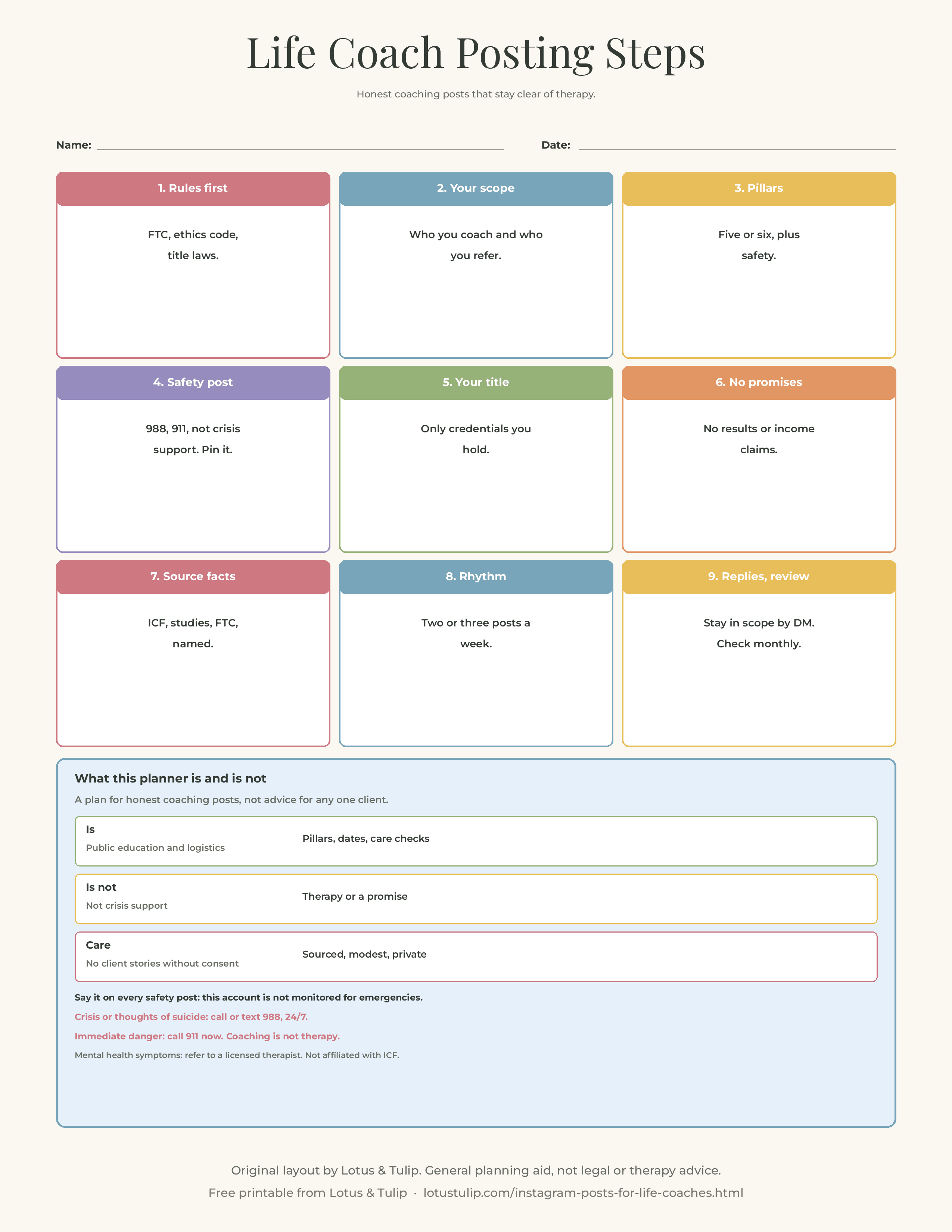
How to plan Instagram posts as a life coach, step by step
- Read your rules first. Read the FTC Endorsement Guides and consumer review rule, the ethics code of any coaching body you belong to, your state's licensing laws for therapy titles, and, if you hold a license, your board's rules. Note anything about titles, claims, testimonials, money and confidentiality.
- Write your scope in one paragraph. Write down who you coach, what you help with, what you do not work on and who you refer to, including therapists, doctors, 988 and 911.
- Choose five or six pillars, plus safety. Use the ten pillars above as a menu. If you cannot say something true and useful under a pillar this month, skip it.
- Write and pin a safety post. Include "coaching is not therapy or crisis support," 988 call, text or chat, 911 for immediate danger and the line that your account is not monitored for emergencies.
- Audit your title and credentials. Use only credentials you hold, with the issuer named; no protected therapy titles; no "ICF certified" unless you hold an ACC, PCC or MCC; other roles disclosed.
- Ban results and income promises from the draft stage. If a post needs a guarantee, an income figure, a client screenshot or a clinical word to work, rewrite it or delete it.
- Source every fact. Name the source on the slide (ICF, Lally 2010, FTC), say "in one study" where it is one study, and add "General information, not therapy or professional advice."
- Set a two or three posts a week rhythm. Batch captions in one quiet hour. Schedule only what has passed the care check. Leave room for stories about openings and workshops.
- Prepare replies and review monthly. Save DM replies that stay in scope, never confirm who is a client and route people to booking, a therapist, 988 or 911. Once a month, update prices and spaces, check disclosures on any affiliate or partner posts, and run every live post through the care check on page 3 of the free printable.
Mistakes and myths
Common mistakes
- Therapy words in a coaching bio. "Trauma healing," "anxiety coach who heals," "therapist" without a license.
- "ICF certified" without a credential. ICF says the phrase applies only to ACC, PCC or MCC holders.
- Income screenshots and lifestyle proof. Earnings claims without a typical-results basis are what the FTC's money-making notice describes.
- Client wins as proof. Testimonials about results are treated as your claim, and they are client information.
- Bonuses for five star reviews. An incentive conditioned on sentiment is prohibited by 16 CFR 465.4.
- Hidden affiliate links and referral fees. Disclose material connections in the post, and tell clients about referral compensation.
- Fake scarcity. Spots that are never really full and countdowns that reset.
- "DM me for pricing." Careful clients leave; pushy sales calls follow.
- No crisis signpost. Sooner or later someone in crisis will message a coaching account.
- Telling followers they don't need therapy. You cannot know that, and it can do real harm.
- Posting session stories. Even anonymous, they can identify someone in a small niche.
- Posting every day until you burn out. Coaching hours are your real work. Protect them.
Myths about life coach Instagram
- "You need testimonials and income proof to grow." You need clarity and trust. A carousel that answers "what happens on a discovery call" can do more for bookings than a screenshot.
- "Coaching is unregulated, so anything goes." Coaching is unlicensed. Consumer protection law, therapy title protection, the FTC's rules on endorsements and earnings claims, and subscription rules all still apply.
- "A disclaimer fixes any claim." The FTC says "results not typical" style lines do not cure deceptive testimonials.
- "Habits take 21 days." In one well known study, the median was 66 days, with a wide range.
- "If I'm trauma-informed, I can work with trauma." Training in how to be careful is not a license to treat. Refer.
- "Good coaches guarantee results." Good coaches are honest about what they can and cannot promise.
Three fictional examples
These coaches are invented. They show how the same principles fit different businesses.
Dana, career transition coach (fictional). Dana coaches mid-career professionals changing fields. Her bio says "ICF PCC, career transition coach" with a link where her credential can be checked. She pins three posts: "What happens on a discovery call," "Coaching, therapy or mentoring?" and a 988 safety post. Twice a week she posts one educational carousel (a weekly review, questions to ask before a career move) and one practical post (fees, new spaces, a workshop). She stopped posting "client landed a job" screenshots after realizing they implied a typical result she could not support, and now sends every client the same honest review invitation at the end of an engagement.
Luis, licensed counselor who also coaches (fictional). Luis is a licensed counselor in one state and offers coaching to people who want help with work and routines rather than therapy. He keeps two accounts, two agreements and two websites. His coaching bio says "Coaching, not therapy." Every coaching post avoids clinical words, and when a coaching client starts describing symptoms, he follows his agreement: pause, explain the difference, and refer to a therapist licensed where the client lives. He checked his board's rules before launching the coaching service.
Mei, wellness and habit coach (fictional). Mei coaches busy parents on routines, sleep habits and movement. Her feed cites the habit study as "one study," never mentions weight loss and points to doctors for medical questions. She runs small online group programs and never posts screenshots from them. When a follower asked her to promise "my anxiety will be gone after your program," she replied that she doesn't work on anxiety, shared how to find a licensed therapist and added 988 in case it was needed.
How this guide compares with neighboring articles
| Guide | Written for | What it covers that this page leaves aside |
|---|---|---|
| This page: Instagram posts for life coaches | Life, career, wellness and habit coaches, coaching studios | Coaching as an unlicensed field, ICF and CCE credentials, the coaching and therapy line, earnings claims, 988 signposting, discovery calls and packages |
| What therapists can post on social media | Licensed therapists and counselors | Licensed clinicians' ethics codes, client privacy, therapy specific advertising |
| Instagram posts for personal trainers | Trainers, studios, online fitness coaches | Fitness certifications, screening and medical clearance, fitness before and after posts |
| Instagram posts for dietitians | Dietitians and nutrition professionals | Nutrition titles and licensure, food and supplement claims |
| Instagram post ideas for therapists | Private practice therapists | Therapy specific post ideas and clinical boundaries |
| Holiday social media posts for therapists | Any wellness feed in December and January | A week by week seasonal calendar and winter hours posts |
Use the neighboring pages for layout ideas (bios, highlights, pinned posts, carousels). Come back here when the question is about coaching credentials, scope, claims or safety.
Honest coaching post versus overclaiming post
| Topic | Honest coaching post | Overclaiming post |
|---|---|---|
| Results | "Here's how we'll work together, and what you'll do between sessions." | "Three months with me and your life will be unrecognizable." |
| Income | "I don't share income claims. Here's what the program includes." | "My clients replace their salary in 90 days." |
| Title | "[Name], ICF ACC, career coach." | "Certified mindset therapist," no license in sight. |
| Scope | "I don't treat anxiety. A licensed therapist is the right first step." | "Heal your anxiety without therapy." |
| Proof | "No client screenshots here. Your story is yours." | "Swipe to see her DM after one session!" |
| Scarcity | "Two spaces open in March. Book when you're ready." | "Price doubles at midnight!" (every week) |
| Reviews | "I invite every client to leave an honest review." | "Free bonus session for every five star review." |
| Safety | "In crisis? Call or text 988. In danger, call 911. I'm not crisis support." | "DM me any time, day or night, I'll get you through it." |
When not to post
- During or right after a session. Your client deserves your full attention, and "just had an amazing breakthrough with a client" posts can identify people.
- When a trend relies on income, transformation or "healing" claims. Skip it, however many views it gets.
- When you cannot find a source. If the ICF, a study you can name or an official source does not say it, leave it out or label it as your opinion.
- When a partner wants a post before you've used their product. Endorsements must reflect real use and honest opinion.
- When a topic is really therapy. If the post only works with clinical language, it belongs on a licensed therapist's feed.
- Right after a difficult client interaction. Vague posts about "a client today" can identify someone and read as unprofessional.
- When you're exhausted. A missed week does no harm. A careless post can.
Free 3 page life coach Instagram printable (US Letter)
Print it, fill it in once a month, and keep it next to your calendar. It works with any design app or template set.
- Page 1: Life Coach Posting Steps. Nine step cards that match the HowTo above, what the planner is and is not, and safety lines for 988, 911 and "not crisis support."
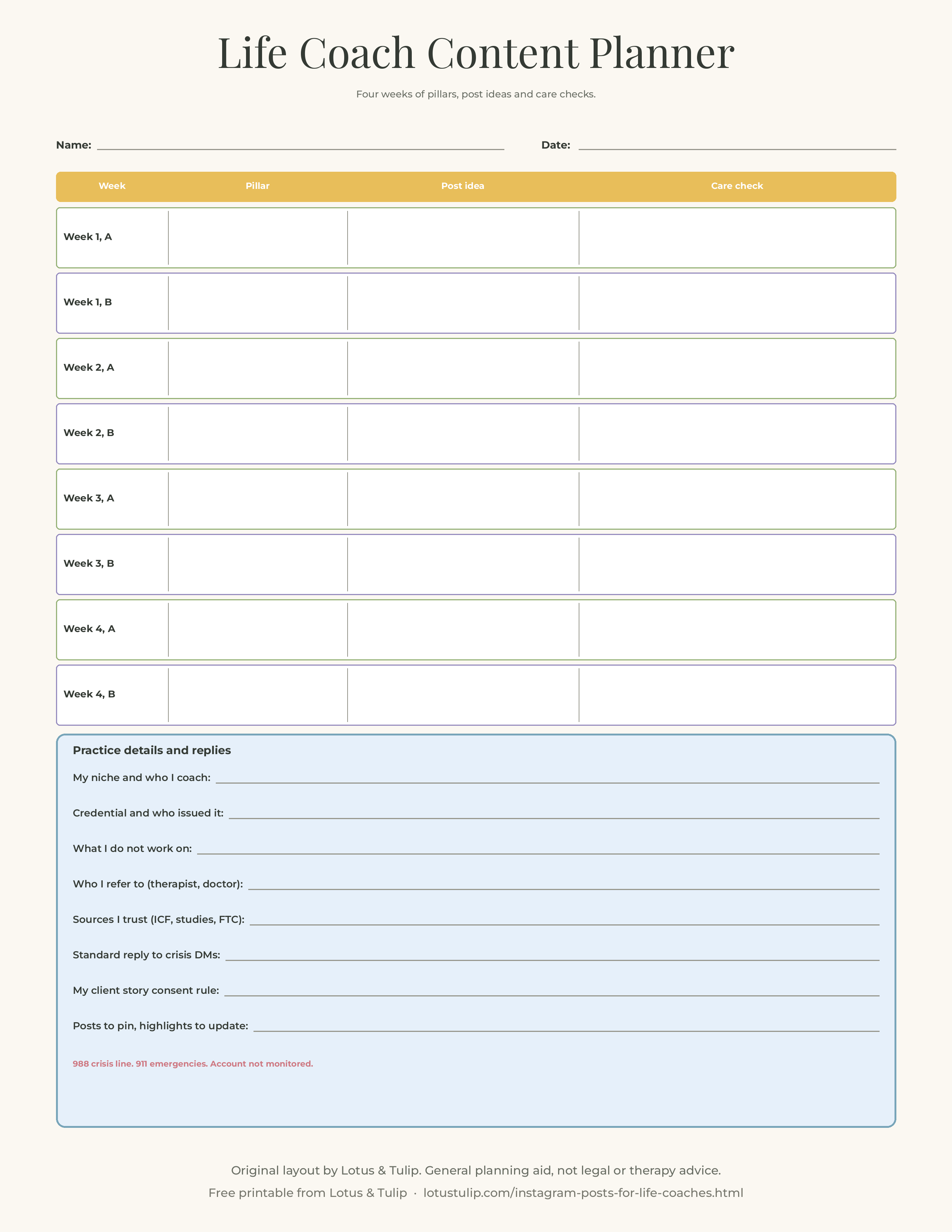
- Page 2: Life Coach Content Planner. Four weeks of posts (two per week) with columns for pillar, post idea and care check, plus fields for your niche and who you coach, your credential and its issuer, a way to check it, what you do not work on, who you refer to, sources you trust, your standard reply to crisis or therapy DMs, your client story consent rule, and posts to pin and highlights to update.
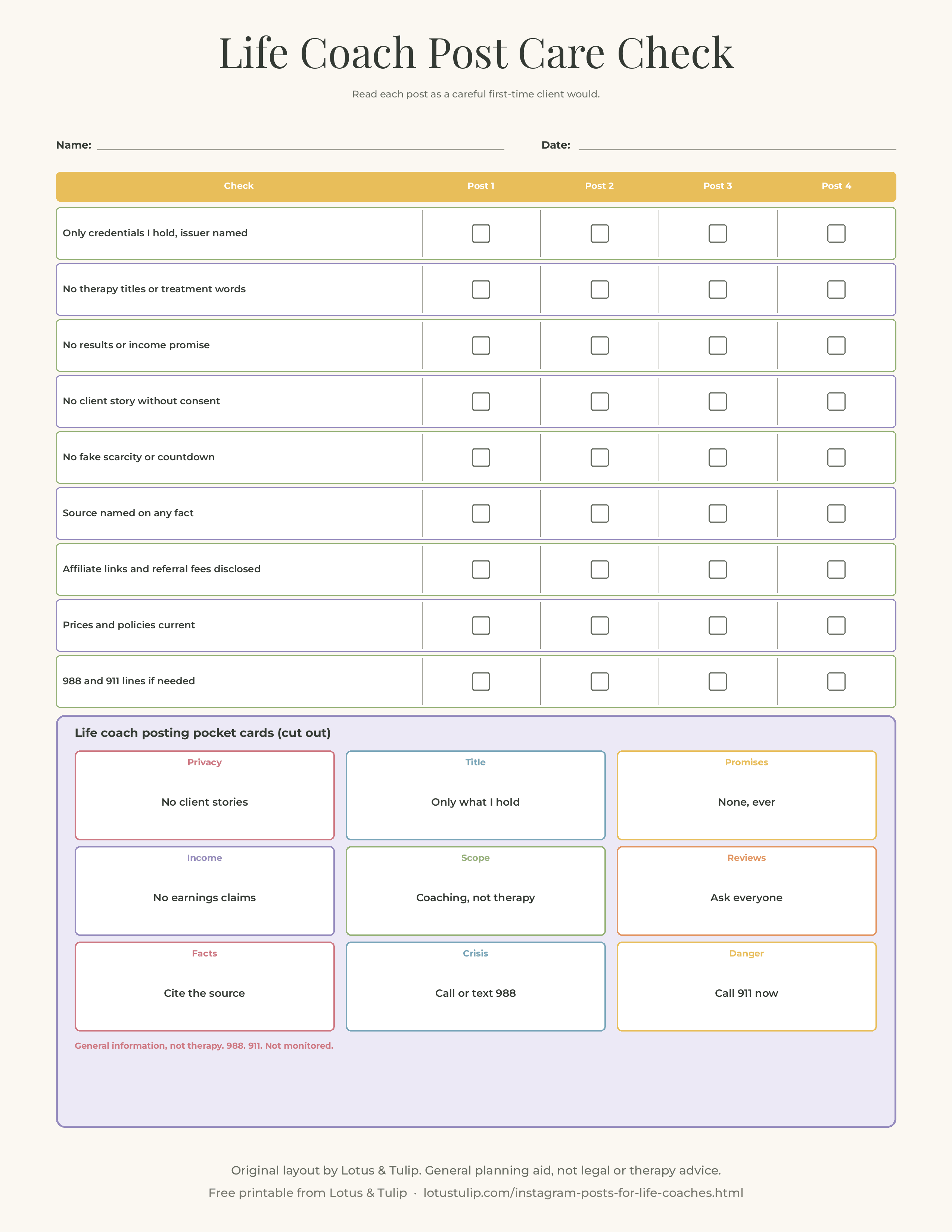
- Page 3: Life Coach Post Care Check. A yes or no check for up to four posts (only credentials I hold, issuer named; no therapy titles or treatment words; no results or income promise; no client story without written consent; no fake scarcity or countdown; source named on any fact; affiliate links and referral fees disclosed; prices and policies current; 988 and 911 lines if needed), plus nine life coach posting pocket cards to cut out.
Download free PDF · Page 1 PNG · Page 2 PNG · Page 3 PNG
Research notes (verified, with caveats)
Sources below were opened or checked through search during this writing session on November 9, 2026, unless marked as checked on November 8, 2026 or in an earlier session on November 9, 2026 for our previous articles. Where we relied on search results rather than the full page, we say so.
- Utah Department of Commerce, Office of Professional Licensure Review. Sunrise Review: Life Coaching, November 2024 (posted November 22, 2024), key findings and recommendations read via search extract this session. No state currently requires a license for life coaches; recommends against a mandatory license or voluntary registry; recommends strengthening mental health scope of practice language and supporting enforcement against bad actors; about 40 percent of the Utah life coaches whose advertising was assessed potentially operated in the mental health therapy space; wide variation in training; reasons some therapists gave for offering coaching. OPLR says its therapist survey figures are likely an upper bound, so we did not use them.
- ProPublica and The Salt Lake Tribune. "Utah Life Coaches Aren't Licensed. Should They Be Regulated?", via search this session. Mostly unregulated across the US; no universally accepted certification; Utah can cite unauthorized practice when coaches diagnose clients or develop plans to manage mental health conditions.
- International Coaching Federation. ICF credentials overview, Experience Requirements and Apply for a Credential pages, via search this session (ACC, PCC and MCC education, experience, paid hours, client counts, mentor coaching, performance evaluation and exams). We did not use application fees.
- ICF Code of Ethics (in effect April 1, 2025), coachingfederation.org, opened this session. Definition of coaching; standards 1.2, 2.1 to 2.5, 3.7, 3.8, 4.3 and 5.2; glossary definition of "ICF Certified"; Ethical Conduct Review process. ICF notes the 2020 Code is still used within its exams.
- ICF. Referring a Client to Therapy: A Set of Guidelines, via search this session (referral responsibility, example scope statement, common mental health issues that suggest therapy). ICF blog on confidentiality limits, via search this session (safety, legal and professional limits). ICF International Coaching Week page, via search this session (held in May; 2027 events being planned); the May 10 to 16, 2027 dates come from third party calendars.
- Center for Credentialing and Education. Board Certified Coach requirements and eligibility policy, via search this session (degree, CCE-approved training with hours depending on background, post-degree experience, endorsement, exam).
- Federal Trade Commission. Guides Concerning Use of Endorsements and Testimonials in Advertising, 16 CFR Part 255 (2023): section 255.2 checked in an earlier session on November 9, 2026 via eCFR; sections 255.3 and 255.5 checked November 8, 2026. Health Products Compliance Guidance (2022), checked in an earlier session on November 9, 2026 via search.
- FTC. Rule on the Use of Consumer Reviews and Testimonials, 16 CFR Part 465 (89 FR 68077, August 22, 2024), eCFR, opened in an earlier session on November 9, 2026. Sections 465.1(c), 465.2, 465.4, 465.5, 465.7 and 465.8.
- FTC. Press release of October 2021, "FTC Puts Businesses on Notice that False Money-Making Claims Could Lead to Big Penalties," via search this session (more than 1,100 recipients including investment and business coaching; practices described including typicality, no experience needed and act immediately).
- Unified Agenda, Earnings Claims Trade Regulation Rule, RIN 3084-AB70 (reginfo.gov), via search this session (ANPRM March 11, 2022; proposed rule released January 13, 2025 but never published in the Federal Register; prerule stage). FTC regulatory agenda in the Federal Register, August 14, 2026, via search.
- FTC. Publishing.com Decision and Order and related reports, via search this session (final order approved July 2, 2026; $1.5 million; limits on earnings claims without a written, reasonable typical-earnings basis).
- Restore Online Shoppers' Confidence Act and the Eighth Circuit's July 2025 vacatur of the FTC's 2024 negative option amendments, via search this session (law firm summaries; ROSCA requirements continue).
- HHS Office for Civil Rights. Covered Entities and Business Associates, checked November 8, 2026.
- Federal gift card rule, 12 CFR 1005.20 (Regulation E), checked November 8, 2026.
- 988 Suicide and Crisis Lifeline, 988lifeline.org (Chat and Text, Get Help), via search this session. Call, text or chat 988, 24/7; Spanish: press 2 or text AYUDA to 988.
- Lally P, van Jaarsveld CHM, Potts HWW, Wardle J. How are habits formed: Modelling habit formation in the real world. European Journal of Social Psychology 2010;40:998 to 1009, doi 10.1002/ejsp.674, via search this session (median 66 days to 95 percent of the automaticity plateau for participants whose data fit the model, range 18 to 254 days). The finding that missing one opportunity did not materially affect habit formation is from the same paper, checked when our Clear Compass kit was written.
This page is not affiliated with or endorsed by the ICF, CCE, the FTC, HHS, the 988 Lifeline, the State of Utah, ProPublica or any coaching school or professional association. We used no coaching industry survey statistics and no income figures. Our paid template kits are marketing tools for coaching and wellness businesses. They are not legal, financial or therapy tools. You stay responsible for what you post.
Instagram posts for life coaches: FAQ
What should a life coach post on Instagram?
Focus on what a careful new client needs: who you are, your niche, your real credential and its issuer, what coaching is and is not, what happens on a discovery call and in the first month, your fees and policies, sourced education (such as the ICF definition of coaching and the habit research), and a pinned safety post with 988, 911 and a note that coaching is not crisis support. Leave out income claims, results promises, client screenshots and therapy language.
How often should a life coach post on Instagram?
Two or three feed posts a week is enough for most solo coaches, plus stories for openings and workshops. Once a week is fine if your fees, discovery call, FAQ and safety posts are current. Batch your content in one quiet session rather than posting daily.
Do life coaches need a license in the US?
No state currently requires a license for life coaches, according to Utah's Office of Professional Licensure Review (November 2024). But coaching being unlicensed does not make therapy unlicensed: diagnosing or treating mental health conditions, or using protected titles such as licensed professional counselor or psychologist, requires the matching state license. Consumer protection and advertising laws apply to coaches as to any business.
Can I call myself ICF certified?
Only if you hold an ICF credential. The ICF Code of Ethics glossary says "ICF Certified" applies only to those with an ICF credential such as ACC, PCC or MCC. Membership alone is not a credential. If you are working toward one, say so plainly.
Can a life coach post client testimonials?
Carefully, if at all. The FTC's Endorsement Guides treat testimonials about results as claims about what clients generally achieve, which you must be able to support, and the ICF Code of Ethics asks coaches to maintain strict confidentiality. If you use one, get written permission for that specific post, do not edit it, and ask whether it represents typical experience. Never offer an incentive for a positive review; 16 CFR 465.4 prohibits it.
Can I share income results or say clients make six figures?
Avoid it. The FTC's 2021 Notice of Penalty Offenses on money-making opportunities, sent to businesses including business and investment coaching companies, describes false or misleading earnings claims and claims that represented earnings are typical as practices it has found deceptive. A dedicated earnings claims rule is not final, but deceptive earnings claims are already unlawful, and the FTC's 2026 Publishing.com order shows enforcement continues.
What should I do if someone in crisis messages my coaching account?
Reply quickly and kindly with 988 (call, text or chat at 988lifeline.org, 24/7) and 911 for immediate danger, and say your account is not monitored for emergencies. Do not try to coach a crisis by DM. Pin a safety post and add the same lines to any auto-reply so the information is there even when you are not.
Is the free printable a copy of the paid kit?
No. The free three page set is an original planning aid: posting steps, a four week content planner and a post care check with pocket cards. The paid Clear Compass kit contains designed posts, stories, highlight covers, captions and a 12 week calendar. The printable is not a preview of that kit.