
Therapist marketing · Updated 2026-11-08
Instagram Post Ideas for Dietitians (with Free Printable)
Ready-made template kit: Dietitian Instagram Templates Holiday 20% off: about $22.08, was $28 (EUR 24) · instant digital download
Buy on Etsy
Instagram posts for dietitians live in one of the noisiest corners of the internet. Every scroll offers a detox tea, a "what I eat in a day" reel, a supplement code, a before and after photo and someone with no training explaining insulin. Prospective clients arrive confused, sometimes ashamed, sometimes hoping you will send a meal plan in a DM by tonight. Referral sources arrive wanting to know whether you see their patients and how you talk about food. The algorithm rewards certainty, transformation and fear. Your credential, your state law, HIPAA and the people who trust you reward the opposite: honest titles, no promised outcomes, no identifiable clients, and a clear line between public nutrition education and individualized care.
This guide is written for US registered dietitians, registered dietitian nutritionists and the teams around them who run or contribute to a professional Instagram account: private practices, group practices, outpatient clinic dietitians who post for their employer, telehealth nutrition businesses, sports and pediatric dietitians, and nutrition and dietetics technicians, registered, who post under a practice account with accurate roles. It covers what to post on Instagram as a dietitian: why the job is different from generic wellness posting, the parts of the Academy of Nutrition and Dietetics and Commission on Dietetic Registration Code of Ethics that touch social media, how to show RD, RDN, NDTR, state license titles and specialist letters honestly, why "nutritionist" is a different word in many states, client privacy, the difference between public education and medical nutrition therapy, scope next to physical therapy, occupational therapy, speech-language pathology, health coaching, nutrition coaching and personal training, safety posts for emergencies, crises and food allergy, extra care around eating disorders and weight, sourced public education on the Nutrition Facts label, food safety, supplements and detoxes, cash-pay and insurance language without billing advice, ten content pillars, 34 post ideas with original caption angles, six fuller captions, DM scripts that refuse diagnosis and meal plans by message, a two or three posts a week rhythm and a 12 week overview, the March dates that suit a nutrition feed, a nine step HowTo, mistakes, myths, three fictional examples, two comparison tables, when not to post, research notes and a free three page US Letter printable: Dietitian Posting Steps, a Dietitian Content Planner and a Dietitian Post Care Check with pocket cards.
If you are newer to posting as a clinician, our general ethics checklist for therapist social media and Instagram post ideas for therapists cover basics written mainly for mental health practices. Neighboring clinical feeds have their own pages: Instagram post ideas for physical therapists, Instagram post ideas for occupational therapists, Instagram post ideas for speech therapists and Instagram post ideas for couples therapists. Seasonal logistics for any clinical feed are in holiday social media posts for therapists. The general therapist bio, caption, story, highlight and carousel pages remain useful for layout, not for dietetics-specific ethics. This page stays with questions dietitians tend to face: food education that never becomes a stranger's meal plan, weight and body talk that does not harm readers, supplement questions without supplement sales, food allergy safety, and a respectful line between a credentialed dietitian and the many other people who talk about food online.
We relied on primary sources and opened each one while writing: the Academy of Nutrition and Dietetics and CDR Code of Ethics for the Nutrition and Dietetics Profession (effective June 1, 2018), CDR pages on the RD and RDN credentials, credential use and misuse, the graduate degree eligibility requirement and the Dietitian Licensure Compact, the CDR Definition of Terms list, the Academy's National Nutrition Month pages and 2026 press releases, FDA pages on the Nutrition Facts label and percent Daily Value, the FDA Questions and Answers on Dietary Supplements, the USDA Food Safety and Inspection Service food safety basics page, the NIH National Center for Complementary and Integrative Health page on detoxes and cleanses, the Food Allergy Research and Education page on recognizing and treating reaction symptoms, HHS guidance on HIPAA and marketing, the CMS page on good faith estimates for people not using insurance, 45 CFR 149.610, Telehealth.HHS.gov on licensing across state lines, 988lifeline.org, and the FTC Guides Concerning Use of Endorsements and Testimonials in Advertising (16 CFR Part 255). Notes are at the end. The printable is an original Lotus and Tulip layout.
This guide is general marketing information, not legal, ethical, billing, medical or nutrition advice. Your state licensure or certification law where it exists, the Academy and CDR Code of Ethics if you hold a CDR credential or Academy membership, HIPAA if you are a covered entity, payer contracts and your employer policy all come first. A social media post is public education. It is not a nutrition assessment, it is not medical nutrition therapy, it is not a meal plan and it is not treatment by Instagram or DM. If someone is in danger or has a medical emergency, call 911. For a mental health or suicidal crisis, call or text 988. For a severe allergic reaction, use epinephrine if it has been prescribed and call 911, as Food Allergy Research and Education advises. Dietetics is not emergency care. Every safety post you publish should repeat that message and say that your account and inbox are not monitored for emergencies.
What this guide is and is not
It is a planning guide for public, educational Instagram content from a nutrition practice or an individual dietitian who posts professionally. It helps you choose themes, write captions that stay inside your credential and your competence, describe how your practice works, and keep privacy and safety information where people can find it.
It is not legal advice. Dietetics licensure, certification and title protection laws vary from state to state, and a few states have no dietetics licensure at all. Some state laws protect the word "dietitian," some also regulate "nutritionist," and some regulate the practice itself rather than only the title. Hospitals, health systems, food companies and telehealth platforms usually have their own social media policies, and those are often stricter than anything here. When in doubt, read the rules or ask the risk management line that comes with your liability insurance.
It is not clinical advice. Nothing here tells you how to manage diabetes, kidney disease, an eating disorder, a tube feeding, a pregnancy or a pediatric growth concern. Those decisions belong in your training, your assessment and your collaboration with the client's other clinicians. Public education is not an individualized nutrition care plan, and a comment thread is not a telehealth visit.
It is not a promise that Instagram will fill a schedule. Many dietitian referrals still come from physicians, therapists, insurance directories, employers and word of mouth. A good feed helps a stranger understand what you do before they book, and it helps a referral source feel comfortable sending people to you. That is a real benefit, and it is smaller than the growth claims you will see on courses that sell "six figures from Reels."
And it is not a meal plan for your followers. A feed can explain how a label works, why a cleanse is not necessary, how to keep leftovers safe and what to expect at a first session. It cannot decide what a stranger with three medications and a history you do not know should eat for dinner.
Why posting as a dietitian is different from generic wellness posting
Most "health Instagram" advice is written for influencers, supplement brands and fitness coaches. Their incentives are reach and conversion. A dietitian feed shares some of their tools, such as carousels, stories and clear design, but it carries obligations they do not.
- Everyone eats, so everyone feels qualified. Food is personal, cultural, emotional and cheap to talk about. Your caption sits beside thousands of confident opinions from people without training. The temptation is to out-shout them with your own certainty. The stronger move is to be the account that says "it depends, and here is how to find out for you."
- People want a plan, not an explanation. Followers ask "what should I eat for my PCOS," "what is the best breakfast for blood sugar," or "can you look at my food log." A caption that answers with a specific menu is individualized nutrition care for someone you have never assessed. Keep public posts at the level of general education and route personal questions to a real appointment.
- Weight and bodies sit close to every topic. Body images, scale numbers and "transformation" content are the most rewarded formats in the wellness space. They can also harm readers who are in recovery from an eating disorder, readers in larger bodies, teenagers and anyone whose relationship with food is fragile. A dietitian feed can teach without ever showing a body as proof.
- Supplements and products are one click away. Affiliate codes, brand gifts and sponsored posts are common. Your Code of Ethics asks you to disclose conflicts of interest and financial interests in products you recommend. The FTC asks for clear disclosure of material connections. A supplement post written like an ad is an ad.
- Food allergy and food safety are real safety topics. A label-reading post is helpful until someone treats it as allergy management. A leftovers post is helpful until someone uses it to decide about food left out on a hot afternoon. Safety lines belong on these posts, every time.
- Titles are confusing to the public. RD, RDN, LD, LDN, CN, "certified nutritionist," "holistic nutritionist" and "nutrition coach" all appear on profiles that look alike. A respectful explanation of what your credential means, without attacking anyone, is one of the most useful posts you can make.
The good news is that nutrition content does not need drama to work. Calm, sourced, kind explanations of food labels, food safety and how care works are exactly what many people cannot find elsewhere.
The ethics that shape a dietitian feed
The Academy of Nutrition and Dietetics and its credentialing agency, the Commission on Dietetic Registration (CDR), share one Code of Ethics for the Nutrition and Dietetics Profession. The Academy's code page states that the Academy Board of Directors and the CDR Board approved the updated Code in February 2018, that it has been in effect since June 1, 2018, and that the 2009 version is no longer valid. The Code says that by accepting Academy membership and/or accepting and maintaining CDR credentials, nutrition and dietetics practitioners agree to abide by it. It is organized as a preamble, four principles and their ethical standards. Several standards do most of the work on Instagram.
Principle 1: competence and scope (non-maleficence)
Standard 1a asks practitioners to practice using an evidence-based approach within areas of competence and to recognize limitations. Standard 1f asks them to recognize and exercise professional judgment within the limits of individual qualifications, collaborate with others, seek counsel and make referrals as appropriate. Standard 1h asks them to practice within the limits of their scope and collaborate with the inter-professional team. On Instagram, that means you do not present yourself as an expert in renal nutrition, oncology nutrition or eating disorder treatment because a topic is trending. It also means a post about blood sugar can say "your physician and your dietitian can help you decide what fits you," instead of pretending one carousel replaces a care team.
Standard 1c asks practitioners to assess the validity and applicability of scientific evidence without personal bias. That is a useful filter for any "new study says" post. If you would not change your own practice based on one small study, do not post it as if the public should.
Principle 2: integrity (autonomy)
Standard 2a asks practitioners to disclose any conflicts of interest, including any financial interests in products or services that are recommended, and to refrain from accepting gifts or services that potentially influence, or may give the appearance of influencing, professional judgment. A free box of protein bars from a brand, an affiliate code for a supplement or a paid partnership with a food company all belong inside that standard. Standard 2b asks practitioners to comply with applicable laws and regulations, including obtaining and maintaining a state license or certification if they practice where nutrition and dietetics statutes apply. Standard 2c asks them to maintain and appropriately use credentials. Standard 2e asks them to "provide accurate and truthful information in all communications." Standard 2h asks them to respect client autonomy and safeguard client confidentiality according to current regulations and laws, and Standard 2i asks them to implement appropriate measures to protect personal health information, with encryption given as an example. A screenshot of a client's food log, even blurred, sits squarely inside 2h and 2i.
Principle 3: professionalism (beneficence), with social media named
Standard 3c is the line most often quoted by dietitians who post: practitioners shall "demonstrate respect, constructive dialogue, civility and professionalism in all communications, including social media." Standard 3d asks them to refrain from communicating false, fraudulent, deceptive, misleading, disparaging or unfair statements or claims. Standard 3b asks them to respect the values, rights, knowledge and skills of colleagues and other professionals. Standard 3h asks them to communicate at an appropriate level to promote health literacy. Put together, those four standards describe an ethical nutrition feed: plain language, accurate claims, no mocking of other professions or of clients, and no fear-based marketing.
Principle 4: social responsibility (justice)
Standard 4d asks practitioners to promote the unique role of nutrition and dietetics practitioners, and 4e to engage in service that benefits the community and enhances the public's trust in the profession. Standard 4a asks them to collaborate with others to reduce health disparities. A feed can do this quietly: posts about budget-friendly label reading, food safety for community meals or how to find a dietitian who accepts a particular kind of insurance serve the public and the profession at the same time.
Testimonials, reviews and the FTC
The FTC Guides Concerning Use of Endorsements and Testimonials in Advertising (16 CFR Part 255) apply to health and nutrition businesses that post reviews or partner with brands. Section 255.1 says endorsements must reflect the honest opinions, findings, beliefs or experience of the endorser, and may not convey any express or implied representation that would be deceptive if the advertiser made it directly. Section 255.2 says an advertiser needs adequate substantiation for claims made through endorsements, and that consumer endorsements themselves are not competent and reliable scientific evidence. If an advertisement does not have substantiation that an endorser's experience is representative of what consumers will generally achieve, it should clearly and conspicuously disclose the generally expected performance. Section 255.5 requires clear and conspicuous disclosure of a connection between endorser and seller that might materially affect the weight or credibility of the endorsement and that the audience would not expect, such as payment, free products or a family relationship. For a nutrition practice, a client quote such as "I finally lost the weight" is both a typicality problem and, in many cases, a privacy problem. That is one reason the Nourished Practice kit contains no testimonial or before and after posts at all.
Credentials: RD, RDN, NDTR, state titles and specialist letters, shown honestly
The public mixes up credentials, licenses, degrees and job titles. That makes credentials a good education post and a common source of quiet overstatement.
- RD and RDN are the same credential. CDR awards the Registered Dietitian credential and lets RDs optionally use Registered Dietitian Nutritionist instead. CDR's RDN FAQ says the RD and RDN credentials "have identical meanings and legal trademark definitions," that RDs are not required to use RDN, and that there is no extra cost or separate recertification. Pick one for your bio and use it consistently. Neither one should be written after your name unless your CDR registration is current.
- How the credential is earned, in one honest sentence. CDR's use and misuse page says the RD, RDN, DTR and NDTR credentials are awarded to individuals who meet specific academic and supervised practice requirements and pass a registration examination. CDR also requires a graduate degree for first-time eligibility to take the registration examination for dietitians, effective January 1, 2024. People who were already registered or who had established eligibility before that date are not required to obtain one. A caption can say "RDs complete accredited coursework, supervised practice and a national exam, and maintain continuing education" without listing hours you have not checked for your own situation.
- NDTR and DTR are a distinct credential. Nutrition and dietetics technicians, registered (NDTR), also written as dietetic technicians, registered (DTR), hold their own CDR credential. If a technician appears in staff posts, name the role accurately and do not let a caption suggest that every team member is a dietitian.
- State titles are separate from CDR credentials. Many states license or certify dietitians, and the resulting title varies: LD, LDN, CD and CDN are among the titles that appear in different state laws. CDR's RDN FAQ notes that many state licensure or certification laws already reference the term nutritionist, for example LDN or CDN. Show a state title only if that state issued it to you and it is active. If you hold licenses in several states, either list them accurately or say "licensed where required; see website for states."
- "Nutritionist" is often not a protected title. In many states, anyone can call themselves a nutritionist. In others, the word is regulated or tied to a license. Dietitians often summarize this with the CDR Definition of Terms line, "All registered dietitians are nutritionists, but not all nutritionists are registered dietitians." That is a fair education post if it is written without contempt for people who use the word legally. It is not a reason to hint that every nutritionist is unqualified.
- Specialist certifications are earned, not implied. CDR lists board certifications such as Board Certified Specialist in Sports Dietetics (CSSD), Pediatric Nutrition (CSP), Renal Nutrition (CSR), Oncology Nutrition (CSO), Gerontological Nutrition (CSG) and Obesity and Weight Management (CSOWM), and the advanced practitioner designation RD-AP or RDN-AP. Write those letters only if you currently hold them. "I work with many athletes" is honest. CSSD without the certification is misuse of a protected mark.
- Interns, students and dietetic graduates are not yet RDs. If you supervise interns, celebrate them by role. "Dietetic intern" or "RD-eligible" (only where that is accurate and allowed in your state) is different from "dietitian."
This is why the Nourished Practice kit prints no credentials on any slide. The kit cannot know whether you are an RDN, an LDN, a technician or a nutrition counselor in a state that licenses something else. You type the title you actually hold into your bio and your welcome post.
Public education is not medical nutrition therapy
Medical nutrition therapy (MNT) has a specific meaning in US law. The Medicare statute defines medical nutrition therapy services as nutritional diagnostic, therapy and counseling services for the purpose of disease management, furnished by a registered dietitian or nutrition professional pursuant to a referral by a physician (42 U.S.C. 1395x(vv)(1)). Medicare's MNT benefit is tied to diabetes and kidney disease. Private payers and state laws use their own definitions. Whatever the payer, MNT starts with an individual assessment and produces a plan for one person.
Instagram cannot do that. A carousel about fiber is education. A caption about "the best diet for your kidneys" aimed at a stranger edges into individualized care without an assessment, a chart or a referral. Keep a clean line:
- Education: how the Nutrition Facts label works, what percent Daily Value means, why food safety time limits exist, how supplements are regulated, what to ask before booking, what a first session involves.
- Not education: a meal plan for a named condition, a calorie target, a supplement dose, a "fix your hormones" protocol, a diagnosis from a symptom list, or a reply that tells a specific person what to eat.
Say it in your posts. "General information, not individual medical or nutrition advice" is short, and it is the same line the kit places on every health fact slide. Put it near the start of a caption, not only at the very bottom, and do not write a caption that the disclaimer then has to unsay.
The same logic applies to DMs. Saying "DM me your labs" or "send me your food diary for a free review" invites health information into a consumer app and makes it look as if you are evaluating someone. It also creates a professional relationship you did not intend, without consent, intake, documentation or a fee agreement.
Client privacy: HIPAA, consent and what never belongs on a grid
If your practice is a HIPAA covered entity, the Privacy Rule generally requires a client's written authorization before you use or disclose their protected health information for marketing. HHS guidance on marketing cites 45 CFR 164.501 and 164.508(a)(3) and says that, with limited exceptions, the Rule requires an individual's written authorization before protected health information is used or disclosed for marketing. Even if you are not a covered entity, Standard 2h of the Code asks you to safeguard confidentiality according to current regulations and laws, and clients trust you with some of the most private parts of their lives: food, weight, digestion, money and family.
A simple policy is easier to keep than a case-by-case one:
- No identifiable clients. No faces, names, first initials, voices, kitchens, lunch boxes, grocery carts or locations that a friend could recognize.
- No food logs, app screenshots or lab values, even with the name cropped. Food logs are health information, and the pattern of meals can identify someone to their household.
- No "client wins" posts that describe a person's progress, even anonymously. They raise the FTC typicality problem and they teach readers to compare their bodies with someone else's.
- No "DM me your intake" or "comment your diagnosis for a tip." Offer a booking link and a phone number instead.
- Staff photos without clients. Your office, your bookshelf, your empty waiting room and your hands on a laptop are enough.
When a happy client says "you can share my story," thank them privately and explain that your practice keeps every client private. That sentence protects them, protects the next client who reads your feed, and protects you.
Dietitian, nutrition coach, health coach, personal trainer, PT, OT and SLP
Many people help others eat, move and feel better. A respectful comparison post builds trust. A dismissive one makes you look insecure, and Standard 3b asks you to respect the knowledge and skills of colleagues and other professionals. Use plain, kind descriptions and check any legal claim against your own state.
- Registered dietitian or RDN. Holds a CDR credential after accredited education, supervised practice and a national exam, maintains continuing education, and may hold a state license where required. Provides nutrition assessment, counseling and, where allowed, medical nutrition therapy.
- Nutritionist. A broad word. Some nutritionists are dietitians. Some hold other degrees or state credentials. Some have no formal training. What they may legally do depends on the state. Your post can explain that readers should ask about training and licensure, without claiming that the word always means one thing.
- Nutrition coach and health coach. Coaches usually focus on habits, goals and accountability. Credentials vary widely, and many coaching certifications come from private organizations rather than state boards. A good coach knows when to refer to a dietitian or physician. A fair post says that coaches and dietitians can work well together and that medical nutrition therapy for a disease belongs with a qualified, licensed professional where your state requires it.
- Personal trainer. Designs exercise sessions for healthy adults and often talks about food in general terms. Many trainers rely on dietitians for nutrition questions that go beyond general guidelines. A shared post with a trainer you trust can be a lovely, non-competitive collaboration.
- Physical therapist. A licensed clinician who examines and treats movement problems. Dietitians and PTs often share clients after surgery, injury or chronic illness. Neither replaces the other.
- Occupational therapist. Helps people do daily activities, which can include feeding, cooking and grocery tasks. A dietitian and an OT may both work on mealtimes, from different angles.
- Speech-language pathologist. Evaluates and treats swallowing disorders as well as communication. If a follower describes choking or trouble swallowing, the answer is not a texture tip from you on Instagram. It is "please talk with your physician, who may refer you to an SLP," or 911 if someone is choking now.
Comparison posts work best when they answer the reader's real question: "who should I see first for this?" Often the honest answer is "your primary care clinician, who can refer you."
Safety posts: 911, 988, food allergy and "not emergency care"
A nutrition feed will be read by people at bad moments. Plan for that before it happens.
Emergencies and crises
Every safety post should say that your account and inbox are not monitored for emergencies. Then give the two numbers that cover most situations in the United States: call 911 for a medical emergency, and call or text 988 for a mental health or suicidal crisis. The 988 Suicide and Crisis Lifeline website says people can call, text or chat with a counselor, and that it is available around the clock. Do not invent other hotline numbers, and do not list a specialty helpline unless you have checked its official page recently, because services change.
Food allergy
The kit includes a food allergy post that tells readers when to call 911, and your own feed should keep that standard. Food Allergy Research and Education (FARE) describes severe symptoms such as shortness of breath, wheezing, repetitive cough, a tight or hoarse throat, trouble breathing or swallowing, significant swelling of the tongue or lips, many hives over the body, repetitive vomiting, feeling faint or a weak pulse, and a feeling that something bad is about to happen. FARE's page says a reaction that involves any severe symptom is a severe reaction, and so is a reaction with mild symptoms in more than one body area. Its steps are to use epinephrine at the first sign of a severe allergic reaction or as prescribed, call 911 and say epinephrine was used for a suspected anaphylactic reaction to food, and go to the emergency room even if symptoms seem to resolve. FARE also notes that epinephrine is the only medication that can reverse the symptoms of anaphylaxis, and that people should follow their personalized Food Allergy and Anaphylaxis Emergency Care Plan from their doctor.
For Instagram, keep that message short and faithful: "Severe allergic reaction? Use epinephrine if it has been prescribed, then call 911. Follow your own emergency care plan. This account is not monitored for emergencies." Cite FARE. Do not write a post that tells people how to tell whether they "really" have an allergy, and do not suggest that reading labels replaces an allergist's plan.
Eating disorders, weight and bodies
Eating disorder content needs more care than any other topic on a nutrition feed. You do not need statistics to take it seriously, and this guide deliberately does not use any. Practical rules many careful dietitians follow:
- No before and after bodies, no scale photos, no body measurements, no calorie counts on "what I eat in a day" posts, and no comparisons between people's bodies.
- No moral language about food or weight: no "good" and "bad" foods, no "earning" dessert, no presenting BMI or body size as a measure of someone's worth or discipline.
- No do-it-yourself treatment. If you work in eating disorder care, your posts can describe what treatment involves in general terms and encourage readers to talk with a physician, therapist or dietitian with eating disorder training. They should never give a meal plan, a weight target or "recovery tips" that a person might follow alone.
- If a follower writes something that sounds like an eating disorder in crisis, or like self-harm, reply with 911 for immediate danger and call or text 988 for a mental health crisis, and explain that you cannot provide care by message. We have not listed an eating disorder helpline number here because we did not verify a current one on an official page while writing this guide. If you add one to your highlight, check the provider's own page first and recheck it every few months.
- If you do not specialize in eating disorders, say so in your FAQ and name the kind of professional you refer to.
The kit follows the same restraint: it contains no weight-loss or diet-outcome content, no before and after posts and no meal plans.
Choking and swallowing
If someone is choking now, that is a 911 call. If someone describes ongoing trouble swallowing, point them to their physician. Texture advice for a stranger is not an Instagram topic.
Public nutrition education you can source and stand behind
These topics match the kit's care and come from federal or nonprofit sources we opened while writing. Cite the source on the slide or in the caption, keep numbers exactly as the source states them, and keep the "general information" line.
The Nutrition Facts label and percent Daily Value
FDA explains that the percent Daily Value (%DV) shows how much a nutrient in a serving of a food contributes to a total daily diet, and that the Daily Values are reference amounts of nutrients to consume or not to exceed each day. As a general guide, FDA says 5% DV or less of a nutrient per serving is considered low, and 20% DV or more is considered high. FDA suggests choosing foods more often that are higher in dietary fiber, vitamin D, calcium, iron and potassium, and lower in saturated fat, sodium and added sugars. FDA also notes that the %DV column does not add up to 100%, that protein generally has no %DV listed so people can use grams instead, and that trans fat and total sugars have no %DV. FDA's label page reminds readers that the serving size is not a recommendation of how much to eat, and that one package may contain more than one serving.
Those facts make an excellent carousel: one slide for serving size, one for %DV, one for the 5 and 20 guide, one for nutrients without a %DV, and a final slide that says "Your needs may differ. Talk with your dietitian or physician about your own situation."
The 2-hour food safety rule
The USDA Food Safety and Inspection Service says to refrigerate perishable food within 2 hours, or within 1 hour when the temperature is above 90 degrees Fahrenheit, and to discard food left out at room temperature for more than 2 hours (1 hour if the temperature was above 90 degrees F). FSIS also lists the four basic steps: clean, separate, cook and chill, and says the refrigerator should be at 40 degrees F or below and the freezer at 0 degrees F or below. These are short, practical and verifiable. They are also a reminder that a food safety post is not the place for "I leave rice out overnight and I am fine" humor.
Supplements, without selling supplements
FDA's Questions and Answers on Dietary Supplements explains that under the Dietary Supplement Health and Education Act of 1994 (DSHEA), FDA does not have the authority to approve dietary supplements before they are marketed, and that FDA generally does not approve supplement claims or labeling before use. FDA advises consumers to talk with their doctor, pharmacist or other health care professional before deciding to use a supplement, noting that some supplements might interact with medicines or other supplements. When a label makes a structure or function claim, it must carry the disclaimer: "This statement has not been evaluated by the Food and Drug Administration. This product is not intended to diagnose, treat, cure, or prevent any disease." FDA also says a product sold as a dietary supplement and represented to treat, prevent or cure a disease meets the definition of a drug.
A good supplement post teaches how supplements are regulated and why people should tell their clinicians what they take. It does not recommend a brand, a dose or a stack. If you do earn money from a supplement company, Standard 2a and FTC Section 255.5 both point to clear disclosure, and many dietitians simply keep affiliate links off a clinical account.
Skipping the cleanse
The NIH National Center for Complementary and Integrative Health (NCCIH) page on detoxes and cleanses says there have been only a small number of studies of detoxification programs in people and that those studies were of low quality. It reports that a 2015 review found no compelling research to support detox diets for weight management or eliminating toxins, and that a 2017 review said juicing and detox diets can cause initial weight loss from low calorie intake but tend to lead to weight gain once a person resumes a normal diet. NCCIH notes that FDA and FTC have taken action against companies selling detox or cleansing products for hidden ingredients, false disease claims or unapproved device uses, that unpasteurized juices can make people sick, that laxatives can cause diarrhea and dehydration, and that colon cleansing can have serious side effects. It encourages people to talk with their health care providers. That is enough for a calm myth versus fact carousel without mocking anyone who has tried one.
How to choose a nutrition professional
This is one of the kit's topics and one of the most useful public posts you can make. Suggested questions for readers: What credential do you hold, and who issued it? Are you licensed in the state where I live, if my state requires it? Do you work with my kind of concern, or would you refer me? How do sessions work, online or in person? What does it cost, do you take insurance, and can I get a written good faith estimate if I pay myself? How do you handle my privacy? Keep the questions neutral so they help readers evaluate you as fairly as anyone else.
Fees, insurance, estimates and telehealth, without legal or billing advice
Money posts are ethics posts. Standard 2g of the Code asks practitioners to document, code and bill to most accurately reflect the character and extent of delivered services. A fees post that is clear and current prevents misunderstandings later.
- Self-pay clients and good faith estimates. The CMS consumer page on medical bill rights when not using insurance says the No Surprises Act went into effect on January 1, 2022, and that if you do not have or use health insurance, providers usually must give you a good faith estimate of how much care will cost when you schedule at least 3 business days in advance or if you ask for one. It says a person may be able to dispute a bill that is at least $400 more than the estimate, and that people will not get an estimate during emergency care. Provider requirements are in 45 CFR 149.610, which covers good faith estimates for uninsured or self-pay individuals upon request or upon scheduling. Your post can say "Paying yourself? Ask us for a written good faith estimate." Leave the legal detail to your own compliance review.
- Insurance, described rather than promised. Say which plans you are in network with today, and that coverage depends on the plan. Do not write "covered by insurance" as a blanket promise.
- Packages. If you sell packages, describe what is included and the cancellation and refund terms. Avoid "transformation package" language that implies a result.
- Telehealth across state lines. Telehealth.HHS.gov says the ability to deliver care across state lines varies based on state regulations, with pathways such as a full license, temporary practice laws, reciprocity, licensure compacts and telehealth registration, and it advises providers to verify patient location and obtain consent before an appointment. CDR's page on the Dietitian Licensure Compact describes an agreement among participating states, says RDs in states without licensure cannot use it, and says the first compact privileges are expected sometime in 2027. Do not list participating states in a caption, because membership and timelines change. List the states where you can see clients now.
If you offer online sessions, say where you can see clients, that you confirm location each session, and that a video session is a real appointment, not a free comment-section consult.
Ten content pillars for a dietitian Instagram
Pillars keep you from reinventing your account every Monday. Five or six would be enough. Ten gives you room to rotate without falling back on food photos and trends.
- Who we are. Names, the credentials you actually hold, the states you serve, languages spoken, the kinds of clients you see and whom you refer out.
- What a dietitian does (and does not). Assessment, counseling, collaboration with physicians and therapists, and the difference between education and medical nutrition therapy.
- Safety. 911, call or text 988, the food allergy steps from FARE, and "this account is not monitored for emergencies."
- Privacy and consent. Why you never post clients, why you do not review food logs or labs by DM, and how to ask a question without sending health details.
- The first session. How to prepare, what to bring, how long it lasts, online or in person, and how goals are set together.
- Time, money and paperwork. Session and package fees, insurance as a description, good faith estimates, cancellation and late policies.
- Labels and shopping. Nutrition Facts, percent Daily Value, serving size, a grocery checklist that is not a diet.
- Food safety. The 2-hour rule, the four steps, fridge and freezer temperatures, safe leftovers at holidays.
- Myths and marketing. Detoxes and cleanses, supplement claims, "superfoods," and how to read a health headline. Always sourced, never mocking.
- Dates and community. National Nutrition Month, RDN Day, holiday hours, gift cards and thank-you posts that do not display clients.
Pin at least three posts: the safety post, a privacy post and a booking or first-session post. Keep matching highlights (the kit's set includes About, Services, Fees, Book, FAQ, Labels, Safety, Policies, Online, Tips, Allergies and Gifts) so a new visitor can find what they need without scrolling a year of content.
34 Instagram post ideas for dietitians, with caption angles
These are original planning ideas, not captions copied from any template kit. Adapt the wording to your practice, your states and your competence. Add "General information, not individual medical or nutrition advice" whenever a post teaches a health idea.
About you and the profession
- What a dietitian actually does in a first session. Caption angle: listening, a nutrition assessment, shared goals and a plan you build together, with no promise of a particular result.
- RD and RDN: same credential, two names. Caption angle: CDR lets RDs choose either designation. Explain it in two sentences and link to the CDR credential verification you recommend.
- Dietitian versus nutritionist, kindly. Caption angle: all RDs are nutritionists, not all nutritionists are RDs, and the word's legal meaning depends on the state. Encourage readers to ask about training.
- Who we see, and who we refer. Caption angle: the populations you actually serve, plus examples of when you refer to a physician, a therapist, an SLP or a dietitian with a specialty you do not hold.
- A day in the practice, with no clients on camera. Caption angle: an empty office, notes time, the reference books you use, the way you prepare before a session.
- Meet the team, titles only as held. Caption angle: first names, roles and languages. Technicians, interns and admin staff named accurately.
- Why I do not post what I eat in a day. Caption angle: my plate is not your plate, and comparing meals can hurt people. Offer a label or food safety post instead.
Safety, privacy and first sessions
- Pinned safety post. Caption angle: 911 for emergencies, call or text 988 for a mental health crisis, severe allergic reaction steps from FARE, and "this account is not monitored for emergencies."
- Food allergy emergency steps. Caption angle: use epinephrine if prescribed, call 911, go to the emergency room even if symptoms improve, follow your own emergency care plan. Cite FARE.
- Why we never post clients. Caption angle: privacy is part of care. Your food, your body and your story stay in the session.
- Please do not send food logs or labs by DM. Caption angle: an inbox is not a chart. Here is how to book or ask a general question safely.
- How to prepare for a first session. Caption angle: your current medication and supplement list, any recent lab results your clinician shared, questions, and what you hope to change.
- How long a first session lasts, here. Caption angle: your real time range, online or in person, and what happens after.
- Questions to ask any nutrition professional before you book. Caption angle: credential, state license, experience with your concern, fees, privacy and how they refer.
Money, access and operations
- Session and package fees, in plain numbers. Caption angle: what each option includes and how cancellations work. No "transformation" language.
- Insurance, described honestly. Caption angle: plans you are in network with today, and why coverage depends on the plan and sometimes on a referral.
- Good faith estimates for self-pay clients. Caption angle: if you are not using insurance, you can usually ask for a written estimate. Link to the CMS consumer page.
- Booking and cancellation policy, said kindly. Caption angle: the rule, the reason, and how to reschedule without shame.
- Online sessions and the states we serve. Caption angle: list the states, say you confirm location each session, and explain that a video session is a real appointment.
- New client spaces this month. Caption angle: days and times that are true today, and how the waitlist works.
- Running late, holiday hours and closures. Caption angle: what to do if you are late, when the practice is closed, and where emergencies go. Pair with the holiday social media posts for therapists page for a winter plan.
Labels, food safety and myths, sourced
- Serving size is not a recommendation. Caption angle: FDA's own wording, plus a reminder that a package can hold more than one serving.
- Percent Daily Value in one slide. Caption angle: FDA's general guide, 5% DV or less is low and 20% DV or more is high, and why the column does not add up to 100%.
- Nutrients with no %DV. Caption angle: protein, trans fat and total sugars, and FDA's suggestion to use grams to compare.
- The 2-hour rule. Caption angle: FSIS says refrigerate perishables within 2 hours, or 1 hour above 90 degrees F. A picnic and holiday favorite.
- Clean, separate, cook, chill. Caption angle: the four FSIS steps as a four-slide carousel, plus fridge at 40 degrees F or below and freezer at 0 degrees F or below.
- Myth versus fact: "If it is sold as a supplement, the FDA approved it." Caption angle: under DSHEA, FDA does not approve supplements before they are marketed. Tell your clinicians what you take.
- What the supplement disclaimer means. Caption angle: quote FDA's required disclaimer and explain that only a drug can legally claim to treat or cure a disease.
- Myth versus fact: "I need a cleanse." Caption angle: NCCIH found the research small and low quality and lists real safety concerns. No mocking, no shame.
- Myth versus fact: carbs. Caption angle: the kit's three types of carbs topic, framed as general education with a source and no meal plan or weight claim.
Community, dates and gratitude
- National Nutrition Month (March). Caption angle: the Academy's 2026 theme was "Discover the Power of Nutrition." Check the Academy's page each year before naming a theme.
- RDN Day. Caption angle: the Academy holds RDN Day on the second Wednesday of March during National Nutrition Month. In 2026 it was March 11. Thank colleagues, explain one misunderstood part of the work.
- A grocery checklist that is not a diet. Caption angle: staples, label checks and food safety for the trip home, with no "allowed" and "forbidden" lists.
- Thank you, without a testimonial slideshow. Caption angle: thank referral partners and your community in general words. No client quotes, no results.
Six fuller caption examples you can adapt
These are original drafts. Replace bracketed details. Do not paste a client's story into any of them.
- Welcome. "Hello from [practice name] in [city, state]. I am [first name], [the credential and state title you actually hold]. I work with [the people you actually serve], online in [states] and in person in [city]. I do not post clients, and I cannot give personal nutrition advice in comments or DMs, because good advice starts with knowing you. If you would like to work together, the booking link is in our bio. General information, not individual medical or nutrition advice."
- Safety. "Please read this before you send a message. This account is not monitored for emergencies, and nutrition care is not emergency care. If someone is in danger or has a medical emergency, call 911. If you are in a mental health crisis, call or text 988. If someone is having a severe allergic reaction, Food Allergy Research and Education says to use epinephrine at the first sign or as prescribed, call 911, and go to the emergency room even if symptoms seem to improve. For practice questions, call us during [hours]."
- Labels. "One number on the Nutrition Facts label does a lot of work: the percent Daily Value. FDA explains that it shows how much a nutrient in one serving contributes to a total daily diet. As a general guide, 5% DV or less is low and 20% DV or more is high. Check the serving size first, because the package may hold more than one. Source: FDA. General information, not individual medical or nutrition advice. Your needs may differ."
- Food safety. "Holiday table tip, straight from USDA FSIS: perishable food should go in the fridge within 2 hours, or within 1 hour if it is above 90 degrees F. If it sat out longer, the safer choice is to throw it out. Keep the fridge at 40 degrees F or below. General information, not individual advice."
- Supplements. "Many people are surprised to learn this: FDA explains that it does not have the authority to approve dietary supplements before they are sold. That is why FDA suggests talking with your doctor, pharmacist or another health professional before you start one, because some supplements interact with medicines. I do not sell supplements on this account and I do not give doses by DM. If you take something, bring the bottle to your next appointment. Source: FDA."
- Choosing a professional. "Looking for nutrition help? Good questions to ask anyone, including me: What credential do you hold, and who issued it? Are you licensed where I live, if my state requires it? Have you worked with concerns like mine, or would you refer me? What does it cost, and can I get a written estimate if I pay myself? How do you protect my privacy? A good professional will be glad you asked."
DM and comment replies that refuse clinical advice kindly
Save these where your whole team can find them. Edit for your voice. The goal is to be warm and boringly consistent.
- When someone sends a food log, lab results or a symptom list. "Thank you for trusting me with this. I cannot review food logs, labs or symptoms by message, because that would not be a real assessment and this inbox is not secure or monitored like a clinic. If you would like to work together, here is how to book: [link]. If you feel suddenly unwell, please call 911 or contact your physician."
- When someone asks for a meal plan. "I do not write meal plans for people I have not met, because the right plan depends on your health, medicines, culture, budget and goals. If you would like individual care, we can book a session. In the meantime, our pinned posts on labels and food safety are general education anyone can use."
- When someone asks what to eat for a diagnosis. "I am sorry you are dealing with that. Nutrition for a medical condition should be planned with your care team, and I cannot do that by message. Your physician can refer you to a dietitian, or you are welcome to book with us if we serve your state."
- When someone asks about a supplement dose or brand. "I do not recommend supplement doses or brands on Instagram. FDA suggests talking with your doctor or pharmacist before starting a supplement, because some interact with medicines. If you are a client, bring the bottle to your next session."
- When someone shares weight or body numbers. "Thank you for sharing. I do not discuss individual weights or body numbers on social media. If food or body thoughts are feeling hard to manage, please reach out to your physician or a therapist. If you are in crisis, call or text 988. If you are in danger, call 911."
- When a happy client wants to be featured. "That means so much. Our practice keeps every client private, so I will not post your story, even with permission. Thank you for understanding."
- When a brand offers free products for a post. "Thank you for thinking of us. Our clinical account does not accept gifted products or sponsored posts." If you decide differently, disclose the connection clearly every time, as FTC Section 255.5 and Code Standard 2a expect.
A sustainable rhythm and a 12 week overview
Two or three feed posts a week is enough for most solo dietitians and small practices. Daily posting usually leads to thinner captions, trend chasing and food photos that invite comparison. The kit's 12 week calendar uses 3 posts a week. Stories can be lighter: a closed sign, a reminder that the inbox is not for emergencies, a poll on whether people knew serving size is not a recommendation.
Here is a 12 week overview you can repeat or rearrange. It is an original planning sketch, not a copy of any paid calendar.
- Weeks 1 and 2. Who you are, your credential explained, how to choose a nutrition professional, and the pinned safety post.
- Weeks 3 and 4. First session, how to prepare, a privacy post about DMs and food logs, and online sessions with your states.
- Weeks 5 and 6. Fees, insurance language, a good faith estimate reminder, and booking and cancellation.
- Weeks 7 and 8. The Nutrition Facts label: serving size, percent Daily Value, nutrients without a %DV. One post per idea.
- Weeks 9 and 10. Food safety: the 2-hour rule and the four steps, plus a food allergy emergency post.
- Weeks 11 and 12. Myths: supplements and cleanses, with sources. Then review: delete anything that overclaimed, update hours and highlights, and run live posts through the care check.
If National Nutrition Month falls inside a block, swap the order rather than doubling your posting rate. A steady March is better than fifteen posts in one week and silence in April.
March: National Nutrition Month and RDN Day
National Nutrition Month is every March. The Academy's About National Nutrition Month page describes it as an annual campaign during the month of March created by the Academy, says it started in 1973 as National Nutrition Week, and says it became a month-long observance in 1980. The same page states that the theme for National Nutrition Month 2026 is "Discover the Power of Nutrition," and the Academy's March 2, 2026 press release repeats that theme. Themes change each year, so check the Academy's page before naming the 2027 theme. Do not invent one.
RDN Day falls during National Nutrition Month. The Academy's March 11, 2026 press release says RDN Day is held annually on the second Wednesday of March during National Nutrition Month, and that RDN Day 2026 was March 11. The Academy's 2026 materials also name Nutrition and Dietetics Technician, Registered Day on the following Thursday, March 12, 2026. If you post for either day, thank colleagues and explain the work. Avoid implying that the Academy endorses your practice, and treat the theme as the Academy's campaign language, not your slogan.
Other dates, such as local farmers market openings, school wellness nights or a community food drive, are fine when they match the people you serve. Do not attach official themes to observances you have not checked.
How to plan Instagram posts as a dietitian, step by step
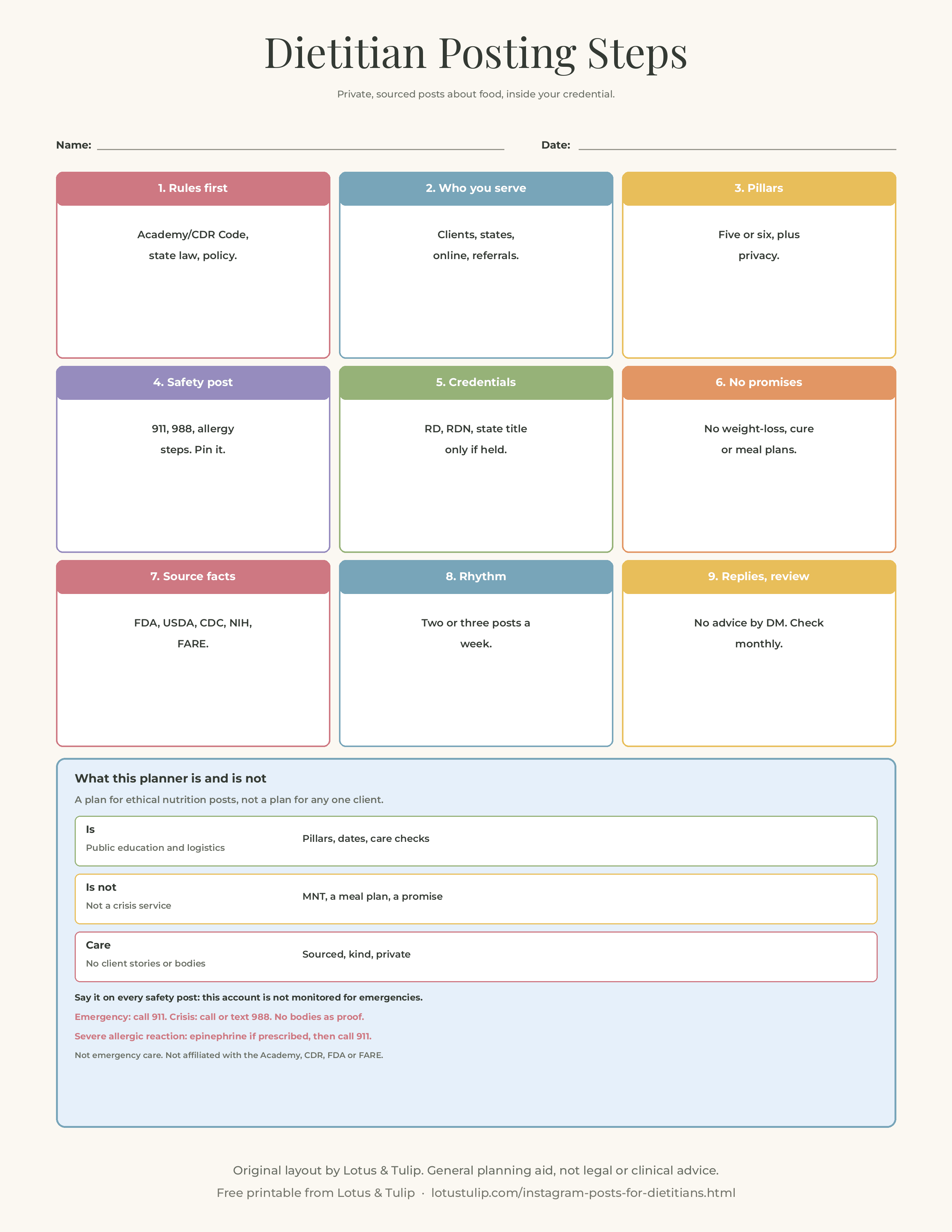
- Read your rules first. Open the Academy and CDR Code of Ethics, your state licensure or certification law and any board advertising rules, your employer's social media policy, and HIPAA guidance if you are a covered entity. Note anything about testimonials, titles, supplements or client images.
- Name who you serve and where. List the people you actually see, your states, whether you offer online sessions, and the concerns you refer out. This becomes the edge of every booking and telehealth caption.
- Choose five or six pillars, plus privacy and safety. Use the ten pillars above as a menu. If you cannot say something true and sourced under a pillar this month, skip it.
- Write and pin a safety post. Include 911, call or text 988, FARE's severe allergic reaction steps (epinephrine if prescribed, call 911, go to the emergency room), and the sentence that your account is not monitored for emergencies. Put a copy in a Safety highlight.
- Audit your credentials in the bio and on every graphic. Keep RD or RDN, NDTR, state titles and specialist letters only when they are current and yours. Remove course names that look like certifications.
- Ban promises, plans and bodies from the draft stage. If a caption needs a weight-loss claim, a disease claim, a timeline, a meal plan, a supplement dose or a before and after image to work, rewrite it or delete it.
- Source every health fact. Use FDA, USDA, CDC, NIH or FARE wording, name the source on the slide, and add "General information, not individual medical or nutrition advice."
- Set a two or three posts a week rhythm. Batch captions on a quiet morning. Schedule only what has passed the care check. Leave room for a story if hours change.
- Prepare replies and review monthly. Save DM replies that refuse meal plans and assessments by message and route people to booking, their own clinician or emergency services. Once a month, update fees and hours, remove outdated openings, and run every live post through the care check on page 3 of the free printable.
Mistakes and myths
Common mistakes
- Before and after photos. The comparison itself promises a result, and it centers bodies as proof. Cropping a face does not solve privacy or typicality.
- Client weight-loss quotes. FTC Section 255.2 says consumer endorsements are not competent and reliable scientific evidence, and that an advertiser needs substantiation that the experience is representative or must disclose what people can generally expect.
- "Heal your gut in 7 days" and other disease or timeline claims. Code Standard 3d asks you to refrain from false, deceptive or misleading claims. No one can promise that to a stranger.
- Meal plans in captions. "Here is what to eat this week for PCOS" is individualized care without an assessment.
- Inviting food logs and labs into DMs. You collect health information on a consumer app and appear to evaluate someone.
- Undisclosed brand deals. Free products and affiliate codes are material connections under Section 255.5 and conflicts of interest under Standard 2a.
- Letters you do not hold. CSSD without certification, "RD" after registration lapses, or calling a technician a dietitian.
- "Clients nationwide" for telehealth. Cross-state practice depends on state rules. List the places you can serve.
- Mocking other professions. Standard 3b and 3c ask for respect and civility, including on social media. Teach the difference without contempt.
- Posting your own plate as a template. Your lunch is not a recommendation, and followers will treat it as one.
Myths about dietitian Instagram
- "Nutrition content only works with transformation photos." Label carousels, food safety tips and honest first-session posts explain your value without any body on screen.
- "A disclaimer at the end makes a meal plan okay." The impression comes from the whole post. Put the limit near the start and do not give the plan.
- "Coaches and trainers are the competition." Many people work with more than one professional over time. A respectful post can make you the person they refer to.
- "You must post daily to grow." Two or three careful posts a week, with current highlights, serve a practice better than daily filler.
- "Supplement affiliate links are harmless income." They are financial interests in recommended products. Disclose them clearly or keep them off a clinical account.
- "Instagram replaces a website." People still need a page with your credential, states, fees, privacy practices and contact details they can read without an app.
Three fictional examples
These people and practices are invented. They show decisions, not real practices.
- Odalys, a private practice RDN who sees adults online. A stranger comments "can you just tell me what to eat for my blood sugar" with a list of numbers. Odalys hides the comment so the numbers are not public, sends the saved reply about booking and talking with her physician, and that week posts a carousel on reading the Nutrition Facts label with FDA's 5 and 20 guide. She does not mention the commenter.
- Tobias, a sports dietitian working with a college team. An athlete offers to post a side-by-side photo "to show your plan works." Tobias declines, explains the practice keeps everyone private, and writes a general post about what a sports dietitian does, naming the CDR specialist certification he actually holds. He adds that supplement questions go through the team's medical staff and that he does not give doses on Instagram.
- Priyanka, a dietitian in a group practice with a therapist and a PT. A supplement company offers free product for a story. Priyanka checks the Code, sees Standard 2a on conflicts of interest, and declines. Instead she posts FDA's explanation that supplements are not approved before they are marketed and the required disclaimer wording. Later, the group writes a joint post explaining who does what in the practice, with no client stories.
How this guide compares with neighboring Instagram articles
| Guide | Written for | What it covers that this page leaves aside |
|---|---|---|
| This page: Instagram posts for dietitians | RDs, RDNs, NDTRs and nutrition practices | Education versus medical nutrition therapy, food labels, food safety, supplements, cleanses, food allergy safety, eating disorder care, National Nutrition Month and RDN Day |
| Instagram posts for physical therapists | PTs and PTAs | Movement education without home programs, medical red flags, direct access, PT versus trainer |
| Instagram posts for occupational therapists | OTs and OTAs | What occupation means, children and sensory differences, splints, school OT |
| Instagram posts for speech therapists | SLPs | Child language and communication, stuttering, sudden speech-change safety |
| Instagram posts for couples therapists | Couple and family therapists | Relationship ethics and session privacy between partners |
| Holiday social media posts for therapists | Any clinical feed in December and January | A week by week seasonal calendar and winter clinic-hour posts |
| Instagram post ideas for therapists, captions for therapists and therapist Instagram bio | Mental health clinicians | Counseling themes, crisis language for therapy practices, general bio and caption craft |
Use the general therapist pages for layout ideas (bios, highlights, pinned posts, carousels). Come back here when the question is about food, nutrition credentials or nutrition safety.
Ethical dietitian post versus overclaiming post
| Topic | Ethical dietitian post | Overclaiming post |
|---|---|---|
| Weight | "We do not post bodies or scale numbers. Here is how a first session works." | "Down 30 pounds in 8 weeks with my plan. You are next." |
| Meal plans | "Plans are built after an assessment, for one person. This post is general education." | "Screenshot my 7-day meal plan for hormone balance." |
| Credentials | "[Your actual credential], licensed in [states]. Specialist letters only if certified." | "Certified gut expert, board certified in everything." |
| Supplements | "FDA does not approve supplements before they are sold. Ask your clinician before starting one." | "My must-have stack, 20 percent off with my code." |
| Cleanses | "NCCIH found the research on detoxes small and low quality, with real safety concerns." | "Flush toxins in 3 days with this juice reset." |
| Food allergy | "Severe reaction? Epinephrine if prescribed, call 911, then the emergency room. Source: FARE." | "Test your allergies at home with this elimination trick." |
| Reviews | "Feedback is welcome privately. We do not post client stories." | "Swipe for client transformations." |
| Safety | "911 for emergencies, call or text 988 in a crisis, this account is not monitored." | "DM me any time, I always answer." |
When not to post
- Right after a hard session. If the caption only works because of one client's day, wait and write something general, or write nothing.
- When a trend asks you to show your body or your plate. Skip it. Your feed does not need to prove anything with a body.
- When you cannot find a primary source. If FDA, USDA, CDC, NIH or FARE does not say it, and you cannot cite a quality source, leave it out.
- During a news panic about a food or additive. Wait until official guidance is clear. A calm "here is what FDA says today" post later beats a fast fear post now.
- When a brand is paying and the post would not exist otherwise. If you go ahead, disclose clearly. If you hesitate, that is your answer.
- When you are exhausted or comparing yourself with louder accounts. A quiet week with current highlights is fine.
- When your employer or health system policy says no. Follow it, even on a personal-looking account that names your workplace.
Free 3 page dietitian Instagram printable (US Letter)
Print it, fill it in once a month, and keep it next to your scheduling tool. It works with any design app or template set.
- Page 1: Dietitian Posting Steps. Nine step cards that match the HowTo above, what the planner is and is not, and safety lines for 911, 988, food allergy and "not emergency care."
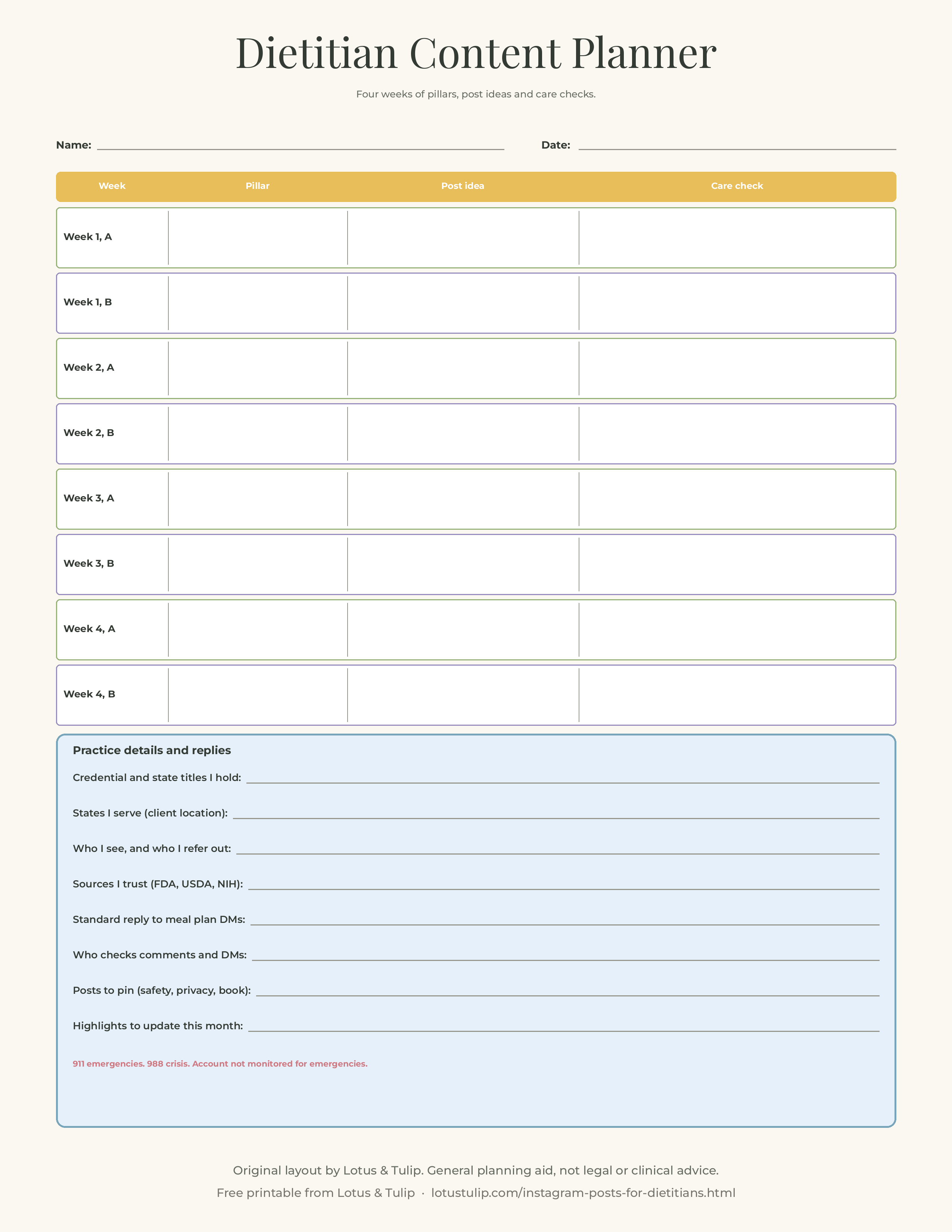
- Page 2: Dietitian Content Planner. Four weeks of posts (two per week) with columns for pillar, post idea and care check, plus fields for the credential and state titles you hold, states you serve, who you see and refer out, sources you trust, your standard reply to meal plan DMs, who checks messages, posts to pin and highlights to update.
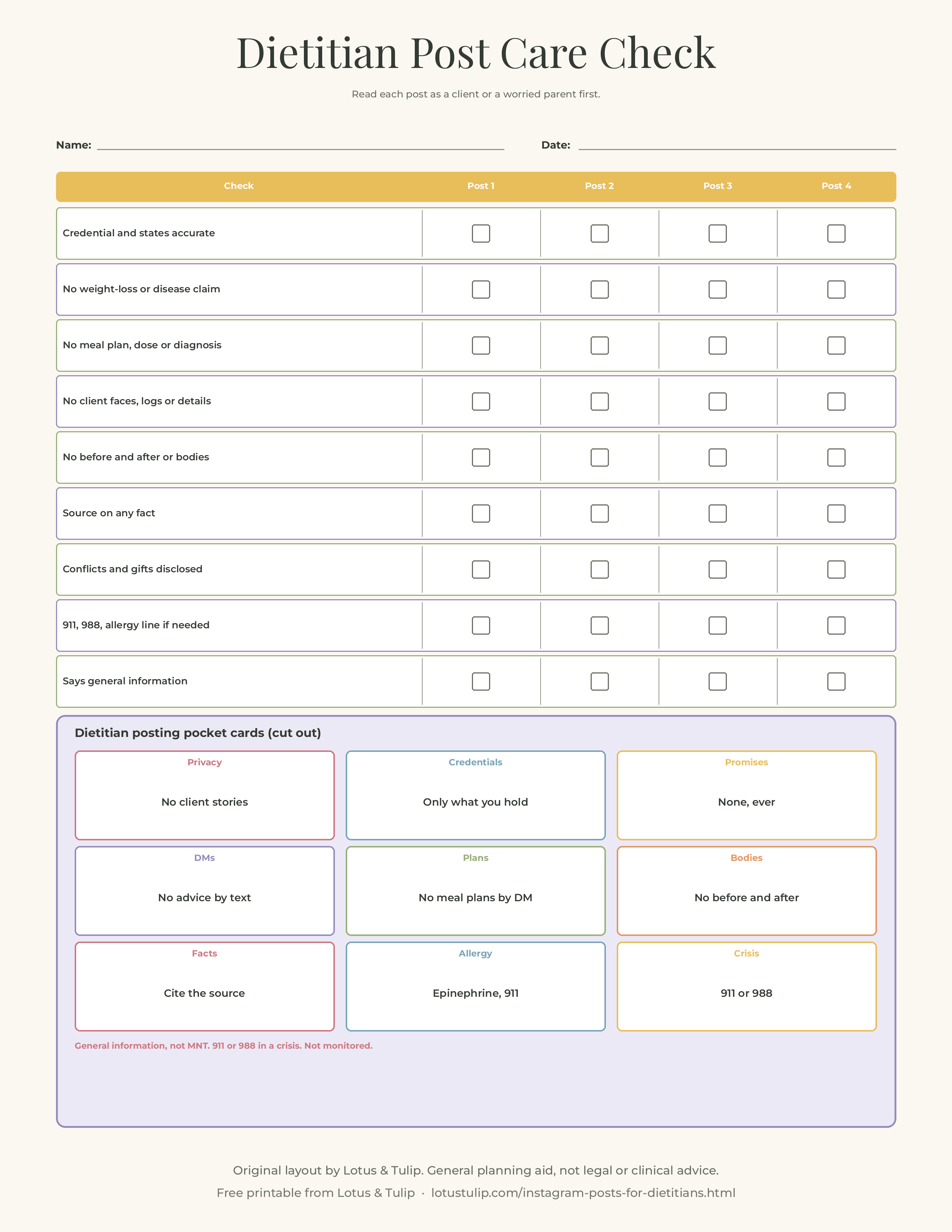
- Page 3: Dietitian Post Care Check. A yes or no check for up to four posts (credential and states accurate, no weight-loss or disease claim, no meal plan or dose, no client images or details, no before and after, source on any fact, conflicts disclosed, 911, 988 and allergy lines if needed, says general information), plus nine dietitian posting pocket cards to cut out.
Download free PDF · Page 1 PNG · Page 2 PNG · Page 3 PNG
Research notes (verified, with caveats)
- Academy of Nutrition and Dietetics and Commission on Dietetic Registration. Code of Ethics for the Nutrition and Dietetics Profession, eatrightpro.org/practice/code-of-ethics/code-of-ethics-for-the-nutrition-and-dietetics-profession, opened this session (PDF also hosted at eatright.org). Approved by the Academy Board of Directors and the CDR Board in February 2018; in effect since June 1, 2018; the 2009 version is no longer valid. Applies to Academy members and to people who accept and maintain CDR credentials. Four principles: competence and professional development in practice (non-maleficence), integrity in personal and organizational behaviors and practices (autonomy), professionalism (beneficence), and social responsibility for local, regional, national and global nutrition and well-being (justice). Standards cited: 1a, 1c, 1f, 1h, 2a, 2b, 2c, 2e, 2g, 2h, 2i, 3b, 3c (names social media), 3d, 3h, 4a, 4d, 4e.
- Commission on Dietetic Registration. RDN credential FAQ (cdrnet.org/rdncredentialfaq): RD and RDN have identical meanings and legal trademark definitions; RDN is optional; no additional cost or separate recertification; many state laws already reference the term nutritionist (for example LDN or CDN). Credential use and misuse page (cdrnet.org/use-misuse): credentials awarded after academic and supervised practice requirements and a registration examination; list of CDR marks including RD-AP, RDN-AP, CSG, CSOWM, CSO, CSP, CSPCC, CSR and CSSD. Graduate degree page (cdrnet.org/graduatedegree), via search: graduate degree required for first-time eligibility for the dietitian registration examination effective January 1, 2024. Definition of Terms list (2025 revision, cdrnet.org): "All registered dietitians are nutritionists, but not all nutritionists are registered dietitians."
- Commission on Dietetic Registration. Dietitian Licensure Compact page, cdrnet.org/dietitian-licensure-compact, opened this session. Describes the compact, says RDs in states without licensure (examples given: CA, AZ) cannot use it, and says first compact privileges are expected sometime in 2027. We did not list member states because counts and timelines change.
- Medicare statute, 42 U.S.C. 1395x(vv)(1), via the Legal Information Institute definition and the CMS national coverage analysis for the medical nutrition therapy benefit for diabetes and end-stage renal disease: medical nutrition therapy services are nutritional diagnostic, therapy and counseling services for disease management furnished by a registered dietitian or nutrition professional pursuant to a physician referral.
- HHS Office for Civil Rights. HIPAA Privacy Rule guidance on marketing (45 CFR 164.501, 164.508(a)(3)), hhs.gov, opened this session. With limited exceptions, the Rule requires an individual's written authorization before protected health information is used or disclosed for marketing.
- Food and Drug Administration. How to Understand and Use the Nutrition Facts Label; The Lows and Highs of Percent Daily Value; What's on the Nutrition Facts Label (fda.gov), via search this session. %DV shows how much a nutrient in a serving contributes to a total daily diet; 5% DV or less per serving is low and 20% DV or more is high; the %DV column does not add up to 100%; protein generally has no %DV; trans fat and total sugars have no %DV; serving size is not a recommendation of how much to eat.
- USDA Food Safety and Inspection Service. Keep Food Safe! Food Safety Basics, fsis.usda.gov, last updated January 5, 2024, opened this session. Clean, separate, cook, chill; refrigerate perishable food within 2 hours (1 hour above 90 degrees F); discard food left out more than 2 hours (1 hour above 90 degrees F); refrigerator 40 degrees F or below, freezer 0 degrees F or below.
- Food and Drug Administration. Questions and Answers on Dietary Supplements, fda.gov, opened this session. DSHEA (1994) definitions; FDA does not have authority to approve dietary supplements before they are marketed; FDA generally does not approve supplement claims or labeling before use; consumers should talk with a health care professional before using a supplement; required disclaimer wording for structure or function claims; products represented to treat, prevent or cure disease meet the definition of a drug; FTC generally regulates supplement advertising.
- NIH National Center for Complementary and Integrative Health. "Detoxes" and "Cleanses": What You Need To Know, nccih.nih.gov, last updated March 2025, opened this session. Small number of low-quality studies; 2015 review found no compelling research for detox diets for weight management or toxin elimination; 2017 review on initial weight loss followed by regain; FDA and FTC actions; safety concerns including unpasteurized juices, laxatives, electrolyte imbalance and colon cleansing side effects.
- Food Allergy Research and Education. Recognizing and Treating Reaction Symptoms, foodallergy.org, opened this session. Mild and severe symptoms; any severe symptom, or mild symptoms in more than one body area, is a severe reaction; epinephrine is the only medication that can reverse anaphylaxis symptoms; use epinephrine at the first sign of a severe reaction or as prescribed, call 911, and go to the emergency room even if symptoms appear to resolve; follow a personalized Food Allergy and Anaphylaxis Emergency Care Plan.
- 988 Suicide and Crisis Lifeline, 988lifeline.org, opened this session. People can call, text or chat with a counselor; available 24/7. We did not include an eating disorder helpline number because we did not verify a current one on an official page while writing.
- Centers for Medicare and Medicaid Services. Know your medical bill rights when not using insurance, cms.gov, opened this session. The No Surprises Act took effect January 1, 2022; providers usually must give a good faith estimate when care is scheduled at least 3 business days in advance or on request; a bill at least $400 more than the estimate may be disputed; no estimate during emergency care. 45 CFR 149.610 (eCFR, opened this session) sets requirements for good faith estimates for uninsured or self-pay individuals upon request or upon scheduling.
- Telehealth.HHS.gov. Licensing across state lines, last updated April 30, 2025, opened this session. Cross-state practice varies by state; pathways include a full license, temporary practice laws, reciprocity, compacts and telehealth registration; providers should verify patient location and obtain consent before an appointment.
- Academy of Nutrition and Dietetics. About National Nutrition Month (eatright.org), the March 2, 2026 press release "Academy Celebrates Power of Nutrition for 2026 National Nutrition Month," and the March 11, 2026 RDN Day press release (eatrightpro.org), via search this session. National Nutrition Month is held each March, began in 1973 as National Nutrition Week and became a month-long observance in 1980; the 2026 theme is "Discover the Power of Nutrition"; RDN Day is the second Wednesday of March during National Nutrition Month (March 11, 2026). The VA Nutrition and Food Services page and an Academy release on GlobeNewswire also name NDTR Day as Thursday, March 12, 2026.
- Federal Trade Commission. Guides Concerning Use of Endorsements and Testimonials in Advertising, 16 CFR Part 255 (revised 2023), via eCFR, opened this session. Section 255.1 (endorsements must reflect honest opinions and may not convey a representation that would be deceptive if made by the advertiser); Section 255.2 (substantiation for claims made through endorsements; consumer endorsements are not competent and reliable scientific evidence; disclose generally expected performance when typicality is not substantiated); Section 255.5 (clear and conspicuous disclosure of unexpected material connections).
This page is not affiliated with or endorsed by the Academy of Nutrition and Dietetics, CDR, FDA, USDA, NIH, CDC, CMS, HHS, FARE, the 988 Lifeline, the Dietitian Licensure Compact, the FTC or any licensing board. We used no prevalence statistics. Our paid template kits are marketing tools for nutrition professionals. They are not clinical interventions and have not been tested in any trial. You stay responsible for what you post.
Instagram posts for dietitians: FAQ
What should a dietitian post on Instagram?
Focus on what prospective clients and referral sources need: who you are and what your credential means, how to choose a nutrition professional, what a first session involves, how privacy works, fees and good faith estimates for self-pay clients, the states you serve online, sourced public education on the Nutrition Facts label, food safety, supplements and cleanses, and a pinned safety post with 911, call or text 988, and food allergy steps from FARE.
How often should a dietitian post on Instagram?
Two or three feed posts a week is enough for most solo dietitians and small practices, plus occasional stories. Once a week is fine if your Safety, Book, Fees and FAQ highlights are current.
Can I share client success stories or before and after photos with permission?
Most careful practices do not. If HIPAA applies, marketing use of protected health information generally needs a written authorization. Even with permission, a weight-loss or symptom story implies typical results under FTC Section 255.2, and body comparisons can harm readers with a difficult relationship with food. Thank the client privately instead.
Should I write RD or RDN in my bio?
Either, if you hold the CDR credential. CDR says the RD and RDN credentials have identical meanings and legal trademark definitions, and RDN is optional. Add a state title such as LD or LDN only if your state issued it to you, and specialist letters such as CSSD only if you are currently certified.
Can I give meal plans or answer nutrition questions in DMs?
Not individualized ones. A meal plan, a supplement dose or advice for a diagnosis needs an assessment and, often, collaboration with the client's physician. Reply kindly, offer a booking link, and point to 911 or 988 when someone sounds unsafe. General education posts are fine.
Is it okay to post about supplements?
Yes, as education. FDA explains that it does not approve dietary supplements before they are marketed and advises people to talk with a health professional before using one. Avoid recommending brands or doses publicly. If you have any financial interest, disclose it clearly, as Code Standard 2a and FTC Section 255.5 expect.
Can I offer online sessions to followers in other states?
Only where you are licensed or otherwise legally allowed to practice for the state where the client is located. Telehealth.HHS.gov advises verifying patient location before each appointment. CDR says the Dietitian Licensure Compact's first privileges are expected in 2027, so do not imply a compact privilege you do not have. List the states you can actually serve.
Is the free printable a copy of the paid kit?
No. The free three page set is an original planning aid: posting steps, a four week content planner and a post care check with pocket cards. The paid Nourished Practice kit contains designed posts, stories, highlight covers, captions and a 12 week calendar. The printable is not a preview of that kit.