
Therapist marketing · Updated 2026-11-08
Instagram Post Ideas for Occupational Therapists (with Free Printable)
Ready-made template kit: Occupational Therapist Instagram Templates Holiday 20% off: about $22.08, was $28 (EUR 24) · instant digital download
Buy on Etsy
Instagram posts for occupational therapists carry an unusual burden. Most people scrolling past have no clear picture of what an OT does, many confuse the profession with physical therapy or with job coaching, and the readers who need you most are often a tired parent at a school pickup line, an adult wearing a splint after hand surgery, or an adult child worried about an aging parent who keeps tripping in the hallway. A careless post can label a child in public, promise neater handwriting by a date, tell a stranger to loosen a splint strap, or turn a comment thread into a free evaluation. A careful post does something more modest and more useful: it explains the work of everyday living, shows how your practice actually runs, and points people to the right door, whether that door is your booking link, their own treating therapist, their doctor or 911.
This guide is written for US occupational therapists who run or contribute to a professional Instagram account: pediatric OTs in private clinics, school-based OTs with an evening or summer side practice, hand therapists (with or without the CHT credential), outpatient and home health OTs, and small practices that employ OTs alongside occupational therapy assistants. It covers what to post on Instagram as an occupational therapist: why the job is different from generic therapy-practice posting, the parts of the AOTA 2020 Occupational Therapy Code of Ethics that touch social media, how to show credentials honestly, how to talk about children and sensory differences without diagnosing anyone, school OT and clinic OT under IDEA, OT, PT and speech side by side, splint and safety messaging, home safety as general education, ten content pillars, 34 post ideas with original caption angles, six fuller captions, DM scripts, a weekly rhythm and a 12 week overview, the dates that suit an OT feed, a nine step HowTo, mistakes, myths, three fictional examples, a comparison table, when not to post, research notes and a free three page US Letter printable: OT Posting Steps, an OT Content Planner and an OT Post Care Check with pocket cards.
If you are newer to posting as a clinician, our general ethics checklist for therapist social media and Instagram post ideas for therapists cover the basics for mental health clinicians. Neighboring professions have their own pages: Instagram post ideas for speech therapists and Instagram post ideas for couples therapists. Seasonal logistics for any clinical feed are in holiday social media posts for therapists. This page stays with the questions only occupational therapists tend to face: hands and splints, school routines, sensory preferences, home setups, return to work and the long explanation of what "occupation" means.
We relied on primary sources and opened each one while writing: the AOTA 2020 Occupational Therapy Code of Ethics (published in the American Journal of Occupational Therapy, Vol. 74, Suppl. 3), the NBCOT page on what it means to hold the OTR and COTA credentials, the Hand Therapy Certification Commission (HTCC) pages on the Certified Hand Therapist credential and its disciplinary policy, the IDEA regulation on related services (34 CFR 300.34), the CDC STEADI Check for Safety home checklist, the 988 Suicide and Crisis Lifeline, the CMS page on Good Faith Estimates, the Telehealth.HHS.gov page on licensing across state lines, the OT Compact status page, the WFOT page on World Occupational Therapy Day, AOTA material on Occupational Therapy Month, the ASHT page on Hand Therapy Week, and the FTC Guides Concerning Use of Endorsements and Testimonials in Advertising (16 CFR Part 255). Notes are at the end. The printable is an original Lotus and Tulip layout.
This guide is general marketing information, not legal, ethical or clinical advice. Your state licensing board and practice act, the AOTA Code of Ethics, NBCOT and HTCC rules if they apply to you, HIPAA if you are a covered entity, FERPA and IDEA if you work in schools, and your employer policy all come first. A social media post is public education. It is not occupational therapy, and an Instagram account is not a clinic. If someone is in danger or has a medical emergency, call 911. For a mental health or suicidal crisis, call or text 988. If a splint or cast feels too tight, the fingers change color, go numb or swell, or a symptom is new or getting worse, contact the treating doctor or clinic right away, and never change a splint or home program without asking the therapist who made it. Occupational therapy is not emergency care. Every safety post you publish should repeat that message and say that your account and inbox are not monitored for emergencies.
What this guide is and is not
It is a planning guide for public, educational Instagram content from an occupational therapy practice or an individual OT who posts professionally. It helps you choose themes, write captions that stay inside your license and your competence, describe how your practice works, and keep privacy and safety information in plain view.
It is not legal advice. Occupational therapy practice acts, title protection, advertising rules and telehealth rules vary from state to state. Some boards say specific things about testimonials, specialty claims or fee advertising. Hospitals, school districts and home health agencies usually have their own social media policies, and those are often stricter than anything here. When in doubt, read the rules or ask the risk management line that comes with your liability insurance.
It is not clinical advice. Nothing here tells you how to evaluate a child with handwriting difficulty, how to fabricate or adjust an orthosis, how to grade a return to work plan or how to recommend home modifications for a particular person. Those decisions belong in your training, your supervision and the evaluation room.
It is not a promise that Instagram will fill a caseload. Many OT referrals come from physicians, surgeons, pediatricians, schools, case managers, insurance networks and word of mouth. A good feed helps someone understand what you do before they call and helps a referral source feel comfortable sending people your way. That is a real benefit, and it is smaller than the growth claims you may see elsewhere.
And it is not occupational therapy for your followers. A feed can teach general ideas about routines, home setup and how to find care. It cannot watch a child hold a pencil in a video and decide what is going on, and it cannot tell a stranger how many hours a day to wear a brace.
Why posting as an OT is different from generic therapy-practice posting
Most therapist Instagram advice is written for counselors and psychologists. Their posts talk about feelings, boundaries and what a session is like. An OT feed shares some of that ground, but it has its own traps and its own opportunities.
- The profession is hard to explain in one line. "Occupation" means the everyday things people need and want to do: getting dressed, eating, bathing, playing, learning, working, caring for others, resting. People hear the word and think of jobs. Your feed has room to fix that misunderstanding gently and repeatedly, and that alone can be the backbone of a year of posts.
- So much of the work is visible. Unlike talk therapy, OT happens with hands, objects, tools and spaces. That makes it tempting to film sessions. A clip of a child threading beads or an adult practicing buttons after a stroke can look harmless and still identify a client, imply a result, and make a private struggle public.
- Medical devices are in the picture. Hand therapists and many outpatient OTs make or fit orthoses (splints). Public advice about straps, wearing schedules or "just loosen it a little" can cause harm when the reader is not your patient and you have never seen their hand. Safe splint content is general and always routes questions back to the treating therapist or doctor.
- Children and schools bring extra privacy layers. Pediatric OTs deal with HIPAA in clinics, FERPA and district policy in schools, and families who may be very open about their child online. Your standard has to be higher than the most open parent in your caseload.
- Diagnostic labels travel fast. Sensory processing, motor coordination, handwriting and attention are areas where parents search for answers. A reel that says "if your child hates tags, they have sensory issues" reaches people you have never met and gives them a label you are not in a position to give. OTs also differ in their training and in which conditions they evaluate, so caution is the default.
- Safety lives next door. Older adult home safety, falls, hand injuries, burns in the kitchen and caregiver strain are all OT topics, and all of them have an emergency edge. A post on getting up from the floor or a hot stovetop routine needs to say plainly when to call 911 instead.
The good news is that OT content does not need drama. People respond to clear, practical, kind explanations of daily life, and that is exactly what the profession is built around.
The ethics that shape an OT feed
The current AOTA Occupational Therapy Code of Ethics is the 2020 edition, published in the American Journal of Occupational Therapy. The Code says it applies to all occupational therapy personnel, its enforceable Standards of Conduct apply to AOTA members, and it notes that many state regulatory boards incorporate the Code or similar language into their laws, so it is worth reading even if you are not a member. It is organized around six core principles (Beneficence, Nonmaleficence, Autonomy, Justice, Veracity and Fidelity) and a set of Standards of Conduct. A handful of those standards do most of the work on Instagram.
Standard 6D: discretion on social media
This is the one to print and pin above your desk. It asks occupational therapy personnel to "demonstrate responsible conduct, respect, and discretion when engaging in digital media and social networking, including but not limited to refraining from posting protected health or other identifying information." Notice the words "or other identifying information." That reaches beyond the formal HIPAA definition. A distinctive adaptive tool, a school uniform, a recognizable clinic corner with a client in it, or a caption that says "my Tuesday 4 pm kiddo finally did it" can identify a person in a small community.
Standards 6A and 6B: confidentiality in every format
Standard 6A covers verbal, written, electronic, augmentative and nonverbal communication and names HIPAA and FERPA as examples of the privacy laws to follow. Standard 6B asks you to maintain privacy and truthfulness whether services are delivered in person or virtually. For a feed, that means no client names, no initials that locals would decode, no session anecdotes, no screenshots of messages, no photos or video of clients unless you hold specific written authorization for that exact use, and even then a hard look at whether the post is needed.
Standards 6F and 6H: truthful marketing
Standard 6F says not to use or participate in any form of communication that contains false, fraudulent, deceptive, misleading or unfair statements or claims. Standard 6H asks you to "ensure that all marketing and advertising are truthful, accurate, and carefully presented to avoid misleading recipients of service, research participants, or the public." In practice that rules out captions such as "fix handwriting in six weeks," "guaranteed return to work," or "the only sensory gym in the county" unless you can actually support the claim, and the first two cannot be supported for a stranger at all.
Standard 5B: credentials as they really are
Standard 5B asks you to "represent credentials, qualifications, education, experience, training, roles, duties, competence, contributions, and findings accurately in all forms of communication." Instagram bios are a form of communication. If you write OTR/L, both halves should be true: the OTR part depends on NBCOT, and the L part depends on your state license. If you list CHT, you need to hold it now. If you completed a weekend course, describe it as a course, not as a certification.
Standard 4B: individual plans belong in evaluation
Standard 4B asks OTs to provide appropriate evaluation and a plan of intervention specific to a client's needs. A public caption cannot meet that standard for the reader, which is one more reason to keep public content general and to refuse DM consultations kindly.
Testimonials and the FTC
The FTC Guides Concerning Use of Endorsements and Testimonials in Advertising (16 CFR Part 255, revised in 2023) apply to health care practices that post reviews. Section 255.2 says an advertisement that uses consumer endorsements about a key attribute will likely be read as saying the endorser's experience is what people can generally expect, and that you need substantiation for that impression. It also says you should not take actions that distort what consumers think, such as publishing only glowing reviews. Section 255.5 covers disclosure of material connections, so a family that received a discount for a review is not an ordinary reviewer. Many OTs decide not to request public reviews from current clients at all, because the treating relationship makes a request hard to refuse.
Credentials: OTR, OTR/L, COTA and CHT, shown honestly
Credentials in occupational therapy have several layers, and the public rarely knows what each one means. That makes them a good topic for an education post and a common source of quiet misrepresentation.
- OTR. NBCOT says occupational therapy professionals who are certified with it hold either the Occupational Therapist Registered OTR credential or the Certified Occupational Therapy Assistant COTA credential, and that "only those who maintain an Active in Good Standing status with NBCOT can use the OTR or COTA credential." If your NBCOT certification has lapsed, the R should come off your bio, even if your state license is current.
- The L. The L in OTR/L stands for state licensure. It means you hold a license in at least one state. It does not mean you can see clients in every state, and it does not mean you are licensed where every follower lives.
- COTA and OTA titles. If your practice employs occupational therapy assistants, describe their roles accurately. NBCOT explains that the OTR evaluates, plans interventions and completes discharge documents and provides clinical supervision of the COTA. Do not let a caption suggest that an assistant runs evaluations, and do not call an aide or a student by a title they do not hold.
- CHT. HTCC describes a Certified Hand Therapist as an occupational therapist or physical therapist who has a minimum of three years of clinical experience, including 4,000 hours or more of direct practice in hand therapy, and who has passed a comprehensive exam. CHTs recertify every five years. HTCC's disciplinary policy lists misrepresenting certification status as a violation. "Hand therapist" and "Certified Hand Therapist" are not the same claim, and an OT who treats hands without the CHT should not use the initials.
- Other letters. Board and specialty certifications, continuing education certificates and trademarked method trainings all mean different things. If a course gives you a certificate of completion, say "trained in" or "completed coursework in" and name it plainly. Do not stack letters that look like credentials but are really course names.
A strong credentials post explains, in plain language, how to look up an OT license on a state board website, what OTR means, and what CHT means, then lists only the credentials you hold. That post builds more trust than a crowded bio.
Children, families and sensory differences without diagnosis
Pediatric OT content draws the largest audience and the largest risks. Parents search at night for answers about tantrums at bath time, refusal of certain clothes, messy handwriting, toe walking or a child who seems clumsy compared with cousins. Your posts can help them understand what an OT looks at and when to ask a pediatrician or school about an evaluation. They cannot tell those parents what is going on with their child.
Describe differences, not disorders
A careful post talks about preferences and behaviors in everyday language: some children seek more movement, some avoid loud rooms, some dislike certain textures, and many grow and change. It avoids labels such as "sensory processing disorder" or "dyspraxia" as conclusions the reader should draw. If you write general education that mentions a recognized condition, cite a reputable source, keep the language descriptive, and end with "General education, not individual advice. Talk with your child's doctor or a licensed OT about your own child." Never write a checklist in the style of "five signs your child has..." because readers will treat it as a screening tool.
No child faces, no child stories
The safest standard, and the one we recommend, is that clients and their children do not appear on the practice account at all. Use original graphics, empty therapy spaces, objects with no names on them, or clearly fictional examples. A parent who says "you can post my kid, everyone knows" is offering something you can politely decline. The child did not consent, and the post would still work as advertising for your services.
Handwriting and fine motor as education, not treatment
Handwriting is one of the most searched pediatric OT topics. Keep posts at the level of general information: what handwriting asks of a child (posture, attention, visual skills, hand use and practice), why paper and pencil choices matter for comfort, and why a child who struggles is not lazy. Avoid "do these three exercises every night" or "this grip trainer fixes letter reversals." A home program is individual. Offer instead a parent workshop, a free school-year routine handout that is clearly general, or a link to book an evaluation.
School OT, home routines and parent roles
Parents are often the real audience for pediatric content, and many are juggling work, siblings and appointments. Posts that make routines feel lighter (a visual morning sequence, clothing choices that reduce battles, calm transitions after school) are kind and useful, as long as they are framed as ideas families can try rather than therapy, and as long as they do not shame parents who cannot manage another task.
School OT and clinic OT under IDEA, explained without legal advice
Families often do not know that school-based OT and clinic-based OT exist side by side and work toward different goals. That makes "school OT or clinic OT?" one of the most useful posts a pediatric OT can publish.
Under the Individuals with Disabilities Education Act regulations, 34 CFR 300.34 defines related services as "transportation and such developmental, corrective, and other supportive services as are required to assist a child with a disability to benefit from special education," and lists occupational therapy among them. The same section says occupational therapy means services provided by a qualified occupational therapist and includes improving, developing or restoring functions impaired or lost through illness, injury or deprivation; improving ability to perform tasks for independent functioning; and preventing, through early intervention, initial or further impairment or loss of function.
In plain language for a caption: in public schools, OT is a related service that supports a child's special education program, and the IEP team decides whether a child needs it. Clinic or private OT is arranged by a family, often through a physician referral and insurance or self-pay, and its goals can extend to home and community life. Some children receive both, some only one. Very young children may be served through your state early intervention program. Keep the post descriptive, avoid telling families what the school "must" provide in their case, and suggest they ask the school team or a parent training center for questions about rights. You are not their advocate in a comment thread.
If you work in a district and also run a private account, separate the roles clearly. Do not discuss students, do not recruit families from your school caseload to your private practice through Instagram, and follow your district policy on outside employment and social media. If a parent from school comments on your private page, move the conversation to the official school channel.
OT, PT and speech: a fair comparison post
"What is the difference between OT and PT?" is a question every OT has heard. A comparison post can be clear without turning into a turf war. Write it as typical focus, not hard boundaries, and admit overlap.
- Occupational therapy typically focuses on the daily activities a person needs and wants to do (self-care, home management, school, play, work, community life), and on adapting tasks, tools and environments so those activities are possible.
- Physical therapy typically focuses on movement, strength, balance, walking and mobility.
- Speech-language pathology typically focuses on communication and, for SLPs trained in it, feeding and swallowing.
Add a line such as "Many people see more than one of us, and we often work as a team. Your doctor or an evaluation can help you decide where to start." Avoid absolute claims ("only OTs can help with this") and avoid ranking professions. AOTA Standard 6L asks OTs to engage in collaborative communication as members of interprofessional teams, and a respectful comparison post models exactly that.
Safety posts: 911, 988, splints and "not emergency care"
Every OT account needs at least one pinned safety post. Keep it short and specific.
- Emergencies: "If someone is in danger or has a medical emergency, call 911."
- Mental health crisis: "If you or someone you know is in crisis or thinking about suicide, call or text 988, the Suicide and Crisis Lifeline. It is free, confidential and available 24 hours a day."
- Splints and casts: "If a splint or cast feels too tight, your fingers change color, feel numb or tingly, or swelling gets worse, contact your doctor or clinic right away. Do not cut, heat, bend or adjust a splint yourself, and do not change your wearing schedule or home program without asking the therapist who gave it to you."
- New or worsening symptoms: "A new symptom or one that is getting worse is a reason to call your doctor or clinic, not to wait for your next OT visit."
- Not monitored: "This account and inbox are not monitored for emergencies. Occupational therapy is not emergency care."
The splint line matters more than it may seem. Hand therapists know that a well-meant tweak can cause skin damage or undo a surgical protocol. Your public content should never teach strangers to modify their own orthoses, and it should treat "as the therapist showed you" as the rule: "Wear and clean your splint exactly as your therapist showed you. If you are unsure, ask them."
Home safety education, kept general
Home safety is a natural OT topic, especially for outpatient, home health and geriatric practices. The CDC STEADI program publishes a free brochure, Check for Safety: A Home Fall Prevention Checklist for Older Adults, and it is a good source for short, general posts because the advice is concrete and widely applicable. Its room by room suggestions include keeping objects off stairs and floors, having a light and switch at the top and bottom of stairs, making sure handrails are on both sides of the stairs and as long as the stairs, removing throw rugs or using double-sided tape or a non-slip backing, coiling or taping cords next to the wall, keeping often-used items on lower shelves (about waist high), using a sturdy step stool with a bar and never a chair, placing a lamp close to the bed, putting a nightlight on the path from the bed to the bathroom, using a non-slip mat or strips in the tub or shower, and having grab bars put in next to and inside the tub and next to the toilet.
Turn those into a series of single-idea posts ("The path from bed to bathroom at night," "Grab bars are not only for older adults," "Stairs: lights and rails on both ends") and cite CDC STEADI on the slide. Stop short of telling a specific reader what to install or how to get up after a fall in their home. Close with "General education, not individual advice. An OT home safety evaluation looks at your home and your routines. If someone has fallen and is hurt, cannot get up, or hit their head, call 911." The CDC site also points older adults to their local community or senior center for fall prevention programs, which is a kind referral to include.
Ten content pillars for an occupational therapist Instagram
Pick five or six as your regular rotation. Keep safety and privacy in every set. Choose the others to match who you actually serve. A hand clinic does not need a weekly toddler post, and a pediatric practice should not post as if it treats hands after surgery.
| Pillar | What it answers for the reader | Example angle |
|---|---|---|
| What OT is | "Is this job training?" | Occupation means daily life: self-care, home, school and play, work, rest; you list only the areas you serve |
| Daily occupations | "Why would I see an OT for getting dressed?" | One everyday task per post, what OTs consider (the person, the task, the setting), no instructions for a specific reader |
| Pediatric and school | "School OT or clinic OT?" | IDEA related service in schools, family-arranged care in clinics, routines and play explained gently |
| Hand therapy | "What is a CHT?" | What hand therapy covers in general terms, splint care as the therapist showed you, the CHT definition if you hold it |
| Home safety | "How do I make the house safer for Dad?" | CDC Check for Safety themes: night lights, grab bars, clear floors, rails on both sides |
| Return to work and daily roles | "Can OT help me get back to my job?" | What OTs look at in work tasks, general energy and pacing ideas, no promised timelines |
| Practice logistics and fees | "How do I start and what will it cost?" | Referral needs, insurance or self-pay, Good Faith Estimate line, hours, telehealth states |
| Family and caregiver education | "How do I help without taking over?" | Caregiver workshops, respect for autonomy, ideas that reduce strain at home |
| Credentials and trust | "Are you licensed?" | How to look up a license, OTR, OTR/L, COTA and CHT explained, privacy habit |
| Seasonal awareness days | "Why is everyone posting about OT this week?" | OT Month in April, Hand Therapy Week in June, World OT Day on October 27, back to school |
Two optional pillars suit some practices and should stay off others: mental health and OT (occupational therapy has deep roots in mental health practice, but only post here if it is inside your competence and current work), and driving or community mobility (a specialized area with its own credentials and state rules).
34 Instagram post ideas for occupational therapists, with caption angles
Each idea can be written without a client story. The angles are original starting points for your own words, not scripts. End educational posts with "General education, not individual advice," and add "This account is not monitored for emergencies" to anything about safety, splints or symptoms.
About you and the profession
- What occupation means. Angle: "When OTs say occupation, we mean the everyday things you need and want to do: dressing, eating, bathing, cooking, playing, learning, working, caring for someone, resting. OT helps when one of those has become hard."
- A day in a life, not a day in a session. Angle: "Picture a morning: wake, wash, dress, eat, pack a bag, get out the door. Any one of those steps can be where things fall apart after an injury, an illness or a change in development. That is where OT starts looking."
- Who I see and who I refer. Angle: "This practice sees [children / adults / both] for [areas]. I do not treat [areas]. If that is what you need, I am happy to point you toward someone who does."
- How to check an OT license. Angle: "Every state has a licensing board with a public lookup. Search my name there. OTR means current NBCOT certification; the L means a state license. I list only what I hold."
- What happens at a first evaluation. Angle: "Expect questions about daily routines, what is hard and what matters most to you, plus some activities or standardized tasks. The result is a plan we agree on together, or sometimes a recommendation that you do not need OT right now."
- From first call to first visit. Angle: "Here is what happens after you reach out: a reply within [timeframe] during office hours, intake forms, a check on referral or insurance needs, and a scheduled evaluation. If something is urgent, please call your doctor or 911 instead of waiting for us."
- OTs and OTAs on one team. Angle: "You may meet an occupational therapist and an occupational therapy assistant here. The OT completes the evaluation and plan and supervises the OTA, who carries out parts of the treatment. Both are licensed in this state."
- Your privacy habit. Angle: "You will not see clients on this account: no faces, no hands in splints, no session videos, no stories about the people I work with. If a review ever appears here, it is there with written permission."
Children, families and school
- School OT or clinic OT? Angle: "In public schools, OT is a related service under IDEA that supports a child's education, decided by the IEP team. Clinic OT is arranged by families and can focus on home and community life. Some children have both. Ask your school team about school services."
- Sensory preferences in everyday words. Angle: "Some children seek big movement, some cover their ears at the school assembly, some refuse socks with seams. Preferences like these are common and vary a lot. If daily life is getting very hard, an evaluation can help; a reel cannot."
- What handwriting asks of a child. Angle: "Writing a sentence takes sitting balance, shoulder and hand control, seeing and copying shapes, remembering letters and paying attention, all at once. A messy page is not proof of laziness."
- Getting dressed without the morning battle. Angle: "Lay clothes out the night before in the order they go on, let your child choose between two options, and leave extra minutes for practice on calm days. Ideas, not a treatment plan."
- Play is real work. Angle: "Building, pouring, climbing, squishing dough and dressing dolls are how children practice using their hands and bodies. Pediatric OT often looks like play because play is a child's main occupation."
- Parent handwriting workshop announcement. Angle: "Join a [date] workshop for parents of [age range] about what handwriting involves and how to make homework time calmer. General education for families, not individual assessment. Seats are limited to [number]."
- Back to school routines. Angle: "New shoes, new backpack, new locker combination: the first weeks bring many small tasks at once. A visual checklist by the door can lighten mornings for some families."
- Questions to ask before you book any pediatric OT. Angle: "Are you licensed in my state? What ages and concerns do you usually see? How do you involve parents? How will we know whether OT is helping? What does a session look like?"
Hands, splints and adult rehab
- What hand therapy is. Angle: "Hand therapists are OTs or PTs who focus on the hand, wrist, elbow and arm after injury, surgery or conditions that affect them. A Certified Hand Therapist (CHT) has passed an HTCC exam after years of hand therapy practice."
- Caring for your splint, as your therapist showed you. Angle: "Keep it away from heat, clean it the way your therapist showed you, and wear it on the schedule you were given. Too tight, numb fingers or color changes: call your clinic or doctor. Never adjust it yourself."
- Why we ask about your job and hobbies. Angle: "If I ask how you hold a coffee cup, what tools you use at work or whether you garden, it is because recovery is measured in real tasks, not only in degrees of motion."
- Getting back to work, without a timeline promise. Angle: "OTs look at what your job asks of your body and mind, then work with you and your doctor on a plan. Every return is different, and no one should promise you a date on Instagram."
- Energy and pacing, kept general. Angle: "Many people find it helps to plan the heaviest tasks for the time of day they feel strongest and to break big jobs into smaller pieces. If fatigue is new or worsening, talk with your doctor."
- Kitchen safety basics. Angle: "Keep often-used items between waist and shoulder height, use a stool with a bar if you must reach, and turn pot handles inward. General ideas; an OT can look at your own kitchen."
Home, caregivers and community
- The path from bed to bathroom at night. Angle: "CDC's Check for Safety checklist suggests a nightlight on the path from the bed to the bathroom and a lamp close to the bed where it is easy to reach. Small, cheap and often overlooked."
- Grab bars and rails. Angle: "The same checklist suggests grab bars next to and inside the tub and next to the toilet, and handrails on both sides of the stairs. Source: CDC STEADI. General education, not individual advice."
- Clear floors, fewer trips. Angle: "Throw rugs, cords and piles of shoes are common trip spots. Coil cords along the wall and remove rugs or use a non-slip backing."
- For caregivers: helping without taking over. Angle: "Doing a task for someone can be faster. Setting it up so they can do part of it themselves often matters more to them. Ask what they want to keep doing."
- Telehealth and where you are sitting. Angle: "I can see you by video when you are located in a state where I am licensed or otherwise allowed to practice, and when your concern suits video. Before each visit I confirm where you are."
- Fees, insurance and Good Faith Estimates. Angle: "Our fees are listed at [link]. If you are paying without insurance and book at least three business days ahead, or ask us for one, you can receive a Good Faith Estimate of expected charges. Questions about your plan's coverage are best asked of your insurer."
- Office hours and closures. Angle: "Here are this month's hours and closures. Messages outside these times are read on the next working day. This account is not monitored for emergencies."
Awareness days and community posts
- Occupational Therapy Month (April). Angle: "April is Occupational Therapy Month. This year we are sharing one everyday occupation a week and what OT looks at when it becomes hard."
- Hand Therapy Week (first full week of June). Angle: "ASHT celebrates Hand Therapy Week in the first full week of June. Here is what a hand therapist does, how to check whether a therapist holds the CHT, and why your splint questions belong with your own therapist."
- World Occupational Therapy Day (October 27). Angle: "October 27 is World Occupational Therapy Day, led by the World Federation of Occupational Therapists. The 2026 theme was Participation Matters: the everyday roles and routines that support health and wellbeing."
- OT, PT or speech? Angle: "OT focuses on daily activities, PT on movement and mobility, speech on communication and swallowing. Lots of overlap, lots of teamwork. Your doctor or an evaluation can help you choose where to begin."
- A thank you that does not request a review. Angle: "Thank you to the families and adults who trust this practice with their everyday lives. If you want to share feedback, you can always do it privately."
Six fuller caption examples you can adapt
These are original. Copy them into a notes app, replace every bracket, and check them against your state rules. Do not add a client story to make them warmer.
- Welcome: "Hello, I am [Name], an occupational therapist licensed in [state or states]. [Only if held: I hold the OTR from NBCOT / I am a Certified Hand Therapist.] I work with [children / adults / both] on the everyday things that have become hard, like [areas you actually treat]. This account shares general education about daily living and practical information about how this practice works. It is not therapy and it cannot replace an evaluation. If you would like to start, the link in bio explains how. General education, not individual advice."
- What OT is: "People often think occupational therapy is about jobs. In OT, occupation means anything that occupies your day: getting dressed, making breakfast, writing your name, holding a grandchild, typing at work, getting into the shower safely. When an injury, illness, disability or developmental difference makes one of those hard, an OT looks at three things together: you, the task and the place where it happens. Then we change one or more of them. Sometimes that means practicing a skill, sometimes adapting the task, sometimes changing the setup at home or school. General education, not individual advice."
- Splint care: "If you wear a splint made in a clinic, a few general reminders. Keep it away from heat, such as a hot car dashboard or a radiator. Clean it only the way your therapist showed you. Wear it on the schedule you were given, not the schedule a friend uses. If it feels too tight, your fingers look pale, blue or very red, you feel numbness or tingling, or swelling is getting worse, contact your clinic or doctor right away. Please do not trim, bend, heat or restrap it yourself, and do not change your home program without asking the therapist who gave it to you. If you have an emergency, call 911. This account is not monitored for emergencies."
- School OT or clinic OT: "A question we hear every fall: is school OT the same as clinic OT? Not quite. Under the IDEA regulations, occupational therapy is one of the related services that can support a child's special education program, and the school team decides whether a child needs it. Clinic OT is arranged by families, often with a physician referral, and its goals can include home routines and community life. Some children receive both. If you have questions about school services, start with your child's school team. General education, not legal or individual advice."
- Home safety at night: "Many trips happen on the way to the bathroom in the dark. CDC's Check for Safety checklist for older adults suggests a lamp near the bed that is easy to reach and a nightlight on the path from the bed to the bathroom. It also suggests grab bars next to and inside the tub and next to the toilet. Small changes like these are worth a look this weekend. An OT home safety visit looks at the person and the home together. If someone has fallen and is hurt or cannot get up, call 911. General education, not individual advice."
- Safety and support: "This account shares general education. It is not monitored for emergencies, and occupational therapy is not emergency care. If someone is in danger or has a medical emergency, call 911. If you or someone you know is in crisis or thinking about suicide, call or text 988, available 24 hours a day. For a new or worsening symptom, or a splint that feels too tight, contact your doctor or clinic. Clients of this practice can reach us during office hours at [phone or portal]."
DM and comment replies that refuse clinical advice kindly
Save these as quick replies. You will use them more often than any caption.
- The symptom description: "Thank you for reaching out. I cannot evaluate anyone or give individual advice over Instagram, and I would not want to guess. If you would like an evaluation, here is how to book: [link]. If this is urgent, please contact your doctor, and for emergencies call 911."
- The video of a child: "I can see why a quick video feels like a shortcut. I cannot use videos sent here to assess a child or suggest activities for them. Please do not send identifying videos or details by DM. An evaluation, or a conversation with your pediatrician or school team, is the right next step."
- The splint question: "Please ask the therapist or doctor who made or prescribed your splint. I cannot advise on a splint I have not seen, and adjusting it without them could cause harm. If it feels too tight or your fingers change color or go numb, contact them or seek care right away."
- The home program question from someone else's client: "That is a great question for your own therapist, who knows your plan. Please do not change your exercises or wearing schedule based on general posts, including mine."
- The crisis disclosure: "I am glad you told someone. This inbox is not monitored for emergencies. If you are in danger, call 911. You can call or text 988 at any time to reach the Suicide and Crisis Lifeline."
- The colleague asking about a named client: "I cannot discuss anyone here. If we have the right authorization in place, please contact me through the practice line or secure email."
Decide who reads comments and DMs and how often, and say so in your bio or a highlight. If you are a solo practitioner who checks on weekdays only, write that. Delete or hide comments that disclose another person's health information, and move any client contact to a secure channel.
A sustainable rhythm and a 12 week overview
Two or three feed posts a week is plenty for most solo OTs and small clinics. Posting is a marketing task, not a professional duty, and a reliable rhythm beats bursts. A pattern that works:
- One education post (what occupation means, a daily task explained, home safety, school OT or clinic OT).
- One practice post (who you see, how to start, fees and Good Faith Estimates, telehealth states, hours, privacy).
- An optional third post or a few stories (a poll about workshop times, a reminder of the pinned safety post, an awareness day).
A 12 week overview you can copy onto the free planner:
- Weeks 1 and 2. Welcome, what occupation means, who you see and who you refer, your privacy habit.
- Weeks 3 and 4. How to check a license (OTR, L, CHT), first evaluation, first call to first visit, pinned safety post.
- Weeks 5 and 6. Pediatric or adult focus, depending on your caseload: school OT or clinic OT, play as work, handwriting demands; or what hand therapy is, why we ask about your job, splint care as your therapist showed you.
- Weeks 7 and 8. Home safety series with CDC Check for Safety themes: the night path, grab bars, clear floors, stairs.
- Weeks 9 and 10. Daily roles: getting dressed, kitchen basics, returning to work without timeline promises, caregivers helping without taking over.
- Weeks 11 and 12. Logistics and community: fees and Good Faith Estimates, telehealth and location, OT, PT or speech, a thank you without a review request. If your week 12 lands in April, June or late October, swap in OT Month, Hand Therapy Week or World OT Day.
Pin three posts: safety, privacy and how to book. Highlights in the style of The Steady Hand set work for most practices: About, Services, Fees, Book, FAQ, Kids or Hands, Online, Workshops, Tips, Safety, Contact. Leave out a Reviews highlight unless you have written-permission reviews you are comfortable defending under the FTC Guides.
April, June and October: the dates that fit an OT feed
Occupational Therapy Month, April. AOTA celebrates OT Month every April. In 2026 it ran April 1 to 30 with the theme "Enriching Lives Through Meaningful Engagement." It is a natural month for a weekly "one occupation, explained" series, a credentials explainer and a thank you to referral partners. It is a poor month for a montage of client transformations.
Hand Therapy Week, first full week of June. The American Society of Hand Therapists says Hand Therapy Week "is held each year during the first full week of June (beginning on a Monday)." In 2026 that was June 1 to 7. By the same rule, 2027 falls on June 7 to 13, but confirm on the ASHT site before you schedule. Good posts: what hand therapy covers, what CHT means (only claim it if you hold it), general splint care reminders and seasonal hand safety such as gardening gloves and tool care, written as general education.
World Occupational Therapy Day, October 27. WFOT, the international body for the profession, holds World Occupational Therapy Day annually on October 27; it was first launched on 27 October 2010. The 2026 theme was "Participation Matters," which WFOT describes as highlighting the role of everyday activities, roles and routines in supporting health, wellbeing and quality of life. A story or single post linking your work to that idea fits well. If you use WFOT logos, follow its media pack terms.
Back to school (August and September) and the December break. Pediatric practices see questions about routines, handwriting and school services in late summer. In December, families look up closures and whether to start in January. Our holiday social media posts for therapists guide covers closures and gift card wording for clinical practices in general.
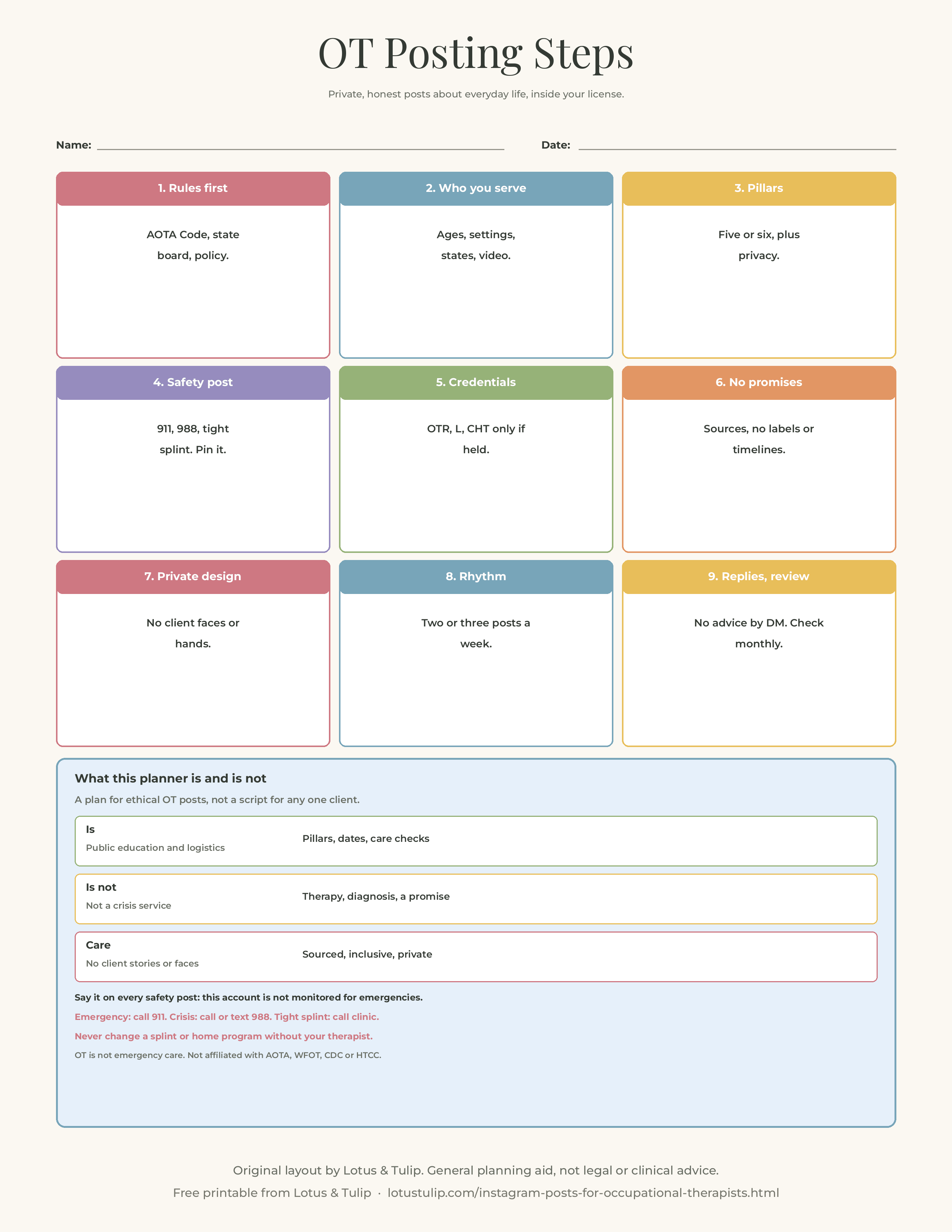
How to plan Instagram posts as an occupational therapist, step by step
- Read your rules first. Review the AOTA 2020 Code of Ethics (especially Standards 5B, 6A, 6D, 6F and 6H), your state practice act and board advertising rules, NBCOT or HTCC rules if you hold their credentials, HIPAA, FERPA or district policy if they apply, and your employer's social media policy.
- Write down who you serve. Ages, settings (clinic, school, home, hand clinic), the areas inside your competence, the states where you are licensed, and whether you offer telehealth. Your posts should match this list exactly.
- Choose five or six pillars. Pick from the ten above. Always keep a safety pillar and a privacy pillar in the rotation.
- Draft and pin the safety post. Include 911 for emergencies, call or text 988 for a crisis, "contact your doctor or clinic for a new or worsening symptom or a splint that feels too tight," "never change a splint or home program without asking your therapist," "occupational therapy is not emergency care" and "this account is not monitored for emergencies."
- Write an honest credentials line. Show your state license, OTR only while your NBCOT certification is active, CHT only if HTCC certifies you, and describe courses as courses.
- Draft posts with sources and without promises. Cite AOTA, IDEA, CDC STEADI, CMS, HHS, HTCC or 988 on the slide when you state a fact. Use descriptive language for sensory differences. End education posts with "General education, not individual advice." Never promise outcomes or timelines.
- Design for privacy and access. Use readable type, your own colors and no client photos or videos. Show objects and spaces, not people you treat. Add alt text and avoid putting key information only inside images.
- Schedule two or three posts a week. Plan four weeks at a time on the planner, mixing one education post, one practice post and an optional awareness or story day.
- Prepare replies and review monthly. Save DM replies that refuse individual advice and route people to booking, their own therapist or emergency services. Once a month, update hours, remove outdated posts and run every live post through the care check.
Mistakes and myths
Common mistakes
- Session clips of children. Even with a proud parent's blessing, a video of a child working on a skill puts a private struggle on display and works as an outcome advertisement. Standard 6D asks you not to post identifying information.
- Hands that can be recognized. A scar, a ring, a tattoo or a distinctive splint color can identify an adult hand therapy client as surely as a face.
- Before and after framing. "Week one versus week eight" posts imply a typical result. Under FTC Section 255.2, consumer endorsements about a key attribute are likely to be read as representative, and you would need to support that impression.
- Timelines and guarantees. "Neater handwriting in six weeks," "back to work in a month," "sensory meltdowns solved." Standard 6H asks for marketing that does not mislead, and no one can promise those results to a stranger.
- Checklists that act like screening tools. "Seven signs your child needs OT" invites self-diagnosis. Describe what an OT looks at instead, and route concerns to a pediatrician, the school team or an evaluation.
- Letters you do not hold. OTR after NBCOT certification lapses, CHT without HTCC certification, or a course name written to look like a credential. Standard 5B asks for accurate representation in all forms of communication.
- Splint tips for strangers. Strap adjustments, heat molding or wearing schedules posted as general advice. Keep splint content to care reminders and "ask your therapist."
- Vague telehealth reach. "Serving clients nationwide" when you are licensed in two states. Telehealth.HHS.gov notes that the ability to deliver care across state lines depends on state rules, and the OT Compact's own status page says you cannot practice under it until a state opens applications and your privilege is approved.
- Asking current clients for public reviews. The request is hard to refuse in a treating relationship, and selective publishing can distort what clients think under Section 255.2(d).
- Posting from a hard day. If a caption is built from one afternoon with one family, wait a day and write something general, or nothing.
Myths about occupational therapist Instagram
- "OT is too visual to explain without client footage." Objects, spaces, simple diagrams and clear words explain OT well. A photo of a buttonhook on a table says as much as a client's hands using it.
- "Parents want to see real kids." Many parents want to know their own child will not appear online. A privacy post often earns more trust than a montage.
- "Sensory content grows accounts, so post more of it." It may attract attention. It also attracts requests to diagnose children in the comments. Post it carefully and less often than the algorithm tempts you to.
- "General tips are basically a home program." A home program is individual and graded for one person. Public tips should be broad, safe for most readers and clearly labeled as general education.
- "You need to post daily." Two or three posts a week with current highlights is enough for most practices.
- "Instagram replaces a website." People still need a page with your license, fees, location, telehealth states and contact details that they can read without an app.
Three fictional examples
These people and practices are invented. They show decisions, not real clinics.
- Imani, a pediatric OT in a small clinic. A mother sends a video of her son practicing scissors and writes, "Post this, he is so proud." Imani thanks her, saves nothing, and replies that the practice never posts clients. That week she publishes a carousel on what cutting with scissors asks of a young child (hand strength, two hands working together, watching the line), ending with "General education, not individual advice." The mother shares the carousel with her own sister. The boy's video stays in the family.
- Teodoro, an OT who works in a hand clinic. Teodoro has years of hand therapy experience and is studying for the CHT exam. A colleague suggests he add "hand specialist" and the CHT initials to his bio because he is "basically there." He writes "Occupational therapist, OTR/L, focused on hand and upper limb rehab" instead and plans to add CHT only after HTCC confirms it. When a follower asks in a comment whether she can loosen her thumb splint because it rubs, he replies publicly that he cannot advise on a splint he has not seen, asks her to call the therapist who made it today, and adds that numbness or color change means she should seek care right away.
- Marguerite, a home health and outpatient OT. After a visit where a client nearly fell on a dark hallway, Marguerite starts drafting "So scary today with one of my patients." She deletes it, because the client's family follows the practice. Instead she posts a CDC Check for Safety series over three weeks: the path from bed to bathroom, grab bars, clear floors. Each slide cites CDC STEADI, says "General education, not individual advice," and ends with "If someone has fallen and is hurt or cannot get up, call 911." She does not claim the series prevented any falls. She keeps it in a Safety highlight.
Ethical OT post vs overclaiming post
| Topic | Ethical OT post | Overclaiming post |
|---|---|---|
| Handwriting | "What handwriting asks of a child, and when to ask about an evaluation." | "Fix messy handwriting in six weeks with these three drills." |
| Sensory | "Sensory preferences vary. If daily life is very hard, talk with your doctor or a licensed OT." | "If your child hates tags, they have sensory processing disorder." |
| Splints | "Wear and clean it as your therapist showed you. Too tight or numb: call your clinic." | "Splint rubbing? Just heat the edge with a hair dryer and bend it out." |
| Credentials | "OTR/L, licensed in [states]. CHT only when certified." | "Hand specialist, CHT (exam next spring)." |
| Results | "Here is what a first evaluation involves and how we set goals together." | "Week one vs week eight: see what OT did for this little guy." |
| Telehealth | "Video sessions for clients located in [states]. We confirm your location each visit." | "Online OT for anyone, anywhere." |
| Safety | "911 for emergencies, call or text 988 for crisis, this account is not monitored." | "DM me any time, I always answer." |
| Reviews | "Feedback welcome privately. Any posted review has written permission." | "Leave us five stars and get a free session." |
If you compare OT posting with neighboring professions, the core is similar: speech therapists worry most about child clips and sudden speech changes, mental health therapists about client stories and crisis lines, and OTs about recognizable hands, children at play, splint advice and home safety. Our speech therapist guide covers the speech side in detail.
When not to post
- When the post only works with a specific client in it. If you cannot write it without that person, do not write it.
- When you are tempted to answer "what does my child have?" Point to an evaluation, the pediatrician or the school team. Do not guess.
- When someone is asking how to change their splint or exercises. Route them to their own therapist or doctor. A public answer reaches many people you have never seen.
- When the post needs a promise to be interesting. Choose a different angle.
- When something is unfolding in your own clinic or family. A fall, an injury or a hard discharge is not content. Write a general post later, if at all.
- When you are tired, angry or comparing yourself with louder accounts. A quiet week with current highlights is fine.
- When your employer or district policy says no. Follow it, even on a personal-looking account.
Free 3 page occupational therapist Instagram printable (US Letter)
Print it, fill it in once a month, and keep it next to your scheduling tool. It works with any design app or template set.
- Page 1: OT Posting Steps. Nine step cards that match the HowTo above, what the planner is and is not, and safety lines for 911, 988, tight splints and "not emergency care."
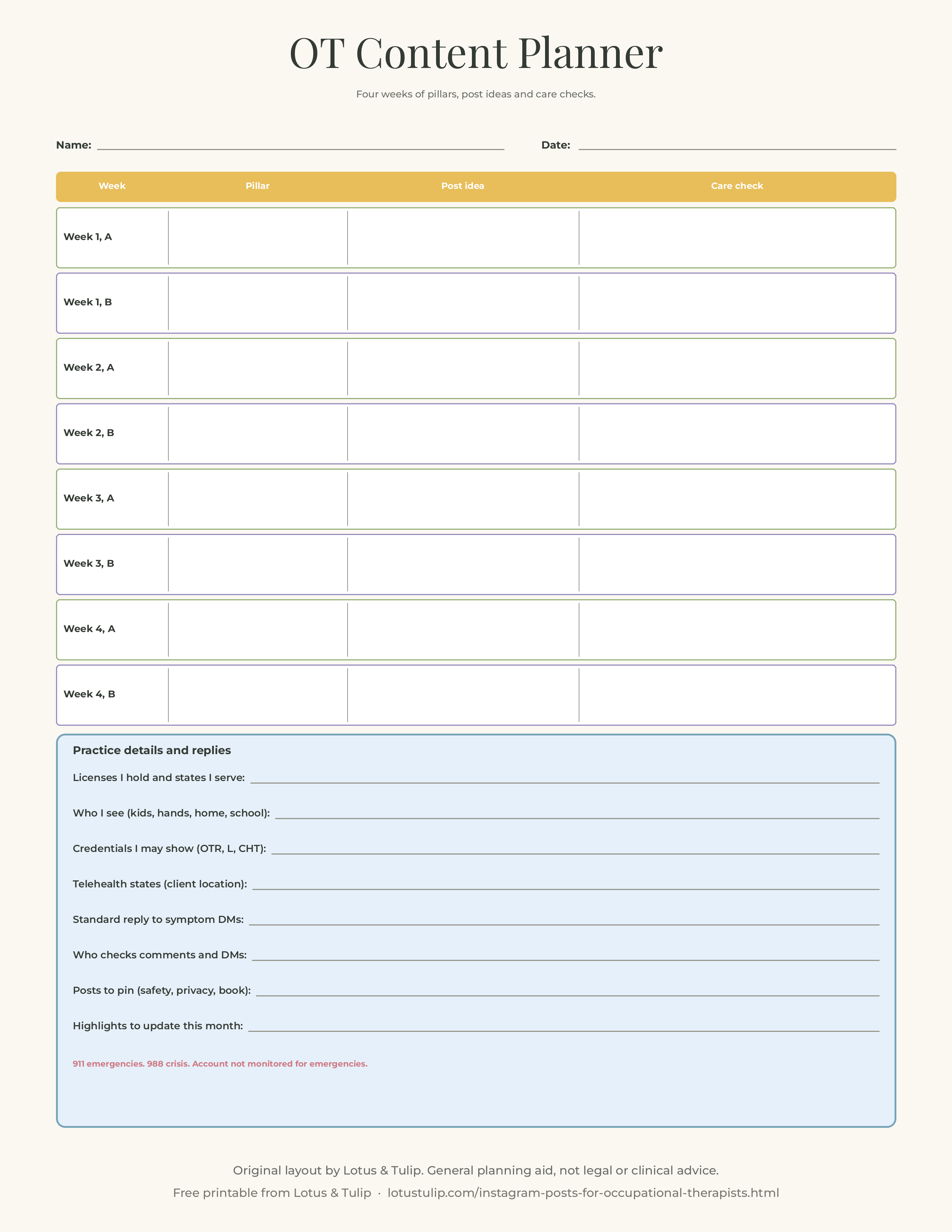
- Page 2: OT Content Planner. Four weeks of posts (two per week) with columns for pillar, post idea and care check, plus fields for licenses and states, credentials you may show, telehealth states, your standard reply to symptom DMs, who checks messages, posts to pin and highlights to update.
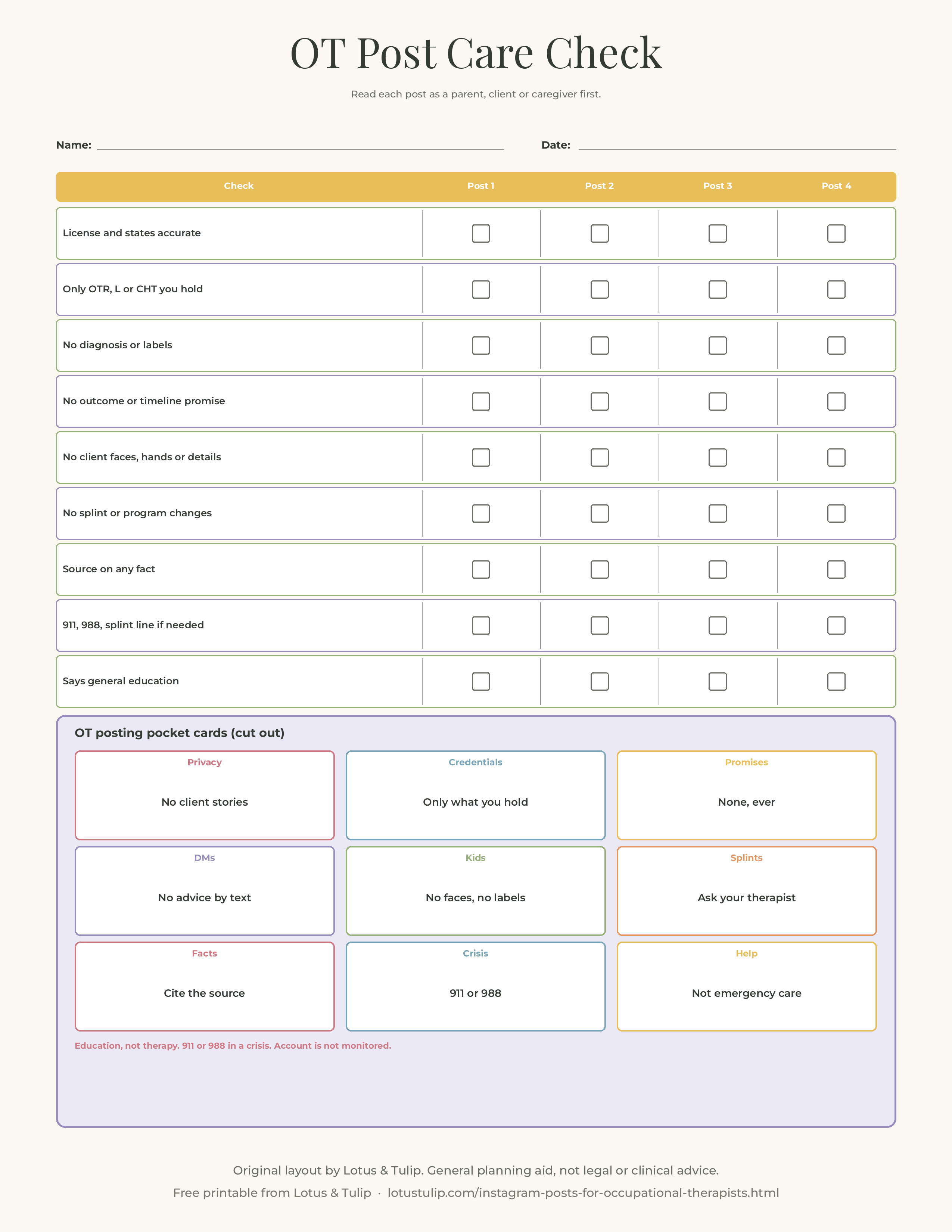
- Page 3: OT Post Care Check. A yes or no check for up to four posts (license and states accurate, only credentials held, no diagnosis or labels, no outcome promise, no client faces, hands or details, no splint or program changes, source on any fact, safety lines when relevant, general-education line), plus nine OT posting pocket cards to cut out.
Download free PDF · Page 1 PNG · Page 2 PNG · Page 3 PNG
Research notes (verified, with caveats)
- American Occupational Therapy Association. AOTA 2020 Occupational Therapy Code of Ethics. American Journal of Occupational Therapy, 74(Suppl. 3), 7413410005. Opened this session as the AJOT PDF (copy hosted by the Illinois Occupational Therapy Association). The Code states it applies to all occupational therapy personnel, that its enforceable Standards of Conduct apply to AOTA members, and that many state regulatory boards incorporate the Code or similar language. Principles: Beneficence, Nonmaleficence, Autonomy, Justice, Veracity, Fidelity. Standards quoted or closely paraphrased: 4B (evaluation and plan specific to the client), 5B (represent credentials, qualifications, education, experience, training, roles, duties, competence, contributions and findings accurately in all forms of communication), 6A (confidentiality of all forms of communication, naming HIPAA and FERPA), 6B (privacy and truthfulness in person or virtually), 6D (responsible conduct, respect and discretion on digital media and social networking, including refraining from posting protected health or other identifying information), 6F (no false, fraudulent, deceptive, misleading or unfair statements or claims), 6H (marketing and advertising truthful, accurate and carefully presented), 6L (collaborative interprofessional communication).
- National Board for Certification in Occupational Therapy. What Does it Mean to Be Board Certified by NBCOT? nbcot.org. Credentials OTR and COTA; "Only those who maintain an Active in Good Standing status with NBCOT can use the OTR or COTA credential"; describes the OTR as evaluating, planning interventions, completing discharge documents and supervising the COTA.
- Hand Therapy Certification Commission. Home page and Definition of Hand Therapy and Scope of Practice, htcc.org. A CHT is an occupational therapist or physical therapist with a minimum of three years of clinical experience, including 4,000 hours or more in direct practice in hand therapy, who has passed a comprehensive exam; CHTs recertify every five years. HTCC Disciplinary Policy lists misrepresenting certification status among violations.
- Electronic Code of Federal Regulations. 34 CFR 300.34, Related services (IDEA Part B regulations). Related services include occupational therapy; (c)(6) defines occupational therapy as services provided by a qualified occupational therapist, including improving, developing or restoring functions impaired or lost through illness, injury or deprivation; improving ability to perform tasks for independent functioning; and preventing, through early intervention, initial or further impairment or loss of function.
- Centers for Disease Control and Prevention, STEADI. Check for Safety: A Home Fall Prevention Checklist for Older Adults (brochure PDF) and the STEADI Patient and Caregiver Resources page. Suggestions used above are taken from the brochure's stairs, floors, kitchen, bedroom and bathroom sections. We did not repeat CDC fall statistics in this guide.
- 988 Suicide and Crisis Lifeline, 988lifeline.org. Call, text or chat; available 24/7/365; free and confidential.
- Centers for Medicare and Medicaid Services. What is a good faith health insurance estimate? cms.gov. If you are not using health insurance, providers usually must give a good faith estimate of expected charges if you request one or schedule services at least three business days in advance.
- Telehealth.HHS.gov. Licensing across state lines (last updated April 30, 2025). The ability to deliver care across state lines varies by state; pathways include a full license, temporary practice laws, reciprocity, compacts and telehealth registration; providers should verify patient location and obtain consent before an appointment.
- Occupational Therapy Licensure Compact, otcompact.gov (status updated October 2026). Compact privileges are equivalent to a license in member states, but you cannot practice under the compact until a state opens applications, deems you eligible and approves your application; until then you need a license in each state where you provide services.
- World Federation of Occupational Therapists. World Occupational Therapy Day page and 2026 theme announcement, wfot.org. Held annually on October 27; first launched on 27 October 2010; 2026 theme "Participation Matters," highlighting the role of everyday activities, roles and routines in supporting health, wellbeing and quality of life.
- American Occupational Therapy Association. Events page (OT Month) and OT Practice, April 2026. OT Month is celebrated each April; April 1 to 30, 2026; 2026 theme "Enriching Lives Through Meaningful Engagement."
- American Society of Hand Therapists. Hand Therapy Week, asht.org. "Hand Therapy Week is held each year during the first full week of June (beginning on a Monday)." The ASHT 2026 prospectus lists June 1 to 7, 2026.
- Federal Trade Commission. Guides Concerning Use of Endorsements and Testimonials in Advertising, 16 CFR Part 255 (revised July 26, 2023, 88 FR 48102), via eCFR. Section 255.2(b) on consumer endorsements and generally expected results; 255.2(d) on not distorting consumer reviews; 255.5 on disclosure of material connections.
This page is not affiliated with or endorsed by AOTA, NBCOT, WFOT, ASHT, CDC, HTCC, CMS, HHS, the OT Compact, the FTC or any licensing board. Our paid template kits are marketing tools for clinicians. They are not clinical interventions and have not been tested in any trial. You stay responsible for what you post.
Instagram posts for occupational therapists: FAQ
What should an occupational therapist post on Instagram?
Focus on what prospective clients, families and referral sources need: what occupation means, one daily task explained at a time, school OT or clinic OT, what hand therapy is, general splint care reminders, home safety ideas from CDC Check for Safety, how to check a license, who you see, fees and Good Faith Estimates, telehealth states, and a pinned safety post with 911 and 988. Keep a pinned privacy post too.
How often should an OT post on Instagram?
Two or three feed posts a week is enough for most solo practitioners and small clinics, plus occasional stories. Once a week is fine if you keep your Safety, Book and Fees highlights current.
Can I post photos or videos of clients if they give permission?
AOTA Standard 6D asks OT personnel to refrain from posting protected health or other identifying information, and HIPAA (if it applies to you) has strict authorization rules for marketing uses. Even with written authorization, consider whether the post identifies the person to their community and whether it acts as an outcome promise. Most practices are safer not posting clients at all.
Can I write OTR/L or CHT in my Instagram bio?
Only if both are true now. NBCOT says only those who maintain an Active in Good Standing status can use the OTR credential, and the L refers to your state license. HTCC lists misrepresenting certification status as a violation, so add CHT only after you are certified. AOTA Standard 5B asks for accurate representation of credentials in all forms of communication.
Is it okay to post sensory processing checklists for parents?
Checklists in the style of "signs your child has..." act like screening tools and invite self-diagnosis. Describe sensory preferences in everyday language, cite a reputable source if you state a fact, add "General education, not individual advice," and suggest talking with the child's doctor or a licensed OT about their own child.
Should I answer splint or home program questions in DMs?
No. Kindly refer the person to the therapist or doctor who made or prescribed the splint or program. Remind them that a splint that feels too tight, or fingers that change color or go numb, needs prompt contact with their clinic or doctor, and that emergencies go to 911.
Can I offer telehealth OT to followers in other states?
Only where you are licensed or otherwise legally allowed to practice in the state where the client is located. Telehealth.HHS.gov notes that rules vary by state and that providers should verify patient location before each appointment. The OT Compact is still being put into operation, and its status page says you cannot practice under it until your privilege is approved.
Is the free printable a copy of the paid kit?
No. The free three page set is an original planning aid: posting steps, a four week content planner and a post care check with pocket cards. The paid Steady Hand kit contains designed posts, stories, highlight covers, captions and a 12 week calendar. The printable is not a preview of that kit.