
Kids and teens · Support for children when a mom or dad has cancer, ages 4 to 12 · Updated 2026-11-15
Parent with cancer worksheets for kids: how to talk with a child about a parent's cancer, what research shows and a free family cancer plan

Ages 5 to 11: Kids Feelings and Social Skills Worksheets, incl. feelings detective, body clues, a feelings thermometer, a coping skills menu and a calm down plan Holiday 20% off: about $11.04, was $14 (EUR 12) · fillable PDF, instant digital download
Buy on EtsyTry it free first: download a fillable sample (feelings thermometer and calm-down plan, PDF, 240 KB). Type into it on screen, then get the full pack. No email needed.
Calm and move tools: Coping Skills Cards for Kids and Teens, 96 printable cards plus a coping skills list, toolbox worksheet and tracker Holiday 20% off: about $5.52, was $7 (EUR 6) · instant digital download
Buy on EtsyKids and teens bundle: Kids and Teens Worksheets Bundle (feelings, anger, self esteem, social anxiety) Holiday 20% off: about $22.08, was $28 (EUR 24) · 80 pages, instant digital download
Buy on EtsyWhen a mom or dad is diagnosed with cancer, one of the first questions parents ask is "what do we tell the kids?" You are far from alone in asking it. Using the US National Health Interview Survey, researchers at the National Cancer Institute estimated that about 1.58 million US cancer survivors live with their minor children, representing about 2.85 million children, and that about 562,000 children live with a parent in the early phases of treatment and recovery (Weaver and colleagues, 2010).
This guide is for parents, other caregivers, teachers, school counselors and therapists supporting children about 4 to 12 while a parent has cancer. It explains what children understand and worry about at different ages, what research shows (honestly, including its limits), what worksheets can and cannot do, eight kinds of activities, nine steps to help, age and need adaptations, notes for schools, common mistakes and three short examples. It ends with a free 2 page printable: My Cancer Questions Map and My Family Cancer Plan.
Professional help first when it is needed: these pages support children and do not replace your cancer care team, a pediatrician, a school counselor or a child therapist. Ask your care team's social worker or nurse for help talking with your children; many cancer centers have one. Ask for extra help if, over weeks, a child has ongoing trouble sleeping, eating, going to school or playing, seems withdrawn and hopeless, or cannot stop worrying. The American Cancer Society answers calls 24 hours a day at 1-800-227-2345. If a child or adult talks about wanting to die or hurt themselves, call or text 988 (Suicide and Crisis Lifeline). If anyone is in immediate danger, call 911.
Download the free parent with cancer worksheets for kids (PDF, 2 pages, US Letter)
Direct download, no email or sign up. See the pages first.
What children understand and worry about
Children usually know something is wrong before anyone tells them. The American Cancer Society (ACS) notes that children can usually sense when something is wrong, and MedlinePlus, from the US National Library of Medicine, points out that cancer is hard to keep secret, that a child who is not told may blame themselves, and that learning the news from someone else can harm their trust.
MedlinePlus lists three common fears that children may not say out loud, so it is a good idea for adults to bring them up first:
- "It is my fault." Younger children in particular may think something they did, said or thought caused the cancer.
- "I can catch it." Many children worry cancer spreads like the flu. The ACS is clear that you cannot catch cancer from someone else, including by touching, hugging, kissing or sharing meals.
- "Everyone dies from cancer." Children may know someone who died of cancer. You can explain that cancer is a serious illness, that there are many kinds, that everyone's cancer is different, and that modern treatments have helped millions of people survive it.
Underneath these is usually one more question: "Who will take care of me?" The ACS advises reassuring children that, no matter what happens, someone will always provide care for them, and sharing the plan for their care if you have one.
What the research shows, honestly
Research on children of parents with cancer is mostly small studies, often of mothers with early breast cancer, and mostly from Europe, the UK and the US. Here is what holds up, with its limits.
Most children do not develop serious problems, but worry and sadness are common. A systematic review by Osborn (2007) found that children and adolescents do not generally show higher levels of serious psychosocial difficulties than comparison groups, but are at a slightly increased risk of internalizing problems such as anxiety and low mood. Adolescent daughters appeared to be the most affected group. An earlier review of 52 studies found similar patterns, with anxiety and depression reported especially in adolescent daughters of ill mothers (Visser and colleagues, 2004).
Parents may miss how much a child is carrying. In a Dutch study that followed 49 adolescents through the first year after a parent's cancer diagnosis, 29% had clinically elevated stress response symptoms within 4 months, 16% at 6 months later and 14% at 12 months later. Teens with more stress symptoms reported more emotional and behavioral problems, while their parents observed fewer problems, which suggests parents may underestimate them (Huizinga and colleagues, 2010).
The family matters more than the medical details. A systematic review of 28 studies covering 2,896 families found no consistent link between illness factors and children's adjustment, except that worse disease status went with lower adjustment. Better family functioning went with better adjustment, and a parent's depressed mood went with worse adjustment (Krattenmacher and colleagues, 2012). Osborn's review also found family communication and openness consistently linked to how children were doing.
Children need information, a way to talk and a place to share feelings. A systematic review of children's needs and interventions identified three: age appropriate information about the parent's cancer, support communicating with parents, family and health professionals, and an environment where they can share positive and negative feelings and feel normal among peers. All 12 intervention studies reported at least one positive outcome, but only 5 showed significant improvements on validated measures, so the evidence is still limited (Ellis and colleagues, 2017).
Helping the parent helps the child. In a randomized trial in six US states, 176 mothers recently diagnosed with stage 0 to III breast cancer and their 8 to 12 year old children were assigned to five 1 hour educational counseling sessions (the Enhancing Connections Program) or to a booklet and phone call. At 2 months, children in the program group had fewer behavior problems and less anxiety and depressed mood, and at 1 year they remained less depressed than controls (Lewis and colleagues, 2015).
Many parents want help with this conversation. In UK interviews with 32 mothers with early breast cancer and their 56 school aged children, the most common reason for not telling children was avoiding their questions, especially about death. Few mothers were offered help talking with their children, and many would have liked it (Barnes and colleagues, 2000).
No study has tested worksheets like the ones on this page. They are a structured way to put the honest information, feelings work and steady routines recommended by the ACS, MedlinePlus and the National Cancer Institute into a child's hands.
What parent with cancer worksheets can and cannot do
They can give a child words for scary and mixed feelings, correct worries about fault and catching cancer, collect a child's questions so they do not stay hidden, show what will stay the same, help a child find ways to stay close on treatment days, and give adults a calm, shared way to check in over weeks and months.
They cannot replace honest conversations, the cancer care team, counseling for a child who is struggling, or support for the parents themselves. They should never be used to make a child talk before they are ready, to quiz what a child knows about the illness, or to give a child adult caregiving jobs.
8 kinds of parent with cancer activities for kids
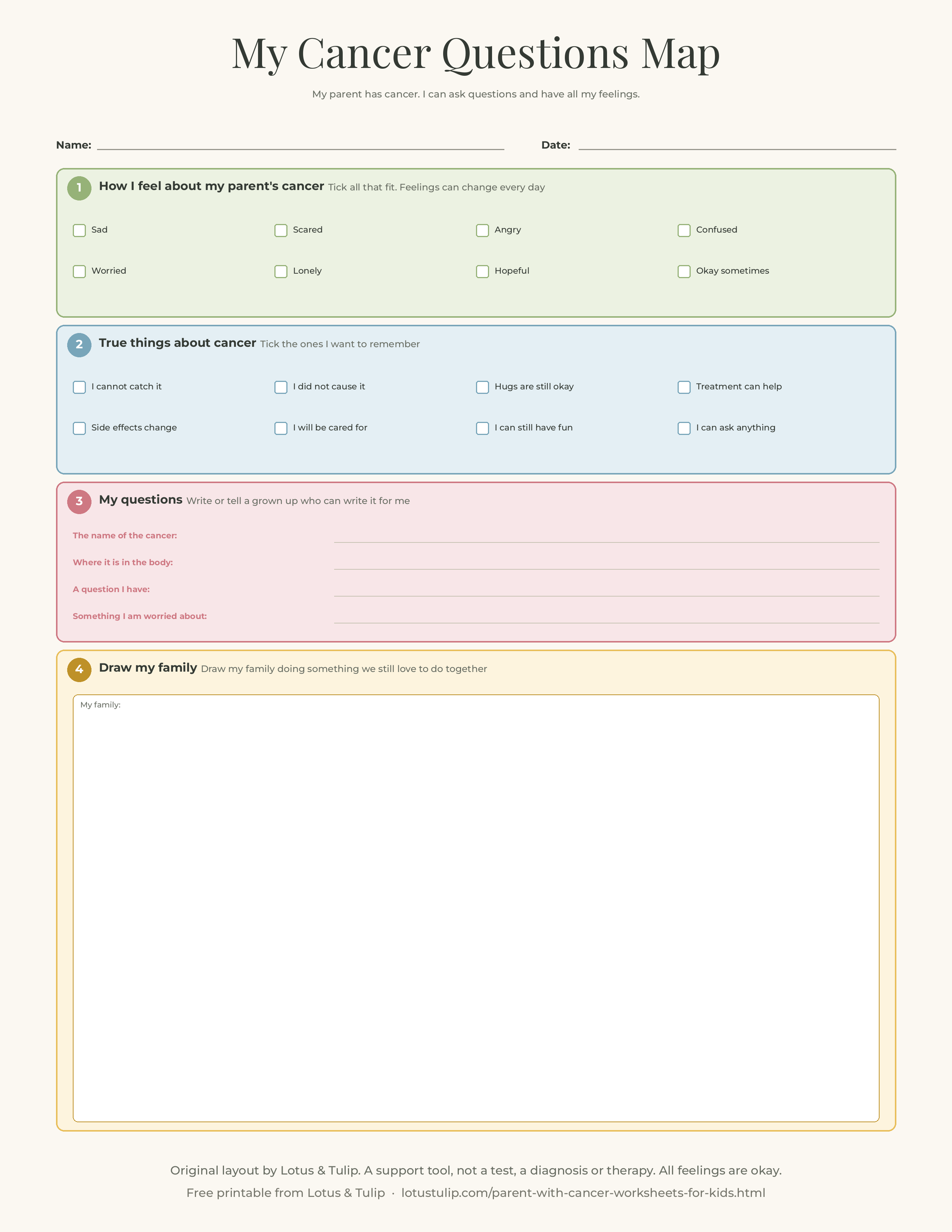
- Feelings check in: a list to tick or color, including scared, angry, lonely and hopeful, so no feeling is off limits.
- True things about cancer: short statements such as "I cannot catch it," "I did not cause it" and "I will be cared for" that answer the common hidden fears.
- My questions: the name of the cancer, where it is in the body, a question and a worry, written by the child or dictated to an adult.
- Draw my family: a drawing of the family doing something they still love to do together, which younger children can explain out loud.
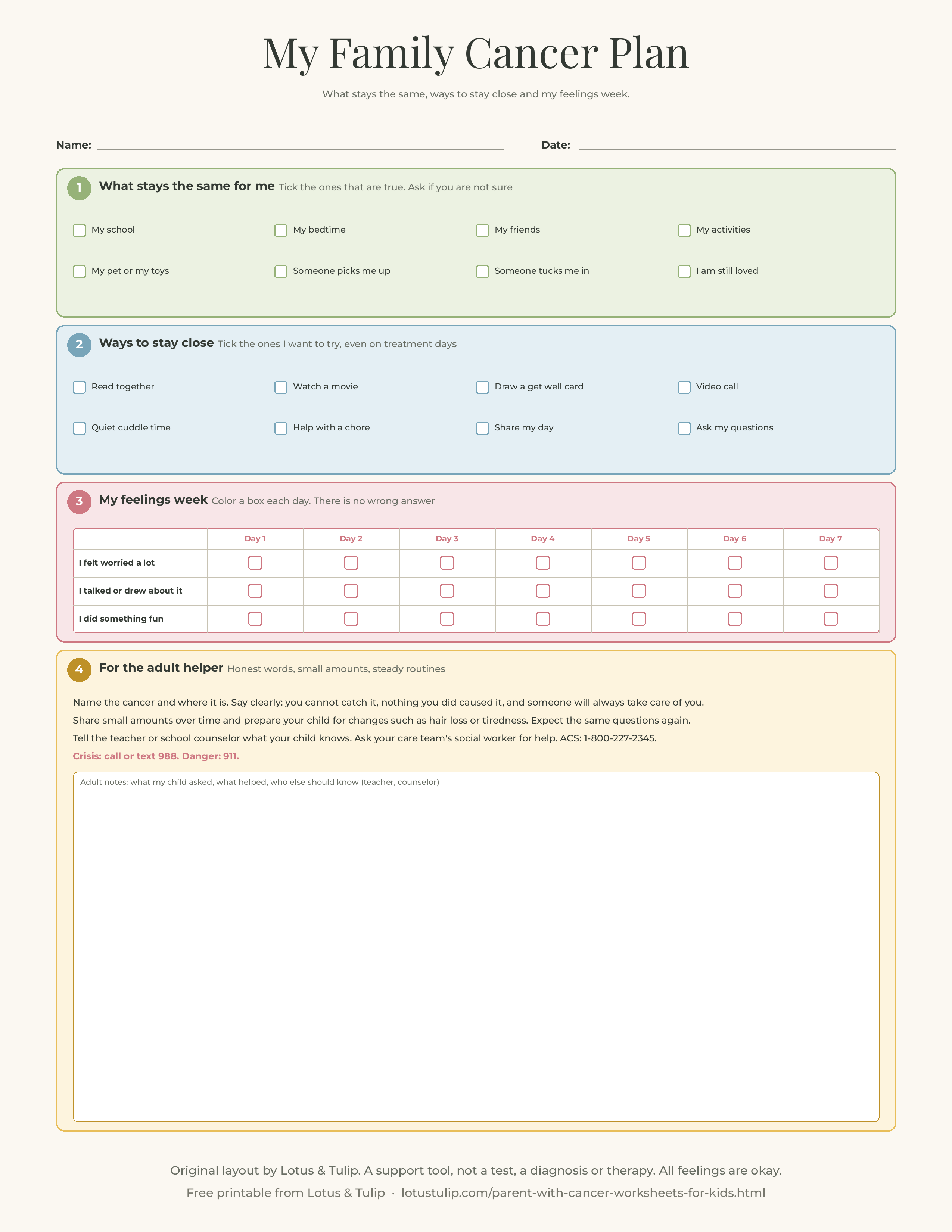
- What stays the same: school, bedtime, friends, activities and who picks the child up, so the child can see what is steady.
- Ways to stay close: reading together, a movie, a card, a video call, quiet cuddle time or a small chore, including on days the parent is tired or away for treatment.
- Feelings week tracker: a simple 7 day chart to notice worry, talking or drawing about it, and doing something fun.
- Changes ahead: preparing for side effects such as hair loss, tiredness or a hospital stay before they happen, and planning what will help.
How to talk with a child about a parent's cancer, step by step
- Tell the child soon, in a calm moment, with words they understand. The ACS notes that telling children the truth lowers the chance they get partial or false information from someone else. Plan what you will say with your partner or another trusted adult first if you can.
- Name the cancer and where it is. The ACS suggests most children need these basics: the type of cancer, where it is in the body, what will happen with treatment, how treatment may change how the parent looks and feels, and how the child's routines may change. For example: "Mommy has an illness called breast cancer. It is in my breast. The doctors will do an operation and give me strong medicine to get rid of it."
- Answer the hidden fears out loud. Say clearly: "You cannot catch cancer. You can still hug me. Nothing you did or thought made this happen." Use page 1 of the printable to tick these "true things" together.
- Promise care, not outcomes. If the outlook is not yet known, do not promise that everything will be fine. You can promise that someone will always take care of them and share who that will be, as the ACS recommends.
- Share small amounts over time and invite questions. The ACS and MedlinePlus suggest several shorter conversations rather than one long one. Ask what your child has heard or wonders about, collect questions on page 1, and say "I don't know yet, but I will tell you when I do" when that is true.
- Prepare for visible changes before they happen. MedlinePlus advises explaining side effects such as hair loss, weight loss or vomiting ahead of time, and which will go away. Before a hospital visit, describe what the child will see and plan a simple activity to do in the room.
- Keep routines steady and say who is helping. The ACS notes that children cope better when they know what to expect. Use page 2 to show what stays the same, who will do school runs, and how the child can reach the parent by phone or video call during treatment.
- Tell the school, with your child's knowledge. The ACS suggests telling the teacher or school counselor enough to understand what your child is going through, and letting your child know first. Help your child practice simple answers if friends ask questions.
- Look after the adults and check in over time. Research links a parent's low mood and family functioning to how children do. Talk with your care team's social worker or nurse about your own feelings, use the feelings week tracker to notice changes, and ask about local support groups for children of parents with cancer.
During treatment, after treatment and if cancer gets worse
During treatment, energy and moods may change from day to day. Quiet ways to stay close, such as reading in bed, watching a movie or drawing a card, keep the connection going on hard days. Children may help with small, age appropriate chores, but they should not be given adult caregiving jobs or be expected to keep adult secrets.
After treatment ends, many families expect life to snap back to normal, but children may still worry, especially around scans or check ups. Tell them about follow up appointments in advance, and keep the door open for questions.
If cancer comes back or the parent is dying, children still need the truth in words they understand. Ask your care team or a hospice social worker for help preparing your children, and see our grief activities for kids for support when a person dies.
How to adapt it by age and need
- Ages 3 to 5: the ACS notes that young children may think of being sick as having a cough or cold, may worry they can catch it, and may show more fear and anxiety when apart from a parent who is ill. Use short, concrete words, picture books, drawing and plenty of routine. Expect some regression in sleep, toileting or separation.
- Ages 6 to 8: children may ask very direct questions, including "are you going to die?" Answer honestly and calmly with what you know, and repeat the promise of care. They can tick the true things and dictate their questions.
- Ages 9 to 12: children may want more facts about the cancer, treatment and side effects, and may hide worry to protect a parent. Invite them to fill in both pages on their own, give them straight answers and make sure they have another trusted adult to talk with.
- Teens: the ACS stresses that telling the truth is especially important for teens and suggests updating them on treatment if they want it. Protect their time for school, friends and activities, and share the National Cancer Institute's free guide When Your Parent Has Cancer: A Guide for Teens.
- Single parent families and children with one main caregiver: explain early who will step in during treatment days, hospital stays and appointments, and write those names on page 2.
- Autism and literal thinkers: plain, consistent words matter even more. A short social story about the cancer and treatment, a picture schedule for changed days and early warnings about visible changes can help.
- ADHD and children who act out: worry often comes out as behavior. Keep activities short and active, keep routines predictable, and avoid punishments that remove time with the parent who is ill.
- When the other parent or a sibling is also struggling: family stress adds up. Ask for help from relatives, friends, school and your care team early rather than waiting.
When a student's parent has cancer: notes for teachers and school counselors
- Check in privately and kindly. A short "I heard your mom is having treatment. I'm here if you want to talk" is better than saying nothing. Follow the family's lead on what to share and never ask for details in front of classmates.
- Expect concentration and energy to dip. Hospital days, changed routines and worry can affect homework and focus. Adjust workload where you can rather than waiting for grades to fall.
- Plan for triggers. Lessons on health, illness or family projects, and events such as fundraising walks for cancer, can be hard or meaningful. Offer choices quietly ahead of time.
- Offer a counselor check in or group. With a caregiver's permission, a few sessions using the free printable can help a student sort feelings, write down questions to ask at home and plan for hard days. Peer groups can help students feel less alone.
- Help with questions from classmates. Younger classmates may believe cancer is catching. A simple class message, agreed with the family, that you cannot catch cancer can stop unkind myths.
- Know when to refer and report. Refer to the school psychologist, social worker or outside care if a student is struggling over time or talks about suicide. If a student describes being hurt or left without care, follow your school's procedure and your state's mandated reporting law.
Common mistakes
- Keeping it a secret. Children notice whispered calls and changes at home. Silence leaves them to imagine the worst or blame themselves.
- Using vague words. "Mommy is a bit sick" can make every cold seem dangerous. Name the cancer and explain how it is different from a cold.
- Promising everything will be fine. If things change, broken promises damage trust. Promise care and honesty instead.
- Not preparing for side effects. A parent suddenly bald, very tired or in a hospital bed can frighten a child who was not told what to expect.
- Turning children into caregivers. Small chores are fine; adult jobs, adult worries and adult secrets are not.
- Forgetting the adults. A parent's low mood is linked to how children do, so getting support for yourself is part of helping your child.
Examples
- Noah, 5: stopped hugging his dad after hearing the word cancer. His mom sat with him and the printable and said: "You cannot catch cancer. Hugs are still okay, and Daddy really wants them." Noah ticked "I cannot catch it" and "Hugs are still okay," and drew his family at the park. He now does a "quiet cuddle" with his dad after each treatment day.
- Sofia, 8: asked whether her mom would die like her friend's grandma. Her mom told her that her cancer was a different kind, that the doctors had a plan, and that Aunt Rosa would pick her up on treatment days. Sofia wrote "Will your hair fall out?" in the questions box, and they chose a fun headscarf together before chemotherapy started.
- Marcus, 11: seemed fine at home but stopped doing homework. With his dad's permission, the school counselor used the feelings week tracker with him and found he was lying awake worrying. His dad started a short weekly update over breakfast, and Marcus joined a support group for kids with a parent who has cancer.
Free printable: parent with cancer worksheets for kids
This printable is an original Lotus & Tulip layout. It is not an assessment, gives no score and does not replace professional help. Page 1, My Cancer Questions Map, has a feelings checklist, true things about cancer, a box for the child's questions and a box to draw the family. Page 2, My Family Cancer Plan, has what stays the same, ways to stay close, a feelings week tracker and notes for the adult helper, including honest words to use, telling the school, the American Cancer Society line, 988 and 911.
Download the free parent with cancer worksheets for kids (PDF, 2 pages, US Letter)
Prefer single images? Page 1: My Cancer Questions Map (PNG) · Page 2: My Family Cancer Plan (PNG)
Related resources
- Sibling support worksheets for kids: when a brother or sister is the one who is ill, with a free sibling support plan
- Hospital stay worksheets for kids: when it is the child who needs surgery or a hospital stay
- Anxiety worksheets for kids: when worry about a parent spills into everyday life
- Separation anxiety worksheet for kids: for children who struggle with goodbyes on treatment days
- Death of a grandparent worksheets for kids: including when a grandparent is very ill
- Grief activities for kids: if a parent dies
- Coping skills list for kids: 60 ideas for hard days
- All counseling resources for kids and teens
FAQ
How do I tell my child I have cancer?
Tell them soon, in a calm moment, in words they understand. Name the cancer, say where it is in the body and what treatment will happen, and explain how it may change how you look and feel and how their routines may change. Say clearly that they cannot catch it, that nothing they did caused it, and that someone will always take care of them.
Should I use the word cancer with a young child?
Yes. The American Cancer Society suggests telling children the type of cancer and where it is. Using the real word helps a child understand that it is different from a cold, and stops them hearing it first from someone else.
What if my child asks if I am going to die?
Answer honestly with what you know. If the outlook is good, you can say so. If it is not yet known, you can say the doctors are working hard, that you will tell them when you know more, and that someone will always take care of them. Avoid promises you may not be able to keep.
Can my child catch cancer from me?
No. The American Cancer Society explains that you cannot catch cancer from someone else, including by touching, hugging, kissing or sharing meals. Many children quietly worry about this, so it helps to say it out loud.
Should I tell my child's school?
Usually yes, with your child's knowledge. Tell the teacher or school counselor enough to understand what your child is going through and what words your family uses, so they can notice changes and offer support.
When should my child see a counselor?
If, over weeks, worry stops a child from sleeping, eating, learning or playing, if they seem withdrawn or hopeless, or if behavior changes a lot, talk with the pediatrician, school counselor or your care team's social worker. If a child talks about wanting to die, call or text 988. In an emergency, call 911.
What age are these parent with cancer worksheets for?
They are designed for children about 4 to 12. Younger children can color, point and talk through the pages with an adult who writes for them. Children 8 to 12 can fill in most of the map and plan themselves. Parents, teachers, school counselors and therapists can all use them.
Sources
- American Cancer Society. Helping children when someone they know has cancer; Telling others you have cancer; Is cancer contagious?
- Barnes, J., Kroll, L., Burke, O., Lee, J., Jones, A., and Stein, A. (2000). Qualitative interview study of communication between parents and children about maternal breast cancer. BMJ, 321(7259), 479 to 482.
- Ellis, S. J., Wakefield, C. E., Antill, G., Burns, M., and Patterson, P. (2017). Supporting children facing a parent's cancer diagnosis: a systematic review of children's psychosocial needs and existing interventions. European Journal of Cancer Care, 26(1), e12432.
- Huizinga, G. A., Visser, A., van der Graaf, W. T., Hoekstra, H. J., Gazendam-Donofrio, S. M., and Hoekstra-Weebers, J. E. (2010). Stress response symptoms in adolescents during the first year after a parent's cancer diagnosis. Supportive Care in Cancer, 18(11), 1421 to 1428.
- Krattenmacher, T., Kühne, F., Ernst, J., Bergelt, C., Romer, G., and Möller, B. (2012). Parental cancer: factors associated with children's psychosocial adjustment, a systematic review. Journal of Psychosomatic Research, 72(5), 344 to 356.
- Lewis, F. M., Brandt, P. A., Cochrane, B. B., and colleagues (2015). The Enhancing Connections Program: a six-state randomized clinical trial of a cancer parenting program. Journal of Consulting and Clinical Psychology, 83(1), 12 to 23.
- MedlinePlus (US National Library of Medicine). How to tell your child that you have cancer.
- National Cancer Institute. When your parent has cancer: a guide for teens.
- Osborn, T. (2007). The psychosocial impact of parental cancer on children and adolescents: a systematic review. Psycho-Oncology, 16(2), 101 to 126.
- Visser, A., Huizinga, G. A., van der Graaf, W. T., Hoekstra, H. J., and Hoekstra-Weebers, J. E. (2004). The impact of parental cancer on children and the family: a review of the literature. Cancer Treatment Reviews, 30(8), 683 to 694.
- Weaver, K. E., Rowland, J. H., Alfano, C. M., and McNeel, T. S. (2010). Parental cancer and the family: a population-based estimate of the number of US cancer survivors residing with their minor children. Cancer, 116(18), 4395 to 4401.
Lotus & Tulip is not affiliated with the American Cancer Society, MedlinePlus, the National Library of Medicine, the National Cancer Institute, the researchers, programs, agencies or organizations named on this page. Names in the examples are invented. This page is educational and does not replace professional medical, mental health or legal advice.