
Kids and teens · Preparing children for a hospital stay or surgery, ages 3 to 12 · Updated 2026-11-15
Hospital stay worksheets for kids: how to prepare a child for the hospital or surgery, what research shows and a free hospital coping plan

Ages 5 to 11: Kids Feelings and Social Skills Worksheets, incl. feelings detective, body clues, a feelings thermometer, a coping skills menu and a calm down plan Holiday 20% off: about $11.04, was $14 (EUR 12) · fillable PDF, instant digital download
Buy on EtsyTry it free first: download a fillable sample (feelings thermometer and calm-down plan, PDF, 240 KB). Type into it on screen, then get the full pack. No email needed.
Calm tools for the waiting room: Coping Skills Cards for Kids and Teens, 96 printable cards plus a coping skills list, toolbox worksheet and tracker Holiday 20% off: about $5.52, was $7 (EUR 6) · instant digital download
Buy on EtsyPicture schedules for hospital days: Visual Schedule and Behavior Supports, 23 pages with first then boards, token boards and 136 picture cards Holiday 20% off: about $6.44, was $8 (EUR 7) · instant digital download
Buy on EtsyA hospital stay or an operation is a big event in a child's life, even when the procedure itself is routine. It is also common. Federal data from the Healthcare Cost and Utilization Project counted about 5.2 million hospital stays for US children aged 0 to 17 in 2019. Most were for newborns and babies, but about 1.2 million were for children aged 1 to 17, with an average stay of about 4 to 5 days. Many more children have day surgery and go home the same day, which these numbers do not include.
This guide is for parents, other caregivers, teachers, school counselors and therapists helping children about 3 to 12 get ready for a planned hospital stay or surgery, and cope during and after it. It covers what children worry about at different ages, what research shows (honestly, including its limits), what worksheets can and cannot do, eight kinds of activities, nine steps to prepare, age and need adaptations, notes for schools, common mistakes and three short examples. It ends with a free 2 page printable: My Hospital Map and My Hospital Coping Plan.
Your child's care team comes first: these pages help children feel prepared and do not replace advice from your child's surgeon, anesthesia team, pediatrician or nurses. Ask them every medical question, including about eating and drinking before surgery, medicines and pain control at home. Ask whether the hospital has a child life specialist; many children's hospitals do. Call the care team if you are worried about your child after they come home. If a child or adult talks about wanting to die or hurt themselves, call or text 988 (Suicide and Crisis Lifeline). If anyone is in immediate danger or has a medical emergency, call 911.
Download the free hospital stay worksheets for kids (PDF, 2 pages, US Letter)
Direct download, no email or sign up. See the pages first.
What children worry about before a hospital stay
Children's fears depend on their age, but they are usually about the unknown, being apart from their family, pain and losing control. Children's hospitals describe the same patterns again and again:
- "Did I do something wrong?" Nationwide Children's Hospital notes that preschoolers may think a hospital stay is their fault, for example because they were "bad" or mean to a sibling. Texas Children's Hospital advises reminding young children that surgery is not a punishment.
- "Will you stay with me?" Separation is a natural fear at every age, and it is strongest in toddlers and preschoolers.
- "Will it hurt? Will I get a needle?" Nemours KidsHealth lists these among the most common questions children ask, along with "Will I be asleep during the operation?" and "Do I have to stay in the hospital?"
- "Will I wake up?" Texas Children's notes that school age children often fear the "sleep medicine" and worry they will wake up during surgery, and may worry about their body, modesty and missing friends and school.
- "What will people think?" Teens tend to worry most about pain, privacy, how surgery will affect their appearance and how it will affect their routines and friends.
What the research shows, honestly
Most research on children's hospital experiences focuses on planned surgery under general anesthesia, much of it from one research group at Yale, and many studies are small. Here is what holds up, with its limits.
Behavior changes after surgery are common, and usually fade. In a Yale study of 163 children aged 2 to 10 having elective surgery, 54% showed some negative behavior changes 2 weeks later, such as nightmares, separation anxiety, eating problems and more fear of doctors. This fell to 20% at 6 months and 7.3% at 1 year. Children of more anxious parents and children with a past poor medical experience were more anxious before surgery (Kain and colleagues, 1996). In a Finnish study of 551 children having day surgery, problem behavior changes fell from 46% on the day of the operation to 9% four weeks later, and pain on the day of surgery predicted problems for weeks afterward (Kotiniemi and colleagues, 1997).
Anxiety before surgery is linked to a harder recovery. In a study of 241 children aged 5 to 12 having their tonsils and adenoids removed, children who were anxious beforehand had more pain in hospital and over the first 3 days at home, used more pain medicine, and had more sleep problems. Emergence delirium (a period of confused, agitated waking) occurred in 9.7% of anxious children compared with 1.5% of those who were not anxious (Kain and colleagues, 2006).
Preparing the whole family helps. In a randomized trial of 408 children and parents, a family centered preparation program called ADVANCE lowered anxiety in the holding area compared with usual care, parent presence or a sedative medicine. Children who had the program were less anxious at the start of anesthesia than those with usual care or parent presence, had less emergence delirium, needed less pain medicine in recovery and left the recovery room sooner (Kain and colleagues, 2007).
Distraction and play can help, but evidence is thin. A Cochrane review of 28 trials with 2,681 children found that having a parent present as anesthesia starts did not, on its own, reduce children's anxiety. Videos of the child's choice, clowns, low sensory stimulation and handheld video games looked promising, but the overall certainty of the evidence was very low (Manyande and colleagues, 2015). In one trial of 112 children aged 4 to 12, 63% of those given a handheld video game had no increase or a decrease in anxiety, compared with 26% given a sedative and 28% with a parent only (Patel and colleagues, 2006). In a trial of 203 school age children having day surgery, preoperative therapeutic play lowered anxiety before and after surgery but did not change pain (Li and colleagues, 2007).
Child life specialists exist for this. An American Academy of Pediatrics policy statement describes how child life specialists use play, age appropriate explanations and preparation to help children understand medical events, rehearse coping and pain management strategies, and work through feelings about past or upcoming experiences (Romito and colleagues, 2021).
No study has tested worksheets like the ones on this page. They are a structured way to put the honest preparation, play, coping plans and family involvement that hospitals and researchers recommend into a child's hands.
What hospital stay worksheets can and cannot do
They can help a child name mixed feelings, learn what they will see, hear and feel, collect questions to ask the nurse or doctor, choose comfort items, practice calming skills before the big day, see the order of events, and give adults a calm way to check in during recovery.
They cannot replace medical advice, the hospital's own preparation programs, pain control, or help for a child who is struggling. They should never be used to describe medical risks to a young child, to force a child to talk, or to promise things the care team has not confirmed.
8 kinds of hospital stay activities for kids
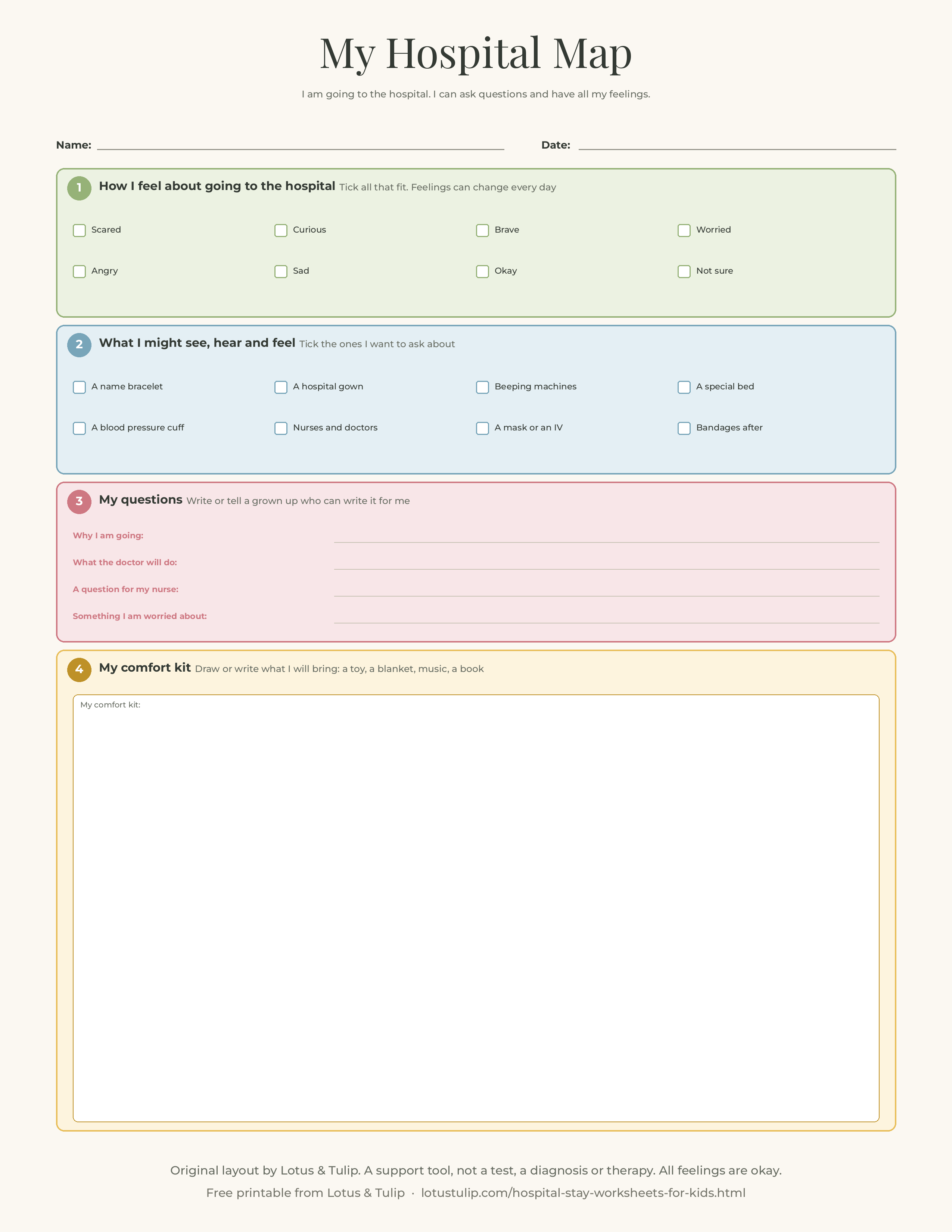
- Feelings check in: a list to tick or color, including scared, curious, brave and angry, so every feeling is allowed.
- What I might see, hear and feel: a picture or word list of hospital sights such as a bracelet, a gown, beeping machines and a blood pressure cuff. Hospitals such as Nationwide Children's recommend sensory descriptions like these.
- My questions: why I am going, what will happen and anything I want to ask, written by the child or dictated to an adult.
- My comfort kit: drawing or listing a favorite toy, blanket, music, book or game to bring.
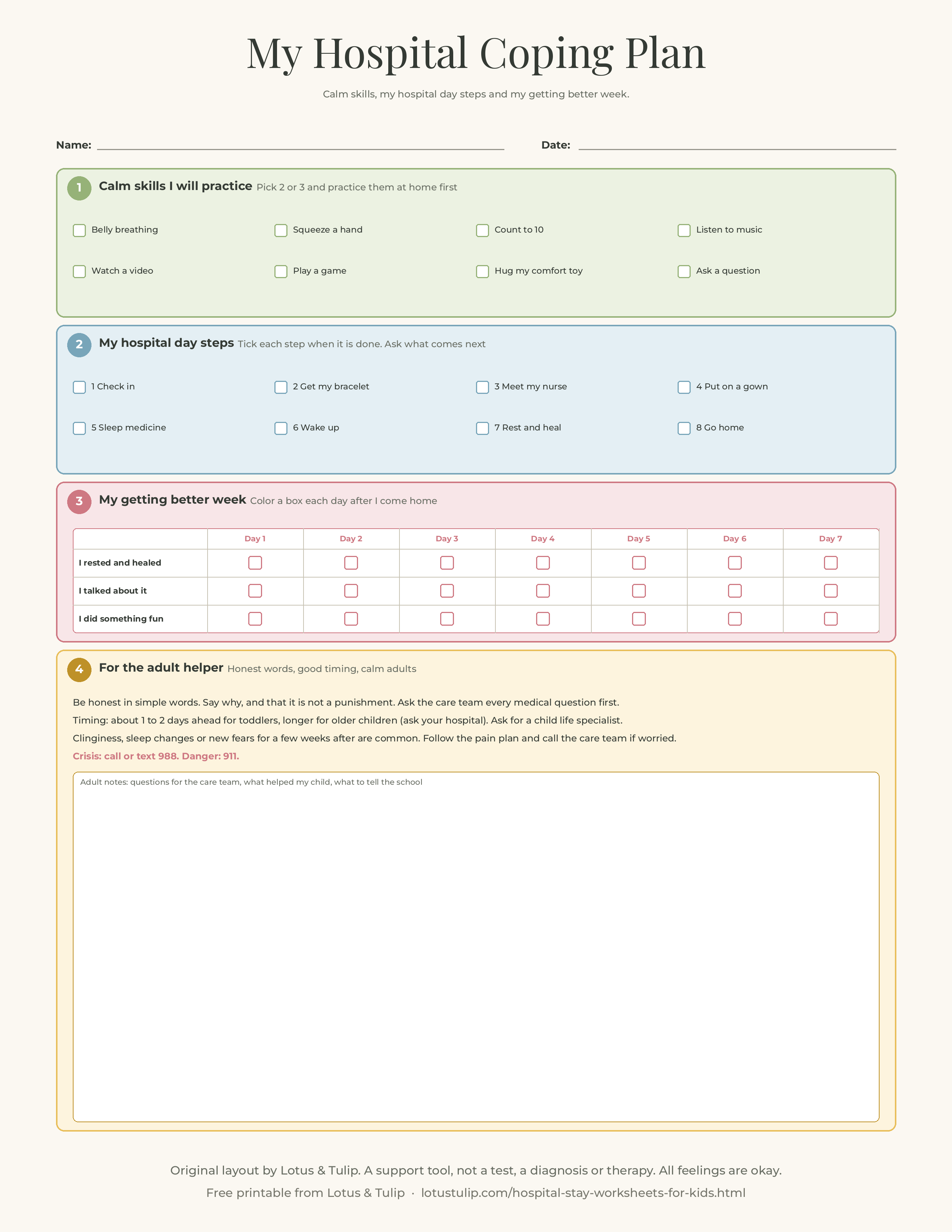
- Calm skills to practice: belly breathing, squeezing a hand, counting, music and looking away or watching, chosen and practiced at home first.
- My hospital day steps: the order of events, from check in to going home, so the day feels predictable.
- Medical play: a toy doctor kit or a stuffed animal "patient" to act out the steps, the core of therapeutic play.
- Getting better tracker: a simple 7 day chart for rest, fun and talking about the hospital, to notice changes after coming home.
How to prepare a child for the hospital or surgery, step by step
- Get the facts first. Nemours KidsHealth advises talking with the surgery team about what will happen before, during and after the procedure. Ask about the order of the day, whether you can stay with your child, how pain will be managed and whether there is a tour, a video or a child life specialist.
- Choose the timing by age. Advice varies a little between hospitals. HealthyChildren.org, from the American Academy of Pediatrics, suggests talking about the procedure 1 or 2 days ahead for toddlers and 5 to 6 days ahead for older children. Nationwide Children's suggests 2 to 4 days for preschoolers and at least a week for school age children and teens. If your child overhears or asks sooner, answer sooner.
- Be honest, in simple words. HealthyChildren.org stresses that honesty keeps a child's trust, and suggests gentle words for young children, such as "sore" instead of "pain." It also notes that children 3 to 12 are often not ready to hear about the risks of surgery or anesthesia, and that the anesthesia team may discuss risks with you when your child is not there.
- Say why, and say it is not a punishment. For example: "The doctor is going to fix your tummy so it stops hurting. You did not do anything wrong."
- Describe what they will see, hear and feel. Use page 1 of the printable to talk about the bracelet, the gown, the bed, the machines and the people. Read a picture book about going to the hospital, or watch the hospital's own tour video together.
- Act it out with play. Let your child be the doctor for a stuffed animal: put on a bracelet, listen with a toy stethoscope, try on a mask. Therapeutic play lowered children's anxiety before surgery in a randomized trial.
- Build a coping plan together. Choose two or three calm skills on page 2 and practice them at home, before the hospital day. Pack the comfort kit together. Nemours suggests letting a young child bring a special animal or blanket and telling them you will keep it during surgery and give it back as soon as you can.
- Stay calm and stay close. HealthyChildren.org notes that even young children pick up on a parent's fear. Get your own questions answered first, and tell your child who will be with them before and after the procedure.
- Plan the recovery and check in over weeks. Expect some clinginess, sleep changes or new fears for a few weeks; research shows they are common and usually fade. Use the getting better tracker, keep routines steady, follow the pain plan the care team gives you, and call the care team or pediatrician if you are worried.
Day surgery, longer stays and emergency admissions
For day surgery, the hospital day steps on page 2 matter most. Plan quiet activities for waiting, and plan a calm afternoon at home.
For longer stays, Nemours suggests helping your child plan things to do while recovering, such as videos, music, a device or visitors when they feel well enough. Keep as much of the normal routine as you can, such as bedtime stories, video calls with siblings and friends, and schoolwork when your child is ready. Ask about the hospital's playroom, school program and child life team.
After an emergency admission, there is no time to prepare beforehand. Use the pages afterward to help your child put the experience into words, sort out confusing memories and plan for follow up visits. If a child has ongoing nightmares, fear or avoidance after a frightening medical event, ask the pediatrician about support; see our trauma worksheets for kids.
How to adapt it by age and need
- Ages 3 to 5: keep explanations short and concrete, focus on what the child will see, hear, smell and taste, and repeat them. Use medical play and picture books, and say clearly that the hospital is not a punishment. Point and color rather than write.
- Ages 6 to 8: children may ask very direct questions such as "Will I wake up?" Answer honestly and simply, and let them dictate questions for the nurse. They can tick what they might see and hear and choose their own calm skills.
- Ages 9 to 12: Texas Children's suggests more detail about what will happen before, during and after, and inviting questions. Children this age often worry about their body, modesty and missing friends. They can fill in both pages on their own and ask the care team questions directly.
- Teens: hospitals recommend honest, complete information, a say in decisions where possible, privacy and time with friends. Teens may not need the worksheets but often value a written question list and a plan for staying in touch.
- Autism and literal thinkers: a picture schedule of the hospital day, photos of the actual hospital, early warnings about touch, noise and waiting, and clear "first, then" language can help. Tell the care team about sensory needs in advance; many hospitals can adjust.
- ADHD and children who find waiting hard: pack short, active distractions and a handheld game or video if the hospital allows it, and break the day into small steps.
- A child who has had a bad medical experience before: research links past poor medical encounters to more anxiety. Tell the care team, plan more preparation and more choices, and ask for a child life specialist.
- Children with chronic conditions and repeated stays: reuse the coping plan and update it each time, and celebrate what went better than last time.
When a student is having surgery or a hospital stay: notes for teachers and school counselors
- Ask the family what to share. Follow their lead on what classmates are told, and check in privately and kindly.
- Plan for missed work. Send manageable work rather than everything, and ask the family when the child is ready. Many school districts offer home or hospital instruction for students who miss extended time for medical reasons, so check what yours offers.
- Help the child stay connected. A class card, a short video message or a planned visit (with the family's permission) can ease the fear of missing out.
- Plan the return. Agree on any limits on activity, rest breaks, nurse visits and medicines with the family and school nurse. For ongoing health needs, ask whether a health plan or Section 504 plan is appropriate.
- Use the printable in a counselor check in. With a caregiver's permission, the pages can help a worried student prepare, or make sense of a hospital stay afterward.
- Know when to refer and report. Refer to the school psychologist, social worker or outside care if a student is struggling over time or talks about suicide. If a student describes being hurt or not cared for, follow your school's procedure and your state's mandated reporting law.
Common mistakes
- Not telling the child, or tricking them. A child taken to the hospital without warning may lose trust in adults and in future medical visits.
- Telling a young child too early or too much. Weeks of warning or detailed risks can make a preschooler more anxious. Match timing and detail to age.
- Promising things you cannot control. "It won't hurt at all" or "no needles" can backfire. Say what the care team will do to help instead.
- Using threats. "If you don't sit still, the doctor will give you a shot" turns medical care into punishment. Texas Children's warns against threats and bribes.
- Skipping the adults' preparation. A parent's calm matters, and research ties parent anxiety to child anxiety. Get your own questions answered first.
- Expecting recovery to end at discharge. Clinginess, sleep problems and new fears for a few weeks are common. Patience and routine help them fade.
Examples
- Mia, 4: was having ear tubes put in. Two days before, her dad read a hospital picture book with her and they gave her bunny a "check up" with a toy kit. Mia colored the bracelet and the gown on page 1 and chose her bunny and her blanket for the comfort kit. On the day she showed the nurse the bunny's bracelet.
- Jayden, 7: asked over and over whether he would wake up during his tonsil surgery. His mom wrote the question on page 1 and he asked the anesthesia nurse himself at the pre surgery visit. He practiced belly breathing and counting to 10, and took a handheld game for the waiting room.
- Ava, 11: had a planned week long stay for a bone operation and worried about missing her friends and her soccer season. With her school counselor, she filled in both pages, planned video calls with friends and asked her teacher for a lighter workload. Back home, she and her mom used the getting better tracker and noticed her sleep improving week by week.
Free printable: hospital stay worksheets for kids
This printable is an original Lotus & Tulip layout. It is not an assessment, gives no score and does not replace medical advice. Page 1, My Hospital Map, has a feelings checklist, things I might see, hear and feel, a box for my questions and a box to draw or list my comfort kit. Page 2, My Hospital Coping Plan, has calm skills to practice, my hospital day steps, a getting better tracker and notes for the adult helper, including timing by age, asking for a child life specialist, what to expect after coming home, 988 and 911.
Download the free hospital stay worksheets for kids (PDF, 2 pages, US Letter)
Prefer single images? Page 1: My Hospital Map (PNG) · Page 2: My Hospital Coping Plan (PNG)
Related resources
- Chronic illness worksheets for kids: for children whose condition is long term, with a free health coping plan
- Sibling support worksheets for kids: for the brothers and sisters at home during a hospital stay, with a free sibling support plan
- Anxiety worksheets for kids: when worry about the hospital spills into everyday life
- Separation anxiety worksheet for kids: for clinginess before and after a hospital stay
- Parent with cancer worksheets for kids: when it is a parent, not the child, who is in the hospital
- Breathing exercises for kids: calm skills to practice before the big day
- Coping skills list for kids: 60 ideas for hard days
- All counseling resources for kids and teens
FAQ
How do I explain surgery to a young child?
Use short, honest, simple words and focus on why and what they will see, hear and feel. For example: "The doctor will fix your ear while you are in a special sleep from medicine. You will not feel it, and I will be there when you wake up." Say clearly that it is not a punishment, and use play and picture books to help.
When should I tell my child about a hospital stay or surgery?
It depends on age, and hospitals vary a little. HealthyChildren.org suggests 1 or 2 days ahead for toddlers and 5 to 6 days ahead for older children, and Nationwide Children's suggests 2 to 4 days for preschoolers and at least a week for school age children and teens. Answer sooner if your child overhears or asks.
Should I tell my child about the risks of surgery?
Usually not in detail for younger children. HealthyChildren.org notes that children 3 to 12 are often not ready to hear about risks, and the anesthesia team may discuss them with you separately. Teens often want and deserve more complete information.
Is it normal for my child to act differently after surgery?
Yes. In research, about half of young children showed some negative behavior changes, such as nightmares, clinginess or eating problems, in the weeks after surgery, and most of these faded over the following weeks and months. Talk with the pediatrician if changes are severe or last more than a few weeks, and follow the care team's pain plan, since pain is linked to these changes.
What is a child life specialist?
A child life specialist is a trained professional who helps children understand and cope with medical care through play, age appropriate explanations and preparation. Many children's hospitals have them; ask whether your child can meet one before or on the day.
Can I stay with my child during surgery?
Policies differ between hospitals, so ask ahead. Some allow a parent to stay as anesthesia starts, and many let a parent rejoin the child in recovery. Research suggests a calm, prepared parent and distraction such as a video or game help more than presence alone.
What age are these hospital stay worksheets for?
They are designed for children about 3 to 12. Younger children can color, point and talk through the pages with an adult who writes for them, while children 8 to 12 can fill in most of the map and plan themselves. Parents, teachers, school counselors, therapists and hospital staff can all use them.
Sources
- Healthcare Cost and Utilization Project (Agency for Healthcare Research and Quality). Weiss, A. J., Liang, L., and Martin, K. (2022). Overview of hospital stays among children and adolescents, 2019. Statistical Brief 299.
- HealthyChildren.org (American Academy of Pediatrics). Lockman, J. L. General anesthesia for children: what parents need to know.
- Johns Hopkins Children's Center. Preparing for your child's hospital stay.
- Kain, Z. N., Mayes, L. C., O'Connor, T. Z., and Cicchetti, D. V. (1996). Preoperative anxiety in children: predictors and outcomes. Archives of Pediatrics and Adolescent Medicine, 150(12), 1238 to 1245.
- Kain, Z. N., Mayes, L. C., Caldwell-Andrews, A. A., Karas, D. E., and McClain, B. C. (2006). Preoperative anxiety, postoperative pain, and behavioral recovery in young children undergoing surgery. Pediatrics, 118(2), 651 to 658.
- Kain, Z. N., Caldwell-Andrews, A. A., Mayes, L. C., and colleagues (2007). Family-centered preparation for surgery improves perioperative outcomes in children: a randomized controlled trial. Anesthesiology, 106(1), 65 to 74.
- Kotiniemi, L. H., Ryhänen, P. T., and Moilanen, I. K. (1997). Behavioural changes in children following day-case surgery: a 4-week follow-up of 551 children. Anaesthesia, 52(10), 970 to 976.
- Li, H. C. W., Lopez, V., and Lee, T. L. (2007). Effects of preoperative therapeutic play on outcomes of school-age children undergoing day surgery. Research in Nursing and Health, 30(3), 320 to 332.
- Manyande, A., Cyna, A. M., Yip, P., Chooi, C., and Middleton, P. (2015). Non-pharmacological interventions for assisting the induction of anaesthesia in children. Cochrane Database of Systematic Reviews, 2015(7), CD006447.
- Nationwide Children's Hospital. Preparing your child for a hospital stay.
- Nemours KidsHealth. Helping kids get ready for surgery.
- Patel, A., Schieble, T., Davidson, M., and colleagues (2006). Distraction with a hand-held video game reduces pediatric preoperative anxiety. Paediatric Anaesthesia, 16(10), 1019 to 1027.
- Romito, B., Jewell, J., Jackson, M., AAP Committee on Hospital Care, and Association of Child Life Professionals (2021). Child life services. Pediatrics, 147(1), e2020040261.
- Texas Children's Hospital. Preparing your child for surgery.
Lotus & Tulip is not affiliated with the American Academy of Pediatrics, the Agency for Healthcare Research and Quality, Nemours, Nationwide Children's Hospital, Texas Children's Hospital, Johns Hopkins, the researchers, hospitals or organizations named on this page. Names in the examples are invented. This page is educational and does not replace professional medical or mental health advice.