
Kids and teens · Supporting brothers and sisters of a child with a chronic illness, cancer or disability, ages 3 to 12 · Updated 2026-11-15
Sibling support worksheets for kids: how to help the brother or sister of a child with a chronic illness, cancer or disability, what research shows and a free sibling plan

Ages 5 to 11: Kids Feelings and Social Skills Worksheets, incl. feelings detective, body clues, a feelings thermometer, a coping skills menu and a calm down plan Holiday 20% off: about $11.04, was $14 (EUR 12) · fillable PDF, instant digital download
Buy on EtsyTry it free first: download a fillable sample (feelings thermometer and calm-down plan, PDF, 240 KB). Type into it on screen, then get the full pack. No email needed.
Calm tools for hard days: Coping Skills Cards for Kids and Teens, 96 printable cards plus a coping skills list, toolbox worksheet and tracker Holiday 20% off: about $5.52, was $7 (EUR 6) · instant digital download
Buy on EtsyBest value for families and counselors: Kids and Teens Worksheets Bundle (feelings, anger, self esteem, social anxiety) Holiday 20% off: about $22.08, was $28 (EUR 24) · 80 pages, instant digital download
Buy on EtsyMany American children grow up next to a brother or sister with serious health needs. In the 2019 to 2020 National Survey of Children's Health, nearly 1 in 5 US children (19.4%, about 14.1 million) had a special health care need, such as a chronic illness, a disability or a developmental or emotional condition, and more than 1 in 4 households with children (28.6%) had at least one such child. Most of those children have brothers or sisters. Those siblings love the child who is sick, and they also live with hospital trips, changed plans, parents who are tired or away and feelings they may think they are not allowed to have.
This guide is for parents, other caregivers, teachers, school counselors, child life specialists and therapists supporting children about 3 to 12 whose brother or sister has cancer, another serious or chronic illness, or a disability. It covers what siblings worry about, what research shows (honestly, including its limits), what worksheets can and cannot do, eight kinds of activities, nine steps to help, situations such as hospital stays and caregiving, age and need adaptations, notes for schools, common mistakes and three short examples. It ends with a free 2 page printable: My Sibling Feelings Map and My Sibling Support Plan.
Professional help comes first when things are hard: these pages support everyday family conversations and do not replace a pediatrician, counselor, psychologist or child life specialist. HealthyChildren.org, from the American Academy of Pediatrics, advises parents not to try to solve a sibling's struggles alone: ask your child's pediatrician or the care team about psychologists, social workers, child life specialists and sibling groups. If a child talks about wanting to die or hurt themselves, call or text 988 (Suicide and Crisis Lifeline). If anyone is in immediate danger, call 911.
Download the free sibling support worksheets for kids (PDF, 2 pages, US Letter)
Direct download, no email or sign up. See the pages first.
What siblings worry about
Family guidance from the American Academy of Pediatrics (AAP), the American Cancer Society (ACS), Children's Hospital of Philadelphia (CHOP) and the Sibling Support Project describes the same themes again and again:
- "Nobody notices me." HealthyChildren.org notes that brothers and sisters may often feel neglected and may feel invisible unless they demand attention, simply because the child with the condition needs so much care.
- "Did I cause this? Can I catch it?" The ACS advises telling siblings of a child with cancer that they cannot catch it and did not cause it. Young children can believe an angry thought or a fight made their brother or sister sick.
- "I'm jealous, and that makes me a bad person." Siblings often feel jealous of the attention, gifts and visits, then guilty for feeling that way. The ACS reminds parents to tell siblings that these feelings are normal and not selfish.
- "I have to be the good one." The Sibling Support Project lists pressure to achieve, embarrassment, resentment and peer issues among the concerns siblings face, along with worries about the future and caregiving demands.
- "What is going to happen?" Uncertainty about tests, treatment and the future is a common theme in research with siblings of children with cancer.
What the research shows, honestly
Research on siblings is large but uneven. Many studies are small, use different measures or compare siblings with population norms rather than matched peers. Here is what holds up, with its limits.
On average the effects are small, but some siblings struggle. A meta-analysis by Sharpe and Rossiter (2002) of 51 published studies and 103 effect sizes found a modest negative effect for siblings of children with a chronic illness, mainly in psychological functioning (such as depression and anxiety), peer activities and cognitive development scores. Effects were larger when the illness needed daily treatment, and parent reports were more negative than children's own reports. A later meta-analysis by Vermaes and colleagues (2012) found a small overall negative effect (d = -.10), with slightly more internalizing problems such as worry and sadness (d = .17). Older siblings and siblings of children with life threatening or highly intrusive conditions were more at risk.
Siblings of children with cancer: not usually a disorder, often real distress. A systematic review of 65 papers found that siblings of children with cancer do not show raised average rates of psychiatric disorders, but a significant subset have post traumatic stress symptoms, strong emotions such as fear, worry, sadness, anger and guilt, and lower quality of life in emotional, family and social areas. Distress was greater closer to diagnosis, and school difficulties showed up within 2 years (Alderfer and colleagues, 2010). An updated review of 102 studies found average anxiety and depression similar to comparison children, but cancer related post traumatic stress symptoms were common, and school aged siblings had poorer school functioning and more absences (Long and colleagues, 2018).
Friendships often hold up. In a classroom study of 87 siblings aged 8 to 16 and 256 matched classmates, peers reported no differences in friendships or acceptance, and teachers rated siblings as more likable. Mothers did report less involvement in activities and poorer school performance for the siblings (Alderfer and colleagues, 2015).
There can be good things too. HealthyChildren.org notes that a family member with a chronic illness can bring opportunities for empathy, responsibility, adaptability, problem solving and creativity, and qualitative studies describe siblings' maturity and compassion alongside the hard parts.
Support helps, though the evidence is early. In a group program for 54 siblings aged 8 to 13 and their parents, siblings' knowledge of the condition and sense of connection rose and behavior problems fell, with gains holding at 3 months in a subsample of 20 families; the study had no control group (Lobato and Kao, 2002). A meta-analysis of sibling well-being programs found 17 studies and pooled 8: before and after comparisons showed better behavior and more knowledge about the sibling's condition, but the behavior effect was not significant in studies with a control group (McKenzie Smith and colleagues, 2018). In pediatric cancer, a review of 125 articles found moderate quality evidence to justify a strong recommendation that siblings receive psychosocial support and that parents and professionals learn how to meet siblings' needs (Gerhardt and colleagues, 2015).
No study has tested worksheets like the ones on this page. They are a simple way to put what guidance and research point to, honest information, room for mixed feelings, protected one on one time and a sibling's own life, into a child's hands.
What sibling support worksheets can and cannot do
They can help a child name mixed feelings, ask the questions they have been holding in, tell adults what they need, plan special time with a parent, keep their own activities going and give adults a calm, regular way to check in.
They cannot treat anxiety, depression or trauma symptoms, replace a counselor or a sibling program, or explain a medical condition in place of the care team. They should never be used to make a child feel guilty for being healthy, to turn a child into a caregiver, or to push a child to say they are fine.
8 kinds of sibling support activities for kids
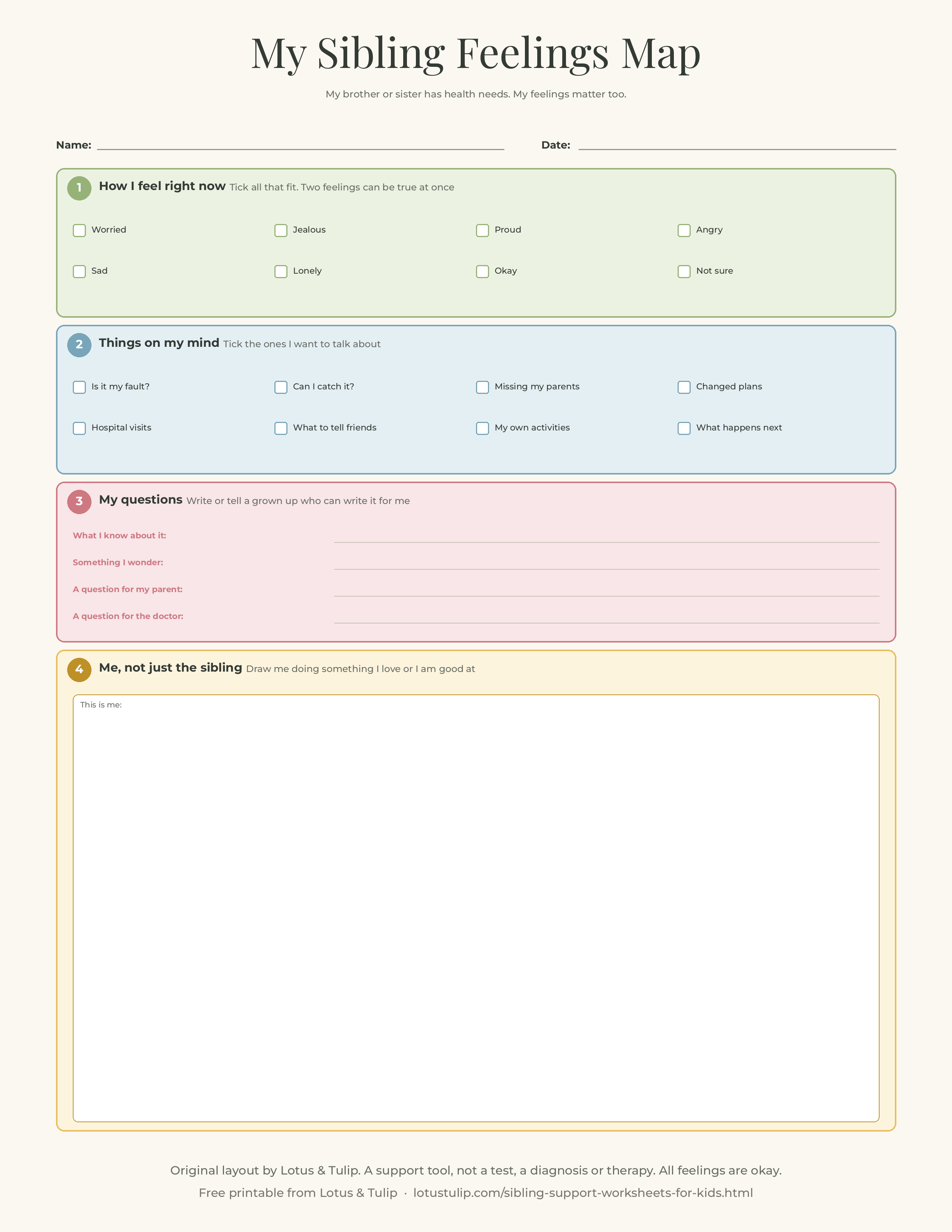
- Feelings check in: a list to tick or color, including worried, jealous, proud, angry, sad and lonely, so every feeling is allowed, including mixed ones at the same time.
- Things on my mind: a checklist of common sibling worries, such as "Is it my fault?", "Can I catch it?", missing my parents, changed plans, what to tell friends and what happens next.
- My questions: short sentence starters for what the child knows, what they wonder and a question for a parent, a nurse or the doctor.
- Me, not just "the sibling": a drawing box for the child's own interests and strengths, so they are seen as a person in their own right.
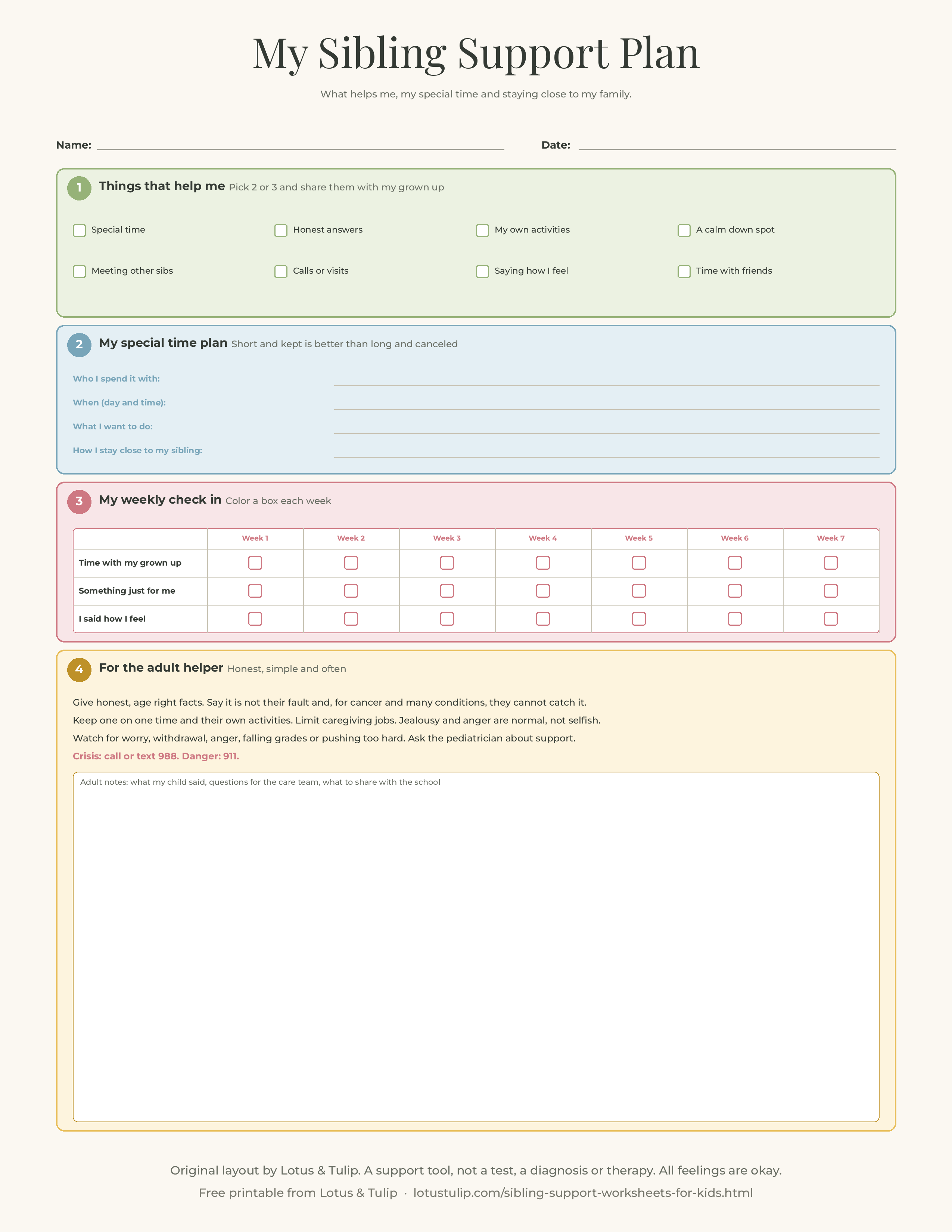
- Things that help me: choosing two or three supports, such as special time with a parent, a calm down spot, keeping my own activities or meeting other siblings.
- Special time plan: a short, protected time each week with a parent or another trusted adult, with the child choosing the activity.
- Staying connected: ways to stay close to a brother or sister in the hospital, such as drawings, video calls, voice messages and visits when allowed, as the ACS suggests.
- Weekly check in: a simple tracker for having time with my grown up, doing something just for me and saying how I feel.
How to support the sibling of a child with a chronic illness, step by step
- Tell them the truth, simply. HealthyChildren.org and CHOP say siblings need honest, age appropriate information about the condition. Name it, explain what treatment looks like and what will change at home, and say that it is okay to ask anything, again and again.
- Clear up blame and contagion early. Say plainly that nothing they did, said or thought caused it. For cancer and many other conditions, tell them they cannot catch it. Young children may need to hear this many times.
- Make room for every feeling. Use page 1 of the printable to name feelings. CHOP suggests making it clear that it is all right to be angry at times. Jealousy, worry, pride and love can all be true together.
- Protect one on one time. HealthyChildren.org suggests spending time with each child individually and building a special relationship with each one. Even 15 minutes at bedtime, set and kept, matters. Use page 2 to plan it.
- Keep their life going. Protect school, friends, sports and lessons where you can. CHOP suggests arranging short term care for the ill child so a parent can attend important sibling events, and occasionally putting the sibling's needs first.
- Limit caregiving. Helping can build pride, but CHOP advises limiting siblings' caregiving responsibilities and using respite and help from friends and family. The Sibling Support Project reminds adults that siblings have a right to their own lives.
- Help them stay connected. Invite drawings, calls and messages to the sibling who is sick, and visits to the hospital when possible. The ACS suggests introducing siblings to the care team so they feel part of what is happening.
- Find other siblings. Ask the care team or school about sibling groups, camps or Sibshops, peer support programs for school age siblings. Meeting children in the same situation helps siblings feel less alone.
- Watch for warning signs and get help. HealthyChildren.org lists signs a sibling may need extra attention, including anxiety, sadness, withdrawal, anger, losing interest in friends or activities, falling grades, pushing too hard to achieve or acting out for attention. If you see them, talk with the pediatrician.
Hospital stays, flare ups and caregiving at home
During hospital stays or intensive treatment. Siblings may stay with relatives or friends for days at a time. A simple schedule of who will pick them up, a phone or video call at a set time each day and a familiar object from home help. If the brother or sister in the hospital needs help preparing, see our hospital stay worksheets for kids.
Flare ups and setbacks. Plans may change at short notice. Tell siblings what is happening in a few words, and keep their routine as steady as you can. Uncertainty is easier with a plan for who will be with them.
Disability and daily care. When a brother or sister has a disability with daily care needs, siblings may help in many ways. The Sibling Support Project notes that ordinary sibling conflict, teasing and arguing are common in most families, even when one child has special needs, and that siblings should not always be told to give in because they are bigger or "should know better."
If a sibling's condition becomes life threatening. Keep information honest and age appropriate, involve the care team, child life specialist or hospital social worker and see our grief activities for kids if a child dies. If it is a parent who is ill, see our parent with cancer worksheets for kids.
How to adapt it by age and need
- Ages 3 to 5: use very short, concrete words ("Sam's blood is sick, and the doctors are giving him medicine"), keep routines the same and let the child color and point while an adult writes. Young children may believe they caused the illness, so repeat often that it is not their fault.
- Ages 6 to 8: children may ask direct questions about fairness and whether they will get sick too. Let them tick worries, dictate questions and draw themselves doing what they love.
- Ages 9 to 12: they understand more and may hide feelings to protect their parents. Offer privacy, let them fill in both pages alone and choose what to share, and give fuller medical information if they want it.
- Teens: respect privacy and independence, include them in family decisions where appropriate, as HealthyChildren.org suggests, and watch for too much caregiving or pressure to achieve.
- Autism and literal thinkers: a visual schedule of who will be home, clear "first, then" language and photos of the hospital or clinic can help.
- ADHD and children who find waiting hard: bring busy kits for appointments and keep check ins short and active.
- A sibling with a disability: focus on the sibling's own relationship with their brother or sister, their questions about the disability and their own future, which the Sibling Support Project says siblings wonder about throughout life.
Notes for teachers and school counselors
- Ask about the sibling, not only the sick child. In Sibling Support Project accounts, adult siblings remember teachers who asked how they were doing and treated them as a person, not just someone's brother or sister.
- Expect school effects and plan for them. Research links a sibling's cancer with more absences and lower school performance in some siblings. Flexible deadlines and a quiet check in can help.
- Keep the family informed. Share what you notice with parents, and keep confidential medical information private.
- Use the printable in a counselor check in. With a caregiver's permission, the pages can help a student sort out feelings and needs. A small group for siblings, or a referral to a local Sibshop, can help students see they are not alone.
- Know when to refer and report. Refer to the school psychologist, social worker or outside care if a student is struggling over time or talks about suicide. If a student describes being hurt or not cared for, follow your school's procedure and your state's mandated reporting law.
Common mistakes
- Saying nothing to protect them. Silence leaves children to fill gaps with their own fears. Honest, simple words are safer.
- Treating jealousy or anger as selfish. These feelings are normal. Shaming them teaches a child to hide them.
- Making the sibling a second caregiver. Some help is fine; regular adult jobs are not.
- Missing the "good" child. A sibling who never complains and pushes hard to achieve may be struggling quietly.
- Letting all special time disappear. Short, protected time that is kept matters more than long plans that keep getting canceled.
- Forgetting siblings after treatment ends. Feelings can surface later, once the crisis is over. Keep checking in.
Examples
- Ava, 5: her baby brother has a heart condition and was in the hospital for weeks. She asked if she made him sick by being mad at him. Her dad told her, many times, that nothing she did caused it. On page 1 she colored "Worried" and "Lonely," and they planned a Saturday library trip, just the two of them.
- Jayden, 8: his sister has leukemia. He was angry that his birthday party was canceled and then felt guilty. His mom told him the anger made sense. They rescheduled a small party while his grandma stayed with his sister, and he made a video message for her that the nurses played in her room.
- Maya, 11: her brother is autistic and needs a lot of help in the mornings. She had started doing most of his routine and fell behind on homework. With her school counselor she filled in page 2 privately and wrote "I want mornings to be less my job." Her parents changed the morning plan and found a Sibshop nearby.
Free printable: sibling support worksheets for kids
This printable is an original Lotus & Tulip layout. It is not an assessment, gives no score and does not replace professional advice. Page 1, My Sibling Feelings Map, has a feelings checklist, things on my mind, my questions and a box to draw "me, not just the sibling." Page 2, My Sibling Support Plan, has things that help me, my special time plan, a weekly check in tracker and notes for the adult helper, including honest information, it is not their fault, limiting caregiving, warning signs, 988 and 911.
Download the free sibling support worksheets for kids (PDF, 2 pages, US Letter)
Prefer single images? Page 1: My Sibling Feelings Map (PNG) · Page 2: My Sibling Support Plan (PNG)
Related resources
- Chronic illness worksheets for kids: for the brother or sister who lives with the condition, with a free health coping plan
- Hospital stay worksheets for kids: for the brother or sister who is going into the hospital
- Parent with cancer worksheets for kids: when it is a parent who is ill
- Sibling rivalry worksheets for kids: for everyday squabbles between brothers and sisters
- Anxiety worksheets for kids: when worry spills into everyday life
- Coping skills list for kids: 60 ideas for hard days
- Grief activities for kids: if a brother or sister dies
- All counseling resources for kids and teens
FAQ
How does having a sick brother or sister affect a child?
It varies. Meta-analyses find small average effects, mostly more worry and sadness, with higher risk when the illness is life threatening or needs intensive daily treatment. Many siblings cope well and also show empathy and maturity, while some struggle, especially near diagnosis. Watching closely and offering support matters more than expecting problems.
What should I tell my child about their sibling's illness?
The truth, in words that fit their age: the name of the condition, what treatment involves, what will change at home and who will look after them. Tell them it is not their fault and, for cancer and many other conditions, that they cannot catch it. Invite questions and answer them again later.
Is it normal for a sibling to feel jealous of a sick child?
Yes. Jealousy of the attention, gifts and visits is very common, and many siblings then feel guilty about it. The American Cancer Society advises reassuring siblings that these feelings are normal and not selfish, and planning individual time with them.
What are signs a sibling needs more help?
HealthyChildren.org lists anxiety, sadness, withdrawal, anger, losing interest in friends or activities, falling grades, pushing too hard to achieve, rebelliousness and acting out for attention. Talk with your pediatrician, who can point you to counselors, child life specialists or sibling groups. If a child talks about suicide, call or text 988.
What is a Sibshop?
Sibshops are lively peer support and information programs for school age siblings of children with health, developmental or mental health needs, created by the Sibling Support Project. They mix games and activities with chances to talk about the good and hard parts of being a sibling. Ask your child's care team or school about one nearby.
Should siblings help care for their brother or sister?
Some age appropriate help can build pride and closeness, but guidance from CHOP advises limiting siblings' caregiving and using respite care and help from friends and family. Siblings also need time to be children with their own friends, activities and future.
What age are these sibling support worksheets for?
They are designed for children about 3 to 12. Younger children can color, point and talk through the pages with an adult who writes for them, while children 8 to 12 can fill in most of the map and plan themselves. Parents, teachers, school counselors, child life specialists and therapists can all use them.
Sources
- Alderfer, M. A., Long, K. A., Lown, E. A., Marsland, A. L., Ostrowski, N. L., Hock, J. M., and Ewing, L. J. (2010). Psychosocial adjustment of siblings of children with cancer: a systematic review. Psycho-Oncology, 19(8), 789 to 805.
- Alderfer, M. A., Stanley, C., Conroy, R., Long, K. A., Fairclough, D. L., Kazak, A. E., and Noll, R. B. (2015). The social functioning of siblings of children with cancer: a multi-informant investigation. Journal of Pediatric Psychology, 40(3), 309 to 319.
- American Cancer Society. Supporting siblings of children with cancer.
- Children's Hospital of Philadelphia. Support siblings of a hospitalized child.
- Gerhardt, C. A., Lehmann, V., Long, K. A., and Alderfer, M. A. (2015). Supporting siblings as a standard of care in pediatric oncology. Pediatric Blood and Cancer, 62(S5), S750 to S804.
- Health Resources and Services Administration, Maternal and Child Health Bureau. Children and youth with special health care needs, 2019 to 2020 (National Survey of Children's Health data brief).
- HealthyChildren.org (American Academy of Pediatrics). Siblings of children with chronic illnesses or disabilities.
- Lobato, D. J., and Kao, B. T. (2002). Integrated sibling-parent group intervention to improve sibling knowledge and adjustment to chronic illness and disability. Journal of Pediatric Psychology, 27(8), 711 to 716.
- Long, K. A., Lehmann, V., Gerhardt, C. A., Carpenter, A. L., Marsland, A. L., and Alderfer, M. A. (2018). Psychosocial functioning and risk factors among siblings of children with cancer: an updated systematic review. Psycho-Oncology, 27(6), 1467 to 1479.
- McKenzie Smith, M., Pinto Pereira, S., Chan, L., Rose, C., and Shafran, R. (2018). Impact of well-being interventions for siblings of children and young people with a chronic physical or mental health condition: a systematic review and meta-analysis. Clinical Child and Family Psychology Review, 21(2), 246 to 265.
- Sharpe, D., and Rossiter, L. (2002). Siblings of children with a chronic illness: a meta-analysis. Journal of Pediatric Psychology, 27(8), 699 to 710.
- Sibling Support Project. What siblings would like parents and service providers to know; Supporting siblings at school; Sibshops standards of practice.
- Vermaes, I. P., van Susante, A. M., and van Bakel, H. J. (2012). Psychological functioning of siblings in families of children with chronic health conditions: a meta-analysis. Journal of Pediatric Psychology, 37(2), 166 to 184.
Lotus & Tulip is not affiliated with the American Academy of Pediatrics, the American Cancer Society, Children's Hospital of Philadelphia, the Sibling Support Project, HRSA, the researchers or organizations named on this page. Names in the examples are invented. This page is educational and does not replace professional medical, mental health or legal advice.