
Kids and teens · Anxiety in children ages 5 to 12 · Updated 2026-11-05
Anxiety worksheets for kids: signs, what helps, brave steps and a free printable
Ready-made printable: Worry Group Curriculum Holiday 20% off: about $11.04, was $14 (EUR 12) · instant digital download
Buy on Etsy
Some worry is part of growing up. A child who is nervous on the first day of school, scared of a thunderstorm or shy at a birthday party is usually right on track. But for some children, worry gets loud, sticky and frequent. It starts to decide where they can go, what they can try and how they sleep. That is when anxiety worksheets for kids, used well, can really help.
This guide is for parents, school counselors, therapists and teachers of kids about 5 to 12. It explains what anxiety is in kid friendly terms, how to tell everyday fear from an anxiety problem, the signs to watch for, what the research says actually helps, how to practice brave steps without forcing a child, what to say in the moment, an 8 step plan and when to get professional help. At the end there is a free three page printable: My Anxiety Alarm, Thought Check and My Brave Plan.
Jump to the free anxiety worksheets for kids printable
What anxiety is, in words kids understand
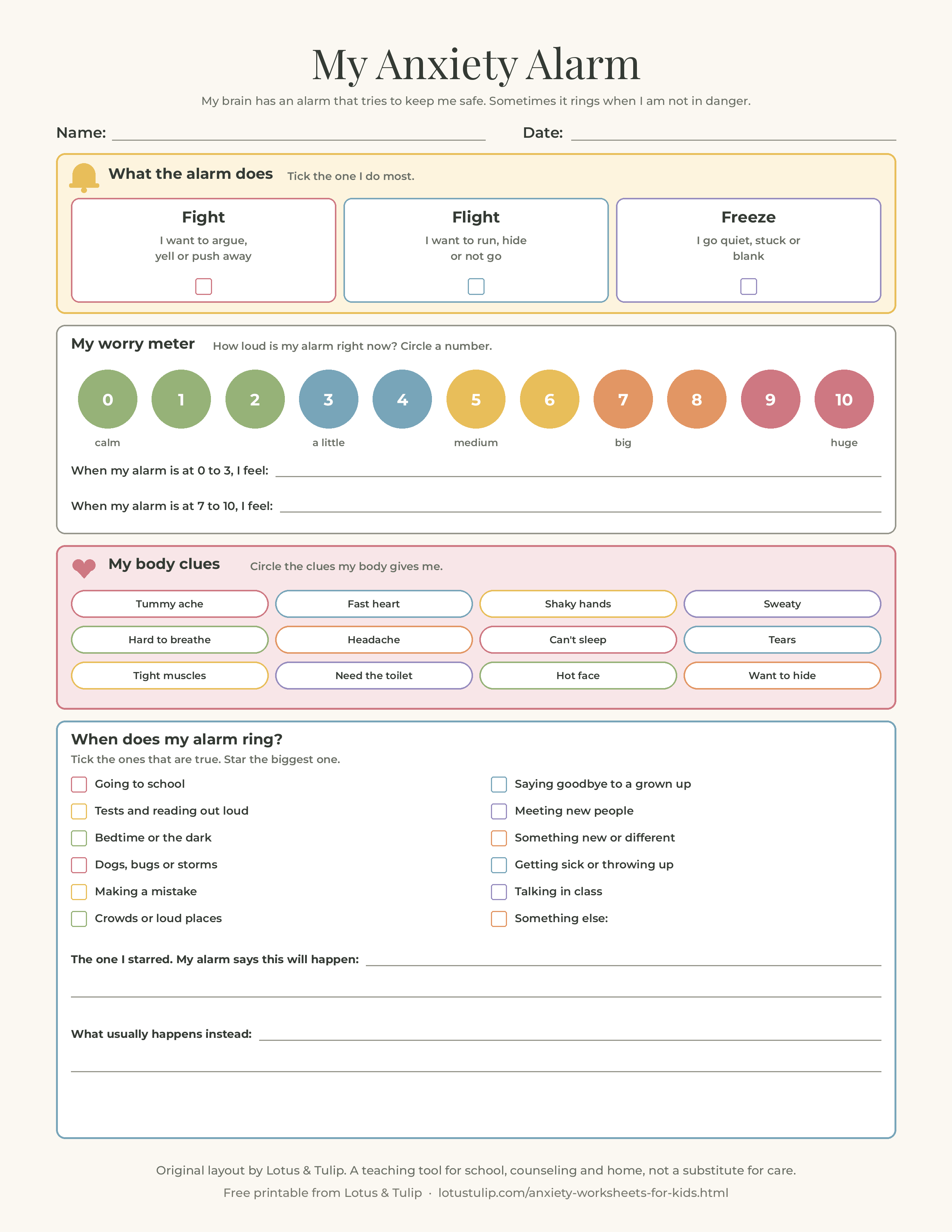
Anxiety is the body's alarm system. When the brain thinks something is dangerous, it gets the body ready to protect itself: the heart beats faster, breathing speeds up, muscles tighten and the stomach can churn. This is often called fight, flight or freeze. Fight looks like arguing, yelling or pushing away. Flight looks like running, hiding or refusing to go. Freeze looks like going quiet, blank or stuck.
The alarm is useful when the danger is real. The trouble is that an anxious child's alarm is extra sensitive. It rings for things that are uncomfortable but safe, like reading aloud, a sleepover or a new teacher. A simple way to explain this to a child is: "Your brain has a smoke alarm. Its job is to keep you safe. Sometimes it goes off for burnt toast, not a fire. We can learn to check whether it is toast or fire, and help your body calm down."
This framing matters. It tells the child that anxiety is not a sign they are weak or broken. It is a normal system that is working a bit too hard, and they can learn to turn the volume down.
Everyday worry or an anxiety problem?
Fears change with age. Toddlers and preschoolers often fear separation, strangers, the dark and loud noises. School age children worry more about getting hurt, storms, illness, school performance and friendships. These fears are expected and usually pass.
Worry may be more than typical when it is:
- Out of proportion. The fear is much bigger than the situation, and reassurance does not settle it for long.
- Frequent and lasting. It shows up most days, for weeks or months, rather than around one event.
- Getting in the way. It stops the child from going to school, sleeping alone, joining activities, eating normally or seeing friends.
- Spreading. The list of things the child avoids keeps growing.
Common types of childhood anxiety include separation anxiety (intense fear of being apart from a parent or caregiver), generalized anxiety (worry about many everyday things), social anxiety (fear of being judged or embarrassed), specific phobias (dogs, vomiting, needles, storms) and selective mutism (not speaking in some settings, such as school, despite speaking at home). Only a qualified professional can diagnose these, but naming the pattern helps you choose the right tools.
Signs of anxiety in kids
Children rarely say "I feel anxious." Anxiety tends to show up in three places.
In the body
Stomach aches, headaches, nausea, needing the toilet often, a racing heart, shaky hands, sweating, feeling hot, tight muscles, trouble falling asleep, nightmares and tiredness. Many anxious children see the school nurse or pediatrician for tummy aches before anyone names worry as the cause.
In thoughts
Lots of "what if" questions, needing to know exactly what will happen, expecting the worst, asking for reassurance again and again, and harsh self talk such as "I will mess up" or "everyone will laugh at me."
In behavior
Avoiding, delaying or refusing (school, parties, the playground, new foods), clinging, tears at drop off, meltdowns before a feared event, perfectionism, irritability and anger. Anxiety in kids can easily look like defiance: a child who throws a backpack and refuses to get in the car on a Monday morning may be in full flight mode.
The avoidance cycle: why worry grows
Avoidance is the engine of most childhood anxiety. It works like this:
- The child faces something that sets off the alarm, such as a birthday party.
- Worry and body signals rise.
- The child avoids or escapes: they stay home, hide behind a parent or leave early.
- Relief arrives quickly. The alarm switches off.
- The brain learns, "That was dangerous, and avoiding it kept me safe." Next time, the alarm rings louder and sooner.
Avoidance feels kind in the moment, and loving adults often help it along without meaning to: answering the same worry question ten times, speaking for a shy child, letting them skip the activity, or changing family plans around the fear. Researchers call this family accommodation. It is very common and comes from love, but it can keep anxiety going because the child never gets to learn that they can cope. The goal is not to remove support. It is to shift from rescuing to coaching.
How common is anxiety in children?
Anxiety is one of the most common mental health conditions in childhood. According to the US Centers for Disease Control and Prevention (CDC), about 11% of children ages 3 to 17 had a current diagnosed anxiety problem in 2023 to 2024, based on parent reports in the National Survey of Children's Health. A CDC analysis of the same survey for 2016 to 2019 found that rates rise with age: about 2.0% of children ages 3 to 5, 8.6% of children ages 6 to 11 and 13.7% of teens ages 12 to 17 had current anxiety.
Because anxiety is common and often hidden, the US Preventive Services Task Force recommended in 2022 that children and teens ages 8 to 18 be screened for anxiety in primary care, even without obvious symptoms. It found too little evidence to make a recommendation for children 7 and younger. Screening tools used in practice include the SCARED (Screen for Child Anxiety Related Disorders) questionnaire.
What the research says helps
Cognitive behavioral therapy (CBT) is the first line therapy
CBT for childhood anxiety teaches children to notice body signals, check and change worried thoughts, and gradually face feared situations. A 2020 Cochrane review pooled 87 studies with 5,964 children and young people under 19. Among those who received CBT, 49.4% no longer met criteria for their main anxiety disorder after treatment, compared with 17.8% of those on a waitlist or receiving no treatment. That works out to roughly one extra child in remission for every three treated. The review also found no clear difference between delivery formats such as individual, group or parent involved CBT, which is good news for school counselors running groups.
Well known kid CBT programs teach a simple sequence. One example is the FEAR plan from the Coping Cat program: Feeling frightened? (notice the body), Expecting bad things to happen? (notice the thoughts), Attitudes and actions that can help (coping steps), and Results and rewards (praise the effort). The three pages of the free printable below follow the same logic: body, thoughts, action.
CBT and medication together
The Child/Adolescent Anxiety Multimodal Study (CAMS), published in the New England Journal of Medicine in 2008, followed 488 children ages 7 to 17 with separation, generalized or social anxiety. After 12 weeks, 80.7% of children who received both CBT and the medication sertraline were rated much or very much improved, compared with 59.7% with CBT alone, 54.9% with sertraline alone and 23.7% with a placebo. Medication is a decision for a family and a prescriber, but this study shows that skills based therapy on its own helps a majority of children.
Parents can be the treatment
The SPACE program (Supportive Parenting for Anxious Childhood Emotions) works only with parents. In a 2020 randomized trial with 124 children ages 7 to 14, 12 parent sessions focused on reducing accommodation and responding with support were as effective as child CBT, and reduced family accommodation more. SPACE teaches parents to pair two messages: acceptance ("I know this feels scary") and confidence ("and I know you can handle it").
The practical lesson for parents and educators: the skills on worksheets work best when the adults around the child stop rescuing and start coaching brave practice.
Thinking traps that feed worry
Anxious thoughts feel true even when they are not. Teaching kids to spot a few common "worry tricks" gives them distance from the thought. Keep the names playful:
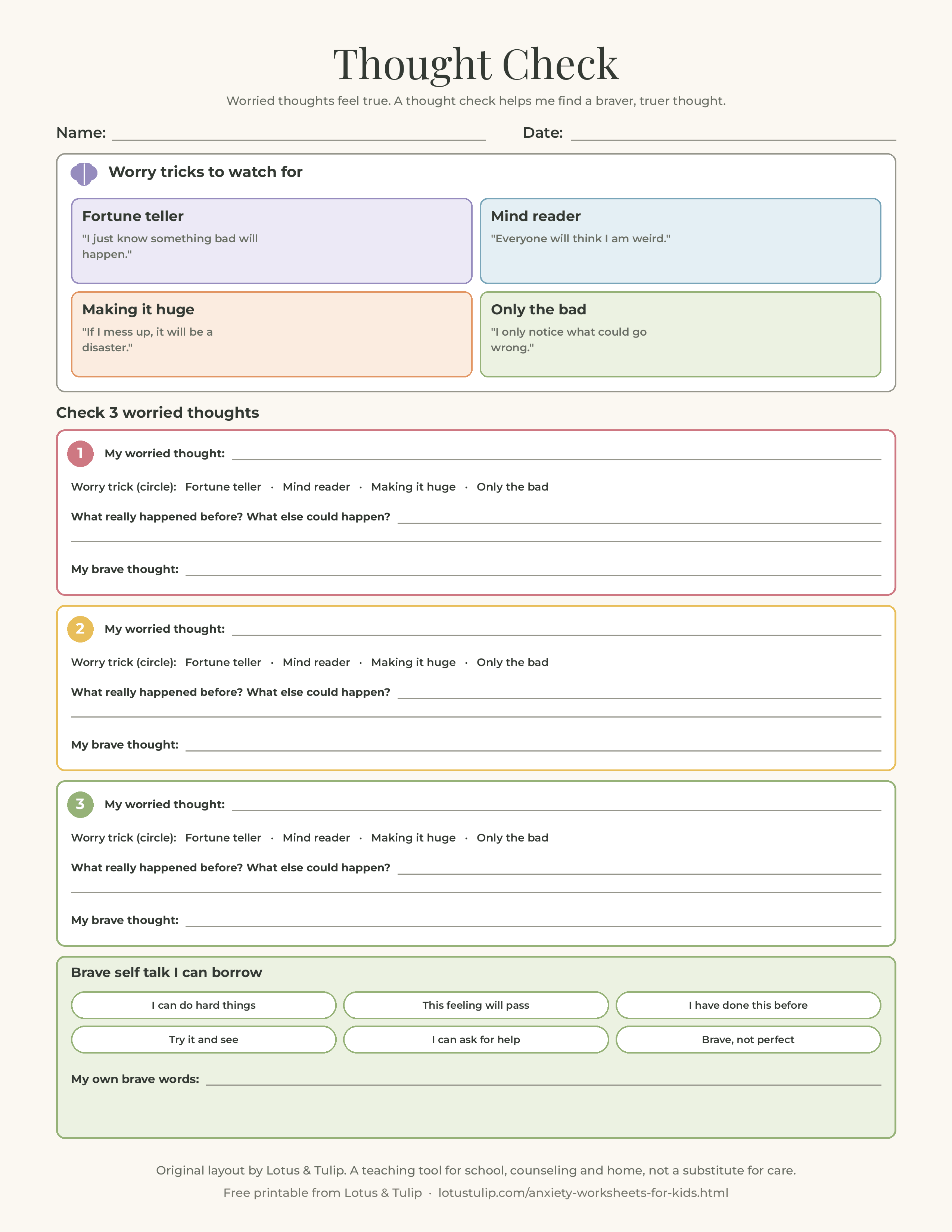
- Fortune teller. "I just know something bad will happen." Predicting the future as if it is a fact.
- Mind reader. "Everyone will think I am weird." Assuming you know what others think.
- Making it huge. "If I get one wrong, it will be a disaster." Turning a small problem into a catastrophe.
- Only the bad. "I only notice what could go wrong." Ignoring all the times things went fine.
Then ask two detective questions: "What really happened the last time?" and "What else could happen?" The goal is not a cheerful thought. It is a truer, braver one, such as "I might feel nervous, and I have done hard things before." Older kids who like this can move on to a cognitive distortions worksheet or a CBT thought record.
Brave steps: facing fears a little at a time
Gradual exposure is the active ingredient in most effective child anxiety treatment. It means facing a feared situation in small, planned steps, staying long enough for the worry to start dropping, and repeating it until it feels easier. Each brave step teaches the alarm, "That was safe after all."
How to build a brave ladder with a child:
- Choose one goal that matters to the child, such as "sleep in my own bed" or "order my own food at a restaurant."
- Brainstorm 5 to 10 smaller steps toward it, from easiest to hardest.
- Rate each step from 0 to 10 on the worry meter.
- Start with a step around 2 or 3. Not 0, because that teaches nothing, and not 8, because that teaches fear.
- Practice that step several times, rating worry before and after, until it feels easy. Then climb one rung.
- Praise and reward the effort, not only the outcome.
Example for separation anxiety: parent in the room at bedtime, then parent in the doorway, then parent in the hallway, then parent checks in after 5 minutes, then 10 minutes, then sleeping alone with one check in. For more ladders and a worry time routine, see the worry worksheet for kids.
Exposure should be a child's choice with your encouragement, never a surprise or a punishment. If a step is too hard, make a smaller step rather than giving up.
20 anxiety activities for kids
Calm the body
- Balloon breathing. Breathe in slowly through the nose to fill a "balloon" in the belly, then let it out even more slowly. A long out breath helps the body settle. More options in breathing exercises for kids.
- Squeeze and let go. Squeeze fists, shoulders or toes for five seconds, then relax and notice the difference.
- 5 4 3 2 1 senses. Name 5 things you see, 4 you can touch, 3 you hear, 2 you smell, 1 you taste. See the 5 4 3 2 1 grounding worksheet.
- Cold water. A drink of cold water or a cool cloth on the face can help a racing body slow down.
- Move it out. A quick walk, wall push ups or jumping jacks, followed by slow breaths.
- Calm spot. A cozy place with a soft toy, a fidget and a few calm cards. Ideas in calm down corner ideas.
Name and measure the feeling
- Worry meter. Rate the alarm from 0 to 10 several times a day. Kids learn that feelings rise and fall. A feelings thermometer works too.
- Body clue map. Color where worry shows up in the body.
- Name the worry. Give the worry a silly name or draw it as a character. "Is Mr. What If talking again?" separates the child from the thought.
- Alarm check. Ask, "Is this a fire or burnt toast?"
Check the thought
- Worry detective. Look for clues for and against the worried thought.
- Spot the worry trick. Fortune teller, mind reader, making it huge or only the bad.
- Brave self talk cards. "I can do hard things." "This feeling will pass." "Brave, not perfect."
- Worry time. Save worries for a short, planned time each day instead of answering them all day long.
- What would I tell a friend? Kids are often kinder and wiser with a friend's worry than their own.
Take brave action
- Brave ladder. Small, planned steps toward a goal, as described above.
- Brave of the day. One small brave thing each day, like asking a question or trying a new food.
- Brave star chart. Color a star for each practice. Celebrate the effort.
- Practice runs. Role play the hard moment at home first: saying goodbye at the door, ordering at the counter.
- Coping plan card. A small card in a pocket or backpack listing the child's top three calm tools and one brave thought. The coping skills list for kids has more ideas.
Anxiety activities by age
Ages 5 to 7
Keep it concrete and playful. Use pictures, stuffed animals and stories. Name the worry as a character, use a simple 0 to 5 meter, and practice one or two breathing games. Brave steps should be very small and rewarded quickly with praise, stickers or a special time with a parent. Adults do most of the coaching.
Ages 8 to 10
Children can now learn worry tricks and detective questions, use a 0 to 10 meter and help build their own brave ladder. Short written worksheets work well. Involve the child in choosing goals and rewards so the plan feels like theirs.
Ages 11 to 12
Preteens can handle more of the "why": how the alarm works, the avoidance cycle and how thoughts affect feelings. Respect their privacy, avoid lecturing and let them lead. Social worries often grow at this age; the social anxiety worksheets for teens page is a good next step for older kids, and the test anxiety worksheet helps with exam nerves.
How to help a child with anxiety, step by step
- Stay calm yourself. Children read your face and voice. A slow, steady tone tells their alarm that things are safe.
- Name and normalize the alarm. Explain fight, flight and freeze, and that everyone has an alarm that sometimes rings too loudly.
- Measure the worry. Use a 0 to 10 worry meter and help the child notice body clues and triggers.
- Teach two or three calm body tools. Practice them when the child is calm, so they are ready when worry rises.
- Check the worried thought. Spot the worry trick, ask what really happened before, and find a braver thought.
- Build a brave ladder. Pick one goal and break it into small steps rated 0 to 10.
- Practice brave steps often. Repeat each step until it gets easier, then move up. Rate worry before and after.
- Shift from rescuing to coaching. Show acceptance and confidence, praise brave tries, and gradually reduce reassurance and accommodation.
What to say to an anxious child (and what to avoid)
Helpful phrases pair empathy with confidence:
- "I can see this feels really scary. I know you can handle it."
- "Your alarm is loud right now. Let's breathe together and let it settle."
- "What is your worry telling you? Is that a fortune teller trick?"
- "What is one small brave step you could try?"
- "You did it even though you were nervous. That is what brave means."
Try to avoid:
- "There is nothing to be scared of." It dismisses a real feeling.
- "Don't worry, nothing bad will happen." You can't promise that, and it teaches the child to rely on your guarantee.
- "Fine, you don't have to go." It brings short relief and long term growth of fear.
- Answering the same reassurance question over and over. Answer once, then gently say, "I think you know what I'm going to say. What can you tell your worry?"
Common mistakes
- Only teaching calm down skills. Breathing helps, but without brave steps, the child may use calming tools to avoid instead of to face fears.
- Starting too big. A ladder that begins with the hardest step usually ends in tears. Start small.
- Stopping when worry is high. Leaving at the peak teaches the alarm that escape was necessary. Where safe, stay until worry drops a little.
- Using worksheets once. Skills grow with repetition. Revisit the same pages weekly and track progress.
- Ignoring the adults. Accommodation by parents and teachers can quietly keep anxiety going. Make a plan for the adults too.
When to get professional help
Talk with your pediatrician, a school counselor or a licensed mental health professional if anxiety is frequent, intense or long lasting; if it keeps a child from school, sleep, eating or friendships; if there are panic attacks, repeated physical complaints with no medical cause, or rituals the child feels they must do; or if you are simply unsure. Effective treatment exists, and earlier help tends to be easier.
In the US, if a child talks about wanting to die or hurting themselves, call or text 988 (the 988 Suicide and Crisis Lifeline) any time, day or night. You can also text HOME to 741741 to reach the Crisis Text Line. If someone is in immediate danger, call 911.
Free anxiety worksheets for kids (PDF)
The free printable has three pages in US Letter size, written for kids about 5 to 12:
- Page 1: My Anxiety Alarm. Fight, flight and freeze explained, a 0 to 10 worry meter, 12 body clue chips to circle, a 12 item "when does my alarm ring?" checklist and space to compare what the alarm predicts with what usually happens.
- Page 2: Thought Check. Four kid friendly worry tricks (fortune teller, mind reader, making it huge, only the bad), three worried thought to brave thought practice rows and brave self talk to borrow.
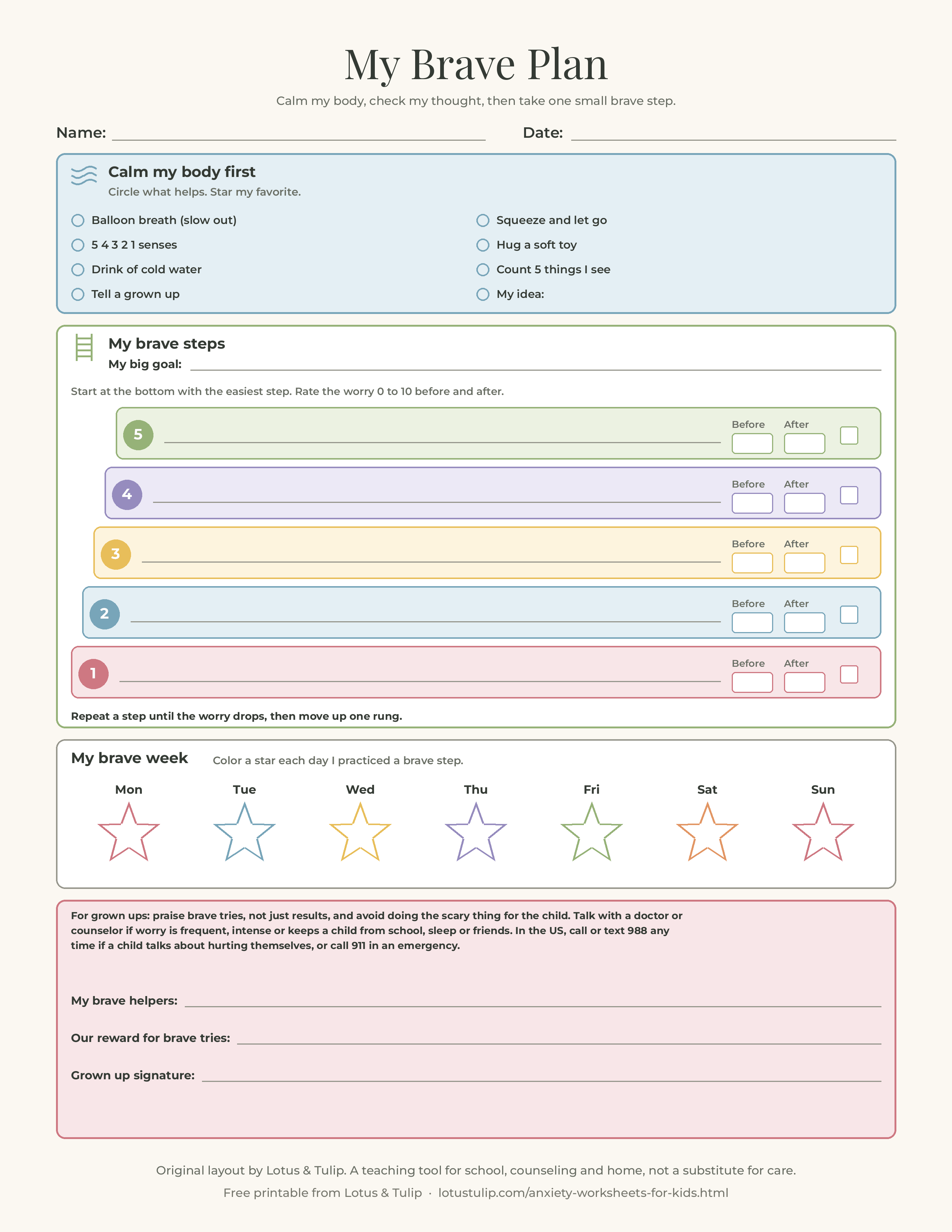
- Page 3: My Brave Plan. Calm body tools to circle, a five rung brave steps ladder with before and after worry ratings, a Monday to Sunday brave week tracker and a note for grown ups with 988.
Download the free anxiety worksheets for kids (PDF, 3 pages, US Letter)
Prefer single images? Page 1: My Anxiety Alarm (PNG) · Page 2: Thought Check (PNG) · Page 3: My Brave Plan (PNG)
Free to print for your own use and for use with your own students, clients or children. Please link to this page rather than re-uploading the file.
Related resources
- Food allergy worksheets for kids: when worry is about eating something by mistake, with a free food allergy brave plan
- Chronic illness worksheets for kids: when worry is about living with a health condition, with a free health coping plan
- Hospital stay worksheets for kids: when a child is worried about surgery or the hospital, with a free hospital coping plan
- Parent with cancer worksheets for kids: when a child is worried because a mom or dad has cancer, with a free questions map
- Nightmare worksheets for kids: when worries come out at bedtime, a free bedtime worries map and calm bedtime plan
- Selective mutism worksheets for kids: when worry freezes a child's voice at school, a free brave talking ladder
- Tic worksheets for kids: when stress makes tics louder, a free tic toolbox plan
- OCD worksheets for kids: when worries come with rituals, a free boss back ladder for ages 5 to 12
- Separation anxiety worksheet for kids (free printable): a goodbye plan and a brave apart ladder
- CBT worksheets for kids (free printable): thought detective and brave steps ladder for ages 5 to 12
- Worry worksheet for kids (free printable)
- Worry time worksheet: how to use scheduled worry time (free printable)
- Small group counseling curriculum for anxiety
- Test anxiety worksheet (free printable)
- Breathing exercises for kids (free printable)
- 5 4 3 2 1 grounding worksheet (free printable)
- Positive self talk worksheet (free printable)
- Emotional regulation worksheets for kids (free printable)
- Mindfulness activities for kids (free printable)
- Skin picking and hair pulling worksheets for kids: when worry shows up as picking, pulling or nail biting
- Picky eating activities for kids: what is normal, what research shows and a free food explorer plan
Sources
- Centers for Disease Control and Prevention. Data and Statistics on Children's Mental Health, cdc.gov (National Survey of Children's Health, 2023 to 2024).
- Bitsko, R. H., Claussen, A. H., Lichstein, J., et al. (2022). Mental health surveillance among children, United States, 2013 to 2019. MMWR Supplements, 71(2), 1 to 42.
- US Preventive Services Task Force. (2022). Screening for anxiety in children and adolescents: US Preventive Services Task Force recommendation statement. JAMA, 328(14), 1438 to 1444.
- James, A. C., Reardon, T., Soler, A., James, G., and Creswell, C. (2020). Cognitive behavioural therapy for anxiety disorders in children and adolescents. Cochrane Database of Systematic Reviews, CD013162.
- Walkup, J. T., Albano, A. M., Piacentini, J., et al. (2008). Cognitive behavioral therapy, sertraline, or a combination in childhood anxiety. New England Journal of Medicine, 359(26), 2753 to 2766.
- Lebowitz, E. R., Marin, C., Martino, A., Shimshoni, Y., and Silverman, W. K. (2020). Parent-based treatment as efficacious as cognitive-behavioral therapy for childhood anxiety: a randomized noninferiority study of Supportive Parenting for Anxious Childhood Emotions. Journal of the American Academy of Child and Adolescent Psychiatry, 59(3), 362 to 372.
- Kendall, P. C., and Hedtke, K. A. (2006). Cognitive-Behavioral Therapy for Anxious Children: Therapist Manual (Coping Cat), 3rd edition. Workbook Publishing.
- 988 Suicide and Crisis Lifeline, 988lifeline.org. Crisis Text Line, crisistextline.org.
Anxiety worksheets for kids: FAQ
What are anxiety worksheets for kids?
Anxiety worksheets for kids are printable pages that teach the core skills used in cognitive behavioral therapy for childhood anxiety: noticing body signals, rating worry, spotting worried thoughts, finding braver thoughts and planning small brave steps. They work best when an adult practices them with the child regularly, not just once.
What are the signs of anxiety in a child?
Common signs include stomach aches and headaches, trouble sleeping, frequent "what if" questions, needing lots of reassurance, clinging, tears or meltdowns before events, irritability, perfectionism and avoiding places like school, parties or new activities. Worry becomes a concern when it is out of proportion, lasts for weeks and gets in the way of daily life.
How can I help my child with anxiety at home?
Stay calm, name the feeling, and pair empathy with confidence: "This feels scary, and I know you can handle it." Teach a few calm body tools, help your child check worried thoughts, and build a ladder of small brave steps. Gradually reduce rescuing and repeated reassurance, praise brave tries and get professional help if anxiety is severe or not improving.
What is the best therapy for childhood anxiety?
Cognitive behavioral therapy (CBT), including gradual exposure to feared situations, is the most studied first line treatment. A 2020 Cochrane review of 87 studies found that 49.4% of children and teens no longer met criteria for their main anxiety disorder after CBT, compared with 17.8% of those on a waitlist. Parent based programs such as SPACE have also been shown to work.
At what age should children be screened for anxiety?
In 2022 the US Preventive Services Task Force recommended anxiety screening for children and teens ages 8 to 18 in primary care. It found insufficient evidence to recommend for or against screening children 7 and younger. Ask your pediatrician about screening at a well child visit.
What should I not say to an anxious child?
Avoid dismissing the fear ("there is nothing to be scared of"), promising that nothing bad will happen, letting the child skip every feared situation, or answering the same reassurance question over and over. These bring quick relief but can make anxiety stronger over time. Acknowledge the feeling, then express confidence and encourage one small brave step.
Are these anxiety worksheets for kids free?
Yes. The three page anxiety worksheets for kids printable is free to print for your own use and for use with your own students, clients or children. Please link to this page rather than re-uploading the file.